Introduction
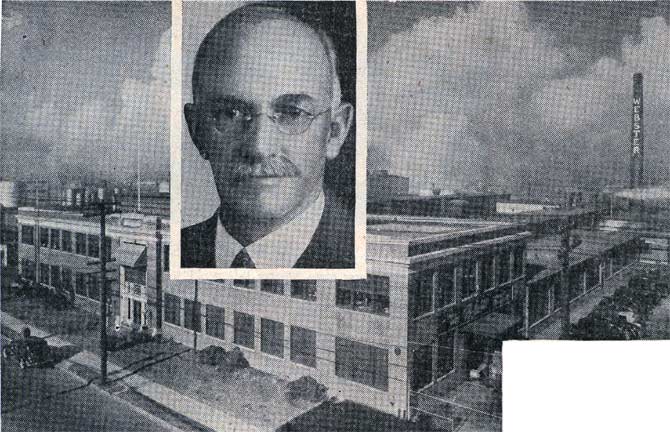
Warren Webster and his factory on Federal Street — 1888
The building has been boarded up and empty for decades, the company long gone, and a brand name that was once a standard in its line is now all but forgotten. In its day, Warren Webster & Company provided heating systems for plants, factories, and large buildings all over the country. Warren Webster & Co. developed systems and controls that made it possible to provide continuous, comfortable, and economical steam heat to large buildings. If you are in a building built in the first part of the 20th Century, there is a strong probability that there are or were Warren Webster components inside.
Warren Webster founded his business in Philadelphia in 1888. He brought his firm to Camden five years later. A large factory was built at Point and Pearl Streets. After World War I a larger plant was built at 17th & Federal Street in East Camden when it was determined that the original plant lay in the path of the soon-to-be-constructed Delaware River Bridge.
Warren Webster passed away in December of 1938, during the 50th year of his firm’s existence. His son, Warren Webster Jr., then headed the company. Sadly, grandson Warren Webster III, a graduate of West Point, was killed in action while serving in Korea in February of 1953. The company was still open in Camden as late as 1959, but by 1970 Warren Webster & Company was no longer listed in the Camden County telephone directory.
Warren Webster Jr. wrote The Life and Times of Warren Webster, a biography of his father, of which a limited edition was published in 1942.
Photos
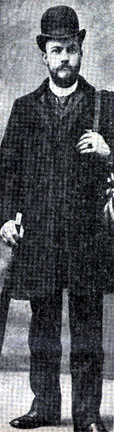
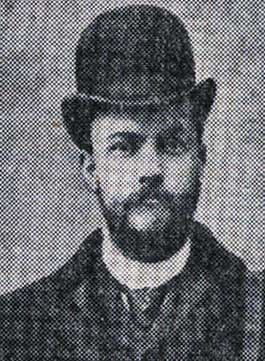
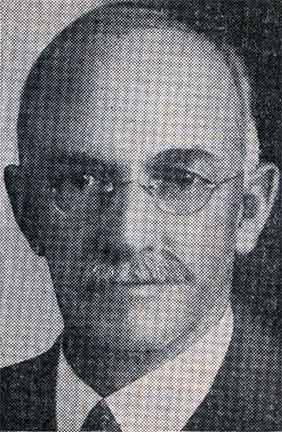
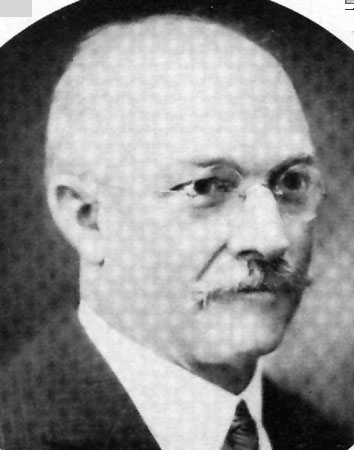
Warren Webster
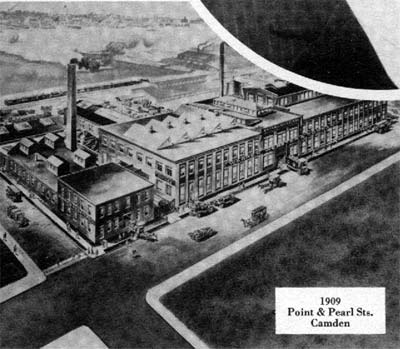
Warren Webster Company factory at Point & Pearl Streets, 1909
1915 Patriotic Order of the Sons of America Program Ad
Patriotic Order of the Sons of America program — 1915
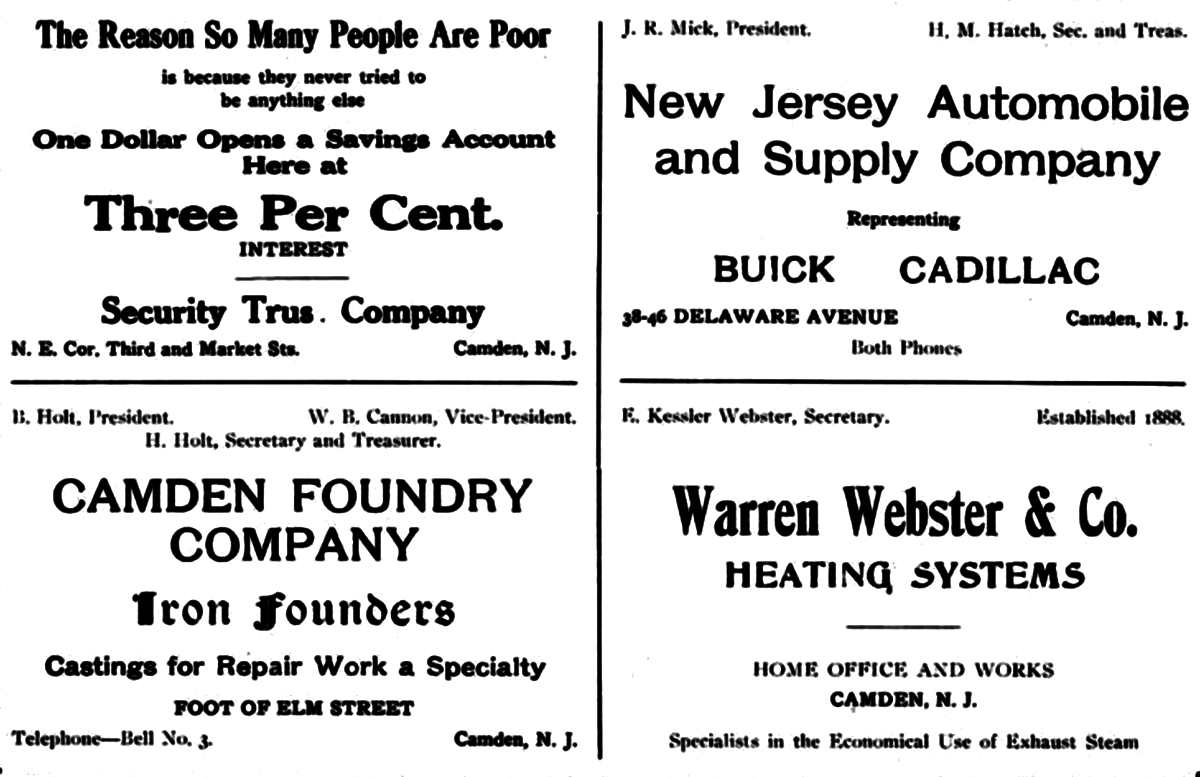
The Reason So Many People Are Poor is because they never tried to be anything else
One Dollar Opens a Savings Account Here at Three Per Cent. INTEREST
Security Trust Company
N. E. Cor. Third and Market Sts. Camden, N. J.
J. R. Mick, President. H. M. Hatch, Sec. and Treas.
New Jersey Automobile and Supply Company
Representing BUICK CADILLAC
38-46 DELAWARE AVENUE Camden, N. J. Both Phones
B. Holt, President. W. B. Cannon, Vice-President. H. Holt, Secretary and Treasurer.
CAMDEN FOUNDRY COMPANY
Iron Founders
Castings for Repair Work a Specialty
FOOT OF ELM STREET
Telephone—Bell No. 3. Camden, N. J.
E. Kessler Webster, Secretary. Established 1888
Warren Webster & Co.
HEATING SYSTEMS
HOME OFFICE AND WORKS CAMDEN, N. J.
Specialists in the Economical Use of Exhaust Steam
Pre-1920 Advertising for Warren Webster & Co.
(advertisement) — pre-1920
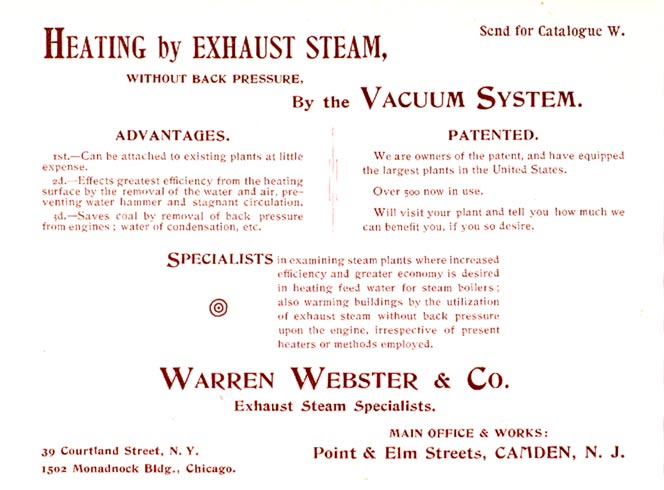
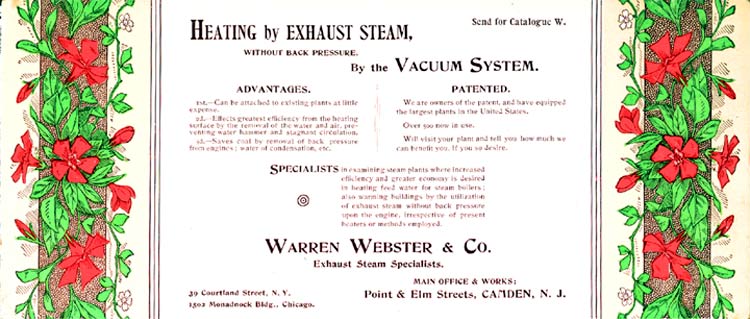
Send for Catalogue W.
HEATING by EXHAUST STEAM, WITHOUT BACK PRESSURE, By the VACUUM SYSTEM.
ADVANTAGES.
1st.—Can be attached to existing plants at little expense.
2d.—Effects greatest efficiency from the heating surface by the removal of the water and air, preventing water hammer and stagnant circulation.
3d.—Saves coal by removal of back pressure from engines; water of condensation, etc.
PATENTED.
We are owners of the patent, and have equipped the largest plants in the United States.
Over 500 now in use.
Will visit your plant and tell you how much we can benefit you, if you so desire.
SPECIALISTS in examining steam plants where increased efficiency and greater economy is desired in heating feed water for steam boilers; also warming buildings by the utilization of exhaust steam without back pressure upon the engine, irrespective of present heaters or methods employed.
WARREN WEBSTER & CO. Exhaust Steam Specialists.
39 Courtland Street, N. Y. 1502 Monadnock Bldg., Chicago.
MAIN OFFICE & WORKS: Point & Elm Streets, CAMDEN, N. J.
Buy New Site for Plant
Philadelphia Inquirer —
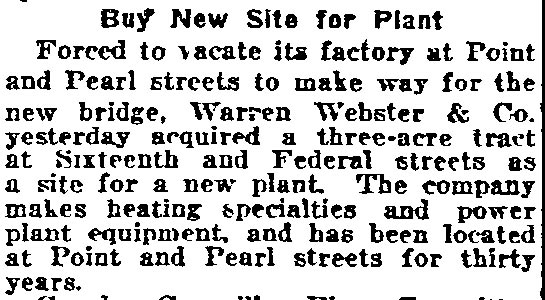
Forced to vacate its factory at Point and Pearl streets to make way for the new bridge, Warren Webster & Co. yesterday acquired a three-acre tract at Sixteenth and Federal streets as a site for a new plant. The company makes heating specialties and power plant equipment, and has been located at Point and Pearl streets for thirty years.
The Factory, 1924
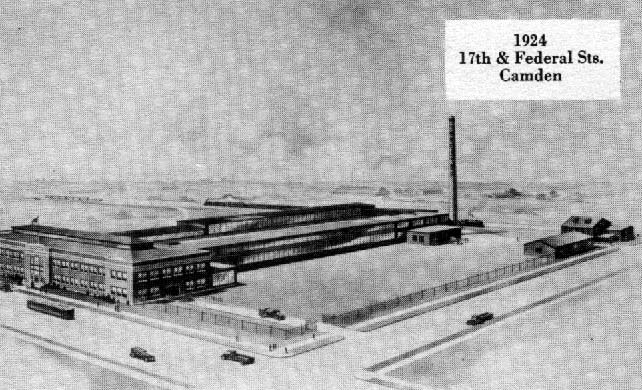
Warren Webster Company factory, 1924
Websters Return From Florida
Camden Courier-Post —
Mr. and Mrs. Warren Webster, formerly of this city, have returned from their estate in Pass-a-Grille, Fla., where they have been spending the Winter and are spending some time at the Warwick, Philadelphia.
Rotarians Have ‘Good Time,’ Even to Milking of Cows
Camden Courier-Post —
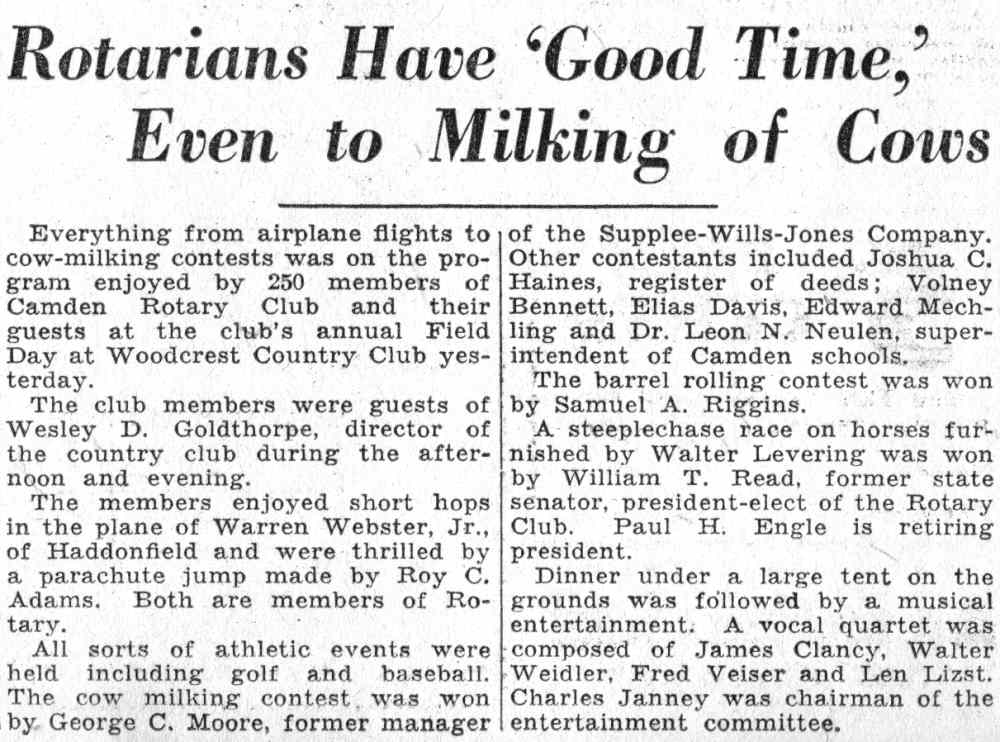
Everything from airplane flights to cow-milking contests was on the program enjoyed by 250 members of Camden Rotary Club and their guests at the club’s annual Field Day at Woodcrest Country Club yesterday.
The club members were guests of Wesley D. Goldthorpe, director of the country club during the afternoon and evening.
The members enjoyed short hops in the plane of Warren Webster, Jr., of Haddonfield and were thrilled by a parachute jump made by Roy C. Adams. Both are members of Rotary.
All sorts of athletic events were held including golf and baseball. The cow milking contest was won by George C. Moore, former manager of the Supplee-Wills-Jones Company. Other contestants included Joshua C. Haines, register of deeds; Volney Bennett, Elias Davis, Edward Mechling and Dr. Leon N. Neulen, superintendent of Camden schools.
The barrel rolling contest was won by Samuel A. Riggins.
A steeplechase race on horses furnished by Walter Levering was won by William T. Read, former state senator, president-elect of the Rotary Club. Paul H. Engle is retiring president.
Dinner under a large tent on the grounds was followed by a musical entertainment. A vocal quartet was composed of James Clancy, Walter Weidler, Fred Veiser and Len Lizst. Charles Janney was chairman of the entertainment committee.
Camden Courier-Post – March 27, 1936
The Webster Moderator System supplies “control-by-the-weather.” During the period of 1931, ‘32 and ‘33 the firm’s sales organization was occupied in making surveys of several thousand large buildings to determine ways and means of reducing fuel expense. It was possible to go into almost seven buildings out of every 10 and find that a saving of approximately 25 percent could be effected by applying this new development. Not only did the company finance the making of these surveys but where it found a saving possible it offered to supply its equipment and to accept payment out of the savings as made, thus combining financing of the equipment with a guarantee of its performance. Several hundred buildings have been thus modernized including among them the New York Evening Post Building and the Bellevue Stratford and Warwick Hotels in Philadelphia.
The company’s plant is operating regularly with a factory and home office staff of approximately 250 employees. More than 185 additional persons are engaged in the work of the company’s 60 branches.
Warren Webster, founder of the company, is its president and general manager; Warren Webster, Jr., a son, is vice president and treasurer, and E. Kessler Webster, a nephew, is secretary and assistant general manager.
Founder of Industry Observes 50th Year as Active President
Camden Courier-Post —
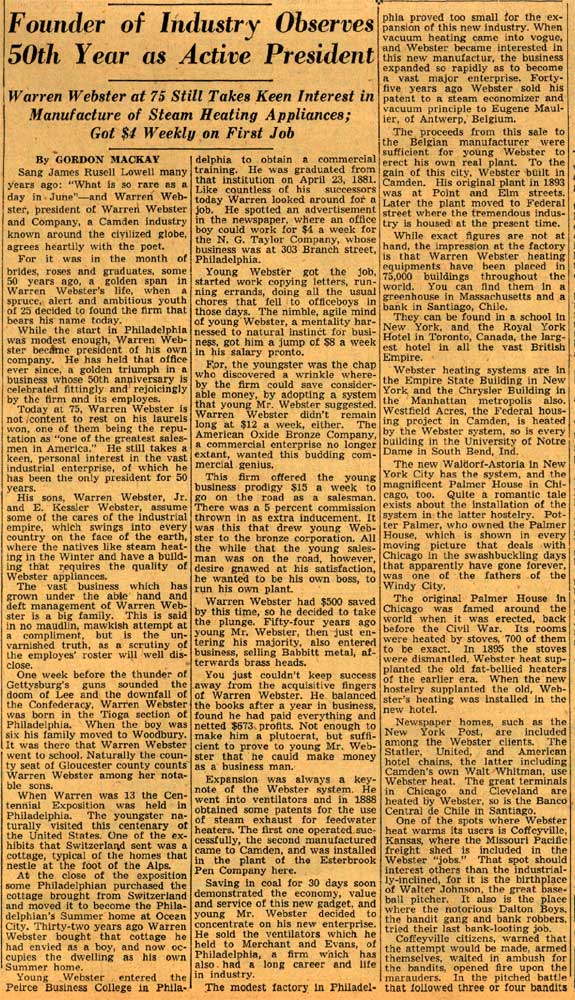
Warren Webster at 75 Still Takes Keen Interest in Manufacture of Steam Heating Appliances; Got $4 Weekly on First Job
By GORDON MACKAY
Sang James Russell Lowell many years ago: “What is so rare as a day in June”—and Warren Webster, president of Warren Webster and Company, a Camden industry known around the civilized globe, agrees heartily with the poet.
For it was in the month of brides, roses and graduates, some 50 years ago, a golden span in Warren Webster’s life, when a spruce, alert and ambitious youth of 25 decided to found the firm that bears his name today.
While the start in Philadelphia was modest enough, Warren Webster became president of his own company. He has held that office ever since, a golden triumph in a business whose 50th anniversary is celebrated fittingly and rejoicingly by the firm and its employes.
Today at 75, Warren Webster is not content to rest on his laurels won, one of them being the reputation as “one of the greatest salesmen in America.” He still takes a keen, personal interest in the vast industrial enterprise, of which he has been the only president for 50 years.
His sons, Warren Webster, Jr., and E. Kessler Webster, assume some of the cares of the industrial empire, which swings into every country on the face of the earth, where the natives like steam heating in the Winter and have a building that requires the quality of Webster appliances.
The vast business which has grown under the able hand and deft management of Warren Webster is a big family. This is said in no maudlin, mawkish attempt at a compliment, but is the unvarnished truth, as a scrutiny of the employes’ roster will well disclose.
One week before the thunder of Gettysburg’s guns sounded the doom of Lee and the downfall of the Confederacy, Warren Webster was born in the Tioga section of Philadelphia. When the boy was six his family moved to Woodbury. It was there that Warren Webster went to school. Naturally the county seat of Gloucester county counts Warren Webster among her notable sons.
When Warren was 13 the Centennial Exposition was held in Philadelphia. The youngster naturally visited this centenary of the United States. One of the exhibits that Switzerland sent was a cottage, typical of the homes that nestle at the foot of the Alps.
At the close of the exposition some Philadelphian purchased the cottage brought from Switzerland and moved it to become the Philadelphian’s Summer home at Ocean City. Thirty-two years ago Warren Webster bought that cottage he had envied as a boy, and now occupies the dwelling as his own Summer home.
Young Webster entered the Peirce Business College in Philadelphia to obtain a commercial training. He was graduated from that institution on April 23, 1881. Like countless of his successors today Warren looked around for a job. He spotted an advertisement in the newspaper, where an office boy could work for $4 a week for the N. G. Taylor Company, whose business was at 303 Branch street, Philadelphia.
Young Webster got the job, started work copying letters, running errands, doing all the usual chores that fell to officeboys in those days. The nimble, agile mind of young Webster, a mentality harnessed to natural instinct for business, got him a jump of $8 a week in his salary pronto.
For, the youngster was the chap who discovered a wrinkle whereby the firm could save considerable money, by adopting a system that young Mr. Webster suggested. Warren Webster didn’t remain long at $12 a week, either. The American Oxide Bronze Company, a commercial enterprise no longer extant, wanted this budding commercial genius.
This firm offered the young business prodigy $15 a week to go on the road as a salesman. There was a 5 percent commission thrown in as extra inducement. It was this that drew young Webster to the bronze corporation. All the while that the young salesman was on the road, however, desire gnawed at his satisfaction, he wanted to be his own boss, to run his own plant.
Warren Webster had $500 saved by this time, so he decided to take the plunge. Fifty-four years ago young Mr. Webster, then just entering his majority, also entered business, selling Babbitt metal, afterwards brass heads.
You just couldn’t keep success away from the acquisitive fingers of Warren Webster. He balanced the books after a year in business, found he had paid everything and netted $673 profits. Not enough to make him a plutocrat, but sufficient to prove to young Mr. Webster that he could make money as a business man.
Expansion was always a keynote of the Webster system. He went into ventilators and in 1888 obtained some patents for the use of steam exhaust for feedwater heaters. The first one operated successfully, the second manufactured came to Camden, and was installed in the plant of the Esterbrook Pen Company here.
Saving in coal for 30 days soon demonstrated the economy, value and service of this new gadget, and young Mr. Webster decided to concentrate on his new enterprise. He sold the ventilators which he held to Merchant and Evans, of Philadelphia, a firm which has also had a long career and life in industry.
The modest factory in Philadelphia proved too small for the expansion of this new industry. When vacuum heating came into vogue, and Webster became interested in this new manufactur, the business expanded so rapidly as to become a vast major enterprise. Forty-five years ago Webster sold his patent to a steam economizer and vacuum principle to Eugene Mauler, of Antwerp, Belgium.
The proceeds from this sale to the Belgian manufacturer were sufficient for young Webster to erect his own real plant. To the gain of this city, Webster built in Camden. His original plant in 1893 was at Point and Elm streets. Later the plant moved to Federal street where the tremendous industry is housed at the present time.
While exact figures are not at hand, the impression at the factory is that Warren Webster heating equipments have been placed in 75,000 buildings throughout the world. You can find them in a greenhouse in Massachusetts and a bank in Santiago, Chile.
They can be found in a school in New York, and the Royal York Hotel in Toronto, Canada, the largest hotel in all the vast British Empire.
Webster heating systems are in the Empire State Building in New York and the Chrysler Building in the Manhattan metropolis also. Westfield Acres, the Federal housing project in Camden, is heated by the Webster system, so is every building in the University of Notre Dame in South Bend, Ind.
The new Waldorf-Astoria in New York City has the system, and the magnificent Palmer House in Chicago, too. Quite a romantic tale exists about the installation of the system in the latter hostelry. Potter Palmer, who owned the Palmer House, which is shown in every moving picture that deals with Chicago in the swashbuckling days that apparently have gone forever, was one of the fathers of the Windy City.
The original Palmer House in Chicago was famed around the world when it was erected, back before the Civil War. Its rooms were heated by stoves, 700 of them to be exact. In 1895 the stoves were dismantled. Webster heat supplanted the old fat-bellied heaters of the earlier era. When the new hostelry supplanted the old, Webster’s heating was installed in the new hotel.
Newspaper homes, such as the New York Post, are included among the Webster clients. The Statler, United, and American hotel chains, the latter including Camden’s own Walt Whitman, use Webster heat. The great terminals in Chicago and Cleveland are heated by Webster, so is the Banco Central de Chile in Santiago.
One of the spots where Webster heat warms its users is Coffeyville, Kansas, where the Missouri Pacific freight shed is included in the Webster “jobs.” That spot should interest others than the industrially-inclined, for it is the birthplace of Walter Johnson, the great baseball pitcher. It also is the place where the notorious Dalton Boys, the bandit gang and bank robbers, tried their last bank-looting job.
Coffeyville citizens, warned that the attempt would be made, armed themselves, waited in ambush for the bandits, opened fire upon the marauders. In the pitched battle that followed three or four bandits were slain, others taken prisoner, and the notorious Dalton Boys gang was broken up forever.
Reams could be written about the romantic side of this seemingly prosaic industry. After all, however, the greatest tribute that could be paid to the industry and its founder is that Warren Webster has been president of the company that he organized 50 years ago, every day of its existence.
The smoothness with which the plant and the offices work and move is not only a tribute to the founder and his sons, but also to the loyalty, service and value of the 250 employes who earn their bread working for Warren Webster and Company.
Warren Webster passed away on December 21, 1938.
Warren Webster Jr., 1903–1997
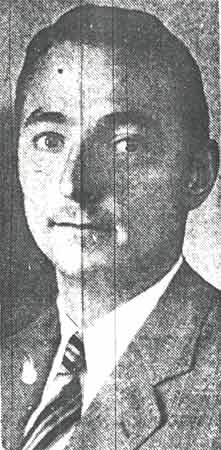
Warren Webster Jr. — photograph published in the Camden Courier-Post, January 6, 1942. Warren Webster Jr. took the reins as president of Warren Webster & Co. after his father’s passing. The company played an active role in armaments production during and after World War II.
The Factory at 17th & Federal Street, Late 1940s
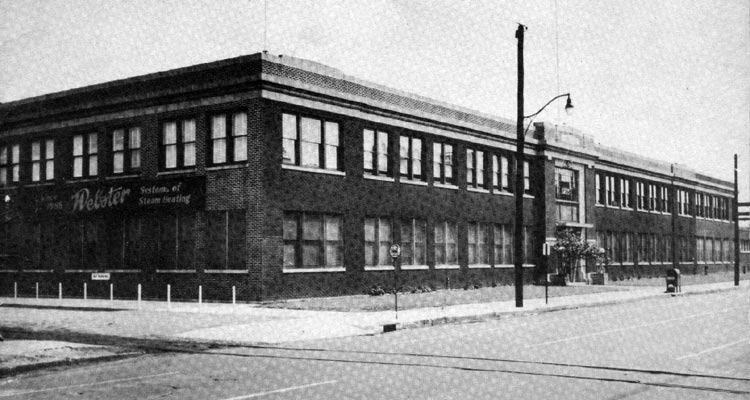
The Warren Webster Company Factory at 17th & Federal Street, late 1940s
Working With Webster — 1940s Employee Handbook
Working With Webster (Warren Webster & Company employee handbook) — 1940s
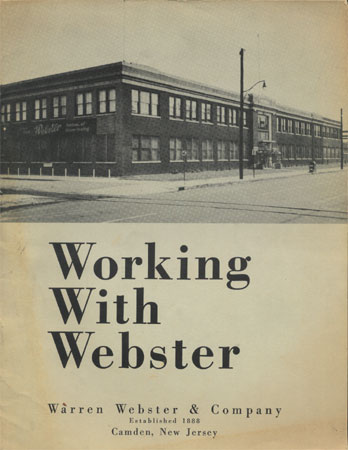
Working With Webster
Warren Webster & Company Established 1888 Camden, New Jersey
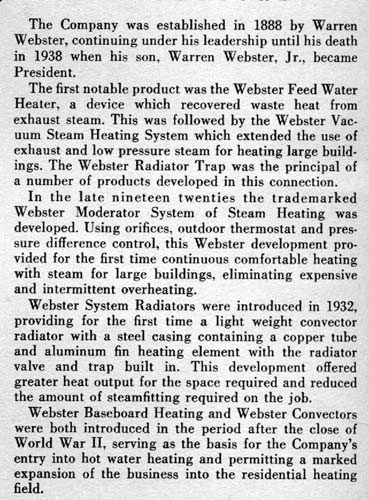
The Company was established in 1888 by Warren Webster, continuing under his leadership until his death in 1938 when his son, Warren Webster, Jr., became President.
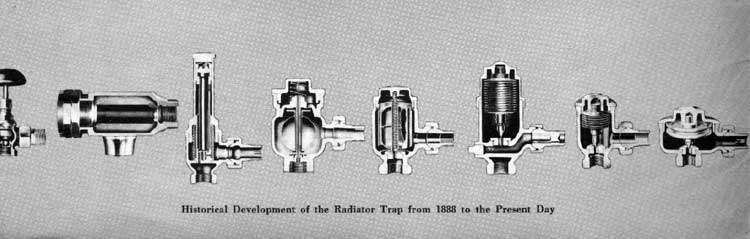
The first notable product was the Webster Feed Water Heater, a device which recovered waste heat from exhaust steam. This was followed by the Webster Vacuum Steam Heating System which extended the use of exhaust and low pressure steam for heating large buildings. The Webster Radiator Trap was the principal of a number of products developed in this connection.
In the late nineteen twenties the trademarked Webster Moderator System of Steam Heating was developed. Using orifices, outdoor thermostat and pressure difference control, this Webster development provided for the first time continuous comfortable heating with steam for large buildings, eliminating expensive and intermittent overheating.
Webster System Radiators were introduced in 1932, providing for the first time a light weight convector radiator with a steel casing containing a copper tube and aluminum fin heating element with the radiator valve and trap built in. This development offered greater heat output for the space required and reduced the amount of steamfitting required on the job.
Webster Baseboard Heating and Webster Convectors were both introduced in the period after the close of World War II, serving as the basis for the Company’s entry into hot water heating and permitting a marked expansion of the business into the residential heating field.