Introduction
JOEL HORNER was born in 1814 in what is now East Camden. He succeeded his brother Asa Horner as a lay judge in 1874 and served at least 9 years in that capacity before returning to farming. Joel Horner passed away in October of 1889.
Conflict of Authority
Camden Post —
The Lay Judges Assert the Right to Override the Law Judge.
Since the conviction and sentencing of William Smith, John Fisher, George Watson, George Johnson, and Harry Getty, at the January term of Court, for breach of the lottery law, their friends through their Council, John H. Fort, Esq., have been untiring in their efforts to have the sentence mitigated on the ground of undue severity. Judge Reed, however, refused to listen to any appeal, but Judges Woolston and Horner have taken the matter into consideration and it is understood will on Monday the 26th inst., reconsider the sentences and impose a fine of $100 without costs, on each aggressor of the law, and the prisoners to stand committed until the same is paid. Sheriff Gibbs has been instructed to hold the prisoners in the County Jail until the matter is finally settled.
As soon as it was known that indictments had been found against these parties for this offence, there was much comment on the probabilities of the sentences that would be pronounced, should conviction follow, the general opinion being, that the full extent of the law would be the limit of mercy shown by the court. Judge Reed had publicly stated that should any person come up for sentence for policy writing that there would be no opportunity for the people to say that he was let off on a fine only, so that from him no clemency was expected, and few believed that the rest of the court would assert the right to make the sentence in accordance with their views. It has been a standing joke that most courts made up as this one is, resembles 100, on the ground that it is composed of “one and two ciphers,” but the action of the lay judges in this case shows that the joke does not apply to their court.
Judge Reed, as he stated on the bench during the consideration of a sentence, has always been in favor of the heaviest punishment, and it is inferred from that remark that whenever judicial clemency has been shown it was due to the associate judges. Judge Reed naturally feels that his position of Presiding Judge and his knowledge of the law should have sufficient weight with the lay judges to cause them to concur with him, while they consider that they are as capable of dealing out justice as the more learned in the Law Judge.
It has rarely, if ever, occurred in this county before, that after the sentences have been publicly pronounced, the lay judges should decide to commute them and assert their right, as the majority of the court, over the sheriff, by instructing him not to take the sentenced prisoners to the State Prison, and by making the sentences as in their judgment seemed best.
Reducing Sentences
Camden Post —
The Policy People and Others Let Down Easy.
The Court of Quarter Sessions opened this morning at ten o’clock, Judges Reed, Woolston and Horner, on the bench.
The jury in the case of George Foster against John Hampton, which had been out since Saturday afternoon, returned a verdict of $50 in favor of the plaintiff.
Judge Reed stated that the majority of the court, Judge Reed dissenting, had decided to reconsider the sentences of John Fisher, George Watson and George Johnson, convicted of policy dealings. They were each sentenced to one year in State prison, which was changed to $100 fine each.
John Clark had been sentenced to the State prison for assault and battery on an officer, and this morning by unanimous decision the court commuted his sentence to a fine of $100.
The case of Charles Pursglove, who was given two years in State Prison, was reconsidered by the Court this morning. His sentence was changed to a fine of $100 instead of two years in State Prison, Judge Reed objecting.
James Wright had plead guilty to a charge of selling liquor without a license, and was sentenced to pay a fine of $20 or stand committed to the county jail for 20 days.
William Smith, for policy playing, had been sentenced to State Prison for one year. This morning Judges Horner and Woolston made his sentence $100 fine and a bond of $1,000 not to write policies hereafter.
The cases of Johnson, Watson, Fisher and Smith were reconsidered on motion of H. S. Scovel, Esq.
The case of Pursglove was reconsidered on motion of J. J. Walsh, Esq.
Thomas Miles and John Ross were placed on trial, charged with receiving stolen goods—the cloth stolen from Caffrey’s carriage works. The case was not concluded at the time of going to press.
The fines of the convicted policy dealers John Fisher, George Johnson and George Watson, were paid this morning and they were released. William Smith, who is required to give $1,000 bonds, not to engage in the business again, is still in confinement. The case of “Doc” Quinn was not mentioned in court this morning.
Harry Getty, in whom the greatest interest centres, is not included with the reconsidered sentences, and his case will be taken to the Supreme Court. The bill of exceptions was presented to Judge Reed for his signature by Mr. Getty’s counsel, but His Honor refused to sign it until he has examined them. The papers, including the stenographer’s report, were then taken by the Judge. The members of the bar are anxious to have this case decided by the supreme bench, as it would settle the points now under dispute.
Judge Horner’s Funeral
Camden Daily Telegram —
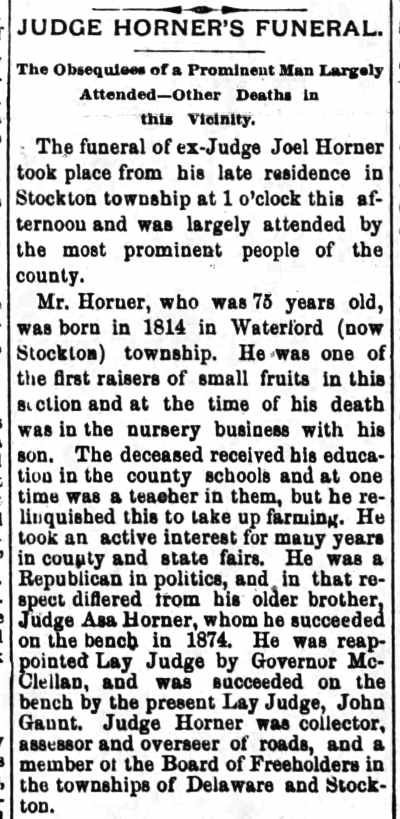
The Obsequies of a Prominent Man Largely Attended—Other Deaths in this Vicinity.
The funeral of ex-Judge Joel Horner took place from his late residence in Stockton township at 1 o’clock this afternoon and was largely attended by the most prominent people of the county.
Mr. Horner, who was 75 years old, was born in 1814 in Waterford (now Stockton) township. He was one of the first raisers of small fruits in this section and at the time of his death was in the nursery business with his son. The deceased received his education in the county schools and at one time was a teacher in them, but he relinquished this to take up farming. He took an active interest for many years in county and state fairs. He was a Republican in politics, and in that respect differed from his older brother, Judge Asa Horner, whom he succeeded on the bench in 1874. He was reappointed Lay Judge by Governor McClellan, and was succeeded on the bench by the present Lay Judge, John Gannt. Judge Horner was collector, assessor and overseer of roads, and a member of the Board of Freeholders in the townships of Delaware and Stockton.