Introduction
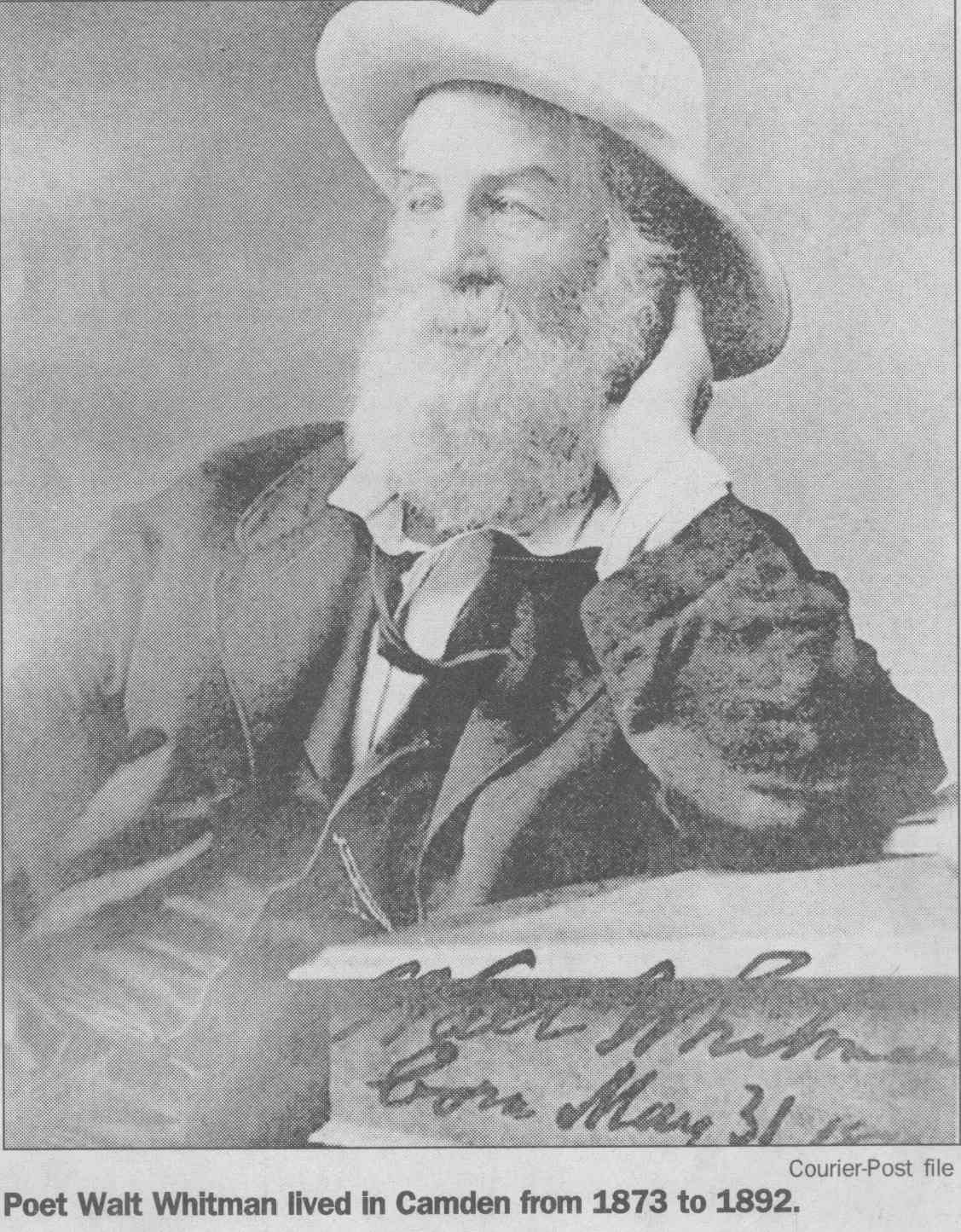
Poet Walt Whitman portrait
[Photo caption] Poet Walt Whitman lived in Camden from 1873 to 1892. Courier-Post file.
WALT WHITMAN, Camden’s “Good Grey Poet,” the life of whom a subject that has been written on at length by many people far wiser than I. Rather than rehash much that is to be read elsewhere, I will present things of interest concerning Whitman, his life and times in and around Camden, and comments by those who knew him and other contemporaries.
One aspect of Whitman that is far off the literary track is the use of his name and image for commercial purposes after his death. The Hotel Walt Whitman, the Walt Whitman Stores grocery chain and the assorted canned and packaged food items distributed under the “Walt Whitman” and “Poet” brand by Camden Grocer Exchange are probably the best remembered examples. Not to be forgotten is the Walt Whitman Bridge over the Delaware River. One has to wonder how many of those who cross the bridge daily know who Whitman was, and of that number, how many have read any of his poetry.
Walt Whitman Surprised
New York Times —

Presented by Many Friends With a Handsome Horse and Phaeton
PHILADELPHIA, Sept. 12.—Toward sundown yesterday the old poet Walt Whitman was dozing over a pile of manuscript near a window in his little frame house in Camden, when the rattle of wheels startled the old man, and a smart phaeton, drawn by a spirited chestnut, drew up to the door. The poet glanced over his flowers at the turnout and nodded his approval of the horse’s flying mane, for he was a favorite, the son of his old friend, Tom Donaldson, who had purchased the animal and handed up with a mysterious air an enveloped commission. The old man tried to walk away, but was called back and induced to enter the cozy workshop.
“Come, all of you, my boy?” inquired Walt Whitman, turning over the missive, and handling the big, thick package as though it contains dynamite.
“It does, your documents,” piped the little fellow, in a childish treble.
“Don’t you open it?” inquired one of the missive, and handling the big, thick package as though it contains dynamite. A commission from some fifty of America’s most distinguished men, which, as he held the envelope up to the light and trotted his thumb back and forth over the cover into the contents. “Is it a patent of nobility?” He inquired, “for some young friends?”
“Don’t you come from me, my boy?” said Whitman, and that young man, who had not been on pins and needles through the consciousness of his commission was glad enough to be rid of it for so small a custodian.
Shuffling all his slippers, and adjusting his spectacles and rubbing and scrutinizing the lettering before finally opening them, the letters were folded and nicely out upon the open end—exactly as though they contained bank notes. They were folded up within. On them were scrawled the warm tributes of old and new friends and the names that plainly their significance once: Walt Whitman, who was now over his eighty years, and the top of the first name.
He took up all the sheets upon the desks upper down and looked on the backs of them, while his fore-finger ticked the pages, one after the other, lightly, and his emotion was not that of the mystery. In utter astonishment he read the letter twice over, pausing with his handkerchief, but their increased translucence he whispered: “They are all very kind, looking with him, but that young man, who had been on pins and needles through the consciousness of his commission was a dog-like fondness in him, a boyhood, yellowing wildly.”
“God bless you all—yours for you for keeps!” and disappeared.
“It is all yours, Mary,” gaped the old gentle-man, as his good housekeeper appeared, with the letters in his hand, and there was a Whitman in his eye and a catch in his throat at the moment. Mr. Donaldson walked in and “What does it mean?” the poet demanded.
“Good things, Walt, the names are in the paper,” he said. He was the laughing winner.
It is an interesting list, isn’t it? He was told that he was the recipient of so valuable a present from so many friends that he had never owned such a thing in his life.
Mr. Donaldson then told him that the presentation was made from some of his most wide-brimmed sombre and initiated upon getting into the phaeton, and drove off. The creeks and drove to his old friend, Henry S. Scovel, who lived in Camden.
It was long after dark before the poet consented to return to his home. A later reporter called at 9 o’clock; the old gentleman was to be found sitting in the little arm-chair beside the window, with the horse turned toward the street, and with the letters still folded on his knees. His slumber was still undisturbed.
“You cannot know how many good friends I have,” said the bard, as he half rose to extend his hand in farewell, and there was actually enough left of the old man above his collar still further from his throat he continued:—
“I cannot say how many touching ways how kind and thoughtful this present is to me, but it is very handsome and valuable, came so opportunely. I have not been able to get out since early summer, and it has made me so lame lately that the doctors say I must drive. I missed my rambles in the country, and my constitution requires them. I feel the more grateful affectionately and sincerely that I was gratified especially by the manner in which the gift was accompanied by the words of friends and admirers of mine in different parts of the country. Mr. Donaldson came with a carriage and horse to ease the pains of the rheumatic poet.”
Here are their names as they constitute the complete list of contributors: R. W. Gilder, of the Century; Edward T. Steed, Mary Louise Booth, Francis S. S. Saltus, Henry Morris, T. W. Higginson, F. D. How, Henry S. Scovel, George H. Boker, Edwin P. Smith, William D. Howells, John G. Whittier, James Whitcomb Riley, John Burroughs, Edmund Clarence Stedman, General O. O. Howard, Brander Matthews, Albert Bierstadt, Chas. Dudley Warner, John Hay, Julian Hawthorne, John A. Logan, General Phil. Sheridan, J. J. Piatt, Charles Eliot Norton, Colonel T. W. Higginson, R. W. Gilder, Edwin Booth, Mark Twain, Thomas Nast, Oliver Wendell Holmes, Rutherford B. Hayes, and others.
Whitman’s Will Filed
Philadelphia Inquirer —
Walt Whitman’s will, the substance of which was published two weeks ago, was filed yesterday in the Camden County Surrogate’s office. The entire estate is valued at about $3500.
Walt Whitman’s Home in Camden
New York Herald —
Editorial in The New York Herald, Monday, May 15
The City Council of Camden, New Jersey, has voted that the home in which Walt Whitman passed the later years of his life and in which on March 26, 1892, he died shall not be destroyed but shall be preserved intact on the site where it stands. There had been a suggestion that it be removed to one of the city’s parks. This did not meet the Council’s approval. The house will stand where it is and where it stood when Walt Whitman lived and died in it.
Camden is a thriving and exceedingly busy city of upward of 116,000 inhabitants. With the completion of the great bridge linking it with Philadelphia across the Delaware its rapid growth is among the certainties. Business and not sentiment is its specialty. But evidently Camden is not so completely absorbed in business that sentiment is totally excluded. It does not forget that in the Whitman home it possesses what to many thousands of persons here and abroad is something in the nature of a literary shrine, and that such a possession entails responsibility on the city.
This responsibility the City Council is preparing to meet in a manner worthy of commendation. The Whitman home will be purchased by the city, the old house will be properly restored, and in it will be assembled all Whitman relics available, there to be preserved for all time. It is fortunate that the good taste of those in authority in Camden forbids the removal of the poet’s home from its original environment and its graceless injection into the scenery of a public park.
It will be 103 years May 31 next since Walt Whitman was born at West Hills, Suffolk county, Long Island, and Camden could not more fittingly commemorate that birthday anniversary than by thus preserving the house in which the poet long lived and finally died.
Whitman Verse Lovers Visit Poet’s Old Haunts To Mark 113th Birthday
Camden Courier-Post —
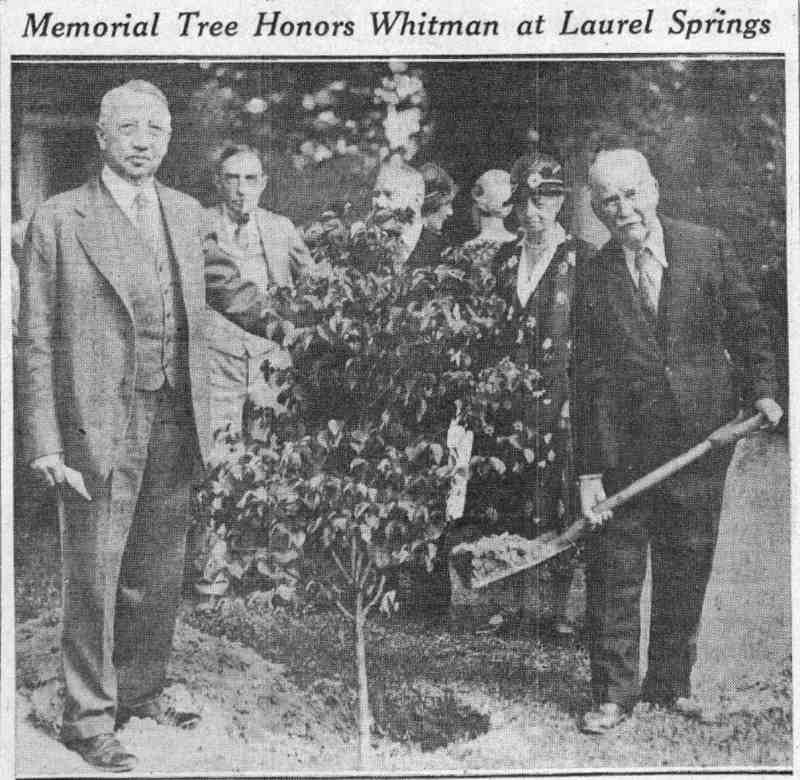
Pilgrimage to Timber Creek at Laurel Springs and Planting of Memorial Tree Feature Observance; Bard Praised for Universal Appeal
The elemental vigor of Walt Whitman, the “Good Gray Poet” of Camden, was recalled yesterday on the banks of Timber creek at Laurel Springs where more than 50 lovers of his poetry met to celebrate his 113th birthday anniversary.
The celebration, in the form of a picnic and ramble along the creeks after the fashion of Whitman, was preceded by the planting of a memorial tree, a dogwood, in the yard of the old Stafford home where Whitman spent many days while recovering from his illness.
The tree was set in place by Dr. Alexander Macalister, of Camden, who was Whitman’s physician, and the spade was wielded by Harrison S. Morris, of Philadelphia, an intimate friend of Whitman.
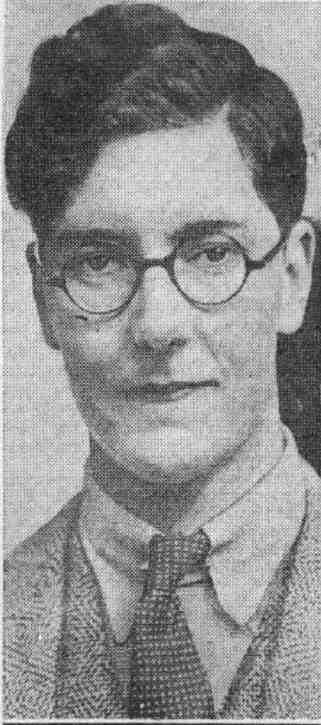
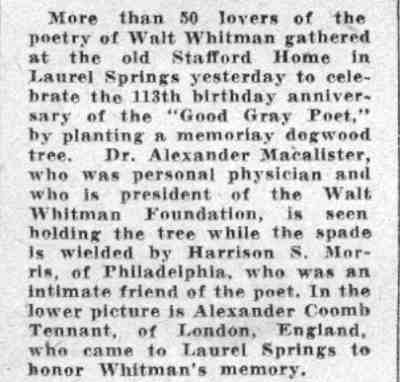
More than 50 lovers of the poetry of Walt Whitman gathered at the old Stafford Home in Laurel Springs yesterday to celebrate the 113th birthday anniversary of the “Good Gray Poet,” by planting a memorial dogwood tree. Dr. Alexander Macalister, who was personal physician and who is president of the Walt Whitman Foundation, is seen holding the tree while the spade is wielded by Harrison S. Morris, of Philadelphia, who was an intimate friend of the poet. In the lower picture is Alexander Coomb Tennant, of London, England, who came to Laurel Springs to honor Whitman’s memory.
Whitman Honored On 113th Birthday
(Continued from Page One)
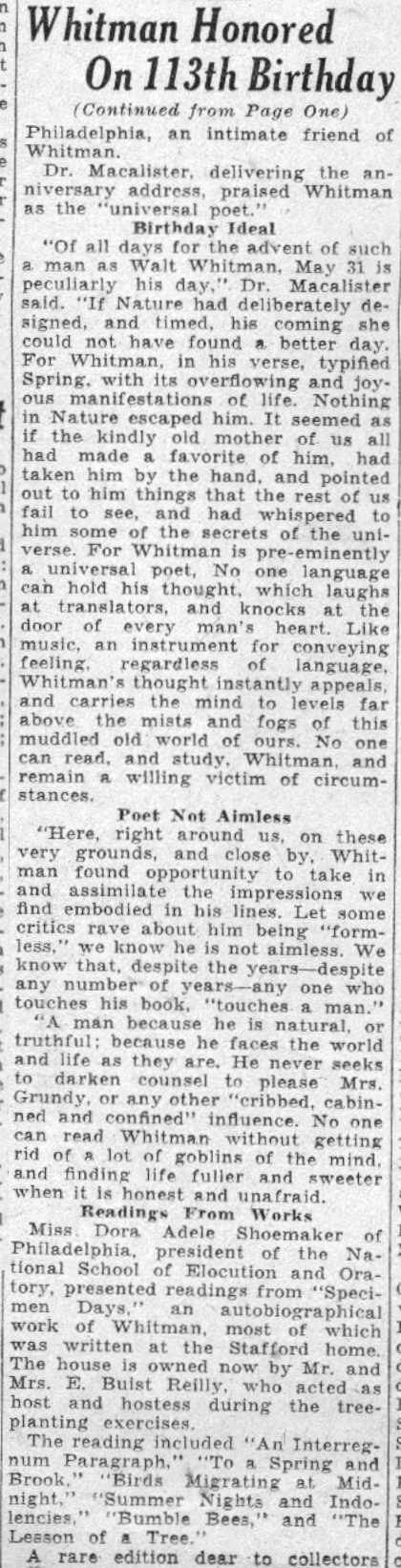
Dr. Macalister, delivering the anniversary address, praised Whitman as the “universal poet.”
Birthday Ideal
“Of all days for the advent of such a man as Walt Whitman, May 31 is peculiarly his day,” Dr. Macalister said. “If Nature had deliberately designed, and timed, his coming she could not have found a better day. For Whitman, in his verse, typified Spring, with its overflowing and joyous manifestations of life. Nothing in Nature escaped him. It seemed as if the kindly old mother of us all had made a favorite of him, had taken him by the hand, and pointed out to him things that the rest of us fail to see, and had whispered to him some of the secrets of the universe. For Whitman is pre-eminently a universal poet. No one language can hold his thought, which laughs at translators, and knocks at the door of every man’s heart. Like music, an instrument for conveying feeling, regardless of language, Whitman’s thought instantly appeals, and carries the mind to levels far above the mists and fogs of this muddled old world of ours. No one can read, and study, Whitman, and remain a willing victim of circumstances.”
Poet Not Aimless
“Here, right around us, on these very grounds, and close by, Whitman found opportunity to take in and assimilate the impressions we find embodied in his lines. Let some critics rave about him being ‘formless,’ we know he is not aimless. We know that, despite the years—despite any number of years—any one who touches his book, ‘touches a man.’”
“A man because he is natural, or truthful; because he faces the world and life as they are. He never seeks to darken counsel to please Mrs. Grundy, or any other ‘cribbed, cabinned and confined’ influence. No one can read Whitman without getting rid of a lot of goblins of the mind, and finding life fuller and sweeter when it is honest and unafraid.”
Readings From Works
Miss Dora Adele Shoemaker of Philadelphia, president of the National School of Elocution and Oratory, presented readings from “Specimen Days,” an autobiographical work of Whitman, most of which was written at the Stafford home. The house is owned now by Mr. and Mrs. E. Buist Reilly, who acted as host and hostess during the tree-planting exercises.
The reading included “An Interregnum Paragraph,” “To a Spring and Brook,” “Birds Migrating at Midnight,” “Summer Nights and Indolencies,” “Bumble Bees,” and “The Lesson of a Tree.”
A rare edition dear to collectors of Whitmania, “Visits with Walt Whitman,” was presented to the Walt Whitman Foundation by Alexander Coomb Tennant of London, England, who came to America at this time to honor Whitman’s memory. Tennant’s father was a friend of Whitman.
The annual birthday anniversary of Whitman is observed under auspices of the Walt Whitman Foundation. Arrangements were in charge of Mrs. Martha Davis, curator of the Walt Whitman Home, 330 Mickle street; Margaret Van Nest Storer of Chestnut Hill and Maguire Ball of West Collingswood.
Spaeth Unable to Attend
Dr. J. Duncan Spaeth, professor of English literature at Princeton University, who was to be a guest of honor, was unable to attend. Among those who knew Whitman and attended were Dr. Macalister, Mr. Morris, Mrs. Hedwig Haslam Alexander of 2208 Wallace avenue, Philadelphia, and Mrs. Margaret Wiley of 2533 Aspen street, Philadelphia, sisters of Mrs. George Whitman, executor for the famous poet.
Others present were: Mr. and Mrs. Donald N. Koster, of Philadelphia; Mrs. Juliet Lit Stern, of Haddonfield; James L. Pennypacker, of Haddonfield; Mrs. Helen D. Cooney, of Brookline, Mass.; Mr. and Mrs. E. Buist Reilly, of Laurel Springs; Helen E. Sherk, of Camden; Mrs. George W. Frick, Mrs. Robert Baird, Mrs. John Hinkle, Mrs. Aaron Heppard, Mrs. Harry Krantz, Mrs. A. M. Plummer, Mrs. Joseph H. Williams and Miss Delma Gardiner, all of Westville; Maguire Ball, of West Collingswood; William R. North, Sara S. North and Billy North, of Bordentown.
W. Lee Davis, of Philadelphia; M. Grace Fenstermaker, of Beach Haven, Pa.; Louise G. Harbauer, of Philadelphia; Mabel Whiting Hooper, of Boston; Hedwig Wiley, of Philadelphia; Arian H. Grimsley of Philadelphia; Marjorie Alexander, of Philadelphia; Margaret Van Nest Storer, of Chestnut Hill; Doris Adele Shoemaker, of Philadelphia; Mrs. Helen B. Ingram, of Haddon Heights; Coulter Davey, of Laurel Springs; Mrs. Helen Lippincott, of Riverton; Mrs. Roy Helton, of Philadelphia, and Mrs. Edwin C. Grice, of Philadelphia.
Walt Whitman Acclaimed as ‘International Prophet’
Camden Courier-Post —
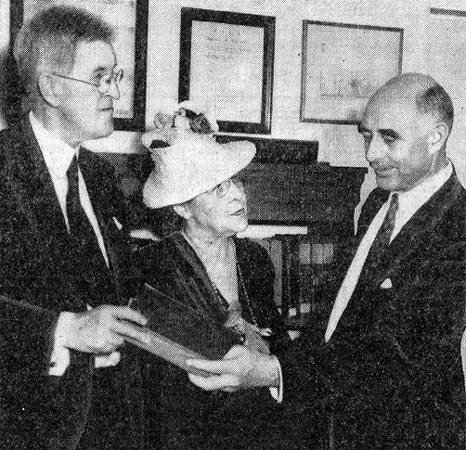
Wescott Recalls Friendship with Poet at Ceremonies Here Marking 120th Anniversary of His Birth; Donaldson Tells of Buggy Gift
by Walter B. Batezel
Acknowledged by the world as the poet of democracy, Camden’s own Walt Whitman was acclaimed here yesterday on the 120th anniversary of his birth as the “prophet of a new internationalism.”
This interpretation of Whitman and his famous “Leaves of Grass,” which introduced free verse to the world and the rugged liberty loving character of America so lustily praised in his songs, was offered by Ralph W. Wescott, of Haddonfield.
Wescott was one of three speakers for the Walt Whitman Foundation which is charged with maintenance of the Whitman home at 330 Mickle Street as a literary shrine. Also speaking on Whitman were Thomas B. Donaldson, Philadelphia insurance man, who as a boy knew Whitman, and Mrs. Elizabeth Cady Conover, also of Philadelphia.
The meeting was held at the headquarters of the Camden County Historical Society, Euclid Avenue and Park Boulevard. Wescott, former comptroller of customs of the Port of Philadelphia and son of the late Judge John W. Wescott, who was an intimate friend of Whitman in Camden and who twice nominated Woodrow Wilson for the presidency, based his lauding of Whitman as an “international prophet” upon excerpts from Whitman’s books.
Urged Universal Freedom
“It is the very catholicity of the man which causes us to celebrate his birthday anniversary,” said Wescott. “He has been seen as the precursor of socialism and the completely going anti-socialist.”
“We almost shrink from news abroad, and we are bound to consider what Whitman’s response would have been. In his poem ‘Salutation,’ I think we find in Whitman the prophecy of a new internationalism, a poem in which he asked for universal freedom against slavery, and called for an international brotherhood.”
“It is unique and significant that on this 120th anniversary of Whitman the New York World’s Fair acclaims him by statue and adulation, and in 1876 during the Centennial Exposition in Philadelphia Whitman indited a poem addressed to foreign readers in which he directed their attention to ‘the peculiar glory of the United States’ as something ‘vaster, saner, more splendid in comradeship, knitting closer all nations and humanity.’”
“Whitman himself wrote poets were necessary to fulfillment of a world brotherhood because their work was needed to vitalize the message of statesmen.”
Preached Good Will
“In the British-written preface to Whitman’s ‘Specimen Days in America,’ which he wrote in Camden and Laurel Springs, there occurred the sentence ‘Whitman preached goodwill between common people of all nations.’ In all the things written of him, Whitman said he liked that description best.”
“So, in Whitman’s own words we find the real message, and as expressed in one of his poems, and so which was an obsession with him in his declining days—we instinctively seek a ‘universal, comprehensive solidarity of man.’ There was no braver or more humanistic American writer than Whitman, nor more humanistic statement for the world than his ‘Leaves of Grass.’”
“Boyhood Recollections of Whitman,” by Donaldson, whose father Blaine Donaldson, of Philadelphia, was a benefactor and fast friend of Whitman, regaled the little literary group of 40 which appeared to honor the birthday of the “Good Gray Poet.”
It was Donaldson’s father who, anxious to aid the paralytic poet in reaching the outdoors, wrote to all of America’s most famous writers and asked they subscribe to a fund to purchase a pony and buggy for Whitman.
Great Writers Gave
The contributors to the fund, Donaldson said, included Ralph Waldo Emerson, John Greenleaf Whittier, John Burroughs, Robert W. Ingersoll, Rutherford B. Hayes, General Phil Sheridan and Oliver Wendell Holmes.
“Hayes and Sheridan were frequent visitors to our home,” said Donaldson, “as was Henry Irving, the actor. Sheridan came often to sniff brandy and Whitman met these men there, but Walt came chiefly for mental regalement and food, because my mother was a good cook.”
“I was a lad of eight to eleven years when Whitman made his visits, and no matter who was there Whitman always dominated the room. In fact, he loved my father so much that he requested that my father be a pallbearer for him.”
“My sister and I sat in his lap often, and we liked that because he looked like Santa Claus, and most children were drawn naturally toward him. He was different and comradely. I can pay tribute to Walt’s whiskers because he didn’t chew tobacco, not then anyway, if later.”
“Walt had the eyes of a stage manager and nothing escaped and no matter how distinguished the audience, Whitman was the boss. His favorite pastime at our home was dipping bananas into sherry wine and eating them as though they were lollypops.”
“It was in 1885 that my father decided to get Walt a pony and buggy, and when the outfit was purchased as a gift from America’s greatest writers to Walt. I was commissioned with a guardian to drive it to Camden.”
Pony Was Groggy
“When I got the pony there in the afternoon Whitman came out and said: ‘Bless me,’ and got in right away. Walt then took to the open in later days, but he soon began to complain the pony was ‘groggy and too slow.’ A few days later Walt turned up at home with a three-gaited horse.”
“The horse obviously was too spirited for Whitman’s crippled condition, and when this was drawn to his attention he said, ‘There is no sense in giving me a crippled horse. What does a helpless hulk like me want with another cripple? This horse is lithesome.’”
“I have some mementos from Whitman which I cherish, but most interesting of all was his personality. To know him was better than any souvenir of him, and in the language of today he had ‘umph!’”
“Mrs. Davis, who took him and who loved him as a mother would, caring for his every wish, was a kind, genial soul, and she in fact, supported Whitman while he saved his money for a monument to himself.”
Full of People
“I recall Whitman’s last days, when my father visited him. Father came home and said the house in Camden was full of people hovering over him with pencil and paper to catch his last words, and that few of them had gone down into their jeans to give him a cent.”
“But over all, I think our attitude toward Whitman must be an offering of our mentality, and our tribute is one of admiration and affection.”
Mrs. Conover paid memorial tribute to Dr. Alexander Macalister, former physician to Whitman, who died last November, and who was president of the Walt Whitman Foundation; Mrs. Sarah D. Wolverton, also a member of the foundation, who died last year; Mrs. Alice Walker Griffiths who lived in Camden at the George Whitman home while Walt lived there, and Mrs. Ruth Stafford Goldy, both of whom died last year. It was at the Stafford home in Laurel Springs that Whitman recuperated from his paralytic stroke.
Mrs. Conover said she was not “impressed by recent documents on Whitman” which she generally described as “insolent,” and said “nearness of approach and intimacy are necessary to get to a cosmic soul.”
“The most direct way to Whitman is through ‘Leaves of Grass,’” she said.
She then told of a recent incident on the finding of a first edition of “Leaves of Grass,” owned by “an unappreciative New York bootlegger,” and in which was found a manuscript of one of Whitman’s poems, “A Backward Glane O’re Traveled Road,” and the title of which had been written and changed three times by the poet on the manuscript.
Cites Honors to Poet
Mrs. Conover also called attention to the Sprague collection of Whitmania on exhibit this year in the Library of Congress, dedication of the Whitman statue at the World’s Fair yesterday, and issuance of a postage stamp in his honor.
“Whitman sailed his ship in deep waters,” she said, “and paid no attention to the shallows. He was the world’s greatest optimist, and under these tremulous, troubled and fear-filled times we should follow as Americans his words, ‘My foothold is tenoned and mortised in granite.’”
Mrs. Conover lauded Mrs. Martha Davis, curator of the Whitman house, as “a stout-hearted disciple of Walt Whitman.”
Wescott, in behalf of the Whitman foundation, presented to the Camden County Historical Society a picture of the Walt Whitman home for its archives. The picture was received for the society by Mrs. A. Haines Lippincott.
The Walt Whitman House
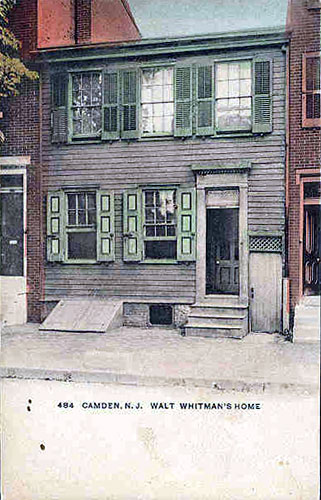
The Walt Whitman House at 328 Mickle Street. This postcard was published within 15 years of his passing, and is the most contemporary picture of the house as it would have looked during the poet’s lifetime.
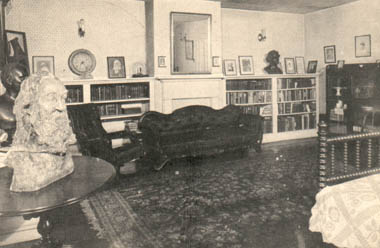
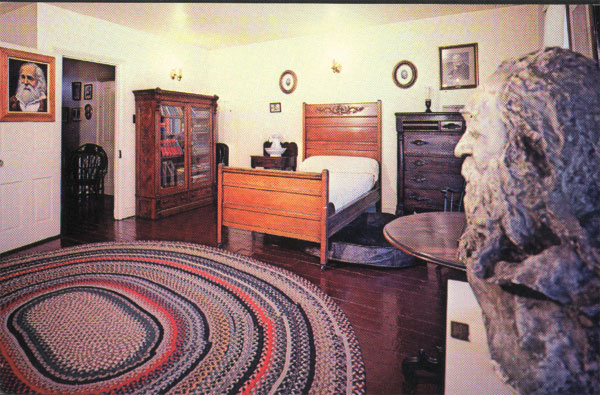
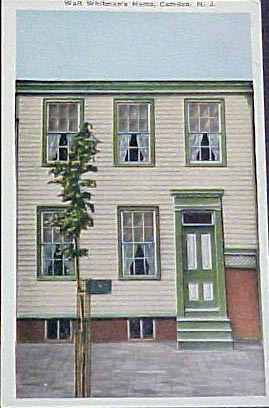
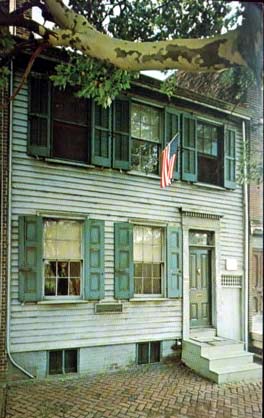
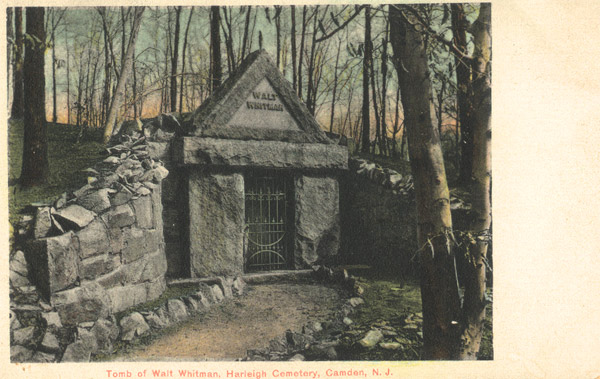
Walt Whitman’s House, 328 Mickle Street, Camden, NJ
Commercial Products
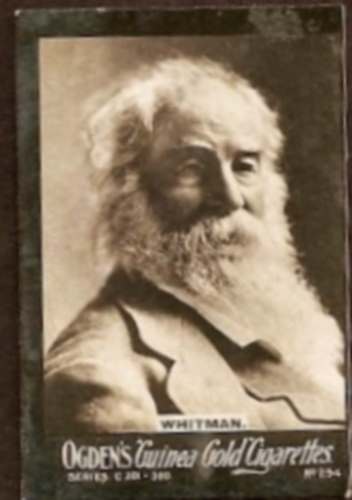
Ogden’s Guinea Gold Cigarettes
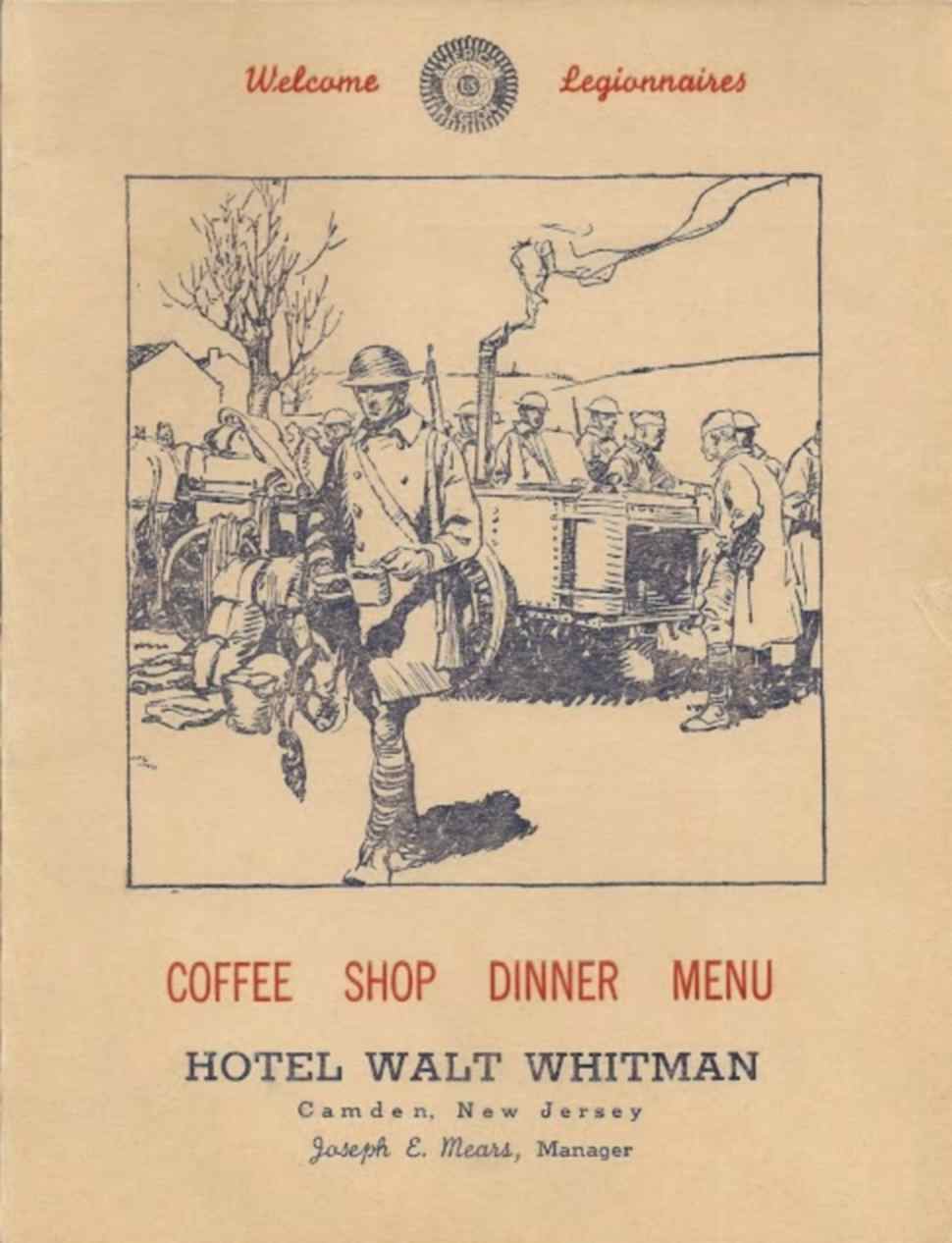
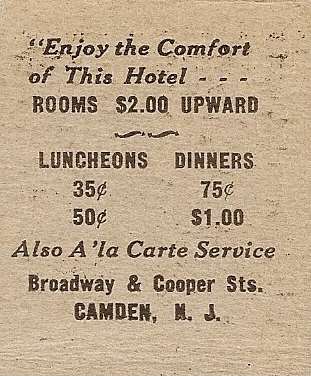
Hotel Walt Whitman Menu
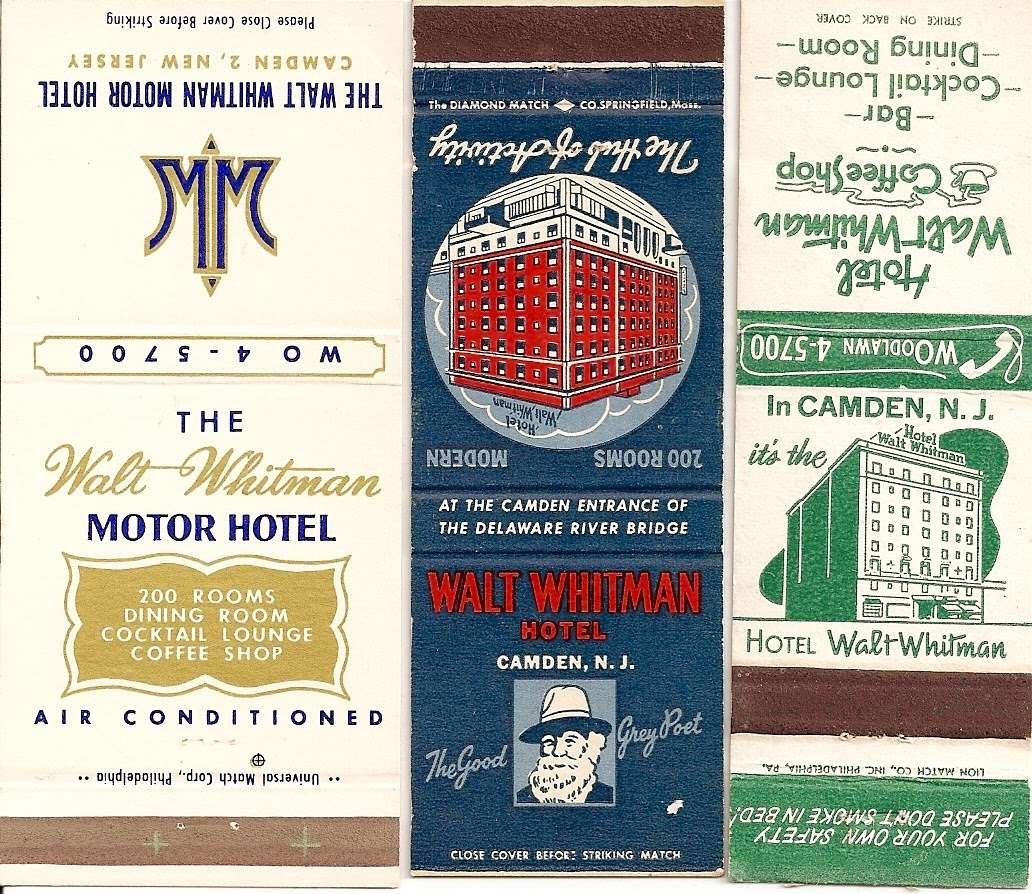
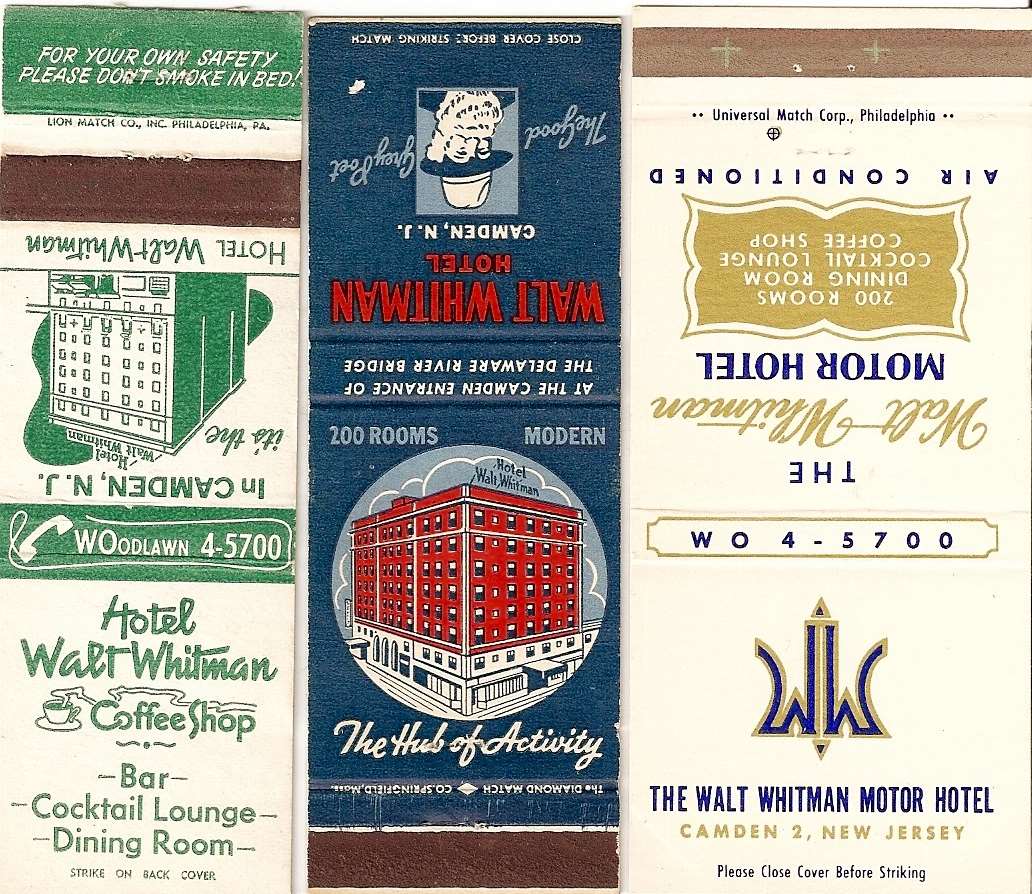
Hotel Walt Whitman Matchbooks
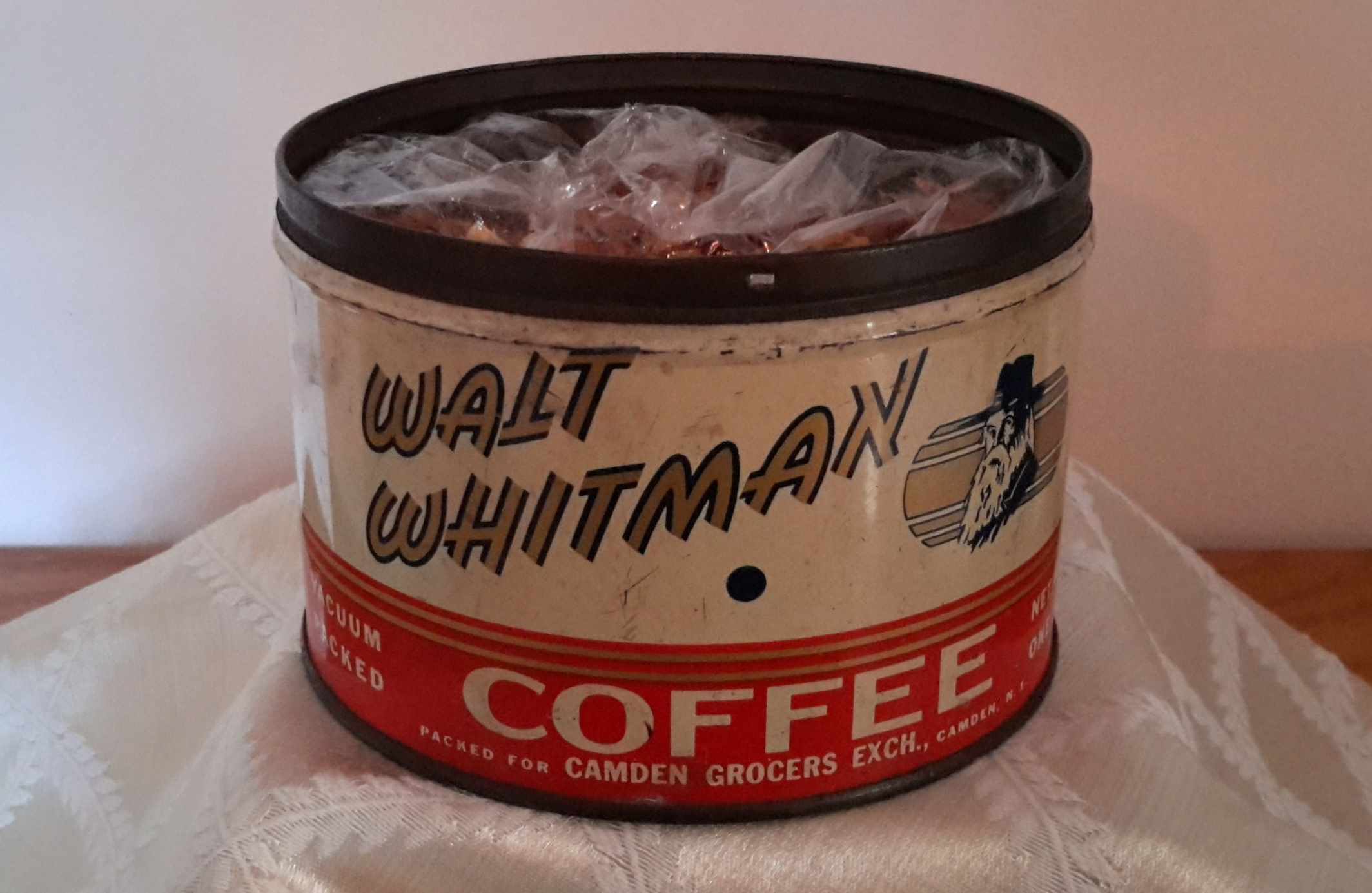
Walt Whitman Coffee distributed by Camden Grocer Exchange
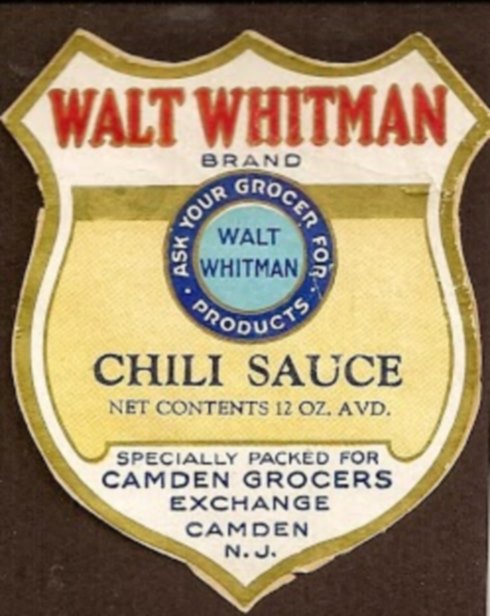
Walt Whitman Brand Chili Sauce distributed by Camden Grocer Exchange
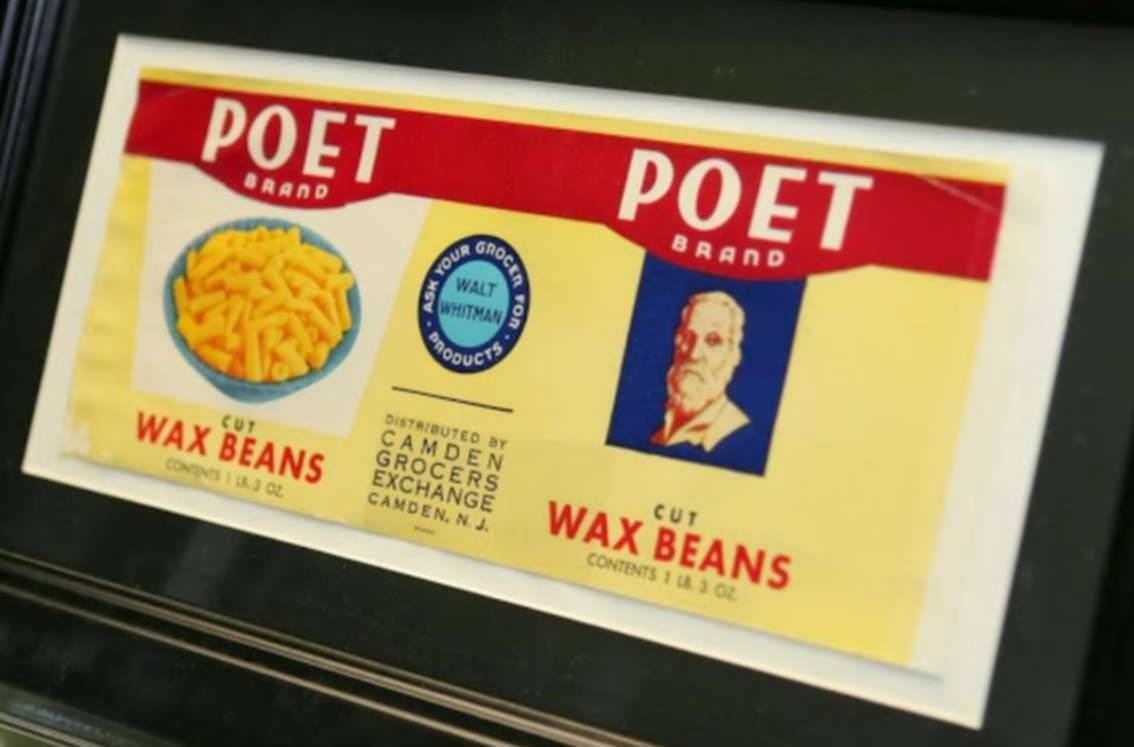
Poet Brand Cut Wax Beans distributed by Camden Grocer Exchange

Walt Whitman Unfiltered Belgian-Style Ale
Thanks to Ed Centeno for images from his Whitman collections.