Rudolph "Rud" Preisendanz Jr.
RUDOLPH “RUD” PREISENDANZ JR. was the son of Annie and Rudolph Priesendanz. Known as Rud Jr., he was born in Camden NJ on May 22, 1890. Rudolph Priesendanz Sr. was in the wagon building business, first working for Jacob Rettberg, then opening his own shop, and eventually buying Rettberg’s West Jersey Wagon Works, at 15–17 Market Street. The business expanded to 15–21 Market Street, and specialized in building and repairing the light and heavy business wagons used by Camden’s many small and large businesses. The firm also maintained a lumber and storage facility across the street at 14 Market Street. He also later acquired Jacob Rettberg’s wagon showroom (the equivalent of a new car dealership) at the northwest corner of Delaware Avenue and Market Street.
When Rud Preisendanz Jr. was born the family lived at 109 Linden Street, a short walk away from his father’s business, then located at 111 North Front Street. By the turn of the century the Preisendanz family had moved to 211 Pearl Street. While his business was quite successful, Rudolph Priesendanz Sr. suffered from a bad heart. Struck by a near fatal attack around Christmas of 1907, he was revived, but suffered a second and fatal heart attack on January 28, 1908. Rud Jr. and older brother Edward Preisendanz subsequently took over the family business. Mrs. Priesendanz, Daughter Henrietta, and Rud Jr. were still residing at 211 Pearl Street when the Census was taken in 1910.
When he registered for the draft in June of 1917 Rudolph “Rud” Preisendanz Jr. and his wife Etta had moved to Parkside, in a fine home at 1515 Baird Avenue, on which block his neighbors included many of the leading businesspersons in Camden at the time. Edward Preisendanz then made his home at 636 Penn Street, across the street from prominent Camden attorney Howard M. Cooper.
By 1917 the family business had been relocated to 34–44 North 5th Street. This property was acquired during the construction of City Hall and turned into the park which became known as Roosevelt Plaza. The business, which was then known as Rudolph Preisendanz’ Sons and run by Edward Preisendanz and Rud Preisendanz Jr., moved to 1706–1716 Federal Street in East Camden, where it specialized in truck bodies. This property had been an automobile dealership as late as 1929.
Rud Preisendanz Jr. and his brother Edward also partnered in a real estate company called the Gillanz Company with Lee J. Gill, a contractor who lived in Merchantville, in the 1920s. Their business was located at 4 North 2nd Street.
Edward and Rud Jr. carried on the family business through 1930. Both Edward and Rud Jr. were active in the fund raising drive that culminated in the building of the Walt Whitman Hotel. Edward Preisendanz also was a charter member of Camden’s Rotary Club. Rudolph Preisendanz Sr. was active in civic and fraternal circles, including the Camden Lodge of Elks. Rudolph Jr. would follow in his father’s footsteps with the Elks.
In 1930 the Preisendanz brothers sold the body business to longtime employee Robert Becker. Rud Preisendanz Jr. went into the broadcast business, setting up the Broadcast Advertising Company. This firm leased municipally-owned radio station WCAM in the 1930s.
Sadly, both brothers would not live to their 50th birthdays. Edward Preisendanz died unexpectedly in October of 1933. By January of 1938 Rud Preisendanz Jr. had passed away. His widow remained active in Elks affairs into the 1940s.
By 1947 the body works had closed, and at 1706–1716 Federal Street a Food Fair grocery store had been erected.
Camden City Directory, 1913
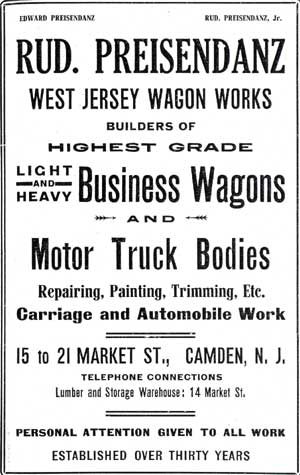
EDWARD PREISENDANZ RUD. PREISENDANZ, Jr.
RUD. PREISENDANZ WEST JERSEY WAGON WORKS BUILDERS OF HIGHEST GRADE LIGHT AND HEAVY Business Wagons AND Motor Truck Bodies Repairing, Painting, Trimming, Etc. Carriage and Automobile Work
15 to 21 MARKET ST., CAMDEN, N. J. TELEPHONE CONNECTIONS Lumber and Storage Warehouse: 14 Market St.
PERSONAL ATTENTION GIVEN TO ALL WORK ESTABLISHED OVER THIRTY YEARS
Smoke Overcomes Two Firemen
Philadelphia Inquirer —
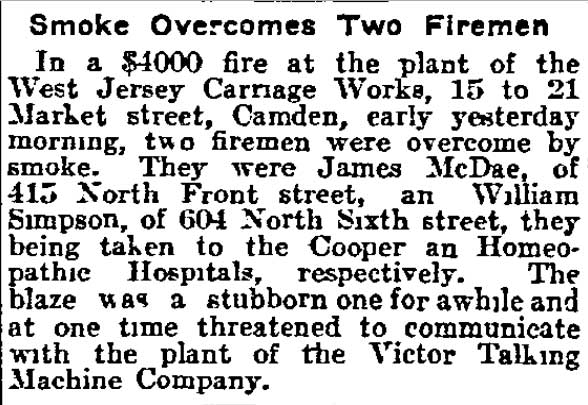
In a $4000 fire at the plant of the West Jersey Carriage Works, 15 to 21 Market street, Camden, early yesterday morning, two firemen were overcome by smoke. They were James McDae [sic], of 415 North Front street, an [sic] William Simpson, of 604 North Sixth street, they being taken to the Cooper an [sic] Homeopathic Hospitals, respectively. The blaze was a stubborn one for awhile and at one time threatened to communicate with the plant of the Victor Talking Machine Company.
Rud Preisendanz’ Sons — Advertisement
Camden Courier-Post —
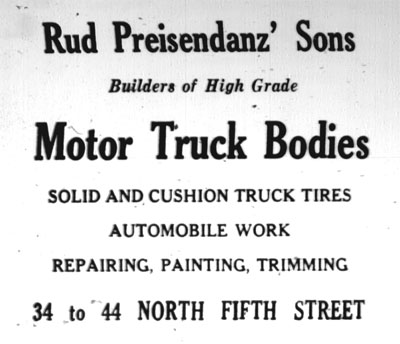
Rud Preisendanz' Sons advertisement
Rud Preisendanz' Sons
Builders of High Grade
Motor Truck Bodies
SOLID AND CUSHION TRUCK TIRES AUTOMOBILE WORK REPAIRING, PAINTING, TRIMMING
34 to 44 NORTH FIFTH STREET
They’ll Frolic at Elks Frolic
Camden Courier-Post —
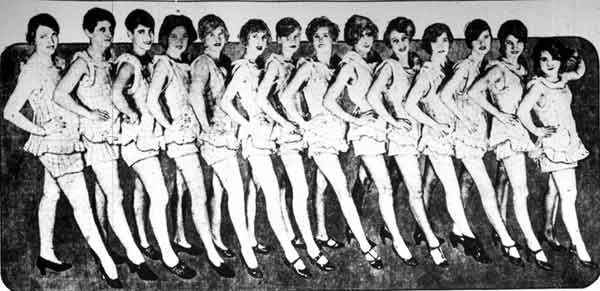
Offering the pick of local talent under skillful direction in an ambitious revue, the annual Elks Frolic for 1928 will be presented Thursday, Friday, and Saturday evenings in the Elks auditorium at Cooper and Seventh Streets.
“Hi-Hat” is the title of the new revue and the appearance of Elsa Dorn is a feature. The revue opens with an act programmed as “Hits and Bits,” in which Rud Preisendanz will act as master of ceremonies. From that point on, the revue makes its way through a series of dances, songs, spectacles and comedy skits until its conclusion.
William H. Iszard, chairman of the frolic committee, also becomes an actor in the performance. Others in the cast include the following.
Benton Vansciver, Ronald Hollingsworth, Fred Peterson, Elmore Craft Jr., Dorothy McDonna, Bernice Hendrickson, Lillian Hill, Jeanette Smith, Dot McGuire, Dot Hemphill, Bill Geyer.
Catherine Hill, Lillian Starke, Irma Huff, Virginia Simms, Mary Hall, “Billie” Dryer, Anna Prayne, Margaret Printz.
Justin McCarthy, Dorothy Ferat, Ed Brewer, Charles Wright, Fred Peterson, Dave Reese, Biel Davis, Bill Huff, Lillian Hill, Roland Hollingsworth, Ed Kelly, Al Durfer, Ed Preisendanz, Bert Poland, Curt Hitchner, Jack Sauerhoff, Perrin G. Somers Jr., Alberta O’Hara.
Harry Todd, Pete McGuire, Bill Gravenstine, Paul Horompo, Frances Brabazon, Irma Huff, Ella Huff, Eleanor Townsend, Bernice Hendrickson, Lillian Hill, Jeanette Smith, Mary Hall, Anna Prayne, Margaret Printz, Marie Carmichael, Elmore Craft, Charles Wright, Joe Hill, Larry Callahan, Harry Glazer, William Ambright, Frank Garrison, Ralph Willey, Jr., William Leckfeld.
New Elks Frolic Is Instant Success
Camden Courier-Post —
Colorful Revue With Snappy Features Delights Big Audience
Colorful and melodious, bearing the mark of skillful coaching and disclosing notable talent, the annual Elks’ Frolic was given its first performance last evening.
An appreciative audience applauded the various performers and their skits as the array of Camden and South Jersey talent offered their musical or humorous wares from the stage of the Elks’ auditorium, at Seventh and Cooper Streets.
Open to the public, the revue, which bears the title of “Hi-Hat,” is to be presented again this evening and tomorrow evening. Not only does the large cast bear no hint of amateurishness in the performance, but through the frolic, the public is given an opportunity to see a number of men prominent in business and professional circles in Camden turn entertainers for the evening. William H. Iszard, former assemblyman, is a member of the cast of “Hi-Hat.” So is Rud Preisendanz, exalted ruler of the Camden Elks’ Lodge and prominent businessman.
The opening act, ‘Hits and Bits,’ gives opportunity to a group of clever singers and dancers. Prominent in this act is Preisendanz as ‘master of ceremonies.’ The specialties introduce Justin McCarthy, Bill Guyer, Jannette Smith, Dorothy Ferat, Cliff Okerson, Charles Wright, Virginia Sims and Joe Hill. A dancing chorus composed of Dorothy McDonna, Bernice Hendrickson, Lillian Hill, Jannette Smith, Dot McGuire, Dot Hemphill, Catherine Hill, Lillian Starke, Francis Brahazon, Mary Hall, Bernice Hendrickson and Irma Huff, execute a series of timed dances. Miss Elsa Dorn has an important role in this and subsequent scenes.
A blackface novelty introduces Pete McGuire and Harry Toll in “The Transfer Men.”
A juvenile diversion features Kathleen Lyle and Ruth Matthiessen. It is called “We Moderns” and depicts a child’s idea of the modern flapper and her collegiate boyfriend.
A sketch dealing with one of the vital problems of the day entitled “Pre-War Scotch,” serves to introduce David Reese as a bellboy, Bill Huff and Bill Geyer are two salesmen, and Bill Davis as the proprietor of a rural hotel.
‘Modern Fairy Tales’ sung by Katherine Hill and Lillian Stark, tells the song story of fairy tales of the past compared to fairy tales of modern times. The sketches are played by Lillian Hill and Justice McCarthy.
Another playlet of the “collegiate” mode is called “The Elopers.” Special song numbers by Perrin G. Somers are interpolated in the act.
“The Musical Tourists,” a parody on the popular songs of the day, coupled in such a manner that they tell the story of the purchase of a second-hand touring car, is one of the hits of the performance. In this act are Ed Kelly, Al Durfer, Ed Preisendanz, Ben Hardy, Harry Todd, Bill Guyer and Jack Sauerhoff.
The Elks’ “Madcap Dancing Ensemble” introduces a series of clever dances by Frances Brahazon, Alberta O’Hara and Virginia Sims. In this are acrobatic, ballet, waltz, clog, buck and eccentric dancing.
The closing scene, beautifully mounted in costumes and scenery, has been given the title “Palate D’Or.” Prominent among the performers are Charles Murray, Bert Poland, Jack Sauerhoff, Ed Kelly, Bill Gravenstine, Elsa Dorn, Pete McGuire, Ed Preisendanz, Harry Todd, Al Durfer, Dave Reese, Dot McGuire, Dorothy McDonna, Irma Huff, Paul Horompf, Lillian Starke, and Rud Preisendanz. A mixed chorus of fifteen voices lends color to the scene. An augmented orchestra was under the direction of Perrin G. Somers, director of the frolic. The curtain rises promptly at 8:30.
Elks Install Stewart as New Ruler Tonight
Camden Courier-Post —
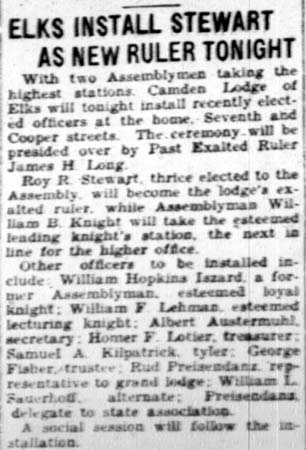
With two Assemblymen taking the highest stations, Camden Lodge of Elks will tonight install recently elected officers at the home, Seventh and Cooper streets. The ceremony will be presided over by Past Exalted Ruler James H. Long.
Roy R. Stewart, thrice elected to the Assembly, will become the lodge’s exalted ruler, while Assemblyman William B. Knight will take the esteemed leading knight’s station, the next in line for the higher office.
Other officers to be installed include: William Hopkins Iszard, a former Assemblyman, esteemed loyal knight; William F. Lehman, esteemed lecturing knight; Albert Austermuhl, secretary; Homer F. Lotier, treasurer; Samuel A. Kilpatrick, tyler; George Fisher, trustee; Rud Preisendanz, representative to grand lodge; William L. Sauerhoff, alternate; Preisendanz, delegate to state association.
A social session will follow the installation.
‘Good Will’ Auto Arrives Here Today
Camden Courier-Post —
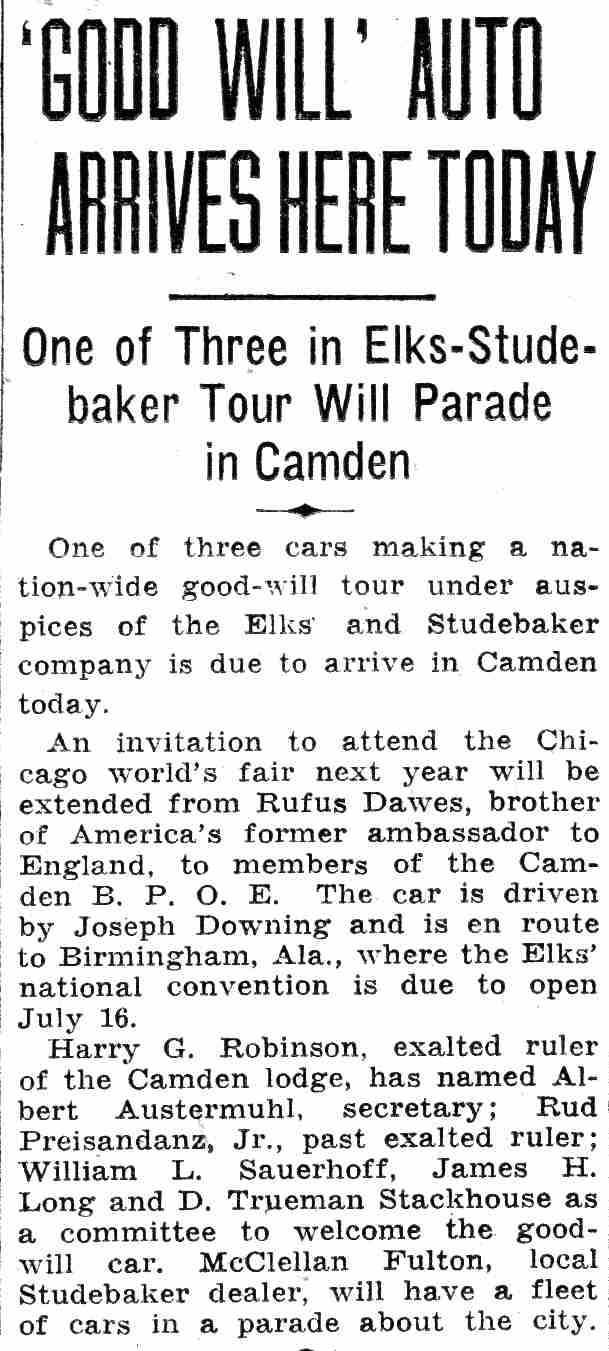
One of Three in Elks-Studebaker Tour Will Parade in Camden
One of three cars making a nation-wide good-will tour under auspices of the Elks’ and Studebaker company is due to arrive in Camden today.
An invitation to attend the Chicago world’s fair next year will be extended from Rufus Dawes, brother of America’s former ambassador to England, to members of the Camden B. P. O. E. The car is driven by Joseph Downing and is en route to Birmingham, Ala., where the Elks’ national convention is due to open July 16.
Harry G. Robinson, exalted ruler of the Camden lodge, has named Albert Austermuhl, secretary; Rud Preisandanz, Jr., past exalted ruler; William L. Sauerhoff, James H. Long and D. Trueman Stackhouse as a committee to welcome the good-will car. McClellan Fulton, local Studebaker dealer, will have a fleet of cars in a parade about the city.
Camden Elks to Honor Past Exalted Rulers
Camden Courier-Post —
Past exalted rulers will be honored tonight by Camden Lodge of Elks with a dinner, ceremonial and entertainment.
The program will be nation-wide. A dinner will be served at 6:00 PM, followed by a business session. Harry G. Robinson, present exalted ruler, will open the ceremonial and turn the lodge over to the past officers.
The past exalted rulers expected are Samuel Kilpatrick, who served in 1900 and 1921; Dr. A. Haines Lippincott, Alexander J. Milliette, J. Harry Switzer, James H. Long, Marian Moriarity, Allen Jarvis, Albert Austermuhl, William L. Sauerhoff, former Mayor Frank S. Van Hart, D. Trueman Stackhouse, Harry Ellis, William G. Ferat, Judge Garfield Pancoast, Rudolph Preisendanz, Jr., Theodore T. Kausel, Edward J. Kelley, Mayor Roy R. Stewart, William H. Iszard, William S. Lehman and J. Harry Todd.
City Adopts Cut Budget After Clash
Camden Courier-Post —
Slash of $702,890 Is Revealed in Totals Passed at Session of Rulers
Lease Announced of Radio Station
Commissioners Debate With Von Nieda as He Charges Gross Extravagance
By WALT BATEZEL
The Camden City Commission yesterday approved the 1933 city budget after hearing and rejecting economy recommendations of several civic and labor organizations.
Eight speakers representing five organizations urged budget reductions and protested the total of $3,353,124.60. Verbal clashes over opinions were frequent between Commissioner Harold W. Bennett, director of finance and revenue, and former Councilman Frederick von Nieda and Thomas B. Hall, representatives of the Congress of Civic Associations of New Jersey.
Nearly 300 persons attended the hearing, in marked contrast to the 5000 who marched on city hall last year to demand budget reductions. The hearing lasted three hours. The departmental budget appropriations of $3,353,124.60 with the local school appropriation of $1,250,000 and other appropriations, totaling $960,060.55 to be added in the tax ordinance yet to be adopted, will give the city a total expense of $5,563,185.15 for 1933.
Tax Bill About Same
The tax rate will not be known until the tax ordinance is adopted. After the hearing Commissioner Bennett declared that due to equalization of assessments, the bills of some taxpayers will be a few dollars higher than last year, and a few dollars lower in other cases. The commission, after approving the budget on a motion by Commissioner Bennett, adopted a resolution leasing WCAM to the Broadcast Advertising Company for $1000 per year and a percentage of all receipts over $24,000. All maintenance costs will be born by the company, of which Rudolph Preisendanz, Jr., is head.
After the budget was adopted Bennett declared the City Commission would take into consideration an allegation of Frank J. Hartmann, Jr., secretary of the Civic Congress, that the $125,400 appropriation for street lighting was $26,450 higher than it should be according to figures obtained by him concerning the city’s lighting equipment. “If there has been an error the budget can be amended at any time,” Commissioner Bennett said.
Commissioner Clay W. Reesman, under whose department street lighting comes, declared that figures in his office concerning street lighting were different from those quoted by Hartmann. The figures he used, Hartmann said, were obtained by him from City Comptroller Sidney P. McCord.
Von Nieda Case
Von Nieda was the first citizen to address the commission. Shifting papers in his hands, he faced the commissioners and said: “We have here $40,000 for your Recorder’s Court in 1932, and $25,000 for 1933.”
Commissioner Bennett jumped to his feet.
“Those 1932 figures,” Bennett said, “were merely an estimate of the receipts to be taken in, but that amount did not come in. This year we anticipate only $25,000, which we consider a fair estimate.”
“That’s fine” said von Nieda, “but we have never had a chance to sit in with you on these figures.”
“You can sit in with us at any time,” responded Bennett, “We’re glad to have you.”
“I see here,” said von Nieda, “that the transportation inspector is paid from fees, but you show no fees and the inspector should be paid by the Public Service. I also suggest that you turn Convention Hall over to the poor. Now in dealing with Station WCAM, I see you show a profit for the last three months of $1000, while in 1932, you show no records of receipts, and we are just wondering.”
Worried by WCAM
“Do you want that answered now?” asked Bennett. “WCAM has given myself and the other commissioners some concern during the past year. It is our duty to see that we receive as much income as possible. Different methods have been used in the radio station to make it pay during the past three months, and during this time that station has been in the black. We figure that in 1933 there will be no deficit in this station, and we look for a profit of more than $1000.”
“Now in this matter of eliminating deputy directors,” von Nieda said.
He was interrupted by Commissioner Reesman.
“I’ll tell you,” said Reesman, “about my deputy director Carlton Harris. My deputy receives $1750 a year. He has charge of all labor in the Department of Parks and Public Property. He is on the job every morning at 7:00 AM, and often works until 10 p. m., with the labor outside.”
“In speaking of the assessors,” von Nieda continued, “we should have assessors who are not influenced by politicians or political dictators.”
“You know I won’t stand for that,” answered Bennett. “The readjustment of ratables is only a small part of the work we are doing. Each property is assessed on a basic principal. Any time you have a suggestion that will help us in our work we will be glad to hear from you but I firmly believe that real state must be relieved of its heavy tax burden by an income and sales tax, and this tax must come sooner or later.”
Seeking Relief
“As far as the city commissioners are concerned, we are studying it from day to day, in efforts to get out of the wilderness.”
“In speaking of the purchasing department,” von Nieda continued, “we know what happened there last year. You fired your purchasing agent, and if you had not fired him it probably would have afforded the public some interesting reading about this purchasing department.”
“All of my men are working overtime,” replied Bennett. “It is true the purchasing agent is out and his work is being done by an assistant (William Dilmore) at half his salary. We have got rid of as many people in these departments as we can. I had to let one girl go in the purchasing department and one girl in Controller McCord’s department. One man went on pension in the tax office and two were let out in efforts to balance the budget.”
“In one of my departments where there were three girls I had to make a $900 cut by leaving one girl out. I called the three girls into my office and told them that one had to go and asked them what their home responsibilities were. One had to take care of her family, including a 77-year-old aunt; another a family with a 66-year-old aunt, and the third was supporting three or four brothers with the help of another brother, who is a barber working for practically what tips he could get.”
“But I had to make a $900 cut. The girls asked me not to dismiss any of them, as they each would take a $300 cut in addition to cuts already applied. Another man took an extra $260 cut so that he would not be out of work. But I had the budget to take care of, and I am ready to challenge any city the size of Camden to show so nearly a balanced budget. Our plan is to pay as we go.”
“You cite two or three instances,” protested von Nieda. “But I want to show you scores of families which have no money and they are taxpayers. You say you have cut to the bone, but you should cut through the bone. This is no grandstand play by us. Maybe we can give you some help. Then, too, the debt interest must be paid on this tragedy,” he shouted, pointing to walls of the commission chamber.
“Maybe you can tell me how to get rid of the bonds,” suggested Bennett. “You must remember this year we have cut $900,000 from the budget.”
Offers Recommendation
Von Nieda said the Civic Congress recommended that work now being done by two city solicitors should be done by one, that when more policemen and firemen are needed “little fellows” be restored first wherever possible; that the city incinerating plant be closed; that the personnel of the city’s two sewage disposal plants be reduced; that the city’s lighting bill be cut $40,000; that inspectors of lighting be abolished and their work done by policemen and the city’s engineer’s department. Personally he favored an income tax, he said, to relieve the burden on real estate.
“I realize,” von Nieda said, “that the city commission has done a fair job, but of the congress, with conservatively 15,000 members, think you can do even better.”
Commissioner Frank B. Hanna, director of public works, interrupted von Nieda on the subject of the incinerating plant, which von Nieda declared could be abandoned because it did not burn garbage, but only rubbish.
“Can you see me at 9:00 AM tomorrow and go through my department with me?” asked Hanna.
“Any time,” replied von Nieda.
Warns of Tax Strike
“However,” von Nieda continued, “we are wondering what the figures in the right hand corner of the tax bill will be. Assessments may be lower and the tax rate higher, and that does not give a true picture. I fear the bills will be more for 1933 and for one am willing now to take the 1932 assessment on my home.”
“The congress vigorously opposes this personality tax. You expect to tax the homeowner for everything he has. I warn you gentlemen that if this tax is imposed in Camden there will be a run on banks and building and loan associations. If that happens homeowners and renters will leave this unfortunate city. There will be a tax strike here, and so help me God, I’m helping it!”
Von Nieda was followed by William Hughes of 578 Mickle street, who spoke for the Unemployed Council of New Jersey.
Hughes reiterated demands of the union for increased relief payments to unemployed, urged a municipally-owned lighting plant, operated at a profit, the same as the city’s water department; a municipal lodging house; use of hand labor instead of machinery in all city contracts and the employment of labor to “tear down the slums in Camden.”
Hartmann was the next speaker. He read from a prepared statement which he declared was an analysis of the city’s 1932 lighting expenses, and which, he said, could be lowered “had we used larger lamps.”
Reesman Contradicts
After enumerating the individual costs of lamps of various candle power, and contending a change in the lamps would effect a saving this year, Hartmann charged the city has overpaid for electric energy in street lighting.
Commissioner Reesman declared that figures used by Hartmann were in error and that therefore, his computations as to possible savings were wrong. He announced, however, he would study the situation to discover if there was any error in the budget concerning street lighting, as alleged by Hartmann.
“The Civic Congress is now circulating petitions for a referendum on a municipal lighting plant,” Hartmann said. “We now have 10,000 of the required 11,000 signatures, and we do not intend to stop until we have 25,000. You commissioners can stop these petitions by adopting a resolution declaring a referendum on the question.”
He then asked that the work of the city electrical inspector be taken over by the National Board of Fire Underwriters, and that “when the next tax sale is held, all properties be advertised, including banks, garages and to whomever the property belongs.”
Commissioner Bennett then arose and said: “I’ve used discretion on that. There are some who are paying as low as $5 per month, and I think these people should be helped. We commissioners do not want to sell the home of anyone. That is what we are trying to stop. We are in perfect agreement on that.”
Debt Moratorium Asked
“How about the Bridge Garage?” some one in the audience shouted.
“The Bridge Garage has just paid $1500,” Bennett said, “and promises to pay something every month. We are trying to make the tax bills lower by getting in all the monies we can, and where possible to take in delinquent payments no matter how small.”
Clarence Moullette, secretary of the Unemployed Union of New Jersey, then arose. He asked for a moratorium on the city debt service for five years, and urged the commission to adopt such a resolution memorializing the Legislature for that relief. He announced opposition to the personality tax.
“We are not questioning the actions of the commissioners,” Moullette said. “Spending less money will not help the situation. Commissioner Hanna told me if he had $51,000 additional in his department six closed garbage trucks could be purchased. This will help give work. By cutting down salaries you decrease purchasing power. Work must be had. Eventually you will pay in scrip. Why not pay in scrip now and give out work.”
Hall asked that Convention Hall be abandoned and the building used for hospitalization work for the needy, and urged the city commission to “meet in the evenings so that citizens will know and see what is going on.” He asked for abolition of the positions of plumbing, building, sewer and heating inspectors.
‘Close High Schools’
“The commission should face conditions as they are,” he said. “I speak for myself, and not the Civic Congress. I ask that the high schools be closed. I heartily approve closing of the Vocational School, but if choice was to be made between high schools and the Vocational School, I would say close the high schools. Before selling the home of anyone to meet impossible taxes, I say cut to the bone by getting rid of everything that is not absolutely necessary.”
“You commissioners must be made to realize that increased taxation is what has destroyed purchasing power in America. Meet this condition!”
Commissioner Bennett challenged the statement of Hall that government costs were responsible for conditions of today.
“There are numerous causes,” Bennett said.
“I would rejoice in debating it with you or anyone you select,” Hall replied, “including United States senators, and convince them in 20 minutes.”
“I’ll debate that with him,” shouted Morris Stempa of Audubon from the audience. Stempa later addressed the commission, speaking for the Socialist party, and urged the moratorium advocated by Moullette, also a Socialist.
Eugene Wasilewski, speaking for the South Camden Civic Association, denounced the commission for failing to call in civic association representatives in their preparation of the Budget.
Bennett Gives Reply
“You called in the bankers, but not those others of us who also are interested in city costs,” Wasilewski said. “You tell us now there is a reduction in assessments and then come along and wallop us with a higher tax rate. That is not fair. You were elected to look after our interests and that you have failed to do. You are making us eat red herring, and we want you to eat red herring with us.”
The last citizen to address the commission was Salvadore Guadelli, president of the Citizens-Taxpayers’ League. He made a general indictment of conditions, and asked that the city commission “do not let sectionalism creep into city affairs.”
Commissioner Bennett then arose and addressed his fellow commissioners and the audience.
“All these things suggested here today have been considered,” he said. “We five men came into office with the idea of serving the people. I know the business of financing the city is a serious problem. We have endeavored to move the budget into that realm of ‘pay-as-you-go.’ We appreciate everything presented here. Every taxpayer we look upon as an employer.”
“Looking at it from every angle, this budget cannot be delayed any longer. You’ll find we were severe in preparing this budget; you’ll find we were severe last year. Last year we cut a half million. This year we cut $702,890.74, and to that the board of education, we hope, will add a cut of $250,000. That is a total cut of $952,890.74. Other cities in New Jersey show nothing to compare with it.”
Budget Adopted
“I hesitate in making more cuts. I speak from experience when I say I’m a taxpayer. In the past two weeks I’ve been trying to raise money to pay taxes. I want all of you to know we commissioners can sympathize. It is not easy being at the head of a government in times like these. I hope that municipalities will receive federal relief in payment of debt service. There has been a tremendous cut in our budget, including the board of education figures. I feel the commissioners are to be commended for the work they’ve done this year.”
“If we pass the budget we won’t stop at that particular point, but will see what else we can do all along the line. I feel the essential thing is to pass the budget. I’m proud of the fact we came through 1932, and are started in 1933 the same way, although I make no promise for the future. I wish for a moratorium for interest on bonds. There are the bondholders on one side and the taxpayers on the other, and the man out of work to be considered.”
“We are in sympathy with the man out of work. I say let the federal government put some money into the interest rate. We must pass this budget this afternoon. Do not delay longer. This is not an arbitrary stand on my part. I make a motion the budget now be passed.”
City Clerk Frank S. Albright called the roll and all five commissioners voting unanimously. No demonstration followed passage of the measure.
*Eugene Wasilewski referred to in this story was Eugene Waleskiewicz, who was later known as Eugene Wales.
Camden Elks Hope to Get Convention
Camden Courier-Post —
Advisory Committee Will Present Formal Invitation for State Meet
The twenty-first annual reunion and the convention of the New Jersey State Elks Association will be held in Camden next June if efforts of the advisory board of Camden Lodge of Elks are successful at the state meeting in Newark on June 15, 16 and 17.
Members of the advisory board for the local lodge, who are past exalted rulers of the Camden lodge, will present the invitation to hold the 1934 meeting in Camden, at the twentieth reunion and convention in Newark.
Members of the lodge have adopted a resolution confirming the action of the advisory board and plans were made to set the necessary machinery in motion to bring the 1934 convention to Camden. It was pointed out that Camden Elks have the largest home in the state.
Samuel Kilpatrick, the oldest past exalted ruler of the lodge, is head of the advisory board, and Harry G. Robinson, youngest past exalted ruler, is delegate to the state association, which is composed of past exalted rulers of all Elks lodges in New Jersey.
Although the state association was formed in Camden, there has never been a reunion or convention of the association held here, it was pointed out.
The outstanding feature of each annual convention is the mammoth sessions, with thousands of Elks in line. It is estimated the parade would draw more than 50,000 persons to Camden, if the local lodge’s invitation is accepted.
The Camden lodge is sending the band and patrol to Newark for the parade, which will start at 7 p. m. on June 17. Arrangements are being made to have the largest delegation in the parade represent Camden.
Past exalted rulers who comprise the advisory board, and the year they took office, follow: Samuel Kirkpatrick, 1900; Dr. A. Haines Lippincott, 1901; Alex J. Milliette, 1906; J. Harry Switzer, 1908; James H. Long, 1911; Marion Moriarty, 1913; Allen Jarvis, 1914; Albert Austermuhl, 1915; William L. Sauerhoff, 1917; Theodore T. Kausel, 1918; Garfield Pancoast, 1919; William G. Ferat, 1920; Harry Ellis, 1921; Samuel A. Dobbins, 1923; D. Trueman Stackhouse, 1924; Frank S. Van Hart, 1925; Edward J. Kelly, 1926; Rud Preisendanz, Jr., 1927; Roy R. Stewart, 1928; William H. Iszard, 1929; William Lehman, 1930; J. Harry Todd, 1931, and Harry G. Robinson, 1932.
Deceased past exalted rulers and the year they took office are: John H. Foster, 1895; W. E. B. Miller, 1896; Philip Burch, 1897; D. Harry Condit, 1898; H. L. Hartshorn, 1891; George D. Borton, 1902; Maurice Rogers, 1904; Francis Warren, 1907; E. Wilmer Collins, 1909; Lewis H. Leigh, 1910; Morris Odell, 1912, and W. Wallace Balcom, 1922.
Flag Day Service Planned by Elks
Camden Courier-Post —
Elaborate Ceremonies Monday Night Will Be Open to Public
An elaborate Flag Day celebration to be open to the public and broadcast over the radio is planned by Camden Elks for Monday night.
Ceremonies will open at 7.30 p. m., in the lodge room, Seventh and Cooper Streets, with a musical program by the Elks Band, under direction of William H. Townsend. Presentation of the colors will be made by August F. Walters Chapter, Disabled American Veterans; Corp. Raymond C. Thoirs Post, American Legion, and Matthews-Purnell Post, Veterans of Foreign Wars.
The invocation will be made by the lodge chaplain, D. Truman Stackhouse. An altar service will be held by officers headed by James MacMillan, exalted ruler. An organ solo of “America” by Charles L. Bowen, solos by Charles T. Murray, Mrs. C. Richard Allen and Albert B. Poland, will feature the musical program.
The history of the flag will be given by George S. Dunkelberger, a senior member of the lodge and chairman of the Flag Day committee. The program will be broadcast over WCAM by courtesy of Rud Preisendanz Jr., past exalted ruler and lessee of the station.
Elks to Observe Flag Day Tonight
Camden Courier-Post —
Uniformed Veterans to Join Lodge Members in Colorful Ceremonies
Arrangements are completed for the Flag Day celebration to be held tonight by the Camden Elks Lodge at Seventh and Cooper Streets.
The program will open at 7.30 p.m. Doors of the lodge room will be opened to the public at 7:15 p. m. The program will be broadcast over WCAM.
The Elks Band, led by William H. Townsend, will open the ceremonies. Presentation of the colors will be made by uniformed units of the August F. Walters Chapter, Disabled American Veterans; Corporal Raymond C. Thoirs Post, American Legion; Matthews-Purnell Post, Veterans of Foreign Wars, and the lodge patrol.
D. T. Stackhouse, chaplain of the lodge, will make the invocation and an altar service will be held by James A. MacMillan, exalted ruler, and the other officers.
There will be musical selections by Charles L. Bowen, organist; Charles T. Murray, Albert B. Poland and Mrs. C. Richard Allen, vocalists.
George S. Dunkelberger, a senior member of the lodge, and chairman of the Flag Day committee, will give the history of the flag. A patriotic address will be given by Police Judge Garfield Pancoast, a past exalted ruler.
The radio program will be presented through courtesy of Rud Preisendanz Jr., past exalted ruler and lessee of the station.
Varied Work Keeps Body Plant Busy
Camden Courier-Post —
All Types of Jobs Handled By Becker Body Company
Business is good at the Becker Body Company plant, Seventeenth and Federal streets.
The photograph accompanying this article gives a glimpse of one corner of the shops. It could be duplicated anywhere in the plant and every picture would show skilled craftsmen busy working.
The work of the Becker Company consists of the repair of damaged automobile bodies and in the repainting or enameling of bodies. The plant is also equipped to handle all truck repairs and to manufacture new truck bodies as well as handle repair work.
The firm employs experienced blacksmiths, metalsmiths, expert carriage painters and stripers, finishers, welders, woodworkers and others. The plant is carefully departmentalized so that whatever the work, there is always a skilled and expert craftsman to take care of it.
It is the result of having hundreds of customers that keeps Becker’s busy. In truck work they have a following among dairy firms, bakeries, meat packers, and other industries who send their work here. The truck department is busy right now and in addition to being crowded with repair work there are half a dozen big bodies being manufactured that look as though they may be intended for beer trucks.
The company’s work on pleasure cars comes largely from insurance companies and automobile dealers of South Jersey. Robert Becker who took over the business of R. Preisendanz and Sons three years ago, was for 15 years associated with the Preisendanz firm.
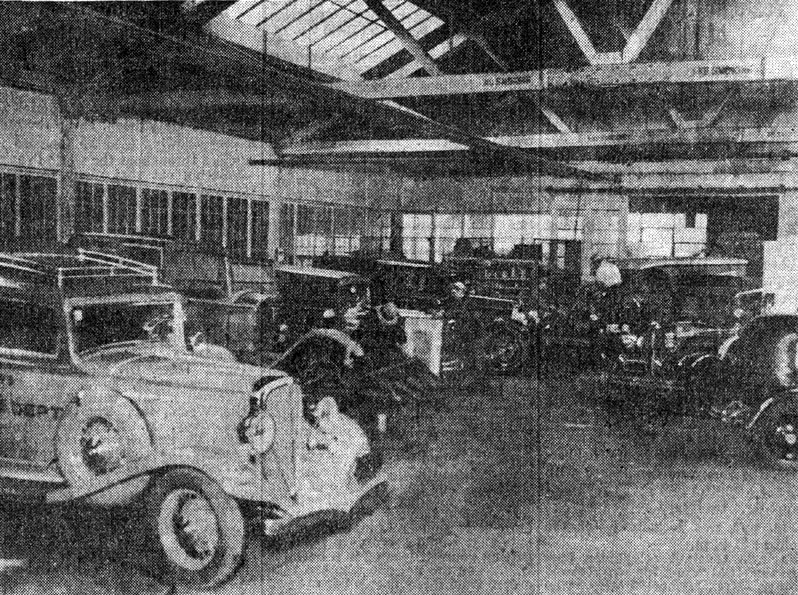
Photo shows a corner of the Becker Body Company plant at Seventeenth and Federal Streets, which is busy with a variety of work on bodies of all types. The firm does work for many large concerns. — Camden Courier-Post, June 8, 1933
WCAM Resolution
Camden Courier-Post —
A resolution was passed protesting an increase in power authorized by the federal government to Station WORC and WEPS, of Worcester, Mass. An increase to 1280 kilocycles and to 500 watts causes interference in broadcasting, from WCAM, the resolution pointed out.
Another resolution was adopted by the commission clarifying to the federal government its position relative to responsibility as to operation of WCAM. It was pointed out in the resolution that the mayor and city clerk had entered a supplemental agreement with the Broadcast Advertising Company, which leases the station from Camden. The government desired to establish that nothing be construed in the agreement which would relieve Camden from responsibility in operation of the station.
Future of WCAM Awaits City Action
Camden Courier-Post —
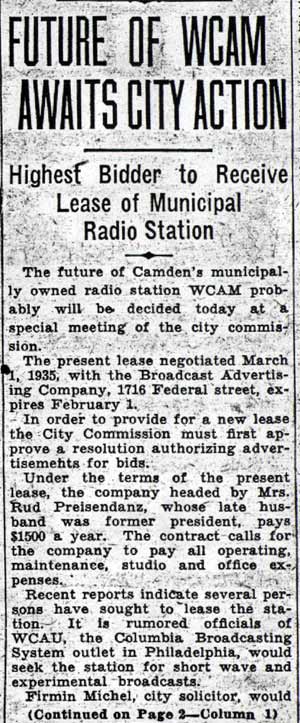
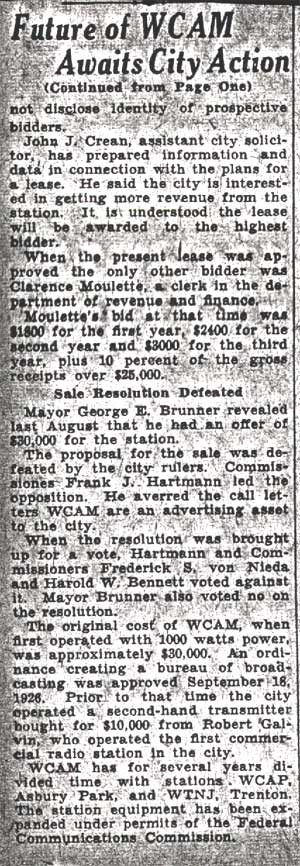
Highest Bidder to Receive Lease of Municipal Radio Station
The future of Camden’s municipally owned radio station WCAM probably will be decided today at a special meeting of the city commission.
The present lease negotiated March 1, 1935, with the Broadcast Advertising Company, 1716 Federal street, expires February 1.
In order to provide for a new lease the City Commission must first approve a resolution authorizing advertisements for bids.
Under the terms of the present lease, the company headed by Mrs. Rud Preisendanz, whose late husband was former president, pays $1500 a year. The contract calls for the company to pay all operating, maintenance, studio and office expenses.
Recent reports indicate several persons have sought to lease the station. It is rumored officials of WCAU, the Columbia Broadcasting System outlet in Philadelphia, would seek the station for short wave and experimental broadcasts.
Firmin Michel, city solicitor, would not disclose identity of prospective bidders.
John J. Crean, assistant city solicitor, has prepared information and data in connection with the plans for a lease. He said the city is interested in getting more revenue from the station. It is understood the lease will be awarded to the highest bidder.
When the present lease was approved the only other bidder was Clarence Moulette, a clerk in the department of revenue and finance.
Moulette’s bid at that time was $1800 for the first year, $2400 for the second year and $3000 for the third year, plus 10 percent of the gross receipts over $25,000.
Sale Resolution Defeated
Mayor George E. Brunner revealed last August that he had an offer of $30,000 for the station.
The proposal for the sale was defeated by the city rulers. Commissiones [sic] Frank J. Hartmann led the opposition. He averred the call letters WCAM are an advertising asset to the city.
When the resolution was brought up for a vote, Hartmann and Commissioners Frederick S. von Nieda and Harold W. Bennett voted against it. Mayor Brunner also voted no on the resolution.
The original cost of WCAM, when first operated with 1000 watts power, was approximately $30,000. An ordinance creating a bureau of broadcasting was approved September 18, 1926. Prior to that time the city operated a second-hand transmitter bought for $10,000 from Robert Galvin, who operated the first commercial radio station in the city.
WCAM has for several years divided time with stations WCAP, Asbury Park, and WTNJ, Trenton. The station equipment has been expanded under permits of the Federal Communications Commission.