Introduction
DAVID ANDREWS served for over 20 years as a member of the Camden Fire Department. He was born in Northern Ireland around 1866 to Samuel and Rachel Andrews. Samuel Andrews worked as a carpenter. David Andrews’ parents brought him and sister Rebecca to America around 1870. The family, which included younger siblings Archibald, Mary, and Samuel, lived at 503 Market Street in 1880.
In May of 1894 he was appointed to the Camden Fire Department, along with Joseph Logue, William Patterson, George Cox, Samuel Curriden, John A. Dold, William Jobes, William O. Sawyer, and Albert James.
David Andrews was assigned to Engine Company 2, which was quartered at Fire Headquarters at the northwest corner of North 5th and Arch Streets. In 1894 the personnel were as follows: Foreman Harry C. Grosscup; Engineer, William Morris; Driver, John P. Long; Stoker, Albert Jones; hosemen, George Wade, William Hertline, and David Andrews.
When the Town of Stockton merged with Camden in 1899, the volunteer fire companies of Stockton remained active for several months brief time. On June 25, 1899 the Stockton companies rendered assistance to the Camden Fire Department when the Moro Phillips Chemical Company factory at North Twelfth Street at Linden Street was struck by fire, resulting in $60,000 worth of damage and injury to three Camden firefighters, Joseph Maxwell, David Andrews, and William Hertline.
David Andrews married around 1898. The 1900 Census shows the David and Elizabeth Andrews at 104 South 5th Street, a short walk from his job at Fire Headquarters, North 5th Street and Arch Streets. Fellow Camden Fire Department member John Lutts lived at 110 South 5th Street, Camden police officer Julius Bosch around the corner at 511 Mickle Street, and city constable J. Fred Voight at 527 Mickle Street.
The 1910 Census and 1919 City Directory shows him living with his wife Elizabeth at 408 Arch Street. He was still working as a firefighter as late as 1919.
He does not appear in the 1924 Camden City Directory, but by 1927 was listed at 702 New Street. When the census was taken in April of 1930, David Andrews was still living with his wife Elizabeth with a home they owned at 702 New Street in South Camden. This is where they lived out their days. Elizabeth Andrews passed away on February 6, 1940. David Andrews joined her on December 19, 1940. They both were buried at Evergreen Cemetery.
Additional Firemen in Camden.
Philadelphia Inquirer —
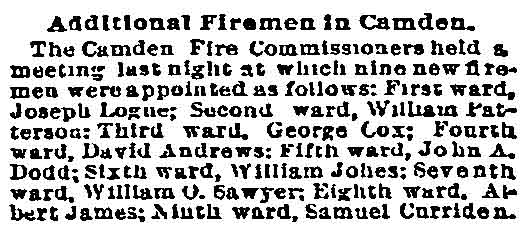
The Camden Fire Commissioners held a meeting last night at which nine new firemen were appointed as follows: First ward, Joseph Logue; Second ward, William Patterson; Third ward, George Cox; Fourth ward, David Andrews; Fifth ward, John A. Dold; Sixth ward, William Jobes; Seventh ward, William O. Sawyer; Eighth ward, Albert James; Ninth ward, Samuel Curriden.
Fire Commissioners.
Camden Daily Telegram —
Appointments Made as Provided for by Ordinance.
At a meeting of the Board of Fire Commissioners of City Council on Tuesday night James Baird was awarded the contract for supplying the department with two horses at $400.
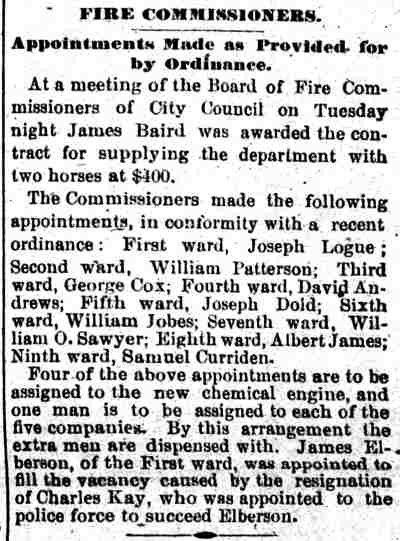
The Commissioners made the following appointments, in conformity with a recent ordinance: First ward, Joseph Logue; Second ward, William Patterson; Third ward, George Cox; Fourth ward, David Andrews; Fifth ward, Joseph Dold; Sixth ward, William Jobes; Seventh ward, William O. Sawyer; Eighth ward, Albert James; Ninth ward, Samuel Curriden.
Four of the above appointments are to be assigned to the new chemical engine, and one man is to be assigned to each of the five companies. By this arrangement the extra men are dispensed with. James Elberson, of the First ward, was appointed to fill the vacancy caused by the resignation of Charles Kay, who was appointed to the police force to succeed Elberson.
Fire Headquarters, North 5th Street
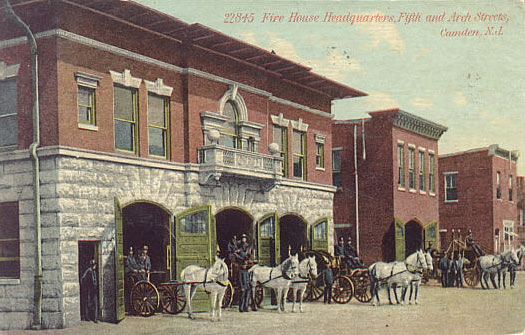
In the foreground, the headquarters of the Camden Fire Department, built in 1899, at 19 North 5th Street. The adjacent building at 31 North 5th Street was built in 1894, and was the home of Ladder Company 1 from 1894 to 1930.
Acids in Flames
Philadelphia Inquirer —

Moro Phillips’ Chemical Works in Camden Partly Destroyed by Fire
Battled Against Heavy Odds, But Saved Most of the Plant—Loss About $60,000
Nearly two acres of buildings forming the site of the Moro Phillips Chemical Company were partly destroyed by fire yesterday, entailing a loss of about $60,000. It was the worst inferno the Camden Fire Department has been called to fight since the old foundry fire of ‘98. The blaze broke out about noon yesterday, and it was noon before the flames were under complete control. Firemen played on the ruins until 1 o’clock in the afternoon.
The origin of the fire is a mystery. A watchman on duty in the building nearest Twelfth street did not discover the fire until 5 o’clock. Instead of springing a regular alarm he telephoned to No. 2 engine house. The signal was received about 8 o’clock; the men were about to respond to roll call at the time. Captain Grosscup then sent in a 3-3, which is as much of an alarm as is customary on local alarms. Before long it was found that the fire was getting beyond the capacity of two companies and Captain Harry Grosscup saw the flames in a peculiar situation. He could not give a general alarm for the simple reason the blaze was half way to the building when a regular alarm was given.
Chief Clifford, upon arriving on the scene, turned in a general alarm, calling out the entire department. The fire was mostly in the old buildings and wooden warehouses, and it was apparent that the main portion of the plant was to be sacrificed.
The fire spread from the fertilizer building and it looked as if the entire plant would be consumed. Dense sheets of heavy black smoke rolled out of the building, and Andrews and Hertline, who went to the rescue of Maxwell, were taken outside for fresh air, and after adjusting to the gases did not have permanent effect. All that portion of the works used for the storage of acids was abandoned to the flames. The main buildings were saved.
New Jersey Firemen’s Convention
Philadelphia Inquirer —
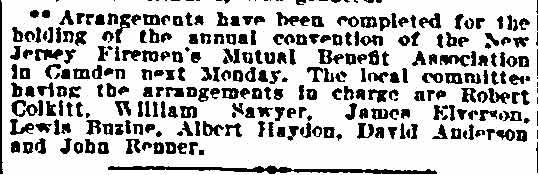
** Arrangements have been completed for the holding of the annual convention of the New Jersey Firemen’s Mutual Benefit Association in Camden next Monday. The local committee having the arrangements in charge are Robert Colkitt, William Sawyer, James Elverson, Lewis Buzine, Albert Haydon, David Andrews, and John Renner.
Brilliant Blaze Attracted Crowds
Philadelphia Inquirer —
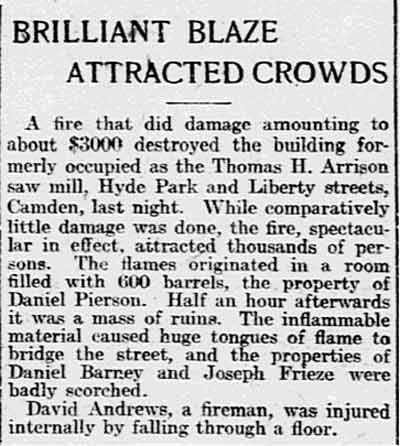
A fire that did damage amounting to about $3000 destroyed the building formerly occupied as the Thomas H. Arrison saw mill, Hyde Park and Liberty streets, Camden, last night. While comparatively little damage was done, the fire, spectacular in effect, attracted thousands of persons. The flames originated in a room filled with 600 barrels, the property of Daniel Pierson. Half an hour afterwards it was a mass of ruins. The inflammable material caused huge tongues of flame to bridge the street, and the properties of Daniel Barney and Joseph Frieze were badly scorched.
David Andrews, a fireman, was injured internally by falling through a floor.