Introduction
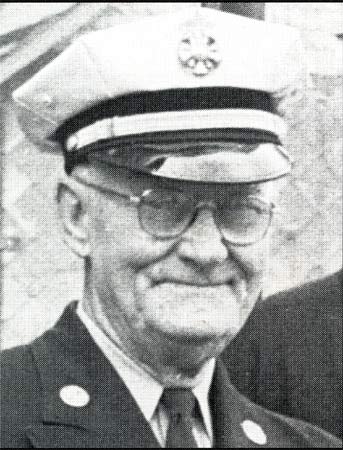
William Van Pfefferle, Chief Engineer
WILLIAM VAN PFEFFERLE was born in Philadelphia, Pennsylvania on February 17, 1891.
William Van Pfefferle married Elsie Maxwell. Her father, Joseph Maxwell, was a career Camden Fire Department fire fighter. The couple lived with the Maxwells at 620 North 3rd Street. By June of 1917 there were two children in the family. William Van Pfefferle then worked as an electrician in Philadelphia.
Joseph Maxwell passed away in September of 1917, at the age of 56. On September 17, 1917 brother-in-law Harry B. Maxwell and William Van Pfefferle were appointed to the Fire Department. William Van Pfefferle reported for duty on October 1, 1917 with Engine Company 1, then located at 409 Pine Street.
William Van Pfefferle rose through the ranks of the Camden Fire Department and served as Chief of Department from 1950 to 1958.
Fire Department records from 1931 show William Van Pfefferle living at 320 Friends Avenue. He moved to 619 North 4th Street shortly afterwards.
On December 15, 1949 William Van Pfefferle was selected to replace the retiring Walter Mertz as Chief Engineer of the Camden Fire Department. Chief Pfefferle selected Morris M. Odell to serve as his aide, a post which he held for over ten years.
In 1950, Acting Chief Walter Mertz retired from the Department. He was succeeded by Chief of Department William Van Pfefferle. “Pappy Van” as he was fondly called by the men of the department, was the last of an old breed, cast from the same mold as such men as Lennox and Elfreth before him. Under his tenure, Van would bring to the Department the time honored values and disciplines of the old fire service.
From 1950 to 1959, the department would also replace its entire fleet of hose wagons. The Department Shop under the direction of Al Healy, Assistant Joseph Snyder and Fire Mechanics Earl VanSandt and Ed Campbell, would design and manufacture most of these apparatus in house. A young fireman, John J. Mogck Jr., would be detailed to the Shops because of his skill and experience in welding and cutting. The Department would acquire commercial truck chassis upon which the hose wagon bodies would be fabricated. The first of these units was a 1951 GMC, two and one-half ton chassis. The hose wagon body was equipped with a 250 GPM Hale Pump, a 1000 GPM deckpipe, a 150 gallon booster tank, and a cartridge canister containing “Wet Water”—an additive agent designed to allow water to penetrate and soak through deep seated fire in baled rags; paper; etc. Engine Companies 2 and 8 were the first units to receive the new hose wagons. Subsequent years would also include Dodge chassis.
On March 6, 1950, the Courier Post Headlines read: “City Studies Closing of Police Precinct and Firehouse—May Be Shifted to Headquarters.” In a politically contrived proposal, Public Safety Director E. George Aaron announced that the closing of the Third District Police Precinct and the quarters of Engine Company 9, Ladder Company 3 and the 2nd Battalion were under consideration. He also said that if the police and fire stations were closed, the buildings would be sold. East Camden residents and merchants were outraged at the announcement. Various civic associations and community groups protested vigorously. The debate continued for several months. Many in the Department were less than concerned over the planned reductions, in that few could take the announcement seriously. The proposed closing would leave Engine Company 11 by themselves in the Cramer Hill section, to cover all of greater East Camden and without the services of a ladder company. The plan was more than folly—it was ludicrous. Finally a decision was made: the police station would close and personnel would transfer to Police Headquarters at City Hall. The firehouse would of course remain open.
The Electrical Bureau was the municipal agency responsible for the maintenance of traffic signals, police call boxes and fire alarm boxes throughout the City. On March 3, 1950, Bureau Chief Harry A. Wolfe retired following nearly fifty years of service to the City. Patrick J. Sullivan was appointed his successor. Harry Wolfe had worked with such old timers as Fire Dispatcher Billy Brower at the old fire alarm office in City Hall on Haddon Avenue. The Electrical Bureau shop was located next to Fire Headquarters at Fifth and Arch Streets.
On January 1, 1951 the Department adopted a three platoon, 56 hour work week to replace the former two platoon, 72 hour system. The Department would add fifty-three Probationary Firemen to the ranks, and a reorganization would abolish the titles of Battalion Chief and Deputy Chief, adopting the consolidated position of District Chief at the salary level of the former Deputy Chief’s rank. This reorganization was effective at midnight, July 1st.
The nineteen fifties witnessed many spectacular fires in the City of Camden. Commercial buildings, mercantile properties and very old churches provided a seemingly endless source of Greater Alarms. In terms of the old adage “Practice Makes Perfect,” the experience level among Camden Fire Fighters in combating major fires was formidable to say the least. The Department also incurred more than its share of arduous fire duty at many other incidents of less notable nature.
The Cramer Hill waterfront was frequently the scene of such lesser campaigns. The Cramer Hill mud flats along the Delaware River extended northward from 27th Street and Buren Avenue, along Adams and Farragut Avenues to about 33rd Street. Along this area of shoreline was a graveyard for derelict barges and scows, that ran for several city blocks. A majority of these discarded vessels, grounded and fully exposed at low tide, were comprised of rotting, heavy timbers with some being as large as two and three stories above grade. One especially spectacular blaze during 1951 started in Noecker’s Shipyard on the river above 27th Street. Salvagers using torches to remove metal from a 182 foot long floating dry dock accidentally set fire to ancient timbers. Attempting to put out the fire with hand extinguishers, they were soon driven back as flames roared out of control. Engine Company 11 arriving first due, found fire shooting 75 feet over the tree tops with large embers blowing downwind igniting derelict barges. District Chief Robert Wonsetler transmitted a second alarm on arrival. The heavily wooded area, remote from paved streets, posed serious access problems for responding companies. When the river tide was favorable, a Philadelphia Fireboat could often get in and darken the fire in a short period of time. But when the tide was out, the boat had no access. This remote area, also absent of hydrants, compelled fire fighters to stretch hoselines for several blocks, often by hand as they wore themselves out in the process of getting water on the fire. Over some twenty year period, hundreds of Mud Flat Campaigns were waged by Cramer Hill Fire Fighters, many of which were Greater Alarms.
Rescue Company 1 was organized in the City of Camden in 1951 utilizing a 1951 G.M.C. custom rescue van. In 1955 the Federal Government allocated Civil Defense rescue apparatus to major cities across the United States. When replaced, the 1951 G.M.C. apparatus was reorganized as a Special Service Unit operated by Engine Company 7.
For many years throughout the 1930s and 40s, Engine Company 2 at Fire Headquarters performed double duty as a Rescue Squad. The unit was designated to carry special equipment including a pulmonary motor (inhalator), mechanical jacks, forcible entry tools, bung and plug accessories, and a first aid kit containing splints, bandages and distilled water. Industrial accidents, refrigerated ammonia leaks, broken acid carboys, and medical emergencies—the dispatcher would take Engine Company 2 out of service and the Rescue Squad would respond throughout the city.
In later years following the organization of a dedicated Rescue Company, Engine Companies 3 and 9 would similarly carry special equipment to function as ancillary Rescue Squads in their respective areas of the city. In 1951 the Department organized Rescue Company 1 and purchased a new apparatus with accompanying equipment. It would be the last new fire company organized in the City of Camden. The Rescue Company was very well suited to performing special operations where physical entrapment demanded expert skills. But its hallmark of service to the Department, established early on, was its ability to perform extraordinary fire duty. The company’s roster included such stalwarts as Philip “Unck” Stinger, Artie Batten, John DiMaggio, Bill Stibi and big Ed Brendlinger, to name just a few. The experience level and professional capabilities of these fire fighters established the Rescue as a premiere unit. Over the years, there were Chief Officers that would special call the Rescue Company to the fire in lieu of a second alarm assignment. No greater mark of professional homage could be paid.
On October 28, 1951, a blaze occurred at the Giordano Waste Material Company on Mt. Ephraim Avenue at Olympia Road, Fairview. The fire was located beneath a metal press and baling machine at the bottom of a 16 foot pit. One worker was critically burned while two others were killed—their bodies found in the trench. Engine Company 10 controlled the blaze while Rescue Company 1 extricated the victims.
On October 26, 1952, Firemen Joshua Robinson and William Hinch of Ladder Company 2, rescued a woman from a fire at Locust and Chestnut Streets, South Camden. The victim was removed to Cooper Hospital for serious smoke inhalation and survived. On the following morning, a spectacular third alarm occurred at the West Jersey Paper Company, Delaware Avenue and Elm Street, North Camden. District Chief Harry Wagner found flames leaping 100 feet above the 50 x 150 foot, one story building. Fire fighters mounted huge piles of coal in the adjoining Shelton & Sons coal yard to position hose streams on the burning factory. The plant was a total loss.
On Tuesday morning, December 16, 1952, Second District units of East Camden were dispatched to a dwelling fire. Shortly thereafter, another alarm was received for the Grace Baptist Church at 27th and Cramer Streets, just one block from the quarters of Engine 9 and Ladder 3, which was vacated by the previous alarm. First District units from center city and North Camden, normally assigned on the second alarm, were now responding first due to the church. Off duty Fire Dispatcher Rex Hurlock, who resided a few doors down from the church, saw the heavy smoke and was able to rescue an infirm 76 year-old woman from an adjoining building. First arriving units transmitted the second alarm, and Chief Van Pfefferle shortly thereafter, a third alarm. South Camden units from the 3rd District responded on the second alarm, while the original units from East Camden that were becoming available from the dwelling fire responded on the third. The blaze originated in the basement and extended upward through interior walls, venting out the roof. In the early stages of the fire, an inside odor of illuminating gas was detected and companies were withdrawn from the interior as the gas company was summoned to shut off the gas service at the street. At the height of the blaze, huge pieces of razor sharp roof slate rained down, endangering firemen. The fire destroyed most of the building including a six thousand dollar pipe organ. Estimated damage was $75,000. The church had over 600 members. The original church erected in 1890 was destroyed by fire in 1904. A new edifice completed in 1906 was also destroyed by yet another blaze in 1913. Firemen Elmer Johnson and John McKay were injured at the latest incident.
During 1953, the City was informed by the Federal Government that the Civil Defense agency was furnishing heavy rescue vehicles to scores of major cities throughout the country. Camden was a selected municipality. Later the Department would accept delivery of a 1955 Diamond Reo, heavy rescue van. The Department’s current rescue, a 1951 GMC, was less than four years old when the C.D. rig was delivered. The GMC was reassigned to the quarters of Engine Company 7, first as a spare rescue apparatus and later, as an unstaffed special unit equipped with foam. The apparatus was designated as “Special Service 1” and remained in operation until its disposal in 1976.
At 9:23 P.M. on the warm evening of July 4, 1953, a Box was transmitted at Argonne Street and Saint Mihiel Avenue, South Camden, reporting a fire at the Camden Convention Hall. The facility was a converted iron foundry, 300 x 150 with an adjoining annex and seating capacity for 7500. A second, third and fourth alarm was pulled in rapid succession as the building lit up. Extremely low water pressure hampered firefighting efforts and a six hour battle ensued before the blaze was controlled. At the height of the fire, two off duty members attending a fireworks display a few miles away in Dudley Grange Park, East Camden, stated that the column of fire and smoke in the sky was so spectacular, that hundreds of people ignored the pyrotechnic demonstration to watch the looming holocaust in the west. For the first time in many years, extensive mutual aid from Pennsauken, Delaware Township (Cherry Hill), Merchantville, Woodlynne, Collingswood and Gloucester City were relocated into the City to cover vacated firehouses. This incident was considered by many to be the worst fire since the R.M. Hollingshead blaze of 1940. Until the following October.
At 8:30 P.M. on Wednesday, October 6, 1954, Box #9 at Delaware Avenue and Market Street was pulled for a fire in the Market Street Ferry Terminal at the Delaware River. The 100 year old ferry house had four slips that extended several hundred feet out into the river. The ferry terminal immediately adjoined the Pennsylvania Railroad Station, a large passenger depot that was attached to frame train sheds, and a long row of retail shops with lofts above. A short circuit started the fire in the loft above a drug store in the retail row. The blaze rapidly extended to the adjoining ferry house and onward to the railroad station and train sheds. First arriving units ordered a simultaneous second and third alarm as a stiff breeze blowing off the river sent hot embers raining down over the massive complex of connected buildings. Upon his arrival, Chief of Department William Van Pfefferle transmitted the rarely heard “Signal 3-3-3” summoning a General Alarm response to the fire and a recall of 25 off duty members. Chief Van also special called two fireboats from the City of Philadelphia to darken the fire from the river side. The blaze was fought throughout the night and a section of the ferry house collapsed, briefly trapping several members. Sixteen firemen were injured at this incident.
Also in 1955, all Chief’s vehicles were equipped with two-way mobile radios operating on the police frequency. This new capability enabled Chief Officers in the field to maintain contact with the Fire Dispatcher via Police Communications. The Department’s radio call signs on the City police channel were FD-1 for the District Chief of the 1st District; FD-2 for the 2nd District; FD-3 for the 3rd District; FD-4 for the Duty Staff Chief; and FD-5 for the Chief of Department. This system remained in effect until 1961 when the Department received a dedicated fire radio frequency.
During 1956, at least a dozen members received hospital treatment for nail puncture wounds of the feet. In March, 1957, Chief William Van Pfefferle issued a Department Order mandating that all members obtain steel insoles for turnout boots. This directive reduced subsequent foot injuries by over 90%. In the annual report for 1957, Ladder Company 3 received a new American LaFrance 75’ midship aerial ladder. Its former 85’ tractor and tiller Pirsch was appropriated as a spare rig, replacing the 1928 American LaFrance aerial that was formerly in reserve. In 1957 the Department also replaced all of its 1950 sedans with new station wagons for Chief Officers. The Department also mounted a flood light appliance on the hose wagon of Engine Company 8. This modification would for the first time provide the Department with a major source of emergency lighting during night time operations. Engine Company 8’s hose wagon was special called to many night time operations throughout the City.
From the mid to late 1950s, the number of alarms and working fires in Camden continued to decline. Like much of America, the City was enjoying the prosperous peace time years. A stable tax base and booming population, coupled with a high level of ratables made Camden an attractive place to live, work and play. It has often been said that the rise and fall of America’s cities are reflected in the statistical records of Fire Departments. In the mid 1950s, few could imagine the phenomenal changes that would occur, just within the next decade. But in 1957, fire service demand was a declining industry as the quality of life among urban dwellers was prodigious. During 1957, the Department rescued fifteen domestic animals from trees. By the end of the following decade, there would not be enough available fire companies to respond to fires.
On January 27, 1957, three alarms were transmitted for a factory at Marlton Avenue and Mickle Street, East Camden. On May 25th, another third alarm occurred for row dwellings on Howard Street above State, North Camden. On September 12th, three alarms for stores and apartments on Broadway near Chestnut Street, injured several members. And on December 22nd, three alarms for a vacant factory at Sixth and Byron Streets, North Camden, destroyed yet another former industrial facility.
In Spring 1957, fifteen members of the Department graduated from the first Heavy Rescue and Civil Defense training course sponsored by the New Jersey State Police at Hammonton, New Jersey. The Chief of Department in his annual report recommended to the City that a new fire station and training facility be constructed in the vicinity of 17th and Mickle Streets, East Camden; and that Ladder Company 4 be reorganized in their former quarters at 2500 Morgan Boulevard South Camden, to alleviate excessive response distances for Ladder Company 2. These recommendations were never acted upon. Also during 1957 and in the interests of morale, the Department issued one new pillow case to each member of the Uniformed Force for his personal use and care, precluding the need to share linen among multiple members.
On September 29, 1958, Chief William Van Pfefferle retired from the service of the Department. For several weeks following Chief Van’s severance, Chief Harry Wagner was designated as Acting Chief of Department on an interim basis pending action by the City. Chief Edward R. MacDowell would be appointed as permanent successor shortly thereafter. Chief MacDowell was a distinguished and unassuming man of quiet nature; very competent and highly experienced, whose presence solicited a paternal respect among the men of the Department. 1958 would be the last year for well over a decade that the number of alarms would decline from the previous year.
Great-grandson Private First Class Warren Walter Pfefferle was killed in a plane crash in Vietnam on August 24, 1965 while serving with the United States Marine Corps.
Promoted Firemen Take Posts Today
Camden Courier-Post —
Promoted Firemen Take Posts Today
Lennox Deputy Chief; Eight Others Elevated as Captains Here
A new deputy chief, a battalion chief and eight new senior and junior captains will assume their posts today in the fire department. The men were promoted yesterday afternoon, along with the announcement of eleven new appointments of firemen, who will go into service April 15.
The new deputy chief, John H. Lennox, now is second in command when his platoon is on duty. He was acting deputy since the naming of Thomas Nicholas as chief two years ago.
The new battalion chief is Rollo Jones. Jones succeeded George B. Wade, who retired January 1.
Junior captains advanced to senior captains, with salaries increased to $2,400, are William H. Harring, Truck Company No. 1, Clarence Madden, Engine Company No. 6 and George Hunt, Engine Company No. 7. The new junior captains advanced from the ranks, with new salaries of $2,299 a year, are David Ellis, driver for Chief Nicholas for nine years, George Saunders, hoseman of Engine Company No. 9; Eli Hunt, driver of Engine Company No. 3, and William Van Pfefferle, hoseman, Engine Company No. 1.
All the promotions were from the civil service eligible list. The captains will be assigned tomorrow.
The new firemen, also civil service eligibles, will start with salaries of $1,500. Each year of service brings an increase, until five years in the department pays $2,040 annually. The new men are Thomas F. Gibbons, Byron M. Davis, John S. Anderson, William H. Toy, Leo J. Tompkins, Horace T. Molan, Lawrence Bolton, George W. Garner, Felix E. Bendzyn, Harry H. Hess and Charles Jones.
Chief Lennox is one of the most popular firefighters in the organization. “Chappie” is the nickname by which he has been known for years. He was appointed a fireman January 1, 1908. He was promoted to a captainship October 1, 1915, and was assigned to Engine Company No. 8.
His promotion to deputy chief gives the department two men in that standing, one in command of each platoon on duty. His new salary will be $2,800 a year. He will be stationed at headquarters, Fifth and Arch streets. He lives at 633 Clinton street. William W. Patterson is the other deputy chief.
Battalion Chief Jones will receive $2,520 a year. He has been in command of Engine Company No. 9, Twenty-seventh and Federal streets. He will be sent to command Engine Company No. 3, Broadway and Ferry avenue. He was a former senior captain of Engine Company No. 4. For a number of years he was an instructor in fire school methods of life saving. He lives at 536 York street.
22 Firemen Assigned to New Stations
Camden Courier-Post —
12 Rookies and 10 Promoted Men Go to Posts
Twelve new firemen and ten men promoted several weeks ago were assigned to their new stations yesterday by Chief Thomas J. Nicholas. With these appointments, the department complement of 200 men is completed.
John H. Lennox, newly named deputy chief, will make his headquarters at the Fifth and Arch streets station. Rollo Jones, promoted from senior captain to battalion chief, succeeding George Wade, recently retired on pension, will move to Engine Company No. 3, Broadway and Ferry avenue.
Three men were promoted from junior to senior captaincies. They are: William Heron, who moved to Company No. 2; George Hunt, Company No. 8, and Clarence T. Madden [sic] Company No. 5.
Taken from the ranks, the following will be stationed as junior captains: David R. Ellis, Company No. 7; Clarence Newton, Company No. 5; William Van Pfefferle, Truck Company No. 2; Eli Hunt, Company No. 9, and George Saunders, Company No. 6.
The new firefighters and their stations are: Lawrence Bolton, Company No. 9; John S. Anderson, Company No. 4; Byron M. Davis, Company No. 1; George W. Garner, Company No. 4; Lawrence Milton, Company No. 5; Thomas Gibbons, Company No. 4; Leo J. Tompkins, Company No. 2; Felix Bendzyn, Company No. 7; Horace T. Molan, Company No. 7; William E. Toy, Company No. 9; Harry H. Hess, Company No. 11, and Edward Callahan, Truck Company No. 4.
Jack the Airedale — Mascot of Fire Headquarters
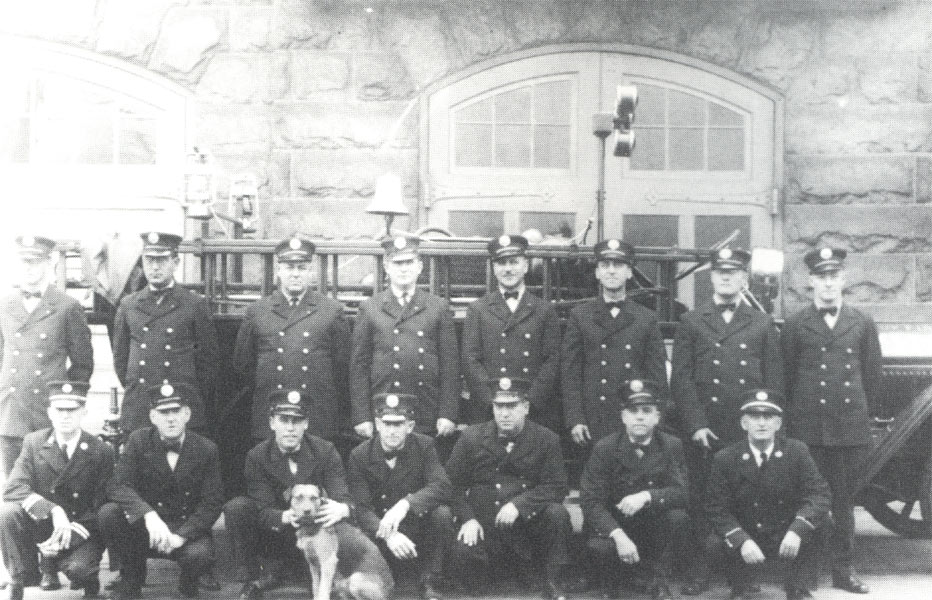
Above: 1930s “Jack Airedale” with members of Engine 2 and Ladder 1.
The American Fire Service has always held domesticated animals as esteemed mascots and the Camden Fire Department was certainly no exception. Through the years there have been many types of mascots in the Department including monkeys, cats, goats, and of course the most popular mascot, the dog. Dating back to the days of horse drawn fire apparatus and even earlier when carriage dogs formed an integral bond with horses, canines distinguished themselves as animals especially attuned to firehouse life.
Jack was the company mascot of Engine 2 and Ladder 1 at old Fire Headquarters for over five years and he was described as an intelligent Airedale of good humored nature. Jack never missed an opportunity to climb aboard the apparatus and answer alarms with his beloved masters. The sight of Engine Company 2 roaring out Federal Street with Jack perched high atop the apparatus, wind blowing in his face amid the shrill pitch of the buckeye whistle and clanging bells was an unforgettable scene. Occasionally and as with all active canines, Jack would be out of quarters and around the corner or down the street when an alarm was transmitted. At such times he would dash down Fifth Street until he caught up with the rolling apparatus and would skillfully leap upward to his accustomed place on the rig. It was under these circumstances that Jack lost his life.
The Department phone jingled and the Housewatchman turned out both companies for an alarm at 119 N. 9th Street. Jack got a late start on the hike and chased the apparatus out Federal Street where he tangled with an automobile at Broadway. While trying to avoid the car Jack darted into the path of the apparatus and was fatally injured. The men of the Engine and Truck were heart broken. Jack was buried the next day in the rear yard of Fire Headquarters in the place that had been his home since puppyhood. Flowers were planted to adorn the fresh grave while some of the toughest Firemen in the house were visibly grief stricken. One year later on the anniversary of Jack’s death a memorial service was held after Roll Call in the rear yard of Fire Headquarters. The members erected a tombstone and in a quiet service, Fireman John Yates blew taps over Jack’s grave. There were no words spoken. All that needed to be said was inscribed upon the little headstone: “Our Faithful Pal Jack” died in service, November 5, 1934.
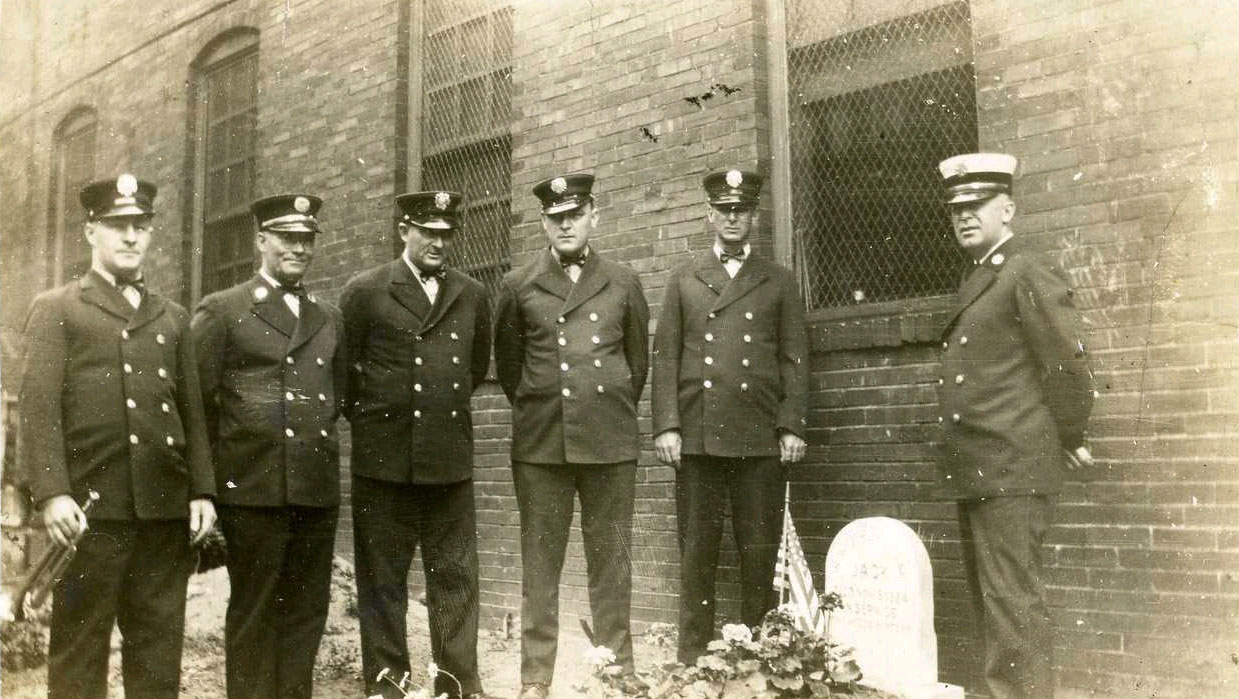
November 1934, at grave site outside Fire Headquarters at North 5th and Arch Streets, immediately following ceremony for “Jack.” From left: Fireman John Yates, Captain William Van Pfefferle, Fireman William Hopkins, Fireman Lester Anderson, Acting Captain Edgar Ellender, Deputy Chief William Harring.
Taps Sound for Jack Airedale, Canine Mascot of Fire Laddies
Camden Courier-Post —
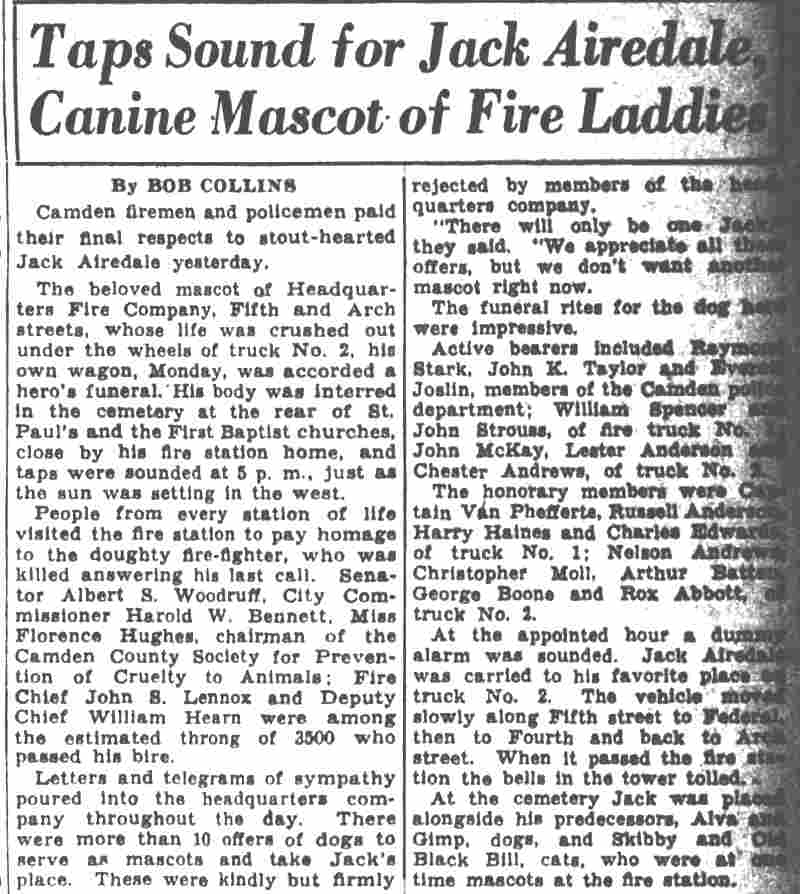
Taps Sound for Jack Airedale, Canine Mascot of Fire Laddies
By Bob Collins
Camden firemen and policemen paid their final respects to stout-hearted Jack Airedale yesterday.
The beloved mascot of Headquarters Fire Company, Fifth and Arch streets, whose life was crushed out under the wheels of truck No. 2, his own wagon, Monday, was accorded a hero’s funeral. His body was interred in the cemetery at the rear of St. Paul’s and the First Baptist churches, close by his fire station home, and taps were sounded at 5 p. m., just as the sun was setting in the west.
People from every station of life visited the fire station to pay homage to the doughty fire-fighter, who was killed answering his last call. Senator Albert S. Woodruff, City Commissioner Harold W. Bennett, Miss Florence Hughes, chairman of the Camden County Society for Prevention of Cruelty to Animals; Fire Chief John S. Lennox and Deputy Chief William Hearn were among the estimated throng of 3500 who passed his bier.
Letters and telegrams of sympathy poured into the headquarters company throughout the day. There were more than 10 offers of dogs to serve as mascots and take Jack’s place. These were kindly but firmly rejected by members of the headquarters company. “There will only be one Jack,” they said. “We appreciate all these offers, but we don’t want another mascot right now.”
The funeral rites for the dog were impressive.
Active bearers included Raymond Stark, John K. Taylor and Everett Joslin, members of the Camden police department; William Spencer and John Strouss, of fire truck No. 1; John McKay, Lester Anderson and Chester Andrews, of truck No. 2.
The honorary members were Captain Van Pfefferle, Russell Anderson, Harry Haines and Charles Edwards, of truck No. 1; Nelson Andrews, Christopher Moll, Arthur Batten, George Boone and Rox Abbott, of truck No. 2.
At the appointed hour a dummy alarm was sounded. Jack Airedale was carried to his favorite place on fire truck No. 2. The vehicle moved slowly along Fifth street to Federal, then to Fourth and back to Arch street. When it passed the fire station the bells in the tower tolled.
At the cemetery Jack was placed alongside his predecessors, Alva and Gimp, dogs, and Skibby and Old Black Bill, cats, who were at one time mascots at the fire station.
Lester Store Razed By $100,000 Fire
Camden Courier-Post —
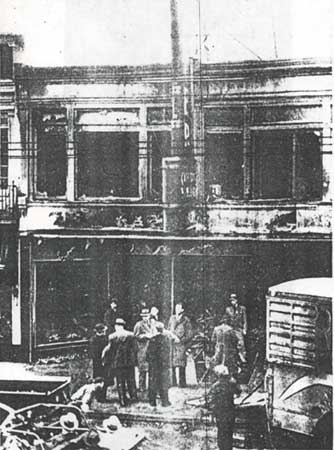
Lester Store Razed By $100,000 Fire
Flames on Broadway Are Subdued After Seven-Hour Battle
The clothing and jewelry store of S. Lester, at 713 Broadway, was destroyed by fire of undetermined origin following an explosion late Saturday night.
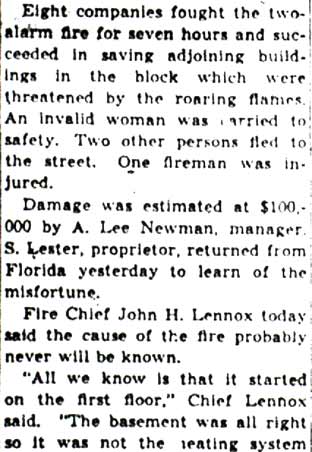
Eight companies fought the two-alarm fire for seven hours and succeeded in saving adjoining buildings in the block which were threatened by the roaring flames. An invalid woman was carried to safety. Two other persons fled to the street. One fireman was injured.
Damage was estimated at $100,000 by A. Lee Newman, manager. S. Lester, proprietor, returned from Florida yesterday to learn of the misfortune.
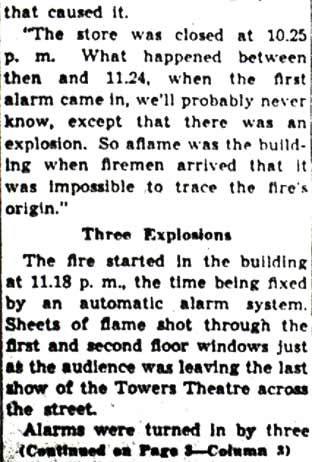
Fire Chief John H. Lennox today said the cause of the fire probably never will be known. “All we know is that it started on the first floor,” Chief Lennox said. “The basement was all right so it was not the heating system that caused it. The store was closed at 10.25 p. m. What happened between then and 11.24, when the first alarm came in, we’ll probably never know, except that there was an explosion. So aflame was the building when firemen arrived that it was impossible to trace the fire’s origin.”
The fire started in the building at 11.18 p.m., the time being fixed by an automatic alarm system. Sheets of flame shot through the first and second floor windows just as the audience was leaving the last show of the Towers Theatre across the street.
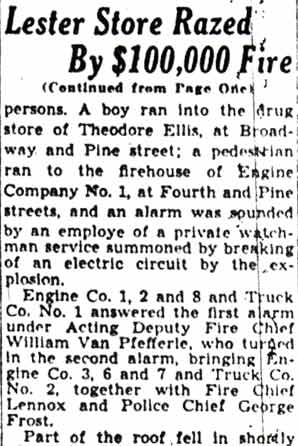
Alarms were turned in by three persons. A boy ran into the drug store of Theodore Ellis, at Broadway and Pine street; a pedestrian ran to the firehouse of Engine Company No. 1, at Fourth and Pine streets, and an alarm was sounded by an employee of a private watchman service summoned by breaking of an electric circuit by the explosion.
Engine Co. 1, 2 and 8 and Truck Co. No. 1 answered the first alarm under Acting Deputy Fire Chief William Van Pfefferle, who turned in the second alarm, bringing Engine Co. 3, 6 and 7 and Truck Co. No. 2, together with Fire Chief Lennox and Police Chief George Frost.
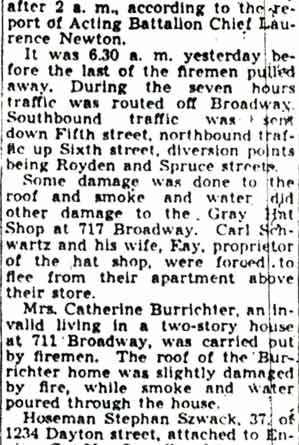
Part of the roof fell in shortly after 2 a.m., according to the report of Acting Battalion Chief Laurence Newton.
It was 6.30 a.m. yesterday before the last of the firemen pulled away. During the seven hours traffic was routed off Broadway. Southbound traffic was sent down Fifth street, northbound traffic up Sixth street, diversion points being Royden and Spruce streets.
Some damage was done to the roof and smoke and water did other damage to the Gray Hat Shop at 717 Broadway. Carl Schwartz and his wife, Fay, proprietor of the hat shop, were forced to flee from their apartment above their store.
Mrs. Catherine Burrichter, an invalid living in a two-story house at 711 Broadway, was carried out by firemen. The roof of the Burrichter home was slightly damaged by fire, while smoke and water poured through the house.
Hoseman Stephan Szwack, 37, of 1234 Dayton Street, attached to Engine Co. No. 8, suffered a cut on the left hand while fighting the fire. He was treated at West Jersey Hospital.
Lester said a temporary store will be opened within a few days while a new store is being built. Collection records and account books were saved by their steel containers, Lester explained, and were moved to the office of Dr. Benjamin W. Kauffman at 706 Broadway.
“We shall start at once to construct the finest store in South Jersey,” Lester said. “Our temporary store will be open with new merchandise for the Easter season.”
Fireman Toy Dead From Auto Crash
Camden Courier-Post —
Fireman Toy Dead From Auto Crash
Pfefferle’s Condition Reported Good; Bus Driver to Face New Charges
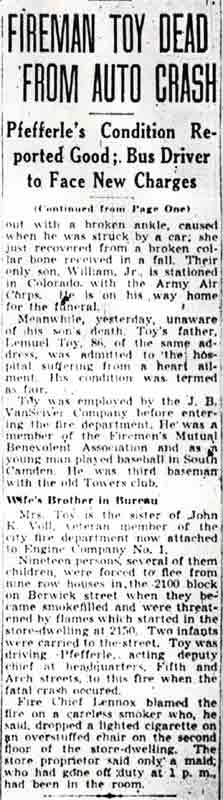
William Earl Toy, veteran Camden fireman, succumbed yesterday to injuries received in the line of duty Saturday while driving to a fire at Berwick and Boyd streets.
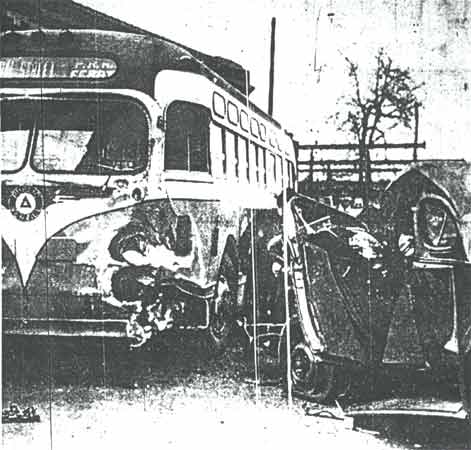
Toy, 45 and a member of the department 17 years, was at the wheel of Acting Chief William Van Pfefferle’s car when it collided with a west-bound Public Service bus at Sixteenth and Federal Streets.
Pfefferle escaped with severe cuts and bruises but Toy suffered fractures of the thigh, arm and wrist and internal injuries, the latter proving fatal. Both men were taken to Cooper Hospital, where Pfefferle’s condition today was described as good.
The driver of the bus, Norman Davidson, of 3738 Frosthofer avenue, Pennsauken, previously released on $500 bail to await outcome of Toy’s injuries, will be arraigned before Police Judge Cohen Wednesday on a charge of death by auto.
Davidson escaped injury but three passengers in the bus bound from Merchantville to the Camden ferries were hurt slightly. They are Miss Katherine Durborrow, 28, of 2928 High street; Greta Gaskill, 12, of 3311 Highland avenue, and Elaine Miller, 8, of 6211 Magnolia avenue, Pennsauken.
Toy and his wife, Margaret C., lived at 607 West Street. He recently returned to duty after being out with a broken ankle, caused when he was struck by a car; she just recovered from a broken collar bone received in a fall. Their only son, William, Jr., is stationed in Colorado, with the Army Air Corps. He is on his way home for the funeral.
Meanwhile, yesterday, unaware of his son’s death, Toy’s father, Lemuel Toy, 86, of the same address, was admitted to the hospital suffering from a heart ailment. His condition was termed as fair.
Toy was employed by the J. B. VanSciver Company before entering the fire department. He was a member of the Firemen’s Mutual Benefit Association. As a young man played baseball in South Camden. He was third baseman with the old Towers club.
Mrs. Toy is the sister of John K. Voll, veteran member of the city fire department now attached to Engine Company No. 1.
Nineteen persons, several of them children, were forced to flee from nine row houses in the 2100 block on Berwick street when they became smokefilled and were threatened by flames which started in the store-dwelling at 2150. Two infants were carried to the street. Toy was driving Pfefferle, acting deputy chief at headquarters, Fifth and Arch streets, to this fire when the fatal crash occurred.
Fire Chief Lennox blamed the fire on a careless smoker who, he said, dropped a lighted cigarette on an overstuffed chair on the second floor of the store-dwelling.
Funeral on Friday for Fireman Toy
Camden Courier-Post —
Funeral on Friday for Fireman Toy
Fellow Members of City Department Will Act as Pallbearers
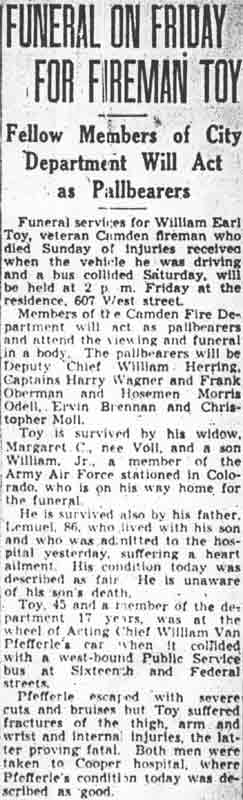
Funeral services for William Earl Toy, veteran Camden fireman who died Sunday of injuries received when the vehicle he was driving and a bus collided Saturday, will be held at 2 p. m. Friday at the residence, 607 West Street.
Members of the Camden Fire Department will act as pallbearers and attend the viewing and funeral in a body. The pallbearers will be Deputy Chief William Herring, Captains Harry Wagner and Frank Oberman and Hosemen Morris Odell, Ervin Brennan and Christopher Moll.
Toy is survived by his widow, Margaret C., nee Voll, and a son William, Jr., a member of the Army Air Forces stationed in Colorado, who is on his way home for the funeral.
He is survived also by his father, Lemuel, 86, who lived with his son and who was admitted to the hospital yesterday, suffering a heart ailment. His condition today was described as fair. He is unaware of his son’s death.
Toy, 45 and a member of the department 17 years, was at the wheel of Acting Chief William Van Pfefferle’s car when it collided with a west-bound Public Service bus at Sixteenth and Federal streets. Pfefferle escaped with severe cuts and bruises but Toy suffered fractures of the thigh, arm and wrist and internal injuries, the latter proving fatal. Both men were taken to Cooper Hospital, where Pfefferle’s condition today was described as good.
Van Pfefferle Acting Head Of Fire Dept.
Camden Courier-Post —
Van Pfefferle Acting Head Of Fire Dept.
Named as Mertz Gets Leave and Prepares To Retire on Jan. 15
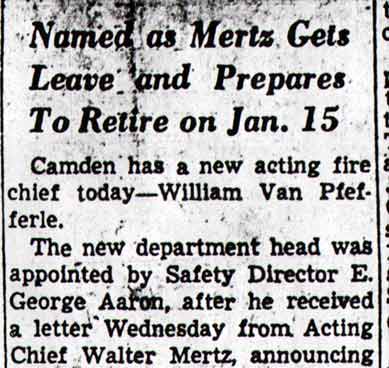
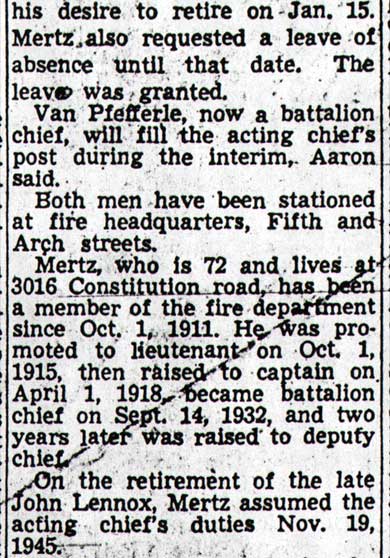
Camden has a new acting fire chief today—William Van Pfefferle.
The new department head was appointed by Safety Director E. George Aaron, after he received a letter Wednesday from Acting Chief Walter Mertz, announcing his desire to retire on Jan. 15. Mertz also requested a leave of absence until that date. The leave was granted.
Van Pfefferle, now a battalion chief, will fill the acting chief’s post during the interim, Aaron said.
Both men have been stationed at fire headquarters, Fifth and Arch streets.
Mertz, who is 72 and lives at 3016 Constitution road, has been a member of the fire department since Oct. 1, 1911. He was promoted to lieutenant on Oct. 1, 1915, then raised to captain on April 1, 1918, became battalion chief on Sept. 14, 1932, and two years later was raised to deputy chief.
On the retirement of the late John Lennox, Mertz assumed the acting chief’s duties Nov. 19, 1945.
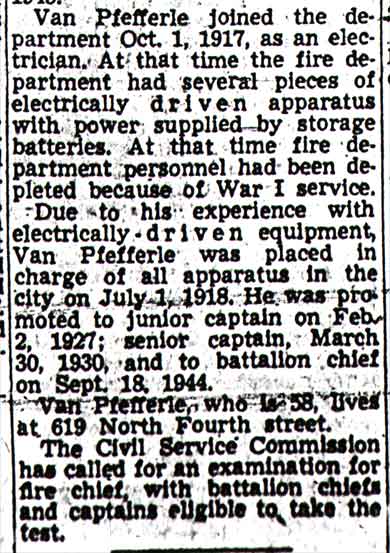
Van Pfefferle joined the department Oct. 1, 1917, as an electrician. At that time the fire department had several pieces of electrically driven apparatus with power supplied by storage batteries. At that time fire department personnel had been depleted because of War I service.
Due to his experience with electrically-driven equipment, Van Pfefferle was placed in charge of all apparatus in the city on July 1, 1918. He was promoted to junior captain on Feb. 2, 1927; senior captain, March 30, 1930, and to battalion chief on Sept. 18, 1944.
Van Pfefferle, who is 58, lives at 619 North Fourth street. The Civil Service Commission has called for an examination for fire chief, with battalion chiefs and captains eligible to take the test.
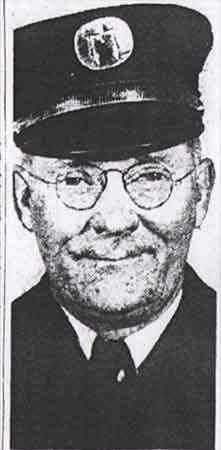
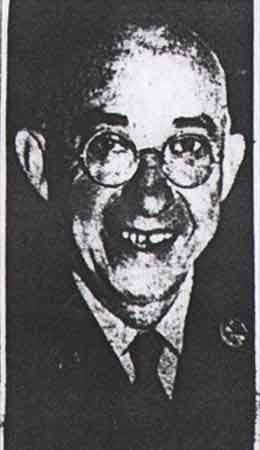
William Van Pfefferle — Portrait
[Portrait of William Van Pfefferle, Acting Chief of the Camden Fire Department, in uniform]
New Fire Dept. Head
Camden Courier-Post —
New Fire Dept. Head
After 38 years of faithful and efficient service to the city in the fire department, the last four as acting chief, Walter Mertz has been granted retirement and will officially step out Jan. 15, at the age of 72. He has been a splendid public servant and has well earned a rest.
His retirement paves the way for the appointment of William Van Pfefferle, a battalion chief, as acting chief. Van Pfefferle was one of only two battalion chiefs who had been eligible for the post, the other being the late Leonard J. Megee, who died just a few days ago after a short illness.
Like his predecessor, Chief Van Pfefferle enjoys a fine reputation both as a man and as a department officer and can be sure of the loyalty of those under him. He joined the department in 1917 as an electrician and rose rapidly. He is responsible for much of the modernizing of the city’s fire equipment.
An examination of eligible captains and battalion chiefs for the position of fire chief has been called for by the Civil Service Commission. It is likely that in the near future a permanent fire chief as well as a permanent police chief will be named, Commissioner Aaron having indicated he believed both posts should be occupied on a permanent rather than an acting basis when he took over the Department of Public Safety a short time ago.
This change would seem to be desirable in the interest of efficiency and morale, and in fairness to the men who have the duties and responsibilities of a chief to carry out.
Attendance Record for Firemen
Camden Courier-Post —
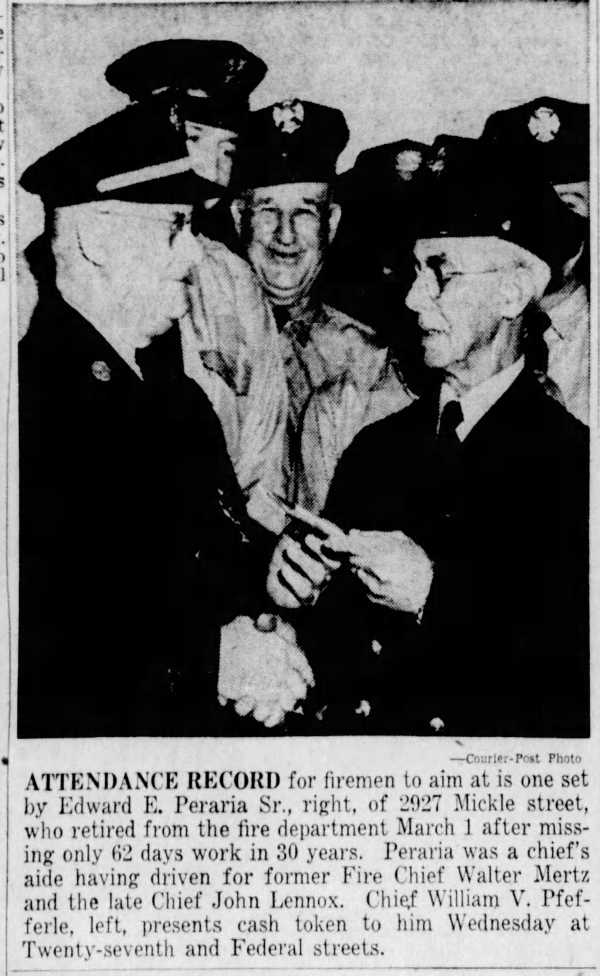
Attendance record for firemen to aim at is one set by Edward E. Peraria Sr., right, of 2927 Mickle street, who retired from the fire department March 1 after missing only 62 days work in 30 years. Peraria was a chief’s aide having driven for former Fire Chief Walter Mertz and the late Chief John Lennox. Chief William V. Pfefferle, left, presents cash token to him Wednesday at Twenty-seventh and Federal streets. — Camden Courier-Post, March 27, 1952
Fire Sweeps Mickle Street Coat Factory
Camden Courier-Post —
Fire Sweeps Mickle Street Coat Factory
50 Workers Idled; Damage Placed At $40,000
Fire swept through a considerable portion of a woman’s coat manufacturing plant at 210 Mickle Street early today, causing damage estimated by the owner at between $40,000 and $50,000.
About 50 women employes of the Progressive Garment Co., Inc. were thrown out of work as the result of the fire. The company is owned by Benjamin Schwartz, of Fifty-second street and Montgomery avenue, Philadelphia.
Firemen were summoned at 4.57 a. m. when an automatic alarm was touched off by the heat. Three engine companies and one truck company had the fire under control in about one hour, but firemen remained at the scene until after 8 a. m. District Chief Howard Gick directed the fire-fighting.
Gick said a portion of the front of the shop, which is on the second floor, was enveloped in flames when firemen arrived. He said the heat was so intense that a wire-glass skylight cover, which can resist temperatures up to 1600 degrees, had melted.
Chief Engineer William Pfefferle, who visited the scene, said the fire had “probably been caused” by a defective motor in a soft drink dispensing machine.
Schwartz, who gave an estimate of the damage, said he was insured. He reported 150 bolts of uncut cloth, many finished coats, 3000 zippers and hundreds of buttons were either destroyed or damaged beyond use. He also said the fire seriously damaged a number of cutting and sewing machines.
Police Investigate 3 Fires in 4 Hours In One Section
Camden Courier-Post —
Police Investigate 3 Fires in 4 Hours In One Section
Kaighn School Razed; Blazes Set in Church, Unoccupied House
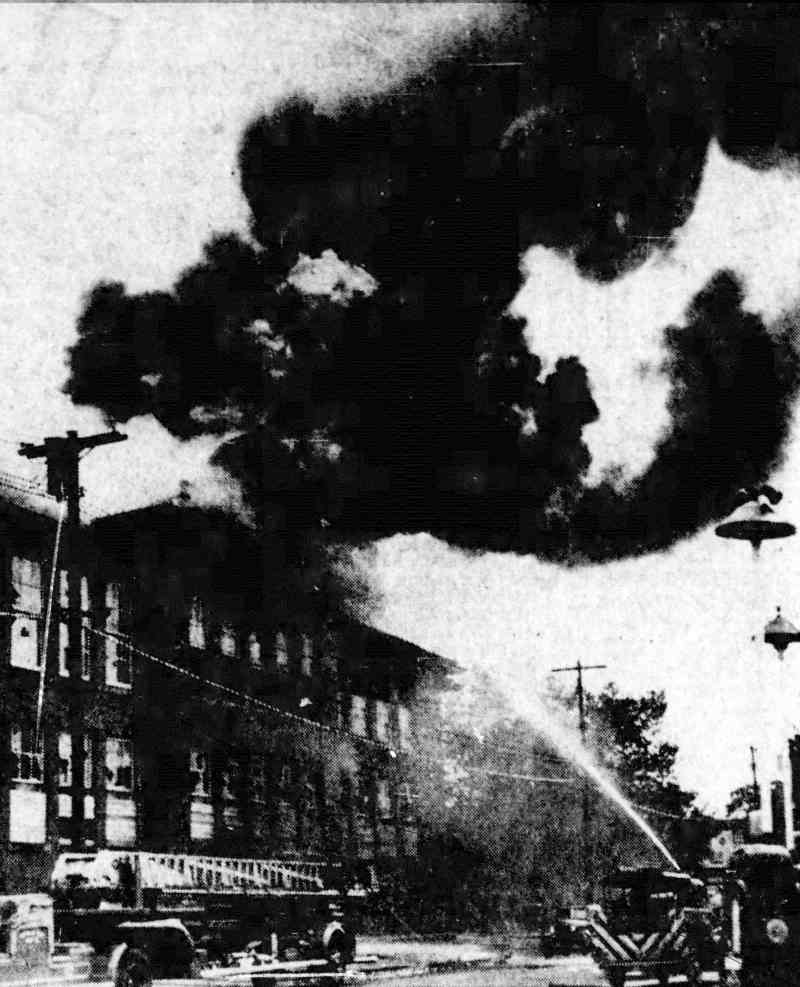
Police today are investigating the possibility that three fires Wednesday within a quarter-mile area inside of three hours and 46 minutes were the work of a firebug.
The blaze which razed the Kaighn School, 5th and Chestnut sts., seriously damaged Our Lady of Mt. Carmel R. C. Church, 4th and Division sts., and consumed a pile of rubbish in the basement of an unoccupied three-story house at 7th and Pine sts., came on the 12th anniversary of the disastrous Hollingshead fire.
That fire, on July 30, 1940, leveled the R. M. Hollingshead plant, then located at 9th and Market sts., took 10 lives and caused an estimated $4 million damage, according to city fire department records. It was Camden’s worst fire.
Police Chief Koerner, commenting on Wednesday’s fires which caused damage estimated at more than $17,000, said: “We are going to make a thorough study of every available clue to see whether the fires could have been started by one person.”
Koerner, Pfefferle Investigate
Fire Chief Pfefferle agreed with Chief Koerner and said that he had already requested the fire marshal’s office to probe into the circumstances of the chain of fires. He kept the city’s fire department on the go from 12:46 p. m. until well after 9 p. m.
The most disastrous of the series of fires was that which broke out in the cupola of the Kaighn School at 3 p. m. Damage was estimated at “$15,000 or more,” by Joseph C. Ragone, secretary of the Camden Board of Education.
A dozen row houses on Sycamore st. and six homes on Newton ave. were imperilled and Acting District Fire Chief Henry E. Zook ordered the buildings wetted down.
School Closed for Three Years
The three-story abandoned school was a shambles by 6 p. m. One of the oldest schools in the city, the 15-room structure had been unused for the past three years. The last fire apparatus, Engine 3, left the scene at 9 p. m.
Upon arrival on the scene Zook immediately sent in a second alarm while thousands of onlookers gathered in the area. Police emergency cars, an ambulance, fire apparatus and cars belonging to fire and police officials choked the narrow streets. As the blaze continued an enterprising ice cream vender halted his cart and did a thriving business among spectators.
Three firemen were injured slightly. Walter Dilsworth, of Engine Co. 2, William Warren, of Engine 8, and Eugene Alston, of Engine 1, were treated at Cooper Hospital. In this connection Zook told a Courier-Post reporter: “I’d been expecting this place to go for a long time and I always hoped it would be in the daytime. I don’t hesitate to say that if this fire had broken out at night we might have had a fatality. The roof collapsed within the first 25 minutes.”
‘Bottlegangers’ Used School
Still another possibility of tragedy was suggested by Fire Chief Pfefferle. “We found ample evidence that the abandoned school was used as a rendezvous by bottlegangers. Among the debris we saw lots of empty bottles. If any of these bottlegangers had been sleeping off a drunken stupor there is very little chance that he would have been discovered. After all, we do not look for tenants in buildings that are boarded up.”
The chief added that although he would ask Police Chief Koerner to probe into the possibility of an arsonist, he was personally inclined to the belief that children were responsible.
“It looks like kids’ work to me,” Pfefferle declared.
The fire chief declined to estimate the loss in the three fires and said he had no idea as to the cause of the church and school fires. He said the third fire, in the basement of an unoccupied three-story brick apartment at 701 Pine st., was caused by rubbish.
New Truck Used
The chief said the new aerial ladder, used for the first time on a real fire, “worked in first class condition.”
To protect both firemen and civilians Max Dippner, Public Service Gas and Electric Co. employe, disconnected a 2400-volt transformer on a pole near the school and left an area of four city blocks without power or light until 5 p. m., when he restored the service.
Damage at the earlier fire at Our Lady of Mt. Carmel Church, 4th and Division sts., was estimated at “several thousand dollars,” by Rev. Michael Argullo, the pastor.
7 Children Saved in Blaze; City Fireman Overcome
Camden Courier-Post —
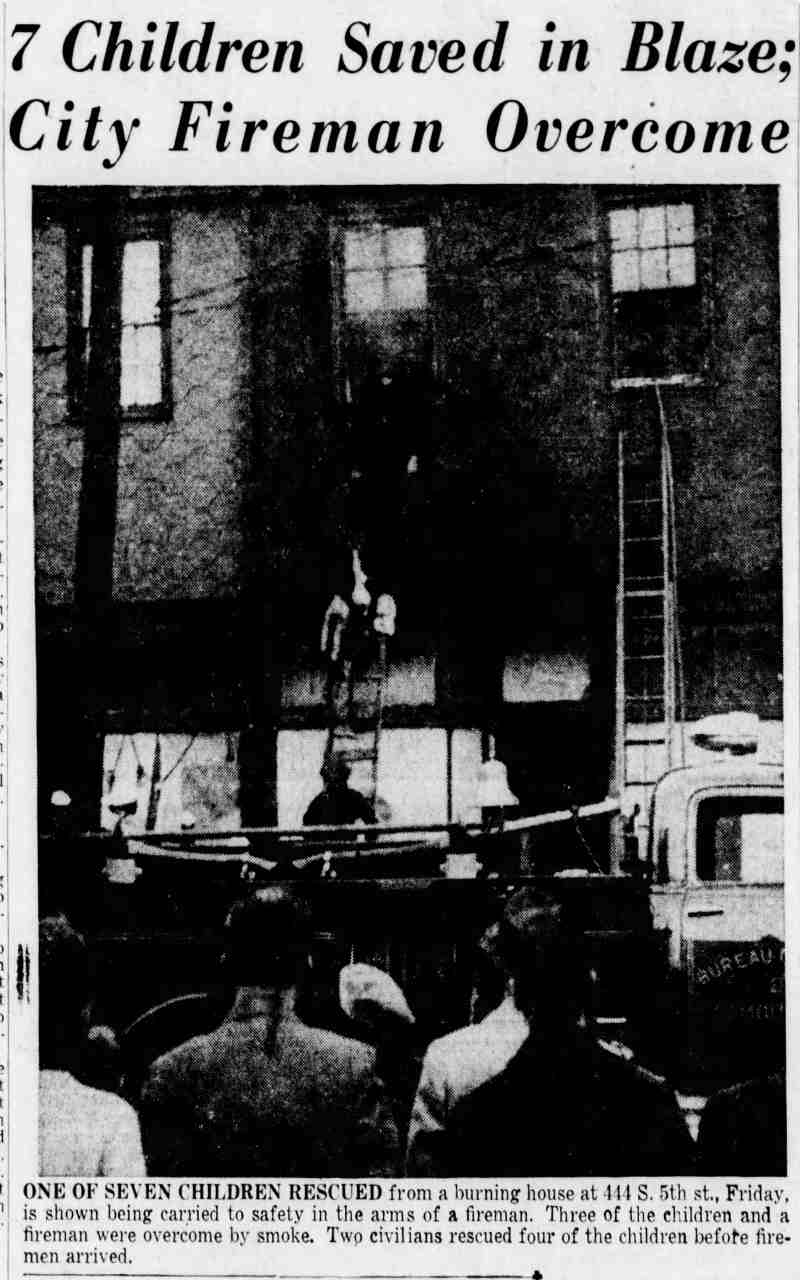
7 Children Saved in Blaze; City Fireman Overcome
One of seven children rescued from a burning house at 444 South 5th Street, Friday, is shown being carried to safety in the arms of a fireman. Three of the children and a fireman were overcome by smoke. Two civilians rescued four of the children before firemen arrived.
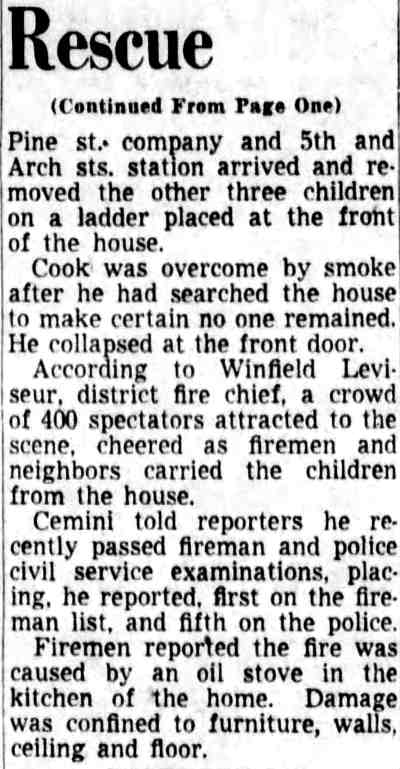
Cook was overcome by smoke after he had searched the house to make certain no one remained. He collapsed at the front door.
According to Winfield Leviseur, district fire chief, a crowd of 400 spectators attracted to the scene cheered as firemen and neighbors carried the children from the house.
Firemen reported the fire was caused by an oil stove in the kitchen of the home. Damage was confined to furniture, walls, ceiling and floor.
Six Firemen Cited Here for Heroism
Camden Courier-Post —
Six Firemen Cited Here for Heroism
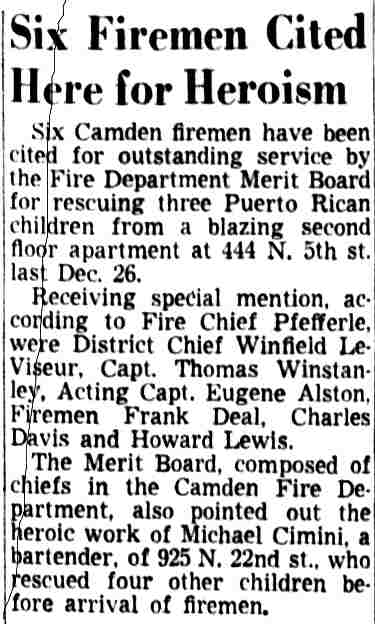
Six Camden firemen have been cited for outstanding service by the Fire Department Merit Board for rescuing three Puerto Rican children from a blazing second floor apartment at 444 North 5th Street last Dec. 26.
Receiving special mention, according to Fire Chief Pfefferle, were District Chief Winfield LeViseur, Capt. Thomas Winstanley, Acting Capt. Eugene Alston, Firemen Frank Deal, Charles Davis and Howard Lewis.
The Merit Board, composed of chiefs in the Camden Fire Department, also pointed out the heroic work of Michael Cimini, a bartender, of 925 North 22nd Street, who rescued four other children before arrival of firemen.
2 Firemen Given Merit Awards
Camden Courier-Post —
2 Firemen Given Merit Awards
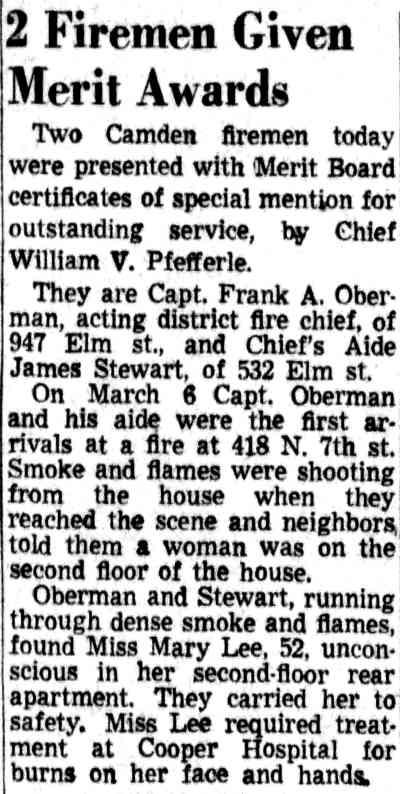
Two Camden firemen today were presented with Merit Board certificates of special mention for outstanding service, by Chief William V. Pfefferle.
They are Capt. Frank A. Oberman, acting district fire chief, of 947 Elm Street, and Chief’s Aide James Stewart, of 532 Elm Street.
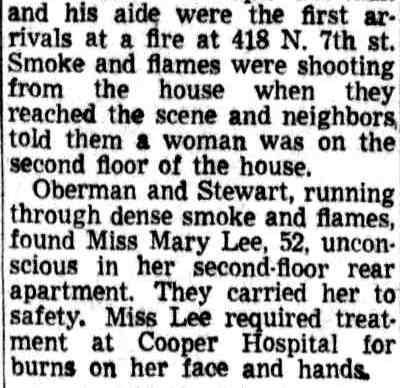
On March 6 Capt. Oberman and his aide were the first arrivals at a fire at 418 N. 7th Street. Smoke and flames were shooting from the house when they reached the scene and neighbors told them a woman was on the second floor of the house.
Oberman and Stewart, running through dense smoke and flames, found Miss Mary Lee, 52, unconscious in her second-floor rear apartment. They carried her to safety. Miss Lee required treatment at Cooper Hospital for burns on her face and hands.
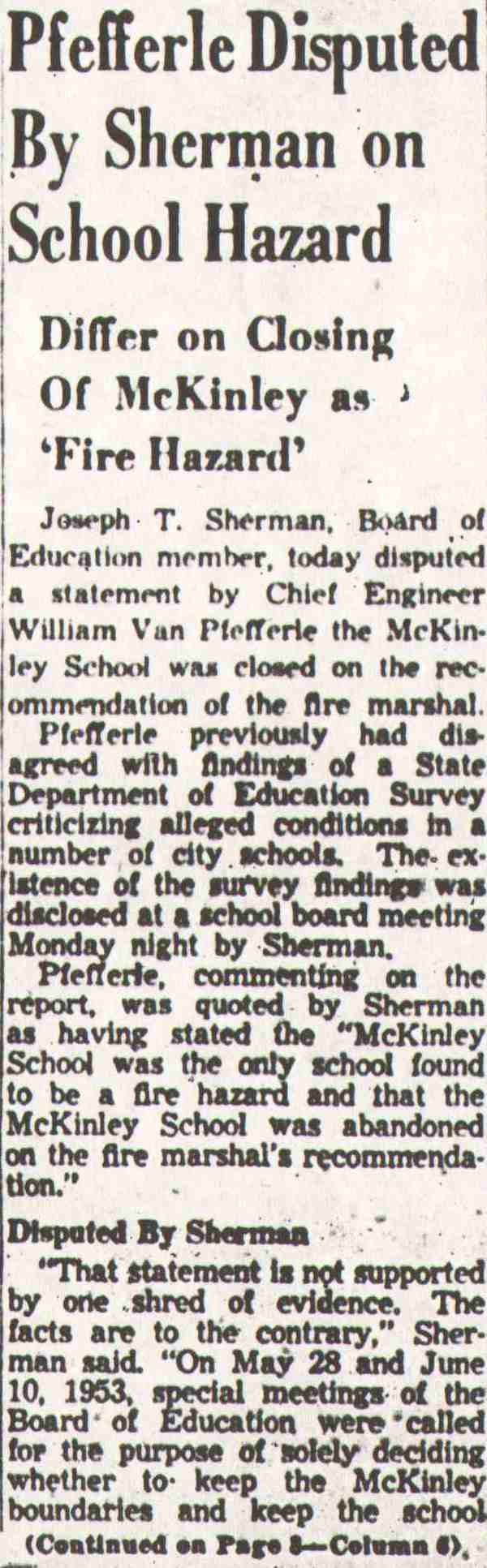
Pfefferle Disputed By Sherman on School Hazard
Camden Courier-Post —
Pfefferle Disputed By Sherman on School Hazard
Differ on Closing Of McKinley as ‘Fire Hazard’
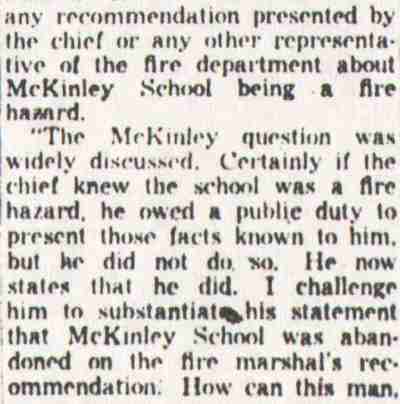
Joseph T. Sherman, Board of Education member, today disputed a statement by Chief Engineer William Van Pfefferle the McKinley School was closed on the recommendation of the fire marshal.
Pfefferle previously had disagreed with findings of a State Department of Education Survey criticizing alleged conditions in a number of city schools. The existence of the survey findings was disclosed at a school board meeting Monday night by Sherman.
Pfefferle, commenting on the report, was quoted by Sherman as having stated the “McKinley School was the only school found to be a fire hazard and that the McKinley School was abandoned on the fire marshal’s recommendation.”
Disputed By Sherman
“That statement is not supported by one shred of evidence. The facts are to the contrary,” Sherman said. “On May 28 and June 10, 1953, special meetings of the Board of Education were called for the purpose of solely deciding whether to keep the McKinley boundaries and keep the school open or to abandon the school. The public was invited to attend and did so. Opposing groups argued the merits of continued use of the McKinley School. Commissioner Aaron, a member of the Board of Education and also Chief Pfefferle’s boss, as head of the Camden City Department of Public Safety, was present and participated.”
“On June 29, 1953, the Board of Education after full public hearing decided to abandon McKinley School. At no time was there any recommendation presented by the chief or any other representative of the fire department about McKinley School being a fire hazard.”
Explains Own Stand
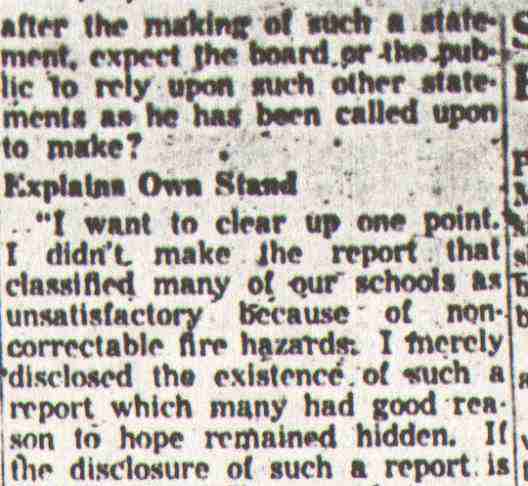
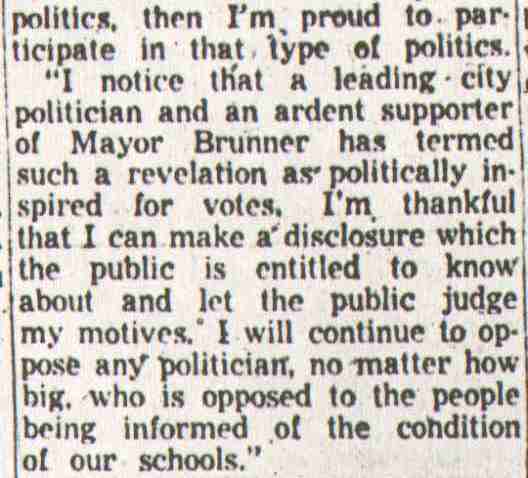
“I want to clear up one point. I didn’t make the report that classified many of our schools as unsatisfactory because of non-correctable fire hazards. I merely disclosed the existence of such a report which many had good reason to hope remained hidden. If the disclosure of such a report is politics, then I’m proud to participate in that type of politics.”
“I will continue to oppose any politician, no matter how big, who is opposed to the people being informed of the condition of our schools.”
District Firemen Fete 2 Veterans On Retirement
Camden Courier-Post —
District Firemen Fete 2 Veterans On Retirement
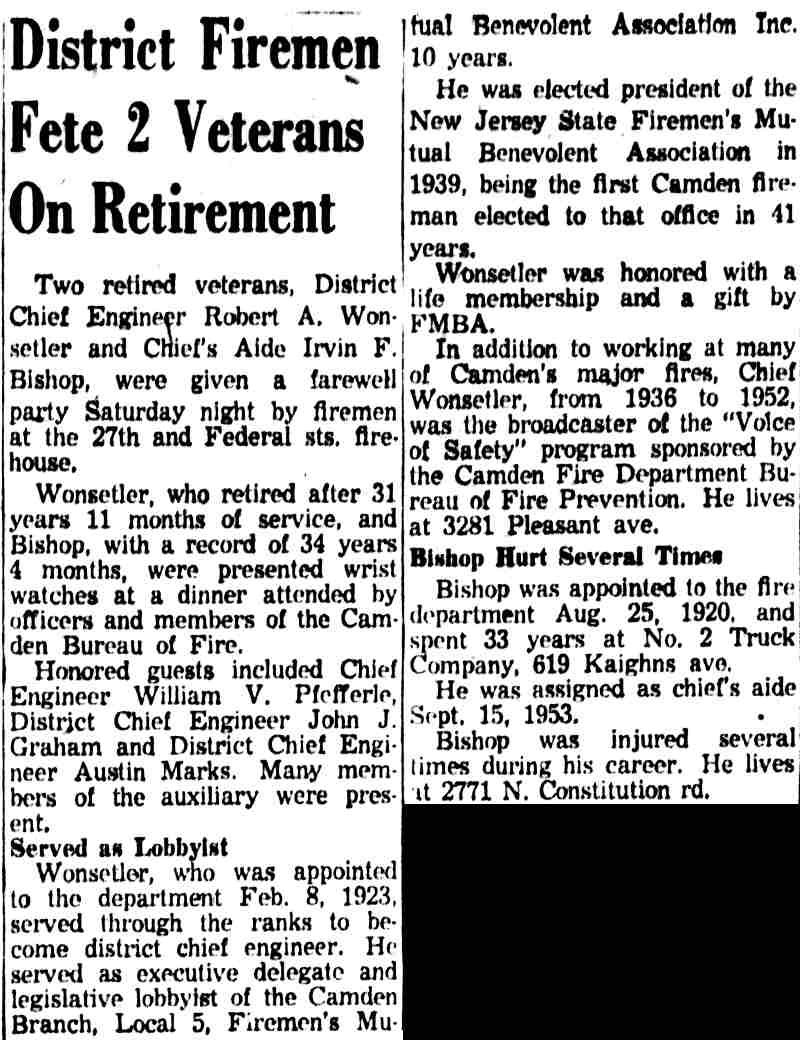
Two retired veterans, District Chief Engineer Robert A. Wonsetler and Chief’s Aide Irvin F. Bishop, were given a farewell party Saturday night by firemen at the 27th and Federal sts. firehouse.
Wonsetler, who retired after 31 years 11 months of service, and Bishop, with a record of 34 years 4 months, were presented wrist watches at a dinner attended by officers and members of the Camden Bureau of Fire.
Honored guests included Chief Engineer William V. Pfefferle, District Chief Engineer John J. Graham and District Chief Engineer Austin Marks. Many members of the auxiliary were present.
Served as Lobbyist
Wonsetler, who was appointed to the department Feb. 8, 1923, served through the ranks to become district chief engineer. He served as executive delegate and legislative lobbyist of the Camden Branch, Local 5, Firemen’s Mutual Benevolent Association Inc. 10 years.
He was elected president of the New Jersey State Firemen’s Mutual Benevolent Association in 1939, being the first Camden fireman elected to that office in 41 years. Wonsetler was honored with a life membership and a gift by FMBA. In addition to working at many of Camden’s major fires, Chief Wonsetler, from 1936 to 1952, was the broadcaster of the “Voice of Safety” program sponsored by the Camden Fire Department Bureau of Fire Prevention. He lives at 3281 Pleasant Avenue.
Bishop Hurt Several Times
Bishop was appointed to the fire department Aug. 25, 1920, and spent 33 years at No. 2 Truck Company, 619 Kaighns ave.
He was assigned as chief’s aide Sept. 15, 1953.
Bishop was injured several times during his career. He lives at 2771 N. Constitution Road.
Firemen Here Get Advanced First Aid Course
Camden Courier-Post —
More than 40 members of the Camden Fire Department have completed the Red Cross course in advanced first aid according to announcement today by Howard F. Keller, Collingswood, chairman of the Camden County Chapter’s first aid committee.
Instruction sessions were under the direction of Fire Chief William V. Pfefferle. Drillmaster Anthony Dzinski, a member of the local chapter first aid group, assisted by Nicholas E. George, were instructors. Dzinski is a member of the Red Cross faculty at the National Aquatic School held in this area each year for instruction in advance safety techniques. Dick Harris, director of Red Cross safety services, supervised.
All members of the graduating class are personnel of several units housed at fire department headquarters here. These include the Headquarters Company, Engine Company 2, Rescue Squad 1 and Truck Company 1. These groups include:
Rescue Squad: Captains Arthur Batten, Philip A. Stinger and Albert Weller; Edward Brendlinger, Harrison MacNeir, Robert Olesiewicz and James W. Smith.
Headquarters Company: Raymond Banford, John K. Voll and John W. Yates.
Truck Company 1: Captains Daniel Jiannetto, Robert E. Dukes and Otto V. Kaiser; William Watkin, Chester Gedrich, George Baxter, John Mogck, George C. Hennessy, Charles Devlin, Ambrose W. Faust, Joseph McTaggart, Howard R. Taggart, William G. Winstanley and Elmer Johnson Jr.
Engine Company 2: Captains James R. Asher, Thomas Winstanley; Carl Wirtz, James McGrory, Edwin V. Decker, James Stewart, Francis X. McTaggart, Anthony T. Orme, Mario D. Fattore, James O. Jones, Francis P. Stibi, William Hopkins, Robert E. Briggs, John Giuliano, Casper Martelli, Harold H. Pike, John J. Vane, William Stibi, John DiMaggio and Harry Kleinfelder.
Certificates of Commendation
Camden Courier-Post —
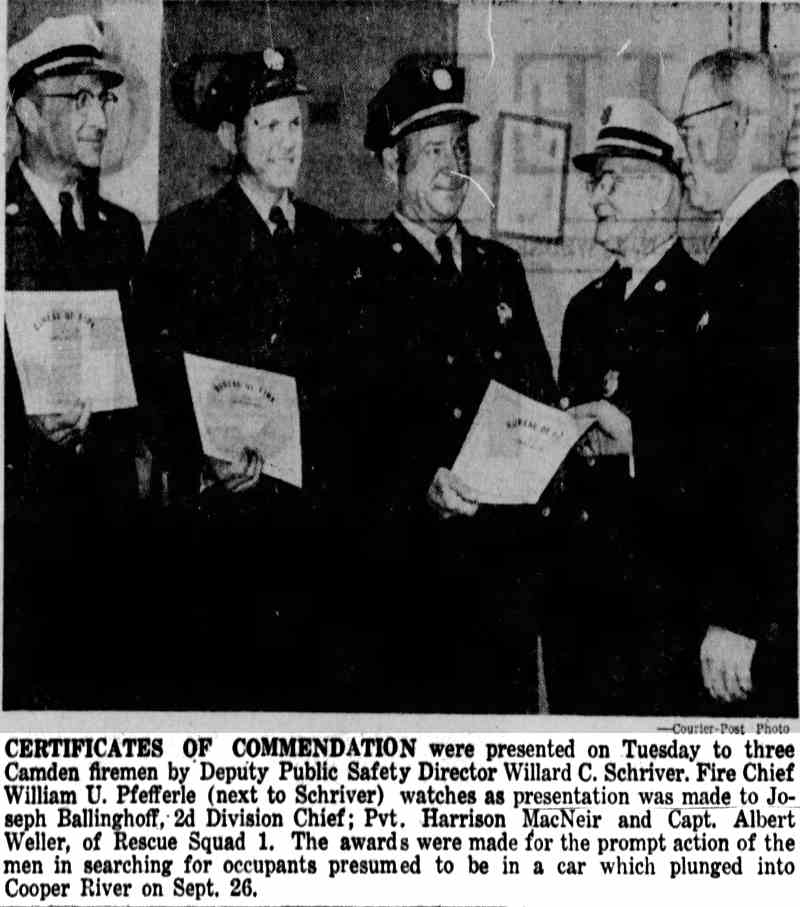
Certificates of commendation were presented on Tuesday to three Camden firemen by Deputy Public Safety Director Willard C. Schriver. Fire Chief William Van Pfefferle (next to Schriver) watches as presentation was made to Joseph Ballinghoff, Second Division Chief; fireman Harrison MacNeir and Captain Albert A. Weller, of Rescue Squad 1. The awards were made for prompt action of the men in searching for occupants presumed to be in a car which plunged into Cooper River on September 26. — Camden Courier-Post, October 9, 1957
Police ‘Burn’ Guns Seized In Arrests
Camden Courier-Post —

Police ‘Burn’ Guns Seized In Arrests
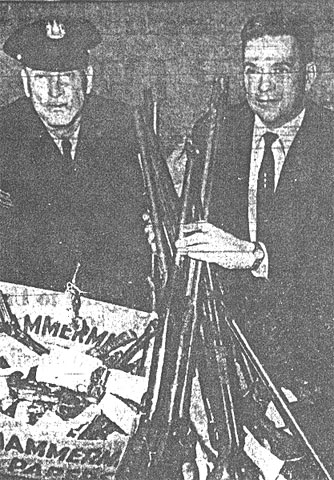
‘59 Auto Patterns!: Rifles, pistols and knives confiscated by Camden police are assembled by Lt. William Yeager (right) and Sgt. William Schultz before being tossed into the furnace at Camden Foundry Co., Delaware Avenue and Elm Street.
Your 1959 automobile may owe its sleek lines in part to a variety of deadly weapons confiscated over the past 18 months by the Camden Police Dept. and melted down Friday in brief “last rites” at the Camden Foundry Co., Delaware ave. and Elm st.
Guns, knives and blackjacks taken from convicted holdup men and other criminals became a mass of molten metal after being tossed into a foundry furnace at 3200 degrees F. According to John W. March, president of the company, the metal will be used in casting patterns for bodies of 1959 cars.
Present at the scene were: Willard C. Schriver, deputy director of public safety; chief of police Gustav Koerner; Lt. Yeager; Fire Chief William V. Pfefferle, and Sgt. William Schultz of the police dept.
Chief Koerner explained that the contraband could not be disposed of until after the criminals’ periods of appeal from conviction had expired. This was why the horde of 50 pistols and revolvers, 20 shotguns, 20 knives, 15 blackjacks and 2 sets of brass knuckles had accumulated.
Service Record
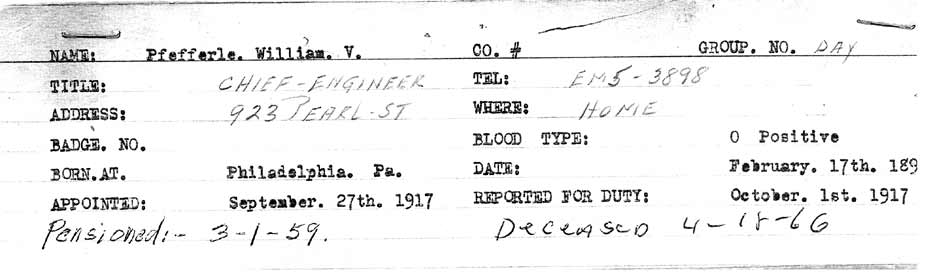
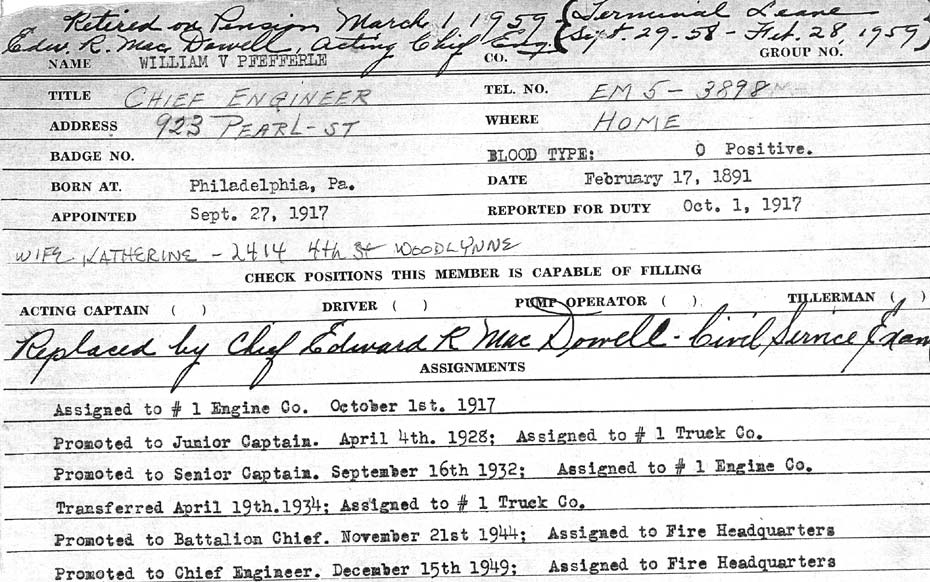
Camden Fire Department service record for William V. Pfefferle. Appointed September 27, 1917; reported for duty October 1, 1917. Promoted to Chief Engineer December 15, 1949. Retired on pension March 1, 1959. Deceased April 18, 1966.