Introduction
ISAAC C. RANDOLPH was appointed to the Camden Fire Department in July of 1873, taking the place of Thomas Grapevine, who had resigned. He served as an extra man with Engine Company 2 until April of 1874, when he was replaced by Charles Swope. He was re-appointed on April 8, 1878. He served until April 5, 1882 when he was replaced by Isaac M. Shreeve.
Isaac C. Randolph was born in New Jersey in January of 1843 to Edward E. and Rebecca P. Randolph. The family, which included younger brother William, was living in Camden’s South Ward when the 1850 Census was taken. Edward E. Randolph was working as a house carpenter. The family was still in the South Ward at the time of the 1860 Census. Isaac Randolph was working as an apprentice hatter.
Isaac C. Randolph enlisted in Company G, 12th New Jersey Infantry Regiment on September 4, 1862.
The Twelfth New Jersey Infantry was commanded by Colonels Robert C. Johnson, J. Howard Willetts, and John Willian during its term of service. This regiment was raised under the second call of the president for 300,000 men, Robert C. Johnson, of Salem, formerly major of the Fourth regiment (3 months’ men), being commissioned as colonel early in July, 1862. Woodbury, Gloucester county, was selected as the rendezvous, and on July 25 the first detachment of troops, about 950 men, was mustered into the U. S. service. Many of the officers had already seen service in other regiments, but comparatively few of the men were familiar with military duties or requirements, though all entered cheerfully upon the work of preparing for the duties before them.
On September 7, 1862 the regiment left the state for Washington, but at Baltimore was diverted from its course by Gen. Wool, commanding that district, who ordered it to proceed to Ellicott City, the county seat of Howard County, Maryland, 15 miles from Baltimore on the line of the Baltimore & Ohio railroad.
At Chancellorsville, on May 3, 1863, the regiment received its first taste of actual warfare. It behaved with great gallantry, though the loss was severe, amounting to 179 in killed, wounded and missing. Although under arms during the two succeeding days and nights, it was not again engaged, and on the night of the 5th it re-crossed the Rappahannock and proceeded to its old camp, having in its first battle lost over one-tenth of its men. Soon after reaching the field at Gettysburg on July 2, Company I was sent out on the skirmish line, but the combat not yet being opened, only two or three casualties were sustained. In the afternoon a house and barn standing about 200 yards west of the Emmitsburg road and nearly equidistant from either army having been occupied as a cover by the Confederate sharpshooters, Companies B, H, E and G were sent out to dislodge them, which they did, capturing 6 commissioned officers and 80 men, but with considerable loss, Captain Horsfall of Company E, a brave officer, being killed, and Lieutenant Eastwick wounded. During the fearful infantry contest of the following day the regiment was actively engaged, but only lost 5 or 6 men killed and 1 officer and 30 men wounded.
On October 14, when near Auburn mills, some 2 miles east of Warrenton, the Confederate cavalry made an attack upon the corps of which the regiment was a part, evidently hoping to capture its train, but they were repulsed with loss and the corps continued its retreat toward Centerville, the point which Lee was straining every nerve to reach in advance of the Union troops. In the engagement at Bristoe Station, which lasted for 3 or 4 hours, several men of the Twelfth were wounded, Lieutenant Lowe, of Company G, being among the number. In the skirmishes at Mine Run the regiment did not sustain any casualties, although under fire on several occasions. In the affair at Morton’s Ford, some 10 men of the regiment were wounded, but only 1 fatally.
At the battle of the Wilderness, although not engaged as a whole, the regiment suffered considerably, Lieutenant John M. Fogg, of Company H, being killed, while Lieutenant Frank M. Riley, of Company K, and several others were wounded. Two days later the regiment lost heavily, Lieutenant Colonel Davis and Captains Chew and Potter being among the wounded. In the magnificent assault at Spottsylvania, which resulted in the capture of over 3,000 prisoners and some 30 guns, the Twelfth again suffered severely, Lieutenant Colonel Davis being instantly killed while bravely leading the regiment; Captain H. M. Brooks and Lieutenant E. P. Phipps were severely wounded and were obliged to quit the service in consequence. In the assault at Cold Harbor the loss of the regiment was severe, Captain McCoomb, commanding the regiment, being mortally wounded by the explosion of a shell, which also killed or wounded several privates. Up to June 16 the total loss of the regiment in this memorable campaign had been some 250 killed, wounded or missing—a large proportion of the wounded being officers.
From this time forward the regiment was in position at various points on the line, and in July it participated in the movement and affair at Strawberry Plains and Deep Bottom, on the north side of the James. Thence, by a forced march, it returned to the Petersburg front, arriving in time to support the assault at the explosion of the mine, July 30, though not actually engaged. It participated in the second movement to Deep Bottom, charging the enemy’s picket line under Captains Chew and Acton, and upon returning marched to the extreme left flank of the Army of the Potomac, whence it was marched to Reams’ Station, on the Weldon railroad, where the 1st division of the corps had preceded it. In the severe action at the latter place Lieutenant Colonel Thompson, commanding the regiment, was severely wounded and Lieutenants Rich and Stratton were killed.
After the action at Reams’ station the regiment was in various positions along the Petersburg front, Fort Hell on the Jerusalem plank road, Fort Morton, and at other points, until late in October, when it moved out and participated in the action known as the battle of the Boydton road, where it lost 4 killed and 9 wounded, including Captain T. O. Slater. In the winter of 1864–65 it took part in the various actions at Hatcher’s Run, where in one instance it charged across the run, waist deep, and took the enemy’s works, upon which its color bearer, Ellwood Griscom, was the first to plant the national colors. It was present in the movements of the army preceding the main assault on the Petersburg defenses; took part in the assault, under the command of Major Chew, and aided in the various actions during Lee’s retreat until his surrender. It returned, via Richmond, to Bailey’s crossroads, in front of Washington, where in June, 1865, the old battalion of the regiment was mustered out of service, and in July the remainder of the regiment. Its total strength was 1,899, and it lost, by resignation 14, by discharge 171, by promotion 56, by transfer 206, by death 261, by desertion 216, by dismissal 3, not accounted for 29, mustered out, 943.
Private Randolph was among those who mustered out on June 4, 1865 at Munson’s Hill, Virginia.
Isaac Randolph returned to Camden and married. When the 1870 Census was taken Isaac and Martha “Mattie” Randolph were living with his parents and brother William in Camden’s Middle Ward. Isaac Randolph was working as a clerk in a box factory at the time.
As stated above Isaac Randolph was appointed to the Camden Fire Department in July of 1873. He was then living at 653 John Street, which was later renamed Locust Street. Four other Camden firefighters of that era also lived in the 600 block of John Street, William Gleason 646, James M. Lane at 644, John Vanstavern at 647, and John W. Streeper at 649.
By 1877 the Randolph family had moved to 225 Pine Street. Edward Randolph had passed away, his widow lived with Isaac and his family, as did brother William Randolph.
The 1880 Census shows Isaac and Martha Randolph living with their children Franklin T., 10 and Clara, 8 months at 203 Hartman Street, which was renamed Clinton Street in 1882. Isaac Randolph was working as a sawyer. His brother William was living with them, but had no occupation.
The 1883 City Directory shows that Isaac Randolph and family was still living at Clinton Street. Involving himself in local politics, Isaac Randolph served on the Board of Education in 1884 and 1885.
By 1887 Isaac Randolph had moved to 526 South 2nd Street, where he would make his home through 1906. On June 5, 1900 when the Census was taken, Isaac C. Randolph was living at 526 South 2nd Street with his wife, Martha “Mattie” Randolph. Of their five children, only one was living. He was working as “box sawyer.” His brother William Randolph was living with him; he was not working and passed away not long afterwards.
Isaac Randolph passed away in 1909, survived by his wife, son Frank T. Randolph, and two grandchildren. His widow was approved for a Civil War widow’s pension on May 26, 1909. She was living at 200 Berkley Street when the 1910 Census was enumerated.
Isaac C. Randolph was a member of the William B. Hatch Post No. 37, Grand Army of the Republic, as were brother firefighters William W. Mines, Alfred Ivins, and Benjamin H. Connelly.
George Reeser Prowell's History of Camden County, N.J., 1886
WILLIAM B. HATCH POST No. 37, of Camden, was instituted and chartered November 25, 1879, with eighty-one members and the following named Post officers:
Post Commander, John E. Grubb; Senior Vice-Commander, Richard J. Robinson; Junior Vice-Commander, Daniel J. Fullen; Surgeon, Thomas G. Rowand, M.D.; Chaplain, John Quick; Officer of the Day, John A. Dall; Officer of the Guard, Edmund G. Jackson, Jr.; Quartermaster, Christopher J. Mines, Jr.; Adjutant, Benjamin J. Pierce; Sergeant-Major, William A. Tattern; Quartermaster-Sergeant, William B. E. Miller.
At the first meeting of the Post it was decided by a unanimous vote to name it in honor of the late Colonel William B. Hatch, of the Fourth Regiment. When Mrs. C. Hatch, the mother of the colonel was informed that the post had honored the memory of her son by naming it after him, she sent to the Post the following response:
Camden N. J.,
November 26th, 1879John E. Grubb, Post Commander
Dear Sir,
It will afford me much pleasure to be identified with Post 37, G. A. R., named in honor of my son, William B. Hatch, by allowing me to present to the same its colors. The memory of my son is ever dear to me, and, while at the same moment I may have thought the sacrifice too great an affliction, yet I was consoled by the fact that I gave him up that this Union might be preserved. It was duty and patriotism that called him, and while I mourn him as a mother for a well-beloved son, yet I would not have stayed him, for the love of country and the upholding of this glorious Republic is what every mother should instill into her sons, as the purest and holiest spirit.Yours truly,
C. Hatch
The following is a complete roster of this post for 1886:
Post Commander, Benjamin H. Connelly; Senior Vice-Commander, Adam C. Smith; Junior Vice-Commander, William Haegele; Surgeon, George Pfau; Chaplain, Samuel Gaul; Officer of the Day, Robert Crawford; Officer of the Guard, John D. Cooper; Quartermaster, Samuel J. Fenner; Adjutant, William B. Summers; Sergeant-Major, Stacy H. Bassett; Quartermaster-Sergeant, Otto K. Lockhart.
Comrades: Philip Achenbach, George L. Allchin, Isaac Albertson, Joseph Applegate, John W. Barclay, Martin M. Barney, Joseph Baxter, William W. Bennett, Charles L. Bennett, Henry Bickering, Abel Biddle, George K. Biddle, John Bieri, Robert M. Bingham, Socrates T. Bittle, George W. Bittle, Benjamin F. Blizzard, Joseph Borton, Frederick Bowers, Benjamin M. Braker, John Breyer, William H. Brians, Wm. J. Broadwater, William Broadwater, John Brown, Harris Brooks, William H. Brooks, Joseph F. Bryan, Joseph Buddew, J. Q. Burniston, George Burton, Frederick Buser, Thomas L. Bush, William Butcher, Isaac B. Buzby, Edward C. Cattell, Joseph Cameron, James H. Carey, William Carey, James Chadwick, James Chafey, George M. Chester, James D. Chester, Lewis L. Chew, Henry S. Chew, John W. Churn, Andrew B. Cline, Charles Clarke, Samuel J. Cook, Levi E. Cole, John J. Collins, John C. Cooper, John W. Cotner, Thomas L. Conly, Harvey M. Cox, Jason S. Cox, Harris Crane, Charles Cress, Joel G. Cross, O. C. Cunningham, John A. Dall, John Dalby, John H. Damon, Westley Dare, John E. Dawson, Adam T. Dawson, James L. Davis, William Davis, Amos R. Dease, Henry Deford, Lewis F. Derousse, Michael Devinney, Glendora Devo, John Digney, Joseph Dilks, William A. Dobbins, George W. Dunlap, Aaron B. Eacritt, John J. Early, Christopher Ebele, Godfrey Eisenhart, John Elberson, Charles Elwell, Charles Eminecker, John Esler, John H. Evans, Charles S. Fackler, James Fanington, James A. Farraday, John H. Farry, John Faughey, Wm. H. Fenlin, George G. Felton, George W. Ferguson, Charles W. Fish, Israel L. Fish, James Finnan, Samuel B. Fisher, Edward L. Fisher, Ephraim B. Fithian, Jacob T. Fisher, Edward Fitzer, Samuel Flock, Leonard Flor, John Fox, John S. Fox, H. H. Franks, Chas. B. Frazer, Thomas J. Francis, Samuel W. Gahan, Chas. H. Gale, James Galbraith, Thomas Garman, Harry Garren, John W. Garwood, Josiah Garrison, John B. Gaskill, Richard Gaunt, Wm. German, Christopher Getsinger, Christopher Gifney, Jacob Giffens, Albert Gilbert, James Gillen, Wm. Giffins, C. C. Greany, Charles Green, W. H. Griffin, Louis Grosskops, William Grindrod, John B. Grubb, Mark H. Guest, John Guice, Alfred Haines, Charles G. Haines, Japhet Haines, George F. Hammond, Charles Hall, Solon B. Hankinson, Samuel P. Hankinson, James Hanson, Charles Hannans, H. A. Hartranft, Mahlon E. Harden, William F. Harper, George W. Hayter, Samuel B. Harbeson, J. T. Hazleton, H. Heinman, James Henderson, William H. Heward, Franklin Hewitt, James T. Hemmingway, Charles Hewitt, Edward K. Hess, Samuel B. Hickman, George Higgens, Ephraim Hillman, C. M. Hoagland, Guadaloupe Holl, William A. Holland, Isaac K. Horner, Count D. G. Hogan, William H. Howard, Baxter Howe, Alien Hubbs, Charles G. Hunsinger, Presmel D. Hughes, I. N. Hugg, Sebastian Hummell, Edward Hutchinson, C. Innes, Alfred Ivins, Benjamin Ivins, E. G. Jackson Sr., E. G. Jackson Jr., Thomas Jameson, George Jauss, William P. Jenkins, James L. Johnson, Alfred Jones, B. F. Jones, William Joline, Charles Joseph, Charles Justice, C. H. Kain, E. E. Kates, Benjamin Kebler, Frank Kebler, Peter Keen, Henry N. Killian, J. W. Kinsey, C. H. Knowlton, Thomas W. Krips, Joseph H. Large, John E. Leake, John Lecroy, Charles Leonhart, George W. Locke, E. J. Long, Charles L. Lukens, J. H. Lupton, Valentine Machemer, Edward Macloskey, Edward A. Martin, William P. Marsh, John Mapes, William Mead, William Metcalf, E. A. Meyer, C. Meyers, George Meilor, C. A. Michener, William B. E. Miller, Jacob Miller, W. D. Miller, Samuel Mills, William W. Mines, Christopher J. Mines, George Molesbury, William Moran, Edward More, Richard Morgan, John F. Moore, S. H. Moyer, Jacob L. Morton, John Muir, John J. Murphy, Isaac Murray, Charles Myers, W. H. McAllister, James McCracken, Edward C. McDowell, Hugh McGrogan, H. M. Mcllvaine, W. F. McKillip, W. J. McNeir, Lewis McPherson, E. McPherson, Jacob Naglee, William Naphas, Antonio Nosardi, Robert O’Keefe, John S. Owens, Robert Owens, Edward H. Pancoast, James Pancoast, Robert B. Patterson, William Patterson, E. W. Pease, John B. Pepper, Joel Perrine, John Peterson, D. E. Peugh, Frederick Phile, Samuel B. Pine, William M. Pine, Adon Powell, John Powell, John Portz, J. B. Prucelle, John Quick, S. E. Radcliffe, Isaac C. Randolph, James A. Regens, Philip Reilly, Charles P. Reynolds, Alexander Rhodes, Benjamin F. Richard, Andrew Ridgway, Benjamin Robbins, Edward C. Roberts, James Roberts, Richard J. Robinson, William B. Robertson, Isaac Rogers, John Rogers, William H. Rogers, Thomas G. Rowand, Sebastian Schaub, Maurice Schmidt, Christian K. Schallers, James Schofield, George W. Scott, John E. Scott, John M. Shemelia, Edward M. Siemers, John Simmons, Benjamin F. Shinn, Thomas Sheeran, James Shield, Charles Smith, George H. Smith, William W. Smith, Charles S. Small, Adolph Snow, W. Souder, Francis Senders, Robert Sparks, David C. Sprowl, Alfred L. Sparks, Abraham Springer, George W. Stewart, William L. Stevenson, Thomas G. Stephenson, Samuel R. Stockton, Thomas Stockton, Thomas H. Stone, Henry Strick, E. J. Strickland, Charles String, George F. Stull, George W. Swaney, Crosby Sweeten, William F. Tarr, William A. Tatem, Thomas S. Tanier, George Rudolph Tenner, Charles L. Test, Leonard Thomas, Benjamin Thomas, Henry C. Thomas, George F. Thorne, Wesley Thorn, Thomas W. Thornley, Alexander W. Titus, Joseph Tompkins, J. E. Troth, Isaac C. Toone, Samuel Tyier, Jacob M. Van Nest, Albert Vansciver, Joseph Wakeman, Theodore F. Walker, Charles Walton, George Walton, Joseph Welsh, David Watson, George W. Wentling, Edward West, Elmer M. West, George Weyman, Wilmer Whillden, James Whittaker, Samuel Wickward, Calvin T. Williams, George W. Williams, William H. Williams, John Williams, Samuel Winner, Amos P. Wilson, D. H. Wilson, G. A. Wilson, Richard Wilson, George Wispert, John W. Wood, Joseph Woodfield, Walter Wolfkill, E. W. Wolverton, Elijah Worthington, C. M. Wright, George B. Wright, Henry S. Wright, Wesley T. Wright, William Zane.
As of 1886, the Hatch Post met every Thursday evening in their own G. A. R. Hall, on Stevens Street, below Fifth Street. This same building had been used in the late 1870s as the original home of the congregation that formed the Tabernacle Baptist Church. The Hatch Post was affiliated with Hatch League No. 2, of the Loyal Ladies League, their auxiliary, which met at the Post Hall.
Over the River
Philadelphia Inquirer —
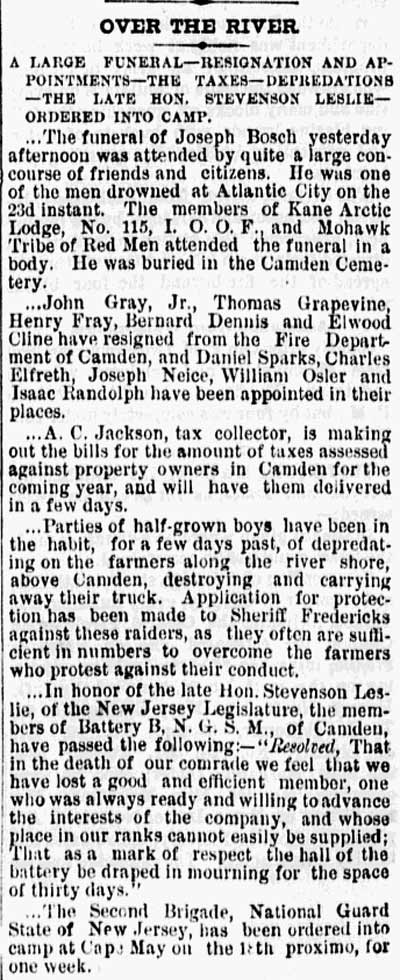
A LARGE FUNERAL—RESIGNATION AND APPOINTMENTS—THE TAXES—DEPREDATIONS—THE LATE HON. STEVENSON LESLIE—ORDERED INTO CAMP.
...The funeral of Joseph Bosch yesterday afternoon was attended by quite a large concourse of friends and citizens. He was one of the men drowned at Atlantic City on the 23d instant. The members of Kane Arctic Lodge, No. 115, I. O. O. F., and Mohawk Tribe of Red Men attended the funeral in a body. He was buried in the Camden Cemetery.
...John Gray, Jr., Thomas Grapevine, Henry Fray, Bernard Dennis and Elwood Cline have resigned from the Fire Department of Camden, and Daniel Sparks, Charles Elfreth, Joseph Neice, William Osler and Isaac Randolph have been appointed in their places.
...A. C. Jackson, tax collector, is making out the bills for the amount of taxes assessed against property owners in Camden for the coming year, and will have them delivered in a few days.
...Parties of half-grown boys have been in the habit, for a few days past, of depredating on the farmers along the river shore, above Camden, destroying and carrying away their truck. Application for protection has been made to Sheriff Fredericks against these raiders, as they often are sufficient in numbers to overcome the farmers who protest against their conduct.
...In honor of the late Hon. Stevenson Leslie, of the New Jersey Legislature, the members of Battery B, N. G. S. M., of Camden, have passed the following:—“Resolved, That in the death of our comrade we feel that we have lost a good and efficient member, one who was always ready and willing to advance the interests of the company, and whose place in our ranks cannot easily be supplied; That as a mark of respect the hall of the battery be draped in mourning for the space of thirty days.”
...The Second Brigade, National Guard State of New Jersey, has been ordered into camp at Cape May on the 1[?]th proximo, for one week.
Extra Firemen Appointed
Philadelphia Inquirer —
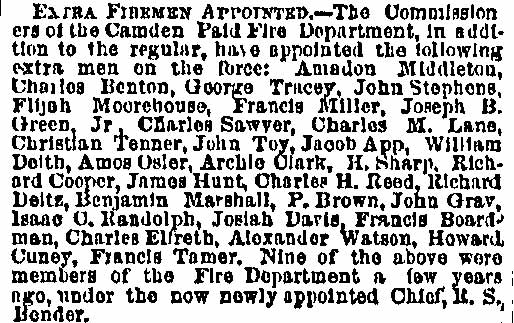
The Commissioners of the Camden Paid Fire Department, in addition to the regular, have appointed the following extra men on the force: Amadon Middleton, Charles Benton, George Tracey, John Stephens, Elijah Moorehouse, Francis Miller, Joseph B. Green, Jr., Charles Sawyer, Charles M. Lane, Christian Tenner, John Toy, Jacob App, William Deith, Amos Osler, Archie Clark, H. Sharp, Richard Cooper, James Hunt, Charles H. Reed, Richard Deitz, Benjamin Marshall, P. Brown, John Grav [sic], Isaac O. Randolph, Josiah Davis, Francis Boardman, Charles Elfreth, Alexander Watson, Howard Cuney, Francis Tamer. Nine of the above were members of the Fire Department a few years ago, under the now newly appointed Chief, R. S., Bender.
Randolph
Philadelphia Inquirer —
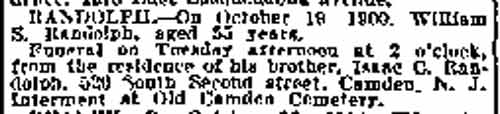
RANDOLPH.—On October 18, 1900, William S. Randolph, aged 55 years. Funeral on Tuesday afternoon at 2 o’clock, from the residence of his brother, Isaac C. Randolph, 539 South Second street, Camden, N.J. Interment at Old Camden Cemetery.
Civil War Pension Record
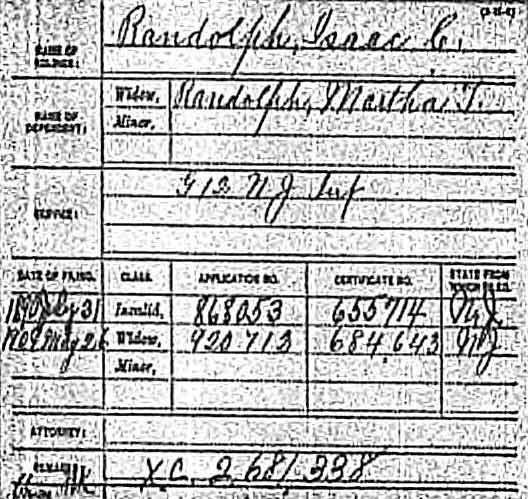
Civil War Pension Record, Isaac C. Randolph.