Introduction
Cornelius M. Brown was one of the original members of the Camden Fire Department, entering service on December 7, 1869 as an extra man with Engine Company 1. Prior to entering the fire department he had worked as a moulder, that is, he worked in an iron works pouring molten metal into moulds. He also at times worked as a machinist. He was living at 458 Kaighn Avenue, then called Kaighn Street, when he joined the department in the fall of 1869.
Cornelius M. Brown was born in Pennsylvania around 1841. His parents were Patrick and Mary Brown. The Brown family, which included an older sister, Margaret, lived in Philadelphia’s Upper Delaware ward when the 1850 Census was taken. By the time of the 1860 Census, they had moved to Newton Township, New Jersey, and Margaret Brown was no longer living at home. Newton Township was annexed to Camden in 1871. Cornelius M. Brown was working as an apprentice moulder when the 1860 Census was taken. The Browns lived three doors away from the Christopher Shields family. In later years Cornelius Brown would board with the Shields.
In April of 1861 Cornelius M. Brown enlisted in the Union Army as a Private. He was assigned to Company C, Fourth Infantry Regiment New Jersey.
The Fourth Regiment—Militia, was commanded by Colonel Matthew Miller, Jr., serving under him were Lieutenant Colonel Simpson R. Stroud and Major Robert C. Johnson. This regiment was mustered into the U. S. service at Trenton, April 27, 1861, to serve for three months, and left the state for Washington, D. C., on May 3, with 37 commissioned officers and 743 non-commissioned officers and privates, a total of 777. On the evening of May 5 it reached the capital, and on the 9th it was ordered to go into camp at Meridian hill, where, within a few days the entire brigade was encamped, and where, on the 12th, it was honored by a visit from the president, who warmly complimented the appearance of the troops. On the evening of May 23 it joined the 2nd and 3d regiments and about midnight took up the line of march in silence for the bridge that spanned the Potomac. This bridge was crossed at 2 o’clock on the morning of the 24th, the 2nd was posted at Roach’s spring, and the 3d and 4th about half a mile beyond on the Alexandria road. On July 16, a guard was detailed from the 4th for a section of the Orange & Alexandria railroad, which it was important to hold; one company from the regiment guarded the Long bridge; still another was on duty at Arlington mills; and the remainder of the regiment, together with the 2nd, was ordered to proceed to Alexandria. On July 24, the term of service having expired, the 4th returned to New Jersey and was mustered out at Trenton, July 31, 1861. The total strength of the regiment was 783, and it lost by discharge 6, by promotion 2, by death 2 and by desertion 7, mustered out, 766.
Several men who served with the Fourth Regiment became members of the Camden Fire Department after it was founded in 1869, including Benjamin Cavanaugh, J. Kelly Brown, Henry F. Surault, Edward Mead, William Cox, James M. Lane, William Gleason, Theodore A. Zimmerman, Charles G. Zimmerman, William C. Lee, George B. Anderson, Jesse Chew, William H.H. Clark, William W. Mines, John J. Brown, Benjamin Connelly, and G. Rudolph Tenner. Several other Fourth Infantry veterans played significant roles in Camden in the ensuing years.
On October 1, 1865 in Camden Cornelius M. Brown married Sarah Baugh, formerly of Philadelphia. Through death, separation, or divorce, the marriage did not last. Cornelius M. Brown was also active as a volunteer fire fighter in Camden during the 1860s.
On September 2, 1869 City Council enacted a municipal ordinance creating a paid fire department. It provided for the annual appointment of five Fire Commissioners, one Chief Marshal (Chief of Department) and two Assistant Marshals. The City was also divided into two fire districts. The boundary line ran east and west, starting at Bridge Avenue and following the tracks of the Camden and Amboy Railroad to the city limits. District 1 was south of this line and District 2 was north. The commissioners also appointed the firemen who were scheduled to work six 24 hour tours per week. William Abels, from the Weccacoe Hose Company No. 2 was appointed Chief Marshal with William J. Mines, from the Independence Fire Company No. 3 as Assistant Marshal for the 1st District, and William H. Shearman as the Assistant Marshal for the 2nd District. Abels had served with the volunteer fire departments of Philadelphia, Mobile, Alabama and Camden for sixteen years prior to his appointment as Chief of the paid force.
On November 10, 1869 City Council purchased the Independence Firehouse, the three-story brick building at 409 Pine Street, for $4500. The building was designated to serve as quarters for Engine Company 1 and the 1st District. On October 29, 1869 City Council authorized construction of a two-story brick building on the northwest corner of Fifth and Arch Streets as quarters for the 2nd District. On November 25th the Fire Commissioners signed a contract with M.N. Dubois in the amount of $3100 to erect this structure. The 2nd District would share these quarters with Engine Company 2 and the Hook & Ladder Company and the facility would also serve as department headquarters for the new paid force. The original contract remains part of the Camden County Historical Society collection.
Two Amoskeag second class, double pump, straight frame steam engines were purchased at a cost of $4250 each. Two Silsby two wheel hose carts, each of which carried 1000 feet of hose, were another $550 each and the hook & ladder, built by Schanz and Brother of Philadelphia was $900. Each engine company received a steam engine and hose cart. Amoskeag serial #318 went to Engine Company 1, and serial #319 to Engine Company 2. The Fire Commission also secured the services of the Weccacoe and Independence steamers in case of fire prior to delivery of the new apparatus. Alfred McCully of Camden made the harnesses for the horses. Camden’s Twoes & Jones made the overcoats for the new firemen and a Mr. Morley, also of Camden, supplied the caps and belts which were manufactured by the Migeod Company of Philadelphia. The new members were also issued badges.
Badges worn by the marshals, engineers, stokers and engine drivers bore the initial letter of their respective positions and their district number. The tillerman and his driver used the number “3” to accompany their initial letter. The extra men of the 1st District were assigned badges 1-10; 2nd District badges were numbered 11-20 and the extra men of the hook & ladder wore numbers 21-30.
Although the Fire Commission intended to begin operation of the paid department on November 20, 1869, the companies did not actually enter service until December 7th at 6 P.M. because the new apparatus and buildings were not ready. The new apparatus was not tried (tested) until December 9th.
The 1870 Census shows Cornelius Brown living in Camden’s Middle Ward, where he boarded with Christopher Shields and family. He was then working as a machinist. Christopher Shields’ son, George W. Shields, would become a Camden Fire Department member in 1890 and serve with distinction until losing his life while fighting a fire at the Sixth Regiment Armory in 1906.
Cornelius M. Brown resigned from service with the Camden Fire Department on April 18, 1871 to take a position as a police officer. He returned to service with the Camden Fire Department on April 1, 1877 and served as Foreman of Engine Company 1 until the spring of 1882.
When the Census was taken in 1880, Cornelius Brown was still boarding at 458 Kaighn Avenue. He stayed there through 1884. The 1883–1884 City Directory states that he was working for the M.A. Furbush & Son Company, who manufactured woolen machinery at 16 North 12th Street in Camden and 224 Market Street in Philadelphia.
When the 1885 Camden City Directory was compiled, Cornelius M. Brown had moved to 332 Chestnut Street. Cornelius M. Brown died suddenly on February 20, 1887. He had been an active member of the Volunteer Firemen’s Association of Camden.
Engine Company 1 — Original Members
Engine Company 1 Roster
Camden Fire Department Engine Company 1, 1869
Officers
| Name ↕ | Position ↕ | Badge ↕ |
|---|---|---|
| G. Rudolf Tenner | Engineer | |
| William H. Clark | Driver | |
| Thomas McLaughlin | Stoker |
Extra Men (Call Members)
| Name ↕ | Position ↕ | Badge ↕ |
|---|---|---|
| Thomas Allibone | Extra Man | 1 |
| William Deith | Extra Man | 2 |
| George Horneff | Extra Man | 3 |
| John J. Brown | Extra Man | 4 |
| William A.H. White | Extra Man | 5 |
| James Sutton | Extra Man | 6 |
| Cornelius M. Brown | Extra Man | 7 |
| Alexander Peacock | Extra Man | 8 |
| Samuel Buzine | Extra Man | 9 |
| Jesse Chew | Extra Man | 10 |
Historical Photos
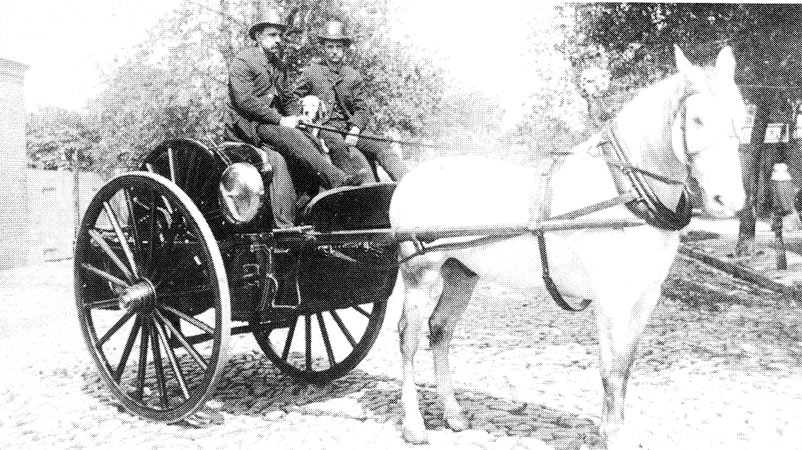
Engine Company 2 with 1869 Silsby Hose Cart. Photo Circa 1890. Note badges upon derby hats worn by Fire Fighters.
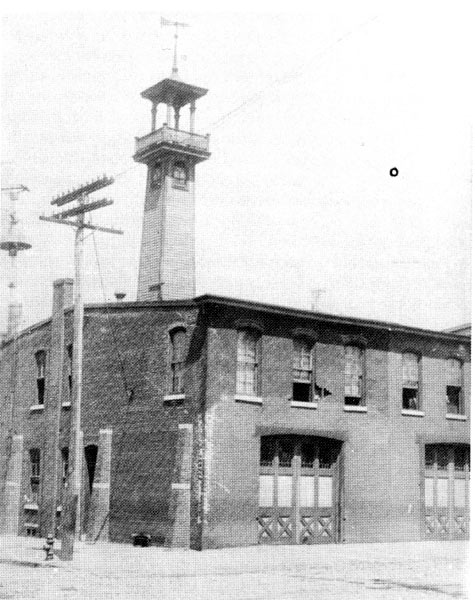
This is the earliest known photo of fire headquarters on the northwest corner of Fifth and Arch Streets. Originally built in 1869, the building shows signs of wear some twenty years later. Note the weathervane shaped like a fireman’s speaking trumpet atop the tower. Also, the fire alarm bell is pictured to the left of the telegraph pole above the rooftop. The bell was removed from the building once the fire alarm telegraph system was expanded and in good working order.
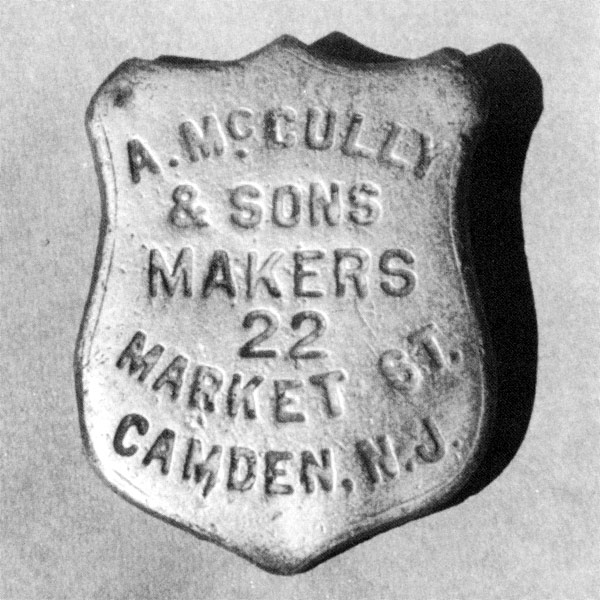
This maker’s plate once was attached to a harness made by A. McCully & Sons, 22 Market Street, Camden, New Jersey. This firm provided the first harnesses for the paid fire department in 1869.
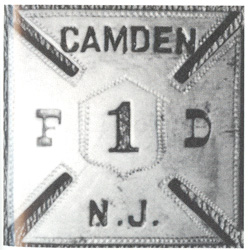
The first style of breast badge worn by members of the career department in the City of Camden. 1869. (Courtesy of the C.C.H.S. Collection).
Married
Philadelphia Inquirer —
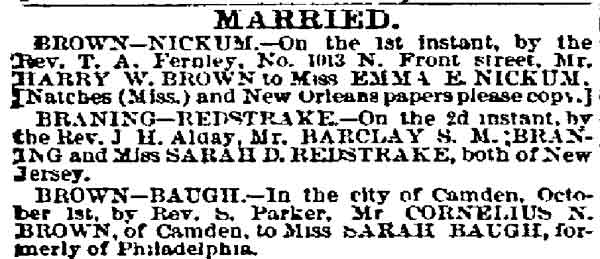
BROWN-NICKUM.
On the 1st instant, by the Rev. T. A. Fernley, No. 1013 N. Front street, Mr. HARRY W. BROWN to Miss EMMA E. NICKUM. [Natches (Miss.) and New Orleans papers please copy.]
BRANING-REDSTRAKE.
On the 2d instant, by the Rev. J. H. Alday, Mr. BARCLAY S. M. BRANING and Miss SARAH D. REDSTRAKE, both of New Jersey.
BROWN-BAUGH.
In the city of Camden, October 1st, by Rev. S. Parker, Mr. CORNELIUS N. BROWN, of Camden, to Miss SARAH BAUGH, formerly of Philadelphia.
The New Police Force
Philadelphia Inquirer —
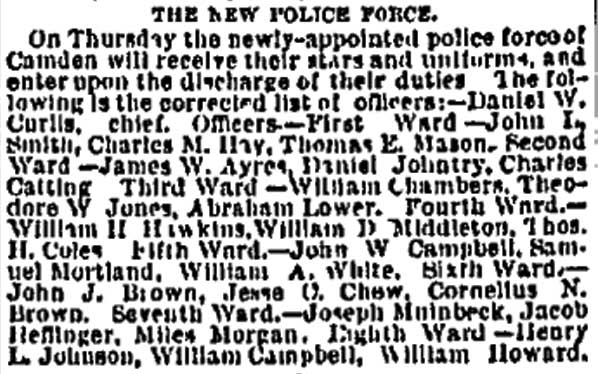
On Thursday the newly-appointed police force of Camden will receive their stars and uniforms, and enter upon the discharge of their duties. The following is the corrected list of officers:—Daniel W. Curlis, chief. Officers—First Ward—John I. Smith, Charles M. Hay, Thomas E. Mason. Second Ward—James W. Ayres, Daniel Johntry, Charles Catting. Third Ward—William Chambers, Theodore W. Jones, Abraham Lower. Fourth Ward—William H. Hawkins, William D. Middleton, Thos. H. Coles. Fifth Ward—John W. Campbell, Samuel Mortland, William A. White. Sixth Ward—John J. Brown, Jesse O. Chew, Cornelius N. Brown. Seventh Ward—Joseph Muinbeck, Jacob Heflinger, Miles Morgan. Eighth Ward—Henry L. Johnson, William Campbell, William Howard.
Camden and Vicinity
Philadelphia Inquirer —
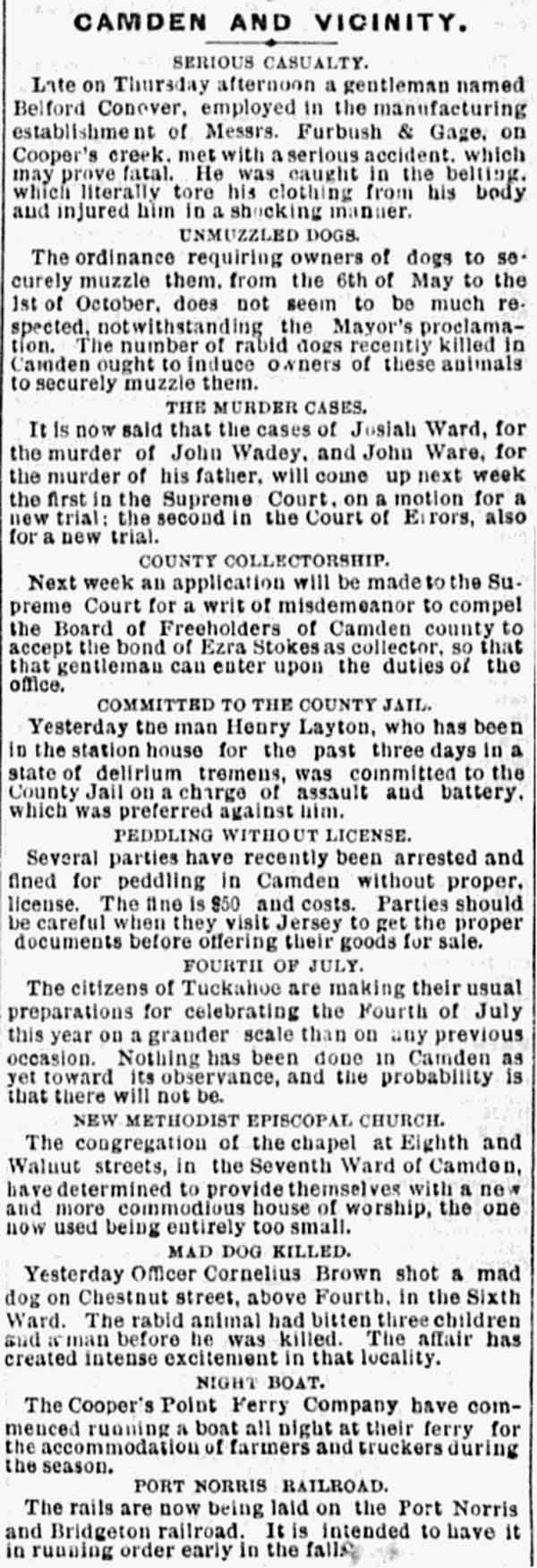
SERIOUS CASUALTY.
Late on Thursday afternoon a gentleman named Belford Conover, employed in the manufacturing establishment of Messrs. Furbush & Gage, on Cooper’s creek, met with a serious accident, which may prove fatal. He was caught in the belting, which literally tore his clothing from his body and injured him in a shocking manner.
UNMUZZLED DOGS.
The ordinance requiring owners of dogs to securely muzzle them, from the 6th of May to the 1st of October, does not seem to be much respected, notwithstanding the Mayor’s proclamation. The number of rabid dogs recently killed in Camden ought to induce owners of these animals to securely muzzle them.
THE MURDER CASES.
It is now said that the cases of Josiah Ward, for the murder of John Wadey, and John Ware, for the murder of his father, will come up next week the first in the Supreme Court, on a motion for a new trial; the second in the Court of Errors, also for a new trial.
COUNTY COLLECTORSHIP.
Next week an application will be made to the Supreme Court for a writ of misdemeanor to compel the Board of Freeholders of Camden county to accept the bond of Ezra Stokes as collector, so that that gentleman can enter upon the duties of the office.
COMMITTED TO THE COUNTY JAIL.
Yesterday the man Henry Layton, who has been in the station house for the past three days in a state of delirium tremens, was committed to the County Jail on a charge of assault and battery, which was preferred against him.
PEDDLING WITHOUT LICENSE.
Several parties have recently been arrested and fined for peddling in Camden without proper license. The fine is $50 and costs. Parties should be careful when they visit Jersey to get the proper documents before offering their goods for sale.
FOURTH OF JULY.
The citizens of Tuckahoe are making their usual preparations for celebrating the Fourth of July this year on a grander scale than on any previous occasion. Nothing has been done in Camden as yet toward its observance, and the probability is that there will not be.
NEW METHODIST EPISCOPAL CHURCH.
The congregation of the chapel at Eighth and Walnut streets, in the Seventh Ward of Camden, have determined to provide themselves with a new and more commodious house of worship, the one now used being entirely too small.
MAD DOG KILLED.
Yesterday Officer Cornelius Brown shot a mad dog on Chestnut Street, above Fourth, in the Sixth Ward. The rabid animal had bitten three children and a man before he was killed. The affair has created intense excitement in that locality.
NIGHT BOAT.
The Cooper’s Point Ferry Company have commenced running a boat all night at their ferry for the accommodation of farmers and truckers during the season.
PORT NORRIS RAILROAD.
The rails are now being laid on the Port Norris and Bridgeton railroad. It is intended to have it in running order early in the fall…
Firemen Appointed
Philadelphia Inquirer —
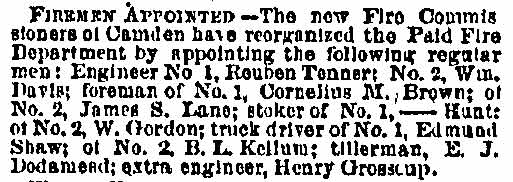
Firemen Appointed — The new Fire Commissioners of Camden have reorganized the Paid Fire Department by appointing the following regular men: Engineer No 1, Rouben Tenner; No. 2, Wm. Davis; foreman of No. 1, Cornelius M., Brown; of No. 2, James S. Lane; stoker of No. 1, — Hunt; of No. 2, W. Gordon; truck driver of No. 1, Edmund Shaw; of No. 2, B. L. Kellum; tillerman, E. J. Dodamead; extra engineer, Henry Grosscup.
A Day in Camden
Philadelphia Inquirer —
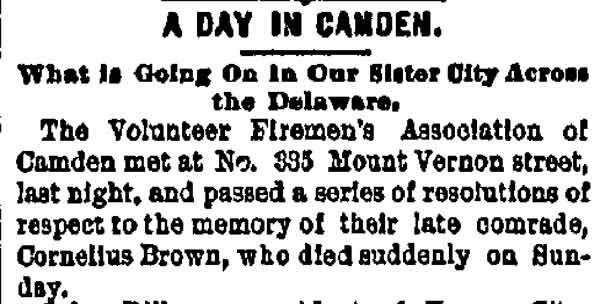
What is Going On In Our Sister City Across the Delaware.
The Volunteer Firemen’s Association of Camden met at No. 335 Mount Vernon Street, last night, and passed a series of resolutions of respect to the memory of their late comrade, Cornelius Brown, who died suddenly on Sunday.