Introduction
Abraham Browning was a prominent attorney in Camden who rose to the post of New Jersey Attorney General during his career. Born near Camden on July 26, 1808, he entered the New Jersey Bar in September of 1834. In 1843 he served with John W. Mickle as delegates to the New Jersey Constitutional Convention. He was named Attorney General in January of 1845, and served until 1850. In these times he was a principal in the Market Street ferry.
For $5,185 Robert K. Matlack and Abraham Browning bought a tract of 1,037 acres located in Gloucester and Cumberland Counties at a public sale on May 29, 1858. In 1860, Thomas Wilson purchased a large tract of land for $10,000 from Matlack and Browning. The Pennsylvania, Reading, and Seashore Railroad extending from Camden to Millville, branched off to connect with the seashore resorts. In 1863 this point was called Newfield, and Newfield became a borough in 1924.
He was a Democrat, and was a delegate to the Democratic National Convention from New Jersey in 1864. He also was a founder and the first president of the Camden County Bar Association.
Alfred M. Heston, in his two-volume work, Jersey Waggon Jaunts, published in 1926 (Camden, NJ, Atlantic County Historical Society, 1926), twice credits Abraham Browning of Camden with coining the name at the Centennial Exhibition in Philadelphia on New Jersey Day, August 24, 1876. On page 310 of volume 2 he writes: “In his address Mr. Browning compared New Jersey to an immense barrel, filled with good things to eat and open at both ends, with Pennsylvanians grabbing from one end and the New Yorkers from the other. He called New Jersey the Garden State, and the name has clung to it ever since.” The problem with this is that the image of a barrel tapped at both ends dates back at least to Benjamin Franklin, so this statement crediting Browning with naming the Garden State can not be taken at face value.
Abraham Browning made his home at 127 Market Street. Among his neighbors were William Calhoun, Sheriff of Camden County in the late 1870s and early 1880s, Charles Kalt, and prominent attorneys James B. Dayton and Peter L. Voorhees. Abraham Browning passed away in Camden on August 22, 1889. The Abraham Browning Council No. 122 of the Junior Order of United American Mechanics, a fraternal organization that was active in Camden from the late 19th through the mid-20th centuries, was named in his honor when it was incorporated in 1898.
Abraham Browning is not to be confused with Capt. Abraham M. Browning (1843–1880), who owned a farm called Cherry Hill Farm in what is now Cherry Hill, New Jersey, on the site of the present-day Cherry Hill Mall and Loews Theater complex.
The Market Street Ferry
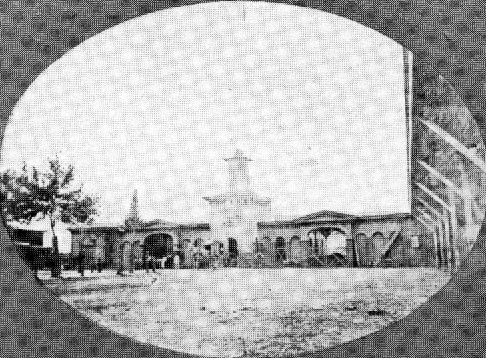
The Market Street Ferry in the days of Abraham Browning.
Biography
The History of Camden County New Jersey — George Reeser Prowell, 1886
Abraham Browning was born July 26, 1808, on his father's farm, in the vicinity of Camden. The family to which he belongs is one of the oldest in the State of New Jersey. The American founder, George Browning, came immediately from Holland, although of ancient English lineage, about the year 1735, and settled near Pea Shore. George Browning's son Abraham followed in his father's footsteps and became a farmer. He married Beulah Genge, who, like himself, was a native of New Jersey, but whose parents were English, arriving in America from London about the year 1760. From this marriage sprang the subject of this sketch and a numerous progeny. Abraham obtained his earliest education at the country schools in the neighborhood of his home. Possessed of a large capacity for acquiring knowledge, and gifted with a studious temperament, he made most effective use of all
his opportunities, and laid a solid foundation, broad and deep, for the superstructure of after-years. After an elementary course
thus satisfactorily pursued, he was placed at the academy at Woodbury. From this he was transferred to the popular school of John Gummere, in Burlington. The enlarged advantages here offered Abraham Browning were industriously improved, and he obtained a good English and a limited classical education.
He became a student in the law-office of Hon. Samuel L. Southard, at Trenton, in 1830. At the expiration of a year passed in preliminary study he entered the Law School of Yale College, and, after remaining two years, he entered the office of the well-known Philadelphia lawyer, Charles Chauncey. He was admitted to the bar in September, 1834, and immediately thereafter began to practice his profession in Camden, where he has ever since resided, laboring in his chosen career. He early became noted for the care and ability with which the business intrusted to his care was managed, and, as a natural consequence, he made steady and rapid progress through the ranks. With clear perception, a well-trained and well-
stored mind, to which constant study was ever bringing valuable contributions, indomitable industry and never-tiring investigation of detail, he obtained so thorough a mastery over his cases as to be almost invincible when he advised contest. Nowhere in the ranks of the profession could a harder student have been found; not one among the aspirants to similar fame devoted more faithful and painstaking labor to his client's interests than he has done. His aid has been sought in many important issues beyond the borders of New Jersey, and his reputation is national. As a constitutional lawyer he has been a recognized authority, and his opinion on points of constitutional issue carries great weight. In railroad cases, also, he has been regarded as especially strong, and
he has been engaged in many important cases, involving difficult and delicate points of railroad law. His famous contest with Hon. Theodore Cuyler, the Pennsylvania Railroad case, in 1871, will long be remembered by members of the profession for the profound legal learning, easy mastery over the mazy difficulties of a peculiarly intricate
St. Paul's Episcopal Church Officers
Philadelphia Inquirer —
In St. Paul’s Episcopal Church, Camden, the following officers were elected: Wardens—Abraham Browning, Marmaduke B. Taylor. Vestrymen—Maurice Browning, William H. Lafferty, Samuel H. Grey, Edward R. Shubrick, Jesse W. Starr, Joseph Fearon, William J. Sewell, H. Genet Taylor, James H. Carpenter, Henry C. Alexander, Robert F. S. Heath, Wilson H. Jenkins, Nathan F. Cowan, Harry Humphreys, E. H. King. Deputies to Diocesan Convention—Abraham Browning, Marmaduke B. Taylor, Edward R. Shubrick. Alternate Deputies to Convention—H. Genet Taylor, Robert F. S. Heath, Henry C. Alexander. Lay Delegate to Burlington Convocation—Joseph Fearon.