William Henry 'Harry' McKeen
William Henry “Harry” McKeen was appointed to the Camden Fire Department to replace Robert Pine as an extra man with Engine Company 2, who resigned April 2, 1870.
William H. McKeen was born in New Jersey around 1841. When the Census was taken in 1860 he was living in Camden’s Middle Ward with a boilermaker, John Cline, his wife Sarah and their children. It appears that William H. McKeen may have been married to Mary Cline. However, in the 1870 Census, in which he appears as Henry McKeen, he is living elsewhere and is single.
William Henry McKeen enlisted as a Private in Company A, 10th Infantry Regiment New Jersey on September 21, 1861.
The Tenth Regiment was eventually attached to the First Brigade of New Jersey Volunteers. Companies A, E, H, and I, of it, were recruited in Camden County. It was created under authority from the War Department and recruited by Colonel William Bryan, of Beverly, against the wishes of Governor Olden, although it was named the “Olden Legion.” His objection was that the War Department issued the authorization direct to private individuals instead of through and to the officials of the State — a course which had previously been unknown. The regiment proceeded to Washington December 26, 1861. On January 29, 1862, the Governor finally accepted it as part of the quota of New Jersey, whereupon it was thoroughly reorganized and designated as the Tenth Regiment, and Colonel William R. Murphy appointed to it. In April, 1863, it was relieved from provost duty in Washington and sent to Suffolk, Virginia, where, on April 23rd and May 4th, it shared in the repulse of Longstreet as a portion of Corcoran’s brigade, Peck’s division, Seventh Corps. In July it was ordered to Philadelphia in anticipation of a resistance to the draft, and remained there two months. Its dress parades were one of the shows of the city. In September it was moved to Pottsville, Pa., and spent the winter of 1863–64 in Schuylkill, Carbon and Luzerne Counties repressing the Confederate sympathizers of the coal region, who were encouraging desertions, interfering with recruiting, interrupting mining operations and murdering men conspicuous for their devotion to the Union. Colonel O. H. Ryerson, who succeeded Murphy in command, was president of a commission which tried many of these offenders. During the winter the regiment re-enlisted and in April, 1864, joined the First Brigade at Brandy Station, Virginia, sharing in all its subsequent battles.
In the battle of the Wilderness the regiment suffered severely, especially in the assault of the Confederate General Gordon late on May 6th. In the engagement resulting from this assault, the regiment lost nearly one entire company in prisoners alone, and losing Colonel Ryerson, who was mortally wounded in the Wilderness. On the evening of the 8th it again met the foe, when the regiment on its left became in some way separated from it and the two being thus isolated, were pounced upon by the enemy with great force, compelling them to give way, with heavy loss — the 10th having 80 men and several officers captured, including Col. Tay, the prisoners being taken to the rear and the next day started for Richmond, but were fortunately on the same day rescued from the hands of their guards by General Sheridan, at Beaver Dam Station. The total loss of the regiment up to this time, aside from prisoners, had been 113 — 18 killed and 95 wounded. In the fighting along the Po river the 10th shared with the brigade, and at Cold Harbor again suffered largely, being in the first day’s engagement in the third line of battle, and losing some 70 in killed and wounded. In the assault upon the enemy’s position the regiment charged alone at a peculiarly exposed point and sustained heavy loss, amounting in all to some 65 in killed and wounded. On August 15 it participated in a sharp picket skirmish near Strasburg, and two days afterward took part in the battle of Winchester, assisting to hold the whole of Early’s army in check for a period of six hours. The regiment not only lost considerably in killed and wounded, but also in prisoners, Col. Tay being again captured, with 115 men of the brigade. At the close of this affair, the 10th, which crossed the Rapidan in May with 600 men, had only 80 men left for duty — a fact which exhibits more forcibly than any words the severity of the experience which it had been called upon to undergo. In the subsequent battles in the Shenandoah Valley the regiment, feeble as it was, bravely maintained its reputation. During the winter of 1864–65, having with the brigade rejoined the army before Petersburg and being largely recruited, it participated in the various movements which resulted so detrimentally to the enemy and in the grand assault of April 2 rendered distinguished service. When the Confederate flag went down at Appomattox, the regiment turned its face homeward, reaching the vicinity of Washington, 450 strong, on June 2, and was mustered out of service at Hall’s Hill, Virginia on June 22, 1865. The total strength of the regiment was 2,584, and it lost, by resignation 20; by discharge 293; by promotion 69; by transfer 162; by death 274; by desertion 748; by dismissal 1; not accounted for 138; mustered out 879.
Private William Henry “Harry” McKeen was among those who mustered out of Company A, 10th Infantry Regiment New Jersey July 1, 1865 at Hall’s Hill.
William Henry McKeen returned to Camden, and in the 1870 Census, he appears as Henry McKeen, living in the Middle Ward, is single and working as a fireman. This is consistent with Camden Fire Department records which show him living at 112 South 2nd Street and as a fireman for the Camden & Amboy Rail Road. William Henry McKeen was appointed to the Camden Fire Department in April of 1870 and served for almost three years. He resigned from service on March 8, 1873. He was still living at 112 South 2nd Street during his last year of service.
William McKeen does not appear in the 1878–1879 Camden City Directory and appears to have left the city. He did live long enough to collect an invalids Civil War pension.
Vacancies Filled
Philadelphia Inquirer —
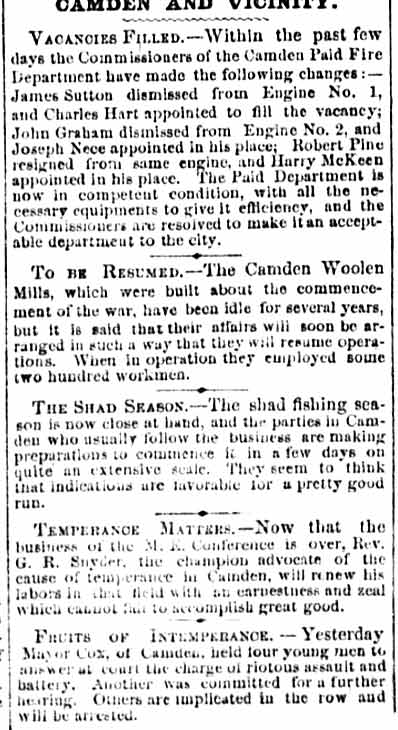
Vacancies Filled.—Within the past few days the Commissioners of the Camden Paid Fire Department have made the following changes: James Sutton dismissed from Engine No. 1, and Charles Hart appointed to fill the vacancy; John Graham dismissed from Engine No. 2, and Joseph Nece appointed in his place; Robert Pine resigned from Engine No. 2, and Harry McKeen appointed in his place. The Paid Department is now in competent condition, with all the necessary equipments to give it efficiency, and the Commissioners are resolved to make it an acceptable institution to the city.
Arrested
Philadelphia Inquirer —
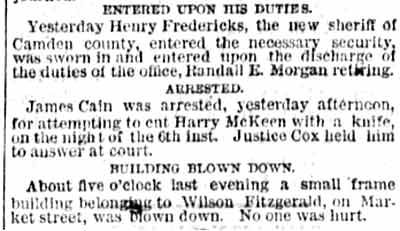
Entered Upon His Duties.—Yesterday Henry Fredericks, the new sheriff of Camden county, entered the necessary security, was sworn in and entered upon the discharge of the duties of the office, Randall E. Morgan retiring.
Arrested.—James Cain was arrested, yesterday afternoon, for attempting to cut Harry McKeen with a knife, on the night of the 6th inst. Justice Cox held him to answer at court.
Building Blown Down.—About five o’clock last evening a small frame building belonging to Wilson Fitzgerald, on Market Street, was blown down. No one was hurt.
Civil War Pension Record
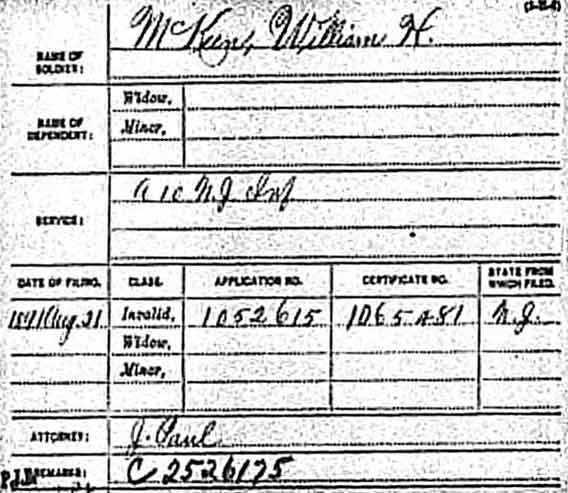
Named: Civil War Pension Record, McKeen, William H., Company A, 10th N.J. Infantry, and Invalid pension, Application No. 1052615.