Introduction
Abram Lower Jr. entered service in December of 1869 as an extra man of the Hook & Ladder Company, the original designation of what is now Ladder Company 1. Prior to entering the fire department he worked as a carpenter and building contractor. Abraham Lower was living at 134 Taylor Avenue when he joined the department in the fall of 1869.
Abram Lower Jr. was born in Pennsylvania in January of 1839. The 1850 census shows the Lower family living in Philadelphia. Abram Lower Jr.’s brother-in-law, William H. Shearman, the husband of his sister Amanda, also lived there. The elder Lower worked as a carpenter, and in time Abram Lower Jr. followed in that profession. He married his wife Elizabeth in 1859. Abram Lower served in the Union Army during the Civil War. Both William H. Shearman and Abram Lower Jr. settled in Camden after the Civil War, and apparently both became volunteer firefighters.
On September 2, 1869 City Council enacted a municipal ordinance creating a paid fire department. It provided for the annual appointment of five Fire Commissioners, one Chief Marshal (Chief of Department) and two Assistant Marshals. The City was also divided into two fire districts. The boundary line ran east and west, starting at Bridge Avenue and following the tracks of the Camden and Amboy Railroad to the city limits. District 1 was south of this line and District 2 was north. The commissioners also appointed the firemen who were scheduled to work six 24-hour tours per week. William Abels, from the Weccacoe Hose Company No. 2 was appointed Chief Marshal with William J. Mines, from the Independence Fire Company No. 3 as Assistant Marshal for the 1st District, and William H. Shearman as the Assistant Marshal for the 2nd District. Abels had served with the volunteer fire departments of Philadelphia, Mobile, Alabama and Camden for sixteen years prior to his appointment as Chief of the paid force.
On November 10, 1869 City Council purchased the Independence Firehouse, the three-story brick building at 409 Pine Street, for $4,500. The building was designated to serve as quarters for Engine Company 1 and the 1st District. On October 29, 1869 City Council authorized construction of a two-story brick building on the northwest corner of Fifth and Arch Streets as quarters for the 2nd District. On November 25th the Fire Commissioners signed a contract with M.N. Dubois in the amount of $3,100 to erect this structure. The 2nd District would share these quarters with Engine Company 2 and the Hook & Ladder Company and the facility would also serve as department headquarters for the new paid force. The original contract remains part of the Camden County Historical Society collection.
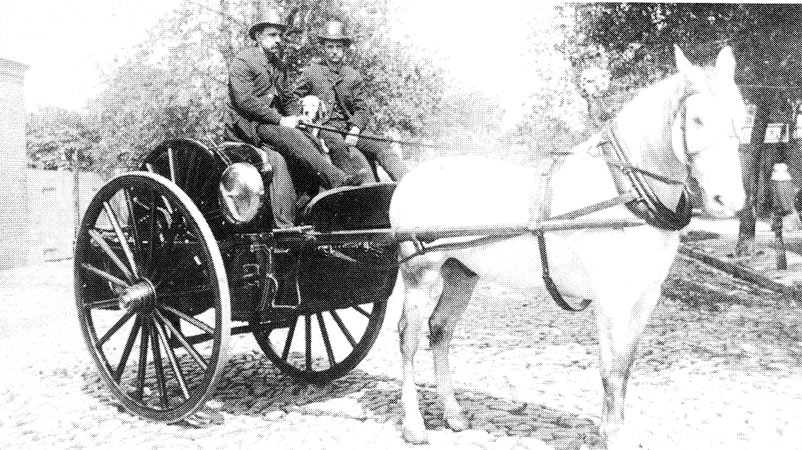
Engine Company 2 with 1869 Silsby Hose Cart. Photo circa 1890. Note badges upon derby hats worn by firefighters.
Two Amoskeag second class, double pump, straight frame steam engines were purchased at a cost of $4,250 each. Two Silsby two wheel hose carts, each of which carried 1,000 feet of hose, were another $550 each and the hook & ladder, built by Schanz and Brother of Philadelphia was $900. Each engine company received a steam engine and hose cart. Amoskeag serial #318 went to Engine Company 1, and serial #319 to Engine Company 2. The Fire Commission also secured the services of the Weccacoe and Independence steamers in case of fire prior to delivery of the new apparatus. Alfred McCully of Camden made the harnesses for the horses. Camden’s Twoes & Jones made the overcoats for the new firemen and a Mr. Morley, also of Camden, supplied the caps and belts which were manufactured by the Migeod Company of Philadelphia. The new members were also issued badges.
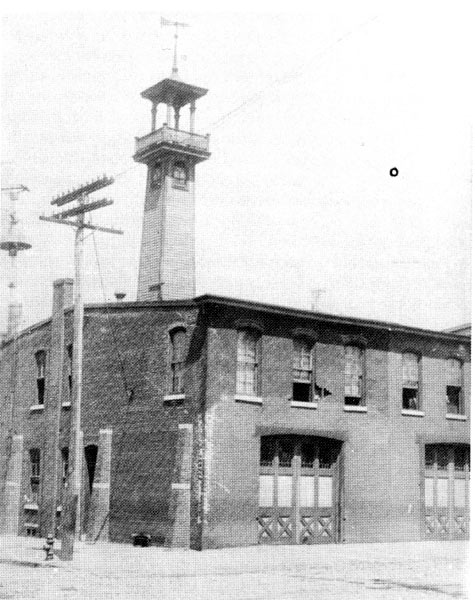
This is the earliest known photo of fire headquarters on the northwest corner of Fifth and Arch Streets. Originally built in 1869, the building shows signs of wear some twenty years later. Note the weathervane shaped like a fireman’s speaking trumpet atop the tower. Also, the fire alarm bell is pictured to the left of the telegraph pole above the rooftop. The bell was removed from the building once the fire alarm telegraph system was expanded and in good working order.
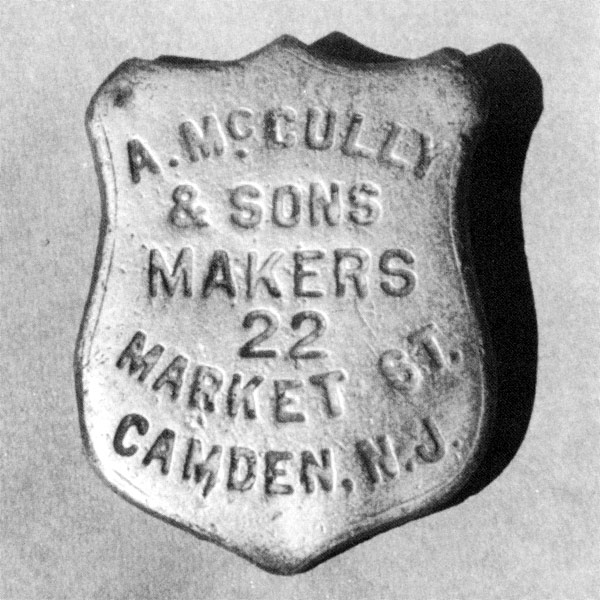
This maker’s plate once was attached to a harness made by A. McCully & Sons, 22 Market Street, Camden, New Jersey. This firm provided the first harnesses for the paid fire department in 1869. (Courtesy of the C.C.H.S. Collection).
Badges worn by the marshals, engineers, stokers and engine drivers bore the initial letter of their respective positions and their district number. The tillerman and his driver used the number “3” to accompany their initial letter. The extra men of the 1st District were assigned badges 1–10; 2nd District badges were numbered 11–20 and the extra men of the hook & ladder wore numbers 21–30.
Although the Fire Commission intended to begin operation of the paid department on November 20, 1869, the companies did not actually enter service until December 7th at 6 P.M. because the new apparatus and buildings were not ready. The new apparatus was not tried (tested) until December 9th.
The new members of the Hook & Ladder Company were:
Edward J. Dodamead, Tillerman; Frank S. Jones, Driver
Extra Men:
- Charles Baldwin – Badge #21
- Charles G. Zimmerman – Badge #22
- John Durkin – Badge #23
- William C. Lee – Badge #24
- James M. Lane – Badge #25
- James Cassidy – Badge #26
- Robert S. Bender – Badge #27
- Thomas McCowan – Badge #28
- Howard Lee – Badge #29
- Abram Lower Jr. – Badge #30
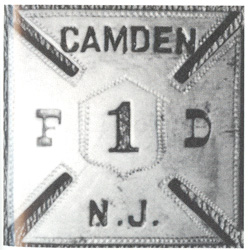
The first style of breast badge worn by members of the career department in the City of Camden. 1869. (Courtesy of the C.C.H.S. Collection).
The Board of Fire Commissioners consisted of Rudolphus Bingham, Chairman, and Samuel C. Harbert, Richard Perks, Jonathon Kirkbride and Jacob Daubman.
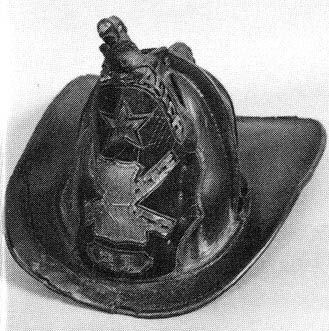
Leather helmet of natural grain believed to have been worn by Fireman Charles Baldwin, Hook & Ladder Company 1 when paid force was organized in 1869. Number 21 at bottom of frontpiece indicates member’s badge number. (Courtesy of the Camden County Historical Society Collection.)
Annual salaries for the members of the paid force were: Chief Marshal, $800; Assistant Marshal, $200; Engineer, $600; Driver, $450; Stoker, $450; Tillerman, $450; Extra Men, $50. All but Extra Men were paid monthly.
Abram Lower Jr. resigned from service with the Camden Fire Department on April 11, 1871. He and his wife eventually settled in Point Pleasant Beach, New Jersey.
Abram Lower Jr. was living in Point Pleasant Beach, New Jersey when the Census was taken in June of 1900. A grandson, Abram Leland, lived with them. Abram Lower Jr. was an active member of the Grand Army of the Republic, better known by its acronym, the G.A.R.
The New Police Force
Philadelphia Inquirer —
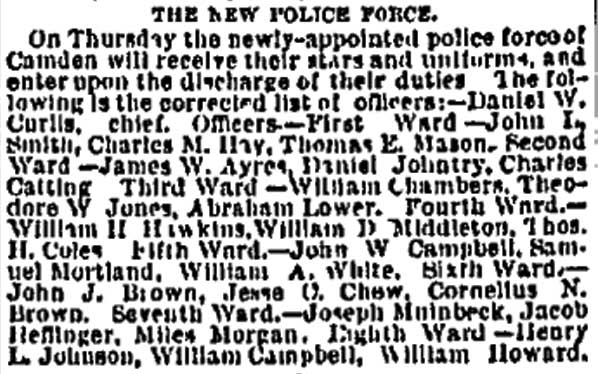
On Thursday the newly-appointed police force of Camden will receive their stars and uniforms, and enter upon the discharge of their duties. The following is the corrected list of officers:—Daniel W. Curlis, chief. Officers—First Ward—John I. Smith, Charles M. Hay, Thomas E. Mason. Second Ward—James W. Ayres, Daniel Johntry, Charles Catting. Third Ward—William Chambers, Theodore W. Jones, Abraham Lower. Fourth Ward—William H. Hawkins, William D. Middleton, Thos. H. Coles. Fifth Ward—John W. Campbell, Samuel Mortland, William A. White. Sixth Ward—John J. Brown, Jesse O. Chew, Cornelius N. Brown. Seventh Ward—Joseph Muinbeck, Jacob Heflinger, Miles Morgan. Eighth Ward—Henry L. Johnson, William Campbell, William Howard.
Held to Answer
Philadelphia Inquirer —

Held to Answer. – Justice Cassady yesterday held Abram Lower in $500 to answer at court for an assault and battery on John Sands, an assault on the Justice, and to keep the peace.
Abe Lower Opens the Campaign
Camden Democrat —
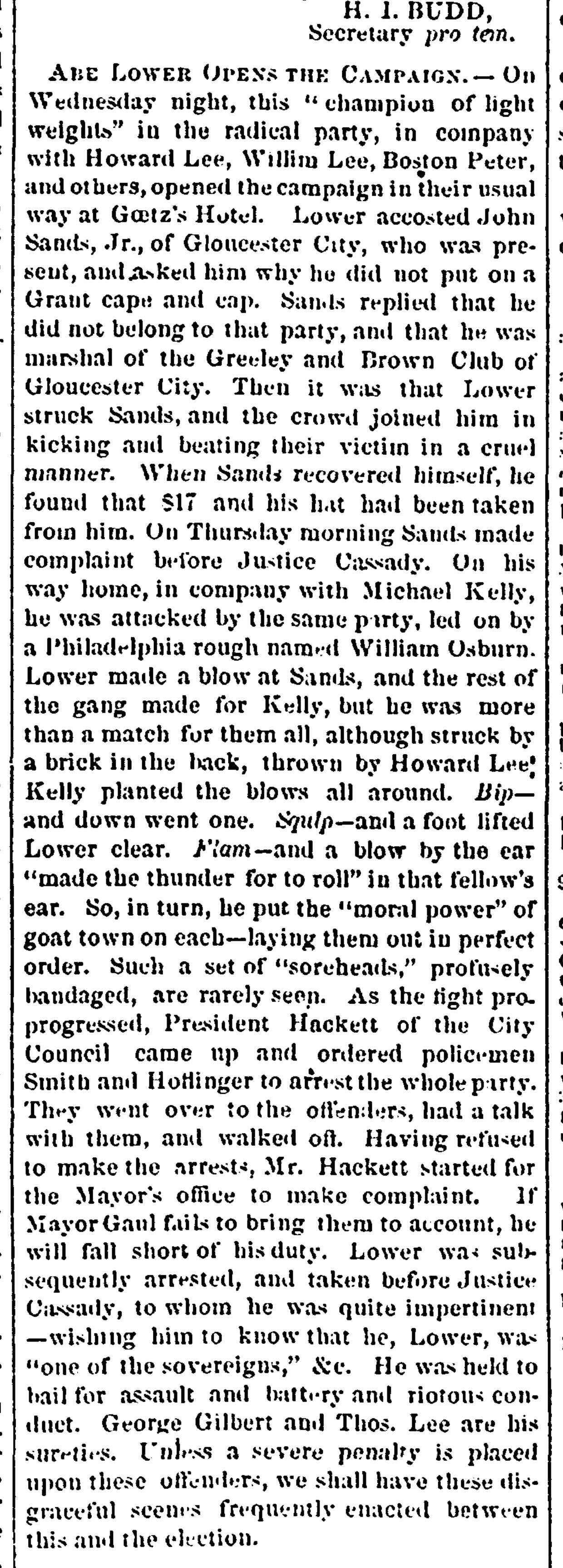
On Wednesday night, this “champion of light weights” in the radical party, in company with Howard Lee, Willim [sic] Lee, Boston Peter, and others, opened the campaign in their usual way at Goetz’s Hotel. Lower accosted John Sands, Jr., of Gloucester City, who was present, and asked him why he did not put on a Grant cape and cap. Sands replied that he did not belong to that party, and that he was marshal of the Greeley and Brown Club of Gloucester City. Then it was that Lower struck Sands, and the crowd joined him in kicking and beating their victim in a cruel manner. When Sands recovered himself, he found that $17 and his hat had been taken from him. On Thursday morning Sands made complaint before Justice Cassady. On his way home, in company with Michael Kelly, he was attacked by the same party, led on by a Philadelphia rough named William Osburn. Lower made a blow at Sands, and the rest of the gang made for Kelly, but he was more than a match for them all, although struck by a brick in the back, thrown by Howard Lee. Kelly planted the blows all around. Bip—and down went one. Squlp—and a foot lifted Lower clear. Flam—and a blow by the ear “made the thunder for to roll” in that fellow’s ear. So, in turn, he put the “moral power” of goat town on each—laying them out in perfect order. Such a set of “soreheads,” profusely bandaged, are rarely seen. As the fight progressed, President Hackett of the City Council came up and ordered policemen Smith and Hollinger to arrest the whole party. They went over to the offenders, had a talk with them, and walked off. Having refused to make the arrests, Mr. Hackett started for the Mayor’s office to make complaint. If Mayor Gaul fails to bring them to account, he will fall short of his duty. Lower was subsequently arrested, and taken before Justice Cassady, to whom he was quite impertinent—wishing him to know that he, Lower, was “one of the sovereigns,” &c. He was held to bail for assault and battery and riotous conduct. George Gilbert and Thos. Lee are his sureties. Unless a severe penalty is placed upon these offenders, we shall have these disgraceful scenes frequently enacted between this and the election.
Barrett Commands
Philadelphia Inquirer —
Special to The Inquirer.
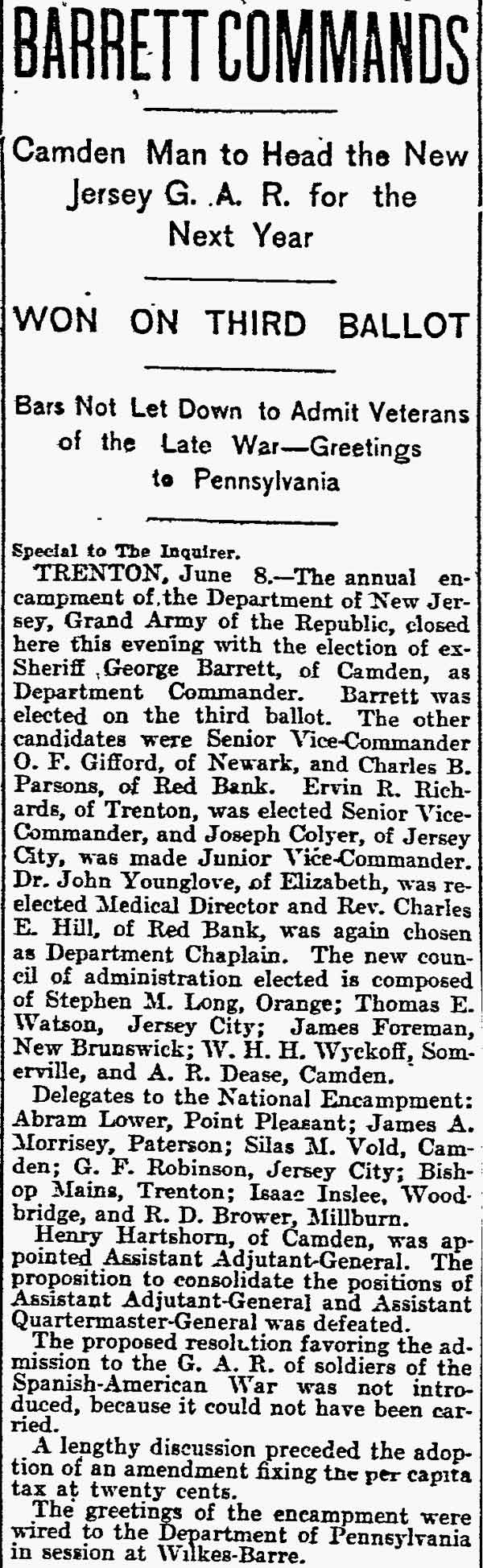
TRENTON, June 8.—The annual encampment of the Department of New Jersey, Grand Army of the Republic, closed here this evening with the election of ex-Sheriff George Barrett, of Camden, as Department Commander. Barrett was elected on the third ballot. The other candidates were Senior Vice-Commander O. F. Gifford, of Newark, and Charles B. Parsons, of Red Bank. Ervin R. Richards, of Trenton, was elected Senior Vice-Commander, and Joseph Colyer, of Jersey City, was made Junior Vice-Commander. Dr. John Younglove, of Elizabeth, was re-elected Medical Director and Rev. Charles E. Hill, of Red Bank, was again chosen as Department Chaplain. The new council of administration elected is composed of Stephen M. Long, Orange; Thomas E. Watson, Jersey City; James Foreman, New Brunswick; W. H. H. Wyckoff, Somerville, and A. R. Dease, Camden.
Delegates to the National Encampment: Abram Lower, Point Pleasant; James A. Morrisey, Paterson; Silas M. Vold, Camden; G. F. Robinson, Jersey City; Bishop Mains, Trenton; Isaac Inslee, Woodbridge, and R. D. Brower, Millburn.
Henry Hartshorn, of Camden, was appointed Assistant Adjutant-General. The proposition to consolidate the positions of Assistant Adjutant-General and Assistant Quartermaster-General was defeated.
The proposed resolution favoring the admission to the G. A. R. of soldiers of the Spanish-American War was not introduced, because it could not have been carried.
A lengthy discussion preceded the adoption of an amendment fixing the per capita tax at twenty cents.
The greetings of the encampment were wired to the Department of Pennsylvania in session at Wilkes-Barre.