John J. Olden
JOHN J. OLDEN was born in Pennsylvania in November of 1837 to David and Sarah Olden. David Olden passed away in 1848. The 1850 Census shows the family in what was then Spring Garden Ward 3, Precinct 2, Philadelphia, Pennsylvania. Older brother Oliver Olden worked as a coach trimmer to support the family. A sister, Martha, and a brother, Cornelius, are listed in the Census.
When the Census was taken in 1860 John J. Olden was living in Philadelphia with his wife, the former Elizabeth Schwaab, widowed mother Sarah and brother Cornelius. John and Elizabeth Olden had wed the year before.
John J. Olden enlisted on August 16, 1861 as a Private in Company E, New Jersey 6th Infantry Regiment.
The Sixth Infantry Regiment was organized under the provisions of an act of Congress, approved July 22, 1861, and was fully organized, equipped and officered by August 19, at which time it was mustered into the U. S. service at Camp Olden, Trenton, for three years. It left the state on Sept. 10, with 38 officers, 860 non-commissioned officers and privates, a total of 898. William H. Schwaab, who was most likely Private Olden’s brother-in-law, was among the 898 men. Both John J. Olden and William H. Schwaab would serve with the Camden Fire Department in the 1870s.
Upon arrival at Washington the regiment went into camp at Meridian hill, and remained there until the early part of December, at which time it was ordered to report to General Hooker, near Budd’s Ferry, Maryland, where it was brigaded with the 5th, 7th and 8th N. J., composing what was generally known as the 2nd New Jersey Brigade, the 3d brigade, Hooker’s division.
At the battle of Williamsburg, Virginia, which took place on May 5, 1862, the brigade was sent into the left of a road and occupied a wood in front of a line of field-works. Among the killed was Lieutenant Colonel John P. Van Leer, and among the wounded were a large number of officers.
At the battle of Fair Oaks the 5th and 6th moved forward under Colonel Starr, cutting their way through a mass of panic-stricken fugitives, the loss of the 6th being 7 killed and 14 wounded. The next morning the two regiments advanced and occupied the ground recovered from the enemy, where they remained until June 25, being almost constantly on duty at the front. In the combat at Savage Station, the New Jersey brigade was not directly engaged, but the 6th regiment had 2 men wounded by shells. At Bristoe Station Colonel Mott was badly wounded in the fore-arm, and in the series of engagements, ending at Chantilly on September 1, 1862, the regiment suffered a total loss of 104 men. Going into camp at Alexandria, the brigade remained undisturbed until November 1 when, Lee having been driven from Maryland, it proceeded towards Bristoe Station, where it arrived on the 4th, the 5th and 6th regiments being in advance. For the Chancellorsville affair in the spring of 1863, the New Jersey brigade, which at that time included the 2nd New York and 115th Pennsylvania regiments, as well as the 5th, 6th, 7th and 8th New Jersey, all under command of General Mott, crossed the Rappahannock on Friday, May 1. The losses of the 6th during the engagement amounted to 6 killed, 59 wounded and 8 missing, Colonel Burling being among the wounded. At the time of the battle of Gettysburg the 115th Pennsylvania and 2nd New Hampshire regiments were attached to the brigade, which was under the command of Colonel Burling, General Mott not having recovered from his wound received at Chancellorsville. At the battle of the Wilderness, at 5 o’clock in the morning of the second day, six regiments of the brigade advanced, the 5th, 6th and 11th N. J. being placed under Colonel Sewell. In the assault at Spottsylvania the brigade was in the front line, the 6th acting as skirmishers. The total losses of the regiment during the months of May and June, 1864, amounted to 16 killed, 99 wounded, 8 missing. In August and September, 1864, a large number of recruits were forwarded to the regiment, and with those who had reenlisted and those whose term of service had not expired, were assigned to what was known as Cos. A, B and C, 6th battalion, until October 12, 1864, at which time they were transferred to and consolidated with the 8th regiment.
Private John J. Olden was among those who reenlisted. He was transferred to Company F, New Jersey 8th Infantry Regiment on October 12, 1864. The regiment fought on October 27, 1864 at Boydton Plank Road, VA, and engaged the enemy on five separate occasions in November at Petersburg before going into winter quarters. The 8th New Jersey fought on February 5 and 6 at Hatcher’s Run, Virginia. After this action, on March 15, 1865 Private John J. Olden was transferred to a Veterans Reserve Corps company. The Veteran Reserve Corps was a military reserve organization created within the Union Army during the Civil War to allow partially disabled or otherwise infirmed soldiers (or former soldiers) to perform light duty, freeing able-bodied soldiers to serve on the front lines. Private Olden mustered out on August 11, 1865, and returned to his wife and family.
The 1870 Census shows John Olden and his wife Elizabeth “Lizzie” living in Camden’s South Ward with their sons Charles 10, and John, 4. John Olden was working as a paperhanger.
John J. Olden became involved with the Camden Fire Department when Robert S. Bender, Chief of the Fire Department, took a leave of absence in September of 1872. Despite a petition for Bender to be kept on as chief, Henry F. Surault was elected by city council to lead the department. Isaac McKinley and Patrick Gallagher were appointed Assistant Chiefs, replacing Assistant Chiefs William W. Mines and William H. Shearman. A greater crisis occurred on October 8, 1872 when most of the regular members of Engine Company 2 resigned at once. Replacements were found quickly, although in a few cases the first ones brought in did not work out and another man was needed to replace the original replacement. In November of 1872 John J. Olden was called upon to serve under Chief Fire Marshal Henry F. Surault as Assistant Fire Marshal for the Camden Fire Department, a post with similar duties to that of Deputy Chief and the old District Chief title. John Olden was responsible for the Second Fire District, i.e., the northern section of what was then Camden. John Olden replaced Patrick Gallagher, who had been elected to this position by City Council on September 26, 1872, as Assistant Fire Marshall for the Second District, and perhaps had something to do with the mass resignation at Engine Company 2.
He remained in this post until the following spring, when Robert S. Bender returned to the Fire Department after having taken a leave of absence, and the Fire Department was reorganized, eliminating the Assistant Marshal’s positions, and creating a position for one Assistant Engineer. This ended John Olden’s tenure with the Camden Fire Department. John Olden was a Democrat in a town that generally was dominated politically by the Republican party, he also had a bit of a reputation as a “tough” individual. In a time when politics was literally a full-contact sport, this was not at all unheard of.
John J. Olden and his family were living at 336 Spruce Street when the Census was taken in 1880. Two more children had joined the family, William and Sarah.
The 1890 Veterans census shows John J. Olden at 338 Spruce Street.
The 1900 Census shows John Olden and Lizzie Olden at 329 Spruce Street. John Olden was still working as a paperhanger. Charles Olden had moved out, but the other three children were still at home and all working.
The 1910 Census shows that John J. Olden had finally retired. The family was living at 829 South 4th Street. Sons John L. and William V. Olden were still at home, both were working at the Victor Talking Machine Company’s factory. Daughter Sarah worked in a department store. When the 1914 Camden City Directory was compiled, the Olden family had moved to 503 Cherry Street, and all appear to have found other employment.
Elizabeth Olden died on December 29, 1915. She was survived by her husband and all four of her children. The 1919 City Directory shows the Olden family at 571 Spruce Street. John J. Olden died in March of 1916 and was buried at Evergreen Cemetery.
Lewis Becker Assault
Trenton State Gazette —
On Monday evening Lewis Becker, a quiet and inoffensive gentleman, was set upon by some men at the foot of Cooper-street, Camden, and beaten in an outrageous manner. Henry Colbert, one of the party, was arrested and fined. Charles Miskelley and John Olden, who, it is said, struck the blows, are still at large.
Camden and Vicinity
Philadelphia Inquirer —
Special Court.
The following sentences were passed in the Special Court yesterday, after which that body adjourned:—John Bamford, atrocious assault and battery, fined $5 and costs, and stand committed until the same are paid; John Olden, assault and battery, $1 and costs; John Donaldson, petit larceny, $5 and costs; William Howe, assault and battery, $1 and costs; John Burk, assault and battery, three indictments, $1 and costs; George Bowen, breaking and entering, six months in State Prison; same, on two charges of larceny, $5 and costs on each; James Welsh, grand larceny, sixty days in county jail, and $20 and costs fine; William Butler, breaking and entering, thirty days in county jail; same, for petit larceny, $5 and costs; Joseph Cowan, assault and battery, $1 and costs; Benjamin Fisher, till tapping, twenty days in county jail; Charles Pippit, assault and battery, $1 and costs; Bridget Sages, assault and battery, $5 and costs. This woman hit a man on the head yesterday with a pitcher, was brought to Camden, tried, convicted, sentenced and released without paying her fine, all the same day. That was rather quick work.
State Scraps
Bridgeton Evening News —
Patrick Gallagher, the newly appointed Fish Warden of Camden county, has selected his crew. It comprises men of the same character as Gallagher himself. Two of them are well known to the Camden authorities. John A. Smith, better known as “Tommy Dodd,” and Harry Gallagher, alias “Friz,” are the two who have repeatedly been before the courts of justice for various offences. The other two members of the crew are John Olden and Edward Swope, well known characters in Camden.
The Democrats Have a Lively Time at Their Primaries
Philadelphia Inquirer —
Camden News Budget.
A Contested Ward.
Blackjacks and free fist fights characterized the Democratic primaries in Camden county last night. The election was held for members of the Executive Committee. The main fights were in the Second and Fifth wards of Camden and the First ward of Gloucester City. In the Second ward William H. Fredericks defeated Harry B. Paul.
In the Fifth ward there was quite a rumpus. Some time ago the ward committee met and elected a set of election officers to act last night. When these men went to serve last night they were refused admittance by the Gallagher faction. The latter’s followers then curb-stoned a set of election officers and started the voting. David B. Peterson, Gallagher’s opponent, then shouted for all of his followers to follow him. They did this and opened a voting place of their own in the house of John J. Olden, on Spruce street below Fourth.
The committee elected were: First ward, John McCormick; Second ward, William H. Fredericks; Third ward, William H. Getty; Fifth ward, contest, to be settled by the committee; Sixth ward, Charles Tanier; Seventh ward, Charles Stevens; Eighth ward, George W. Blake; Ninth ward, Charles S. Reese.
Down in Gloucester they will not be done counting before noon to-day. In the First ward there was a big fight between John Gaunt, of the Prosecutor’s office, and Chief of Police Lyons. Free fights and blackjacking were common things. No arrests were made.
Fraud Charged in an Election
New York Herald —
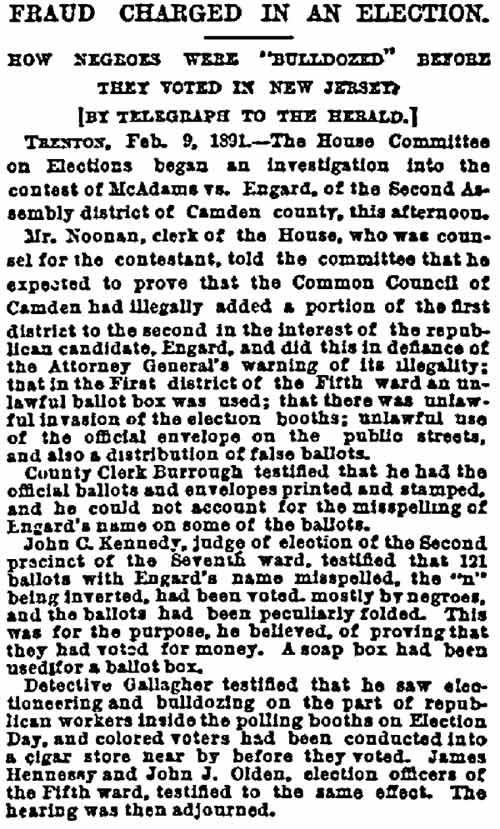
How Negroes Were “Bulldozed” Before They Voted in New Jersey.
[By Telegraph to the Herald.]
TRENTON, Feb. 9, 1891.—The House Committee on Elections began an investigation into the contest of McAdams vs. Engard, of the Second Assembly district of Camden county, this afternoon.
Mr. Noonan, clerk of the House, who was counsel for the contestant, told the committee that he expected to prove that the Common Council of Camden had illegally added a portion of the first district to the second in the interest of the republican candidate, Engard, and did this in defiance of the Attorney General’s warning of its illegality; that in the First district of the Fifth ward an unlawful ballot box was used; that there was unlawful invasion of the election booths; unlawful use of the official envelope on the public streets, and also a distribution of false ballots.
County Clerk Burrough testified that he had the official ballots and envelopes printed and stamped, and he could not account for the misspelling of Engard’s name on some of the ballots.
John C. Kennedy, judge of election of the Second precinct of the Seventh ward, testified that 121 ballots with Engard’s name misspelled, the “n” being inverted, had been voted, mostly by negroes, and the ballots had been peculiarly folded. This was for the purpose, he believed, of proving that they had voted for money. A soap box had been used for a ballot box.
Detective Gallagher testified that he saw electioneering and bulldozing on the part of republican workers inside the polling booths on Election Day, and colored voters had been conducted into a cigar store near by before they voted. James Hennesay and John J. Olden, election officers of the Fifth ward, testified to the same effect. The hearing was then adjourned.
John J. Olden, Evergreen Cemetery
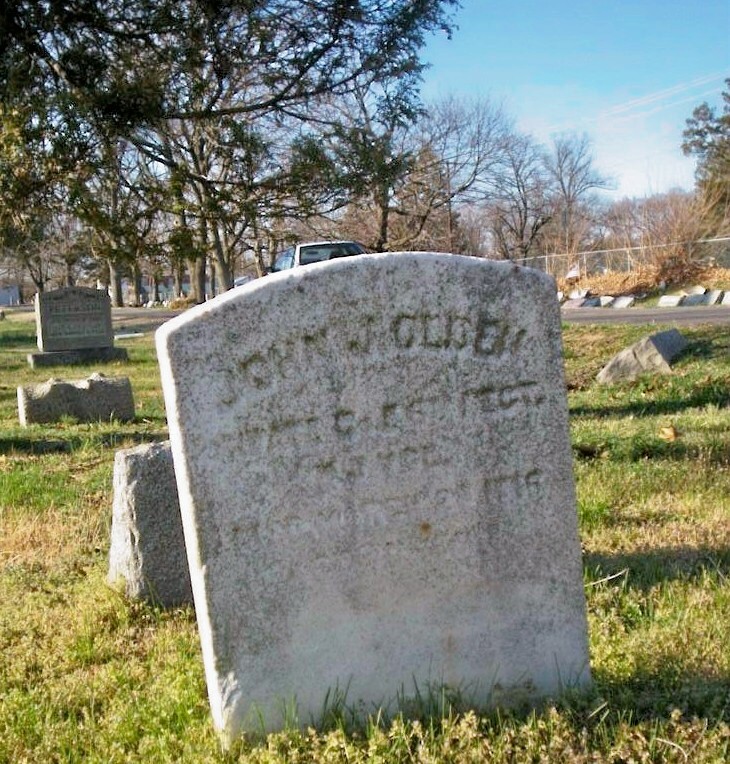
Gravestone of John J. Olden, Evergreen Cemetery