Introduction
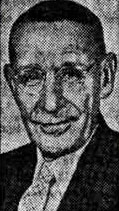
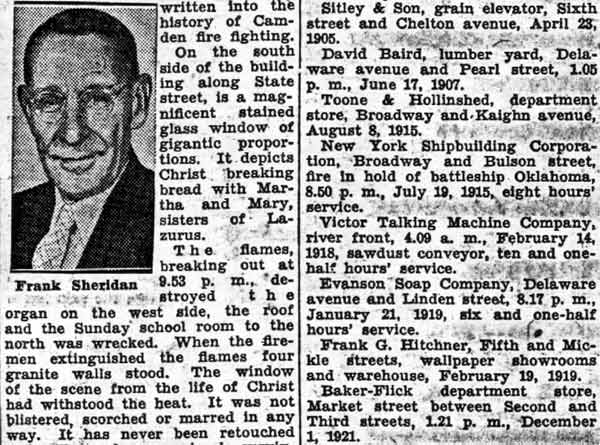
Reporter Frank Sheridan
Reporter Frank Sheridan wrote a series chronicling the history of fire fighting in Camden from the formation of the first volunteer company in 1810 through 1936. It was the first complete history of the fire department written since 1886 and linked the old volunteers with the then new paid motorized department. It was published in conjunction with Fire Prevention Week, which was sponsored by the Camden County Fire Chiefs Association and the Camden Fire Department.
The Courier also ran a series of articles and photographs about activities to educate the public during Fire Prevention Week.
Camden Fire Department Started in 1810 As Bucket Brigade Comprising Leading Citizens
Camden Courier-Post —

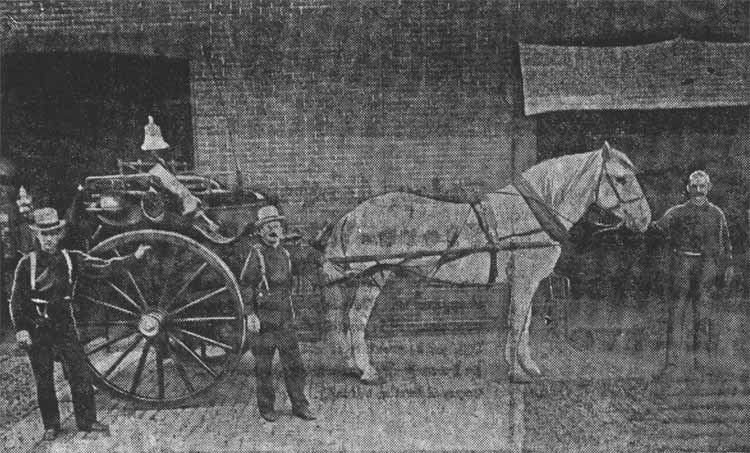

When Camden City Council established a paid fire department in 1869 it purchased steam engines, hook and ladder trucks and a hose carriage, a photo of which appears above.
Camden’s Fire Department has grown from a bucket brigade in 1810 to the present motorized equipment of 25 pieces of modern apparatus.
Prior to 1810 bucket brigades were formed to combat fires. And with the advent of the first hand pumper in 1810, the bucket brigade still carried water from wells to be pumped on fires.
The advancement of fire fighting in the early days of the colonies was slow. For nearly 125 years nothing was done even to introduce the Roman method of spraying a fire with bellows.
The first hand-pumper was purchased in 1810 by the Perseverance Fire Company, which was organized on March 15 of that year. The company was composed of leading citizens. The pumper was manufactured by “Pat” Lyons, of Philadelphia.
Placed in a frame building at Front street above Market, now the site of an RCA building, it later was moved to a frame house on Second street adjoining the State Bank.
Women Helped Men
The bucket brigade continued after the introduction of the hand-pumper. Civic-minded citizen dug wells at convenient places on main thoroughfares to supply water for fire-fighting. An alarm of fire called both men and women to duty. Every citizen was compelled to respond to the alarm. They formed lines to and from the pumper and the nearest well. Buckets of water were passed from the well to one person and another until it had run the gauntlet of a human chain to the pumper. Another line carried the buckets back to the well for replenishment of the supply.
Every householder was expected to have sufficient buckets handy for fire-fighting. Children frequently joined their parents on the fire lines. The equipment of the pumper included a hand-pumper, already known as an “engine,” and a cart to carry buckets. The apparatus was hand-drawn.
Wells and pumps also were deemed essential as fire fighting equipment by city council. The council encouraged the digging of wells. As proof thereof Joseph Kaighn dug a well in 1834 on Kaighn avenue and was reimbursed for part of the costs. George Genge dug one on Market street and the bill was paid by the city. Abraham Browning enlarged a well near Front and Market streets and was allowed part of the costs.
Divided Into Five Districts
In 1834 the city was divided into three fire districts, Cooper and Line streets being the dividing lines. But there was no organized fire department until several years later. It was not until the establishment of the first water works in 1848 that any steps were taken to increase materially the efficiency of the fire fighting equipment. Until the water works were established strong men mounted the hand pumps, pushed the levers down and pulled them up. Usually eight men operated the pumps, four on each side of the apparatus.
It was not until 1851 that city council appointed a committee to exercise supervision over fire apparatus, which had grown to six by that time.
Although formed in 1810 the Perseverance Company was not incorporated until March 15, 1832. The charter was for 20 years. The names appearing on the charter were among the foremost citizens of that period. They included Nathan Davis, Gideon V. Stivers, Jeremiah H. Sloan, John Lawrence, Samuel D. Wessels, Isaac Cole, Ledden Davis, John Browning, Joab Scull, Richard W. Howell, Auley McAlla, Dr. Thomas Lee, William H. Ogden, Richard H. Fetters and Abraham Browning.
The charter was renewed in 1852 with the following incorporators: James C. Morgan, William E. Gilmore, Samuel Hanna, William Hanna, Lewis P. Thompson, Joseph D. Howell, Pancoast Roberts, Alfred Hugg, Amos Stiles, Jr., Samuel Cooper, Nathan Davis, Jr., Samuel Ashurst, Andrew Zimmerman, David Sheppard, John W. Carter, Henry Kesler, John Warner, John Ross, Charles A. Garret and Thomas Sulger.
War Broke Up Company
The company prospered until the outbreak of the Civil War, when a majority of the able-bodied men enlisted in a company of volunteers commanded by Capt. Richrd [sic] A. Lee.
Another fire engine of the hand pumper type was purchased in 1830 for the Perseverance company by a committee including Browning, McAlia and Howell. It was purchased from the Fairmount Company, Philadelphia. The committee presented a bill for $50 to city council for the pumper on August 27, 1830. It was five feet high and eight men could hardly get gold [sic] of the levers.
It was called the “Fairmount.” It was purchased by the Weccacoe Fire Company in 1848. Then it passed to the reorganized Fairmount Company in 1851. It was eventually stored away after long usage. It was purchased by Robert S. Bender in 1864 for $20. He sold it to a Woodbury company for $50. Shortly afterward it was destroyed by fire.
Historians give conflicting accounts of the purchase of the “Fairmount.” Pennypacker not only says the city purchased it in 1830, but in his account of the organization of the Fairmount Fire Company, on October 7, 1830, he says the Fairmount Company purchased the apparatus from the Fairmount Fire Company, Philadelphia. It is evident that this company had the use of the apparatus because the fire fighters changed the name of the company to “Niagara” when the name was changed on the sides of the old pumper. It is also evident that it was city property, as the same historian says it was loaned to the Weccacoe company for a few months after that company organized in 1848.
(Tomorrow’s installment will tell of the formation of the first famous Weccacoe Company.)
Weccacoe Company Made Camden History As Leaders of Early Volunteer Fire Fighters
Camden Courier-Post —


First Steam Engine Used to Stop Flames Was Purchased in 1864 for $850
1300-Pound Bell Suspended From Two Poles Served as Alarm for City
This is the second installment of a history of fire fighting in Camden from the time of the formation of the first volunteer company in 1810 to 1936. It is the first complete history of the fire department written since 1886 and links the old volunteers with the new paid motorized department. It is being published in conjunction with Fire Prevention Week, which is being sponsored by the Camden County Fire Chiefs Association and the Camden Fire Department. Yesterday’s installment told of the formation of the Perseverance Fire Company in 1810, the first in the city’s history.
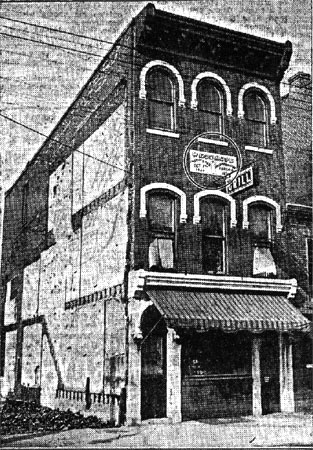
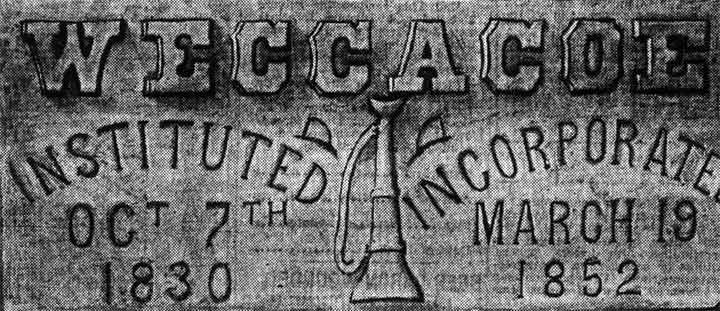
The famous Weccacoe Fire Company was instituted in 1830 and incorporated in 1852. It was the parent to the Weccacoe Hose Company. The company had its fire house on Plum street, now Arch, between Fifth and Sixth streets. A marble slab between the second and third floors was a marker with its history briefly inscribed. The building, later used as The Grill, was razed for the erection of the new city hall and court house annex.
The Fairmount Company, later known as the Niagara, was reorganized as the Weccacoe Fire Company, No. 2, in 1848. The headquarters of the company was moved to the old City Hall lot on Federal street, where the Public Service building now stands. William Hanna joined this company in 1835, James M. Cassady in 1838 and James W. Ayers in 1843. Ayers was later fire marshal.
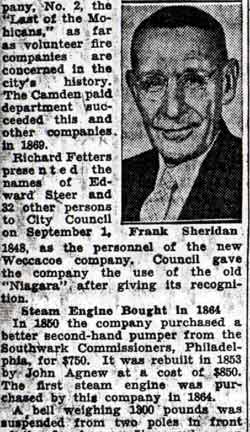
Weccacoe Fire Company, No. 2, should not be confused with Weccacoe Hose Company, No. 2, the “Last of the Mohicans,” as far as volunteer fire companies are concerned in the city’s history. The Camden paid department succeeded this and other companies in 1869.
Richard Fetters presented the names of Edward Steer and 32 other persons to City Council on September 1, 1848, as the personnel of the new Weccacoe company. Council gave the company the use of the old “Niagara”, after giving its recognition.
Steam Engine Bought in 1864
In 1850 the company purchased a better second-hand pumper from the Southwark Commissioners, Philadelphia, for $750. It was rebuilt in 1853 by John Agnew at a cost of $850. The first steam engine was purchased by this company in 1864.
A bell weighing 1300 pounds was suspended from two poles in front of the fire house. It served as an alarm for the entire city. Several attempts by incendiaries to destroy the building finally succeeded on February 17, 1854.
Then the company established headquarters on Fifth street above Arch in a two-story brick building on the site of the old Columbia Gardens, which was originally a cemetery.
The company was incorporated in 1852 with the following as incorporators: John Lanning, James M. Cassady, James W. Ayers, Isaac Shreve, Wesley P. Murray, Joseph F. Murray, Joshua S. Porter, Daniel B. McCully, Richard G. Camp, James Doughten, Stone H. Stow, Charles H. Thorne, and Matthew Miller, Jr.
Mohawks Formed in 1849
Ayers was elected president at the time the company was organized and continued until 1854, when he was absent from the city for a year. He was president until the company was disbanded.
The Mohawk Fire Company was organized in the Spring of 1849, but its career was turbulent and short lived. The company met in a three-story brick house at the northwest corner of Third and Cherry streets. The organizers were men of reputation.
Lambert F. Beatty was president and William S. Frazier secretary. The company was strong in numbers but a lawless element got into the membership with the result there were brawls, riots and other disorder. Fearing incendiarism the company disbanded on April 23, 1851.
Independence Fire Company, No. 3, was organized to take the place of the Mohawk company and Beatty was chosen president and Frazier secretary of the new group. Joseph Wagner was named secretary. Among the early members were Claudius W. Bradshaw, later chief of the paid fire department and still later mayor; Robert S. Bender, also later a chief in the paid department; Jacob Prettyman, David Page, Thomas Stites, Andrew Stilwell, Francis E. Harper, Restore Cook, John Wallace, William H. Hawkins, Christopher J. Mines, later sheriff; Albert V. Mills, Lewis Yeager, Thomas McCowan and William W. Mines.
Fire Destroys Home
The company met in a frame building at Third and Cherry streets for a year. The building was destroyed by fire and Yeager gave the company a plot of ground near Third and Cherry streets. Charles Stockham, lumber merchant, gave lumber for the construction of a new firehouse. The company purchased another lot on Third street above Cherry street in 1853. This was occupied until 1859 when a defect in the title resulted in the property being offered for sale by the sheriff.
When the sheriff arrived on the scene the day of the sale he found the firemen and their apparatus were on an adjoining lot, and James B. Dayton, who caused the sale, was in possession of the firehouse.
In 1860 the company bought a lot on Pine street, east of Fourth, and built a three-story brick building, one of the most substantial firehouses in the city. The building was subsequently sold to the city for $4500 and now houses Engine Company No. 1.
Independence was a hose company until June 4, 1864, when an Amoskeag steam fire engine was purchased. It was the first steam engine used in the city. In 1869 the company purchased a larger engine, selling the Amoskeag to Millville. Millville sold it to the city of Camden in 1874.
Disbands in 1874
Bender served as president of the company from 1854 until October 13, 1874, when the company formally disbanded after paying all claims. It had a roster of 60 men.
Other presidents of the company were Timothy C. Moore, who was also a president of Mohawk; Beatty, William L. Frazier, Mines, John Wallace, Hawkins, J. Kelly Brown and Gilbert. Other secretaries were Mines, Mortimer C. Wilson and McCowan. Bender and Joseph Wagner served as treasurers.
The Shiffler Hose Company, No. 1, was organized March 7, 1849, and was given councilmanic recognition on August 30 that year. The charter members were George W. Thompson, president; George F. Ross, secretary; Joseph Brown, W. W. Burt, Charles Cheeseman, Robert Maguire, Samuel Brown, John G. Hutchinson, Armstrong Sapp, Richard Cheeseman, Albert Robinson, George F. Ross and William Wallace.
The company purchased a horse hose carriage from the Shiffler Hose Company, Philadelphia, for $10. That marked the introduction of horse-drawn apparatus. The apparatus was housed in a carpenter shop on Sycamore street, near Third, and remained there until a two-story brick firehouse was erected on Fourth street, below Walnut.
The company was incorporated in March, 1852, by Burt, Sapp, Thompson, Robert Maguire, James Sherman, Wallace, Hutchinson, Brown and William Harris.
Jacob C. Daubman, later a sheriff, was elected president in 1854 and served until the company was disbanded in 1869. On March 29, 1864, the company obtained a new charter as the Shiffler Hose and Steam Fire Company. A steam engine was purchased and the company maintained a high state of efficiency until it disbanded in 1869.
Volunteer Firemen Worked 14 Years To Pay Off $5000 Debt on Engine
Camden Courier-Post —


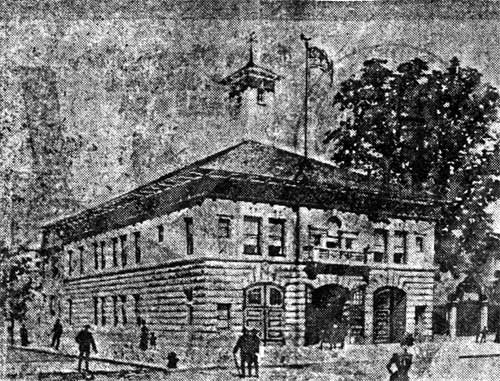
Above is shown a photo of fire headquarters, Fifth and Arch streets, before it was remodeled to provide sleeping quarters for each fireman. The photo was taken in the Gay 90’s. A hook and ladder truck was housed in a building to the north of it. The main building contained horse-drawn apparatus. The stables were in the rear. Note the tower from which hose was suspended to dry after a fire.
Answered No Alarms but Paid Dues and Staged Benefits
BITTER RIVALRY HAMPERED MEN
This is the third installment of a history of fire fighting in Camden from the formation of the first volunteer company in 1810 to 1936. It is the first complete history of the fire department written since 1886 and links the old volunteers with the new paid motorized department. It is being published in conjunction with Fire Prevention Week, sponsored by the Camden County Fire Chiefs’ Association and the Camden Fire Department. Yesterday’s installment told of the purchase of the first steam pumper by Weccacoe in 1864.
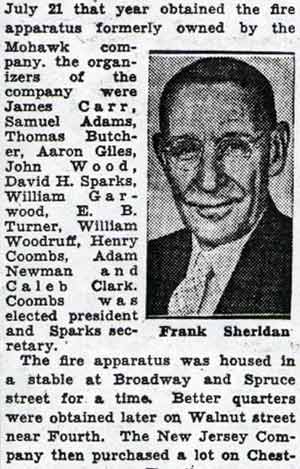
The New Jersey Fire Company was organized May 1, 1851, and on July 21 that year obtained the fire apparatus formerly owned by the Mohawk company. The organizers of the company were James Carr, Samuel Adams, Thomas Butcher, Aaron Giles, John Wood, David H. Sparks, William Garwood, E. B. Turner, William Woodruff, Henry Coombs, Adam Newman and Caleb Clark. Coombs was elected president and Sparks secretary.
Frank Sheridan
The fire apparatus was housed in a stable at Broadway and Spruce street for a time. Better quarters were obtained later on Walnut street near Fourth. The New Jersey Company then purchased a lot on Chestnut street near Fourth street and erected a two-story brick building.
The company was incorporated in 1854 and disbanded in 1866. Its other presidents in succession were Carr, John Crowley, Joshua L. Melvin, Samuel Hickman, John Warrington, Jeremiah Brannon, Richard C. Mason and C. De Grasse Hogan.
A second Fairmount Fire Company was organized in 1854 and City Council gave the company the old Fairmount apparatus. The firemen rented a one-story frame building on Pine street near Third. The structure had been vacated by the Shiffler Hose Company.
[text missing between the crops]
Organizers were William C. Figner, president; William J. Miller, secretary; Frederick Breyer, treasurer; William H. Hawkins, John W. Hoey, Henry A. Breyer, and Alfred H. Breyer. Additional members enrolled were George W. Watson, Anthony R. Joline, Thomas Francis, John L. Ames, George W. Howard, William F. Colbert, Francis Fullerton, John S. Ross, Joshua Spencer, Lawrence Breyer, William H. Lane and James Scout.
Incorporated in 1853
The company was incorporated on February 17, 1853. The name was changed to United States Fire Company, No. 5, on February 10, 1854. Scout was elected president and George Deal, secretary.
New fire apparatus was purchased by the reorganized company. A lot was acquired and a two-story frame house was erected at 239 Pine street. The company continued at the fire house until it disbanded with other volunteer companies in 1869.
The Weccacoe Hose Company, No. 2, was organized on March 15, 1858, and housed with Weccacoe Fire Company on Arch street between Fifth and Sixth streets, for two years. In 1860 the company moved to a stable at Hudson street and Bridge avenue. Later the firemen moved to De La Cour’s labratory [sic], Front street near Arch. In 1863 the company bought ground on Benson street above Fifth costing $450 and built a two-story brick building costing $2200.
The organizers were Allan Ward, Edward T. James, Edward J. Steer, John W. Garwood, George W. Thomas, Simeon H. Pine, Thomas C. Barret, Thomas Ellis, and John Thornton. Thomas D. Laverty was elected president; Ward, vice president; James, secretary, and Steer, treasurer.
Steam Engine Purchased
The company was incorporated on February 2, 1860. A steam fire engine was purchased in 1868 at a cost of $5800. The company proposed to pay off the debt by subscription, but agitation for a paid department prevented collection of the money. When the company went out of service in 1869 to be succeeded by a paid department the members decided not to disband and remained intact to pay off its indebtedness of $5000 remaining to sustain the honor of the company.
The firemen met at regular periods, paid dues and carried on for 14 years to wipe out the debt. On September 8, 1883, the company met, voted to pay the last claim of $14.25 and adjourned rather than disband. During the 14 years the company answered no alarms but held entertainments and benefits to raise funds to pay off its indebtedness.
The volunteer firemen were prompt, daring and efficient but each company was independent and misdirection frequently resulted in loss of property. This led to agitation for a fire department under complete control of the city, which had maintained indirect jurisdiction over the volunteers.
City Council passed an ordinance in 1866 to reorganize the system and provided for appointment of a fire marshal with approval of the companies. James W. Ayers, of Weccacoe Engine Company, was elected marshal for a term of two years. He was succeeded by Wesley P. Murray, of Weccacoe Hose Company, in 1868.
2 Fire Districts Formed
Both men were good organizers and popular but the rivalry between companies and insubordination re- [cut off at the crop edge]
First City Fire House Located at 5th and Arch
Camden Courier-Post —

Hosemen, Tillermen and Laddermen Paid $50 Monthly While Call Men Received $75 a Year; Steam Engine Held for Emergency
This is the fourth installment of a history of fire fighting in Camden from the time of the formation of the first volunteer company in 1810 to 1936. It is the first complete history of the fire department written since 1886 and links the old volunteers with the new paid motorized department. It is being published in conjunction with Fire Prevention Week, which is being sponsored by the Camden County Fire Chiefs Association and the Camden Fire Department. Yesterday’s installment told of the disbanding of volunteer companies and city council creating a paid department in 1869.
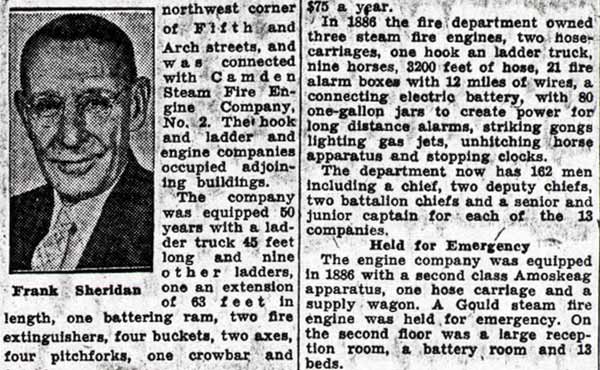
The Camden Hook and Ladder Company, No. 1, was organized in 1869 as a unit of the paid fire department with headquarters at the northwest corner of Fifth and Arch streets, and was connected with Camden Steam Fire Engine Company, No. 2. The hook and ladder and engine companies occupied adjoining buildings.
The company was equipped 50 years with a ladder truck 45 feet long and nine other ladders, one an extension of 63 feet in length, one battering ram, two fire extinguishers, four buckets, two axes, four pitchforks, one crowbar and four lamps.
The members of the Camden Hook and Ladder Company, No. 1, in 1886, when the last history of the department was written, were Amedy Middleton, tillerman; Benjamin L. Kellum, driver; Thomas Walton, and John W. Toy, laddermen; William Doughten, Peter S. Gray, John Gray and Charles A. Todd, callmen.
The Camden Steam Fire Engine Company, No. 1, was organized in 1869 and stationed at Fourth and Pine streets, where Engine Company, No. 1, still is housed. The company was equipped with one second class steam fire engine made by the Amoskeag Manufacturing Company, Manchester, New Hampshire; one hose cart, manufactured by the Silsby Company, Seneca Falls, N. Y.; three horses and 1600 feet of hose.
The members of the company in 1886 were John A. Stockton, foreman; G. Rudolph Tenner, engineer; William Deno, driver; William W. Laird, stoker; Wilson Bromley and Jacob F. Nessen, hosemen; William Deith, Andrew Miller, William Bogia and W. Elwood Campbell, callmen.
Stockton became chief of the department in 1914.
Organized in 1869
The Camden Steam Fire Engine Company, No. 2, was organized in 1869 and located at the paid fire headquarters at Fifth and Arch streets. The ground floor had two connections with the hook and ladder company.
In 1886 the department consisted of one chief engineer, an assistant, 18 regular men and 12 call men. The regular men devoted full time to the service while the call men could go about their regular occupations.
Engineers received $60 monthly, hosemen, tillermen and laddermen $50 monthly. The call men received $75 a year.
In 1886 the fire department owned three steam fire engines, two hose-carriages, one hook an [sic] ladder truck, nine horses, 3200 feet of hose, 21 fire alarm boxes with 12 miles of wires, a connecting electric battery, with 80 one-gallon jars to create power for long distance alarms, striking gongs lighting gas jets, unhitching horse apparatus and stopping clocks.
The department now has 162 men including a chief, two deputy chiefs, two battalion chiefs and a senior and junior captain for each of the 13 companies.
Held for Emergency
The engine company was equipped in 1886 with a second class Amoskeag apparatus, one hose carriage and a supply wagon. A Gould steam fire engine was held for emergency. On the second floor was a large reception room, a battery room and 13 beds.
The roster of the company in 1886 included Samuel S. Elfreth, chief engineer; Samuel S. Buzine, assistant chief engineer; Jacob W. Kellum, extra engineer; Harry C. Grossup, foreman; William Morris, engineer; C. B. Harvey, driver of engine; Frank Turner, stoker; Charles Robinson and Isaac Shreves, hosemen; James Carey, Logan Bates, William Lyons and Howard Currie, callmen.
The early chiefs of the paid department were William Ables, Robert S. Bender, two terms; Cladius [sic] W. Bradshaw, mayor from 1880 to 1886; Henry F. Surault, Samuel S. Elfreth, Daniel A. Carter. These chiefs served for the duration of the terms of the fire committees of city council. This system was changed later and Elfreth was named permanent chief. Buzine was deputy chief under Elfreth.
(Tomorrow’s installment will describe a sudden succession of chiefs brought about by the resignation of Elfreth and the death of Charles Worthington, who was fatally injured in a fall from a roof at a fire.)
Motorization of Camden Fire Department Completed Under Chief P. B. Carter in 1915
Camden Courier-Post —


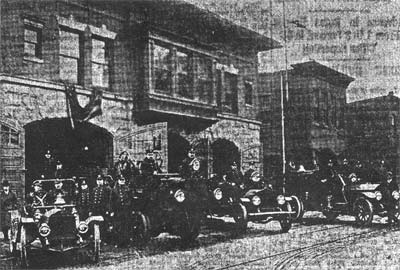
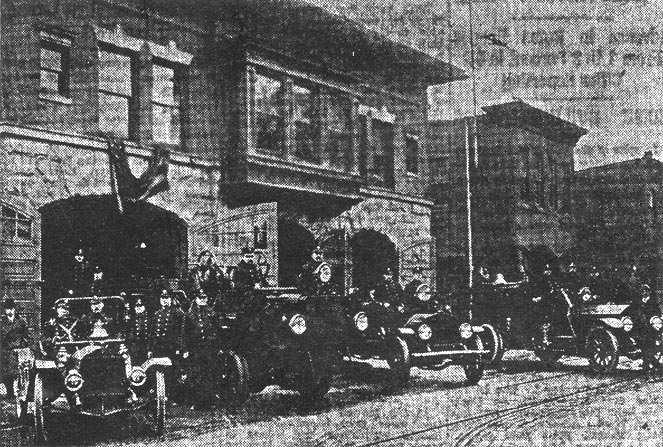
Above is shown a photo of part of the Camden Fire Department after it was motorized. The above companies are stationed at Fire Headquarters, Fifth and Arch streets.
This is the fifth installment of a history of fire fighting in Camden from the time of the formation of the first volunteer company in 1810 to 1936. It is the first complete history of the fire department written since 1886 and links the old volunteers with the new paid motorized department. It is being published in the interest [sic] with Fire Prevention Week, which was sponsored last week by the Camden County Fire Chiefs Association and the Camden Fire Department. Saturday’s installment told of the formation of the paid fire department.
Samuel S. Elfreth was reappointed for several terms as chief by the fire committee of city council before he was made permanent head of the department.
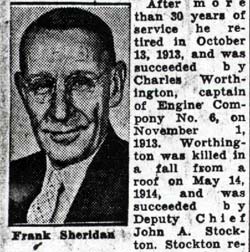
After more than 30 years of service he retired in October 13, 1913, and was succeeded by Charles Worthington, captain of Engine Compony [sic] No. 6, on November 1, 1913. Worthington was killed in a fall from a roof on May 14, 1914, and was succeeded by Deputy Chief John A. Stockton. Stockton retired the following year and was succeeded by Peter B. Carter on October 1, 1915.
Under Carter the motorization of the department was completed. Carter was injured in a fall from a roof when fire destroyed the interior of State Street Methodist Episcopal Church. He retired on a pension on March 31, 1926, to become chief of the Collingswood Fire Department. He remained as Collingswood’s chief until August 29, 1927, when he resigned. He was succeeded as chief of the Camden department by the late Thomas J. Nicholas. Nicholas retired in November, 1932, and was succeeded by John H. Lennox, who was named acting chief by former Mayor Roy R. Stewart on December 1, 1932. He was sworn in as a full-fledged chief on October 1, 1934.
Lennox Heads Department
Lennox is now chief. The deputy chiefs are William R. Harring and Walter A. Mertz and the battalion chiefs, Charles Erickson and Rollo R. Jones. Bernard J. Gallagher is fire marshal, James A. Howell, chief of the electrical bureau, and James H. Long, chief of the water department.
Deputy chiefs were known as assistant chiefs until the two-platoon system was inaugurated in Camden on January 1, 1921, under fromer [sic] Mayor Charles H. Ellis.
Company commanders were at first called foremen. Later they were named lieutenants. When the two-platoon system was adopted, requiring the men to be on duty one-half day instead of 24 hours the ranks of senior and junior captain were created.
The present equipment of the department includes two pieces of apparatus at Engine Companies No. 1, 2, 3, 6, 7, 8, and 9 and one piece at Nos. 10 and 11. The department also has four hook and ladder trucks. Three of these are aerial trucks stationed at Nos. 1, 2 and 4. Company No. 3 has a city service truck. The department also has a supply wagon, four chief cars and a coffee service wagon for third alarms.
Fire headquarters is now maintained at Fifth and Arch streets and the Electrical Bureau is in modern offices on the eighth floor of the new city hall. Engine Company No. 2 is housed with Truck Company No. 1, at headquarters.
The other companies are housed as follows: Engine Company, No. 1, Fourth and Pine streets; Engine Company No. 3, Broadway and Ferry avenue; Engine Company No. 6, Front and Linden streets; Engine Company No. 7, Kaighn avenue above Mt. Ephraim avenue; Engine Company No. 8, and Truck Company No. 2, Sixth street and Kaighn avenue; Engine Company No. 9, and Truck Company No. 3, Twenty-seventh and Federal streets; Engine Company No. 10, and Truck Company, No. 4, Ninth street and Morgan boulevard; Engine Company No. 11, Twenty-seventh street and Hayes avenue.
Engine Company No. 4, Fourth and Vine streets, was abolished in 1932 for economy reasons. Engine Company No. 5, Federal street and Cooper river, was closed with the building of the Federal street viaduct in 1926.
Company Commanders
Company commanders at present are: Engine Company, No. 1, Acting Senior Captain Harry Wagner, Jr., Acting Junior Captain Joseph Gentlesk; Engine Company, No. 2, Acting Senior Captain Rocco Fanelli Acting Captain Edward Ellender; Engine Company, No. 3, Senior Captain Leonard Megee, Junior Captain Eli Hunt; Engine Company, No. 6, Acting Senior Captain George Salnders, Junior Captain George Townsend; Engine Company No. 7, Senior Captain William F. Rose, Junior Captain Henry Zook; Engine Company No. 8, Senior Captain Lawrence Newton, Junior Captain Alvin Thompson; Engine Company No. 9, Senior Captain Daniel Smith, Junior Captain Howard Glick; Engine Company No. 10, Acting Senior Captain Jarrett Zanders, Acting Junior Captain Maurice O’Brien; Engine Company, No. 11, Senior Captain Charles Watkins, Junior Captain Herman Kreher.
Truck Company No. 1, (hook and ladder), Senior Captain William Van Pfeferle, Acting Junior Captain William Judge; Truck Company, No. 2, Acting Senior Captain James Young, Acting Junior Captain Frank Oberman; Truck Company No. 3, Senior Captain Clarence Madden, Acting Junior Captain David Humphreys; Truck Company No. 4, Senior Captain Mordecai Clark, Acting Junior Captain William Scholl.
The coffee wagon was presented to the department by Mrs. Laura Frey, widow of former City Treasurer George A. Frey, on July 20, 1930. The wagon was presented at the request of Frey. It is a modern kitchen on wheels, according to Chief Lennox.
The pumpers of Nos. 1, 2, 3 and 6 have pumping capacity of 1000 gallons per minute. Companies 7, 8, 9, 10, 11 can pump 750 gallons a minute. Nos. 9, 10 and 11 have three-in-one chemical, hose and pumping units. Companies No. 1 and 6 have booster tanks with 100 gallon capacity, replacing chemical, with three-quarter-inch rubber hose.
City Council authorized the motorization of the Camden Fire Department on January 1, 1913. The first motor car was assigned to Chief Elfreth. The motorization was completed under Chief Carter. Camden was one of the first cities in the country to motorize its department and was so equipped before Philadelphia began to use the modern equipment with powerful pumpers.
When the fire department was motorized City Council retained two of the steam pumpers, having them mounted on tractors. After a survey of the city’s fire, water and police equipment and building codes in 1932 by the National Board of Fire Underwriters a recommendation was made that this apparatus be replaced by more modern motor driven and operated equipment. This was done two years ago while former Mayor Roy R. Stewart was director of public safety.
Six Killed at Fire
Six men have been killed in the line of duty fighting fires. The worst catastrophe was at a fire which destroyed the old Fifth Regiment Armory at West and Mickle streets on March 16, 1905. The fire broke out at 5.55 p. m. William Jobes, Engine Company, No. 1; George Shields and William Hillman, Truck Company, No. 2, were trapped in a room in the building and were killed.
Chief Worthington was killed in a fall from a roof while directing the fighting of a fire at Delaware avenue and George street on May 14, 1914.
Capt. Martin Carrigan, of Engine Company, No. 2, was killed directing a fight against a fire which wrecked the interior of the Morris Handle department store at 427 and 429 Kaighn avenue on January 18, 1922.
Hoseman John J. Reilly was killed on January 19, 1925, when a fire extinguisher exploded while fighting a fire at 924 North Second street.
Two Camden firemen were crippled as a result of being caught under a falling wall while battling a fire at the Enterprise Wall Paper plant at Collingswood on January 6, 1915. Injured with them was a Westmont fireman and former Judge John B. Kates, of the Collingswood department, then a member of the General Assembly of New Jersey. The late Battalion Chief George B. Wade and the late William E. Laird, a hoseman, were caught under the falling debris and were in the West Jersey Hospital several weeks. Kates, Wade and Laird suffered crushed limbs.
(Tomorrow’s installment will tell of the most serious fires in the history of the city.)
Stained Church Window Saved in Miracle Fire
Camden Courier-Post —
This is the seventh and last of a series of articles linking the history of fire fighting in Camden from volunteer days of 1819 [sic] to 1936. The series was published in co-operation with Fire Prevention Week, observed last week under the sponsorship of the Camden Fire Department and the Camden County Fire Chiefs Association.
When flames wrecked the interior of State Street Methodist Episcopal Church, Sixth and State streets, on January 11, 1916, a miracle was written into the history of Camden fire fighting. On the south side of the building along State street, is a magnificent stained glass window of gigantic proportions. It depicts Christ breaking bread with Martha and Mary, sisters of Lazurus [sic].
The flames, breaking out at 9.53 p. m., destroyed the organ on the west side, the roof and the Sunday school room to the north was wrecked. When the firemen extinguished the flames four granite walls stood. The window of the scene from the life of Christ had withstood the heat. It was not blistered, scorched or marred in any way. It has never been retouched [words cut by the crop seam] and still stands as a miracle surviving one of the most disastrous church fires in the history of the city.
Chief Peter B. Carter was injured directing the battle against the flames when he fell through an areaway between the main church auditorium and the Sunday school building on the north and was in the hospital several weeks.
Second Church Fire
It was the second serious church fire in the history. St. John’s Protestant Episcopal Church, Broadway and Royden street, was destroyed by fire on Christmas Day, 1870. The church was originally the floating chapel of the Redeemer and was brought here from Philadelphia and converted into a church.
Candles on the altar set fire to Christmas decorations and in a few minutes it was a pile of ruins, a “burnt offering to the Babe of Bethlehem,” the rector said.
The P. R. R. Y. M. C. A., Third and Mickle streets, was badly damaged by fire on March 1, 1932. The fire broke out at 5.33 p. m. and swept the interior of the building, which was originally the Third Street Methodist Episcopal Church, now known as First Church.
Other Serious Fires
Other serious fires in the history of the city were as follows:
Sitley & Son, grain elevator, Sixth street and Chelton avenue, April 23, 1905.
David Baird, lumber yard, Delaware avenue and Pearl street, 1.05 p. m., June 17, 1907.
Toone & Hollinshed, department store, Broadway and Kaighn avenue, August 8, 1915.
New York Shipbuilding Corporation, Broadway and Bulson street, fire in hold of battleship Oklahoma, 8.50 p. m., July 19, 1915, eight hours’ service.
Victor Talking Machine Company, river front, 4.09 a. m., February 14, 1918, sawdust conveyor, ten and one-half hours’ service.
Evanson Soap Company, Delaware avenue and Linden street, 8.17 p. m., January 21, 1919, six and one-half hours’ service.
Frank G. Hitchner, Fifth and Mickle streets, wallpaper showrooms and warehouse, February 19, 1919.
Baker-Flick department store, Market street between Second and Third streets, 1.21 p. m., December 1, 1921.
Toone & Hollinshed department store, Broadway and Kaighn avenue, 12.29 a. m., December 14, 1921.
Morris Handle department store, 427 and 429 Kaighn avenue, 12.07 a. m., January 18, 1922. Capt. Martin Carrigan, Engine Company No. 2, killed.
Frank G. Hitchner, Fifth and Mickle streets, wallpaper showrooms and warehouse, 5.32 a. m., December 10, 1924.
F. W. Woolworth, 550 and 552 Federal street, 10.29 p. m., November 23, 1928.
Campbell Soup Company, Front and Market streets, 1.31 a. m., January 15, 1929, ammonia leak.
Shulte-United store, 21, 23 and 25 Broadway, 2.34 a. m., December 30, 1929.
Sitley, Sixth street and Chelton avenue, grain elevator, 4.17 a. m., April 18, 1930.
Public Service garage, Starr avenue, 2.55 a. m., July 29, 1932.
Bolen Brothers, 23 and 25 Broadway, 12.41 a. m., December 25, 1932.
Martin’s, cleaning and dyeing, 222 Federal street, 2.50 p. m., January 3, 1933.
Curry and Van Fossen, 121 Federal street, printers, 7.16 a. m., January 29, 1933.
Samuel Bernstein and Son, Tenth and Elm streets, wool scourers, 8.38 p. m., January 20, 1933.
Linden School, Tenth and Linden streets, 8.46 p. m., February 11, 1933.
Taylor Brothers, Point and State streets, grain elevator, 6.13 p. m., August 22, 1933.
New Broadway Theatre, Broadway and Carman street, 4.22 a. m., April 29, 1934.
Bell and Evans, 551 North Twenty-seventh street, poultry dealers, 1.34 p. m., May 5, 1934.
Helped Other Towns
The Camden department has never failed to render assistance to other cities and towns. The department performed valiant work at Pennsgrove, Atlantic City, Gibbsboro, Collingswood, Woodbury, Riverside and Woodlynne.
The Camden firemen responded to a call for help from Atlantic City at 11.40 a. m., April 3, 1902, and fought a Boardwalk fire with backfire and brought it under control.
The department battled for nine hours a fire, which destroyed Woodbury High School. The alarm was received at 6.15 a. m., on December 19, 1910.
Camden went to the aid of Collingswood on February 26, 1913, when the postoffice, Masonic hall and an entire block in the business centre was destroyed and numerous houses were set on fire by sparks.
In response to a call from Riverside Camden joined in a fight against a fire at the Taubel hosiery mill on January 2, 1916. The alarm was received at 1.48 a. m.
The Pennsgrove Fire
The most disastrous out-of-town fire fought by the Camden department was at Pennsgrove on March 1, 1932. The alarm was received at 1.30 p. m. Fifty-seven buildings, mostly dwellings, were destroyed. There was a water scarcity and the blaze got beyond control of Salem county fire companies. Camden placed a pumper on the wharf and relayed water from the Delaware River to check the blaze.
In August, 1915, the department sent its motorized equipment on its first out-of-town call to Gibbsboro, where the Lucas paint works was burning beyond control and threatening to destroy the town. The town was without a fire company and the Camden firemen pumped water from the Gibbsboro lake to check the flames.
Woodlynne, without a fire company, summoned Camden to battle a blaze which destroyed Woodlynne Park on March 15, 1914.
On February 23, 1914, the department aided Collingswood in fighting a fire at the home of Burleigh B. Draper, Camden banker.
The department established a Fire Prevention Bureau on July 1, 1933. A training school for firemen was established July 5, 1934. A card fire alarm system was established on September 1, 1933, showing every company’s record, assignments and transfers.
The new fire alarm office on the eighth floor of the new City Hall went into service on April 13, 1934, with all new and modern equipment. The city has a total of 1574 fire hydrants, 331 of which are in East Camden.
The department was placed under the jurisdiction of the director of public safety with the adoption of commission form of government in 1923. The present commissioner is Mary W. Kobus.
When the department attacks a two-alarm fire the water pressure is increased at the city pumping stations. The deputy water chief responds to the alarm and the chief on the third alarm.
THE END