Introduction
By Phil Cohen
In May of 1949 veteran newspaperman Frank Sheridan of the Courier-Post wrote a five-part series in honor of the 50th anniversary of the annexation of the Town of Stockton by Camden, which brought all the land north and east of the Cooper River into the city… what we know today as East Camden and Cramer Hill.
Phil Cohen
Bismarck, ND
November 25, 2019
East Camden Settled by Quakers Seeking Freedom in New World
Camden Courier-Post —
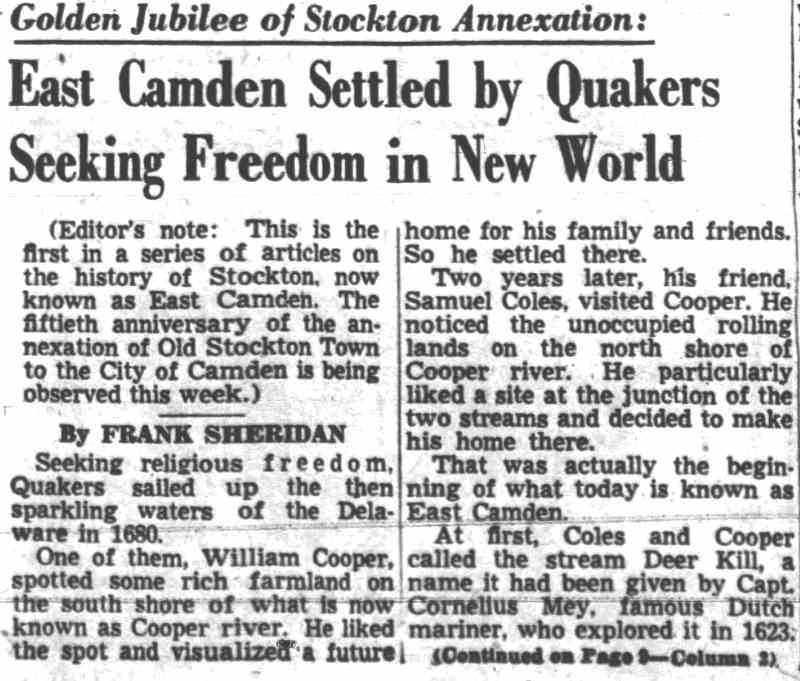
Golden Jubilee of Stockton Annexation — By Frank Sheridan
Seeking religious freedom, Quakers sailed up the then sparkling waters of the Delaware in 1680. One of them, William Cooper, spotted some rich farmland on the south shore of what is now known as Cooper river. He liked the spot and visualized a future home for his family and friends. So he settled there.
Two years later, his friend, Samuel Coles, visited Cooper. He noticed the unoccupied rolling lands on the north shore of Cooper river. He particularly liked a site at the junction of the two streams and decided to make his home there. That was actually the beginning of what today is known as East Camden.
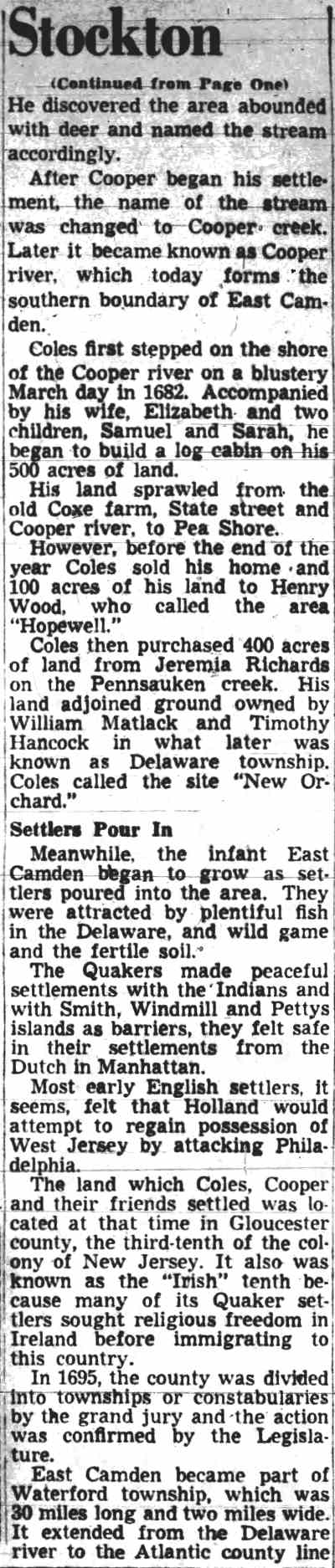
At first, Coles and Cooper called the stream Deer Kill, a name it had been given by Capt. Cornelius Mey, famous Dutch mariner, who explored it in 1623. He discovered the area abounded in deer. After Cooper began his settlement, the name of the stream changed to Cooper creek. Later it became known as Cooper river, as it is known today. Cooper river forms the southern boundary of East Camden.
Coles first stepped on the shore of East Camden on a cold, rainy March day in 1682. Accompanied by his wife, Elizabeth, and two children, Samuel and Sarah, he built a log cabin near the junction. His land sprawled from the Cooper river to Pea Shore, an early name for Pennsauken creek.
In 1684, Coles purchased 400 acres of land from Jeremia Richards, and six years later bought 400 more from William Matlock and Timothy Branson.
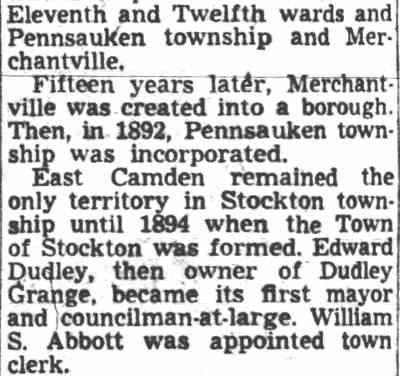
East Camden remained the only territory in Stockton township until 1894 when the Town of Stockton was formed. Edward Dudley, then owner of Dudley Grange, became its first mayor and councilman-at-large. William S. Abbott was appointed town clerk.
In 1892, Pennsauken township was incorporated. Fifteen years earlier, Merchantville was created into a borough. Stockton township also included what became the Eleventh and Twelfth wards.
Sam Coles, First E. Camden Settler, Elected to N.J. Legislature in 1685
Camden Courier-Post —
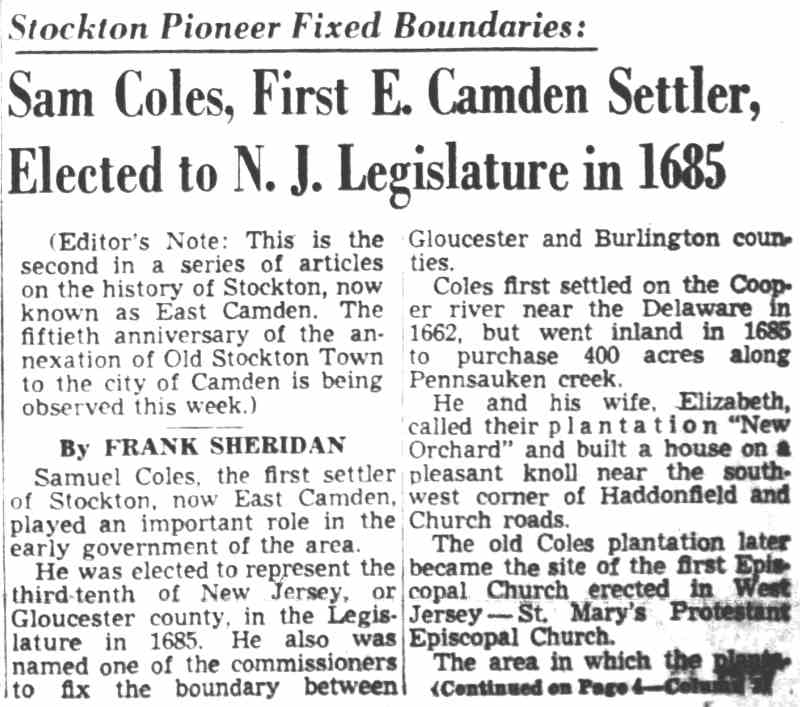

Stockton Pioneer Fixed Boundaries — By Frank Sheridan
Samuel Coles, the first settler of Stockton, now East Camden, played an important role in the early government of the area. He was elected to represent Gloucester county in the Legislature in 1685. He also was named one of the commissioners to fix the boundary between Gloucester and Burlington counties.
Coles first settled on the Cooper river near the Delaware in 1682, but went inland in 1685 to purchase 400 acres along Pennsauken creek. He and his wife, Elizabeth, called their plantation “New Orchard” and built a house on a pleasant knoll near the southwest corner of Haddonfield and Church roads. The old Coles plantation later became the site of the first Episcopal Church erected in West Jersey — St. Mary’s Protestant Episcopal Church.
Coles left on a business trip to England. Returning, he stopped at the Barbadoes to visit a colony of friends there and never came back home. Meanwhile, his widow, Elizabeth, carried on the work of the plantation.
Another early settler was Thomas Mathis, who built on a section of Samuel Coles’ land. Mathis was elected a member of the General Assembly in 1681.
In 1699, Joseph Nicholson acquired 100 acres of land in East Camden. Nicholson’s neighbor was James Griffin, who ran an inn and ferry at what is now the foot of Federal street at Cooper’s Point.
Joseph Nicholson Sr. came to America in 1678 on the vessel “Griffin” with John Fenwick. One of his children, Abigail, married Samuel Coles. Another, Elizabeth, married Joseph Coles.
Spicer and Rudderow Families Among Early East Camden Settlers
Camden Courier-Post —
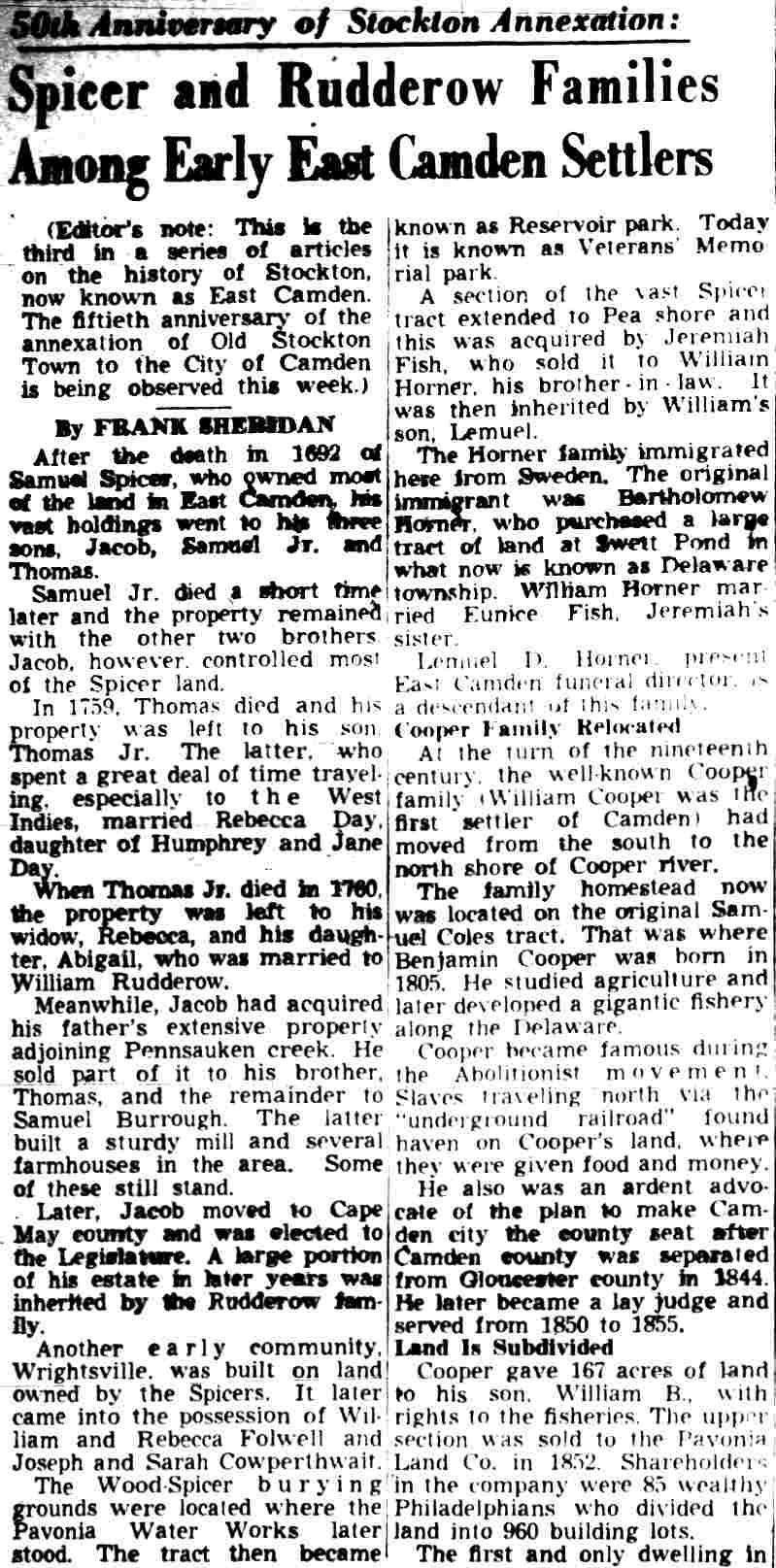
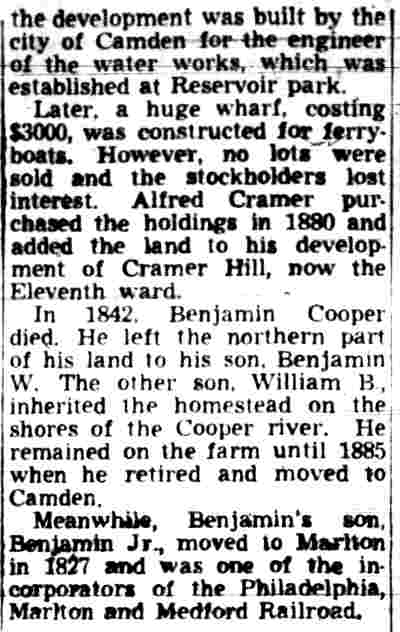
50th Anniversary of Stockton Annexation — By Frank Sheridan
After the death in 1802 of Samuel Browning, who held most of the land in East Camden, his holdings were left to his son Thomas. Thomas Jr. died a short time later and the property came under the control of his son Jacob.
Jacob had acquired adjoining Pennsauken creek. He left some property to his son Thomas, and the remainder to others, and built farmhouses in the area.
Another early community, Wrightsville, was built on land owned by Obadiah Wright and his wife, and the Falwell family. The Woodspicer Burying Ground in the early years of the 19th century was located on land held by the Falwell family. That tract later became known as Reservoir park — today Victoria Meadows.
The Horner family immigrated from New England. The original immigrant was Bartholomew Horner who settled at what is now Delaware avenue, then later moved to Penns Grove.
During the early nineteenth century, the well-known Cooper family moved from the south to the north bank of the Cooper river. Benjamin Cooper built his house at the junction of the old Coles tract. The Cooper family developed a fishery and ferry business, and during the Civil War, slaves traveling the Underground Railroad found shelter in the Cooper homes.
The water works was established at Reservoir park. Later, a huge wharf costing $3,000 was constructed for ferryboats. However, no lots were sold and the stockholders lost interest. Alfred Cramer purchased the holdings in 1880 and added the land to his development of Cramer Hill, now the Eleventh ward.
In 1842, Benjamin Cooper died. He left the northern part of his land to his son, Benjamin W. The other son, William B., inherited the homestead on the shores of the Cooper river and remained on the farm until 1885. Benjamin’s son Benjamin Jr. moved to Marlton in 1827 and was one of the incorporators of the Philadelphia, Marlton and Medford Railroad.
East Camden & Cramer Hill, Part 4
Camden Courier-Post —
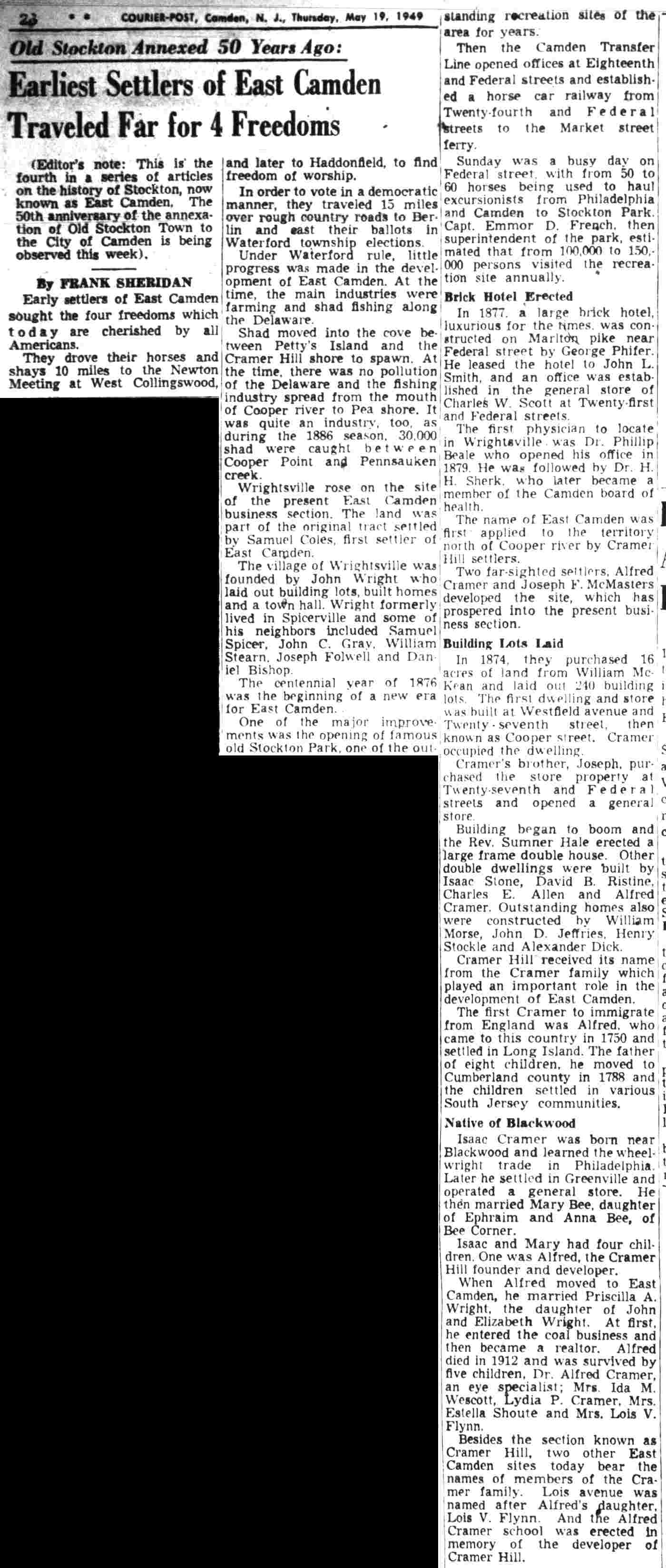
Lois Avenue — Alfred Cramer School — Stockton Park
Dr. Philip Beale — Dr. H.H. Sherk — John Wright — Emmor D. French — Alfred Cramer
Joseph F. McMasters — William McKean — Samuel Spicer — John C. Gray — William Stearn
Joseph Folwell — Daniel Bishop — George Phifer — John L. Smith — Charles W. Scott
East Camden & Cramer Hill, Part 5
Camden Courier-Post —
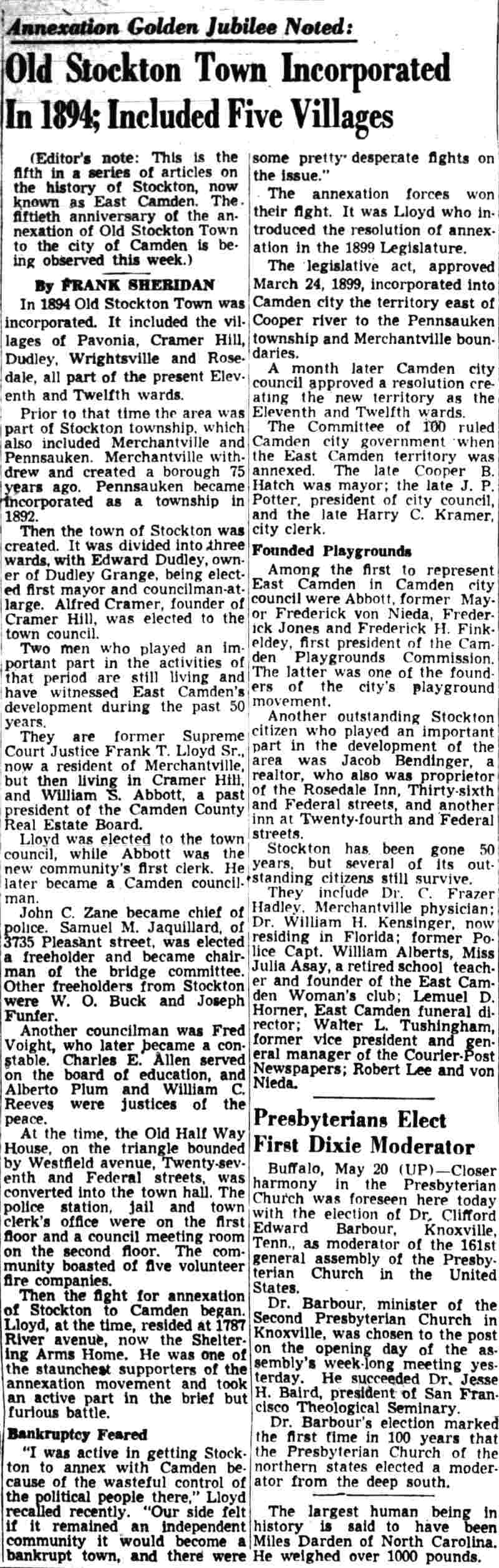
Named: Edward Dudley, Alfred Cramer
Frank T. Lloyd Sr., William S. Abbott
John C. Zane, Samuel M. Jacquillard
W.O. Buck, Joseph Funfer
Fred Voight, Charles E. Allen
Alberto Reeves, William C. Plum
Cooper B. Hatch, Joseph P. Potter
Harry C. Kramer, Frederick von Nieda
Frederick Jones, Frederick Finkeldey
Jacob Bendinger, Rosedale Inn
Dr. C. Frazer Hadley, Dr. William H. Kensinger
William E. Albert, Julia Asay
Lemuel D. Horner Jr., Walter L. Tushingham, and Robert Lee.