Introduction
William H. Whaland was appointed to the Camden Fire Department in the spring of 1884 to serve as an extra man with Engine Company 2. He replaced Charles Fitzsimmons. When the Fire Department was reorganized on July 1, 1885 and eighteen of the extra men were laid off, William H. Whaland was among that number.
William H. Whaland was born in Pennsylvania in 1841. He was the son of William and Maria Whaland. Sadly, his father passed in May of 1847. The 1850 Census shows William H. Whaland living with his mother and sisters Sarah, Ann, Mary, and Abby E. in the Spring Garden section of Philadelphia. When the Census was taken in 1860 William H. Whaland was living in Philadelphia’s Ward 13 with his sister Abby.
When the Civil War erupted in April of 1861, William H. Whaland did not immediately enlist. He enlisted for three years as a Private on August 13, 1862 in Company B, 121st Pennsylvania Infantry Regiment Pennsylvania.
The 121st was recruited in Philadelphia and Venango County and mustered into the service for three years, in September of 1862 at Philadelphia. It was ordered to Washington, where it was attached to Casey’s provisional brigade, and in October, it became a part of General Meade’s division near Antietam. Fredericksburg was its first engagement, after which it went into camp at Belle Plain for the winter. It broke camp to participate in the “Mud March,” and again for the Chancellorsville movement in May, 1863, returning to camp near Falmouth until the Gettysburg campaign.
On July 1, the regiment was hotly engaged and out of 263 men who entered the fight only 84 reported for duty after the day was over. The next day the men had some rest, but were active again on the 3rd and then joined in the pursuit. The 121st guarded Kelly’s Ford and Cedar Run bridge, near Catlett’s Station, joined in the Mine Run movement, and then made winter quarters at Culpeper, Virginia.
In 1864, attached to the 5th corps, the regiment participated in the battle of the Wilderness, where it sustained heavy loss. At Spottsylvania, Jericho Ford, Bethesda Church and Cold Harbor the men fought bravely, their ranks greatly reduced in numbers. William H. Whaland was promoted to Full Sergeant on May 12, in the midst of the fighting at Spottsylvania.
At Cold Harbor the 121st was assigned to the 1st division. It aided in the construction of “Fort Hell” at Petersburg; shared in the raid upon the Weldon railroad in August, fought at Peebles Farm, at which time it formed part of the 3rd brigade, 3rd division. In this engagement a large number of the 121st were cut off by the enemy and made prisoners.
The remnant of the regiment had a part in the movement on the Weldon railroad in December, the Hatcher’s Run movement in February of 1865, the fight at the Boydton Plank Road in March, was active at the battle of Five Forks and was present at Lee’s surrender at Appomattox. A few days of guard duty at Appomattox and two weeks encampment on the South Side railroad followed, after which the regiment proceeded to Washington and was there mustered out on June 2, 1865 at Arlington Heights, Virginia.
Sergeant Whaland was among those who mustered out of Company B, 121st Pennsylvania Infantry on June 2, 1865. He returned to Philadelphia, and was living there with his mother and his sister Abby when the Census was taken in 1870. The census does not indicate a profession, but by 1879, when he had already moved to Camden, William H. Whaland was working as a bricklayer. The 1879–1880 Camden City Directory shows William H. Whaland living at 628 Cherry Street.
When the Census was taken in 1880, William H. Whaland and family resided at 411 Hartman Street in South Camden. Hartman Street was renamed Clinton Street in 1882. The family at that time consisted of William H. Whaland, his wife Mary, and children Lillian, Charles W. Whaland and William K. Whaland. Another son, Harry, was born in 1881.
The family moved to 721 Walnut Street prior to the compilation of the 1881–1882 City Directory. By the middle of 1882 William H. Whaland had moved to 717 Walnut Street. On September 16, 1900 William H. Whaland was awarded an $8.00 per month pension for his Civil War Service.
William H. Whaland was still residing at 717 Walnut Street as late as the summer of 1910. By the time the Census was taken, Mary Whaland had passed away. William H. Whaland was still living at the Walnut Street address with his two oldest sons, William K., an umbrella cutter, and Charles W. Whaland, a Camden police officer. Youngest son Harry had married Harriet Davis and was working as a telegraph operator. By 1914 he had become a lawyer, practicing in Camden.
William H. Whaland was living with his son, William, who by then had also joined the Camden Police Department, at 1166 Everett Street when the Census was taken in 1920.
William H. Whaland was a charter member of William B. Hatch Post No. 37, Grand Army of the Republic.
Death of William Whaland
Philadelphia Public Ledger —
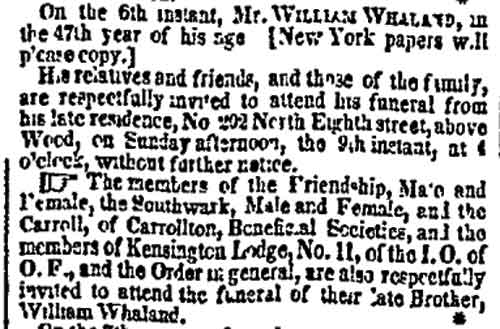
On the 6th instant, Mr. WILLIAM WHALAND, in the 47th year of his age [New York papers will please copy.] His relatives and friends, and those of the family, are respectfully invited to attend his funeral from his late residence, No. 202 North Eighth street, above Wood, on Sunday afternoon, the 9th instant, at 4 o’clock, without further notice. The members of the Friendship, Ma’o and Female, the Southwark, Male and Female, and the Carroll, of Carrollton, Beneficial Societies, and the members of Kensington Lodge, No. 11, of the I.O. of O.F., and the Order in general, are also respectfully invited to attend the funeral of their late Brother, William Whaland.
Chicken Thieves Start Something
Philadelphia Inquirer —
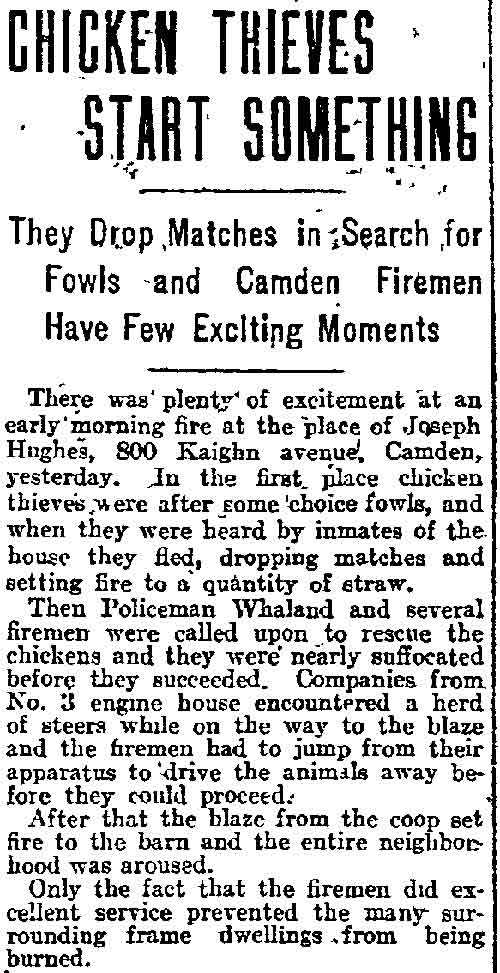
There was plenty of excitement at an early morning fire at the place of Joseph Hughes, 800 Kaighn avenue, Camden, yesterday. In the first place chicken thieves were after some choice fowls, and when they were heard by inmates of the house they fled, dropping matches and setting fire to a quantity of straw. Then Policeman Whaland and several firemen were called upon to rescue the chickens and they were nearly suffocated before they succeeded. Companies from No. 3 engine house encountered a herd of steers while on the way to the blaze and the firemen had to jump from their apparatus to drive the animals away before they could proceed. After that the blaze from the coop set fire to the barn and the entire neighborhood was aroused. Only the fact that the firemen did excellent service prevented the many surrounding frame dwellings from being burned.