Introduction
George Dilmore Sr. operated a saloon at 339–341 Kaighn Avenue, the corner of South 4th Street and Kaighn Avenue in the 1890s and 1910s. He first appears in Camden City Directories in 1894. Directories indicate that he operated his business at 341 Kaighn Avenue while making his residence at 339 Kaighn. He also operated a bottling business during this period.
In December of 1896 the saloon came to the attention of the police and newspapers when a former policeman patronizing the bar, Daniel Lee, was shot and killed by another patron, Edward Melson. Both men had been drinking at the time. Despite numerous witnesses, Melson was acquitted of the crime when tried in January of 1897, much to the apparent disbelief of Prosecutor Wilson Jenkins, Law Judge G.D.W. Vroom, and Associate New Jersey Supreme Court Justice Charles Grant Garrison.
George Dilmore successfully operated his business on Kaighn Avenue through at least 1906. By 1910 he had relocated to 531 Market Street in the heart of downtown Camden, a stone’s throw from the Camden County Courthouse, where he remained in business through at least 1914.
The bar at 341 Kaighn Avenue was acquired by the Palese family by 1910. The building was not used as a bar once Prohibition was enacted. By 1947 Camden Bar and Restaurant Supply was operating at the address. The building still stands today, in use by a non-profit agency in Camden.
One of George Dilmore’s sons, William M. Dilmore, served as the City of Camden’s Purchasing Agent.
Roundabout the State,
Trenton Evening Times —
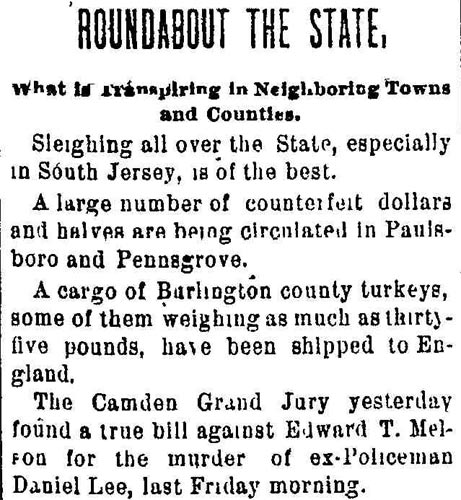
What is Transpiring in Neighboring Towns and Counties.
Sleighing all over the State, especially in South Jersey, is of the best.
A large number of counterfeit dollars and halves are being circulated in Paulsboro and Pennsgrove.
A cargo of Burlington county turkeys, some of them weighing as much as thirty-five pounds, have been shipped to England.
The Camden Grand Jury yesterday found a true bill against Edward T. Melson for the murder of ex-Policeman Daniel Lee, last Friday morning.
New Year’s Day Over in Camden
Philadelphia Inquirer —
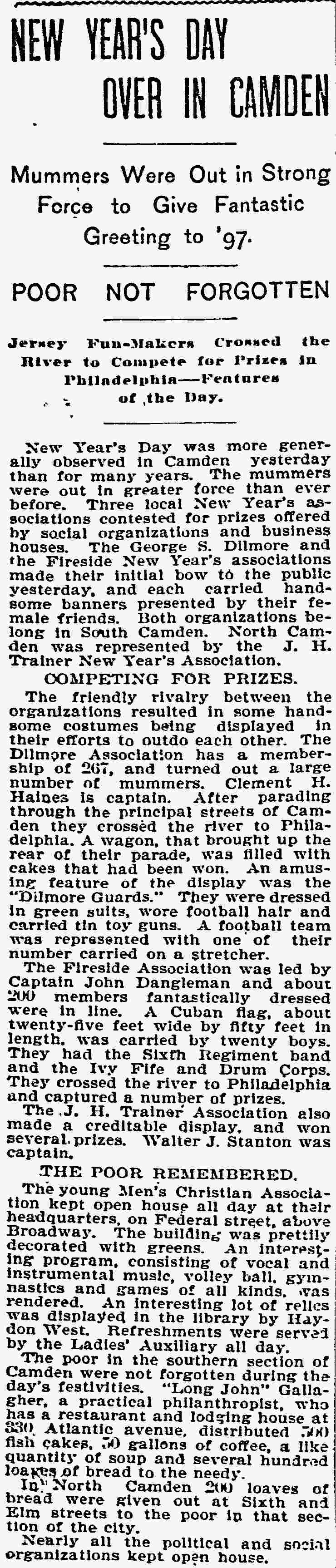
Mummers Were Out in Strong Force to Give Fantastic Greeting to ‘97.
POOR NOT FORGOTTEN
Jersey Fun-Makers Crossed the River to Compete for Prizes in Philadelphia—Features of the Day.
New Year’s Day was more generally observed in Camden yesterday than for many years. The mummers were out in greater force than ever before. Three local New Year’s associations contested for prizes offered by social organizations and business houses. The George S. Dilmore and the Fireside New Year’s associations made their initial bow to the public yesterday, and each carried handsome banners presented by their female friends. Both organizations belong in South Camden. North Camden was represented by the J. H. Trainer New Year’s Association.
COMPETING FOR PRIZES.
The friendly rivalry between the organizations resulted in some handsome costumes being displayed in their efforts to outdo each other. The Dilmore Association has a membership of 267, and turned out a large number of mummers. Clement H. Haines is captain. After parading through the principal streets of Camden they crossed the river to Philadelphia. A wagon, that brought up the rear of their parade, was filled with cakes that had been won. An amusing feature of the display was the “Dilmore Guards.” They were dressed in green suits, wore football hair and carried tin toy guns. A football team was represented with one of their number carried on a stretcher.
The Fireside Association was led by Captain John Dangleman and about 200 members fantastically dressed were in line. A Cuban flag, about twenty-five feet wide by fifty feet in length, was carried by twenty boys. They had the Sixth Regiment band and the Ivy Fife and Drum Corps. They crossed the river to Philadelphia and captured a number of prizes.
The J. H. Trainer Association also made a creditable display, and won several prizes. Walter J. Stanton was captain.
THE POOR REMEMBERED.
The young Men’s Christian Association kept open house all day at their headquarters, on Federal street, above Broadway. The building was prettily decorated with greens. An interesting program, consisting of vocal and instrumental music, volley ball, gymnastics and games of all kinds, was rendered. An interesting lot of relics was displayed in the library by Haydon West. Refreshments were served by the Ladies’ Auxiliary all day.
The poor in the southern section of Camden were not forgotten during the day’s festivities. “Long John” Gallagher, a practical philanthropist, who has a restaurant and lodging house at 330 Atlantic avenue, distributed 500 fish cakes, 50 gallons of coffee, a like quantity of soup and several hundred loaves of bread to the needy.
In North Camden 200 loaves of bread were given out at Sixth and Elm streets to the poor in that section of the city.
Nearly all the political and social organizations kept open house.
On Trial for His Life
The North American —
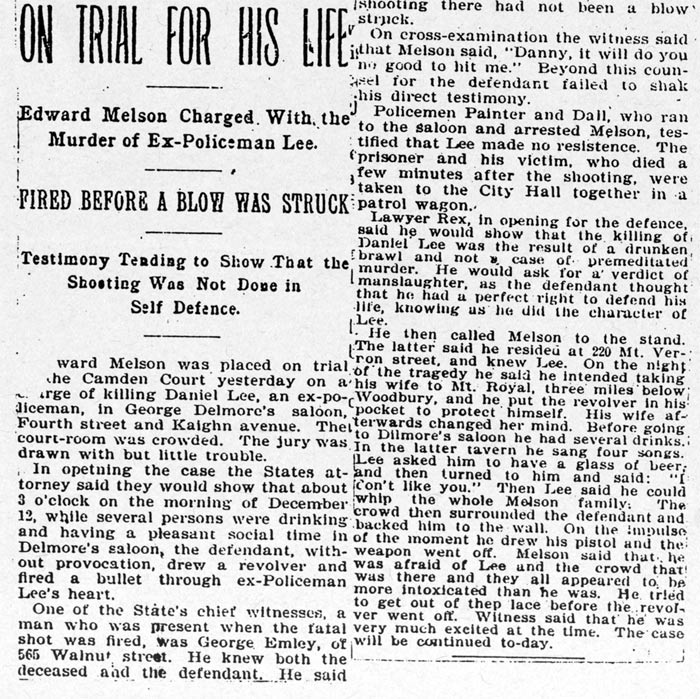
Edward Melson Charged With the Murder of Ex-Policeman Lee.
Fired Before a Blow Was Struck
Testimony Tending to Show That the Shooting Was Not Done in Self Defence.
Edward Melson was placed on trial in the Camden County Court yesterday on a charge of killing Daniel Lee, an ex-policeman, in George Delmore’s saloon, at Fourth street and Kaighn avenue. The court-room was crowded. The jury was drawn with but little trouble.
In opening the case the States attorney said they would show that about 3 o’clock in the morning of December 12, while several persons were drinking and having a pleasant social time in Delmore’s saloon, the defendant, without provocation, drew a revolver and fired a bullet through ex-Policeman Lee’s heart.
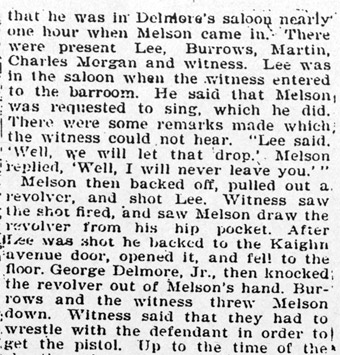
One of the State’s chief witnesses, a man who was present when the fatal shot was fired, was George Emley, of 565 Walnut street. He knew both the deceased and the defendant. He said that he was in Delmore’s saloon nearly one hour when Melson came in. There were present Lee, Burrows, Martin, Charles Morgan and witness. Lee was in the saloon when the witness entered to the barroom. He said that Melson was requested to sing, which he did. There were some remarks made which the witness could not hear. Lee said, “Well, we will let that drop.” Melson replied, “Well, I will never leave you.”
Melson then backed off, pulled out a revolver, and shot Lee. Witness saw the shot fired, and saw Melson draw the revolver from his hip pocket. After Lee was shot he backed to the Kaighn avenue door, opened it, and fell to the floor. George Delmore, Jr., then knocked the revolver out of Melson’s hand. Burrows and the witness threw Melson down. Witness said that they had to wrestle with the defendant in order to get the pistol. Up to the time of the shooting there had not been a blow struck.
On cross-examination the witness said that Melson said, “Danny, it will do you no good to hit me.” Beyond this counsel for the defendant failed to shake his direct testimony.
Policemen Painter and Dall, who ran to the saloon and arrested Melson, testified that Lee made no resistance. The prisoner and his victim, who died a few minutes after the shooting, were taken to the City Hall together in a patrol wagon.
Lawyer Rex, in opening for the defence, said he would show that the killing of Daniel Lee was the result of a drunken brawl and not a case of premeditated murder. He would ask for a verdict of manslaughter, as the defendant thought that he had a perfect right to defend his life, knowing as he did the character of Lee.
He then called Melson to the stand. The latter said he resided at 220 Mt. Vernon street, and knew Lee. On the night of the tragedy he said he intended taking his wife to Mt. Royal, three miles below Woodbury, and he put the revolver in his pocket to protect himself. His wife afterwards changed her mind. Before going to Dilmore’s [sic] saloon he had several drinks. In the latter tavern he sang four songs. Lee asked him to have a glass of beer and then turned to him and said: “I don’t like you.” Then Lee said he could whip the whole Melson family. The crowd then surrounded the defendant and backed him to the wall. On the impulse of the moment he drew his pistol and the weapon went off. Melson said that he was afraid of Lee and the crowd that was there and they all appeared to be more intoxicated than he was. He tried to get out of the place before the revolver went off. Witness said that he was very much excited at the time. The case will be continued to-day.
Want Liquor Men Put on the Rack
Philadelphia Inquirer —

Camden County Law and Order League Hints That Political Pull Saves Offenders
The Camden County Law and Order League is endeavoring to bring to punishment the saloon and tavern keepers who escaped indictment in the recent round up of liquor sellers charged with violating the law. The September and December grand juries indicted 168 liquor dealers out of 216 against whom complaints were filed by the League, and it was currently reported that strong personal and political influences were exercised in behalf of the forty-eight who escaped. Yesterday the League renewed its complaints against the forty-eight “immunes” and sent a communication to the grand jury as follows:
“We presented before the two preceding grand juries the names of about 216 persons charged with about 1200 specific violations of law, including the selling of liquor on Sundays, the having of slot machines and other gambling devices and the keeping of disorderly houses. Of the persons thus charged 168 have been presented to the court for trial, forty-eight were not thus presented, although some of them were known to be old offenders and had committed more offenses than some of those who were presented. To be more particular, while some were presented against whom there were three or four counts, others were not presented, although there were against them as high as twelve, thirteen and fourteen counts, and these, supported by the same evidence precisely as had been accepted in the examination of the cases presented for trial.
HINT AT UNDUE INFLUENCE.
“We cannot account for this, because we refuse to believe that there is one law for one offender and another law for another offender, when the offense is precisely the same; and because we are loth to believe the current rumor that purely political influences had to do with the results of the inquiries. We believe most deeply that the court proceedings must be kept above suspicion and that in their integrity is the safeguarding of the interests of the people. Hence we appeal to your honorable body to make the most searching investigation of our charges in order that the law may be maintained and the really guilty be brought to just account.
“We entreat this the more because in addition to the evidence before presented we have other witnesses who were not heard then and witnesses whose testimony is of much importance in arriving at a just conclusion as to the matters to be inquired into.”
The communication is signed by Rev. John Handley, D. D., president, and Rev. S. H. Hann, secretary of the League. The grand jury sent a formal acknowledgement of the receipt of the communication.
The league supplied the grand jury with a list of the names, places and charges against the accused liquor sellers, whose names are as follows:
SALOONKEEPERS ACCUSED.
CAMDEN CITY.—P. J. Boyle, 1011 Broadway; Philip Berger, Seventh and Clinton; N. N. Chew, 1016 South Fourth; James Croker, 400 Jasper; John Dugan, 100 Pearl; George Doerfuss, River road and Main street; George Dillmore, Fourth and Kaighn avenue; “Doc” Eisner, 3000 Federal; Pat Flood, 640 Pine; William Gallagher, 106 Kaighn avenue; Jesse Grant, 109 Kaighn avenue; West Jersey Hotel, Henry Hussing, 623 Pearl; John Hoosey, Front and Cooper; John J. Keefe, 28 Haddon avenue; P. J. Kelly, 643 North Front; Arthur Lloyd, Sixth and Royden; John McGowan, Tenth and Division; Ed Mulligan, 22 South Eighth; William Moffert, South Third; Frank Norton, 951 Ferry avenue; Z. Heithamer, Day and Federal; William F. Sand, Haddon avenue and Line; A. Schraden, Fourth and Spruce; J. Schramm, Cooper and Cleveland avenues; Jacob Selser, 1186 Kaighn avenue; Thomas Tracey, Twentieth and Federal; Jacob Walz, 33 Union; Frank Wilson, 909 South Fourth; Daniel J. Woods, 108 Kaighn avenue.
Of these thirty Camden saloonkeepers, seventeen have pleaded guilty before Recorder Nowrey for violating the city excise ordinance by selling on Sundays. Some paid the fine of $50, while others escaped punishment, the Supreme Court setting aside the excise ordinance.
The keepers of inns and taverns who are charged with selling on Sundays are Bowman H. Bates, Waterford township; William R. S. Buckingham, Centre township; E. T. Crowley, Winslow township; George C. Stratton, E. B. Davis and Louis Ederle, Gloucester township; Harry Foell, Waterford township; James J. Foster, Centre township; James J. Keating, proprietor of the Red Mill, where a pool room was formerly in operation; Charles H. McCully, Winslow township; Caroline Slemmer, Chesilhurst; William Snyder, Waterford township; A. H. Tiffen, Pensauken township; B. F. C. Rothwell, and Charles H. Wood, Winslow township; F. W. Weldemann, Pensauken township.
Burglary Attempt at Dilmore’s Saloon
Philadelphia Inquirer —
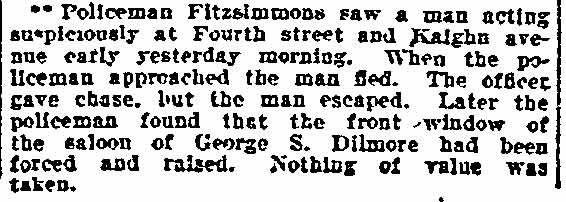
Policeman Fitzsimmons saw a man acting suspiciously at Fourth street and Kaighn avenue early yesterday morning. When the policeman approached the man fled. The officer gave chase, but the man escaped. Later the policeman found that the front window of the saloon of George S. Dilmore had been forced and raised. Nothing of value was taken.