Captain William R. Maxwell
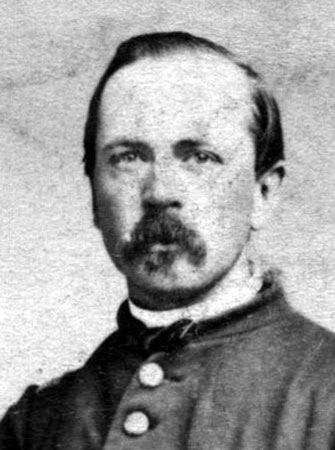
Captain William R. Maxwell
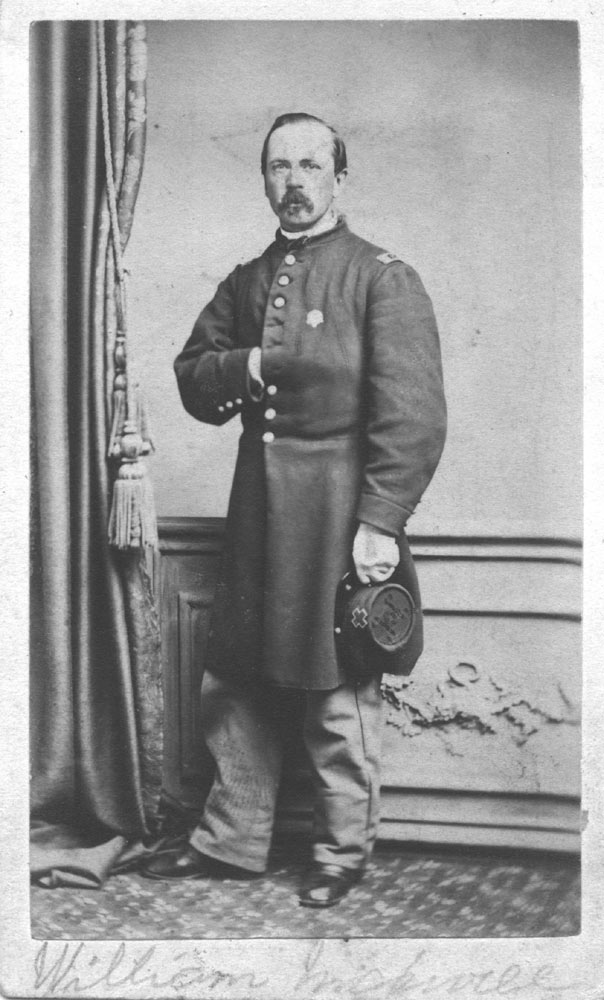
Captain William R. Maxwell
William R. Maxwell was born in New York around 1825. He appears to have moved to Camden during the 1850s. When the Census was taken in 1860, he was living in Camden’s Middle Ward with his wife and son, James T. Maxwell. Mrs. Maxwell’s given name is recorded as Harriet. Descendants of William Maxwell believe, however, that her name was Susannah or Susan. A daughter, Edith, was born after the Census was enumerated.
On April 13th, 1861 Confederate forces at Charleston, South Carolina attacked Fort Sumter, which guarded the approaches to the harbor. Two days later President Lincoln issued a proclamation calling for the states to raise an army of 75,000 men to serve for three months in order to stamp out the rebellion. 116 of Camden’s leading citizens, including William R. Maxwell, met the next day to consider the proclamation. George Reeser Prowell wrote the following account in his epic History of Camden County, New Jersey:
On the 16th of April, 1861, three days after the Confederates fired upon Fort Sumter, at the entrance of Charleston Harbor, a large number of loyal and patriotic citizens of Camden City and County issued the following vigorous and spirited response to the President’s proclamation:
To the President of the United States:
Peaceful reconciliation upon the form of our Constitution is repelled and scorned, and secession means, in the hearts of its supporters, both Treason and war against our Country and Nation.
“We, therefore, the undersigned Loyal Citizens of the United States, and inhabitants of the city of Camden, in the State of New Jersey, responding to the proclamation of the President of the United States, hereby declare our unalterable determination to sustain the government in its efforts to maintain the honor, the integrity and the existence of our National Union and the perpetuity of the popular Government, and to redress the wrongs already long enough endured; no differences of political opinion; no badge of diversity upon points of party distinction, shall restrain or withhold us in the devotion of all we have or can command to the vindication of the Constitution, the maintenance of the laws and the defense of the Flag of our Country.
Among the signatories were I. S. Mulford, B. M. Braker, James M. Cassady, Timothy Middleton, Richard H. Lee, C. G. Zimmerman, Thomas M. K. Lee, Jr., Richard Fetters, Abner Sparks, William B. Hatch, Thomas H. Dudley, James B. Dayton, and William R. Maxwell himself.
In response to a call, on the 18th of April an enthusiastic meeting was held in the county court-house, which was formed of a large collection of prominent citizens. The court-room was decorated with flags and mottoes. John W. Mickle was chosen president and Samuel C. Harbert and Thomas G. Rowand secretaries. The president addressed the meeting first and Rev. Mr. Monroe offered a prayer. Hon. Thomas P. Carpenter, Thomas B. Atkinson (mayor) and Joseph Painter were appointed a committee on resolutions. Judge Philip J. Grey addressed the meeting, after which the committee adopted a long series of patriotic resolutions. The Washington Grays, Stockton Cadets and the Zouaves marched into the room and were received with cheers, Samuel Hufty read a resolution which was signed by many persons, who immediately formed the Home Brigade. David M. Chambers, Captain Stafford, Benjamin M. Braker, John H. Jones and E. A. Acton each addressed the meeting. James M. Scovel was then called upon and responded in eloquent terms and with patriotic energy. S. H. Grey offered a resolution, which was adopted, that the City Council and the Freeholders of the county be requested to appropriate money for the equipment of persons who may volunteer in defense of the country, and S. H. Grey, James M. Cassady and Joseph Painter were appointed to a committee to look after the interests of the resolution. The meeting continued in session until eleven p.m.
On the 22d of April Samuel H. Grey made an address before the Board of Freeholders in a patriotic appeal, soliciting the board to make appropriations for the relief of families of volunteer soldiers. John S. Read offered a resolution favoring the appropriation of five thousand dollars, which was unanimously adopted. On the evening of the 25th the City Council voted four hundred dollars for the same purpose. On the same evening the First Methodist Episcopal Church of Camden collected one hundred and fifty dollars and purchased five hundred Bibles for the volunteer soldiers of Camden County.
The State Bank of Camden loaned twenty-five thousand dollars and the Farmers and Mechanics Bank ten thousand dollars to the Governor of New Jersey to aid in the prosecution of the war. In July, 1861, the County Bible Society sent large installments of Bibles to the Camden County soldiers at Trenton.
On April 19th the Washington Grays, of Camden, held a meeting and resolved to open the armory for recruits. By Saturday, April 20th, those two companies, the Camden Zouaves and the Union Guards were reported ready for service and the Camden Light Artillery organizing. On the 25th the same correspondent wrote that the following companies had taken their departure from Camden for Trenton:
Washington Grays, Captain E. Price Hunt.
Camden Light Artillery, Captain I. W. Mickle.
Stockton Cadets, Captain E. G. Jackson.
Camden Zouaves, Captain John R. Cunningham.And the following from Gloucester City:
Union Guards, Captain Joseph B. Strafford.
Anderson Guards, Captain John P. Van Leer.It was the boast of the Gloucester people that Union township, which had but four hundred voters, sent at this time one hundred and ninety-eight good men to do duty for the cause.
Foster’s history asserts that on April 18th, Captain John R. Cunningham tendered the Camden Zouaves, a well-drilled and uniformed company, to the Governor. This organization had been formed under the militia law in the preceding year, when the tour of the principal cities made by Ellsworth’s Chicago Zouaves inspired thousands of young men to join companies patterned upon that famous model. It was mustered into the Fourth Regiment, on April 25th, as Company G, under command of Captain Cunningham, First Lieutenant Louis M. Morris and Ensign Joseph L. De La Cour.
The other five companies from Camden County were placed in the same regiment. Captain Hunt’s company became Company F; Captain Van Leer’s, Company H; Captain Jackson’s, Company C; Captain Strafford’s, Company D; and Captain Mickle’s, Company E. The two first were mustered on April 25th and the three last on April 27th.
Among the individual offers was that of William B. Hatch, of Camden, who had served in 1859 and 1860 in the cavalry of the Russian army; he was commissioned as adjutant of the Fourth Regiment in the ninety days’ service, and subsequently made major of the Fourth (three years’) Regiment. Mrs. Hettie K. Painter, of Camden, volunteered as a nurse, and became known to thousands of sick and wounded men for her gentle and efficient ministrations in the hospitals of the Army of the Potomac.
Company C, 4th Regiment New Jersey Infantry (Three Months)
The official record for William R. Maxwell reads as follows:
Enlisted as a 1st Lieutenant on 27 April 1861.
Commission in Company C, 4th Infantry Regiment New Jersey on 27 Apr 1861.
Mustered Out Company C, 4th Infantry Regiment New Jersey on 31 Jul 1861 at Trenton, NJ.
It should be noted that no less than five of Lieutenant Maxwell’s men became charter members of the Camden Fire Department when it was founded in 1869. Those men were as follows: Benjamin Connolly, G. Rudolph Tenner, Cornelius M. Brown, John Brown, and Jesse Chew.
| Captain | Edmund G. Jackson |
|---|---|
| First Lieutenant | William R. Maxwell |
| Ensign | William H. Hemsing |
| First Sergeant | Benjamin Connelly |
| Sergeants | G. Rudolph Tenner, John W. Moore, David D. Helm |
| Corporals | William Rogers, Samuel Ratcliff, George W. Jackson, William D. Miller |
| Fifer | George Jauss |
| Drummer | Charles Hoy |
| Privates | |
| James Albright | Henry Frost |
| Robert H. Ames | Jacob Gerhart |
| Joseph Bazarth | Charles G. P. Goforth |
| Anthony Bernard | John R. Grubb |
| James G. Boileau | Josiah Harley |
| Cornelius Brown | William H. Helams |
| John Brown | Walter Hill |
| Charles B. Capewell | Thomas Henderson |
| Thomas Carr | William S. Hineline |
| William H. Carson | Alfred Horner |
| Jesse C. Chew | Willard Howe |
| William H. H. Clark | Edward A. Johnston |
| John Clevenger | John Lezenby |
| William P. Copeland | William Loel |
| Collin Coutts | Alfred Martin |
| Dilwyn Cowperthwaite | Frank McCannon |
| John O. Crowell | William Morris |
| Charles Davis | Francis Mount |
| Elijah T. Davis | Davis H. Nichols |
| Clayton Edwards | George S. Patterson |
| William A. Fish | John P. Price |
| Richard J. Robinson | |
| Charles H. Rogers | William H. Schwaab |
| August Scior | Richard Smith |
| Charles Spooner | Savillion A. Steinmetz |
| Andrew H. Stilwell | Stacy Stockton |
| John Sweesley | Edward Thornton |
| James H. Townsend | Theodore Vansciver |
| Andrew J. Wallace | Joshua Wallens |
| John W. Wetherby | Joseph M. White |
| Thomas White | Thomas Whittaker |
| Charles Wilson | Isaac F. Wright |
| George W. Wood | |
Regimental History: 4th Infantry Militia (Three Months)
NEW JERSEY — FOURTH INFANTRY MILITIA (Three Months)
(Also known as the Twentieth N. J. Infantry)
Fourth Regiment—Militia.—Col., Matthew Miller, Jr.; Lieut.-Col., Simpson R. Stroud; Maj., Robert C. Johnson.
This regiment was mustered into the U. S. service at Trenton, April 27, 1861, to serve for three months, and left the state for Washington, D. C., on May 3, with 37 commissioned officers and 743 non-commissioned officers and privates, a total of 777. On the evening of May 5 it reached the capital, and on the 9th it was ordered to go into camp at Meridian Hill, where, within a few days the entire brigade was encamped, and where, on the 12th, it was honored by a visit from the president, who warmly complimented the appearance of the troops. On the evening of May 23 it joined the 2nd and 3d regiments and about midnight took up the line of march in silence for the bridge that spanned the Potomac. This bridge was crossed at 2 o’clock on the morning of the 24th, the 2nd was posted at Roach’s spring, and the 3d and 4th about half a mile beyond on the Alexandria road. On July 16, a guard was detailed from the 4th for a section of the Orange & Alexandria railroad, which it was important to hold; one company from the regiment guarded the Long bridge; still another was on duty at Arlington mills; and the remainder of the regiment, together with the 2nd, was ordered to proceed to Alexandria. On July 24, the term of service having expired, the 4th returned to New Jersey and was mustered out at Trenton, July 31, 1861. The total strength of the regiment was 783, and it lost by discharge 6, by promotion 2, by death 2 and by desertion 7, mustered out, 766.
Second Enlistment: 10th Regiment New Jersey Infantry
William R. Maxwell returned to Camden, but did not stay long. In November of 1861 he again answered his nation’s call to service and re-enlisted for a term of three years in the newly formed 10th New Infantry Regiment New Jersey. He served with this unit for a little more than a year before being promoted to Captain and transferring to the 4th Infantry Regiment New Jersey, which had suffered many casualties during the Antietam campaign. His official record reads as follows:
Enlisted as a 1st Lieutenant on 15 November 1861.
Commission in Company H, 10th Infantry Regiment New Jersey on 15 Nov 1861.
Promoted to Full Captain (As of Company H 4th Infantry) on 22 Oct 1862.
Discharged for promotion Company H, 10th Infantry Regiment New Jersey on 8 Nov 1862.
Commission in Company H, 4th Infantry Regiment New Jersey on 8 Nov 1862.
The 10th Infantry Regiment New Jersey spent 1862 in and around Washington, under the command of the Provost Marshall’s office. For all intents and purposes the Regiment served as a Military Police unit. The Provost Marshall’s office had been developed under the command of General McClellan during the early part of the war. This development created the Provost Marshall General, and the newly charged special department whose duties and definition of this office was for the first time under one management department head.
The Regiment’s duties included the following:
The suppression of marauding and depredation on private property.
The preservation of good order.
The prevention of straggling.
The suppression of gambling houses or other establishments prejudicial to good order and discipline.
Supervision of hotels, saloons and places of resort and amusements generally.
The Provost Marshall partook the character both of a Chief of Police and Magistrate. Among the duties of this officer he was entrusted with the duty of making searches, seizures and arrest. He had the custody of deserters, and of deserters from the opposing forces and of prisoners of war. All prisoners taken in battle were turned over to the Provost Marshall and by him later transferred to special guards, who delivered the prisoners to prison camps farther North.
He also had jurisdiction over the issuance of passes into camps to citizens as well as to hearing complaints lodged by citizens. Among his contact with the citizens was the supervision of the draft. He, also, saw that order was preserved, and that arrests were made against all offenders against military discipline under his authority, in short, preserving Martial Law among the citizens. All arrests made, the Provost Marshall was responsible for their safe keeping.
Regimental History: 10th Infantry (Three Years)
NEW JERSEY — TENTH INFANTRY (Three Years)
Tenth Infantry.—Colonels, William Bryan, William R. Murphy, Henry O. Ryerson; Lieutenant Colonels, John W. Wright, William S. Truex, Charles H. Tay, John D. Johnson; Majors, Mathew W. Berriman, Daniel Lodor, Jr., Henry A. Perrine, James W. McNeely.
This regiment was organized under the provisions of an act of Congress, approved July 22, 1861, and by authority issued by the war department direct to private individuals resident of the state, and not in any way under the control or supervision of the state authorities. Under the authority thus given, recruiting was commenced and the organization soon completed. It was then accepted by the war department as an independent organization, having been designated the “Olden Legion.” The regiment went into camp at Beverly, N. J., and from thence proceeded to Washington on Dec. 26, 1861, with 35 officers, 883 non-commissioned officers and privates, a total of 918. It went into camp at Camp Clay on the Bladensburg turnpike, a mile from Washington. On Jan. 29, 1862, the regiment was transferred to the state authorities and it was then thoroughly reorganized and designated the 10th regiment. The greater part of its early service was performed in and around Washington, having been assigned there for provost duty.
Promoted to Captain: 4th Infantry (Three Years)
As stated above, William R. Maxwell was promoted to Captain and transferred to the Fourth Infantry Regiment in the fall of 1862. This unit, not to be confused with the three-months unit in which William Maxwell had served previously, organized in the summer of 1861 after the Battle of Bull Run, when it became apparent that the war would not be over in a matter of weeks. Below is the unit’s entry from The Union Army. A History of Military Affairs in the Loyal States 1861–1865—Records of the Regiments in the Union Army—Cyclopedia of Battles—Memoirs of Commanders and Soldiers.
NEW JERSEY — FOURTH INFANTRY (Three Years)
Fourth Infantry—Colonels, James H. Simpson, William B. Hatch, William Birney, Edward L. Campbell; Lieutenant Colonels, J. L. Kirby Smith, Barzilla Ridgway, Charles Ewing, Baldwin Hufty; Majors, Samuel Mulford, David Vickers.
The 4th was organized under the provisions of an act of Congress, approved July 22, 1861. It was fully organized, equipped and officered by Aug. 19, at which time it was mustered into the U. S. service for three years, at Camp Olden, Trenton. It left the state the next day with 38 officers, 871 non-commissioned officers and privates, a total of 909. It reached Washington on Aug. 21, accompanied by a battery of 6 pieces, furnished by the state and commanded by Capt. William Hexamer, who had been waiting for six months for an opportunity to enter the service. It was assigned to the brigade of Gen. Kearney, then consisting of the 1st, 2nd and 3d N. J. regiments. Immediately after the first battle of Bull Run it joined the brigade near Alexandria, and in the operations along the line of the Orange & Alexandria railroad acted as a support to the advance. Just before the battle of West Point, Va., the brigade relieved the troops in advance and the men lay on their arms in line of battle until daylight, when they were ordered forward, the 4th being held as a reserve. At the battle at Gaines’ Mill the brigade was formed in two lines, the 4th being in the front, and advanced to the brow of a hill, where the 4th was sent into the woods by order of an aide of Gen. McClellan, all the brigade being engaged at the most dangerous and difficult parts of the field, until at last, wearied, bleeding, ammunition exhausted, the brigade slowly retired and crossing the bridge at 11 o’clock, reached its old camp about midnight, having sustained a total loss of over 1,000 men in killed and wounded, of whom some 500, belonging to the 4th were captured in a body, having refused to retreat from the woods when they might have done so, and continuing to fight until completely surrounded. Besides this loss in prisoners the regiment lost 38 killed and 111 wounded.
The regiment participated in the Second Battle of Bull Run and on September 14, 1862 fought at the battle at Crampton’s Gap, where again heavy casualties were taken. Having fought at Crampton’s Gap, the regiment was present at the Battle of Antietam, three days later. The regiment did not take part in the attack, but came under severe artillery fire during the fray.
Replacements including Captain Maxwell joined the Fourth Regiment in October and November 1862. The unit took part in the movement against Fredericksburg on December 13, 1862. At Fredericksburg, December 13th and 14th, it saw hard fighting on the left of the line, and Colonel William B. Hatch was fatally wounded in leading the Fourth Regiment to an assault.
The first part of 1863 was relatively quiet for Captain Maxwell and the men of the Fourth Regiment. During the Gettysburg campaign the regiment was detailed for provost duty in Washington. In that capacity the Fourth New Jersey was utilized to guard the ammunition train of the Union Army’s Artillery Reserve at Gettysburg. The following report summarizes the regiment’s activities at the battle.
Gettysburg after battle report:
Report of Maj. Charles Ewing, Fourth New Jersey Infantry, Train Guard.
Near Warrenton Junction, Va.,
August 23, 1863.Capt. C. H. Whittelsey,
A. A. G., Artillery Reserve, Army of the Potomac.Captain,
In obedience to orders received from headquarters Artillery Reserve, I have the honor to report that on July 2, while in charge of the ammunition train of the Artillery Reserve, my regiment arrived at the scene of action at Gettysburg, Pa.
The part taken by the regiment was insignificant, being that of guarding the train, until about noon on the 3d instant, at the time of the enemy’s terrific attack upon the left center, at which time the fugitives from the field began to rush toward the rear upon the road upon which I was stationed. I immediately deployed across the road and into the woods on my right flank with fixed bayonets, where I stopped and reorganized between 400 and 500 men, whom I turned over to Gen. Patrick. As soon as the panic subsided, I resumed my former duty with the ammunition train, which was not again interrupted during the battle.
All of which is respectfully submitted.
I am, captain, very respectfully, your obedient servant,
CHAS. EWING,
Maj., Comdg. Fourth New Jersey Volunteers.
Captain Maxwell is thought to have been wounded at Crampton’s Gap. At some point after Gettysburg he returned to Camden, where he died of neuralgia on February 28, 1864. The 1863–1864 Camden City Directory indicates his residence as 18 Federal Street. After his death Mrs. Maxwell resided at 814 Carpenter Street. By 1870 Mrs. Maxwell remarried, but died not long afterwards. Her husband, a Mr. Smith, relocated to Atlantic City where he raised Edith Maxwell. James T. Maxwell remained in Camden.
James T. Maxwell was living in Camden and working as a telegraph operator as late as 1880. He worked as a telegraph operator beginning in the 1860s. He married Sarah Ella “Ella” Lore at Cedarville, New Jersey on October 22, 1873. The couple were living at 401 North 2nd Street when the Census was taken in 1880. Not long afterwards they left Camden. James and Ella Maxwell were living in Woodbury, New Jersey at the time of the 1900 Census.
1860 Census
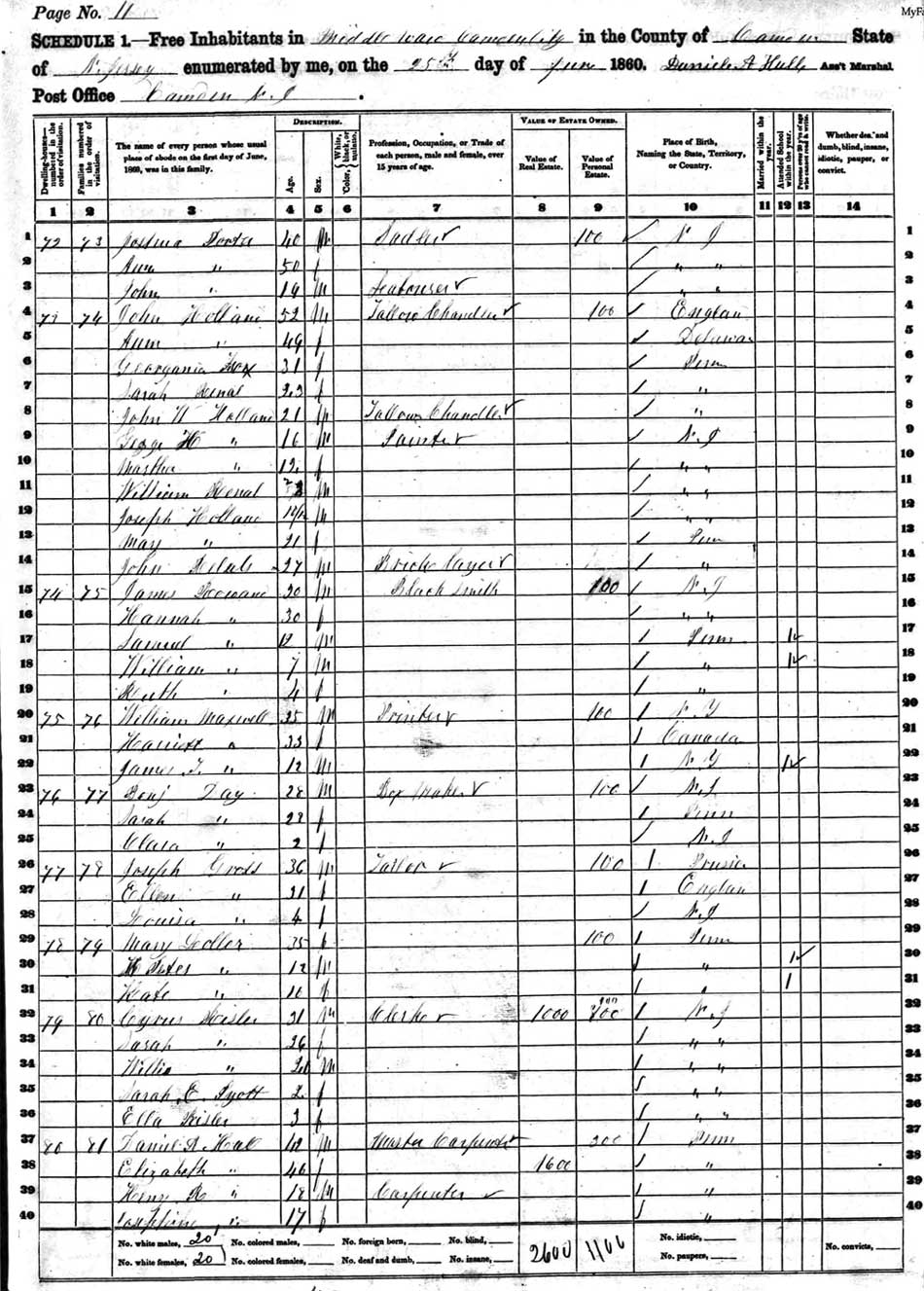
1860 Census — William R. Maxwell, Camden, NJ
Promoted
Philadelphia Inquirer —
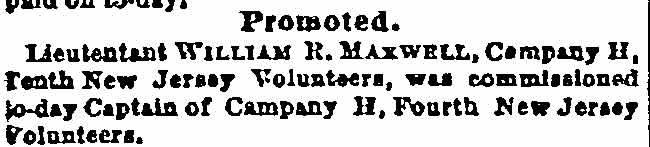
Promoted.
Lieutenant William R. Maxwell, Company H, Tenth New Jersey Volunteers, was commissioned to-day Captain of Company H, Fourth New Jersey Volunteers.