Thomas B. Atkinson
THOMAS B. ATKINSON was born in Camden in 1815. His father, Josiah Atkinson, was a prominent citizen and county magistrate. Thomas Atkinson learned the carpenter’s trade, and over the years erected several large buildings in Camden. Joining the Methodist Church during the great religious revival of 1837–1838, he built the Third Street Methodist Church, which stood for many years at Third Street and Bridge Avenue. He was a lifelong member of that church from its inception.
Thomas Atkinson became involved in politics as a Democrat. He was first elected to public office as a councilman from the Middle Ward in 1853, and subsequently to the office of recorder in 1856. He ran for mayor five times, in 1855, 1860, 1861, 1867, and 1869. In those days, the mayoral election was led annually. He was defeated for mayor in 1855 by Samuel Scull, and in 1867 and 1869 by Charles Cox, but was elected in 1860, receiving 608 votes to 578 for Paul C. Budd, American, and 547 for William F. Colbert, Republican; in 1861, the vote being,— Atkinson, 904; Budd, 634; Samuel Hufty, 480.
He succeeded Clayton Truax in 1860, and was in turn succeeded by Paul C. Budd as mayor.
Thomas Atkinson lived in the latter years of his life with wife Martha at 23 Third Street in Camden. He passed away on January 3, 1886, survived by his wife.
Thomas B. Atkinson
The History of Camden County New Jersey — George Reeser Prowell — 1886

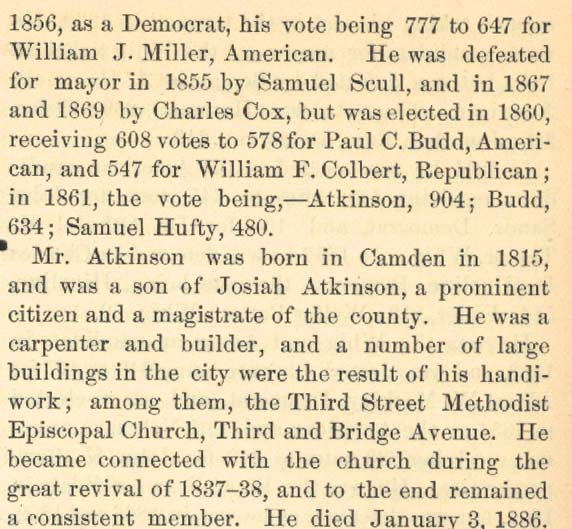
Thomas B. Atkinson was elected to Council from the Middle Ward in 1853, and recorder in 1856, as a Democrat, his vote being 777 to 647 for William J. Miller, American. He was defeated for mayor in 1855 by Samuel Scull, and in 1867 and 1869 by Charles Cox, but was elected in 1860, receiving 608 votes to 578 for Paul C. Budd, American, and 547 for William F. Colbert, Republican; in 1861, the vote being,—Atkinson, 904; Budd, 634; Samuel Hufty, 480.
Mr. Atkinson was born in Camden in 1815, and was a son of Josiah Atkinson, a prominent citizen and a magistrate of the county. He was a carpenter and builder, and a number of large buildings in the city were the result of his handiwork; among them, the Third Street Methodist Episcopal Church, Third and Bridge Avenue. He became connected with the church during the great revival of 1837–38, and to the end remained a consistent member. He died January 3, 1886.
1861 — The First War Meeting in Camden
On the 16th of April, 1861, three days after the Confederates fired upon Fort Sumter, at the entrance of Charleston Harbor, a large number of loyal and patriotic citizens of Camden City and County issued the following vigorous and spirited response to the President’s proclamation:
To the President Of the United States:
“The unparalleled events of the last week have revealed to the citizens of the United States, beyond question or the possibility of a doubt, that peaceful reconciliation upon the form of our Constitution is repelled and scorned, and secession means, in the hearts of its supporters, both Treason and war against our Country and Nation.
“We, therefore, the undersigned Loyal Citizens of the United States, and inhabitants of the city of Camden, in the State of New Jersey, responding to the proclamation of the President of the United States, hereby declare our unalterable determination to sustain the government in its efforts to maintain the honor, the integrity and the existence of our National Union and the perpetuity of the popular Government, and to redress the wrongs already long enough endured; no differences of political opinion; no badge of diversity upon points of party distinction, shall restrain or withhold us in the devotion of all we have or can command to the vindication of the Constitution, the maintenance of the laws and the defense of the Flag Of our Country.
I. S. Mulford • E. R. Johnson • Louis L. Scovel • B. M. Braker • Joseph C. Nichols • Elwood C. Fortiner • Joseph Vautier • Edmund Brewer • Uriah Norcross • Isaac L. Lowe • Henry B. Goodwin • Richard W. Test • James M. Cassady • John Duprey • Jesse Pratt • Hamilton Johnston • Charles P. Dickinson • Richard H. Lee • C. G. Zimmerman • Thomas M. K. Lee, Jr. • Charles J. Sanders • Samuel S. E. Cowperthwait • James M. Scovel • S. C. Harbert • John S. Read • D. H. Erdman • Adam Angel • George W. Vanhorn • Charles S. Garrett • Thomas M. Barracliff • W. H. Saunders • Jacob Harman, Jr. • Charles K. Horsfall • Timothy Middleton • William W. Sloan • Charles Cloud • A. W. Test • C. A. S. Driesback • Henry Schock • Walter Patton • Azael Roberts • Thomas Jeffries • O. Gilbert Hannah • J. C. De Lacour • Edward T. Andrews • Conclin Mayhey • William Reynolds • Simon Rammell • H. H. Goldsmith • John Horsfall • Thomas H. Dudley • Robert Folwell • Edw. H. Saunders • James O. Morgan • David H. Sheppard • Richard Fetters • Charles C. Reeves • S. H. Grey • N. B. Stokes • S. O. Wright • Joseph Dlinston • David Creary • John R. Barber • James H. Denny • William R. Maxwell • Robert Wible • Hamilton William • George W. Jackson • Joseph Maurer • Joseph D. Brown • William S. Scull • Daniel Witham • Isaac Shreeve • Adam Hare • George Wardell • Joseph Coffman • George W. Conrow • Joshua Howell • Martin Grey • S. L. Wayne • Abner Sparks • Van T. Shivers • Westcott Campbell • William J. Taylor • Isaiah Norcross • Alden O. Scovel • Philip J. Gray • George W. Gilbert • Charles D. Hineline • Thomas H. Davis • Charles De Haven • Thomas Ackley • John Gill • James B. Dayton • James M. Stevens • Joseph French • George Campbell • A. A. Merry • E. Wells • William D. Clark • William B. Hatch • E. O. Jackson • A. B. Martin • Richard O. Robertson • Timothy O. Moore • George W. Stanley • Robert Schall • Reynell Coates • Aaron Hewit • Henry Shuster • William Hartsgrove • William B. French • W. A. Winchester • John M. Natty
In response to a call, on the 18th of April an enthusiastic meeting was held in the county court-house, which was formed of a large collection of prominent citizens. The court-room was decorated with flags and mottoes. John W. Mickle was chosen president and Samuel C. Harbert and Thomas G. Rowand secretaries. The president addressed the meeting first and Rev. Mr. Monroe offered a prayer. Hon. Thomas P. Carpenter, Thomas B. Atkinson (mayor) and Joseph Painter were appointed a committee on resolutions. Judge Philip J. Grey addressed the meeting, after which the committee adopted a long series of patriotic resolutions. The Washington Grays, Stockton Cadets and the Zouaves marched into the room and were received with cheers, Samuel Hufty read a resolution which was signed by many persons, who immediately formed the Home Brigade. David M. Chambers, Captain Stafford, Benjamin M. Braker, John H. Jones and E. A. Acton each addressed the meeting. James M. Scovel was then called upon and responded in eloquent terms and with patriotic energy. S. H. Grey offered a resolution, which was adopted, that the City Council and the Freeholders of the county be requested to appropriate money for the equipment of persons who may volunteer in defense of the country, and S. H. Grey, James M. Cassady and Joseph Painter were appointed a committee to look after the interests of the resolution. The meeting continued in session until eleven p.m.
Building Inspector Report
Philadelphia Inquirer —

Thomas B. Atkinson, Building Inspector, reported that Mr Reily had erected two additional buildings on Hartranft street, contrary to the ordinance. Referred to Solicitor to act.
Admitted to Bail
Philadelphia Inquirer —
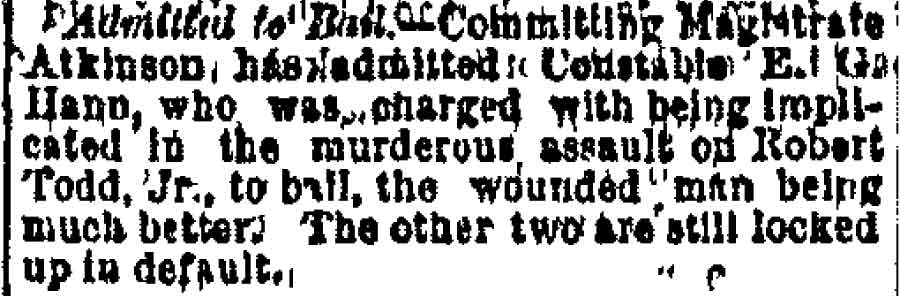
Admitted to Bail — Committing Magistrate Atkinson, has admitted Constable E. J. Gallann, who was charged with being implicated in the murderous assault on Robert Todd, Jr., to bail, the wounded man being much better. The other two are still locked up in default.
Atrocious Assault and Battery
Philadelphia Inquirer —
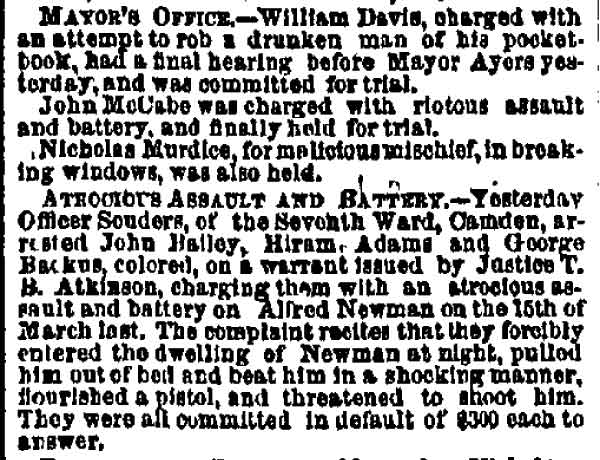
Mayor’s Office.—William Davis, charged with an attempt to rob a drunken man of his pocketbook, had a final hearing before Mayor Ayers yesterday, and was committed for trial.
John McCabe was charged with riotous assault and battery, and finally held for trial.
Nicholas Murdice, for malicious mischief, in breaking windows, was also held.
Atrocious Assault and Battery.—Yesterday Officer Sounders, of the Seventh Ward, Camden, arrested John Bailey, Hiram Adams and George Backus, colored, on a warrant issued by Justice T. B. Atkinson, charging them with an atrocious assault and battery on Alfred Newman on the 15th of March last. The complaint recites that they forcibly entered the dwelling of Newman at night, pulled him out of bed and beat him in a shocking manner, flourished a pistol, and threatened to shoot him. They were all committed in default of $300 each to answer.