Captain Thomas M. K. Lee Jr.
CAPTAIN THOMAS M.K. LEE JR.
1861 — The First War Meeting in Camden
On the 16th of April, 1861, three days after the Confederates fired upon Fort Sumter, at the entrance of Charleston Harbor, a large number of loyal and patriotic citizens of Camden City and County issued the following vigorous and spirited response to the President’s proclamation:
To the President Of the United States:
“The unparalleled events of the last week have revealed to the citizens of the United States, beyond question or the possibility of a doubt, that peaceful reconciliation upon the form of our Constitution is repelled and scorned, and secession means, in the hearts of its supporters, both Treason and war against our Country and Nation.
“We, therefore, the undersigned Loyal Citizens of the United States, and inhabitants of the city of Camden, in the State of New Jersey, responding to the proclamation of the President of the United States, hereby declare our unalterable determination to sustain the government in its efforts to maintain the honor, the integrity and the existence of our National Union and the perpetuity of the popular Government, and to redress the wrongs already long enough endured; no differences of political opinion; no badge of diversity upon points of party distinction, shall restrain or withhold us in the devotion of all we have or can command to the vindication of the Constitution, the maintenance of the laws and the defense of the Flag Of our Country.
I. S. Mulford
E. R. Johnson
Louis L. Scovel
B. M. Braker
Joseph C. Nichols
Elwood C. Fortiner
Joseph Vautier
Edmund Brewer
Uriah Norcross
Isaac L. Lowe
Henry B. Goodwin
Richard W. Test
James M. Cassady
John Duprey
Jesse Pratt
Hamilton Johnston
Charles P. Dickinson
Richard H. Lee
C. G. Zimmerman
Thomas M. K. Lee, Jr.
Charles J. Sanders
Samuel S. E. Cowperthwait
James M. Scovel
S. C. Harbert
John S. Read
D. H. Erdman
Adam Angel
George W. Vanhorn
Charles S. Garrett
Thomas M. Barracliff
W. H. Saunders
Jacob Harman, Jr.
Charles K. Horsfall
Timothy Middleton
William W. Sloan
Charles Cloud
A. W. Test
C. A. S. Driesback
Henry Schock
Walter Patton
Azael Roberts
Thomas Jeffries
O. Gilbert Hannah
J. C. De Lacour
Edward T. Andrews — Conclin Mayhey
William Reynolds
Simon Rammell
H. H. Goldsmith
John Horsfall
Thomas H. Dudley
Robert Folwell
Edw. H. Saunders
James O. Morgan
David H. Sheppard
Richard Fetters
Charles C. Reeves
S. H. Grey
N. B. Stokes
S. O. Wright
Joseph Dlinston
David Creary
John R. Barber
James H. Denny
William R. Maxwell
Robert Wible
Hamilton William
George W. Jackson
Joseph Maurer
Joseph D. Brown
William S. Scull
Daniel Witham
Isaac Shreeve
Adam Hare
George Wardell
Joseph Coffman
George W. Conrow
Joshua Howell
Martin Grey
S. L. Wayne
Abner Sparks
Van T. Shivers
Westcott Campbell
William J. Taylor
Isaiah Norcross
Alden O. Scovel
Philip J. Gray
George W. Gilbert
Charles D. Hineline
Thomas H. Davis
Charles De Haven
Thomas Ackley
John Gill
James B. Dayton
James M. Stevens
Joseph French
George Campbell
A. A. Merry
E. Wells
William D. Clark
William B. Hatch
E. O. Jackson
A. B. Martin
Richard O. Robertson
Timothy O. Moore
George W. Stanley
Robert Schall
Reynell Coates
Aaron Hewit
Henry Shuster
William Hartsgrove
William B. French
W. A. Winchester
John M. Natty
In response to a call, on the 18th of April an enthusiastic meeting was held in the county court-house, which was formed of a large collection of prominent citizens. The court-room was decorated with flags and mottoes. John W. Mickle was chosen president and Samuel C. Harbert and Thomas G. Rowand secretaries. The president addressed the meeting first and Rev. Mr. Monroe offered a prayer. Hon. Thomas P. Carpenter, Thomas B. Atkinson (mayor) and Joseph Painter were appointed a committee on resolutions. Judge Philip J. Grey addressed the meeting, after which the committee adopted a long series of patriotic resolutions. The Washington Grays, Stockton Cadets and the Zouaves marched into the room and were received with cheers, Samuel Hufty read a resolution which was signed by many persons, who immediately formed the Home Brigade. David M. Chambers, Captain Stafford, Benjamin M. Braker, John H. Jones and E. A. Acton each addressed the meeting. James M. Scovel was then called upon and responded in eloquent terms and with patriotic energy. S. H. Grey offered a resolution, which was adopted, that the City Council and the Freeholders of the county be requested to appropriate money for the equipment of persons who may volunteer in defense of the country, and S. H. Grey, James M. Cassady and Joseph Painter were appointed a committee to look after the interests of the resolution. The meeting continued in session until eleven p.m.
George Reeser Prowell’s History of Camden County, New Jersey — 1886
Captain Thomas M.K. Lee Jr. early in 1861, identified himself with the troops who volunteered from the city of Camden. He enlisted as a private in Company F, Fourth Regiment New Jersey Volunteer Militia; was promoted sergeant and served with the regiment until discharged at expiration of term of service, July 31, 1861. He enlisted August 9, 1861, in Company I, Sixth Regiment New Jersey Volunteer Infantry, for three years. September 9, 1861, he was commissioned first lieutenant of the company; and, on January 16, 1863, was commissioned as captain of Company K of his regiment. He commanded the regiment from Spottsylvania Courthouse VA, to North Anna River; was detailed judge advocate on the staff of Brigadier General McAllister, commanding Third Brigade, Third Division, Second Army Corps, and as the same under Major General Gershom Mott. He was mustered out with his regiment September 7, 1864.
With his regiment he participated in the following battles:
Siege of Yorktown VA, April and May, 1862
Williamsburg VA, May 5, 1862
Fair Oaks, June 1 and 2, 1862
Seven Pines VA, June 25, 1862
Savage Station, VA, June 29, 1862
Malvern Hill VA, July 1, 1862
Bristow Station VA, August 27, 1862
Second Bull Run, August 29, 1862
Chantilly VA, September 1, 1862
Centreville VA, September 2, 1862
Fredericksburg VA, December 13 and 14, 1862
Chancellorsville VA, May 3 and 4, 1862
Gettysburg, Pa., July 2 and 3, 1863
Wapping Heights VA, October 15, 1863
Mine Run VA, November 29 and 30, 1863
Wilderness VA, May 5 to 7, 1864
Spottsylvania VA, May 8 to 11, 1864
Spottsylvania Courthouse VA, May 12 to 18, 1864
North Anna River VA, May 23 to 24, 1864
Tolopotomy Creek VA, May 30, 1864
Cold Harbor VA, June 1 to 5, 1864
Petersburg VA, June 16 to 23, 1864
Deep Bottom VA, July 25 to 27, 1864
Mine Explosion VA, July 30, 1864
North Bank James River VA, August 14 to 18, 1864
Ream’s Station VA, August 25, 1864
Captain Lee was wounded in the head at battle of Chancellorsville, and was wounded in face and neck at battle of Spottsylvania. He returned to Camden after the war and was elected, in 1865, as county clerk, and held the position for five years. He died December 10, 1873, aged thirty-seven years, and was buried in Evergreen Cemetery. A wife and one child survive him.
In January of 1876, a Grand Army of the Republic Post was organized in Camden NJ. At the first meeting of the new post, it was unanimously decided to honor Captain Lee by adopting the name Thomas M.K. Lee Post. The Thomas M.K. Lee Post No. 5, Grand Army of the Republic had among its members several prominent Camden residents, including Mahlon F. Ivins Sr., Benjamin D. Coley (who had served under Captain Lee with Company K, 6th New Jersey Infantry Regiment), George R. Danenhower, Dr. John W. Donges, and Dr. Henry Genet Taylor.
Abe Lower Opens the Campaign.
Camden Democrat —
H. I. BUDD, Secretary pro tem.
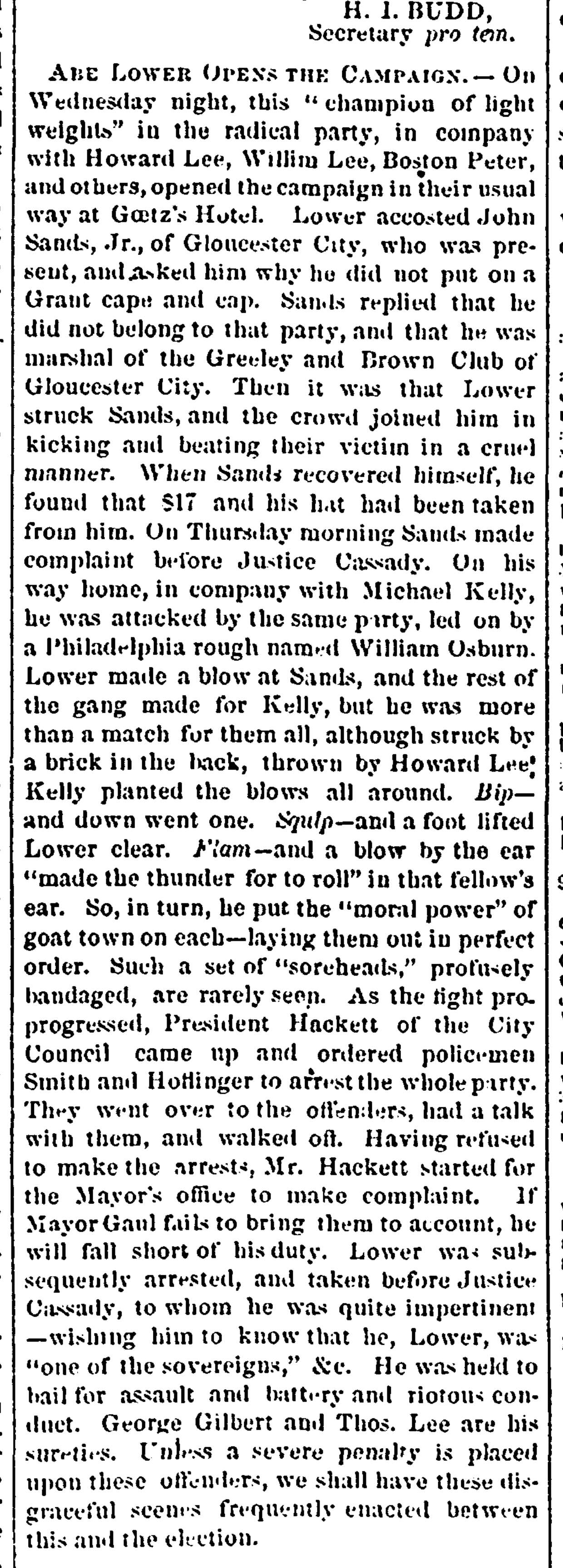
Abe Lower Opens the Campaign.—On Wednesday night, this “champion of light weights” in the radical party, in company with Howard Lee, William Lee, Boston Peter, and others, opened the campaign in their usual way at Goetz’s Hotel. Lower accosted John Sands, Jr., of Gloucester City, who was present, and asked him why he did not put on a Grant cape and cap. Sands replied that he did not belong to that party, and that he was marshal of the Greeley and Brown Club of Gloucester City. Then it was that Lower struck Sands, and the crowd joined him in kicking and beating their victim in a cruel manner. When Sands recovered himself, he found that $17 and his hat had been taken from him. On Thursday morning Sands made complaint before Justice Cassady. On his way home, in company with Michael Kelly, he was attacked by the same party, led on by a Philadelphia rough named William Osburn. Lower made a blow at Sands, and the rest of the gang made for Kelly, but he was more than a match for them all, although struck by a brick in the back, thrown by Howard Lee. Kelly planted the blows all around. Bip—and down went one. Squlp—and a foot lifted Lower clear. Flam—and a blow by the ear “made the thunder for to roll” in that fellow’s ear. So, in turn, he put the “moral power” of goat town on each—laying them out in perfect order. Such a set of “soreheads,” profusely bandaged, are rarely seen. As the fight progressed, President Hackett of the City Council came up and ordered policemen Smith and Hollinger to arrest the whole party. They went over to the offenders, had a talk with them, and walked off. Having refused to make the arrests, Mr. Hackett started for the Mayor’s office to make complaint. If Mayor Gaul fails to bring them to account, he will fall short of his duty. Lower was subsequently arrested, and taken before Justice Cassady, to whom he was quite impertinent—wishing him to know that he, Lower, was “one of the sovereigns,” &c. He was held to bail for assault and battery and riotous conduct. George Gilbert and Thos. Lee are his sureties. Unless a severe penalty is placed upon these offenders, we shall have these disgraceful scenes frequently enacted between this and the election.