Josiah Matlack
JOSIAH MATLACK was born in Lancaster, Pennsylvania on April 13, 1830. His family moved to Haddonfield, New Jersey when he was two. He came to Camden in his teens. After an accident made carpentry work impossible, he went into business and did well. A nomination to Camden's school board in 1871, and although did not win, was elected to City Council the following year. The 1867 City Directory shows Bowman Matlack at 931 South 5th Street. He was still at that address as late as 1894.
Josiah Matlack was appointed Chief of Police in 1880 by Mayor Claudius Bradshaw, replacing Charles F. Daubman. Josiah Matlack served in that position for six years. He was succeeded by Harry H. Franks, who was appointed by Jesse Pratt after Pratt's victory in the 1886 mayoral election.
Josiah Matlack died at the home of city council president Charles H. Ellis on August 23, 1896. He was interred at Harleigh Cemetery on August 25, 1896.
Personal Sketches — No. 4: Josiah Matlack
Camden County Courier —

By D. W. Seller
Josiah Matlack, now Chief of Police of Camden, N. J., was born in Lancaster, Pennsylvania, on the 13th of April, 1830. In 1832, when he was only two years of age, his parents removed to Haddonfield, where he remained for several years. When about nine years of age Josiah was put to service on a farm, having previously lived with a grandfather and grandmother in the country; eleven, a later period in life, he was apprenticed to an old carpenter, and began to learn the millwrighting business. He served five years at this trade. In about 1853, he came to Camden and commenced working at the same employment. In this line of duty he was an adept and always had plenty of work, and was never idle. At the time the new school-house at Fifth and Market streets was in course of erection (subsequently known as the Green School) the scaffolding gave way, precipitating him to the ground and injuring him to such an extent that he was obliged to abandon that profession. He then went into the produce-commission business in which he has also been successful.
Politically Mr. Matlack is a Democrat; not of that litigative character which ignores good in an opposing party, but of a liberal school, and can appreciate true political merit wherever found. He has often said that there are too many things connected with politics that one cannot subscribe to which are revolting to his nature. In 1871 he received the nomination for the Board of Education against Levi S. Newton, Republican, and when it was found there was a tie in the count of that ward he went to Mr. Newton and proposed to have the ballots recounted, when the other gentleman was declared elected by two majority. No effort was made by Mr. Matlack to contest the election. In 1872 he was nominated for the City Council, in opposition to Mr. W. Cook, and was elected majority of thirty-six. He was properly relieved of the election judges who lost his seat without opposition, although A. W. Cook, Republican, was elected in the ward by a majority of seven, and was elected by Grocer McDavis by twelve. In that contest Mr. Matlack would take no active part until in possession of all the facts and evidence in the case, and had thoroughly studied them. He then voted with his Democratic associates. During his career in Council on all matters of public interest he was guided by a desire to do the best interests of the city, and as he never confronted the unmixed classes of his constituents. He is one of that class of gentlemen who cannot see why politicians should be less upright and honest in their dealings with the public than private individuals in their legitimate business transactions. Hence, although under obligations to the party that elected him, he frequently voted against measures they proposed simply because they did not meet with conscientious views of right and justice. This trait of character is commendable in him — it is worth far more in any man who has moral courage sufficient to do so. Municipal affairs have often brought into an imbroglio by partisan and ruling partisans, and to be inflicted on a community which independent and honest discharge of duties would have averted. Mr. Matlack's conduct, if entirely divested of partisanism, was therefore worthy of emulation.
The subject of this sketch was never one of those war-menders who apply more time to bewailing misfortunes than to timely efforts to avert them. From his youth he has been a progressive thinker and a hard worker. With him self-dependence is a cardinal virtue — if, even at an early age he went out from the parent fold to struggle with the fortunes and misfortunes of life, to win or lose in the great game of draughts which mankind is ever playing on the rocky world's checker-board. Mr. Matlack is a gentleman of unmistakable vital ordinate makeup. Muscular in build, and well athletic, with a brunette type of complexion, his physical forces are vigorous, strongly developed. His mind is clear, sharp and broad, but his moral consciousness dominates over all these. He will not jump at any conclusions, but likes to examine them, be in possession of all the facts of a question, and these facts must be thoroughly convincing and positive before he gives a final decision. His moral sentiments are strongly marked. Along with his dignity, integrity, determination and large veneration, he cannot easily be persuaded to do anything or adopt a line of policy not strictly in accord with plain old honesty. His language is plain but in deliberate of and legislative bodies he is unusual. Though possessing no considerable share of self-esteem, he is rather notorious in attempting to address large bodies, exhibiting a timidity which, when over-mastered, might educate him into a pretty good debater. Realizing this, he did not wish to obtrude any views upon Council which were not needed of a legal firmament, and which were not perfectly nominal. Yet they imbue his whole nature with a kind and sympathetic character, and these make it evident that he is better adapted to serve than to excite, especially when force and eloquence are needed.
Such a man is Josiah M. Matlack.
Over the River
Philadelphia Inquirer —
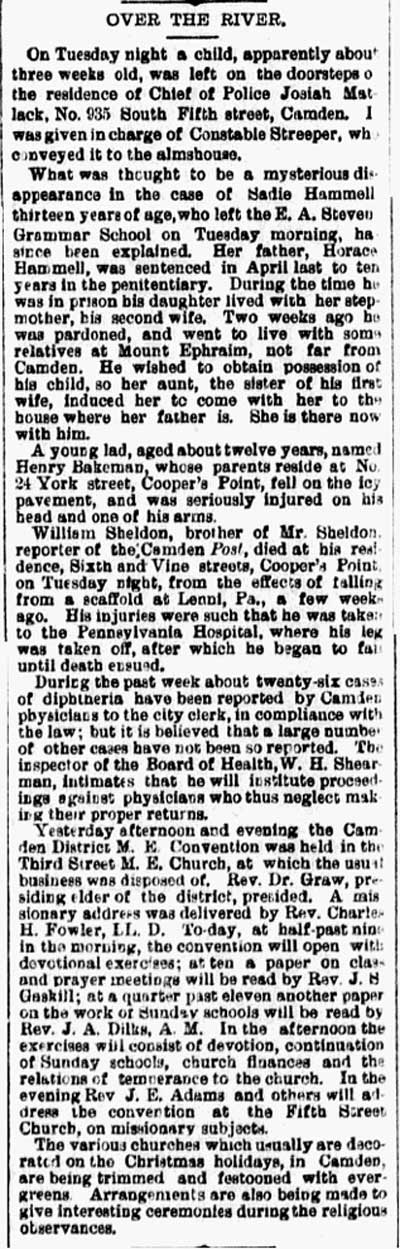
On Tuesday night a child, apparently about three weeks old, was left on the doorsteps of the residence of Chief of Police Josiah Matlack, No. 935 South Fifth street, Camden. It was given in charge of Constable Streeper, who conveyed it to the almshouse.
What was thought to be a mysterious disappearance in the case of Sadie Hammell, thirteen years of age, who left the E. A. Stevens Grammar School on Tuesday morning, has since been explained. Her father, Horace Hammell, was sentenced in April last to ten years in the penitentiary. During the time he was in prison his daughter lived with her stepmother, his second wife. Two weeks ago he was pardoned, and went to live with some relatives at Mount Ephraim, not far from Camden. He wished to obtain possession of his child, so her aunt, the sister of his first wife, induced her to come with her to the house where her father is. She is there now with him.
A young lad, aged about twelve years, named Henry Bakeman, whose parents reside at No. 24 York street, Cooper's Point, fell on the icy pavement, and was seriously injured on his head and one of his arms.
William Sheldon, brother of Mr. Sheldon, reporter of the Camden Post, died at his residence, Sixth and Vine streets, Cooper's Point, on Tuesday night, from the effects of falling from a scaffold at Lenni, Pa., a few weeks ago. His injuries were such that he was taken to the Pennsylvania Hospital, where his leg was taken off, after which he began to fail until death ensued.
During the past week about twenty-six cases of diphtheria have been reported by Camden physicians to the city clerk, in compliance with the law; but it is believed that a large number of other cases have not been so reported. The inspector of the Board of Health, W. H. Shearman, intimates that he will institute proceedings against physicians who thus neglect making their proper returns.
Yesterday afternoon and evening the Camden District M. E. Convention was held in the Third Street M. E. Church, at which the usual business was disposed of. Rev. Dr. Graw, presiding elder of the district, presided. A missionary address was delivered by Rev. Charles H. Fowler, LL. D. Today, at half-past nine in the morning, the convention will open with devotional exercises; at ten a paper on class and prayer meetings will be read by Rev. J. S. Gaskill; at a quarter past eleven another paper on the work of Sunday schools will be read by Rev. J. A. Dilks, A. M. In the afternoon the exercises will consist of devotion, continuation of Sunday schools, church finances and the relations of temperance to the church. In the evening Rev. J. E. Adams and others will address the convention at the Fifth Street Church, on missionary subjects.
The various churches which usually are decorated on the Christmas holidays, in Camden, are being trimmed and festooned with evergreens. Arrangements are also being made to give interesting ceremonies during the religious observances.
Policy Shop Raided on Joint Alley
Philadelphia Inquirer —
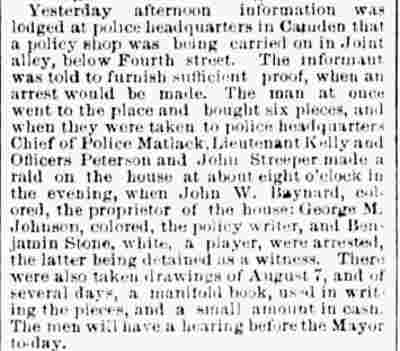
Yesterday afternoon information was lodged at police headquarters in Camden that a policy shop was being carried on in Joint alley, below Fourth street. The informant was told to furnish sufficient proof, when an arrest would be made. The man at once went to the place and bought six pieces, and when they were taken to police headquarters Chief of Police Matlack, Lieutenant Kelly and Officers Peterson and John Streeper made a raid on the house at about eight o'clock in the evening, when John W. Baynard, colored, the proprietor of the house; George M. Johnson, colored, the policy writer, and Benjamin Stone, white, a player, were arrested, the latter being detained as a witness. There were also taken drawings of August 7, and of several days, a manifold book, used in writing the pieces, and a small amount in cash. The men will have a hearing before the Mayor today.
A Favorite Row Drawn After a Year's Rest — Mayor Bradshaw's Raid
Camden Daily Courier —
4-11-44.
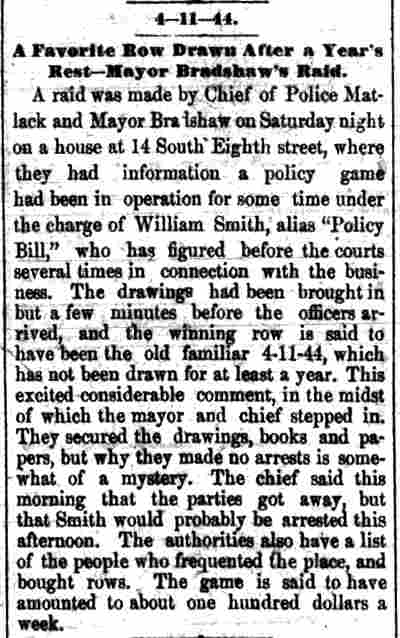
A raid was made by Chief of Police Matlack and Mayor Bradshaw on Saturday night on a house at 14 South Eighth street, where they had information a policy game had been in operation for some time under the charge of William Smith, alias “Policy Bill,” who has figured before the courts several times in connection with the business. The drawings had been brought in but a few minutes before the officers arrived, and the winning row is said to have been the old familiar 4-11-44, which has not been drawn for at least a year. This excited considerable comment, in the midst of which the mayor and chief stepped in. They secured the drawings, books and papers, but why they made no arrests is somewhat of a mystery. The chief said this morning that the parties got away, but that Smith would probably be arrested this afternoon. The authorities also have a list of the people who frequented the place, and bought rows. The game is said to have amounted to about one hundred dollars a week.
'Policy Bill' Did Not Come
Camden Daily Courier —
“Policy Bill” Did Not Come.
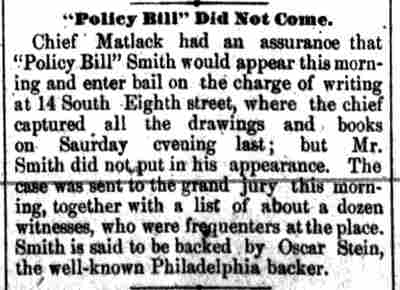
Chief Matlack had an assurance that “Policy Bill” Smith would appear this morning and enter bail on the charge of writing at 14 South Eighth street, where the chief captured all the drawings and books on Saturday evening last; but Mr. Smith did not put in his appearance. The case was sent to the grand jury this morning, together with a list of about a dozen witnesses, who were frequenters at the place. Smith is said to be backed by Oscar Stein, the well-known Philadelphia backer.
The Policy Raid
Camden Post —
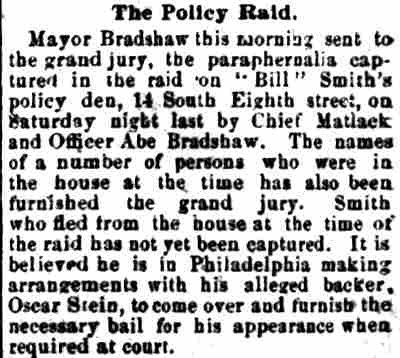
The Policy Raid.
Mayor Bradshaw this morning sent to the grand jury, the paraphernalia captured in the raid on “Bill” Smith's policy den, 14 South Eighth street, on Saturday night last by Chief Matlack and Officer Abe Bradshaw. The names of a number of persons who were in the house at the time has also been furnished the grand jury. Smith who fled from the house at the time of the raid has not yet been captured. It is believed he is in Philadelphia making arrangements with his alleged backer, Oscar Stein, to come over and furnish the necessary bail for his appearance when required at court.
The Smith Policy Case
Camden Daily Courier —
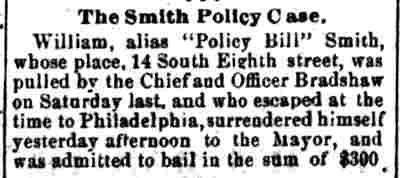
The Smith Policy Case.
William, alias “Policy Bill” Smith, whose place, 14 South Eighth street, was pulled by the Chief and Officer Bradshaw on Saturday last, and who escaped at the time to Philadelphia, surrendered himself yesterday afternoon to the Mayor, and was admitted to bail in the sum of $300.
Chief Matlack
Camden Post —
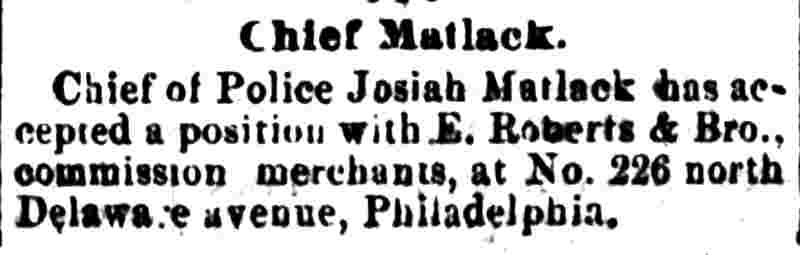
Chief of Police Josiah Matlack has accepted a position with E. Roberts & Bro., commission merchants, at No. 226 north Delaware avenue, Philadelphia.
Franks Sworn in as Chief
Camden Daily Courier —

The New Official and Six Men Take the Oath
Ex-Chief Matlack Commends the Forty Patrolmen, Thanks Mayor Pratt for His Gentlemanly Conduct and Retires
It is Chief Franks now. Mr. Matlack, the retiring chief turned over the police department to his successor shortly after noon. All the officers gathered at the hall, as this is the semi-monthly pay day. The six new men who were to take the places of the patrolmen who resigned, came in one at a time and were taken into the mayor's private office, where behind the closed door they were sworn in by his honor. Chief-elect Franks was also sworn in privately.
All the Democratic officers then assembled in the mayor's hearing room, at the request of retiring Chief Matlack and it was with evident feeling that he bade them farewell in an eloquent address. He said:
The Chief's Address.
“Gentlemen of the police department—The time has arrived for me to turn over the police department to my successor. During my term as chief I have formed acquaintanceships and friendships among you which have been a great pleasure to me, and which I hope to retain. Among us during all that time there has been peace and harmony in the main. I am glad to say that no strifes or bickerings have occurred to mar our peace and good will. At times our actions have been criticised, and aspersions cast against us, but these were only the contingencies of our positions; we must learn to take the bitter with the sweet. No serious accidents or deaths have occurred among us, and for this we should be thankful to the Giver of all good things. We have made some mistakes no doubt—none of us are infallible—but let bygones be bygones, and endeavor to fulfill your duty always.
“There is one thing in particular that I wish to commend you for, and that is your gentlemanly and courteous conduct while I have been connected with the department, and your cheerfulness in obeying orders. For this you have my sincere thanks, and also my best wishes for your futures.”
The Department Turned Over.
The chief closed his remarks to the men with a moral admonition. To Mayor Pratt he returned his thanks for the gentlemanly demeanor of his honor during their brief official association, and expressed the hope that his administration would be one of good government. Chief Matlack then formally delivered the department to his successor and said he trusted it would be more efficient than ever before.
The chief's remarks were very brief and pointed. He said: “Gentlemen and members of the police department. I hope you will continue in the discharge of your duties as before. I expect obedience to the rules of the department, and the orders of his honor the mayor. Any disapproval or disobedience of orders will be deemed sufficient cause for removal.”
New Patrolmen.
The following is the list of retiring officers and their successors, with their numbers: First ward—John Jacobs; successor, Alfred Summers, No. 5. Fourth ward—Simpson Long, successor, Samuel Lee, No. 17; Charles Peterson, successor, Charles O. Pedrick, No. 20. Sixth ward, Bowman Matlack, successor, Christopher Tenner, No. 29; John Fox, successor, John Dall, No. 30. Seventh ward, Harry Griffin, successor, C. H. Peters, No. 33.
The retiring officers delivered up their equipments. C. H. Peters, who was the first of the new men to be sworn in, had a bran new suit of blue and went on duty at once. John Dall was not present to be sworn in with the others.
Josiah Matlack Dead
Camden Post —
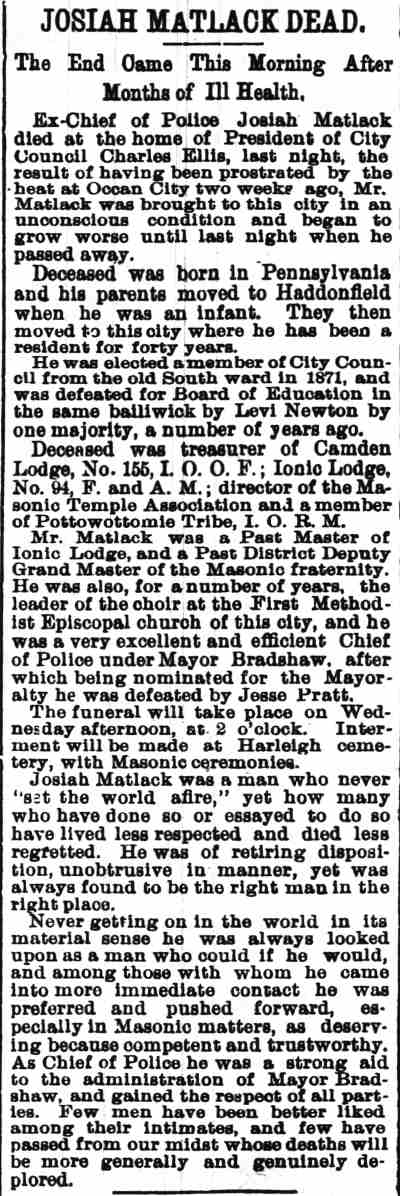
The End Came This Morning After Months of Ill Health.
Ex-Chief of Police Josiah Matlack died at the home of President of City Council Charles Ellis, last night, the result of having been prostrated by the heat at Ocean City two weeks ago. Mr. Matlack was brought to this city in an unconscious condition and began to grow worse until last night when he passed away.
Deceased was born in Pennsylvania and his parents moved to Haddonfield when he was an infant. They then moved to this city where he has been a resident for forty years.
He was elected a member of City Council from the old South ward in 1871, and was defeated for Board of Education in the same bailiwick by Levi Newton by one majority, a number of years ago.
Deceased was treasurer of Camden Lodge, No. 155, I. O. O. F.; Ionic Lodge, No. 94, F. and A. M.; director of the Masonic Temple Association and a member of Pottowottomie Tribe, I. O. R. M.
Mr. Matlack was a Past Master of Ionic Lodge, and a Past District Deputy Grand Master of the Masonic fraternity. He was also, for a number of years, the leader of the choir at the First Methodist Episcopal church of this city, and he was a very excellent and efficient Chief of Police under Mayor Bradshaw, after which being nominated for the Mayoralty he was defeated by Jesse Pratt.
The funeral will take place on Wednesday afternoon, at 2 o’clock. Interment will be made at Harleigh cemetery, with Masonic ceremonies.
Josiah Matlack was a man who never “set the world afire,” yet how many who have done so or essayed to do so have lived less respected and died less regretted. He was of retiring disposition, unobtrusive in manner, yet was always found to be the right man in the right place.
Never getting on in the world in its material sense he was always looked upon as a man who could if he would, and among those with whom he came into more immediate contact he was preferred and pushed forward, especially in Masonic matters, as deserving because competent and trustworthy. As Chief of Police he was a strong aid to the administration of Mayor Bradshaw, and gained the respect of all parties. Few men have been better liked among their intimates, and few have passed from our midst whose deaths will be more generally and genuinely deplored.
Funeral Notice
Camden Post —
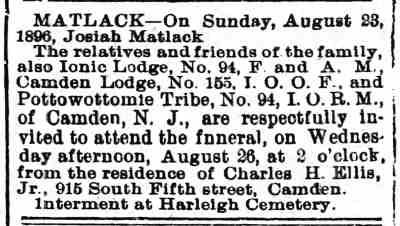
MATLACK—On Sunday, August 23, 1896, Josiah Matlack
The relatives and friends of the family, also Ionic Lodge, No. 94, F. and A. M., and Camden Lodge, No. 155, I. O. O. F., and Pottowottomie Tribe, No. 94, I. O. R. M., of Camden, N. J., are respectfully invited to attend the funeral, on Wednesday afternoon, August 26, at 2 o’clock, from the residence of Charles H. Ellis, Jr., 915 South Fifth street, Camden. Interment at Harleigh Cemetery.
Chief Matlack's Funeral
Camden Daily Courier —
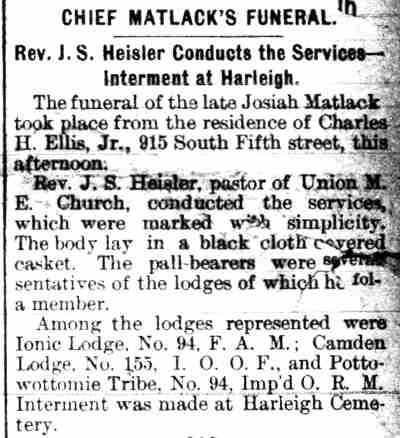
Rev. J. S. Heisler Conducts the Services—Interment at Harleigh.
The funeral of the late Josiah Matlack took place from the residence of Charles H. Ellis, Jr., 915 South Fifth street, this afternoon.
Rev. J. S. Heisler, pastor of Union M. E. Church, conducted the services, which were marked with simplicity. The body lay in a black cloth covered casket. The pall-bearers were representatives of the lodges of which he was a member.
Among the lodges represented were Ionic Lodge, No. 94, F. A. M.; Camden Lodge, No. 155, I. O. O. F., and Pottowottomie Tribe, No. 94, Imp'd O. R. M. Interment was made at Harleigh Cemetery.