J. Russell Carrow
James Russell Carrow was born in Camden on September 9, 1887 to Howard Carrow and his wife, the former Emma Bender. The Carrows lived at 515 North 4th Street through at least the middle of 1888. By the middle of 1890 the family had moved to Merchantville. Howard Carrow was a prominent lawyer in Camden and the surrounding area, and on merit was appointed to a five-year term in district court for Camden in April of 1891, a remarkable achievement for a man not yet 30 years of age. The Carrows owned a large home at 39 North Maple Avenue. Besides J. Russell Carrow, the family also included younger sisters Linda and May. After leaving the bench, Howard Carrow returned to his law practice in Camden, at 207 Market Street. Howard Carrow was also prominent in New Jersey Democratic politics.
By September 1911, J. Russell Carrow was working as an attorney, and like his father, active politically as a Democrat. He was admitted to the New Jersey Bar in November of 1911.
On September 26, 1912 J. Russell Carrow was nominated for the State Assembly as a Democrat from Camden along with Albert Neutze and Bernard A. Gallagher. They ran against a Republican slate consisting of Isaac Coles, Albert DeUnger and John B. Kates. J. Russell Carrow was elected and served one term in the Assembly. His most notable achievement was the introduction of a bill naming the violet as New Jersey’s state flower.
J. Russell Carrow married Hilda Donnell on June 21, 1913, in a double wedding, as his father, who had been a widower for several years, also took a wife that day.
After serving in the legislature, J. Russell Carrow returned to Camden to practice law, with an office at 313 Market Street. He was still making his home in Merchantville at that time.
J. Russell Carrow was nominated for the position of County Prosecutor in February of 1916 by Democratic Governor Edge. The Republican-controlled legislature would not confirm his appointment, however. In April of 1916 State Supreme Court Justice Black designated J. Russell Carrow as temporary prosecutor for the County of Cape May. This caused a bit of a fuss in political circles. He served in the position of County Prosecutor until early in 1917.
With the outbreak of World War I, J. Russell Carrow responded to his country’s call. He had previously served as a Lieutenant in the New Jersey National Guard prior to registering for the draft on June 5, 1917. The Carrow family by then was living at 224 North 9th Street in Camden.
J. Russell Carrow was mobilized and served with the United States Army during World War I. After returning from the war he came back to Camden. By January of 1920 he owned a home at 320 North 7th Street. On July 27, 1920 he was nominated to a post on the Camden County Tax Board by then-Governor Edwards, to fill a vacancy created by the death of John P. Wright. J. Russell Carrow served two terms on this board.
The following year, J. Russell Carrow received a great deal of press attention in his efforts as the defense attorney for murderer Raymond Schuck, on trial for the kidnap-robbery-murder of bank messenger David Paul. Schuck and his co-defendant, however, were convicted and executed.
J. Russell Carrow continued to practice law in the area through at least 1930, and prospered, as his address in April of 1930 at 308 Warwick Road in Haddonfield would attest. J. Russell Carrow and wife Hilda had been blessed with two daughters, Mary V. and Helen. Their next door neighbor at 310 Warwick Road was banker Philip Wilson. At some point in the 1930s, J. Russell and Hilda Carrow divorced. By 1940 Hilda had married Philip Wilson.
By the spring of 1942 things appear to have drastically changed in the life of J. Russell Carrow. He was living in New York City with his daughter Mary, and no longer practicing law. Later that year he returned to Camden, where he lived at and worked as a non-salaried employee of the West Jersey Hospital on Mount Ephraim Avenue.
J. Russell Carrow died on November 27, 1957 and was buried at Harleigh Cemetery.
South Jersey — A History
by Raymond A. Heston
JAMES RUSSELL CARROW—Among the distinguished citizens of this section, prominent in county, State and national affairs, James Russell Carrow is eminent, as was also his father before him, in the services rendered to community and commonwealth, and the Nation. A native of the State of New Jersey, his whole life has been spent in her service, and the record is one that redounds to his honor for achievement.
James Russell Carrow was born September 9, 1887, in Camden, New Jersey, son of Howard and Emma (Bender) Carrow. His father was also a native of Camden, born in 1860, and was educated in the public schools in his youth, and followed the profession of law, having studied and practiced in Philadelphia, Pennsylvania. He was made judge of the Camden County District Court in 1891, and served for five years in this capacity. He also served as chairman of the Democratic State Convention; his life was one of long continued rendering of service, and he died on Easter Sunday morning, 1922, his sign still hanging in front of his old office on Market Street.
James Russell Carrow, the son, was educated first at Lawrenceville, then changed to Browne Preparatory School, from which he was graduated. He then took special academic courses at the University of Virginia, being graduated also from this institution of learning, whence he attended the University of Pennsylvania, taking there special courses in law. He registered with his father, and spent three years with him, learning much of the routine of his work, and laying a sure foundation, garnered from the long experience of the older practitioner. He was admitted to the bar in November, 1911, and immediately started in an independent practice on Federal Street. In 1913 he was made Democratic member of the New Jersey State Legislature, from Camden County, and served for one term; in 1915 he was appointed prosecutor of Cape May County, filling an un-expired term of three years; in 1920 to 1923, he was made a member of the County Board of Taxation of Camden County. He entered the New Jersey National Guard in 1911, and was made lieutenant of Company M, Third New Jersey National Guard, in 1912, holding this commission for five years, when we entered the great World War. He was then made lieutenant of infantry during the war, and served on special duty in the Officers’ Training School at various camps, among them, Camp Custer, Camp Lee and Camp Dix. He was moved, as his services were required in the various camps, and was held in this country, not getting across to any foreign service. Mr. Carrow is an active member of the Benevolent and Protective Order of Elks, which he joined in 1913; and is also an alumnus of Beta Chapter of Sigma Nu Fraternity of the University of Virginia. In his religious connection he is a member of the Episcopal Church, as are the members of his family, also.
James Russell Carrow married, June 21, 1913, at the Church of the Holy Trinity, Philadelphia, Pennsylvania, Helen Donnell, of Philadelphia, daughter of George and Emily (Hess) Donnell, and they are the parents of two children: 1. May Virginia, born August 16, 1918. 2. Helen Louise, born August 7, 1921.
Father and Son Take Brides
Washington Post —
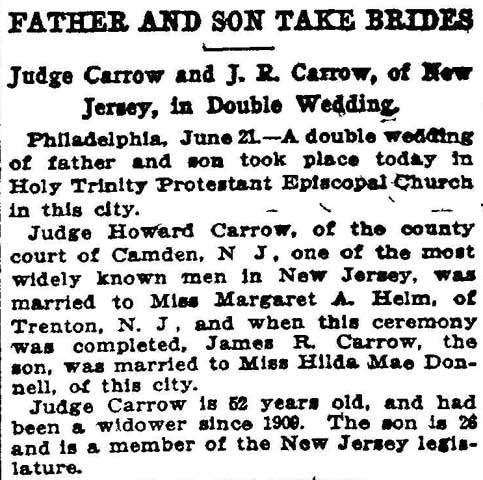
Judge Carrow and J. R. Carrow, of New Jersey, in Double Wedding.
Philadelphia, June 21.—A double wedding of father and son took place today in Holy Trinity Protestant Episcopal Church in this city.
Judge Howard Carrow, of the county court of Camden, N. J., one of the most widely known men in New Jersey, was married to Miss Margaret A. Helm, of Trenton, N. J., and when this ceremony was completed, James R. Carrow, the son, was married to Miss Hilda Mae Donnell, of this city.
Judge Carrow is 52 years old, and had been a widower since 1909. The son is 26 and is a member of the New Jersey legislature.
Draft Registration Cards
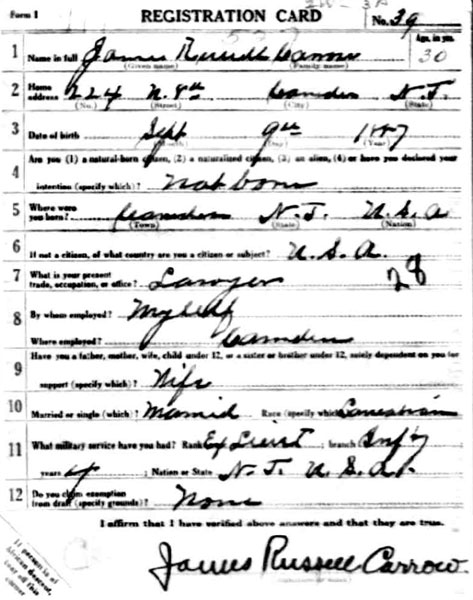
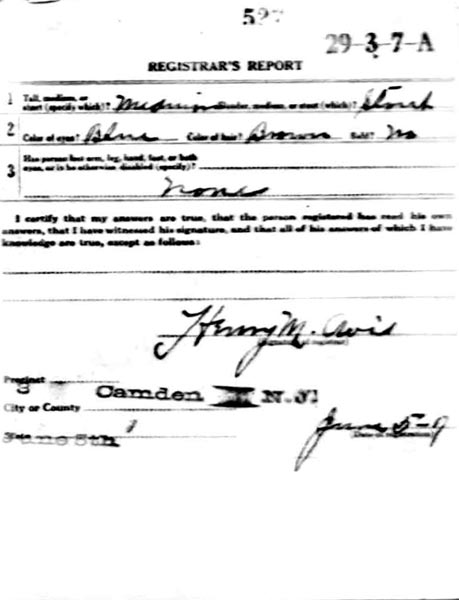
World War I Draft Card
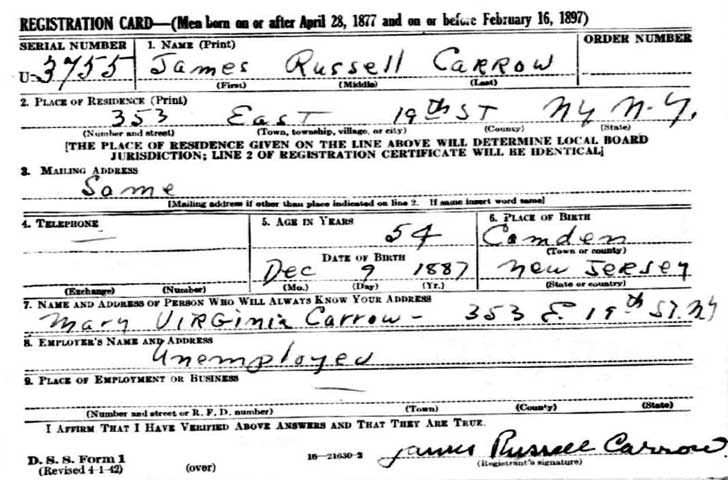
World War II Draft Card — 1942
Schuck Trial Postponed
(Mt. Holly) New Jersey Mirror —
The trial of Raymond W. Schuck for the murder of David S. Paul, has been postponed from January 4 to February 7. Application for the postponement was made before Supreme Court Justice Katzenbach at Camden on Monday, by J. Russell Carrow, counsel for Schuck. Prosecutor Wolverton did not interpose any objection. The ground on which the postponement was asked was that time might be given for the drawing of a special jury panel.
The postponement of Schuck’s trial may result in putting off the sentencing of his confederate in crime, Frank James, already convicted of murder in the first degree. The State may want to use James as a witness against Schuck. The latter claims that he entered into no plot with James to murder Paul and that he had nothing to do with the actual killing, James said that Schuck was as deep in the revolting crime as the former and that as a matter of fact Schuck struck some of the blows that caused death. There is no attempt made to conceal the enmity between the two former friends.
Faces Jury With a Smile
(Mt. Holly) New Jersey Mirror —
Mystery Woman Appears; Kept From Reporters—State’s Surprises.
Twice postponed, the trial of Raymond W. Shuck, of Camden, for the murder of David S. Paul, the bank messenger whose body was found in a shallow grave in the pines of this county last fall, was commenced in the Camden county court on Monday. Supreme Court Justice Katzenbach and County Judge Kates were on the bench. There was the same large crowd present at the sessions on the opening day as attended the trial of Frank J. James, who earlier was convicted of murder in the first degree for his part in the dastardly murder and is now awaiting sentence.
Shuck, dapper and apparently confident of escaping the electric chair, sat beside his counsel, J. Russell Carrow, while the jury was being selected and appeared to take a keen interest in the selection of the talesmen. Frequently he leaned over to confer with his lawyer as though to offer suggestions as to the acceptability of otherwise of members of the special panel who were being questioned by Prosecutor Wolverton or Judge Carrow. Back in the audience sat Shuck’s well-dressed and rather good looking young wife who had their small son with her.
She was accompanied by friends and seemed to have the personal sympathy of everybody in the court room. She had remained steadfast in her faith in her accused husband and even in the face of evidence of his infidelity, her apparent affection for Shuck did not waver. Six hours were expended in securing twelve men tried and true, who were acceptable to both the State and defense. Counsel for Shuck challenged the array of talesmen on the grounds that there were no women in the panel. The challenge was not allowed by Supreme Court Justice Katzenbach, presiding judge. Finally the jury was made up and the trial at once began.
Jacob Hill, a farmer, of Merchantville, was the first juror accepted and was consequently selected as foreman. Hill is a personal friend of the Shuck family. The other jurors follow:
John H. Sibley, clerk, 576 Line Street, Camden; Charles Myers, painter, Pennsauken; Benjamin Hoffman, real estate, 1323 Broadway, Camden; William P. Fowler, manager, Westmont; George Riggs, retired, Merchantville; Charles Fells, farmer, Gloucester Township; Harry App, carpenter, Merchantville; Nathan Holland, huckster, Pennsauken; Harry Fifield, mechanic, 712 Haddon Avenue, Camden; William H. Gourley, farmer, Pennsauken; Joseph Keegan, retired, Haddon Heights. Keegan is sightless. Despite his condition he was accepted after withstanding cross-examination.
When Prosecutor Wolverton, without attempt at oratory of the theatrical but in an even, conversational tone, opened the case for the State and outlined to the jury what the prosecution would undertake to prove, Shuck at times gulped hard and seemed to be having a difficult time to preserve his outwardly calm demeanor. The Prosecutor made it clear at the outset that the State would contend that Shuck had the part of the principal in the murder of Paul and that he dealt some of the blows which resulted in the bank messenger’s death. Not only did the Prosecutor charge that Shuck dealt death-causing blows upon Paul but he also alleged that Shuck on two occasions previous to October 5 conspired with James to hold up and rob Paul of sums of money he was carrying. He named the north walk to Federal street ferry as the advantageous spot where the holdup could be staged. That allegation came as a great surprise and it is believed weakened Shuck’s defense.
The Prosecutor averred that he could prove to the jury that Shuck and James had twice before October 5 arranged to holdup, but failed to carry it out because their nerve failed them.
The Prosecutor recited the details of the Paul murder. He explained that Shuck’s previous statements that he knew nothing of any plot to rob Paul. He charged that Shuck was aware of the conspiracy and that he was a willing conspirator. Graphically did the Prosecutor relate how Paul was unmercifully beaten in James’ automobile in the rear of the Market street walk to the Pennsylvania ferries. He further alleged that Shuck helped toss Paul over the front seat into the back of the car where James fiendishly wielded the automobile spring flange.
It was also charged that Shuck dealt the finishing blows which silenced the pleading Paul, who begged for his life. The placing of Paul’s body in the swamps at Irick’s crossing near Tabernacle, Burlington county, and at the burial of the body later were related by the Prosecutor, who also told of how Shuck hid the money first in his own home and later in a grave in the Shuck family lot in Evergreen Cemetery. In closing the Prosecutor asked the jury to return a verdict of murder in the first degree.
The appearance of a handsomely dressed and rather striking looking young woman when the trial was begun, lent a new phase to the situation that was watched keenly by those who knew the facts.
The young woman is known by the officers who have been working on the case as “Mysterious Mary.” It is alleged that she kept $1,300 which Shuck left in her custody over night after the murder, he promising to buy her a $480 fur coat the next day, which he did. It is not alleged that this young woman with whom Shuck’s relations are hinted to have been more than platonic, had any guilty knowledge of the crime or of her admirer’s participation in it. She is believed to have told a straight story to the Prosecutor and it is the understanding that her presence at the trial is intended as a subtle threat by the State that if Shuck undertakes to lie on the stand and further becloud the situation, the woman known to
(CONTINUED ON PAGE 5, WHICH WAS MISSING FROM THIS COPY OF THE PAPER…)
Schuck Verdict
(Mt. Holly) New Jersey Mirror —
Harry Paul, of Mount Holly, son of David S. Paul, the murdered bank runner, of Camden, had been in attendance at the trial of Raymond Shuck, one of the murderers of the elder Paul, in Camden, when he was interviewed by a newspaper reporter on Monday. Here is what he said after stating that his mother has been in failing physical condition ever since the tragedy, and that he feared she would die as the result of her grief and the shock of the crime.
“No matter what happens to these men—Schuck and James—it will not bring my father back to me.
“I feel terribly sorry for the families of James and Shuck. No one has any idea of my sympathy for them.
“But as for the men themselves, their conscience must be racked by the knowledge that their days seem to be numbered, and their end will be the electric chair. I cannot say I want to see them die as murderers. I cannot move myself to voice such an expression.
“I cling to the belief, however, that if they do escape the death penalty, it would be a horrid example for other men with evil in their minds.”
It took the jury at Camden yesterday less than an hour to return a verdict of first degree murder against Raymond W. Shuck for his part in the murder of David S. Paul. The defendant had been subjected to a grueling cross-examination lasting nearly ten hours in all, by Prosecutor Wolverton, said to have been the longest line of interrogation of a murder defendant ever pursued in a trial in New Jersey. Shuck claimed that he was not a party to the actual murder but was compelled to drive the murder car and help dispose of the body of the victim at Irick’s Crossing, near Tabernacle, this county, under threats of death by Frank James, already convicted of murder in the first degree and awaiting the sentence that will send him the electric chair. There was marked feeling between the two accused men when James appeared as a witness for the State. He made no effort to escape his own responsibility for the crime but stoutly maintained that Shuck had assisted in planning the crime and was equally guilty with him. Large crowds witnessed every session of the long trial which lasted all of last week and over into this, being concluded yesterday afternoon after the noon recess. It was evident that J. Russell Carrow, counsel for the prisoner, was fighting to save his client from the chair and that life imprisonment would be a welcome alternative. Even some of those who had worked on the case for the State were not sure that Shuck would be called upon to pay the extreme penalty for his complicity in the foul murder. A recommendation for mercy, included in the jury’s verdict of first degree murder would under the law have required the court to pass a sentence of life imprisonment instead of capital punishment. Strangely enough, this bill was introduced and sponsored by Prosecutor Wolverton, when he was a member of the House Assembly some years ago.
Shuck’s wife stood by her dissolute husband throughout his trying ordeal and aided him in every way in his fight for life. She was evidently on the verge of collapse during the closing hours and when called to the stand fainted before she had been under the Prosecutor’s questioning more than two or three minutes. She was not called back, nor was she in the court room when her faithless husband was pronounced equally guilty of the murder of Paul and started on his way to the death chair. He will be sentenced on a date to be fixed later by the court.
Del Duca Guilty as Operator of Disorderly House
Camden Courier-Post —
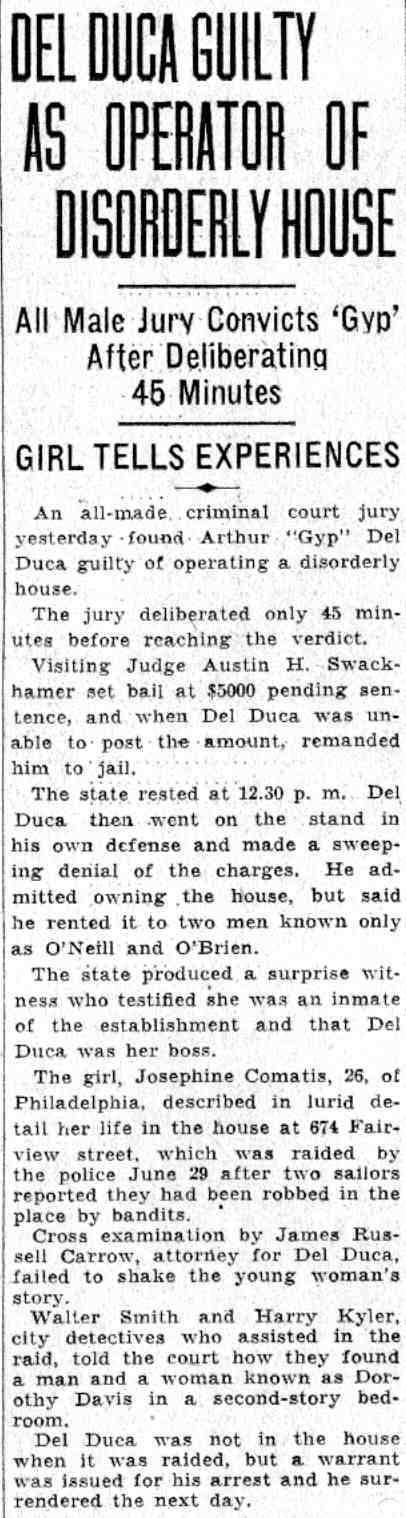
All Male Jury Convicts ‘Gyp’ After Deliberating 45 Minutes
GIRL TELLS EXPERIENCES
An all-male criminal court jury yesterday found Arthur “Gyp” Del Duca guilty of operating a disorderly house.
The jury deliberated only 45 minutes before reaching the verdict, his counsel, Judge Austin H. Swackhamer set bail at $5000 pending sentence, and when Del Duca was unable to post the amount, remanded him to jail.
The state rested at 12:30 p.m. Del Duca then went on the stand in his own defense and made a sweeping denial of the charges. He admitted owning the house, but said he rented it to two men known only as O’Neill and O’Brien.
The state produced a surprise witness who testified she was an inmate of the establishment and that Del Duca was her boss.
The girl, Josephine Comatis, 25, of Philadelphia, described in lurid detail her life in the house at 674 Fairview street, which was raided by the police June 29 after two sailors reported they had been robbed in the place by bandits.
Cross examination by James Russell Carrow, attorney for Del Duca, served to show the young woman’s story.
Walter Smith and Harry Kyler, city detectives who assisted in the raid, told the court how they found a man and a woman as Dorothy Davis in a second-story bedroom.
Del Duca was not in the house when it was raided, but a warrant was issued for his arrest and he surrendered the next day.
3 Women Scream as Former Boxer Gets 5-Year Term
Camden Courier-Post —


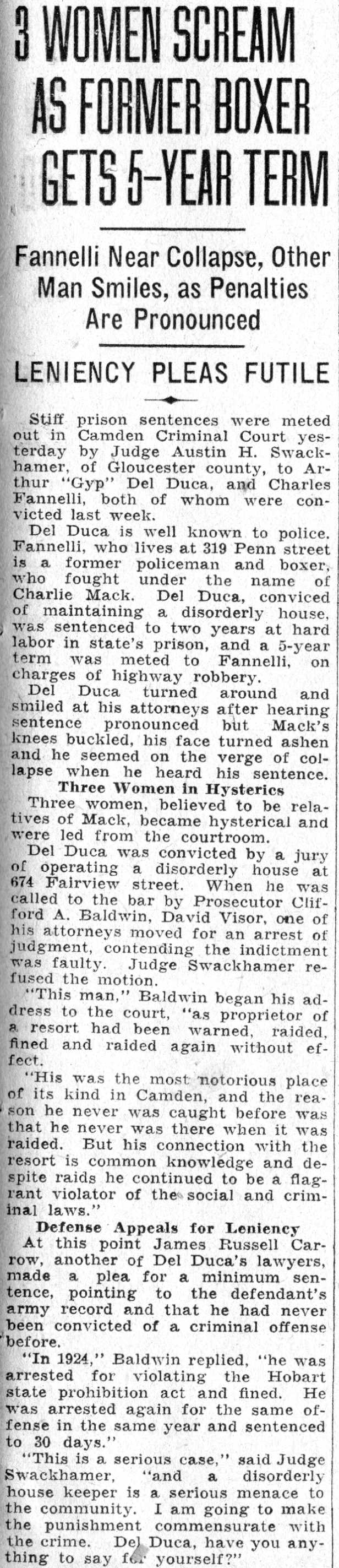
‘Gyp’ Del Duca and ‘Charlie Mack’ Doomed to Hard Labor at State Prison
Fannelli Near Collapse, Other Man Smiles, as Penalties Are Pronounced
LENIENCY PLEAS FUTILE
Stiff prison sentences were meted out in Camden Criminal Court yesterday by Judge Austin H. Swackhamer, of Gloucester county, to Arthur “Gyp” Del Duca, and Charles Fannelli, both of whom were convicted last week.
Del Duca is well known to police. Fannelli, who lives at 319 Penn street is a former policeman and boxer, who fought under the name of Charlie Mack. Del Duca, convicted of maintaining a disorderly house, was sentenced to two years at hard labor in state’s prison, and a 5-year term was meted to Fannelli, on charges of highway robbery.
Del Duca turned around and smiled at his attorneys after hearing sentence pronounced. But Mack’s knees buckled, his face turned ashen and he seemed on the verge of collapse when he heard his sentence.
Three women in mysteries believed to be relatives of Mack, became hysterical and were led from the courtroom.
Del Duca was convicted by a jury of operating a disorderly house at 674 Fairview street. When he was called to the bar by Prosecutor Clifford A. Baldwin, David Visor, one of his attorneys, moved for an arrest of judgment, contending the indictment was faulty. Judge Swackhamer refused the motion.
“This man,” Baldwin began his address to the court, “as proprietor of a resort had been warned, raided, fined and raided again without effect.
“His was the most notorious place of its kind in Camden, and the reason he never was caught before was that he never was there when it was raided. But in connection with the resort is common knowledge and despite raids he continued to be a flagrant violator of the social and criminal laws.”
Defense Appeals for Leniency
At this point James Russell Carrow, another of Del Duca’s lawyers, made a plea for a minimum sentence, pointing to the defendant’s army record and that he had never been convicted of a criminal offense before.
“In 1924,” Baldwin replied, “he was arrested for violating the Hobart state prohibition act and fined. He was arrested again for the same offense in the same year and sentenced to 30 days.”
“This is a serious case,” said Judge Swackhamer, “and a disorderly house keeper is a serious menace to the community. I am going to make it a punishment commensurate with the crime. Del Duca, have nothing to say for yourself?”
Takes ‘Rap’ With Smile
“Your honor this is the first time I was ever here on such a charge,” the prisoner said.
Sentence was then pronounced. Del Duca smiled broadly at Carrow and Visor and was led away by attaches. Carrow notified the court he would appeal.
Fannelli then was called to the bar. He is convicted of holding up and taking $51 from Joseph Weska, of Philadelphia, whom he met in a speakeasy near Broadway and Kaighn avenue last November 10.
“Fannelli, or Mack, gambled with fate and decided on a jury trial in an attempt to beat the rap,” said Assistant Prosecutor Rocco Palese. Gene Mariano, Mack’s attorney, objected to the word “gambled,” and added that if the prisoner were sent to prison for a long term he would come out a hardened criminal.
“On the contrary,” Judge Swackhamer declared, “he might have a chance for reformation because I am going to give him a sentence under which he will have plenty of time to reflect and meditate upon his past conduct and make up his mind to do better when he comes out. I sentence you to five years.”
Apparently surprised at the sentence, Mack grabbed his chair for support. He finally regained his composure, however, just as three women in the back of the court began screaming and weeping, Battling Mack, the prisoner’s brother, led them away, but before they left one of them shouted, “I hope you’re satisfied, now!”
At this point, seven state troopers, witnesses in another case, entered the room and order was restored.
Funeral Conducted For J. R. Carrow
Camden Courier-Post —
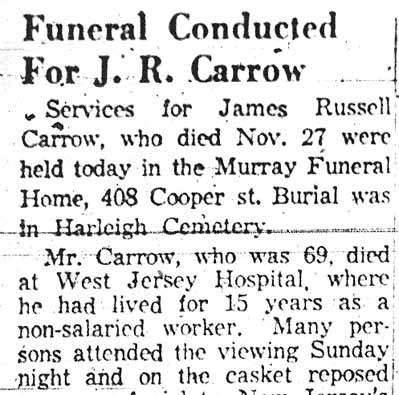
Services for James Russell Carrow, who died Nov. 27 were held today in the Murray Funeral Home, 408 Cooper st. Burial was in Harleigh Cemetery.
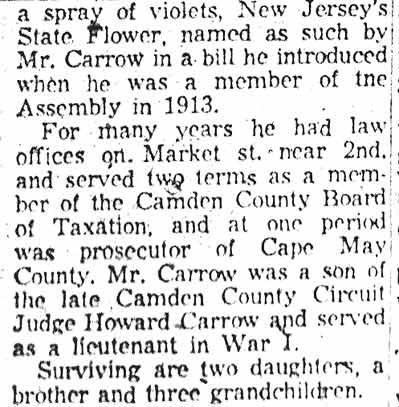
Mr. Carrow, who was 69, died at West Jersey Hospital, where he had lived for 15 years as a non-salaried worker. Many persons attended the viewing Sunday night and on the casket reposed a spray of violets, New Jersey’s State Flower, named as such by Mr. Carrow in a bill he introduced when he was a member of the Assembly in 1913.
For many years he had law offices on Market st., near 2nd, and served two terms as a member of the Camden County Board of Taxation, and at one period was prosecutor of Cape May County. Mr. Carrow was a son of the late Camden County Circuit Judge Howard Carrow and served as a lieutenant in War I.
Surviving are two daughters, a brother and three grandchildren.