Introduction
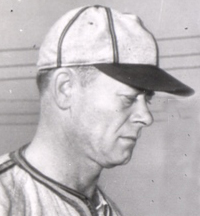
SIG JAKUCKI was born Sigmund Jakucki in Camden NJ on August 20, 1909 to John Jakucki and his wife, the former Johanna Opczynski. His father had come to America in March of 1903, his mother a year later.
Sig Jakucki was one of at least four children, coming after older brother Andrew and before brother Theodore and sister Florence. The family lived at 1249 Morton Street in Camden’s Liberty Park neighborhood as early as 1918 into the early 1950s. The elder Jakucki worked at the Penn Shipyard in Gloucester City and later at the J. Eavenson & Sons soap factory on Delaware Avenue. The Jakucki family were members of the St. Joseph Roman Catholic Church, at South 10th and Mechanic Street.
Early Baseball Career
Sig Jakucki, who was generally known to his teammates as Jack, grew up to become a 6’2,” 198 pound right-handed pitcher who featured a sinking fastball and a curve ball. He compiled a 25–22 record with a 3.79 earned run average, mostly during the 1944 and 1945 seasons.
Sig Jakucki played baseball for the Polish American Citizens Club in Camden. In 1927 he enlisted in the United States Army. Stationed at Schofield Barracks in Hawaii, he became a star slugger and occasional pitcher for the barracks’ baseball team. When his term of enlistment ended in 1931, he stayed in Hawaii to play semipro ball, first with the Honolulu Braves and later with Asahi, a team that as author William B. Mead put it, “was made up of Hawaiians of Japanese descent, Hawaiians of Portuguese descent, and one hefty towhead of Polish descent named Jakucki.”
Sig Jakucki became such a star in Hawaii that on the recommendation of Bill Inman, scout for the San Francisco Seals of the Pacific Coast League, fans paid his way to San Francisco for a tryout as an outfielder. The Seals were set with Joe DiMaggio in the outfield, but Jakucki caught on with the Oakland Oaks. However, he wasn’t quite ready for the AAA level pitching and was let go in May. He caught on with the Galveston Sand Crabs of the Texas League, where manager Billy Webb converted him to a full-time pitcher. He responded by posting a 10–7 record in 1934, and won 15 games the following year. Still with Galveston in 1936, Jakucki had lost nineteen games by late August, but pitched well enough to catch the Browns’ eye; they brought him up. He lost three games, won none, and failed to impress manager Rogers Hornsby. Bill DeWitt, who was with the Browns at the time said:
Hornsby didn’t like the guy, so in spring training of 1937 we sent him back to the minors. He bounced around from one club to another, and he’d get drunk all the time, so he got released. Then he started pitching for these semi-pro clubs in Galveston and Houston. He was a paperhanger and painter during the week and then he’d pitch on weekends.
We had forgotten all about him. Then in the spring of ’44 we were short of pitchers, and this fellow down in Texas told us about him. He says, ‘You better get this guy. He can win some games for you.’ So we got him.
Minor League Adventures
The Browns sent Sig Jakucki back to Galveston on April 1, 1937. He had won three and lost six before being sent to the New Orleans Pelicans of the Southern Association. He won twelve games and lost six. He also made the acquaintance of ex-Philadelphia Phillie hurler Euel Moore. According to Arthur Daley in the New York Times,
Jakucki and Euel Moore once went to see a wrestling match after a game. The hefty, playful Moore had the reputation of being the strongest man in baseball, and in Jakucki he found a kindred soul. The wrestling match turned out to be slightly on the boring side, so to provide some excitement, Moore picked up the 200-pound Sig, and tossed him into the ring. The startled grapplers thought Jakucki was merely part of the act and that someone had forgotten to tip them off. But the indignant referee took a swing at Jakucki, a sad mistake. Jakucki flattened him. Thereupon the two wrestlers pounced on the interloper, also a mistake. Moore joined in until the police broke up the free-for-all and carted Jakucki and Moore to the nearest jail.
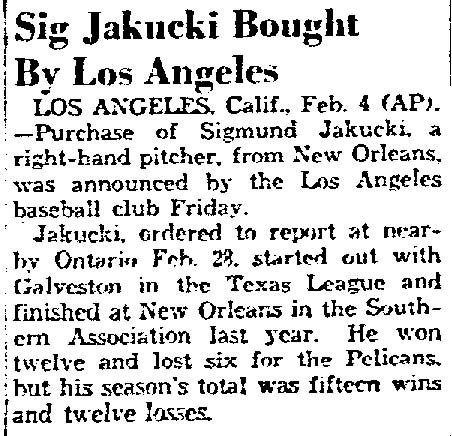
Despite his winning record, the Pelicans did not bring Sig Jakucki back in 1938. On February 4 he was sold to the Los Angeles Angels of the Pacific Coast League, but did not play, and it appeared that his career as a professional baseball player was over. He bounced around Texas and Kansas, playing semi-pro ball and eventually ended up working at a shipyard in Houston.
Jakucki would get drunk. He pitched in the National Semi-pro Tournament in 1940 for Houston Grand Prize beer. They won third place. Jakucki got stiff, and he got angry at an umpire, and he accosted him crossing the Arkansas River right outside Lawrence Stadium in Wichita, and he dangled the umpire over the rail by his heels. Oh, he was something, that Jakucki. Luke Sewell had some real cutthroats to handle.
After the shipyard job ended Sig Jakucki returned to Galveston where he worked as a painting and wallpaper subcontractor. When the Browns surprised Jakucki with a contract, the big right-hander was 34 years old and had been out of organized baseball for six years. But he had become something of a legend in semi-pro ranks. Bob Broeg of the St. Louis Post Dispatch noted that Sig Jakucki clinched the Browns’ only pennant with a 5–2 win over the Yankees on the last day of the 1944 season. His heavy drinking, however, resulted in his suspension the following year.
The 1944 Season & Pennant Race
The 1944 baseball season was the peak—or, to look at it another way, the nadir—of wartime baseball. The National League didn’t embarrass itself; the Cardinals won their third straight pennant behind respectable ballplayers like Marty Marion, Walker Cooper, Johnny Hopp, and especially Stan Musial.
But in the American League, the acute shortage of players dragged the entire league down to the level of the St. Louis Browns, perennial doormats who had finished in the second division nine out of the previous ten seasons. The dismal Browns had never won a pennant in 43 years of American League competition.
The 1944 Browns were relatively untouched by the military draft, as they featured an all-4F infield, nine players on the roster 34 years old or older, and a motley collection of notorious characters, such as Tex Shirley and Mike Kreevich. Sig Jakucki, who went 13–9 with a 3.55 ERA that year, had as stated above, been rediscovered pitching for a Houston industrial-league semi-pro team.
Rounding out the staff were old men Nels Potter (who went 19–7 with a 2.83 ERA) and Denny Galehouse (9–10), and youngsters Jack Kramer (who finished 17–13 with a 2.49 ERA) and Bob Muncrief (13–8). The big hitters for the Browns were 23-year-old shortstop Vern Stephens, who hit .293 and was second in homers with 20 and first in RBI with 109, and Kreevich, the team’s only .300 hitter at .301.
St. Louis won its first nine games of the season, and continued to surprise the baseball world by hanging tough in a four-team race with Detroit, Boston, and the Yankees. The race came down to the final week, when the Browns defeated New York five times, winning the pennant by 1 game over Detroit.
June 29, 1944 — The Yanks move to 2½ games behind St. Louis with a 1–0 win over Sig Jakucki. Walt Dubiel gives up 2 hits for the win.
July 4, 1944 — Sig Jakucki, the Browns’ 34-year-old rookie, threw his 3rd shutout in 4 games, blanking the Athletics, 4–0. Sig has given up 1 run in 27 innings. The win keeps the Browns 1½ games ahead of Boston. The A’s win the nightcap, 8–3, behind Hot Potato Hamlin, who strands 10 runners. Frankie Hayes has a HR to tie for the AL lead with 9.
July 8, 1944 — At Washington, the Browns edged the Nationals, 5–4, behind Sig Jakucki. Sig walked 7, including 3 intentional walks to Stan Spence. Johnny Niggeling gives up 10 hits and strikes out 10 in losing to the league-leaders.
September 26, 1944 — Sig Jakucki pitched the Browns to a 1–0 win over the Red Sox to keep St. Louis in 1st place.
October 1, 1944 — The Browns have their first sellout in 20 years, and their largest crowd ever, as 37,815 pack Sportsman’s Park. St. Louis clinches the flag on the final day of the season by sweeping the series with the Yankees and coming from behind to win 5–2. The big blows are a pair of 2-run home runs by Chet Laabs, off Mel Queen. Sig Jakucki was the winning pitcher.
St. Louis clinched the flag with victory over New York on two home runs by Chet Laabs and one by Stephens. The Browns finished with a record of 89–65, which was, at the time, the worst record ever by an American League pennant-winner.
The Night Before the Pennant
The night before the pennant-winning game against the Yankees, Sig Jakucki, who was the scheduled starter, was spotted by Browns’ team trainer Bob Bauman entering the team hotel with a bag of whiskey bottles. Jakucki was a terrible drinker, and Bauman—seeing the Browns’ first pennant disappear in a Jakucki bender—accosted the pitcher. “You’re not going to take that to your room,” Bauman shouted. Jakucki resisted, and swore he would not drink that night.
The next morning, at the ballpark, Bauman immediately realized that Jakucki had indeed been drinking. Jakucki defended himself: He admitted he had promised not to have a drink the night before, and insisted he hadn’t. But, he added, “I didn’t promise I wouldn’t take one this morning.”
Jakucki proceeded to outpitch the Yankees’ Mel Queen, and the Browns took the game, 5–2. The Browns had won the pennant!
World Series & the 1945 Season
The World Series was another story. Starting Game Four for the Browns, Jakucki gave up a first inning single to Cardinal first baseman Johnny Hopp. Stan Musial followed with a two-run homer. Jakucki was touched for another run in the third when Danny Litwhiler scored on a Walker Cooper single. The Cardinals went on to win the World Series in six games.
The Browns were contenders the following season, but fell short for a variety of reasons. Symptomatic of the Browns’ 1945 season were the events of June 19, 1945.
June 19, 1945 — At St. Louis, in what would be dubbed the “Battle of the Dugouts,” the 8th inning produces fireworks as the White Sox score 4 runs to eventually win, 4–1. After reliever George Caster is lifted, he fires the ball into the White Sox dugout, prompting manager Jimmie Dykes to come out and protest. Browns catcher Gus Mancuso tells Dykes to shut up Karl Scheel, a Sox bench jockey who has been mercilessly “riding” the Browns. When Dykes says you can find him in the dugout, a few Browns, led by Sig Jakucki and Ellis Clary, do just that, giving Scheel a “most brutal” (according to Dykes) pounding. The ex-Marine required first aid but traveled with the team to Cleveland. About 100 spectators milled onto the field to try and see the action. In Cleveland, Dykes sent a telegram to Will Harridge accusing Browns manager Luke Sewell with instigating the riot.
The 1945 Browns also featured the big league’s only one-armed player, outfielder Pete Gray. Gray was not a particularly popular fellow, and Sig Jakucki, who later wound up in prison, was not always the kindliest of men, either. One story about the two states that when Gray asked Jakucki if he might help him tie his shoes, Jakucki replied, “Tie your own goddamned shoes, you one-armed son of a bitch.” They eventually got into an argument one day and settled it with a fight. Jakucki agreed to fight with one arm held behind his back.
The Union Station Incident
Sig Jakucki’s final game was on August 29, 1945. He started at home against the league-leading Detroit Tigers, but was taken out in the third inning by manager Luke Sewell. He proceeded to get very drunk that night, and showed up late and intoxicated the next morning at Union Station in St. Louis, from where the Browns were to travel to Chicago and beyond.
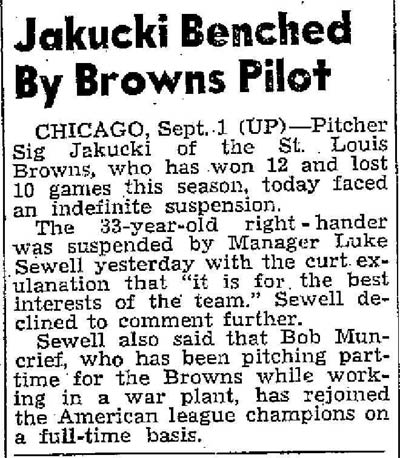
The Browns’ manager Luke Sewell’s patience concerning Jakucki’s drinking and behavior, and the Browns’ play in general, finally wore out on August 30 and August 31, 1945. Although the Browns were still in the pennant race, the right-hander was given his unconditional release. Some say that the defensive liabilities of the one-armed outfielder combined with the release of Jakucki, who had a 12–10 record at the time, may have cost the Browns a second trip to the World Series. Without a doubt both contributed to manager Sewell’s decision to quit the team.
Browns’ trainer Bob Bauman told author William B. Mead of the events that led to Jakucki’s release:
We were leaving Union Station in St. Louis around 8 a.m. I’m standing out there, checking to make sure they all get on the train. Everybody is there but Jakucki. He comes late; he’s carrying a bag of liquor in one hand and a suitcase in the other. He couldn’t walk straight, he’s so drunk.
“Sewell says, ‘You’re not getting on the train. Turn around and go back. You’re through.’ Jakucki says, ‘No, I’m not. I’m going on the train.’ He drops the suitcase and starts swinging, but he can’t hurt anybody.
“Sewell got on the train, hollered at me to get on, and told the porter ‘Don’t let him in the car.’ The porter’s standing on the area-way between the two cars. Jakucki climbs up there. He drops his grip and it breaks the porter’s toe.
So the train starts. Jakucki’s between the two cars. Sewell has the conductor get the police to take him off at Delmar Station [a passenger station in suburban St. Louis]. Shortest trip in history.
That night about midnight, [Browns’ Traveling Secretary] Charley DeWitt gets a call. Jakucki’s in the lobby; wants a room. Know how he got to Chicago? Hopped a freight. They won’t give him a room, so he lays down on one of the divans.
Coming down in the morning, it was one of the funniest sights I’ve ever seen. Here he is, peeking around a corner. He’s been sleeping down in that lobby all night long. He’s got a dirty shirt on; looks like he just got out of jail.
DeWitt told him he was through with the ballclub. That was where his career ended.
Post-Browns Career
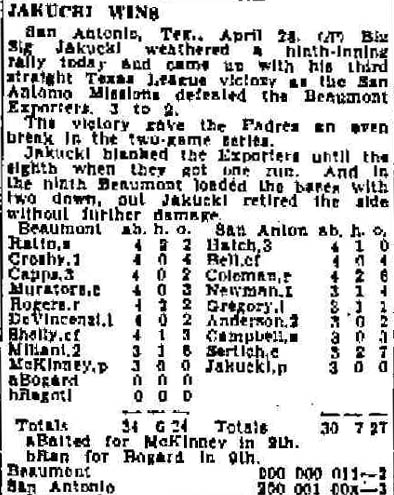
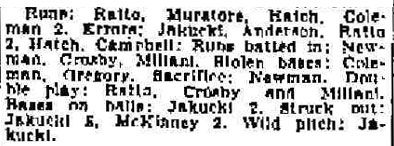
There were, however, still teams willing to pay Sig Jakucki to play baseball. He pitched for the San Antonio Missions in the Texas League in 1946. Still in good form on the mound, he won his first three decisions, and was still with the team at the end of the season. The Missions were affiliated with the Browns; apparently Sig Jakucki had not burned all of his bridges behind him. One of his teammates on the Missions was a young pitcher named Ned Garver. Garver went up to the majors with the Browns in 1948. He managed to win 20 games for the big club in 1951, quite an achievement as the Browns lost 102 games that year. Garver remains the only pitcher in American League history and modern baseball history (post-1920) to win 20 or more games for a team which lost 100 or more games in the same season and the only pitcher in Major League history to do so with a winning record.
The Missions traded Sig Jakucki to the Seattle Rainiers in the Pacific Coast League after the 1946 season ended. On April 19, 1947 Sig Jakucki surrendered a home run to San Francisco Seals outfielder Joe Brovia. Brovia’s ball carried 560 feet over the 40-foot high center-field fence at Seals Stadium.
Well into his late 30s, Sig Jakucki could still pitch. His exploits on and off the field in Seattle were as such—Sig would pitch a three-hitter and celebrate by taking two or three days off.
The Rainier Brewery Story
The Rainiers’ saintly general manager, Earl Sheely, did his best to reform him, leading to a perhaps apocryphal story. To keep Sig out of bars, Sheely would drive him home. One night he drove by the Rainier Brewery, where the midnight shift was going full blast.
“See that, Sig,” Sheely said. “You can’t drink it as fast as they can make it.”
“Maybe not,” Sig said, “but I got ’em workin’ nights.”
Final Years & Frank Mancuso’s Watch
Things did not go well for Sig Jakucki after that. He returned to Houston, Texas where he had been living before the Browns called him up, and then to Galveston. His alcoholism left him living on the streets, and begging for what he could. He would occasionally go to Houston, drop in the city hall to talk over old times with his old friend Frank Mancuso, who had been a reserve catcher on the 1944 and 1945 Browns teams. He never asked for anything, but when the former pitcher was ready to head back to the streets Mancuso would slip something into Sig’s pocket. Frank was always pleased to see his friend come in although he might not see him for months. The bottle ruined Sig’s life, and eventually caused his death.
Sigmund “Sig” or “Jack” Jakucki passed away on May 28, 1979 in Galveston, Texas at the age of 69. Near the end of his life, Sig had fallen upon hard times due to bad health and personal problems. He was fortunate to have the nearby friendship of Frank Mancuso, one of his teammates from the 1944 Browns American League championship club. Frank Mancuso pretty much took care of Jakucki in his waning months, including paying for his burial. Not wanting to feel like a burden upon Frank, Sig insisted that Frank hold onto his watch as collateral for the help.
In later years, when anyone would ask about the beat-up watch, Mancuso, who had made a career as a politician in Houston, would say: “That old ticker has been on my desk for years, and not a day goes by that I don’t look at that old Timex and think of Sig and the talks we used to have. He was a great pitcher with lots of potential, he just got lost along the way.”
Youth Is Killed as Three ‘Skip’ School to Hunt
Camden Courier-Post —

YOUTH IS KILLED AS THREE ’SKIP’ SCHOOL TO HUNT
Boy Shot in Head When Companion Fires at Quail
GUN TRAGEDY OCCURS IN PENNSAUKEN TWP.
Three South Camden Lads Quizzed By Cops and Prosecutor
A hunting expedition by three Camden boys ended tragically today when one, in firing a shotgun at a rising quail, killed a second who suddenly placed himself between the muzzle of the weapon and the target.
The dead boy was Theodore Jakucki, 14, of 1207 Whitman avenue.
The youth said by the police to have fired the shot that killed the Jakucki boy is Meyer Albert, 16, of 1186 Kaighn avenue. With him was Leon Grenkwicz, 15, of 1469 Louis street.
According to the story told the Pennsauken police, the three “hookeyed” school today and left early on a shooting trip. They made their way out Mariton pike to the old Welch farm.
Borrowed Gun Used
The youth said he had borrowed a shotgun belonging to his brother, Constant, 19. Albert was carrying the gun and Jakucki was walking in the lead when the quail suddenly took to the air with a whirr of wings. Jakucki stooped suddenly either to pick up something or to tie his shoe. With the discharge of the gun he straightened up and received the full charge in his head, which was partly blown away.
Another gunner, whose name was not obtained, appeared as Jakucki fell to the ground. The boys asked him to send somebody to get the youth to a hospital.
The Pennsauken township police were summoned and the body was removed to police headquarters. The body was examined by Coroner Melvin Cain.
The two boys with Constant Grenkwicz were taken to the office of Prosecutor Baldwin by Detective Fiore Troncone, who questioned them. They told the same story they had told the Pennsauken police.
Word to Family Delayed
Although the tragedy occurred before 10 a. m. and although Albert and the Grenkwicz brothers were taken to the prosecutor’s office before 11 o’clock the family of the dead boy had not been informed of what had happened until shortly before noon.
Then, a reporter, seeking a picture of Jakucki, sought out the correct address which until then had not been obtained, and found the family ignorant of Theodore’s death.
The reporter asked if the home was that of Theodore. “Yes, but don’t worry,” said Mrs. Jakucki, “he’s in school all right.” The woman thought the reporter was a truant officer.
Members of the family, who had been awaiting the preparation of the noon-day meal, had been laughing and singing and listening to the radio. When the reporter asked for the picture the others crowded about to know what had happened.
The reporter said merely that the boy had been hurt and that someone ought to go to the office of the prosecutor.
The dead boy’s family includes his mother and father, three sisters, Viola, 19, Lucy, 5, and Helen, 4, and two brothers, Joseph, 13, and Sigmund, 12. Theodore was a first-year student in the Camden Vocational School, where he was studying to be an automobile mechanic.
Albert and the Grenkwiczs boys were released by the prosecutor after statements had been obtained from them.
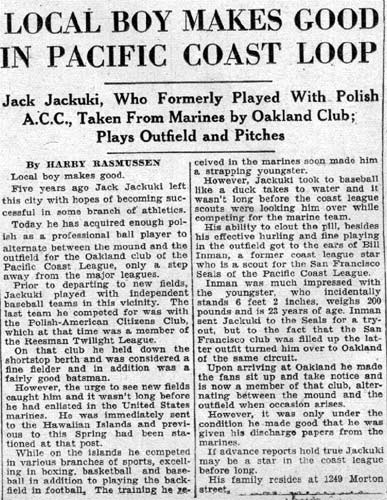
Local Boy Makes Good in Pacific Coast League
Camden Courier-Post —
Sig Jakucki Bought By Los Angeles
Dallas Morning News —
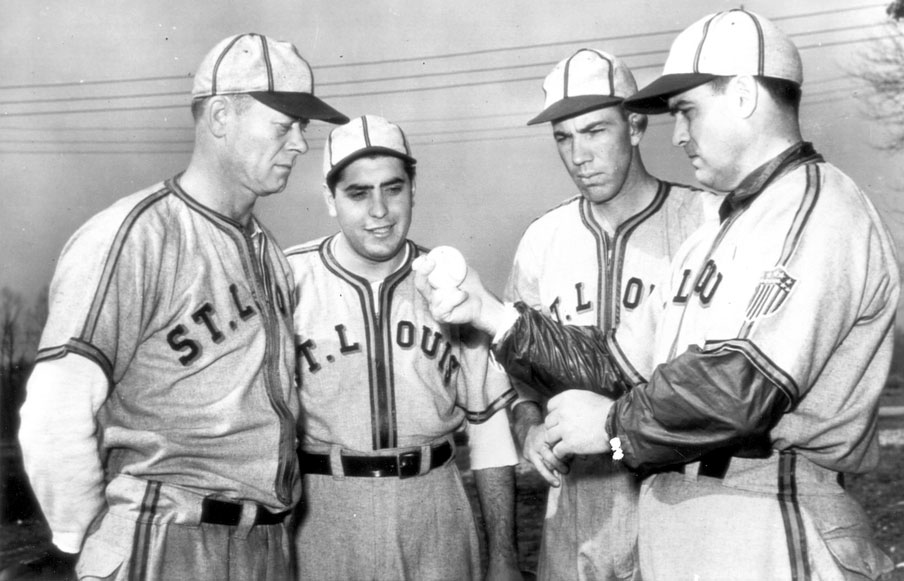
AP Wirephoto

Baseball Card & Autograph
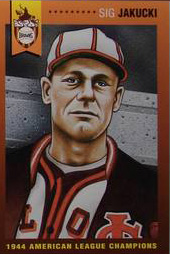
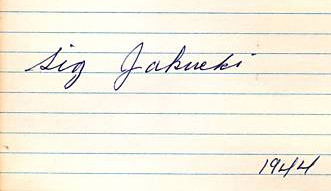
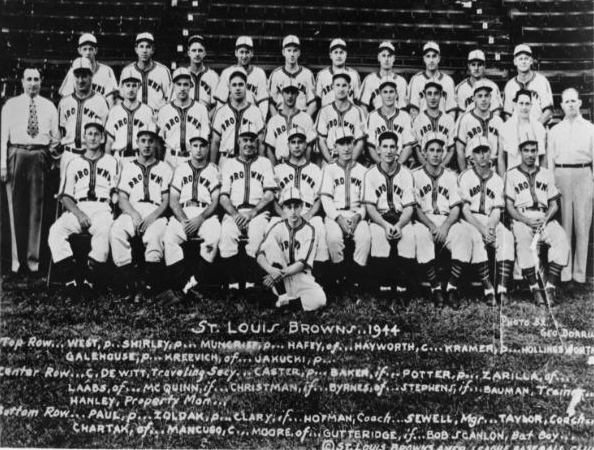
1944 St. Louis Browns
The Browns Win The Pennant!
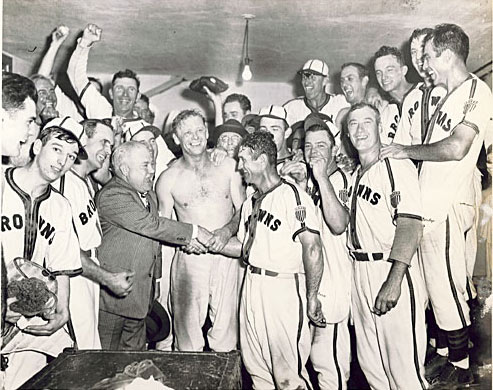
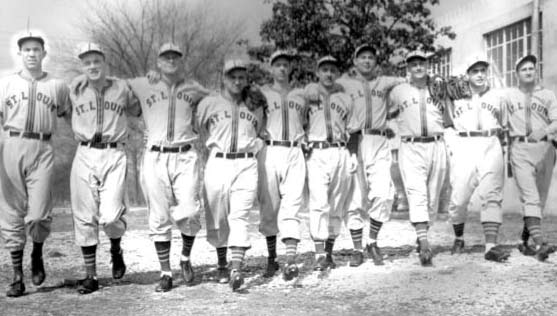
Bottom, from left: bat boy Bobby Scanlon, manager Luke Sewell, owner Donald Barnes, Sig Jakucki, Mike Kreevich, Vern Stephens (with fist upraised), Al Hollingsworth. Rear, from left: coach Freddie “Bootnose” Hoffman, coach Zack Taylor (fist upraised), Al Zarilla (face and dark hair only), Tex Shirley (white hat behind Kreevich), Gene Moore, Sam Zoldak, Bob Muncrief, Denny Galehouse, Don Gutteridge.
1944 St. Louis Browns
Sig Jakucki, Third from Left
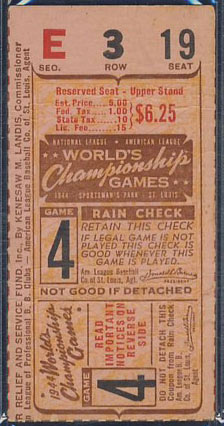
World Series Ticket Stub
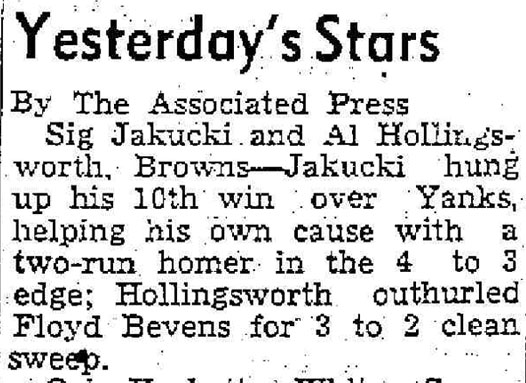
Yesterday’s Stars
Moberly, Missouri Monitor-Index —
Jakucki Benched By Browns Pilot
Ogden, Utah Standard-Examiner —
Major League Record
Major League Record
Regular Season Pitching
| Year ↕ | Age ↕ | Team ↕ | Lg ↕ | W ↕ | L ↕ | G ↕ | Gs ↕ | Cg ↕ | Sho ↕ | Ip ↕ | H ↕ | Bb ↕ | So ↕ | Era ↕ |
|---|---|---|---|---|---|---|---|---|---|---|---|---|---|---|
| 1936 | 26 | SLB | AL | 0 | 3 | 7 | 2 | 0 | 0 | 20.7 | 32 | 12 | 9 | 8.71 |
| 1944 | 34 | SLB | AL | 13 | 9 | 35 | 24 | 12 | 4 | 198.0 | 211 | 54 | 67 | 3.55 |
| 1945 | 35 | SLB | AL | 12 | 10 | 30 | 24 | 15 | 1 | 192.3 | 188 | 65 | 55 | 3.51 |
| Total | 25 | 22 | 72 | 50 | 27 | 5 | 411.0 | 431 | 131 | 131 | 3.79 |
Regular Season Batting
| Year ↕ | Age ↕ | Team ↕ | Lg ↕ | G ↕ | Ab ↕ | R ↕ | H ↕ | 2b ↕ | 3b ↕ | Hr ↕ | Rbi ↕ | Ba ↕ |
|---|---|---|---|---|---|---|---|---|---|---|---|---|
| 1936 | 26 | SLB | AL | 7 | 6 | 0 | 0 | 0 | 0 | 0 | 0 | .000 |
| 1944 | 34 | SLB | AL | 36 | 73 | 9 | 11 | 1 | 1 | 1 | 8 | .151 |
| 1945 | 35 | SLB | AL | 30 | 70 | 7 | 13 | 1 | 1 | 2 | 6 | .186 |
| Total | 73 | 149 | 16 | 24 | 2 | 2 | 3 | 14 | .161 |
Postseason Pitching — 1944 World Series
| Year ↕ | Round ↕ | Team ↕ | Opp ↕ | W L ↕ | G ↕ | Gs ↕ | Ip ↕ | H ↕ | Er ↕ | Bb ↕ | So ↕ | Era ↕ |
|---|---|---|---|---|---|---|---|---|---|---|---|---|
| 1944 | WS | SLB | STL | L | 1 | 1 | 3.0 | 5 | 3 | 0 | 4 | 9.00 |
Jakucki Wins
Galveston, Texas Daily News —
1947 Seattle Rainiers
Pacific Coast League
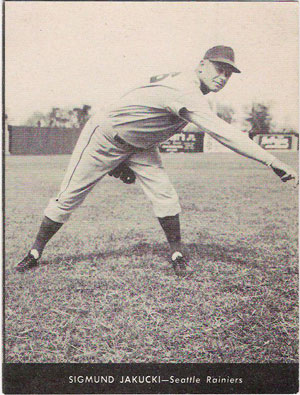
Centennial Flour issued 4 sets over a 5-year span in the mid-1940s. The cards are fairly large at roughly 4” by 5” in size, and feature only players from the Seattle Rainiers of the PCL. The back of the cards include a short player bio and a compliments of Centennial Flour ad. The 1943 set is complete at 25 different cards, the 1944 set is complete at 25 different cards, the 1946 set is complete at 27 different cards, and the 1947 set is complete at 32 different cards.