Introduction
Hale Street ran north to south between Central Avenue and Ferry Avenue, west of the railroad tracks that still exist today. It first appears in Camden City Directories in 1895. Four homes stood on Hale Street. They were originally numbered 1701, 1703, 1705, and 1707. At some point between 1913 and 1920 they were renumbered 1800, 1802, 1804, and 1806. These homes were still standing in 1962, and at least two, 1802 and 1806, were still occupied in 1969. In the 1970s these homes were taken, and, with all of Hale Street, erased to make way for the I-676 North-South Freeway.
Intersection of Hale Street & Central Avenue
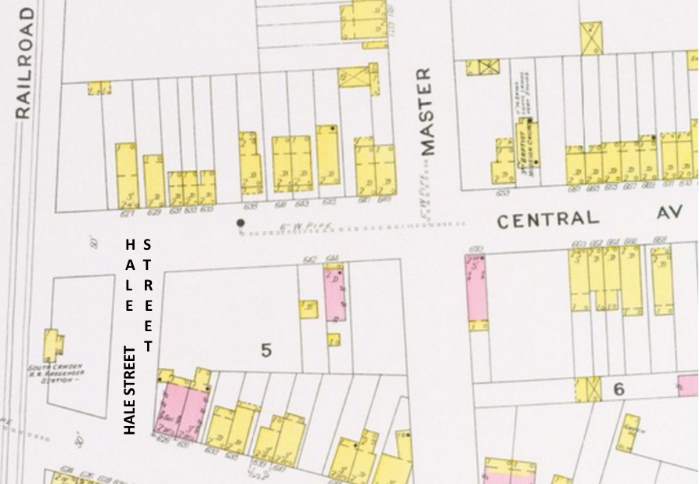
1906 Sanborn Map. The houses that stood on Hale Street had not been built yet.
1700 & 1800 Blocks of Hale Street — Occupants
City directory records, 1909–1947. Houses originally numbered 1701, 1703, 1705, and 1707 were renumbered 1800, 1802, 1804, and 1806 between 1913 and 1920.
1701 Hale Street (later 1800)
| Year ↕ | Name ↕ |
|---|---|
| 1909–1912 | Stanislaus (Stanley) Macks & Family |
1703 Hale Street (later 1802)
| Year ↕ | Name ↕ |
|---|---|
| 1912–1913 | Thomas Kopsinski & Family (Theodore & Kate Kopsinski) |
1705 Hale Street (later 1804)
| Year ↕ | Name ↕ |
|---|---|
| 1910–1911 | Thomas Kopsinski & Family (Theodore & Kate Kopsinski) |
1701 Hale Street — 1913
| Year ↕ | Name ↕ |
|---|---|
| 1913 | Alexander Cappi |
1800 Hale Street (formerly 1701)
| Year ↕ | Name ↕ |
|---|---|
| 1920–1922 | James Rabrar & Family (James & Lucy Rabrar) |
| 1947 | No information available |
1802 Hale Street (formerly 1703)
| Year ↕ | Name ↕ |
|---|---|
| 1920–1921 | No information available |
| 1929 | No information available |
| 1947 | No information available |
1804 Hale Street (formerly 1705)
| Year ↕ | Name ↕ |
|---|---|
| 1921 | No information available |
| 1922 | No information available |
| 1934 | Nicholas Sustich |
| 1947 | No information available |
1806 Hale Street (formerly 1707)
| Year ↕ | Name ↕ |
|---|---|
| 1920–1921 | No information available |
| 1922 | No information available |
| 1947 | No information available |
Related: Stanislaus Macks — 1701 Hale Street, 1909–1912.
Mother and Babes Alone
Philadelphia Inquirer —
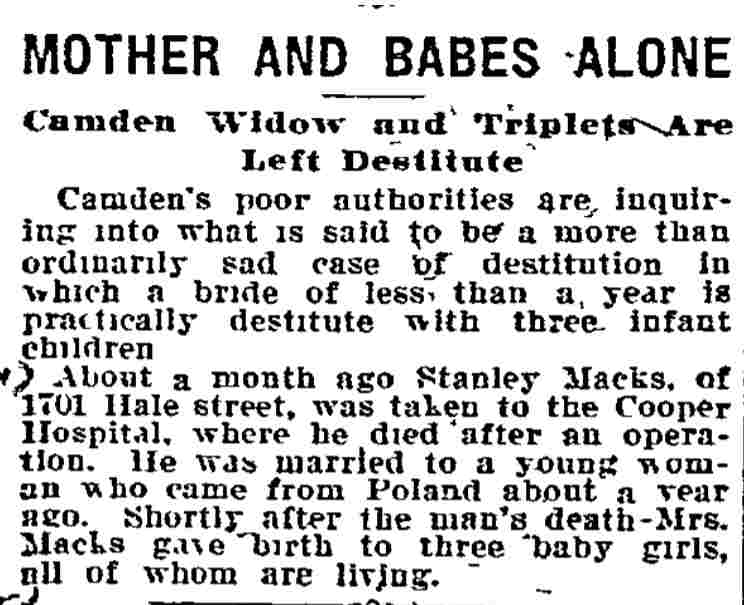
Camden Widow and Triplets Are Left Destitute
Camden's poor authorities are inquiring into what is said to be a more than ordinarily sad case of destitution in which a bride of less than a year is practically destitute with three infant children.
About a month ago Stanley Macks, of 1701 Hale street, was taken to the Cooper Hospital, where he died after an operation. He was married to a young woman who came from Poland about a year ago. Shortly after the man's death Mrs. Macks gave birth to three baby girls, all of whom are living.
Triplets' Mother Happy
Philadelphia Inquirer —
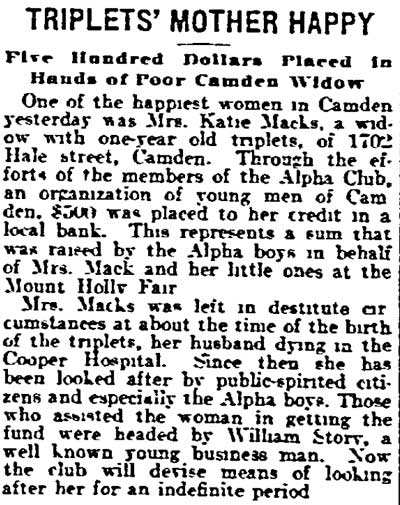
Five Hundred Dollars Placed in Hands of Poor Camden Widow
One of the happiest women in Camden yesterday was Mrs. Katie Macks, a widow with one-year old triplets, of 1702 Hale street, Camden. Through the efforts of the members of the Alpha Club, an organization of young men of Camden, $500 was placed to her credit in a local bank. This represents a sum that was raised by the Alpha boys in behalf of Mrs. Mack and her little ones at the Mount Holly Fair.
Mrs. Macks was left in destitute circumstances at about the time of the birth of the triplets, her husband dying in the Cooper Hospital. Since then she has been looked after by public-spirited citizens and especially the Alpha boys. Those who assisted the woman in getting the fund were headed by William Story, a well known young business man. Now the club will devise means of looking after her for an indefinite period.
Julia Macks, 1701 Hale Street
Philadelphia Inquirer —

Falling on a nail two-year-old Julia Macks, one of the celebrated triplets of that name, ripped a three-inch gash in her right leg, at her home, 1701 Hale street. The injury was dressed at Cooper Hospital.
Dozen Battles Draw 1000 as Victory March Pays Serenade
Camden Courier-Post —
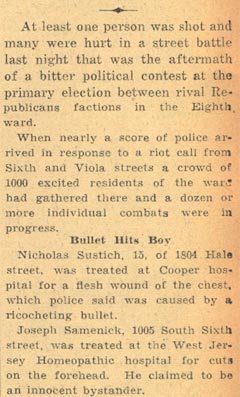
Youth Cut in Chest by Bullet; Bystander Cut on Head
POLITICAL LEADERS PUT TO QUIZ BY DETECTIVES
At least one person was shot and many were hurt in a street battle last night that was the aftermath of a bitter political contest at the primary election between rival Republicans [sic] factions in the Eighth ward.
When nearly a score of police arrived in response to a riot call from Sixth and Viola streets a crowd of 1000 excited residents of the ward had gathered there and a dozen or more individual combats were in progress.
Bullet Hits Boy
Nicholas Sustich, 15, of 1804 Hale street, was treated at Cooper hospital for a flesh wound of the chest, which police said was caused by a ricocheting bullet.
Joseph Samenick, 1005 South Sixth street, was treated at the West Jersey Homeopathic hospital for cuts on the forehead. He claimed to be an innocent bystander.
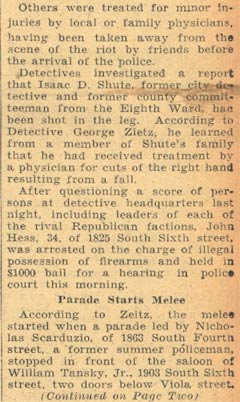
Others were treated for minor injuries by local or family physicians, having been taken away from the scene of the riot by friends before the arrival of the police.
Detectives investigated a report that Isaac D. Shute, former city detective and former county committeeman from the Eighth Ward, had been shot in the leg. According to Detective George Zietz, he learned from a member of Shute’s family that he had received treatment by a physician for cuts of the right hand resulting from a fall.
After questioning a score of persons at detective headquarters last night, including leaders of each of the rival Republican factions, John Hess, 34, of 1825 South Sixth street, was arrested on the charge of illegal possession of firearms and held in $1000 bail for a hearing in police court this morning.
Parade Starts Melee
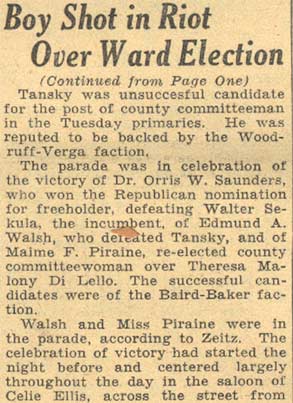
According to Zeitz, the melee started when a parade led by Nicholas Scarduzio, of 1863 South Fourth street, a former summer policeman, stopped in front of the saloon of William Tansky, Jr., 1903 South Sixth street, two doors below Viola street.
Tansky was unsuccesful [sic] candidate for the post of county committeeman in the Tuesday primaries. He was reputed to be backed by the Woodruff-Verga faction.
The parade was in celebration of the victory of Dr. Orris W. Saunders, who won the Republican nomination for freeholder, defeating Walter Sekula, the incumbent, of Edmund A. Walsh, who defeated Tansky, and of Maime F. Piraine, re-elected county committeewoman over Theresa Malony Di Lello. The successful candidates were of the Baird-Baker faction.
Walsh and Miss Piraine were in the parade, according to Zeitz. The celebration of victory had started the night before and centered largely throughout the day in the saloon of Celie Ellis, across the street from that of Tansky.
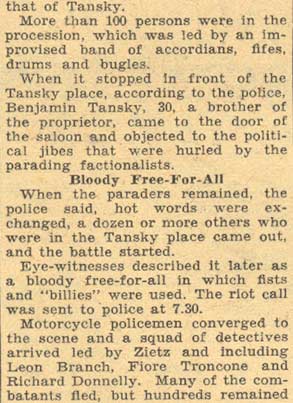
More than 100 persons were in the procession, which was led by an improvised band of accordians [sic], fifes, drums and bugles.
When it stopped in front of the Tansky place, according to the police, Benjamin Tansky, 30, a brother of the proprietor, came to the door of the saloon and objected to the political jibes that were hurled by the parading factionalists.
Bloody Free-For-All
When the paraders remained, the police said, hot words were exchanged, a dozen or more others who were in the Tansky place came out, and the battle started.
Eye-witnesses described it later as a bloody free-for-all in which fists and “billies” were used. The riot call was sent to police at 7.30.
Motorcycle policemen converged to the scene and a squad of detectives arrived led by Zietz and including Leon Branch, Fiore Troncone and Richard Donnelly. Many of the combatants fled, but hundreds remained as police and detectives strove to locate the injured, most of whom had been removed.
Scarduzio Beaten Badly
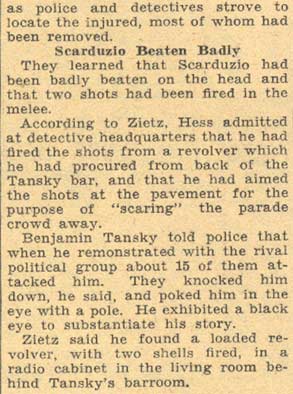
They learned that Scarduzio had been badly beaten on the head and that two shots had been fired in the melee.
According to Zietz, Hess admitted at detective headquarters that he had fired the shots from a revolver which he had procured from back of the Tansky bar, and that he had aimed the shots at the pavement for the purpose of “scaring” the parade crowd away.
Benjamin Tansky told police that when he remonstrated with the rival political group about 15 of them attacked him. They knocked him down, he said, and poked him in the eye with a pole. He exhibited a black eye to substantiate his story.
Zietz said he found a loaded revolver, with two shells fired, in a radio cabinet in the living room behind Tansky’s barroom.