Introduction
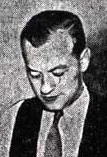
George Roundey
George Roundey was born in 1905 in Bridgeton NJ to William and Anna V. Roundey. The family later moved to Vineland NJ where William Roundey worked driving an express wagon.
George Roundey worked at the Camden County Jail in Camden until his death on February 23, 1947. By 1936 he was chief of the identification bureau at the jail, in charge of photographing and fingerprinting those who passed through the jail. He apparently became warden of the county jail sometime thereafter, working under the supervision of the Camden County Sheriff.
Fingerprints Betray Criminals Here As Expert Aids Judge and Prosecutor
Camden Courier-Post —


Hidden Pasts of Many Law Violators Revealed by Scientific Process as Local Authorities Work in Unison With National and State Agencies; George Roundey, County Aid, Efficient Link in Hunt For Enemies to Society
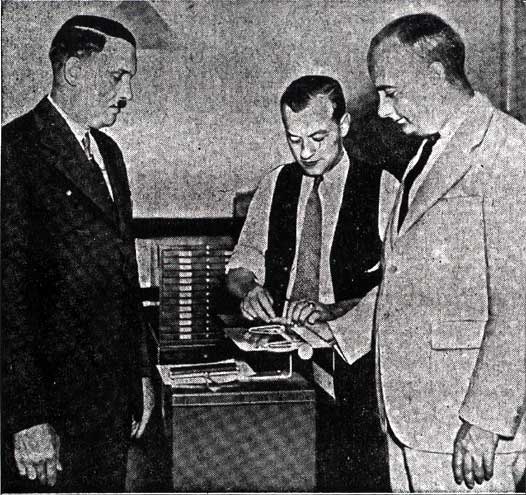
Judge Frank F. Neutze, intrigued by the system which has equipped him with more knowledge of prisoners than they wish him to possess, is fingerprinted in the bureau of identification at the Camden county jail. George Roundey, expert of the bureau, is shown making impressions of the jurist’s fingers, while Sheriff Joseph H. Van Meter is an interested onlooker.
Scene: Camden County Criminal Court. John Doe is facing the court for sentence having just been convicted for burglary.
Judge Frank F. Neutze: “Doe, you have been convicted by a jury and I will now impose sentence. Have you ever been convicted of any other crime?”
John Doe: “No, your honor, this is the first time that I have ever been in trouble.”
Judge Neutze: “I don’t believe you” (he scrutinizes several papers on the bench before him). “You became a criminal when you were 12 years old when you lived in Portland, Me. You served three terms in reformatories in Maine, Vermont, and New Hampshire. You also served two terms of five years each in Sing Sing. You did three years at Joliet. You served 18 months for burglary in California. You also served time in Wisconsin for robbery and another five year term in Texas for holdup with a revolver. You will serve from five to seven years in state prison. Next case, Mr. Prosecutor.”
(The court lays the paper aside and picks up others as the next defendant appears for sentence).
John Doe might have escaped with a lighter prison sentence had Judge Neutze not had those mysterious sheets of paper before him. The papers were given to the court 24 hours before John Doe appeared for sentence by George Roundey, chief of the bureau of identification of the Camden county jail. They contained the complete criminal record of all defendants appearing before the court should the defendant have a criminal record.
Roundey has a room in the jail that is devoted exclusively to photographic and fingerprint work. His files contain thousands of fingerprints and photographs of captured and “wanted” criminals.
Roundey is one of the busiest men in the court house. Every minute of his working day he is taking rogues gallery pictures, filing applications for revolver permits, filing fingerprints by the hundreds, received from various police departments throughout the nation.
Although Roundey’s department is small, police officials who have visited it state it to be one of the most complete they have ever seen. They marvel at the fact that it is being operated by only one man.
A Psychologist, Too
Roundey is not only a fingerprint expert but a student of psychology and human nature. On numerous occasions after police have questioned arrested criminals with no result Roundy [sic] takes them into his office to be photographed and fingerprinted and treats them like human beings and it invariably happens that Roundey [sic] suggestions to the criminal to “come clean” has resulted in defendants “copping a plea” and saving the county the expense of a trial.
“I consider the work of George Roundey, in the identification and record bureau of the county prison, to be most invaluable to my court,” Judge Neutze said. “Every defendant who appears before me has or has not a police record. If he has a record, Roundey sees that a copy of that record is in my hands when the defendant is up for trial and sentence. His co-operation with my court has been most splendid and the court feels proud to have such a young man working with it. He is always on the job and in imposing sentence I depend largely on the notations that Roundey has placed in my hands.”
Similar praise of Roundey’s works was voiced by Prosecutor Samuel P. Orlando.
Helps Reduce Crime
“The prosecutors [sic] office, before Roundey started the identification bureau, had no set way of learning the past records of persons brought into this office. Since he assumed charge of the identification bureau several years ago, his work there has been most beneficial to this office. It is to be regretted that his department is not as extensive as it should be and we all wish that the Board of Freeholders could see their way clear to appropriate more money to extend the facilities and scope of this department which to my mind has been instrumental in cutting down crime in this county,”
Sheriff Joseph H. Van Meter also was loud in his praise for the work done for the county by Roundey’s department. Van Meter said that Roundey has completed plans for a “stand-up” room in the county jail where complainants might look over defendants for identification purposes without being seen by the suspects. It is expected that this identification room will be completed in several weeks.
Roundey, found in his “workshop” filing fingerprints, reluctantly consented to an interview. He continued working as he was being asked about his work.
“Everyone arrested for an indictable offense, regardless of whether they are sentenced in police court or not, are fingerprinted and photographed,” he said.
Records Exchanged
“After we get our returns from the state and national bureaus on each subject, we contact every police department that has had anything to do with the criminal and find out from them what their charges were and also the final disposition of their case. We further check to see if that department wants the person that we have.
“After we get back all of our returns from the different departments, we make four copies of the subject’s completed record. One of these is placed in our files as a master record. The others we keep until the subject is placed on trial, and on that trial three copies are given to Mr. Brager, N. J. parole officer; the prosecutor’s office, and to Judge Neutze.
“Judge Neutze has on the bench with him on every trial day, either a clean bill of health or the criminal to write us for the final dispositions as they will appear on the returns sent out by the state and national bureaus. This alone will mean considerable saving both in time and money to our bureau in the future.
“In my spare time I have made up a small modus operandi file for the bureau. Every one who is arrested for breaking and entering, robbery, larceny of auto or any type of larceny is indexed in our files, this file shows name, description, fingerprint classification and with whom the subject associates. Any department who later makes an arrest on this man, or who suspects him on some job, can come to this bureau and get a list of the names of his pals and in that way many jobs can be cleaned up as the police know who they want from the start of the case.
List of ‘Wanted’ Persons on File
“A ‘wanted’ file is kept of everyone that is known to be wanted by the prosecutor’s office and all other departments in the county. These persons who are wanted are also posted as wanted in the state and national bureaus. They in turn notify us the minute that the wanted person is arrested by any other department in the country.
“Before this department was established, neither the prosecutor nor the judge knew the past history of record of every person who comes before him that we have had in the jail.
“We miss a few cases because the defendant is let out on bail at the hearing and is not committed to the county jail. This can only be eliminated by having a county bureau of identification and require that every person arrested for an indictable offense be brought to that bureau for fingerprinting before he or she is released in bail. Judge Neutze has worked very well with me in this respect. If he is doubtful of a person who I have not had a chance to investigate, he always sends them up to the jail for printing and defers sentence until my investigation is completed.
Every Case Studied
“Every case that goes through this bureau is followed by us until it is disposed of, either by the grand jury throwing it out or by being tried in court and found not guilty or guilty. In this way we get the final disposition of each case and forward them to the state police and Washington bureau so that the final disposition of every case handled by this bureau appears on the master records of their bureaus. This will in the future keep other departments who may arrest this subject from having any criminal who was brought to trial.
“A library of fingerprint reference books and fingerprint law is kept in the bureau, not only for the use of the department but also for the use of the prosecutor’s office should questions on these subjects arise. Considerable money was saved in the building of this department by former Sheriff Pelouze and myself. We visited several other departments and profited greatly by their experience and also by their mistakes. Total cost of the department including files, indexes, cameras, building and equiping [sic] dark room, rogues gallery, was less than $1400. Money saved by securing ruling from the postmaster general that prints are printed matter and may be sent as third class and not first is about $75.00 per year.
Urges Extension of Work
“This county needs and should have a bureau that would be open 24 hours a day. Everyone arrested should be brought to that bureau for fingerprinting so that their identification could be established before they are released in bail. In this way the prosecutor and the court would have complete records of everyone brought to trial. It would also be of use to the county probation officer in that many of his men on probation or parole are arrested in other towns and he has no way of knowing it.
“Applications for pistol permits are investigated. Five copies of prints are taken. One copy is for the police chief of the town where the applicant resides; the bureau of investigation, Washington; the N. J. state police, Trenton; the Camden county clerk, and our own bureau. The police chief must sign any application and also answer questions that appear on a sheet attached.
“All guns owned by an applicant must be brought to the bureau so that we may check the numbers and file them with the state police. An applicant must have a very good reason for carrying a pistol or the permit is denied. We have cut down on the number of permits in the county, exclusive of Camden City, as ourt [sic] total number of applicants since 1933 is only 165. As soon as a person who holds a pistol permit is adrested [sic], this bureau is notified by the state and national bureaus, we in turn advise the judge who issued that permit, of the arrest, so that he can take whatever action in the matter he cares to. No one is issued a permit without the consent of the police chief of his or her town.”