Introduction
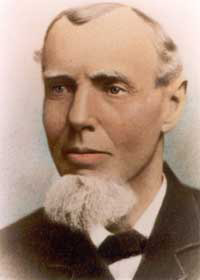
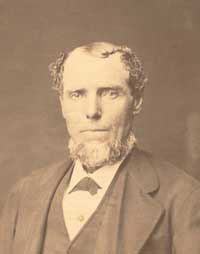
George Pfeiffer Sr.
George Pfeiffer Sr. was born Johann George Pfeiffer in the southern region of Germany known as Bavaria in 1828.
When sixteen years of age, George Pfeiffer came to seek his fortune in America, locating in Philadelphia, where he learned the baker’s trade, and worked there until the time of the Mexican War, when he enlisted in the United States Army. He served with the Pennsylvania regiment commanded by General Beauregard, of Civil War fame. At the close of the war he returned and in 1854 settled in Camden NJ, where according to the 1897 published book Biographical Revue Contaning Life Sketches of Leading Citizens of Camden and Burlington Couties, New Jersey he founded a bakery. Census records and city directories of the time indicate that George Pfeiffer was running a saloon, from the 1850s through 1880s. The discrepancy is probably attributable to the Boston-based publisher’s desire to “shine the apple,” the temperance movement then being quite strong in some quarters of the United States.
The Census for 1860 gives his occupation as restaurant keeper, those for 1870 and 1880 also reveals that he was operating a lager beer saloon in these times. The 1860 and 1870 Censuses indicate that his close neighbor was shoe merchant Anthony Kobus. The 1880 Census indicates an address of 830 South 4th Street. Son George Jr. was at this time in the beer bottling business, and living in the next block at 714 South 4th Street. This is confirmed by the many deposit bottles bearing his name still in existence today. By 1887 George Pfeiffer seems to have closed his saloon, and moved to 818 South 5th Street. The 1890–1891 City Directory places him on Market Street at 7th.
Biographical Revue states that George Pfeiffer Sr. went into the coal and lumber business in Camden, where he successfully conducted business until 1875. He then established a Coal, brick, and stone business at the corner of the Coopers Creek Bridge and Federal Street which he operated profitably until his death in 1894. His son, George Pfeiffer Jr. would operate the business several years after his father’s passing.
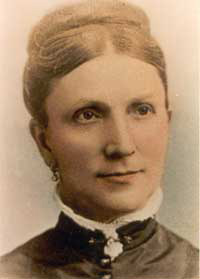
George Pfeiffer Sr. married Catherine Kuemmerer, who also had been born in Germany. They had five children, George Jr., born in 1856, Lizzie, David, Rose, and Anna. They were members of Trinity German Evangelical Lutheran Church. In 1870 the church in order to expand, purchased two lots on either side for fifteen hundred dollars. George Pfeiffer Sr. contributed one-third of the amount.
George Pfeiffer Sr. was a prominent member of several fraternal organizations, including the Masons, the Independent Order of Odd Fellows, and the Improved Order of Red Men. He was buried with Masonic honors.
Firemen Arrested for Interfering with Officer
Philadelphia Inquirer —
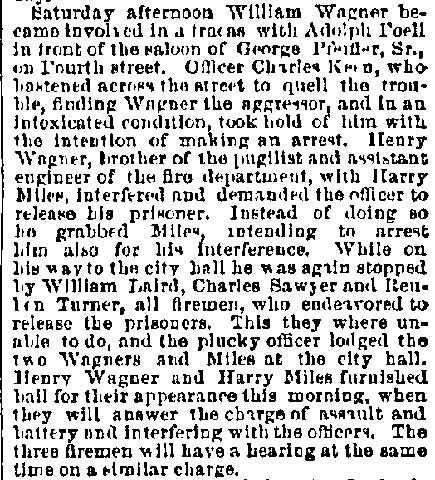
Saturday afternoon William Wagner became involved in a fracas with Adolph Poell in front of the saloon of George Pfenler, Sr., on Fourth street. Officer Charles Keen, who hastened across the street to quell the trouble, finding Wagner the aggressor, and in an intoxicated condition, took hold of him with the intention of making an arrest. Henry Wagner, brother of the pugilist and assistant engineer of the fire department, with Harry Miles, interfered and demanded the officer to release his prisoner. Instead of doing so he grabbed Miles, intending to arrest him also for his interference. While on his way to the city hall he was again stopped by William Laird, Charles Sawyer and Reuben Turner, all firemen, who endeavored to release the prisoners. This they where [sic] unable to do, and the plucky officer lodged the two Wagners and Miles at the city hall. Henry Wagner and Harry Miles furnished bail for their appearance this morning, when they will answer the charge of assault and battery and interfering with the officers. The three firemen will have a hearing at the same time on a similar charge.
The German Mass Meeting.
Camden Daily Courier —
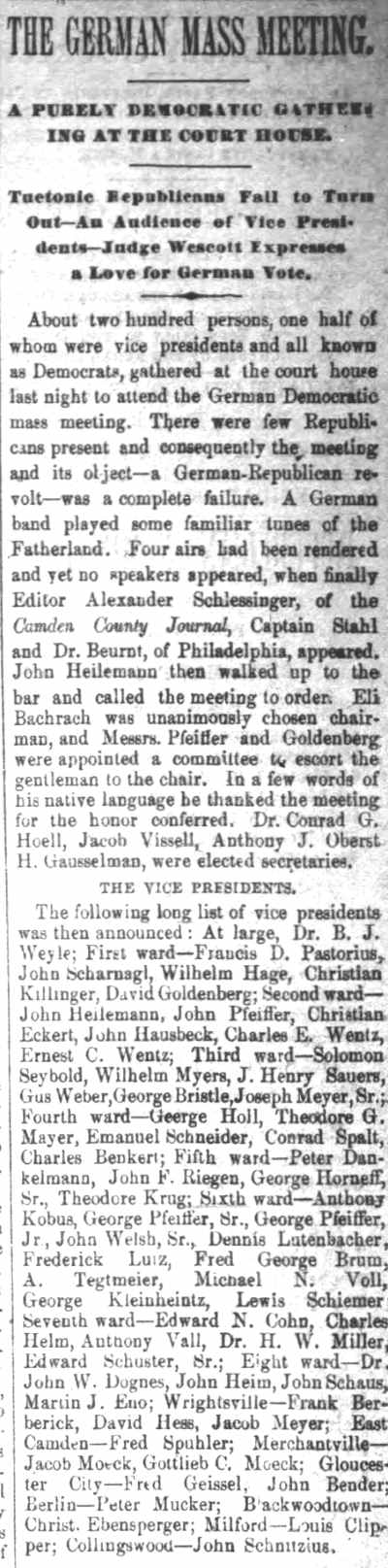
A PURELY DEMOCRATIC GATHERING AT THE COURT HOUSE.
Tuetonic [sic] Republicans Fail to Turn Out—An Audience of Vice Presidents—Judge Wescott Expresses a Love for German Vote.
About two hundred persons, one half of whom were vice presidents and all known as Democrats, gathered at the court house last night to attend the German Democratic mass meeting. There were few Republicans present and consequently the meeting and its object—a German-Republican revolt—was a complete failure. A German band played some familiar tunes of the Fatherland. Four airs had been rendered and yet no speakers appeared, when finally Editor Alexander Schlessinger, of the Camden County Journal, Captain Stahl and Dr. Beurnt, of Philadelphia, appeared. John Heilemann then walked up to the bar and called the meeting to order. Eli Bachrach was unanimously chosen chairman, and Messrs. Pfeiffer and Goldenberg were appointed a committee to escort the gentleman to the chair. In a few words of his native language he thanked the meeting for the honor conferred. Dr. Conrad G. Hoell, Jacob Vissell, Anthony J. Oberst, H. Gausselman, were elected secretaries.
THE VICE PRESIDENTS.
The following long list of vice presidents was then announced: At large, Dr. B. J. Weyle; First ward—Francis D. Pastorius, John Scharnagl, Wilhelm Hage, Christian Killinger, David Goldenberg; Second ward—John Heilemann, John Pfeiffer, Christian Eckert, John Hausbeck, Charles E. Wentz, Ernest C. Wentz; Third ward—Solomon Seybold, Wilhelm Myers, J. Henry Sauers, Gus Weber, George Bristle, Joseph Meyer, Sr.; Fourth ward—George Holl, Theodore G. Mayer, Emanuel Schneider, Conrad Spalt, Charles Benkert; Fifth ward—Peter Dankelmann, John F. Riegen, George Horneff, Sr., Theodore Krug; Sixth ward—Anthony Kobus, George Pfeiffer, Sr., George Pfeiffer, Jr., John Welsh, Sr., Dennis Lutenbacher, Frederick Lutz, Fred George Brum, A. Tegtmeier, Michael N. Voll, George Kleinheintz, Lewis Schiemer; Seventh ward—Edward N. Cohn, Charles Helm, Anthony Vall, Dr. H. W. Miller, Edward Schuster, Sr.; Eight [sic] ward—Dr. John W. Dognes, John Heim, John Schaus, Martin J. Eno; Wrightsville—Frank Berberick, David Hess, Jacob Meyer; East Camden—Fred Spuhler; Merchantville—Jacob Moeck, Gottlieb C. Moeck; Gloucester City—Fred Geissel, John Bender; Berlin—Peter Mucker; Blackwoodtown—Christ. Ebensperger; Milford—Louis Clipper; Collingswood—John Schnutzius.
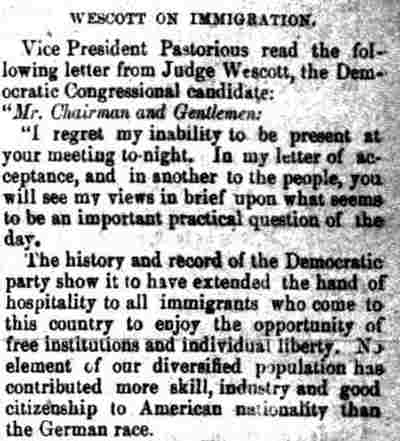
WESCOTT ON IMMIGRATION.
Vice President Pastorious read the following letter from Judge Wescott, the Democratic Congressional candidate:
“Mr. Chairman and Gentlemen:
“I regret my inability to be present at your meeting to-night. In my letter of acceptance, and in another to the people, you will see my views in brief upon what seems to be an important practical question of the day.
The history and record of the Democratic party show it to have extended the hand of hospitality to all immigrants who come to this country to enjoy the opportunity of free institutions and individual liberty. No element of our diversified population has contributed more skill, industry and good citizenship to American nationality than the German race.
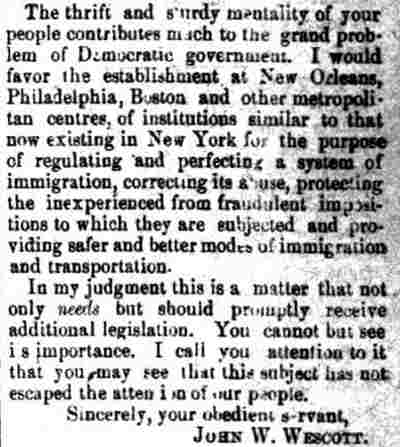
The thrift and sturdy mentality of your people contributes much to the grand problem of Democratic government. I would favor the establishment at New Orleans, Philadelphia, Boston and other metropolitan centres, of institutions similar to that now existing in New York for the purpose of regulating and perfecting a system of immigration, correcting its abuse, protecting the inexperienced from fraudulent impositions to which they are subjected and providing safer and better modes of immigration and transportation.
In my judgment this is a matter that not only needs but should promptly receive additional legislation. You cannot but see its importance. I call your attention to it that you may see that this subject has not escaped the attention of our people.
Sincerely, your obedient servant,
JOHN W. WESCOTT.
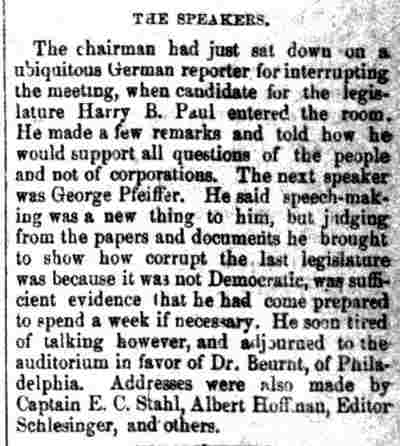
THE SPEAKERS.
The chairman had just sat down on a ubiquitous German reporter for interrupting the meeting, when candidate for the legislature Harry B. Paul entered the room. He made a few remarks and told how he would support all questions of the people and not of corporations. The next speaker was George Pfeiffer. He said speech-making was a new thing to him, but judging from the papers and documents he brought to show how corrupt the last legislature was because it was not Democratic, was sufficient evidence that he had come prepared to spend a week if necessary. He soon tired of talking however, and adjourned to the auditorium in favor of Dr. Beurnt, of Philadelphia. Addresses were also made by Captain E. C. Stahl, Albert Hoffman, Editor Schlesinger, and others.
Pfeiffer Family Plot at Harleigh Cemetery
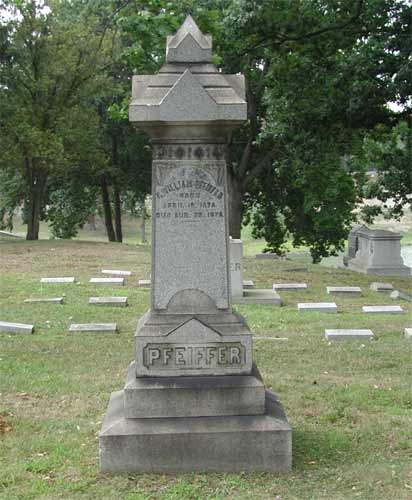
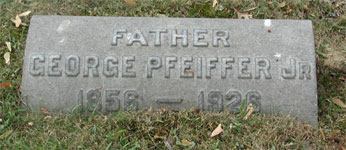
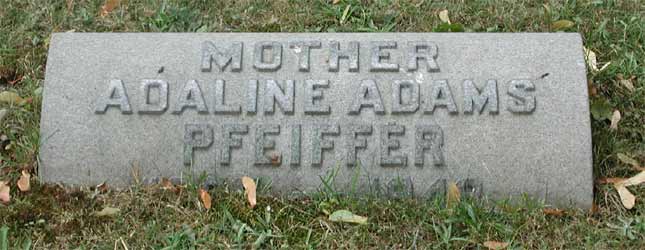
Pfeiffer family plot at Harleigh Cemetery