Francis E. Senseman
Private, U.S. Army
Service Number: 13004762
Unit: 59th Coast Artillery Regiment
Entered the service from: New Jersey
Died: December 30, 1942 — Missing in Action or Buried at Sea
Tablets of the Missing at Manila American Cemetery, Manila, Philippines
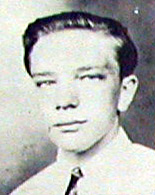
Francis E. Senseman
Private Francis Eugene Senseman was serving with the United States Army in the Philippine Islands when the Japanese attacked Pearl Harbor. He survived the brutal fighting in the Philippines until the American forces surrendered in 1942. A prisoner of the Japanese, he died in one of their prison camps on December 30, 1942.
Francis Senseman was a member of the Collingswood High School graduating class of 1943. The second son of Frederick and Alma Senseman, he had spent his early years on 5th Avenue in Runnemede, NJ, before moving to 135 Powelton Avenue, Woodlynne, NJ, sometime around 1939. His father worked in a shop as a painter, having been born in Pennsylvania. The elder Senseman later had his own painting contracting business. Alma Senseman, 23 years younger than her husband, was born in New Jersey to German immigrant parents. Francis Senseman’s uncle, W. Raphael Senseman, was well known in Camden and Collingswood as an artist. W. R. Senseman’s portrait of Lord Camden was presented to the city in 1928. In 2003 it was placed on permanent loan with the Camden County Historical Society and has been in City Hall ever since.
Francis Senseman, like so many others of his era, had left school and sought his fortune with the United States Army, enlisting on July 27, 1940. After his basic training, he was sent to Hawaii, and eventually was assigned to a Coast Artillery Regiment in the Philippine Islands. He served on Corregidor, and was taken prisoner when the island fortress fell in May 1942.
Private Senseman was reported to have died on December 30, 1942. His remains were never identified, and he was memorialized on the Tablets of the Missing at Manila American Cemetery in Manila, Philippines.
Source: American Battle Monuments Commission
Mother's Faith Rewarded; Son Held Prisoner
Camden Courier-Post —
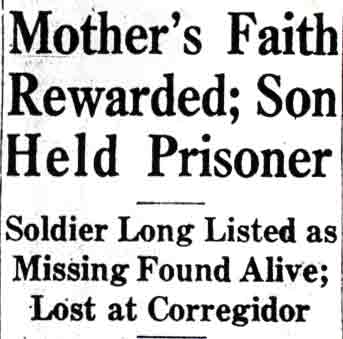
Soldier Long Listed as Missing Found Alive; Lost at Corregidor
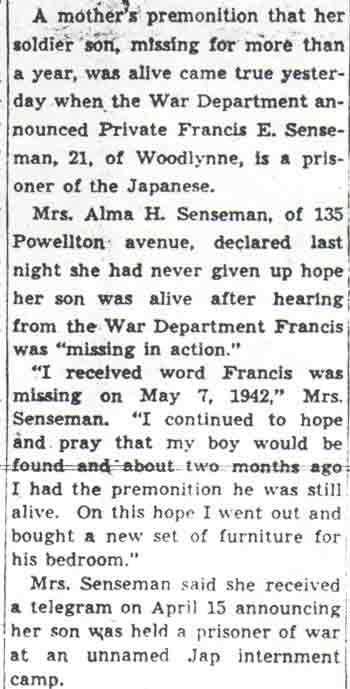
A mother’s premonition that her soldier son, missing for more than a year, was alive came true yesterday when the War Department announced Private Francis E. Senseman, 21, of Woodlynne, is a prisoner of the Japanese.
Mrs. Alma H. Senseman, of 135 Powelton avenue, declared last night she had never given up hope her son was alive after hearing from the War Department Francis was “missing in action.”
“I received word Francis was missing on May 7, 1942,” Mrs. Senseman. “I continued to hope and pray that my boy would be found and about two months ago I had the premonition he was still alive. On this hope I went out and bought a new set of furniture for his bedroom.”
Mrs. Senseman said she received a telegram on April 15 announcing her son was held a prisoner of war at an unnamed Jap internment camp.
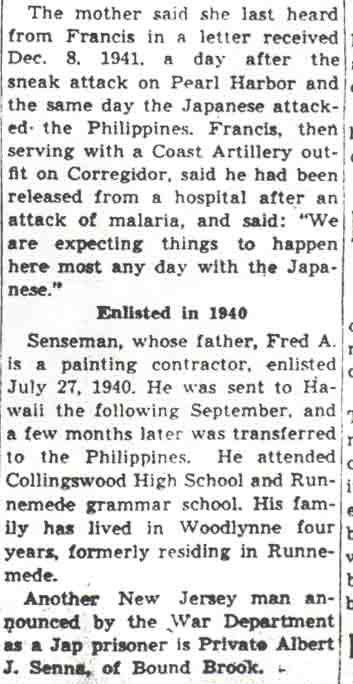
The mother said she last heard from Francis in a letter received Dec. 8, 1941, a day after the sneak attack on Pearl Harbor and the same day the Japanese attacked the Philippines. Francis, then serving with a Coast Artillery outfit on Corregidor, said he had been released from a hospital after an attack of malaria, and said: “We are expecting things to happen here most any day with the Japanese.”
Enlisted in 1940
Senseman, whose father, Fred A., is a painting contractor, enlisted July 27, 1940. He was sent to Hawaii the following September, and a few months later was transferred to the Philippines. He attended Collingswood High School and Runnemede grammar school. His family has lived in Woodlynne four years, formerly residing in Runnemede.
Another New Jersey man announced by the War Department as a Jap prisoner is Private Albert J. Senna, of Bound Brook. — Camden Courier-Post, June 3, 1944
When Alma Senseman received the telegram telling her that her son was a POW, Private Senseman had been dead for four months. On July 16, 1943, another telegram arrived, telling her that her son had died due to “illness.” Private Senseman had been dead for six months before the Japanese released information regarding his death, on July 1, 1943.
Thanks to Fred Baldassarre of “The Battling Bastards of Bataan” who supplied much of the information concerning Private Senseman’s whereabouts and the conditions he endured.
The Defense of Bataan
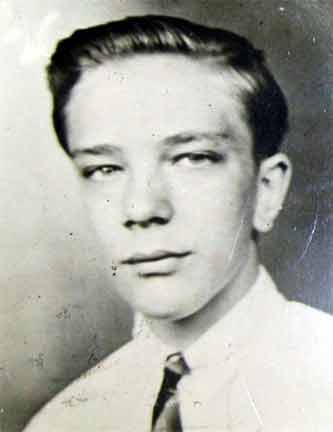
Francis E. Senseman
1. On Dec. 7, 1941, Japan attacked Pearl Harbor. The American Pacific Naval Fleet suffered heavy losses in lives and ships. The Fleet was incapacitated and could not, in that state, defend American interest in the Pacific Rim and in Asia.
2. Only eight hours later, on Dec. 8, 1941 (due to the difference in time zones), Japan launched an aerial attack on Philippines. Most of the American Air Force, in the Philippines, was destroyed, while the planes were on the ground.
3. A few days later, Japanese forces, led by Lt. Gen. Masaharu Homma, landed on the Philippines. The Japanese landings were in Northern Luzon and in the Southern Mindanao Islands.
4. Gen. Douglas MacArthur, Commander of the Filipino-American forces decided to meet the Japanese at their points of landing. This course of action deviated from the original War Plan, devised prior to WW II, which called for the American forces to withdraw into the Bataan Peninsula in case of attack.
5. Inexperienced troops failed to stop the Japanese at these points of landing. MacArthur had to revert back to the original plan, withdrawing the Filipino-American forces into the Bataan Peninsula. By the January 2, 1942, the Northern Luzon forces were in-place for the defense of Bataan.
6. Their mission, in the baseball vernacular, was to “lay down a bunt.” They were to stall the Japanese advancement, by forcing them to use much of their troops and resources in the capturing of the Philippines, for as long as possible. This would buy the necessary time needed to rebuild the American Pacific Fleet, which at the time had been crippled, by the Pearl Harbor attack and the bombing of the American Air Bases, in the Philippines.
7. The Filipino-American Defense of Bataan was hampered by many factors: a shortage of food, ammunition, medicine, and attendant materials; most of the ammunition was old and corroded; tanks, trucks, and other vehicles were in short supply; and poorly trained Filipino troops, most of who never fired a weapon, were thrown into frontline combat against highly trained Japanese veterans.
8. The Defenders of Bataan continued to hold their ground, without reinforcements and without being re-supplied. Disease, malnutrition, fatigue, and a lack of basic supplies took their toll.
9. On March 11, 1942, Gen. MacArthur was ordered to Australia; Gen. Wainwright took his place in Corregidor, as Commander of the Philippine forces, and Gen. King took Wainwright’s place, as Commander of the Fil-American forces in Bataan.
10. Around the latter part of March, Gen. King and his staff assessed the fighting capabilities of his forces, in view of an impending major assault planned by Gen. Homma. Gen. King and his staff determined the Fil-American forces, in Bataan, could only fight at 30% of their efficiency, due to malnutrition, disease, a lack of ammunition and basic supplies, and fatigue. On April 3, 1942, the Japanese launched their all out final offensive to take Bataan.
11. On 9 April 1942, Gen. King surrendered his forces on Bataan, after the Japanese had broken through the Fil-American last main line of resistance.
12. The Japanese assembled their captive Fil-American soldiers in the various sectors in Bataan, but mainly at Mariveles, the southern most tip of the Peninsula. Although American trucks were available to transport the prisoners, the Japanese decided to march the Defenders of Bataan to their destinations. This march came to be known as the “Death March.
13. The “Death March” was really a series of marches, which lasted from five to nine days. The distance a captive had to march was determined by where on the trail the captive began the march.
14. The basic trail of the “Death March” was as follows: a 55-mile march from Mariveles, Bataan, to San Fernando, Pangpanga. At San Fernando, the prisoners were placed into train-cars, made for cargo, and railed to Capas, Tarlac, a distance of around 24 miles. Dozens died standing up in the railroad cars, as the cars were so cramped that there was no room for the dead to fall. They were, then, marched another six miles to their final destination, Camp O’Donnell.
15. Several thousand men died on the “Death March.” Many died, because they were not in any physical condition to undertake such a march. Once on the march, they were not given any food or water. Japanese soldiers killed many of them through various means. Also, POWs were repeatedly beaten and treated inhumanely, as they marched.
16. Approximately 1,600 Americans died in the first forty days in Camp O’Donnell. Almost 20,000 Filipinos died in their first four months of captivity, in the same camp. The healthier prisoners took turns burying their comrades into mass graves, just as they, themselves, would be buried, days or weeks later.
17. Camp O’Donnell did not have the sanitation sub-structure or water supply necessary to hold such a large amount of men. Many died from diseases they had since Bataan. Many caught new diseases, while at the Camp. There was little medicine available to the prisoners. Their inadequate diets also contributed to the high death rate. Diseases such as dysentery, from a lack of safe drinking water, and Beri-Beri, from malnutrition were common to the POWs. The Japanese soldiers continued to murder and mistreat their captives.
18. Due to the high death rate in Camp O’Donnell, the Japanese transferred all Americans to Cabanatuan, north of Camp O’Donnell, on June 6, 1942, leaving behind five hundred as caretakers and for funeral details. They in-turn were sent to Cabanatuan on July 5, 1942. The Filipino prisoners were paroled, beginning in July 1942.
19. Cabanatuan was the camp in which the men from Corregidor were first united with the men from Bataan. No Americans from Corregidor ever made the “Death March” or were imprisoned in Camp O’Donnell. Not having suffered the extreme depravations and conditions endured by the men from Bataan, the prisoners from Corregidor were, overall, much healthier.
20. Cabanatuan, for most prisoners, ended up being a temporary camp. The Japanese had a policy (which was a direct violation of the Geneva Convention) that prisoners were to be used as a source of labor. They sent most of the prisoners, from Cabanatuan, to various other camps in the Philippines, China, Japan, and Korea, where they were used as slave labor. Some worked in mines, others in farms, others in factories, and others unloading ships in Port Areas, for the remainder of the war.
21. Left behind, in Cabanatuan, were approximately 511 officers and the prisoners too sick to move (and most of those too sick to move never recovered and died in Cabanatuan). Towards the end of the war, most of the men who stayed behind were placed on ships and sent to other camps, in Japan, Korea, and China. The Japanese did not mark these ships to note that there were prisoners on board. They were bombed and torpedoed by American planes and submarines. Most of these men died, by drowning at sea.
22. Most prisoners who left Cabanatuan in 1942, were sent to the other countries mentioned, in ships appropriately called “Hell Ships.” These “Hell Ships” sailed from Manila to their various destinations in Japan, Korea, or China. As mentioned earlier, the Japanese did not mark these ships as being prison ships, so they were targets for American planes and submarines. Thousands of Americans, who were passengers on these ships, met their deaths by drowning at sea.
23. The conditions on these ships are indescribable and far worse than the conditions endured in the “Death March” and Camp O’Donnell.
24. For the remaining three years of their captivity, the Defenders of Bataan were spread throughout the various slave labor camps in Japan, Korea, China, and the Philippines, until each camp was individually liberated, in 1945. These prisoners endured the whims of their brutal captors, with similar conditions and mistreatment as those experienced in the “Death March,” and Camp O’Donnell, and the uncertainty of when, if ever, their captivity would end.
25. Coming from the warm tropical climate of the Philippines, the men sent to Japan, Korea, and China had to adjust to the sub-freezing temperatures of Northern Asia, without the proper personal equipment and indoor heating to survive such cold temperatures. In Manchuria, China, the POWs who died in the winter were placed in an unheated shack for their bodies to freeze, because the ground was so frozen and hard that they could not be buried until the spring.
26. After they were released, these men were sent to various military hospitals for physical examinations. Many of their ailments, due to malnutrition, went undiagnosed. Many of the systemic fevers they had contracted went undiagnosed. More importantly, the psychological scars they suffered were never recognized. It was not until years after the Vietnam War that the US government recognized “Post Traumatic Stress Disorder” or PTSD as a legitimate disorder. It is safe to say, each of these men has carried these scars for the rest of their lives, and indirectly, so did their families.
27. After the war, little was made of the plight of these men. Until recently, few books were written about their ordeal. There were many reasons for this: by the time the Defenders of Bataan came home, the US had already heard a multitude of war stories about the great battles in the Pacific and in Europe. The Defenders of Bataan had surrendered. (Most Americans failed to recognize that the Defenders of Bataan were surrendered as a force, by their Commanding General. They did not surrender as individuals.)
28. After the War, Japan and the US formed an alliance to ensure their mutual economic prosperity and to ensure their mutual security. It became an unwritten policy to play down Japanese War Crimes, satisfied with the meager results produced by the Tokyo and Manila War Crimes trials.
29. Unknown to most: POWs held by the Germans died at a rate of 1.1%. POWs held by the Japanese died at a rate of 37%. The death rate amongst the Defenders of Bataan was much higher, because of their weakened condition, prior to their capture.
30. Germany has acknowledged their war crimes and has made restitution to the victims. Japan has denied everything. In their history books and in their school books, they have re-written history in an effort to falsely show they were the victims of the War, citing the atomic bombs in Hiroshima and Nagasaki, as proof of their victimization.
After the war and faced with the threat of the Soviet Union, the United States and its allies permitted Japan to escape the close scrutiny given to the Germans. Known Japanese war criminals went free to walk the streets of Japan, and the streets of the United States, as well.
— The Battling Bastards of Bataan