Warren E. Buck
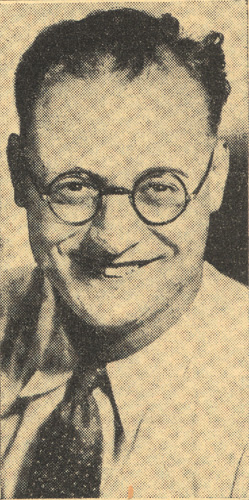
Warren E. Buck, circa 1935
WARREN E. BUCK was born in Massachusetts on August 27, 1903 to Sallie and Julius L. Buck. By the time of the 1920 Census, the Buck family, which included older brother Roy L. Buck, had moved to Camden NJ, where their address was 1902 Stockton Park, in East Camden, just south of Federal Street. The elder Buck then operated a pile driver to support his family. Julius Buck was a naturalist of sorts, and in the 1920s opened a zoo of sorts in East Camden, at 1900 Federal Street. When the Census was taken in April of 1930, Julius Buck gave his occupation as “animal collector.” Warren Buck’s occupation in the 1930 Census was “helper.” The family still lived in Stockton Park, the address however had been changed by the city to 1902 Mickle Street.
Occasionally confused with the famous animal hunter and circus exhibitor Frank Buck, of “Bring ‘Em Back Alive” fame, Warren Buck became famous in his own right as an explorer and naturalist. By August of 1935 he had already made nine trips to Africa, collecting specimens of various plants and animals. He was still operating the zoo his father had opened in East Camden on the grounds of the old Stockton Park.
In August of 1935, Warren Buck was granted a permit to operate an exhibit on a farm in Delaware Township (present-day Cherry Hill) NJ on Marlton Pike, near the site of what became Garden State Racetrack in the 1940s. He made at least one more trip to Africa, as evidenced by the postcard below, mailed from Sierra Leone.
Warren Buck remained in Delaware Township through at least 1959. By 1970 Warren Buck had moved to the Black Horse Pike at Wilson Avenue in the Grenloch section of Gloucester Township NJ. His brother Roy remained in Camden, owning a home at 28 North 30th Street until his passing in 1974.
Warren Buck passed away in November of 1985.
800 Jungle Monkeys Make New Home Here
Camden Post-Telegram —
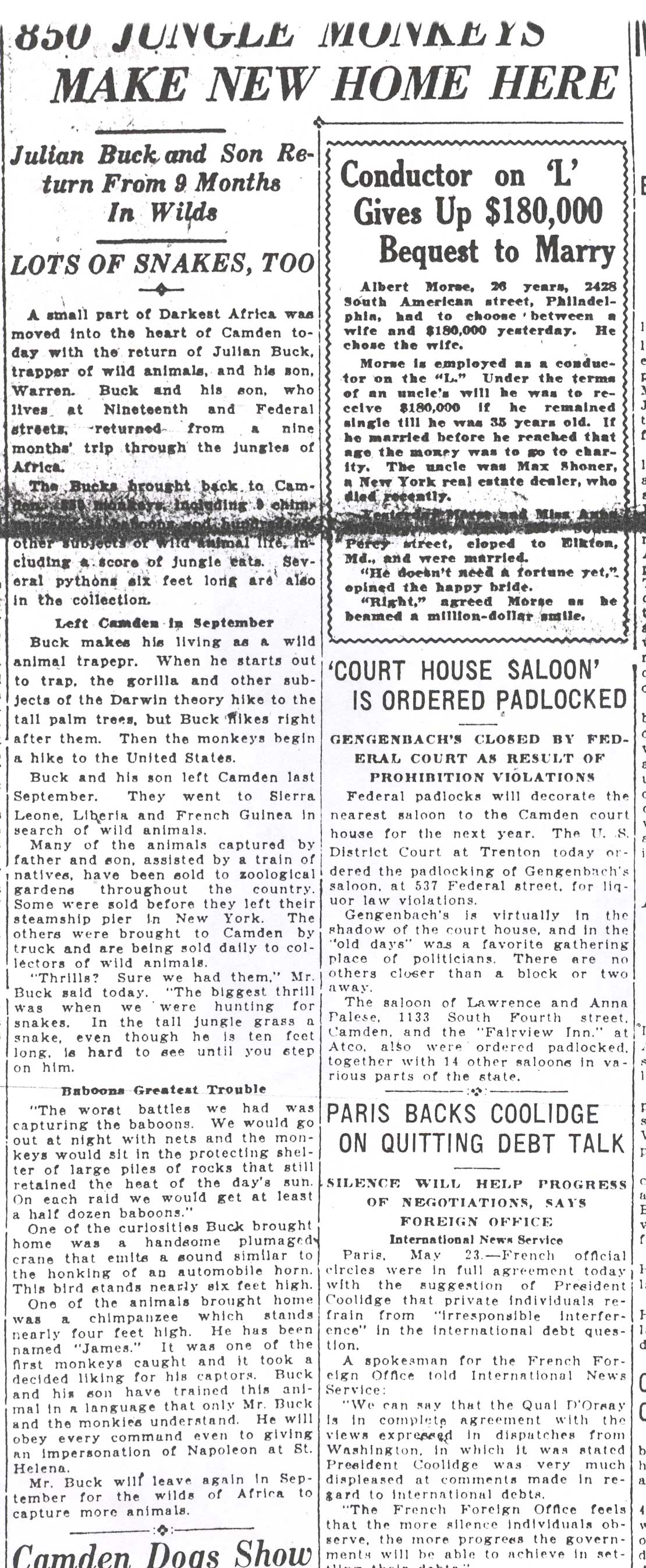
Julius Buck and Son Return From 8 Months in Wilds—Lots of Snakes, Too
A small part of Darkest Africa, with several live animals of the mysterious jungles of wild animals, and the air hot and pungent with unknown odors pervades the house through the jungle of his humble.
Julius Buck, a circus manager in September last years, with his son Warren returned from 8 months in the wilds jungles of wild animals, and the animals, through the country, from the menagerie of strange animals obtained through the country, the animals obtained.
The strangest creature in his collection is the chimpanzee, that weighs 50 pounds. Among the other rare and strange animals, are 1000 monkeys, that he brought back with him. Lions, eagles and French tickets in addition to the animals in the collection.
Besides the animals there is a scarcity on food. He has received a choice of birds and mammals. The animals are now at his home, 1900 Federal street where he expects the animals, until more suitable quarters can be found. No one has come forth yet in relation to the finding of a good home for the collection.
The word variety in all sorts of places throughout the country, but he was certain that his animals will eventually be disposed of satisfactory manner. He has sold at the foot of the Alps and has received an offer for his monkeys and other animals. The man proposed to set them in a woods coney for a public park. His monkeys and other large animals will likely to include his collection.
All arrangements have been made for the shipment of the animals, until more suitable quarters can be found.
World's Most Deadly Snakes Captured By Camden Man
Camden Post-Telegram —
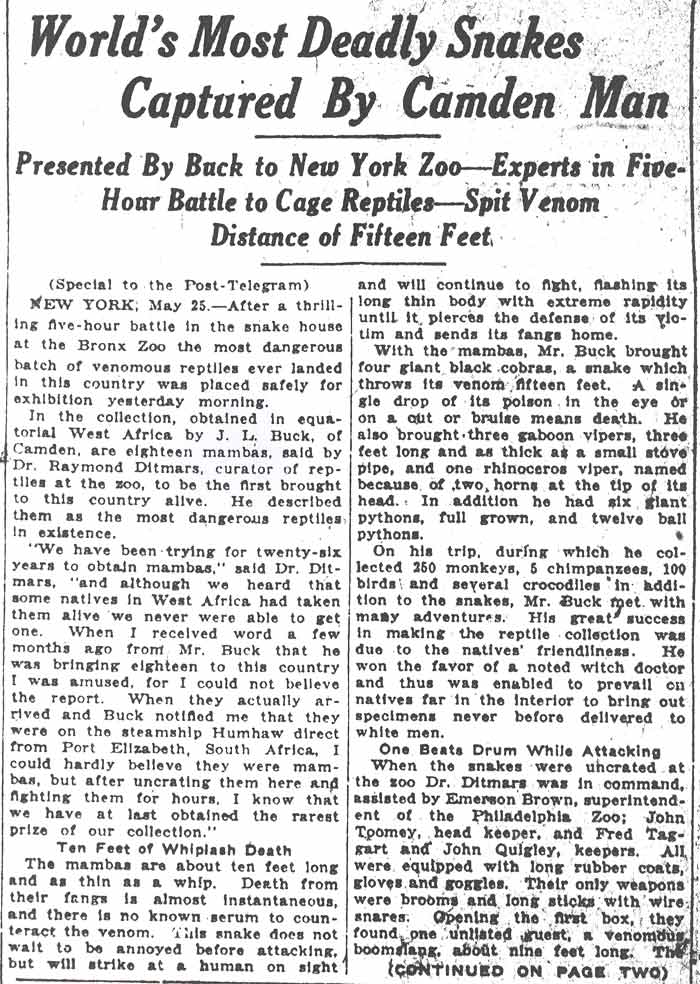
Presented By Buck to New York Zoo—Experts in Five-Hour Battle to Cage Reptiles—Spit Venom Distance of Fifteen Feet
(Special to the Post-Telegram)
NEW YORK, May 25.—After a thrilling five-hour battle in the snake house at the Bronx Zoo the most dangerous batch of venomous reptiles ever landed in this country was placed safely for exhibition yesterday morning.
In the collection, obtained in equatorial West Africa by J. L. Buck, of Camden, are eighteen mambas, said by Dr. Raymond Ditmars, curator of reptiles at the zoo, to be the first brought to this country alive. He described them as the most dangerous reptiles in existence.
“We have been trying for twenty-six years to obtain mambas,” said Dr. Ditmars, “and although we heard that some natives in West Africa had taken them alive we never were able to get one. When I received word a few months ago from Mr. Buck that he was bringing eighteen to this country I was amused, for I could not believe the report. When they actually arrived and Buck notified me that they were on the steamship Humhaw direct from Port Elizabeth, South Africa, I could hardly believe they were mambas, but after uncrating them here and fighting them for hours, I know that we have at last obtained the rarest prize of our collection.”
Ten Feet of Whiplash Death
The mambas are about ten feet long and as thin as a whip. Death from their fangs is almost instantaneous, and there is no known serum to counteract the venom. This snake does not wait to be annoyed before attacking, but will strike at a human on sight and will continue to fight, flashing its long thin body with extreme rapidity until it pierces the defense of its victim and sends its fangs home.
With the mambas, Mr. Buck brought four giant black cobras, a snake which throws its venom fifteen feet. A single drop of its poison in the eye or on a cut or bruise means death. He also brought three gaboon vipers, three feet long and as thick as a small stove pipe, and one rhinoceros viper, named because of two horns at the tip of its head. In addition he had six giant pythons, full grown, and twelve ball pythons.
On his trip, during which he collected 250 monkeys, 5 chimpanzees, 100 birds and several crocodiles in addition to the snakes, Mr. Buck met with many adventures. His great success in making the reptile collection was due to the natives’ friendliness. He won the favor of a noted witch doctor and thus was enabled to prevail on natives far in the interior to bring out specimens never before delivered to white men.
One Beats Drum While Attacking
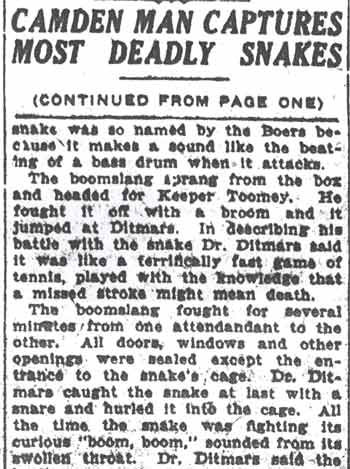
When the snakes were uncrated at the zoo Dr. Ditmars was in command, assisted by Emerson Brown, superintendent of the Philadelphia Zoo; John Toomey, head keeper, and Fred Taggart and John Quigley, keepers. All were equipped with long rubber coats, gloves and goggles. Their only weapons were brooms and long sticks with wire snares. Opening the first box, they found one uninvited guest, a venomous boomslang, about nine feet long. The snake was so named by the Boers because it makes a sound like the beating of a bass drum when it attacks. The boomslang sprang from the box and headed for Keeper Toomey. He fought it off with a broom and it jumped at Ditmars. In describing his battle with the snake Dr. Ditmars said it was like a terrifically fast game of tennis, played with the knowledge that a missed stroke might mean death.
The boomslang fought for several minutes from one attendant to the other. All doors, windows and other openings were sealed except the entrance to the snake’s cage. Dr. Ditmars caught the snake at last with a snare and hurled it into the cage. All the time the snake was fighting its curious “boom, boom,” sounded from its swollen throat. Dr. Ditmars said the battle was one of the most thrilling and unusual in his long experience in handling reptiles.
Some Play They’re Billiard Balls
For five hours the curator and his assistants fought to house the strange snakes. Every mamba fought desperately, but experiences with some of the others were amusing. The ball pythons rolled out on the floor when their case was opened. When frightened or disturbed they at once curl up and form a perfect sphere. They roll like a billiard ball when touched. After the dangerous work with the boomslang and the mambas the snake reception committee enjoyed the rolling snakes.
Dr. Ditmars said some of the snakes would be given to the Philadelphia Zoo. He said the New York Zoo had accepted the entire cargo of poisonous reptiles because it was regarded as a public service so that the reptiles were housed properly and were not a menace to others in this country.
‘Molta’ Doesn’t Yet Know World Series Is Finished
Camden Courier-Post —
So Missing Monk Perches in Delaware Township Apple Tree and Tries a ‘Lefty Grove’ On Passing Pedestrians
By ERNIE TALBOT
“Malta” is out on monkey business.
The “Molta” in question is a male member at Darwin’s theory of what man sprung from, and this time he sprung from the collection of “pets” captured by Julius L. Buck in the African jungles. Until last June, “Malta” had spent a month in “the land of the free” at his new home 1900 Federal Street, where Buck took him to add to his menagerie.
Then “Molta,” on one bright sunny morning in the month of brides, set out for the wilds. He landed in Delaware Township.
“Now, I can have peace and quiet away from those ‘elephant mosquitoes’ that fly day and night over my head,” quoth he.
For months he hunted nuts, for playmates were scarce and there were no monkeyshines to do. A happy thought came. “Mr. Molta” grinned yesterday as he jumped an apple tree in Three Oaks, near Ellisburg.
Sitting on his newly acquired branch, “Molta” looked down to see a man. “Now I can cut up a little,” said he, as his paws grabbed a couple of apples.
George Zerth, a farmer, was passing underneath the perch. “I will see if my aim is as good as it was when I left Africa last May.” “Molta” let go.
“Strike one,” said the monk. Another slow pitch from a new apple hit Zerth. He looked up to see the white teeth of the grinning pitcher and went into the “box” himself. The stone went wild and “Molta” started to run the bases (trees) and has again disappeared — probably awaiting his chance to pitch again.
Zerth reported to police, who started to piece together complaints received by them from citizens in various sections of Delaware township.
“Yes,” they said, “that is the culprit that has been squeaking and keeping our good people from their rest at nights.”
Residents of Ellisburg and other neighborhood towns have complained that “someone” was scratching on the woodwork of their windows, but could not account for an intruder.
Latest complaint lodged with the police, is that chickens have been killed, nothing remaining but bones. Search for “Molta” proceeds.
Buck Granted Use of Tract On Marlton Pike for Menagerie
Camden Courier-Post —

Educational Features of Project Stressed by Naturalist
PROTECTION SEEN IN SANITATION LAW
Warren E. Buck, noted African explorer and naturalist, has been granted permission by Delaware township officials to use a 7½-acre tract on Marlton pike near the railroad as a menagerie farm.
All township sanitation and police regulations must be fully complied with, the township’s committee ruled in favoring Buck’s request made at its meeting Monday night.
In making application, Buck stressed the educational features of the proposed farm and this was a strong factor in approval of the project, Edward R. Stroup, committee chairman, said last night.
“When Buck appeared before us he explained in detail the purposes and ideas behind the request,” Stroup explained. “There are many educational features involved which may prove advantageous, and since there were no protests, we granted permission.
“If any disadvantages from his menagerie become apparent we are fully protected by apparent sanitation and police regulations. I feel convinced, however, that there will be no difficulties.”
Buck asked that his plans not be publicized since they are only in a tentative stage.
Yesterday the widely-known collector spent his thirty-third birthday quietly at work in his local headquarters in old Stockton Park, Nineteenth and Federal streets.
He is now engaged in preparing an exhibit of African curios for the Chicago Hobby Show November 5 to 9. In the course of nine trips to Africa Buck has collected a vast assortment of native handiwork in addition to his menagerie of monkeys, reptiles and insects.
School Pupils Visit Marlton Pike Zoo
Camden Courier-Post —
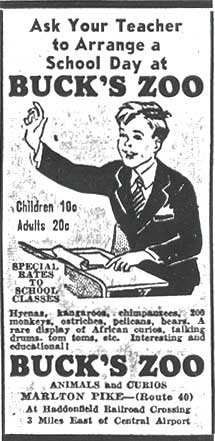
SCHOOL PUPILS VISIT MARLTON PIKE ZOO
Children of Delaware township schools are studying animal life, and African tribal home life and trading methods at first hand this week. Officials of the school decided that the pupils should have an opportunity to visit the Warren Buck Zoo and African curio display before Buck sailed for Africa.
Buck reports that following an article in the Courier-Post last week and a small announcement in the advertising columns, he has had requests for rates for school groups, besides having hundreds of individual visitors, both children and adults to visit the animals, monkeys and curios at his Marlton pike zoo.
Sierra Leone Postcard — February 12, 1937
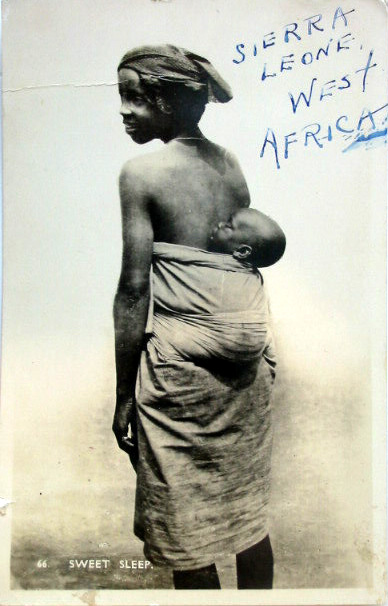
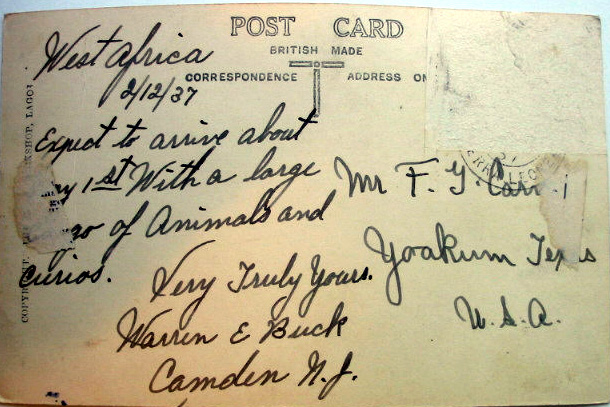
Warren Buck mailed this postcard from Sierra Leone in Africa on February 12, 1937
Dallas Morning News — March 10, 1938
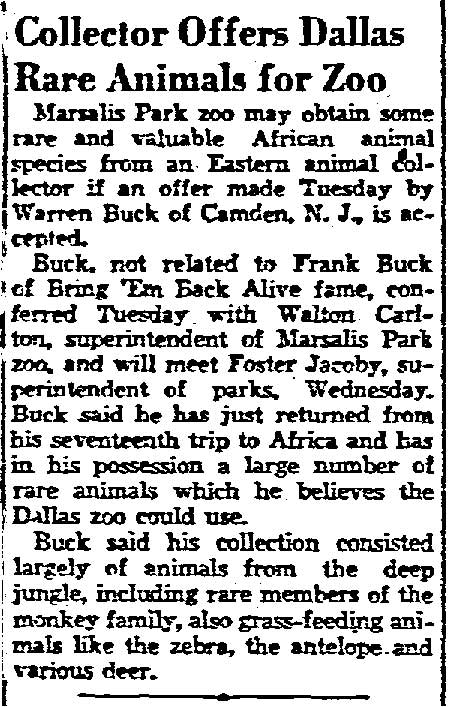
Dallas Morning News — Click image for PDF
Ships Are Stricken In Atlantic’s Wild Storm
Trenton Times —
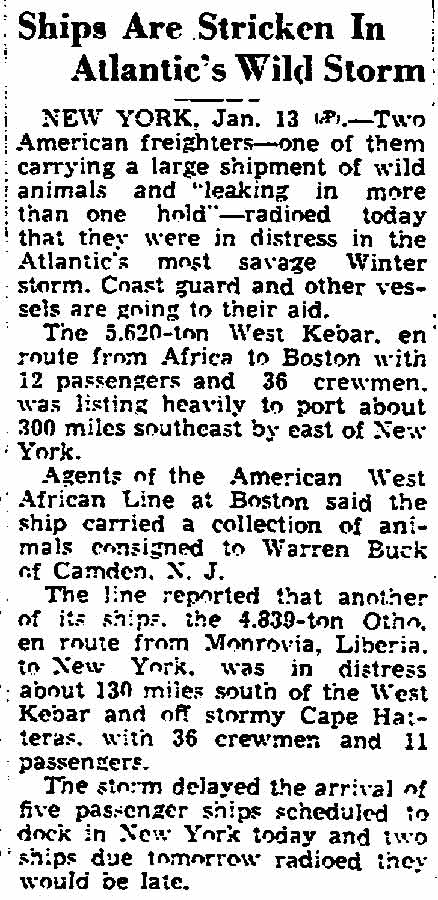
NEW YORK, Jan. 13 (P).—Two American freighters—one of them carrying a large shipment of wild animals and “leaking in more than one hold”—radioed today that they were in distress in the Atlantic’s most savage Winter storm. Coast guard and other vessels are going to their aid.
The 5,620-ton West Kebar, en route from Africa to Boston with 12 passengers and 36 crewmen, was listing heavily to port about 300 miles southeast by east of New York.
Agents of the American West African Line at Boston said the ship carried a collection of animals consigned to Warren Buck of Camden, N. J.
The line reported that another of its ships, the 4,839-ton Otho, en route from Monrovia, Liberia, to New York, was in distress about 130 miles south of the West Kebar and off stormy Cape Hatteras, with 36 crewmen and 11 passengers.
The storm delayed the arrival of five passenger ships scheduled to dock in New York today and two ships due tomorrow radioed they would be late.
Billboard Magazine — July 9, 1942
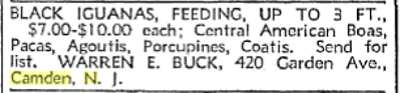
Ron Babli Remembers Warren Buck
When I was a kid probably around the age of 7 or 8, I went to Warren’s house with my parents and I remember his house being on State Street. If you were on State Street heading towards Federal Street his house was on the left just before the ramp that crossed over the railroad tracks. I checked Google maps and it appears that the house is no longer there.
Back in the 60’s Warren would bring animals to a place in Pine Hill called Mike’s Little Zoo which is where Trump’s Pine Hill Golf Course is now, off of a road called Little Mill Rd. My father and Mike were childhood buddies and I actually called him uncle Mike. We would spend every Saturday at the zoo helping with the animals and the property upkeep. Mike had one arm and besides caring for the animals he also was a bartender at a bar called 5 Points Café in Pine Hill. So as a kid growing up around so many different animals was a time I will always cherish.
Attached is picture of Warren with one of his tiger’s named Delhi which was “cross eyed” and another picture of yours truly, when I was about 10 years old, with Delhi when she was a cub.
Ron Babli, January 24, 2014
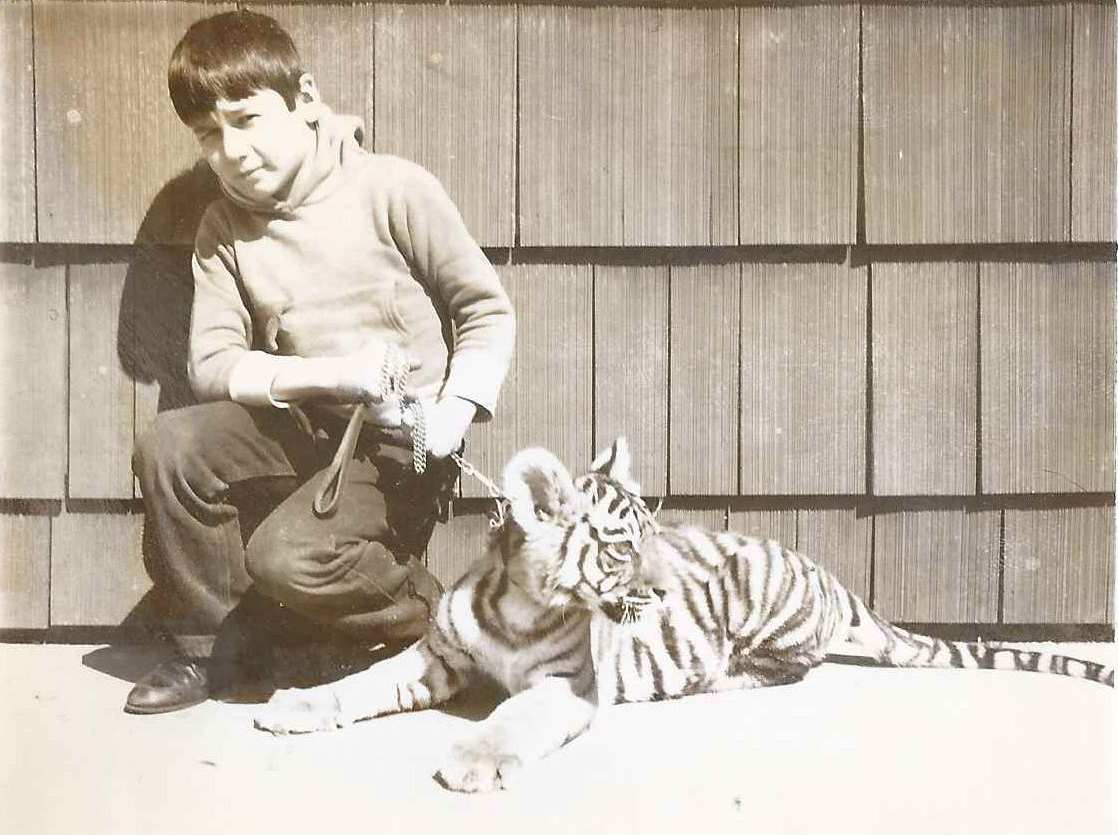
Ron Babli with Delhi
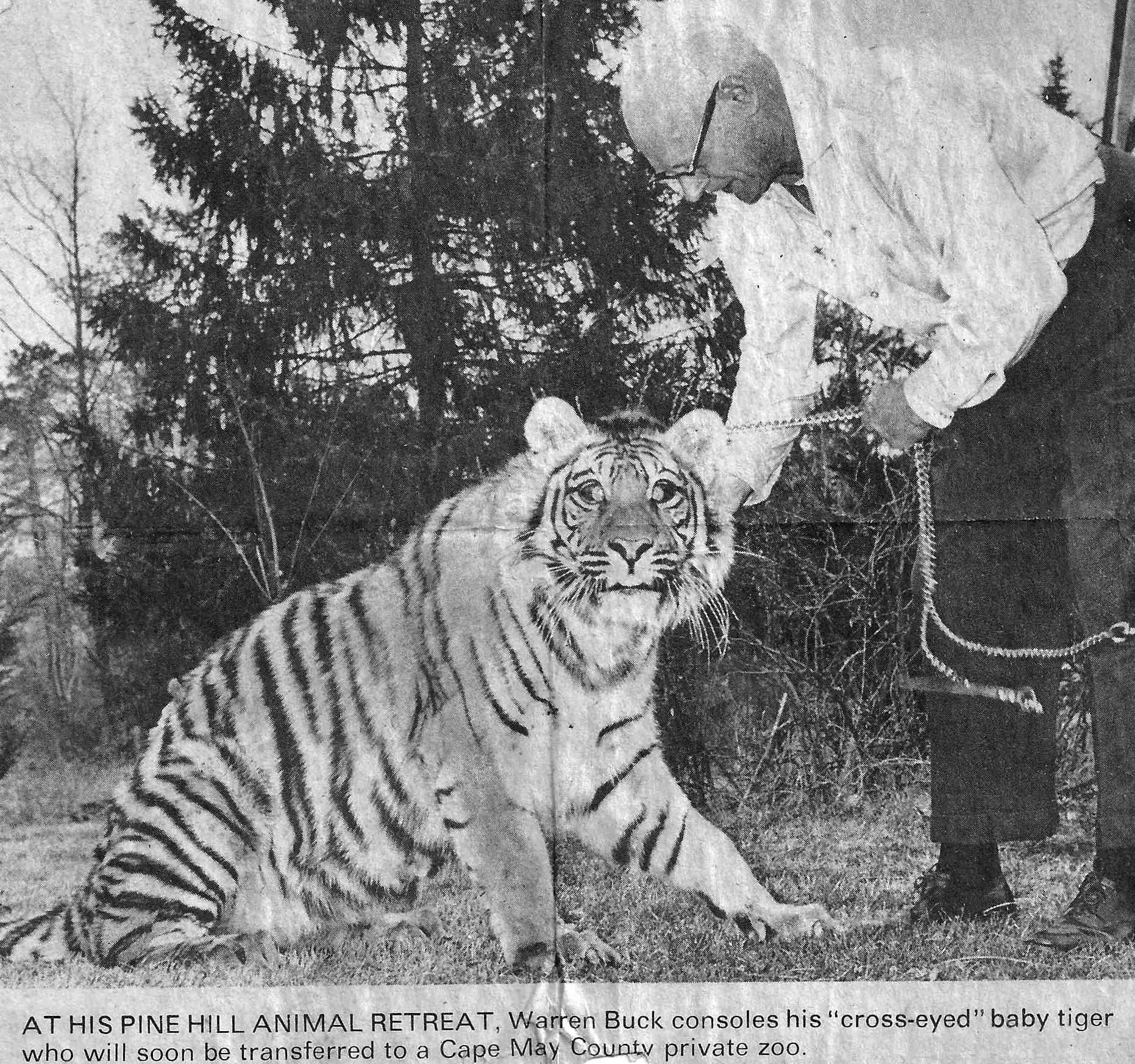
Warren Buck with Delhi
Jersey’s Animal ‘Impressario’ Holds the Wild Kingdom at Bay
Catholic Star-Herald
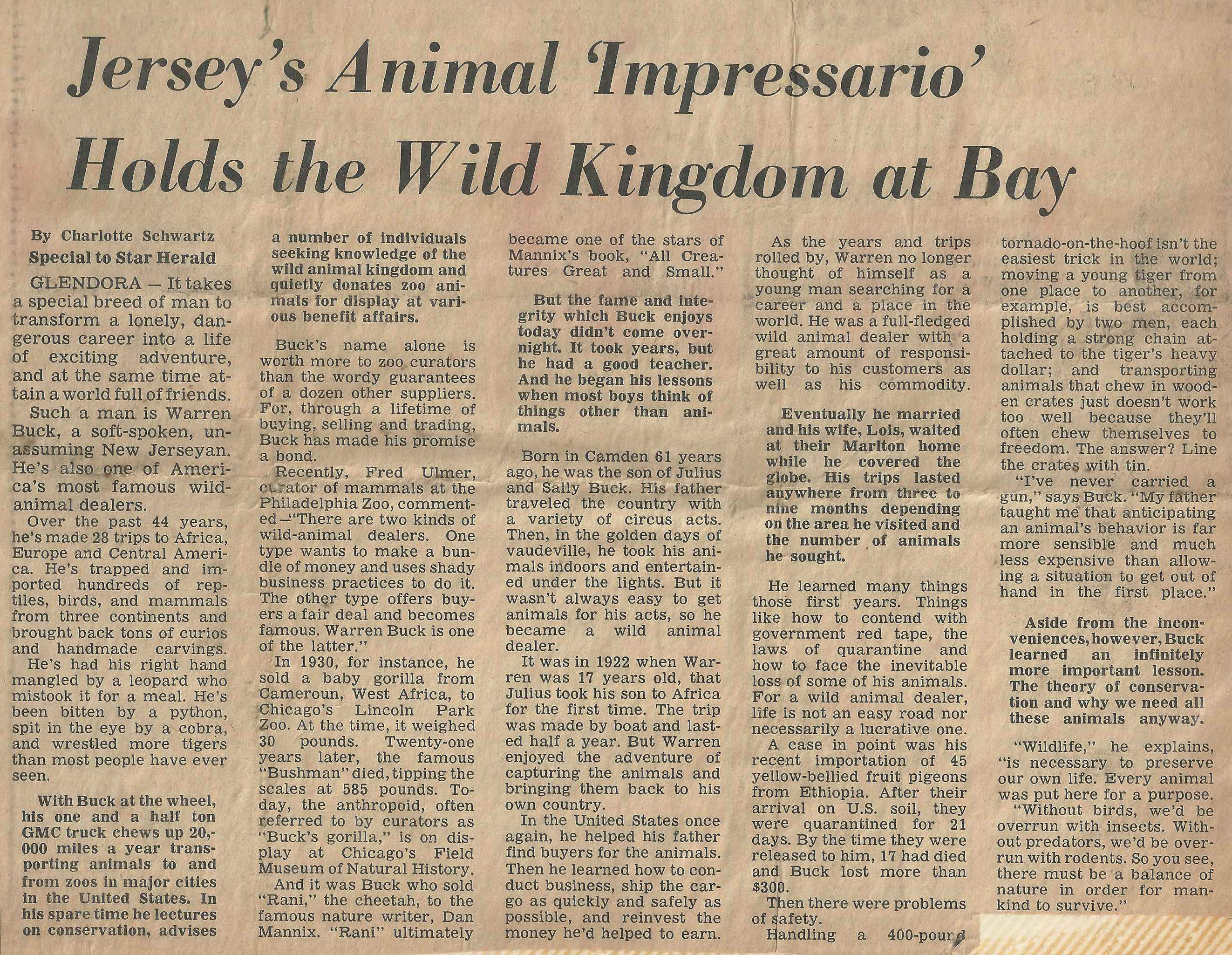
By Charlotte Schwartz, Special to Star Herald
GLENDORA — It takes a special breed of man to transform a lonely, dangerous career into a life of exciting adventure, and at the same time attain a world full of friends.
Such a man is Warren Buck, a soft-spoken, unassuming New Jerseyan. He’s also one of America’s most famous wild animal dealers.
Over the past 44 years, he’s made 28 trips to Africa, Europe and Central America. He’s trapped and imported hundreds of reptiles, birds, and mammals from three continents and brought back tons of curios and handmade carvings.
He’s had his right hand mangled by a leopard who mistook it for a meal. He’s been bitten by a python, spit in the eye by a cobra, and wrestled more tigers than most people have ever seen.
With Buck at the wheel, his one and a half ton GMC truck chews up 20,000 miles a year transporting animals to and from zoos in major cities in the United States. In his spare time he lectures on conservation, advises a number of individuals seeking knowledge of the wild animal kingdom and quietly donates zoo animals for display at various benefit affairs.
Buck’s name alone is worth more to zoo curators than the wordy guarantees of a dozen other suppliers. For, through a lifetime of buying, selling and trading, Buck has made his promise a bond.
Recently, Fred Ulmer, curator of mammals at the Philadelphia Zoo, commented “There are two kinds of wild-animal dealers. One type wants to make a bundle of money and uses shady business practices to do it. The other type offers buyers a fair deal and becomes famous. Warren Buck is one of the latter.”
In 1930, for instance, he sold a baby gorilla from Cameroun, West Africa, to Chicago’s Lincoln Park Zoo. At the time, it weighed 30 pounds. Twenty-one years later, the famous “Bushman” died, tipping the scales at 585 pounds. Today, the anthropoid, often referred to by curators as “Buck’s gorilla,” is on display at Chicago’s Field Museum of Natural History.
And it was Buck who sold “Rani,” the cheetah, to the famous nature writer, Dan Mannix. “Rani” ultimately became one of the stars of Mannix’s book, “All Creatures Great and Small.”
But the fame and integrity which Buck enjoys today didn’t come overnight. It took years, but he had a good teacher. And he began his lessons when most boys think of things other than animals.
Born in Camden 61 years ago, he was the son of Julius and Sally Buck. His father traveled the country with a variety of circus acts. Then, in the golden days of vaudeville, he took his animals indoors and entertained under the lights. But it wasn’t always easy to get animals for his acts, so he became a wild animal dealer.
It was in 1922 when Warren was 17 years old, that Julius took his son to Africa for the first time. The trip was made by boat and lasted half a year. But Warren enjoyed the adventure of capturing the animals and bringing them back to his own country.
In the United States once again, he helped his father find buyers for the animals. Then he learned how to conduct business, ship the cargo as quickly and safely as possible, and reinvest the money he’d helped to earn.
As the years and trips rolled by, Warren no longer thought of himself as a young man searching for a career and a place in the world. He was a full-fledged wild animal dealer with a great amount of responsibility to his customers as well as his commodity.
Eventually he married and his wife, Lois, waited at their Marlton home while he covered the globe. His trips lasted anywhere from three to nine months depending on the area he visited and the number of animals he sought.
He learned many things those first years. Things like how to contend with government red tape, the laws of quarantine and how to face the inevitable loss of some of his animals. For a wild animal dealer, life is not an easy road nor necessarily a lucrative one.
A case in point was his recent importation of 45 yellow-bellied fruit pigeons from Ethiopia. After their arrival on U.S. soil, they were quarantined for 21 days. By the time they were released to him, 17 had died and Buck lost more than $300.
Then there were problems of safety.
Handling a 400-pound tornado-on-the-hoof isn’t the easiest trick in the world; moving a young tiger from one place to another, for example, is best accomplished by two men, each holding a strong chain attached to the tiger’s heavy collar; and transporting animals that chew in wooden crates just doesn’t work too well because they’ll often chew themselves to freedom. The answer? Line the crates with tin.
“I’ve never carried a gun,” says Buck. “My father taught me that anticipating an animal’s behavior is far more sensible and much less expensive than allowing a situation to get out of hand in the first place.”
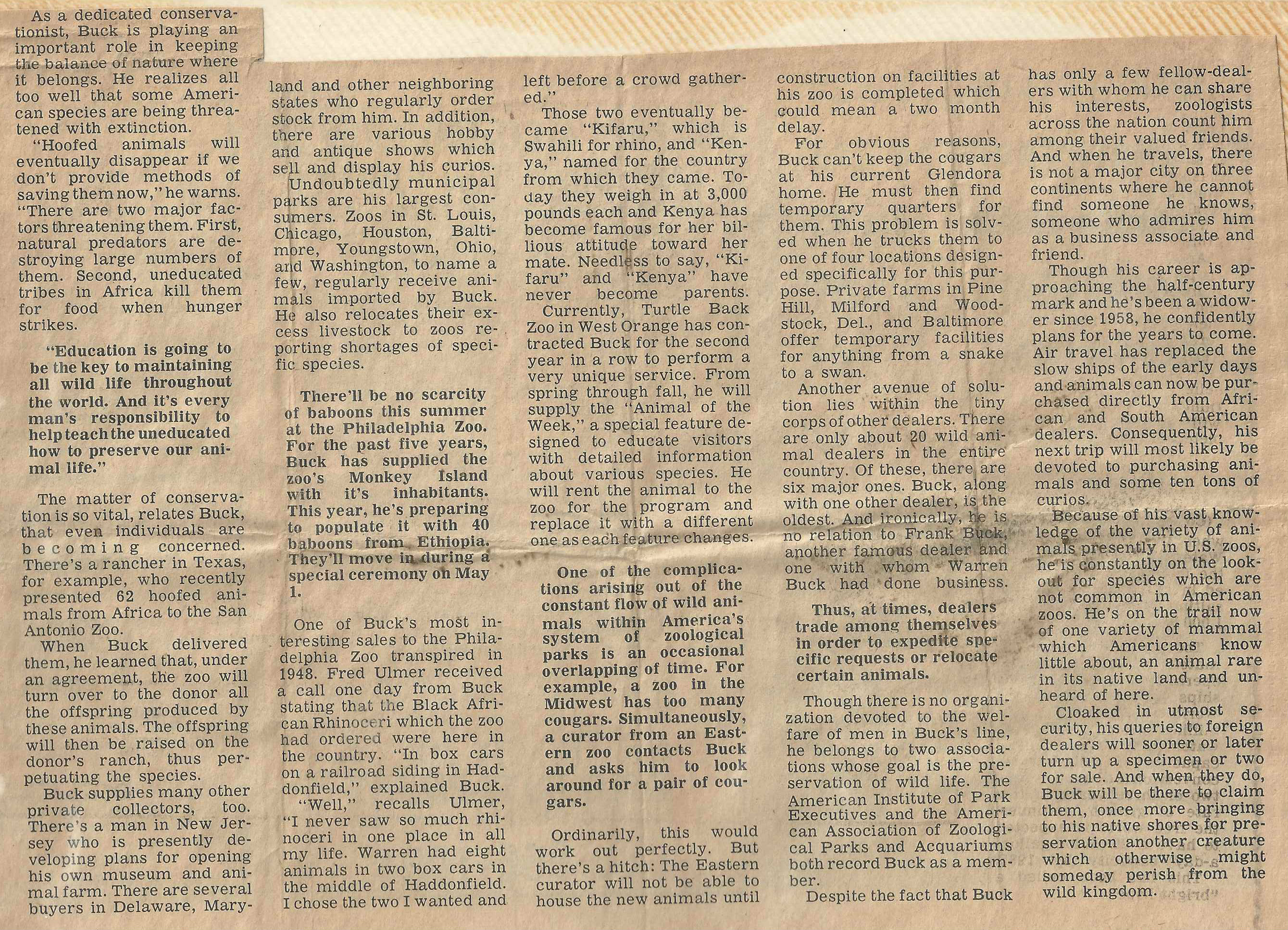
Aside from the inconveniences, however, Buck learned an infinitely more important lesson. The theory of conservation and why we need all these animals anyway.
“Wildlife,” he explains, “is necessary to preserve our own life. Every animal was put here for a purpose.
“Without birds, we’d be overrun with insects. Without predators, we’d be overrun with rodents. So you see, there must be a balance of nature in order for mankind to survive.”
As a dedicated conservationist, Buck is playing an important role in keeping the balance of nature where it belongs. He realizes all too well that some American species are being threatened with extinction.
“Hoofed animals will eventually disappear if we don’t provide methods of saving them now,” he warns. “There are two major factors threatening them.
First, natural predators are destroying large numbers of them. Second, uneducated tribes in Africa kill them for food when hunger strikes.
“Education is going to be the key to maintaining all wild life throughout the world. And it’s every man’s responsibility to help teach the uneducated how to preserve our animal life.”
The matter of conservation is so vital, relates Buck, that even individuals are becoming concerned. There’s a rancher in Texas, for example, who recently presented 62 hoofed animals from Africa to the San Antonio Zoo.
When Buck delivered them, he learned that, under an agreement, the zoo will turn over to the donor all the offspring produced by these animals. The offspring will then be raised on the donor’s ranch, thus perpetuating the species.
Buck supplies many other private collectors, too. There’s a man in New Jersey who is presently developing plans for opening his own museum and animal farm. There are several buyers in Delaware, Maryland and other neighboring states who regularly order stock from him. In addition, there are various hobby and antique shows which sell and display his curios.
Undoubtedly municipal parks are his largest consumers. Zoos in St. Louis, Chicago, Houston, Baltimore, Youngstown, Ohio, and Washington, to name a few, regularly receive animals imported by Buck. He also relocates their excess livestock to zoos reporting shortages of specific species.
There’ll be no scarcity of baboons this summer at the Philadelphia Zoo. For the past five years, Buck has supplied the zoo’s Monkey Island with its inhabitants. This year, he’s preparing to populate it with 40 baboons from Ethiopia. They’ll be moved during a special ceremony on May 1.
One of Buck’s most interesting sales to the Philadelphia Zoo transpired in 1948. Fred Ulmer received a call one day from Buck stating that the Black African Rhinoceri which the zoo had ordered were here in the country. “In box cars on a railroad siding in Haddonfield,” explained Buck.
“Well,” recalls Ulmer, “I never saw so much rhinoceri in one place in all my life. Warren had eight animals in two box cars in the middle of Haddonfield. I chose the two I wanted and left before a crowd gathered.”
Those two eventually became “Kifaru,” which is Swahili for rhino, and “Kenya,” named for the country from which they came. Today they weigh in at 3,000 pounds each and Kenya has become famous for her billious attitude toward her mate. Needless to say, “Kifaru” and “Kenya” have never become parents.
Currently, Turtle Back Zoo in West Orange has contracted Buck for the second year in a row to perform a very unique service. From spring through fall, he will supply the “Animal of the Week,” a special feature designed to educate visitors with detailed information about various species. He will rent the animal to the zoo for the program and replace it with a different one as each feature changes.
One of the complications arising out of the constant flow of wild animals within America’s system of zoological parks is an occasional overlapping of time. For example, a zoo in the Midwest has too many cougars. Simultaneously, a curator from an Eastern zoo contacts Buck and asks him to look around for a pair of cougars.
Ordinarily, this would work out perfectly. But there’s a hitch: The Eastern curator will not be able to house the new animals until construction on facilities at his zoo is completed which could mean a two month delay.
For obvious reasons, Buck can’t keep the cougars at his current Glendora home. He must then find temporary quarters for them. This problem is solved when he trucks them to one of four locations designed specifically for this purpose. Private farms in Pine Hill, Milford and Woodstock, Del., and Baltimore offer temporary facilities for anything from a snake to a swan.
Another avenue of solution lies within the tiny corps of other dealers. There are only about 40 wild animal dealers in the entire country. Of these, there are six major ones. Buck, along with one other dealer, is the oldest. And ironically, he is no relation to Frank Buck, another famous dealer and one with whom Warren Buck had done business.
Thus, at times, dealers trade among themselves in order to expedite specific requests or relocate certain animals.
Though there is no organization devoted to the welfare of men in Buck’s line, he belongs to two associations whose goal is the preservation of wild life. The American Institute of Park Executives and the American Association of Zoological Parks and Aquariums both record Buck as a member.
Despite the fact that Buck has only a few fellow-dealers with whom he can share his interests, zoologists across the nation count him among their valued friends. And when he travels, there is not a major city on three continents where he cannot find someone he knows, someone who admires him as a business associate and friend.
Though his career is approaching the half-century mark and he’s been a widower since 1958, he confidently plans for the years to come. Air travel has replaced the slow ships of the early days and animals can now be purchased directly from African and South American dealers. Consequently, his next trip will most likely be devoted to purchasing animals and some ten tons of curios.
Because of his vast knowledge of the variety of animals presently in U.S. zoos, he is constantly on the lookout for species which are not common in American zoos. He’s on the trail now of one variety of mammal which Americans know little about, an animal rare in its native land and unheard of here.
Cloaked in utmost security, his queries to foreign dealers will sooner or later turn up a specimen or two for sale. And when they do, Buck will be there to claim them, once more bringing to his native shores for preservation another creature which otherwise might someday vanish from the wild kingdom.
Warren Buck at Home in Glendora
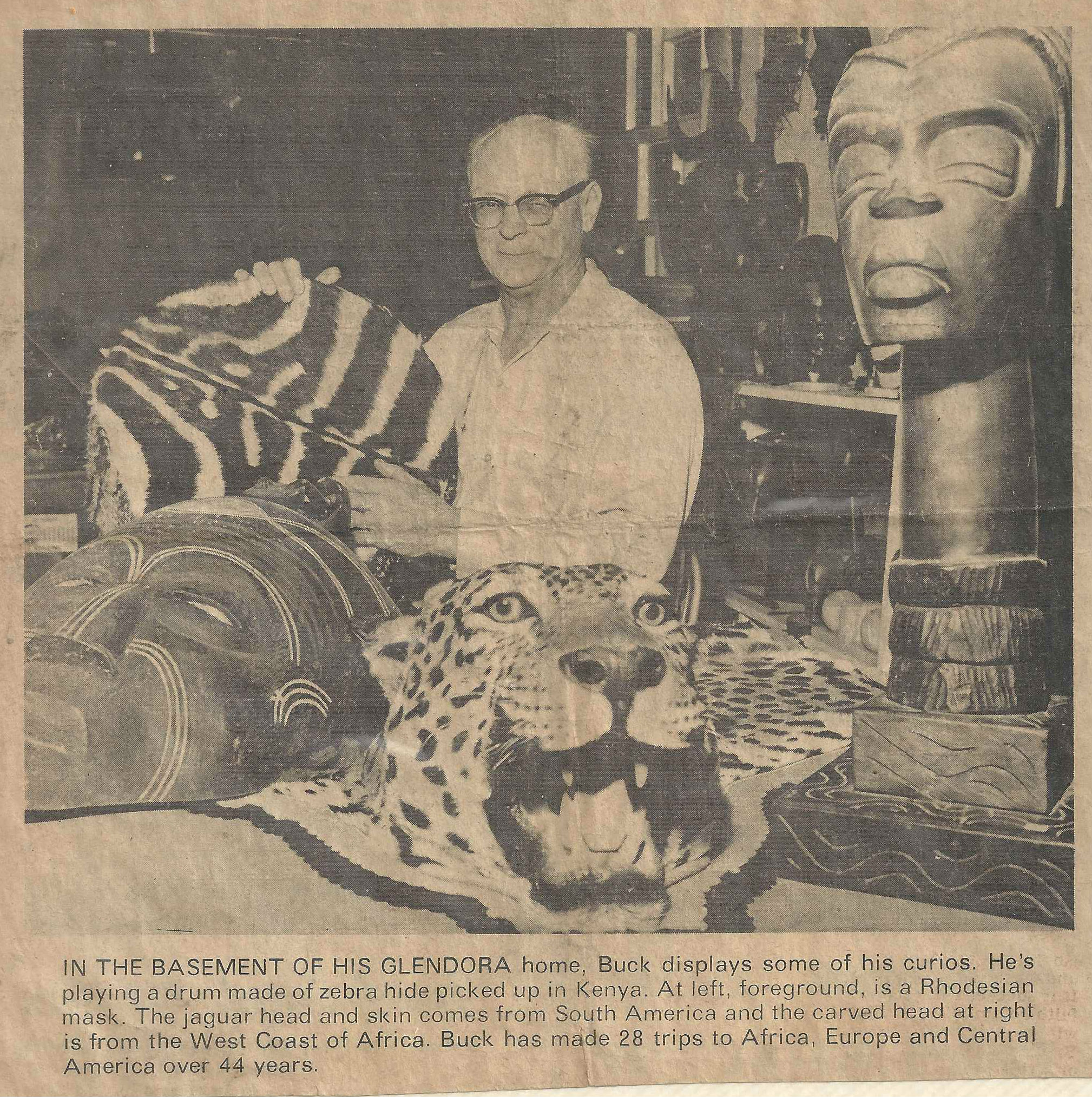
Warren Buck at home in Glendora
Warren Buck and his animal show in East Camden are fondly remembered by John M. Connor, who saw them as a boy at the old Stockton Park.