William A. Hopkins
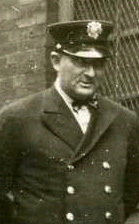
William A. Hopkins, November 5, 1935
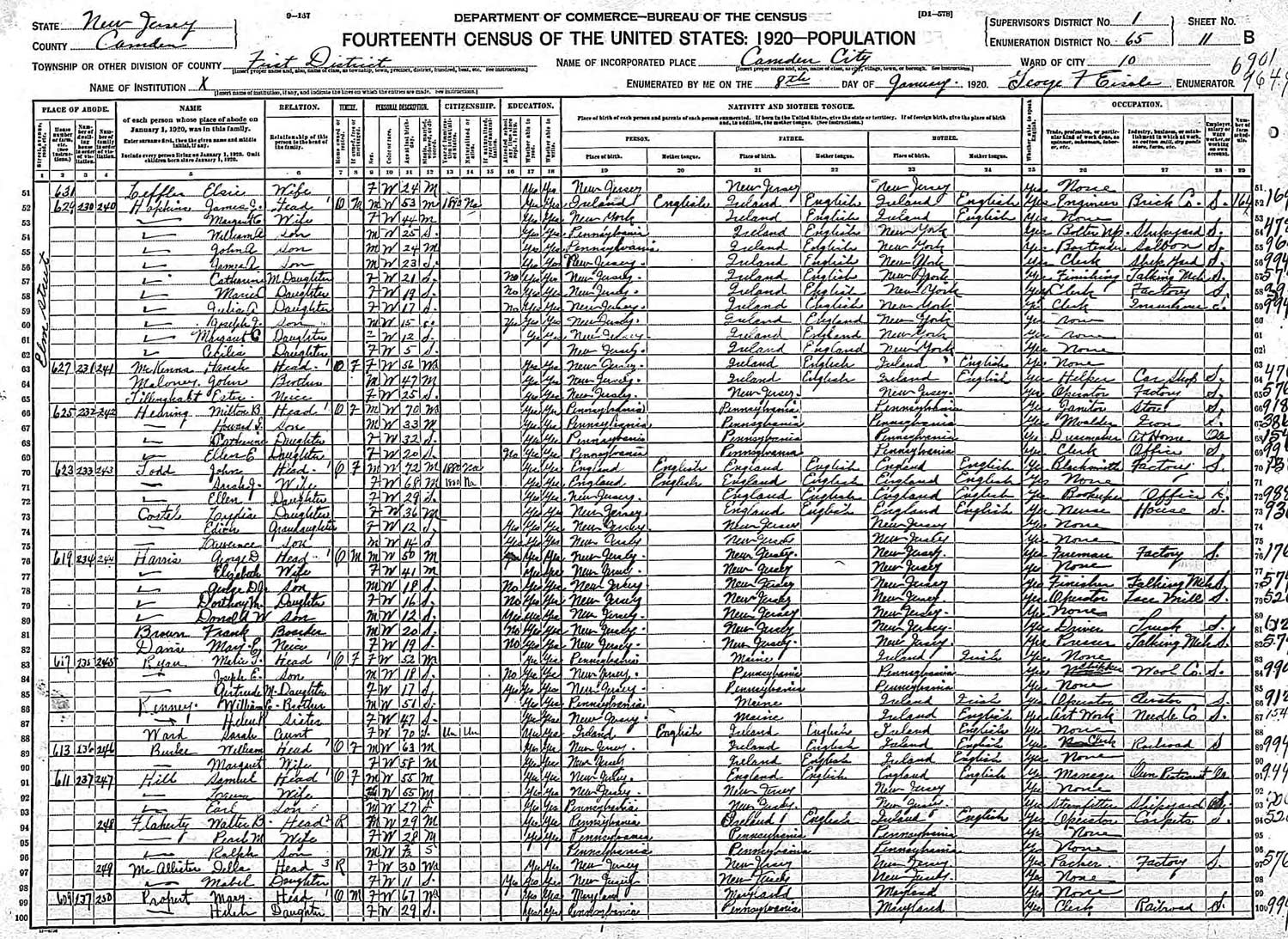
WILLIAM A. HOPKINS was born in Philadelphia on August 23, 1894 to James and Margaret Hopkins, one of at least nine children born to the Hopkins. His family moved to Camden around 1896. They were living at 425 Erie Street when the 1900 Census was enumerated. The 1906 Camden City Directory shows the family at 629 Elm Street. Members of the Hopkins family were still living at 629 Elm Street as late as the fall of 1959.
William Hopkins served in the military during World War I. He returned to the family home on Elm Street in time for the January 1920 Census. William Hopkins married and joined the Fire Department not long after the 1920 Census was enumerated. The 1924 Camden City Directory shows him living at 566 Carman Street. By 1927 he had moved to 581 Carman Street, but returned to 566 Carman Street by 1929. The 1930 census shows the family, which included son William and daughter Mary, at 520 Grant Street in North Camden. By 1931 he had moved to 729 Cedar Street.
William Hopkins was injured while fighting the fire that destroyed the C.B. Coles lumber yard at the foot of Mechanic Street on July 10, 1933.
On April 3rd, 1942 units of the Camden Fire Department’s First Battalion were responding to an alarm at Point and Erie Streets, North Camden. A group of children were on their way to a birthday party for nine-year-old, Betty Mogck. The group of excited birthday celebrants, hearing the fire engines coming, ran into the street to see where they were going. As Engine Company 2 was making the turn at Erie Street, the Chauffeur, Fireman Harry Kleinfelder pulled hard on the wheel to avoid running over the children but not before striking little Betty Mogck. The apparatus swerved to the side of the street, sheared off a utility pole and came to rest on the pavement. Two members were hurled to the ground, slightly injured. Betty’s older brother, John, was down the block talking with friends and came running up the street. Betty Mogck was rushed to Cooper Hospital suffering from a broken leg. Firemen William Hopkins and Harry Haines were treated for bruises and released. Years later, Betty’s brother, John J. Mogck Jr. joined the fire department.
William Hopkins was still on active duty with the fire department in 1947. The 1947 City Directory gives his address as 615 Elm Street.
On December 30, 1955, William Hopkins’ son William J. Hopkins was appointed to the Camden Fire Department. He reported for duty with Ladder Company 1 on January 1, 1956, and served the city for over 25 years.
Hook & Ladder Company 3, Hose & Chemical Company 1 & Engine Company 9 — 1924
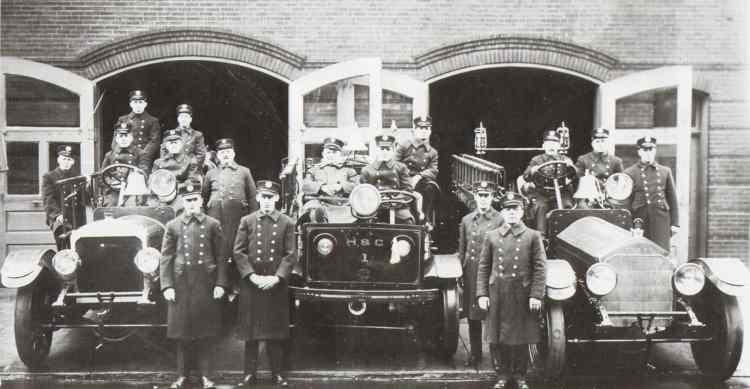
Hook & Ladder Company 3: Captain Joseph B. Ayres, FF Dave Humphries, Al Dukes, John Mulligan, Bill Mountney, Bill Hopkins. Hose & Chemical Company 1: Captain Charles H. Robinson, FF William E “Pud” Jaeckel, George Townsend, Ken Naylor, Howard Gick. Engine Company 9: Captain John H. Vickers, FF Irv Lederman, Newton Ash, Joe Gentlesk, Al Palmer
C. B. Coles Mill Damaged and 7 Houses Burn
Camden Courier-Post —

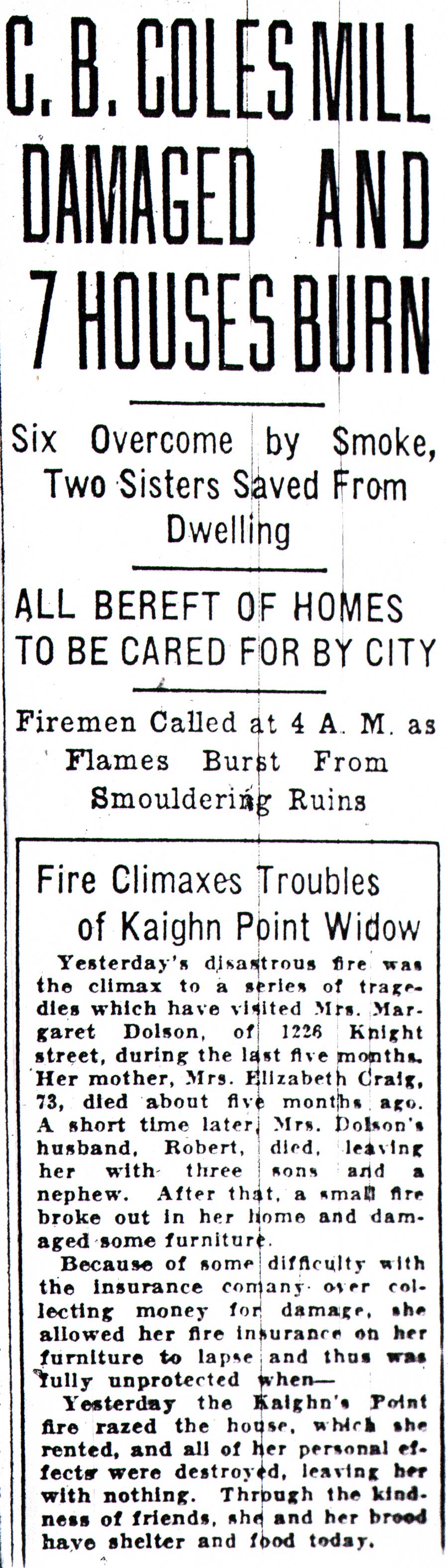
C. B. Coles Mill Damaged and 7 Houses Burn
C. B. COLES MILL DAMAGED AND 7 HOUSES BURN
Six Overcome by Smoke, Two Sisters Saved From Dwelling
ALL BEREFT OF HOMES TO BE CARED FOR BY CITY
Firemen Called at 4 A. M. as Flames Burst From Smouldering Ruins
Fire Climaxes Troubles of Kaighn Point Widow
Yesterday’s disastrous fire was the climax to a series of tragedies which have visited Mrs. Margaret Dolson, of 1226 Knight street, during the last five months. Her mother, Mrs. Elizabeth Craig, 73, died about five months ago. A short time later, Mrs. Dolson’s husband, Robert, died, leaving her with three sons and a nephew. After that, a small fire broke out in her home and damaged some furniture. Because of some difficulty with the insurance company over collecting money for damage, she allowed her fire insurance on her furniture to lapse and thus was fully unprotected when—
Yesterday the Kaighn’s Point fire razed the house, which she rented, and all of her personal effects were destroyed, leaving her with nothing. Through the kindness of friends, she and her brood have shelter and food today.
Six Overcome by Smoke, Two Sisters Saved From Dwelling
ALL BEREFT OF HOMES TO BE CARED FOR BY CITY
Firemen Called at 4 A. M. as Flames Burst From Smouldering Ruins
Fire Climaxes Troubles of Kaighn Point Widow
Yesterday’s disastrous fire was the climax to a series of tragedies which have visited Mrs. Margaret Dolson, of 1226 Knight street, during the last five months. Her mother, Mrs. Elizabeth Craig, 73, died about five months ago. A short time later, Mrs. Dolson’s husband, Robert, died, leaving her with three sons and a nephew. After that, a small fire broke out in her home and damaged some furniture. Because of some difficulty with the insurance company over collecting money for damage, she allowed her fire insurance on her furniture to lapse and thus was fully unprotected when—
Yesterday the Kaighn’s Point fire razed the house, which she rented, and all of her personal effects were destroyed, leaving her with nothing. Through the kindness of friends, she and her brood have shelter and food today.
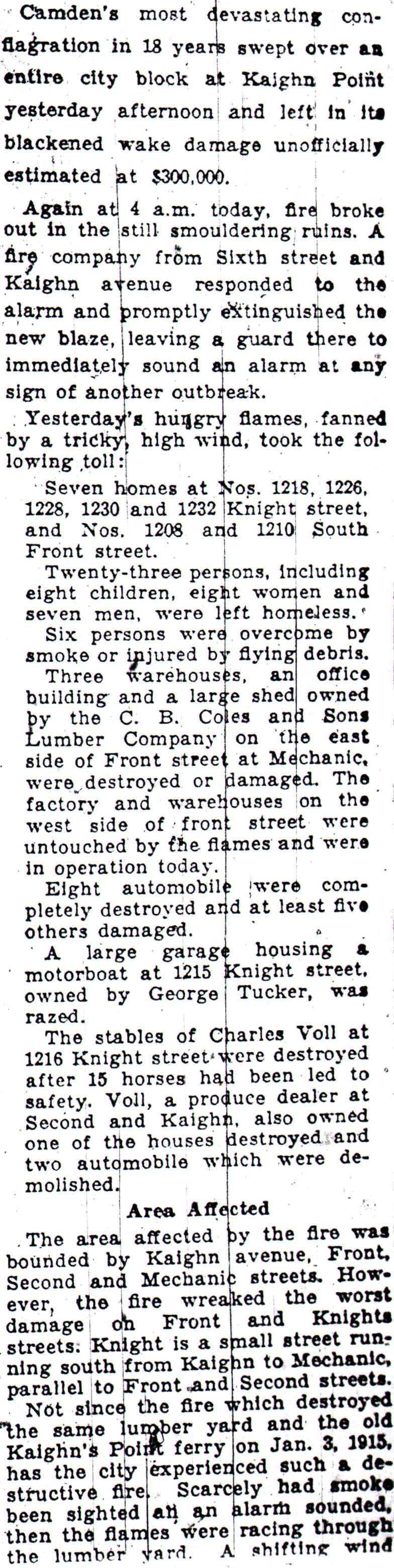
Camden’s most devastating conflagration in 18 years swept over an entire city block at Kaighn Point yesterday afternoon and left in its blackened wake damage unofficially estimated at $300,000.
Again at 4 a.m. today, fire broke out in the still smouldering ruins. A fire company from Sixth street and Kaighn avenue responded to the alarm and promptly extinguished the new blaze, leaving a guard there to immediately sound an alarm at any sign of another outbreak.
Yesterday’s hungry flames, fanned by a tricky, high wind, took the following toll:
Seven homes at Nos. 1218, 1226, 1228, 1230 and 1232 Knight street, and Nos. 1208 and 1210 South Front street.
Twenty-three persons, including eight children, eight women and seven men, were left homeless.
Six persons were overcome by smoke or injured by flying debris.
Three warehouses, an office building and a large shed owned by the C. B. Coles and Sons Lumber Company on the east side of Front street at Mechanic, were destroyed or damaged. The factory and warehouses on the west side of front street were untouched by the flames and were in operation today.
Eight automobiles were completely destroyed and at least five others damaged.
A large garage housing a motorboat at 1215 Knight street, owned by George Tucker, was razed.
The stables of Charles Voll at 1216 Knight street were destroyed after 15 horses had been led to safety. Voll, a produce dealer at Second and Kaighn, also owned one of the houses destroyed and two automobiles which were demolished.
Area Affected
The area affected by the fire was bounded by Kaighn avenue, Front, Second and Mechanic streets. However, the fire wreaked the worst damage on Front and Knights streets. Knight is a small street running south from Kaighn to Mechanic, parallel to Front and Second streets.
Not since the fire which destroyed the same lumber yard on Jan. 3, 1913, has the city experienced such a destructive fire.
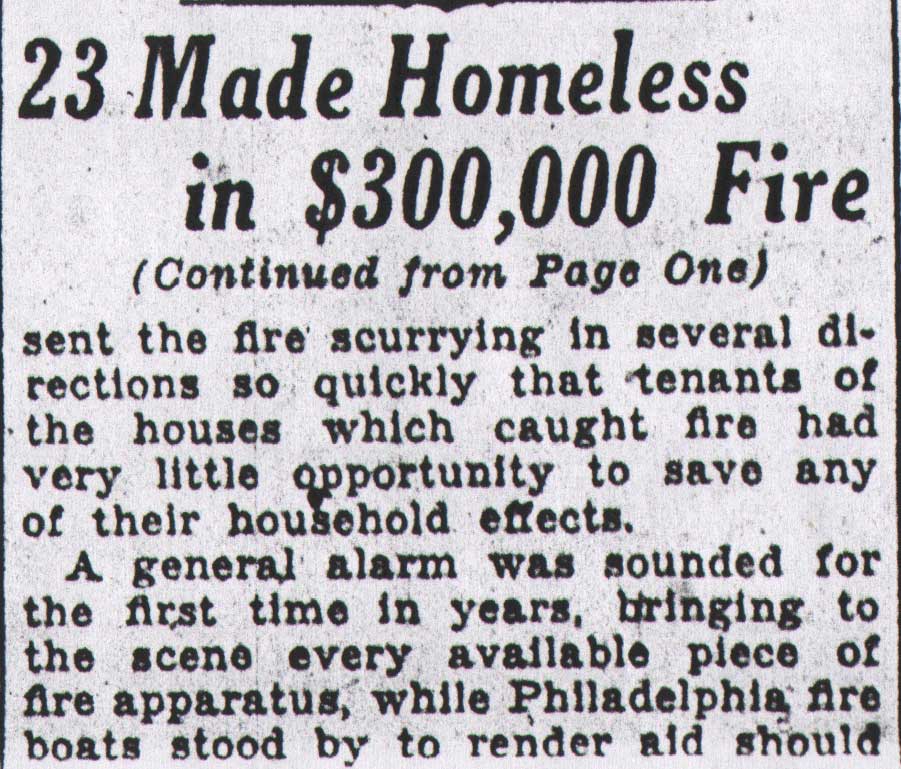
23 Made Homeless in $300,000 Fire
23 Made Homeless in $300,000 Fire
(Continued from Page One)
sent the fire scurrying in several directions so quickly that tenants of the houses which caught fire had very little opportunity to save any of their household effects.
A general alarm was sounded for the first time in years, bringing to the scene every available piece of fire apparatus, while Philadelphia fire boats stood by to render aid should…
23 Made Homeless in $300,000 Fire
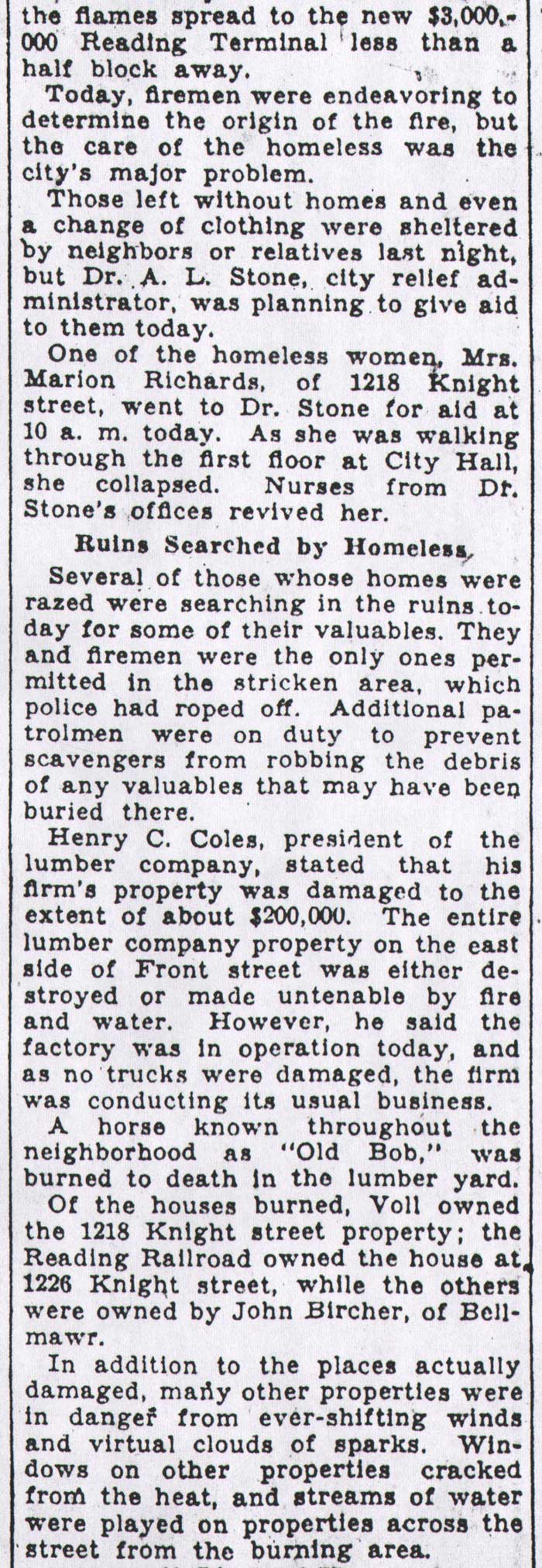
A general alarm was sounded for the first time in years, bringing to the scene every available piece of fire apparatus, while Philadelphia fire boats stood by to render aid should the flames spread to the new $3,000,000 Reading Terminal less than a half block away.
Today, firemen were endeavoring to determine the origin of the fire, but the care of the homeless was the city’s major problem.
Those left without homes and even a change of clothing were sheltered by neighbors or relatives last night, but Dr. A. L. Stone, city relief administrator, was planning to give aid to them today.
One of the homeless women, Mrs. Marion Richards, of 1218 Knight street, went to Dr. Stone for aid at 10 a. m. today. As she was walking through the first floor at City Hall, she collapsed. Nurses from Dr. Stone’s offices revived her.
Ruins Searched by Homeless
Several of those whose homes were razed were searching in the ruins today for some of their valuables. They and firemen were the only ones permitted in the stricken area, which police had roped off. Additional patrolmen were on duty to prevent scavengers from robbing the debris of any valuables that may have been buried there.
Henry C. Coles, president of the lumber company, stated that his firm’s property was damaged to the extent of about $200,000. The entire lumber company property on the east side of Front street was either destroyed or made untenable by fire and water. However, he said the factory was in operation today, and as no trucks were damaged, the firm was conducting its usual business.
A horse known throughout the neighborhood as “Old Bob,” was burned to death in the lumber yard.
Of the houses burned, Voll owned the 1218 Knight street property; the Reading Railroad owned the house at 1226 Knight street, while the others were owned by John Bircher, of Bellmawr.
In addition to the places actually damaged, many other properties were in danger from ever-shifting winds and virtual clouds of sparks. Windows on other properties cracked from the heat, and streams of water were played on properties across the street from the burning area.
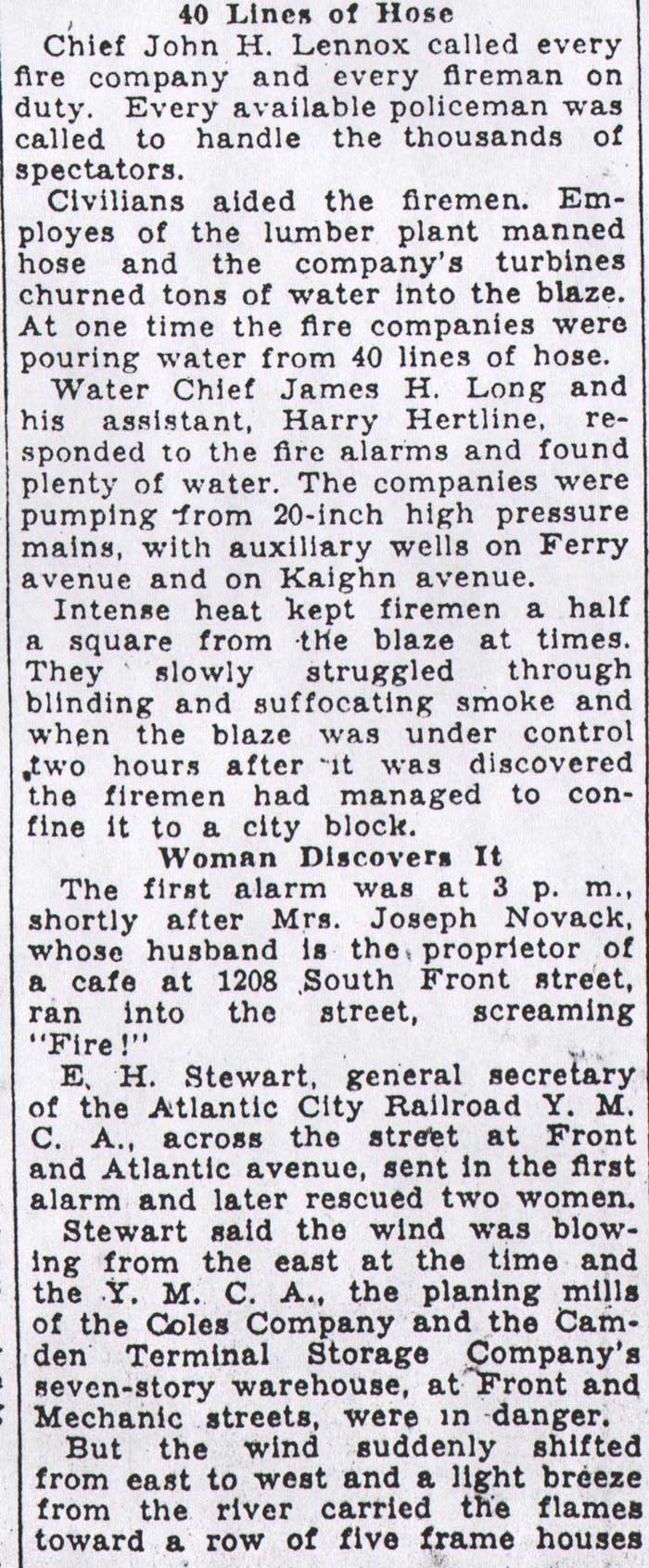
40 Lines of Hose
Chief John H. Lennox called every fire company and every fireman on duty. Every available policeman was called to handle the thousands of spectators.
Civilians aided the firemen. Employes of the lumber plant manned hose and the company’s turbines churned tons of water into the blaze. At one time the fire companies were pouring water from 40 lines of hose.
Water Chief James H. Long and his assistant, Harry Hertline, responded to the fire alarms and found plenty of water. The companies were pumping from 20-inch high pressure mains, with auxiliary wells on Ferry avenue and on Kaighn avenue.
Intense heat kept firemen a half a square from the blaze at times. They slowly struggled through blinding and suffocating smoke and when the blaze was under control two hours after it was discovered the firemen had managed to confine it to a city block.
Woman Discovers It
The first alarm was at 3 p. m., shortly after Mrs. Joseph Novack, whose husband is the proprietor of a cafe at 1208 South Front street, ran into the street, screaming “Fire!”
E. H. Stewart, general secretary of the Atlantic City Railroad Y. M. C. A., across the street at Front and Atlantic avenue, sent in the first alarm and later rescued two women.
Stewart said the wind was blowing from the east at the time and the Y. M. C. A., the planing mills of the Coles Company and the Camden Terminal Storage Company’s seven-story warehouse, at Front and Mechanic streets, were in danger.
But the wind suddenly shifted from east to west and a light breeze from the river carried the flames toward a row of five frame houses…
40 Lines of Hose
Chief John H. Lennox called every fire company and every fireman on duty. Every available policeman was called to handle the thousands of spectators.
Civilians aided the firemen. Employes of the lumber plant manned hose and the company’s turbines churned tons of water into the blaze. At one time the fire companies were pouring water from 40 lines of hose.
Water Chief James H. Long and his assistant, Harry Hertline, responded to the fire alarms and found plenty of water. The companies were pumping from 20-inch high pressure mains, with auxiliary wells on Ferry avenue and on Kaighn avenue.
Intense heat kept firemen a half a square from the blaze at times. They slowly struggled through blinding and suffocating smoke and when the blaze was under control two hours after it was discovered the firemen had managed to confine it to a city block.
Woman Discovers It
The first alarm was at 3 p. m., shortly after Mrs. Joseph Novack, whose husband is the proprietor of a cafe at 1208 South Front street, ran into the street, screaming “Fire!”
E. H. Stewart, general secretary of the Atlantic City Railroad Y. M. C. A., across the street at Front and Atlantic avenue, sent in the first alarm and later rescued two women.
Stewart said the wind was blowing from the east at the time and the Y. M. C. A., the planing mills of the Coles Company and the Camden Terminal Storage Company’s seven-story warehouse, at Front and Mechanic streets, were in danger.
But the wind suddenly shifted from east to west and a light breeze from the river carried the flames toward a row of five frame houses…
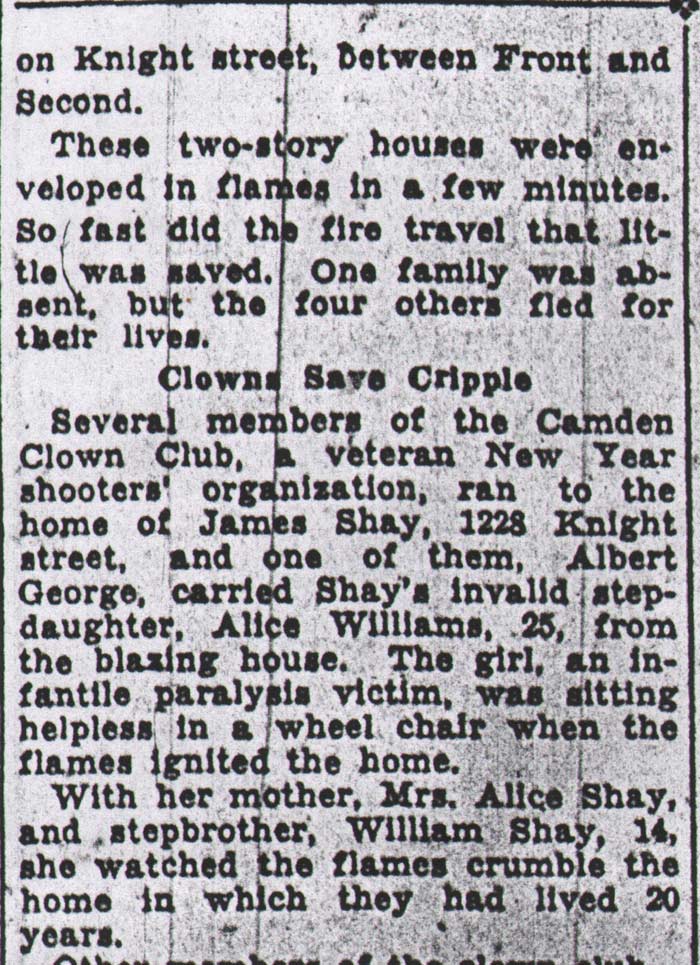
These two-story houses were enveloped in flames in a few minutes. So fast did the fire travel that little was saved. One family was absent, but the four others fled for their lives.
Clowns Save Cripple
Several members of the Camden Clown Club, a veteran New Year shooters’ organization, ran to the home of James Shay, 1228 Knight street, and one of them, Albert George, carried Shay’s invalid stepdaughter, Alice Williams, 25, from the blazing house. The girl, an infantile paralysis victim, was sitting helpless in a wheel chair when the flames ignited the home.
With her mother, Mrs. Alice Shay, and stepbrother, William Shay, 14, she watched the flames crumble the home in which they had lived 20 years.
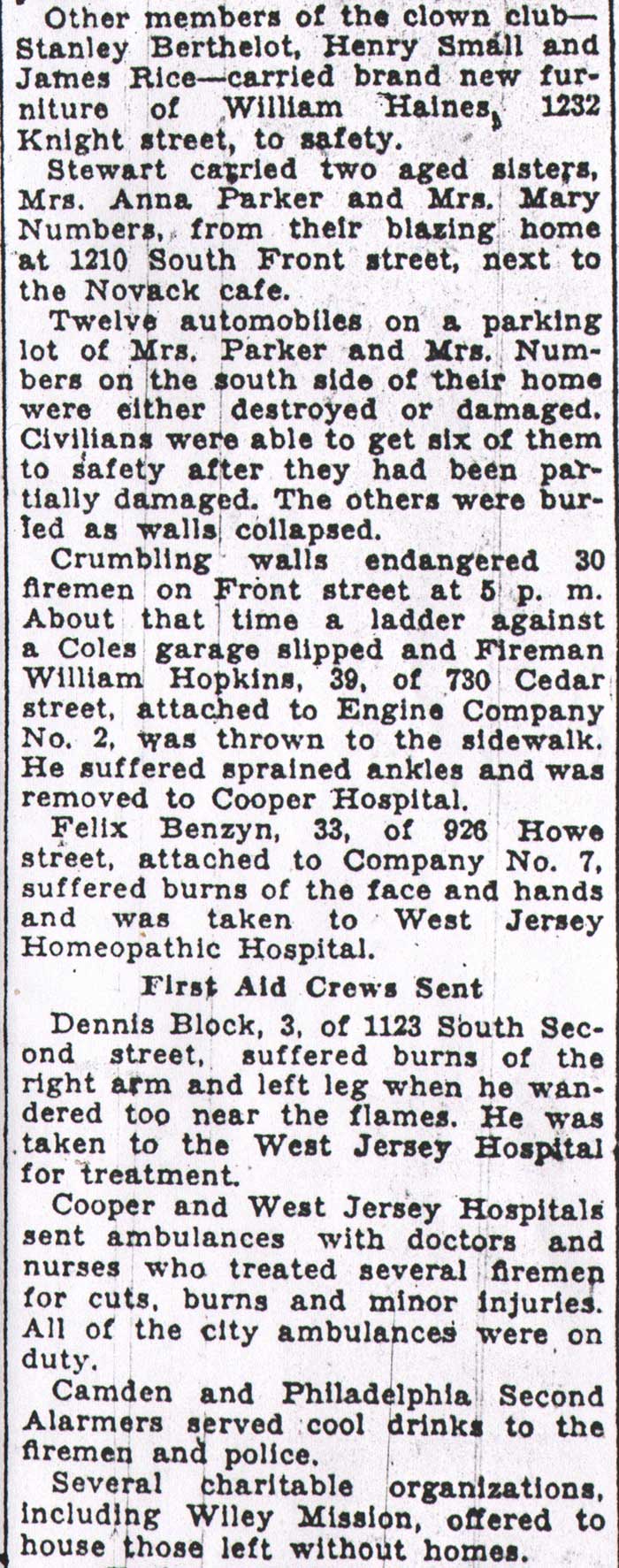
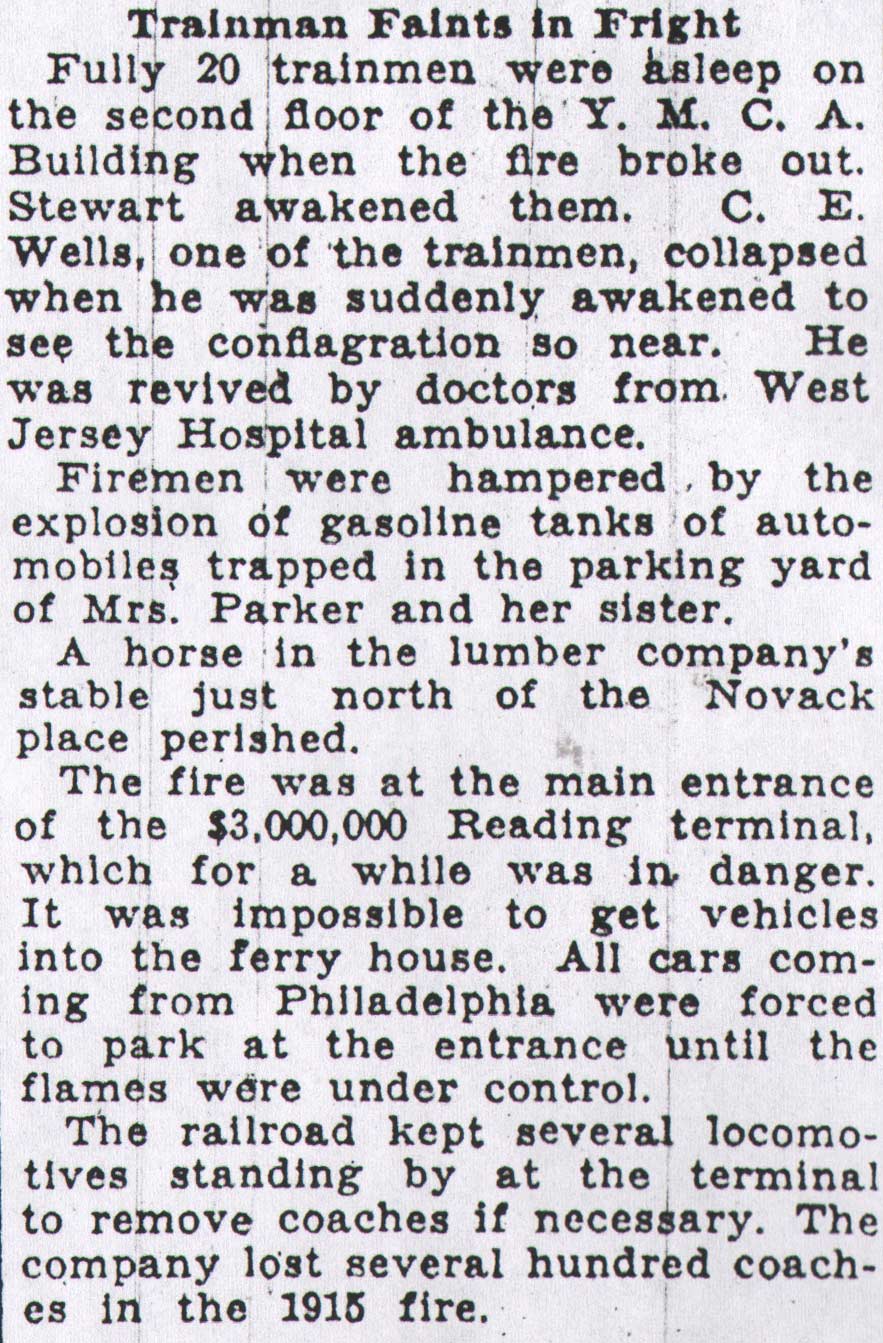
Firemen Injured at C.B. Coles Fire
Other members of the clown club—Stanley Berthelot, Henry Small and James Rice—carried brand new furniture of William Haines, 1232 Knight street, to safety.
Stewart carried two aged sisters, Mrs. Anna Parker and Mrs. Mary Numbers, from their blazing home at 1210 South Front street, next to the Novack cafe.
Twelve automobiles on a parking lot of Mrs. Parker and Mrs. Numbers on the south side of their home were either destroyed or damaged. Civilians were able to get six of them to safety after they had been partially damaged. The others were buried as walls collapsed.
Crumbling walls endangered 30 firemen on Front street at 5 p. m. About that time a ladder against a Coles garage slipped and Fireman William Hopkins, 39, of 730 Cedar street, attached to Engine Company No. 2, was thrown to the sidewalk. He suffered sprained ankles and was removed to Cooper Hospital.
Felix Benzyn, 33, of 926 Howe street, attached to Company No. 7, suffered burns of the face and hands and was taken to West Jersey Homeopathic Hospital.
First Aid Crews Sent
Dennis Block, 3, of 1123 South Second street, suffered burns of the right arm and left leg when he wandered too near the flames. He was taken to the West Jersey Hospital for treatment.
Cooper and West Jersey Hospitals sent ambulances with doctors and nurses who treated several firemen for cuts, burns and minor injuries. All of the city ambulances were on duty.
Camden and Philadelphia Second Alarmers served cool drinks to the firemen and police.
Several charitable organizations, including Wiley Mission, offered to house those left without homes.
Other members of the clown club—Stanley Berthelot, Henry Small and James Rice—carried brand new furniture of William Haines, 1232 Knight street, to safety.
Stewart carried two aged sisters, Mrs. Anna Parker and Mrs. Mary Numbers, from their blazing home at 1210 South Front street, next to the Novack cafe.
Twelve automobiles on a parking lot of Mrs. Parker and Mrs. Numbers on the south side of their home were either destroyed or damaged. Civilians were able to get six of them to safety after they had been partially damaged. The others were buried as walls collapsed.
Crumbling walls endangered 30 firemen on Front street at 5 p. m. About that time a ladder against a Coles garage slipped and Fireman William Hopkins, 39, of 730 Cedar street, attached to Engine Company No. 2, was thrown to the sidewalk. He suffered sprained ankles and was removed to Cooper Hospital.
Felix Benzyn, 33, of 926 Howe street, attached to Company No. 7, suffered burns of the face and hands and was taken to West Jersey Homeopathic Hospital.
First Aid Crews Sent
Dennis Block, 3, of 1123 South Second street, suffered burns of the right arm and left leg when he wandered too near the flames. He was taken to the West Jersey Hospital for treatment.
Cooper and West Jersey Hospitals sent ambulances with doctors and nurses who treated several firemen for cuts, burns and minor injuries. All of the city ambulances were on duty.
Camden and Philadelphia Second Alarmers served cool drinks to the firemen and police.
Several charitable organizations, including Wiley Mission, offered to house those left without homes.
Trainman Faints in Fright
Fully 20 trainmen were asleep on the second floor of the Y. M. C. A. Building when the fire broke out. Stewart awakened them. C. E. Wells, one of the trainmen, collapsed when he was suddenly awakened to see the conflagration so near. He was revived by doctors from West Jersey Hospital ambulance.
Firemen were hampered by the explosion of gasoline tanks of automobiles trapped in the parking yard of Mrs. Parker and her sister.
A horse in the lumber company’s stable just north of the Novack place perished.
The fire was at the main entrance of the $3,000,000 Reading terminal, which for a while was in danger. It was impossible to get vehicles into the ferry house. All cars coming from Philadelphia were forced to park at the entrance until the flames were under control.
The railroad kept several locomotives standing by at the terminal to remove coaches if necessary. The company lost several hundred coaches in the 1913 fire.
Jack the Airedale — Engine 2 and Ladder 1, 1930s
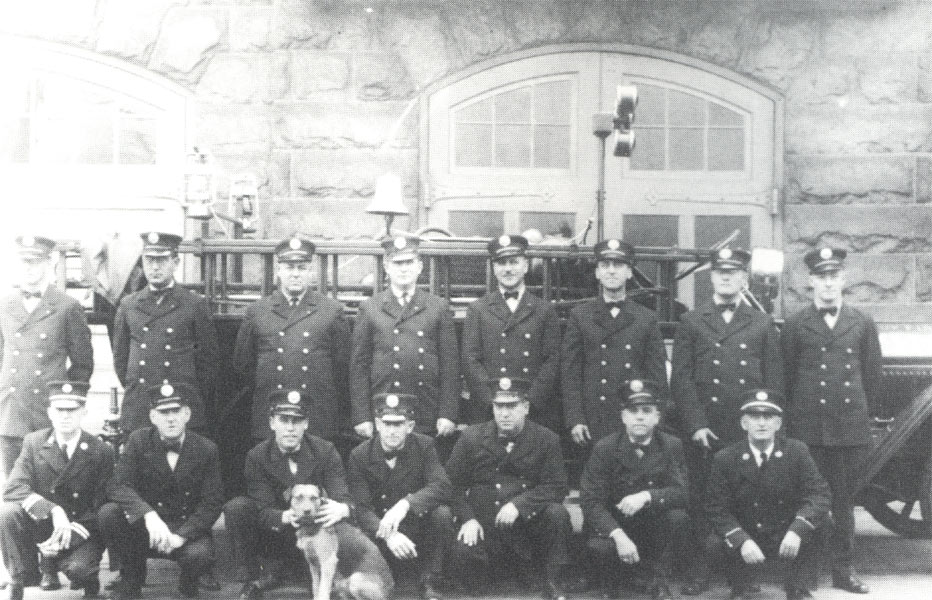
1930s — “Jack Airedale” with members of Engine 2 and Ladder 1
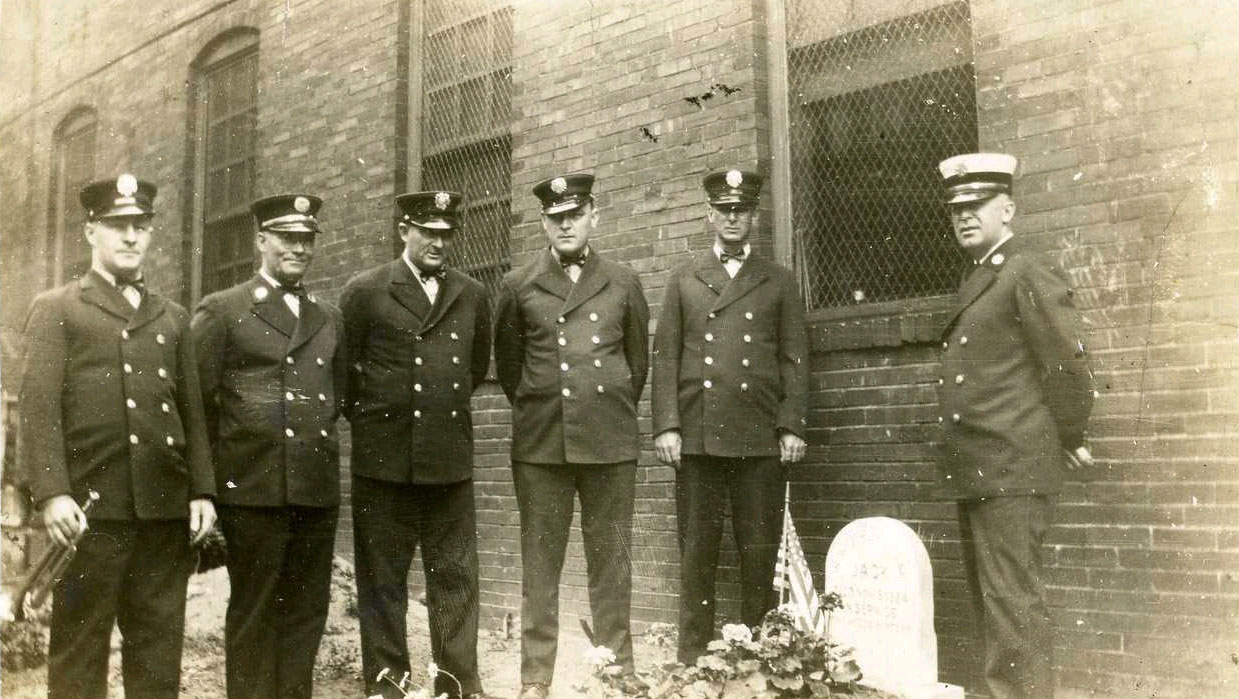
November 1934, at grave site outside Fire Headquarters at North 5th and Arch Streets immediately following ceremony for “Jack,” from left: Fireman John Yates, Captain William Van Pfefferle, Fireman William Hopkins, Fireman Lester Anderson, Acting Captain Edgar Ellender, Deputy Chief William Harring Sr.
The American Fire Service has always held domesticated animals as esteemed mascots and the Camden Fire Department was certainly no exception. Through the years there have been many types of mascots in the Department including monkeys, cats, goats, and of course the most popular mascot, the dog. Dating back to the days of horse drawn fire apparatus and even earlier when carriage dogs formed an integral bond with horses, canines distinguished themselves as animals especially attuned to firehouse life.
Jack was the company mascot of Engine 2 and Ladder 1 at old Fire Headquarters for over five years and he was described as an intelligent Airedale of good humored nature. Jack never missed an opportunity to climb aboard the apparatus and answer alarms with his beloved masters. The sight of Engine Company 2 roaring out Federal Street with Jack perched high atop the apparatus, wind blowing in his face amid the shrill pitch of the buckeye whistle and clanging bells was an unforgettable scene. Occasionally and as with all active canines, Jack would be out of quarters and around the corner or down the street when an alarm was transmitted. At such times he would dash down Fifth Street until he caught up with the rolling apparatus and would skillfully leap upward to his accustomed place on the rig. It was under these circumstances that Jack lost his life.
The Department phone jingled and the Housewatchman turned out both companies for an alarm at 119 N. 9th Street. Jack got a late start on the hike and chased the apparatus out Federal Street where he tangled with an automobile at Broadway. While trying to avoid the car Jack darted into the path of the apparatus and was fatally injured. The men of the Engine and Truck were heart broken. Jack was buried the next day in the rear yard of Fire Headquarters in the place that had been his home since puppyhood. Flowers were planted to adorn the fresh grave while some of the toughest Firemen in the house were visibly grief stricken. One year later on the anniversary of Jack’s death a memorial service was held after Roll Call in the rear yard of Fire Headquarters. The members erected a tombstone and in a quiet service, Fireman John Yates blew taps over Jack’s grave. There were no words spoken. All that needed to be said was inscribed upon the little headstone; “Our Faithful Pal Jack” died in service, November 5, 1934.
Taps Sound for Jack Airedale, Canine Mascot of Fire Laddies
Camden Courier-Post —
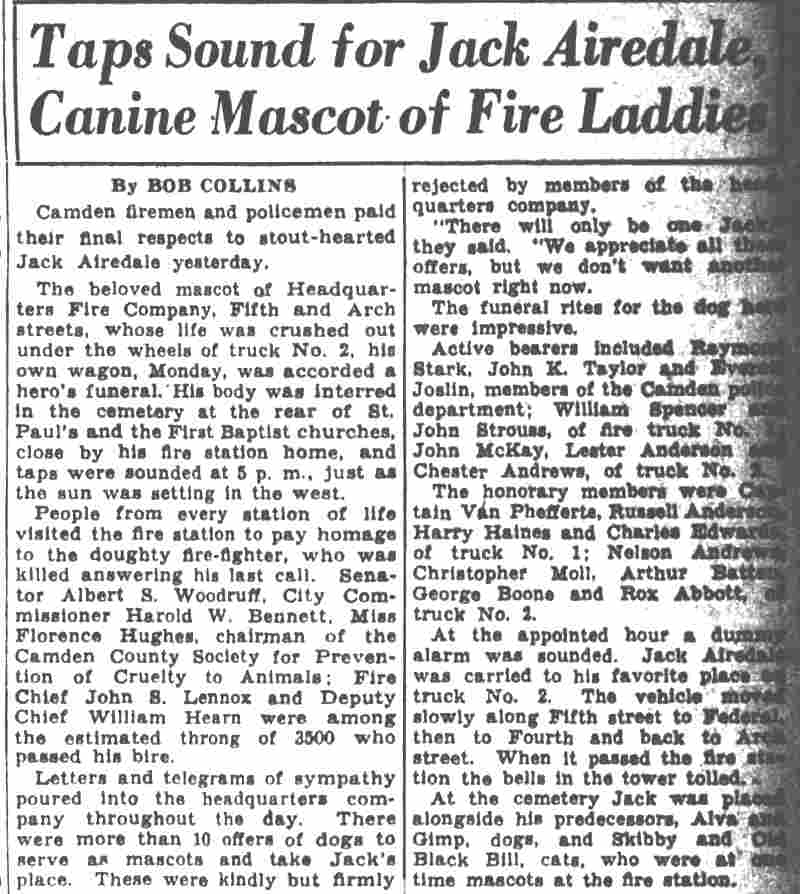
Taps Sound for Jack Airedale, Canine Mascot of Fire Laddies
Taps Sound for Jack Airedale, Canine Mascot of Fire Laddies
By BOB COLLINS
Camden firemen and policemen paid their final respects to stout-hearted Jack Airedale yesterday.
The beloved mascot of Headquarters Fire Company, Fifth and Arch streets, whose life was crushed out under the wheels of truck No. 2, his own wagon, Monday, was accorded a hero's funeral. His body was interred in the cemetery at the rear of St. Paul's and the First Baptist churches, close by his fire station home, and taps were sounded at 5 p. m., just as the sun was setting in the west.
People from every station of life visited the fire station to pay homage to the doughty fire-fighter, who was killed answering his last call. Senator Albert S. Woodruff, City Commissioner Harold W. Bennett, Miss Florence Hughes, chairman of the Camden County Society for Prevention of Cruelty to Animals; Fire Chief John S. Lennox and Deputy Chief William Hearn were among the estimated throng of 3500 who passed his bier.
Letters and telegrams of sympathy poured into the headquarters company throughout the day. There were more than 10 offers of dogs to serve as mascots and take Jack's place. These were kindly but firmly rejected by members of the headquarters company. "There will only be one Jack," they said. "We appreciate all these offers, but we don't want another mascot right now."
The funeral rites for the dog were impressive.
Active bearers included Raymond Stark, John K. Taylor and Everett Joslin, members of the Camden police department; William Spencer and John Strouss, of fire truck No. 1; John McKay, Lester Anderson and Chester Andrews, of truck No. 2.
The honorary members were Captain Van Phefferts, Russell Anderson, Harry Haines and Charles Edwards, of truck No. 1; Nelson Andrews, Christopher Moll, Arthur Batten, George Boone and Rox Abbott, of truck No. 2.
At the appointed hour a dummy alarm was sounded. Jack Airedale was carried to his favorite place on fire truck No. 2. The vehicle moved slowly along Fifth street to Federal, then to Fourth and back to Arch street. When it passed the fire station the bells in the tower tolled.
At the cemetery Jack was placed alongside his predecessors, Alva and Gimp, dogs, and Skibby and Old Black Bill, cats, who were at one time mascots at the fire station.
By BOB COLLINS
Camden firemen and policemen paid their final respects to stout-hearted Jack Airedale yesterday.
The beloved mascot of Headquarters Fire Company, Fifth and Arch streets, whose life was crushed out under the wheels of truck No. 2, his own wagon, Monday, was accorded a hero’s funeral. His body was interred in the cemetery at the rear of St. Paul’s and the First Baptist churches, close by his fire station home, and taps were sounded at 5 p. m., just as the sun was setting in the west.
People from every station of life visited the fire station to pay homage to the doughty fire-fighter, who was killed answering his last call. Senator Albert S. Woodruff, City Commissioner Harold W. Bennett, Miss Florence Hughes, chairman of the Camden County Society for Prevention of Cruelty to Animals; Fire Chief John S. Lennox and Deputy Chief William Hearn were among the estimated throng of 3500 who passed his bier.
Letters and telegrams of sympathy poured into the headquarters company throughout the day. There were more than 10 offers of dogs to serve as mascots and take Jack’s place. These were kindly but firmly rejected by members of the headquarters company. “There will only be one Jack,” they said. “We appreciate all these offers, but we don’t want another mascot right now.”
The funeral rites for the dog were impressive.
Active bearers included Raymond Stark, John K. Taylor and Everett Joslin, members of the Camden police department; William Spencer and John Strouss, of fire truck No. 1; John McKay, Lester Anderson and Chester Andrews, of truck No. 2.
The honorary members were Captain Van Phefferts, Russell Anderson, Harry Haines and Charles Edwards, of truck No. 1; Nelson Andrews, Christopher Moll, Arthur Batten, George Boone and Rox Abbott, of truck No. 2.
At the appointed hour a dummy alarm was sounded. Jack Airedale was carried to his favorite place on fire truck No. 2. The vehicle moved slowly along Fifth street to Federal, then to Fourth and back to Arch street. When it passed the fire station the bells in the tower tolled.
At the cemetery Jack was placed alongside his predecessors, Alva and Gimp, dogs, and Skibby and Old Black Bill, cats, who were at one time mascots at the fire station.
Firemen Pallbearers for Lester Anderson
Camden Courier-Post —
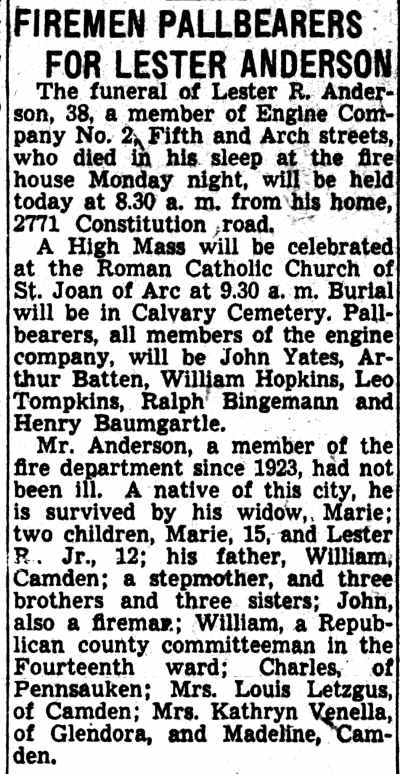
The funeral of Lester R. Anderson, 38, a member of Engine Company No. 2, Fifth and Arch streets, who died in his sleep at the fire house Monday night, will be held today at 8.30 a. m. from his home, 2771 Constitution road.
A High Mass will be celebrated at the Roman Catholic Church of St. Joan of Arc at 9.30 a. m. Burial will be in Calvary Cemetery. Pallbearers, all members of the engine company, will be John Yates, Arthur Batten, William Hopkins, Leo Tompkins, Ralph Bingemann and Henry Baumgartle.
Mr. Anderson, a member of the fire department since 1923, had not been ill. A native of this city, he is survived by his widow, Marie; two children, Marie, 15, and Lester R. Jr., 12; his father, William, Camden; a stepmother, and three brothers and three sisters; John, also a fireman; William, a Republican county committeeman in the Fourteenth ward; Charles, of Pennsauken; Mrs. Louis Letzgus, of Camden; Mrs. Kathryn Venella, of Glendora, and Madeline, Camden.
World War II Draft Card
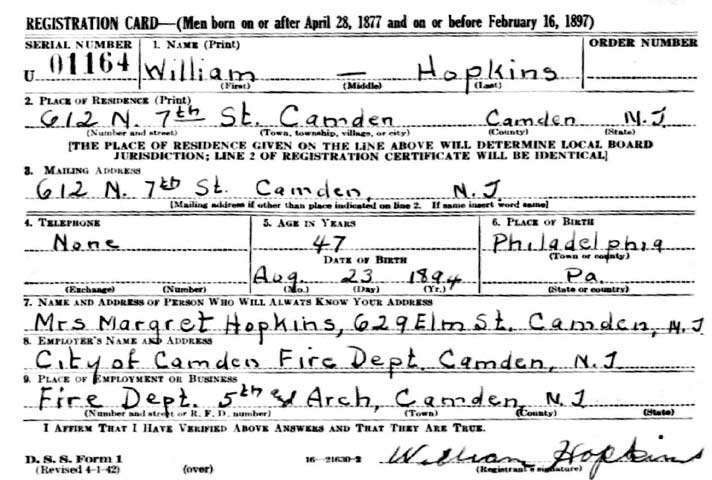
World War II draft registration card for William A. Hopkins
William A. Hopkins, Ex-Fireman, Dies
Camden Courier-Post —
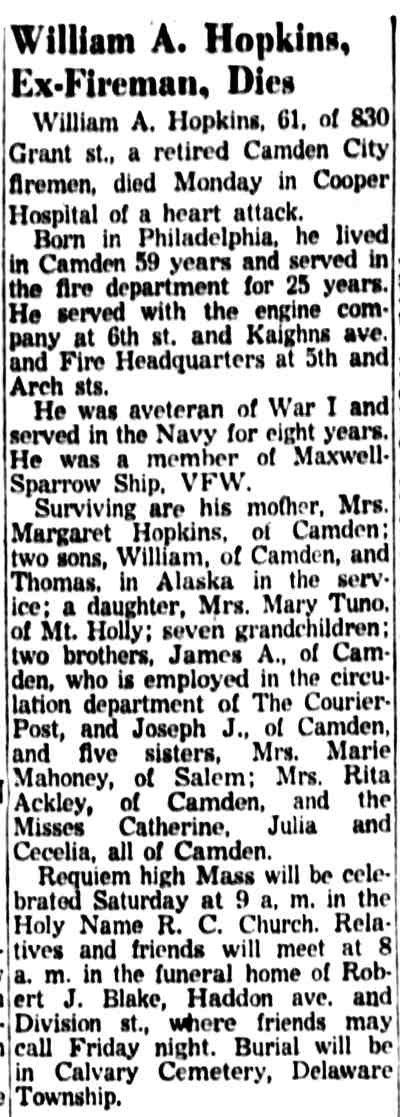
William A. Hopkins, Ex-Fireman, Dies
William A. Hopkins, Ex-Fireman, Dies
William A. Hopkins, 61, of 830 Grant st., a retired Camden City fireman, died Monday in Cooper Hospital of a heart attack.
Born in Philadelphia, he lived in Camden 59 years and served in the fire department for 25 years. He served with the engine company at 6th st. and Kaighns ave. and Fire Headquarters at 5th and Arch sts.
He was a veteran of War I and served in the Navy for eight years. He was a member of Maxwell-Sparrow Ship, VFW.
Surviving are his mother, Mrs. Margaret Hopkins, of Camden; two sons, William, of Camden, and Thomas, in Alaska in the service; a daughter, Mrs. Mary Tuno, of Mt. Holly; seven grandchildren; two brothers, James A., of Camden, who is employed in the circulation department of The Courier-Post, and Joseph J., of Camden, and five sisters, Mrs. Marie Mahoney, of Salem; Mrs. Rita Ackley, of Camden, and the Misses Catherine, Julia and Cecelia, all of Camden.
Requiem high Mass will be celebrated Saturday at 9 a. m. in the Holy Name R. C. Church. Relatives and friends will meet at 8 a. m. from the home of Robert J. Blake, Haddon ave. and Division st., where friends may call Friday night. Burial will be in Calvary Cemetery, Delaware Township.
William A. Hopkins, 61, of 830 Grant st., a retired Camden City fireman, died Monday in Cooper Hospital of a heart attack.
Born in Philadelphia, he lived in Camden 59 years and served in the fire department for 25 years. He served with the engine company at 6th st. and Kaighns ave. and Fire Headquarters at 5th and Arch sts.
He was a veteran of War I and served in the Navy for eight years. He was a member of Maxwell-Sparrow Ship, VFW.
Surviving are his mother, Mrs. Margaret Hopkins, of Camden; two sons, William, of Camden, and Thomas, in Alaska in the service; a daughter, Mrs. Mary Tuno, of Mt. Holly; seven grandchildren; two brothers, James A., of Camden, who is employed in the circulation department of The Courier-Post, and Joseph J., of Camden, and five sisters, Mrs. Marie Mahoney, of Salem; Mrs. Rita Ackley, of Camden, and the Misses Catherine, Julia and Cecelia, all of Camden.
Requiem high Mass will be celebrated Saturday at 9 a. m. in the Holy Name R. C. Church. Relatives and friends will meet at 8 a. m. from the home of Robert J. Blake, Haddon ave. and Division st., where friends may call Friday night. Burial will be in Calvary Cemetery, Delaware Township.