Introduction
Owned and operated for many years by John MacDougall, Mac’s Bar was a fixture from before World War I through at least the fall of 1959 at 839 Market Street. He remained open during Prohibition under a “soft drink” license. When Prohibition was repealed he was granted his beer license on June 30, 1933.
Court Attache Scours City To Round Up Jury for Trial
Camden Courier-Post —
Court Attache Scours City To Round Up Jury for Trial
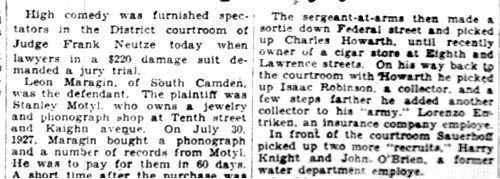
High comedy was furnished spectators in the District courtroom of Judge Frank Neutze today when lawyers in a $220 damage suit demanded a jury trial.
Lecat Maragin, of South Camden, was the defendant. The plaintiff was Stanley Motyl, who owns a jewelry and phonograph shop at Tenth street and Kaighn avenue. On July 30, 1927, Maragin bought a phonograph on the promise of records from Motyl. He was to pay for them in 60 days. A short time after the purchase was made Motyl and his wife separated.
When the storekeeper asked Maragin for the $220, he was informed the sum had been paid to his wife. Motyl claims his wife was not his business partner and that Maragin still owes him the money in spite of the fact that he has a receipted bill.
Carl Kisselman, representing the plaintiff, surprised the court by asking for a jury trial. William Sauerbohn, the sergeant-at-arms was dispatched to seek twelve men who would serve.
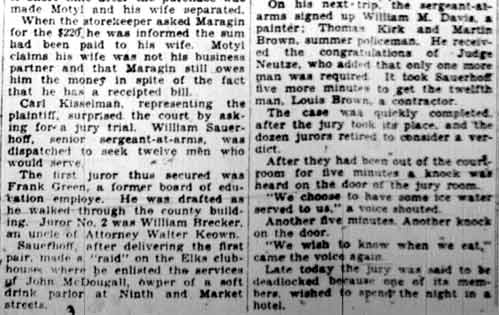
The first juror thus secured was Frank Green, a former board of education employe. He was drafted as he walked through the county building. Juror 2 was William Brecker, an uncle of Attorney Walter Keown.
Sauerbohn, after delivering the first pair, made a “raid” on the Elks clubhouse, where he enlisted the services of John McDougall, owner of a soft drink parlor at Ninth and Market streets.
The sergeant-at-arms then made a sortie down Federal street and picked up Charles Howarth, until recently owner of a cigar store at Eighth and Lawrence streets. On his way back to the courtroom with Howarth he picked up Isaac Robinson, a collector, and a few steps farther he added another “recruit,” one “army” Lorenzo Entriken, an insurance company agent.
In front of the courtroom Sauerbohn picked up two more “recruits,” Harry Knight and John O’Brien, a former water department employe.
On his next trip, the sergeant-at-arms signed up William M. Davis, a painter; Thomas Kirk and Martin Brown, surrounding citizens. He received the congratulations of Judge Neutze, who added that only one more man was required. It took Sauerbohn five more minutes to get the twelfth man, Louis Brown, a contractor.
The case was quickly completed, the jury took its place, and the dozen jurors retired to consider a verdict.
After they had been out of the courtroom for five minutes a knock was heard on the door of the jury room.
“We choose to have some ice water sent to us,” the jury shouted back.
Another five minutes. Another knock on the door.
“We wish to know when we eat,” came the voice again.
Late today the jury was said to be deadlocked because one of its members, wished to spend the night in a hotel.
The Hollingshead Plant at 10th and Market Streets
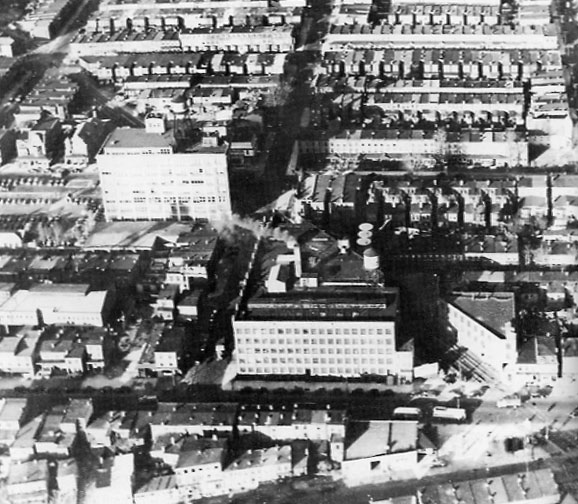
Looking North at the Hollingshead plant at 10th and Market Streets. Photo taken before the fire shows the Hollingshead industrial complex amid congested residential construction. Virtually everything in this picture no longer exists, some lost to fire, most lost to “urban renewal” and highway construction, with one exception, the office building at 9th & Cooper St.
July 13, 1940 — The Hollingshead Fire
The Hollingshead Fire
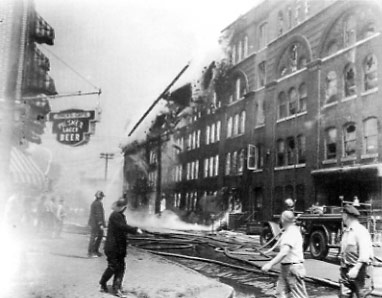
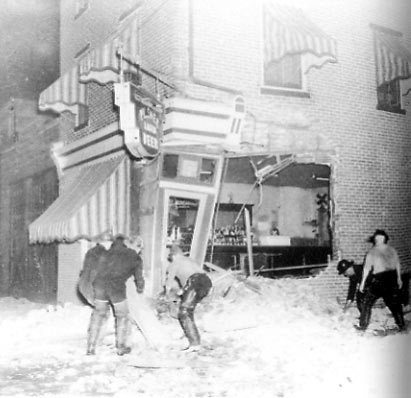
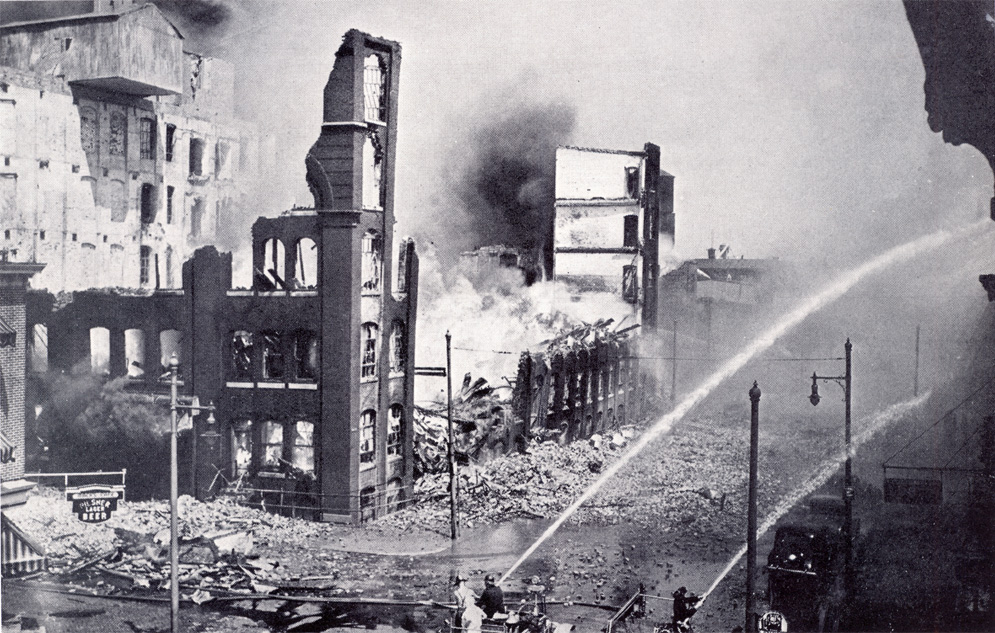
MacDougall’s Tavern aka Mac’s Bar at the far left remains in harm’s way as the fire extends onward. Subsequent damage to the tavern followed additional collapse of factory walls striking the front of the tavern; firefighters are seen freeing a charged hose line beneath rubble. Below, firemen are protecting exposures against the intense heat from the ruins of No. 6 Building. MacDougall’s Tavern aka Mac’s Bar is visible at the lower left.