Robert A. Wonsetler
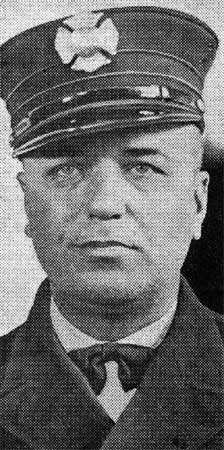
Robert A. Wonsetler
ROBERT AUGUST WONSETLER was born in New Jersey on November 1, 1890 to John B. Wonsetler and his wife, the former Bertha Bridges. His father first appears in Camden City Directories in 1891. Robert Wonsetler was the oldest child. City Directories beginning in 1897 and the 1900 Census shows the Wonsetlers at 816 North 27th Street in the Cramer Hill section of Camden, New Jersey. John Wonsetler was then working as a machinist. There had been another child born to the family, who sadly had not died prior to the enumeration of the census.
By 1910 the family had moved to 864 North 27th Street. John Wonsetler was then working as a cutter in clothing house. Two more children had been born, younger siblings John Charles and Mary. John and Bertha Wonsetler stayed at this address into the 1940s. Although well past 70, John Wonsetler was still working in late 1939 as a truant officer for the Camden Board of Education.
In 1916 Robert A. Wonsetler married Louis M. Vollmer in Philadelphia, Pennsylvania. They made their home with Louise’s parents, Frederick and Louise Vollmer, at 2712 Hayes Avenue. Two children were born before the decade ended, Roberta in 1916 and Frederick John “Jack” Wonsetler in 1919.
When the census was taken in January of 1920 the Wonsetlers were still living at 2712 Hayes Avenue. Also at home were the Vollmers four other adult children, Estella, Carrie, Frederick, and Freda Vollmer. Robert A. Wonsetler was then working as an instructor in a machine shop. Not long after the Census was taken, Freda Vollmer married Samuel Unruh. Their first son, Howard Unruh, was born in January of 1921.
On March 1, 1923 Robert A. Wonsetler was appointed to the Camden Fire Department.
The 1924 and 1929 City Directories shows Robert A. Wonsetler living at 806 North 27th Street. When the Census was taken in April of 1930 the Wonsetlers had moved to 3281 Pleasant Street. Their in-laws, Frederick and Louise Vollmer, then lived with them.
In 1938 Robert A. Wonsetler was elected president of the state Fireman’s Mutual Benefit Association.
By 1940 Robert A. Wonsetler had been promoted to Captain. He was still in that rank in late 1946. By 1951 he had been promoted to District Chief.
In September of 1949, Louise Wonsetler’s nephew, Howard Unruh, went on a shooting rampage on River Avenue, killing 13 people. Mrs. Wonsetler was mentioned a number of times in local and national newspapers as lending support to her younger sister in that trying time.
The Cramer Hill waterfront was frequently the scene of such lesser campaigns. The Cramer Hill mud flats along the Delaware River extended northward from 27th Street and Buren Avenue, along Adams and Farragut Avenues to about 33rd Street. Along this area of shoreline was a grave yard for derelict barges and scowls, that ran for several city blocks. A majority of these discarded vessels, grounded and fully exposed at low tide, were comprised of rotting, heavy timbers with some being as large as two and three stories above grade. One especially spectacular blaze during 1951 started in Noecker’s Shipyard on the river above 27th Street. Salvagers using torches to remove metal from a 182 foot long floating dry dock, accidentally set fire to ancient timbers. Attempting to put out the fire with hand extinguishers, they were soon driven back as flames roared out of control. Engine Company 11 arriving first due, found fire shooting 75 feet over the tree tops with large embers blowing down wind igniting derelict barges. District Chief Robert Wonsetler transmitted a second alarm on arrival. The heavily wooded area, remote from paved streets, posed serious access problems for responding companies. When the river tide was favorable, a Philadelphia Fireboat could often get in and darken the fire in a short period of time. But when the tide was out, the boat had no access. This remote area, also absent of hydrants, compelled fire fighters to stretch hoselines for several blocks, often by hand as they wore themselves out in the process of getting water on the fire. Over some twenty year period, hundreds of Mud Flat Campaigns were waged by Cramer Hill Fire Fighters, many of which were Greater Alarms.
Chief Wonsetler retired from the Camden Fire Department on January 1, 1955. He passed away in 1959.
Brother John C. Wonsetler (1900–1979) had a long and distinguished career as an artist, muralist, and illustrator. He co-authored a number of books for young people with his wife, Adelaide Hill Wonsetler.
864 North 27th Street
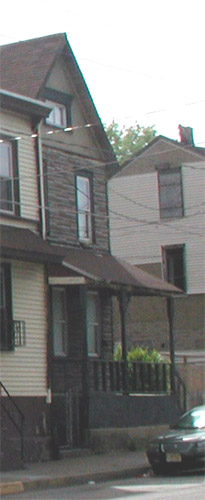
864 North 27th Street — May 7, 2005
World War I Draft Card
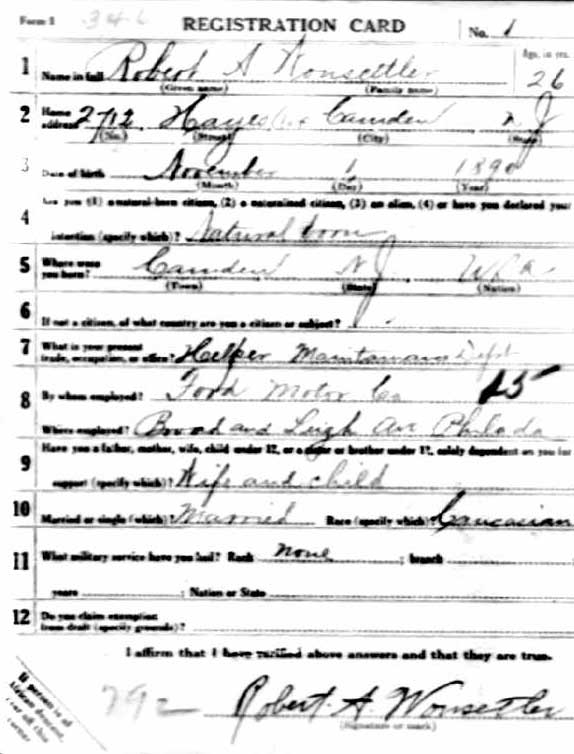
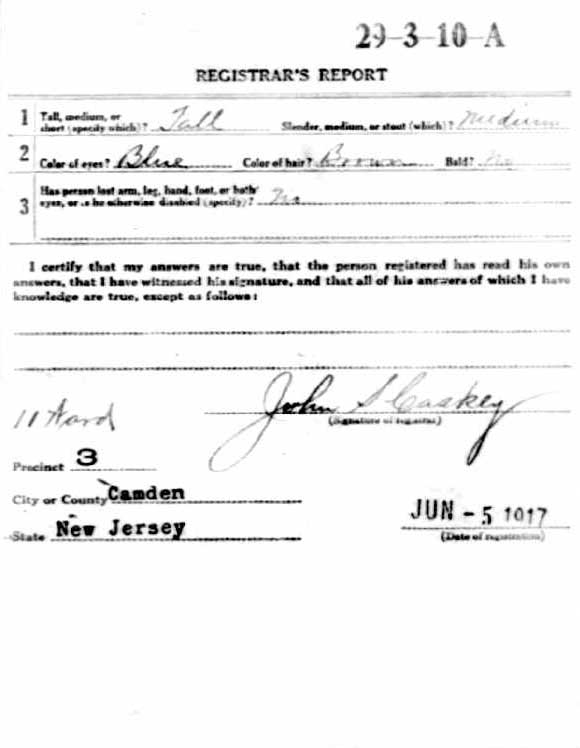
Robert A. Wonsetler — World War I Draft Card
Fire Chief Guest at Honor Dinner
Camden Courier-Post —
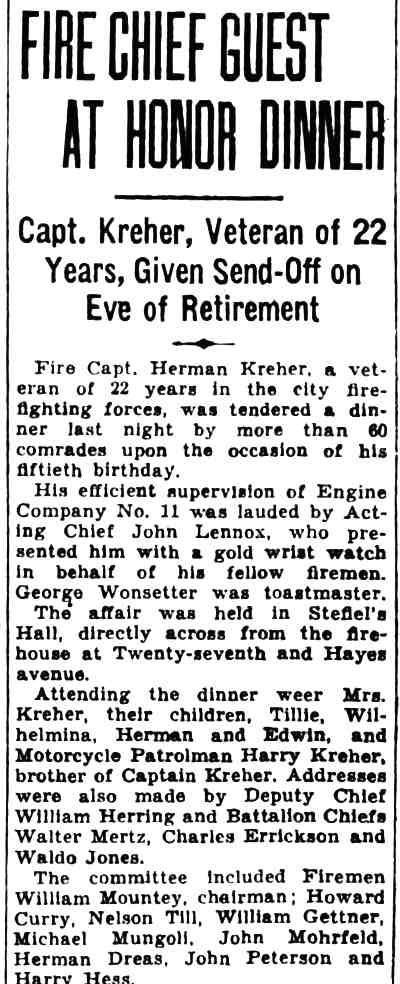
Capt. Kreher, Veteran of 22 Years, Given Send-Off on Eve of Retirement
Fire Capt. Herman Kreher, a veteran of 22 years in the city fire-fighting forces, was tendered a dinner last night by more than 60 comrades upon the occasion of his fiftieth birthday.
His efficient supervision of Engine Company No. 11 was lauded by Acting Chief John Lennox, who presented him with a gold wrist watch in behalf of his fellow firemen. George Wonsetter was toastmaster.
The affair was held in Stefiel’s Hall, directly across from the firehouse at Twenty-seventh and Hayes avenue.
Attending the dinner weer [sic] Mrs. Kreher, their children, Tillie, Wilhelmina, Herman and Edwin, and Motorcycle Patrolman Harry Kreher, brother of Captain Kreher. Addresses were also made by Deputy Chief William Herring and Battalion Chiefs Walter Mertz, Charles Errickson and Waldo Jones.
The committee included Firemen William Mountey [sic], chairman; Howard Curry, Nelson Till, William Gettner, Michael Mungoli, John Mohrfeld, Herman Dreas, John Peterson and Harry Hess.
Robert Wonsetler circa 1937
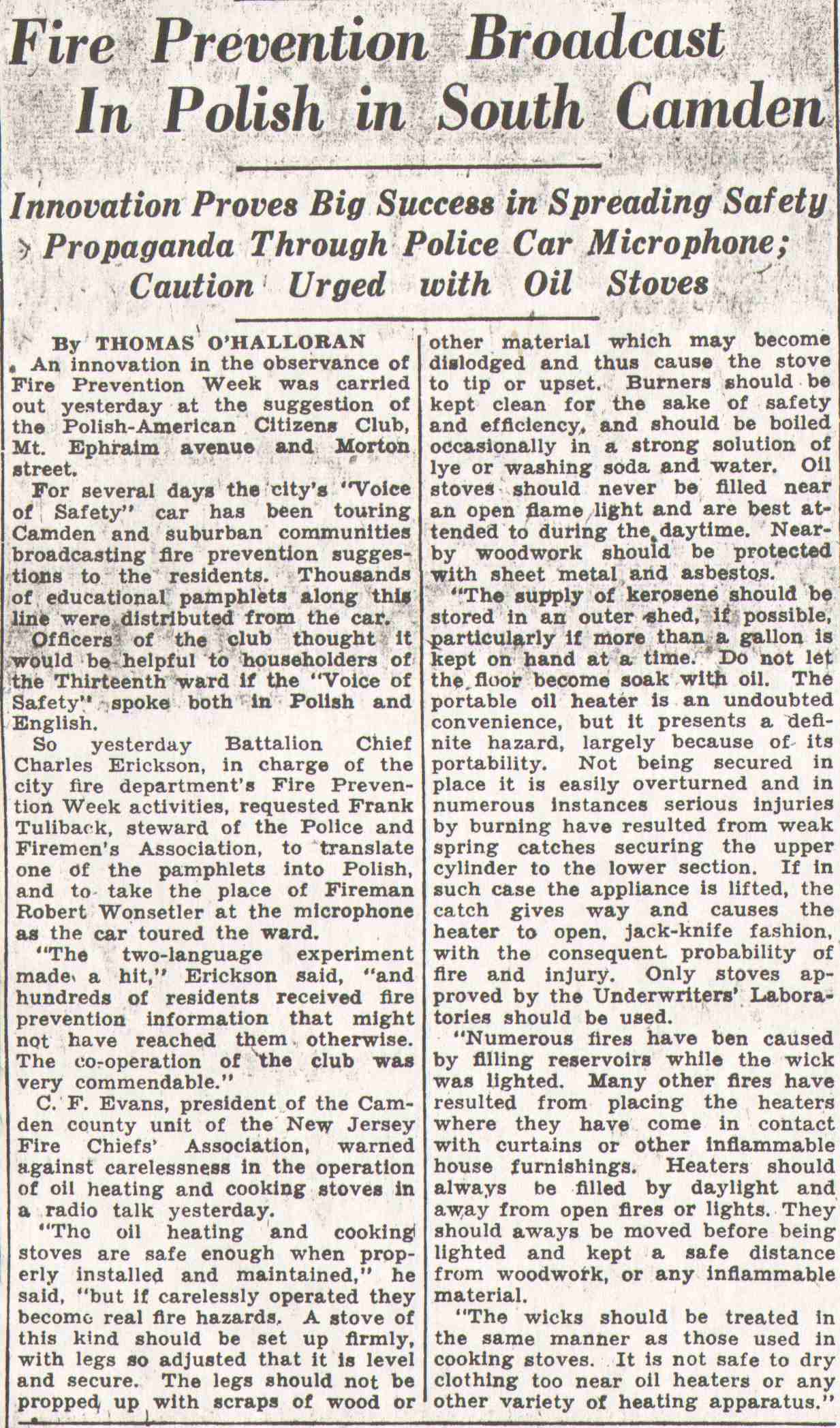
Fire Prevention Broadcast In Polish in South Camden
Innovation Proves Big Success in Spreading Safety Propaganda Through Police Car Microphone; Caution Urged with Oil Stoves
By THOMAS O’HALLORAN
An innovation in the observance of Fire Prevention Week was carried out yesterday at the suggestion of the Polish-American Citizens Club, Mt. Ephraim avenue and Morton street.
For several days the city’s “Voice of Safety” car has been touring Camden and suburban communities broadcasting fire prevention suggestions to the residents. Thousands of educational pamphlets along this line were distributed from the car.
Officers of the club thought it would be helpful to householders of the Thirteenth ward if the “Voice of Safety” spoke both in Polish and English.
So yesterday Battalion Chief Charles Erickson, in charge of the city fire department’s Fire Prevention Week activities, requested Frank Tuliback, steward of the Police and Firemen’s Association, to translate one of the pamphlets into Polish, and to take the place of Fireman Robert Wonsetler at the microphone as the car toured the ward.
“The two-language experiment made a hit,” Erickson said, “and hundreds of residents received fire prevention information that might not have reached them otherwise. The co-operation of the club was very commendable.”
C. F. Evans, president of the Camden county unit of the New Jersey Fire Chiefs’ Association, warned against carelessness in the operation of oil heating and cooking stoves in a radio talk yesterday.
“The oil heating and cooking stoves are safe enough when properly installed and maintained,” he said, “but if carelessly operated they become real fire hazards. A stove of this kind should be set up firmly, with legs so adjusted that it is level and secure. The legs should not be propped up with scraps of wood or other material which may become dislodged and thus cause the stove to tip or upset. Burners should be kept clean for the sake of safety and efficiency, and should be boiled occasionally in a strong solution of lye or washing soda and water. Oil stoves should never be filled near an open flame light and are best attended to during the daytime. Nearby woodwork should be protected with sheet metal and asbestos.
“The supply of kerosene should be stored in an outer shed, if possible, particularly if more than a gallon is kept on hand at a time. Do not let the floor become soak with oil. The portable oil heater is an undoubted convenience, but it presents a definite hazard, largely because of its portability. Not being secured in place it is easily overturned and in numerous instances serious injuries by burning have resulted from weak spring catches securing the upper cylinder to the lower section. If in such case the appliance is lifted, the catch gives way and causes the heater to open, jack-knife fashion, with the consequent probability of fire and injury. Only stoves approved by the Underwriters’ Laboratories should be used.
“Numerous fires have ben [sic] caused by filling reservoirs while the wick was lighted. Many other fires have resulted from placing the heaters where they have come in contact with curtains or other inflammable house furnishings. Heaters should always be filled by daylight and away from open fires or lights. They should aways [sic] be moved before being lighted and kept a safe distance from woodwork, or any inflammable material.
“The wicks should be treated in the same manner as those used in cooking stoves. It is not safe to dry clothing too near oil heaters or any other variety of heating apparatus.”
Wonsetler Hailed as Next President of State
Camden Courier-Post —
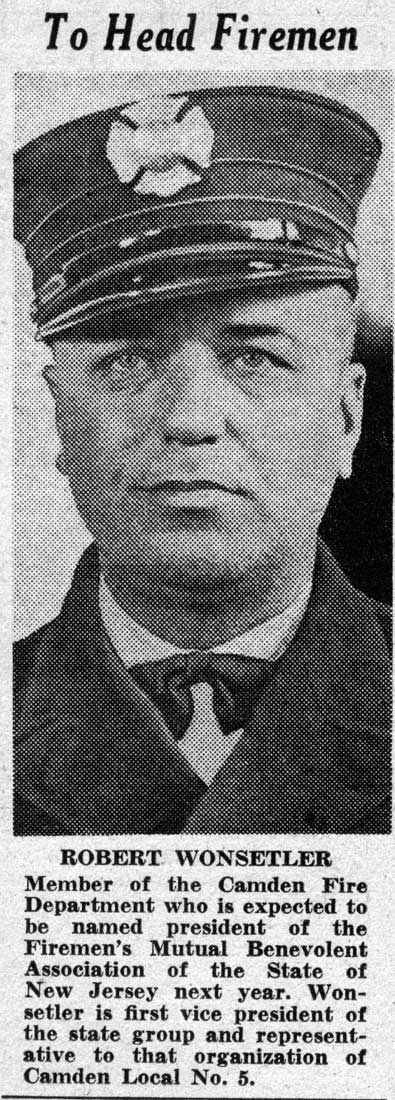
WONSETLER HAILED AS NEXT PRESIDENT OF STATE
Dinner Speakers Predict Camden Man Will Get Association Post
N. J. OFFICERS ATTEND
Robert Wonsetler, of the Camden Fire Department, was hailed as the next state president of the Firemen’s Mutual Benevolent Association at the 41st anniversary dinner of Camden Local, No. 5, last night. It was held in Kenney’s Cafe, with 150 members and their women folks attending.
The Camden man is now first vice president of the state association and state representative of the local. James Delaney, of Elizabeth, state president, and other state officers who were among the speakers predicted that when the local has its 42nd anniversary next year, it will have occasion to celebrate the election of Wonsetler as 1939 state president.
Other speakers were Mayor George E. Bruner, City Commissioners Mary W. Kobus and Frank J. Hartmann, Assemblyman Rocco Palese, Fire Chief John H. Lennox, Carlton W. Rowand, Bruce A. Wallace and Freeholder Edward J. Quinlan.
State officers attending, besides Delaney and Wonsetler, were Fred Bailey, Weehawken, second vice president; George Steele, Union City, recording secretary; Joseph Burke, Newark, financial secretary, and Jack Reed, Kearny, treasurer.
Surrogate Frank B. Hanna, who was toastmaster, referred to the three city commissioners present as “candidates for re-election without opposition.”
Commissioner Kobus, head of the city fire department, was applauded when she announced wash-stands and showers are being installed in local firehouses and that windbreakers and new fire nets have been ordered.
“The firehouses in Camden are in better condition than ever before,” Commissioner Hartmann said.
Officers of the Camden Local are Chester Andrus, president; W. Samuel Mountney, vice president; Nelson Andrews, recording secretary; Harrison Pike, financial secretary; Henry Zook, treasurer; Ralph Bingemann, sergeant-at-arms; William H. Harrison, chaplain, and Wonsetler, state representative.
Russell J. Anderson was chairman of the dinner committee, which included Harry Wagner, Arthur Batten, Harry Wilkers, David Humphries and Pike.
Pensions Studied
Trenton Evening Times —
Pensions are being given consideration at this afternoon’s meeting of the State Firemen’s Mutual Benevolent Association in the Stacy-Trent. Officers are being installed. Robert WonSetler, of Camden, is the new president.
Changes Announced in Fire Department
Camden Courier-Post —
CHANGES ANNOUNCED IN FIRE DEPARTMENT
Truck Disbanded, Engine Company Created; 13 Men Transferred
Commissioner Mary W. Kobus yesterday announced a number of changes in the fire department, including the disbanding of Truck Company No. 4; creation of a new engine company. No. 10, and the transfer of 18 officers and men, 12 of them captains.
Most of the new captains have been serving as acting captains and promotion to full rank will involve no pay increases, inasmuch as the men signed waivers foregoing the raises.
Commissioner Kobus explained most of the changes were made to conform with regulations of the National Board of Fire Underwriters. The board, Mrs. Kobus explained, made a survey of the department and advised appointments of acting captains to full rank.
The commissioner also announced she had appointed Junior Captain Raymond Smith as director of the school for firemen at Engine Company No. 10, Ninth and Morgan streets. Smith, one of the youngest at the recently appointed junior captains, will succeed the late Battalion Chief Rollo Jones.
Senior Captain Leonard Megee was appointed acting battalion chief to succeed Jones. He will continue at the Fifth and Arch streets fire headquarters.
Junior Captain William Spencer, of headquarters company, was named relief captain.
Engine Company No. 10 will use the headquarters of the old truck company, at Ninth and Morgan streets.
To the new company Mrs. Kobus assigned Senior Captain Mortica Clark and Firemen Frank Burt, Frank Esperance and Clifford Lane.
Junior Captain Frank Oberman was transferred from Engine Company No. 10 to Engine Company No. 1, at fire headquarters.
Other assignments are as follows:
Junior Captain Robert Wonsetler, Engine Company No. 11, to Engine Company No. 2.
Fireman Harry Kleinfelder, Engine Company No. 6, to Engine Company No. 2.
Junior Captain Edgar Ellender, Engine Company No. 2, to Engine Company No. 6.
Junior Captain Ralph Bingemann, Truck Company No. 2, to Engine Company No. 7.
Fireman David Humphries, Truck Company No. 3, to Engine Company No. 11.
Junior Captain Nelson Andrews, Engine Company No. 2, to Truck Company No. 1.
Fireman Albert Dukes, Jr., Truck Company No. 1, to Engine Company No. 2.
Junior Captain Winfield Levisuer, Truck Company No. 2, to Truck Company No. 3.
Junior Captain Edward McDowell retains assignment to Engine Company No. 3.
Junior Captain Maurice O’Brien assigned to Engine Company No. 10.
The changes were contained in notice to the Civil Service Commission, are effective as of June 1 and will appear on the June 15 payroll.
World War II Draft Card
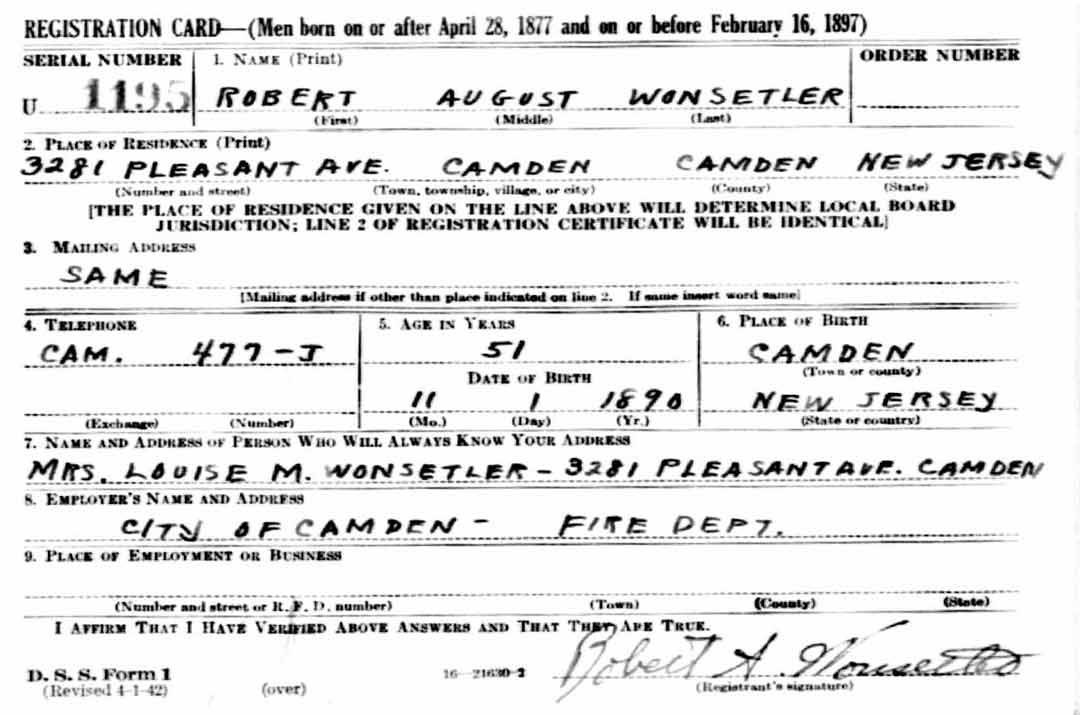
Robert A. Wonsetler — World War II Draft Card
District Chief Robert Wonsetler, 1950s
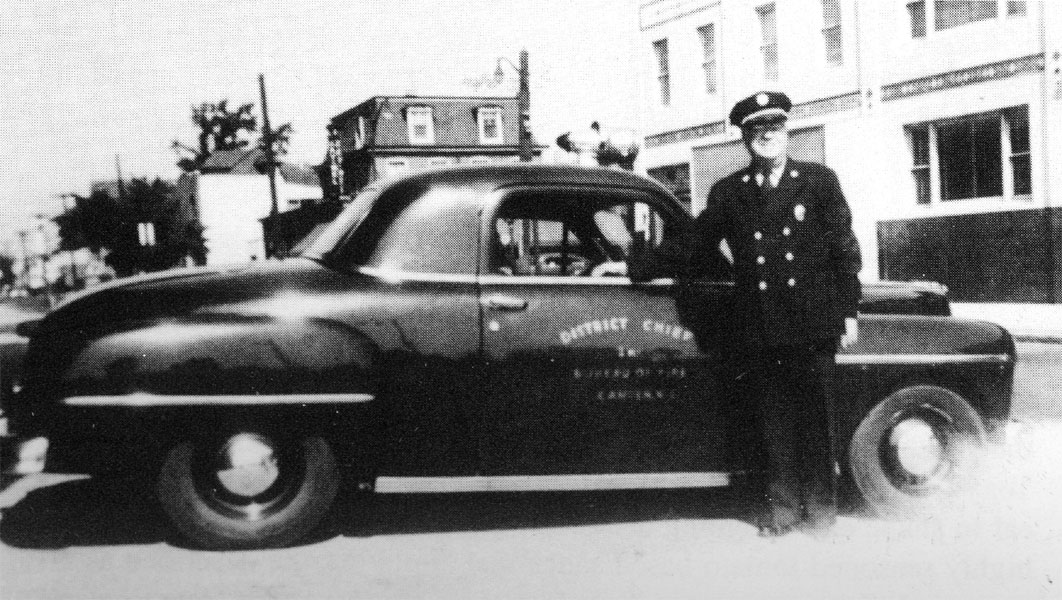
District Chief Robert Wonsetler in front of 2nd Battalion headquarters, 27th & Federal Street, 1950s
Police Investigate 3 Fires in 4 Hours In One Section
Camden Courier-Post —
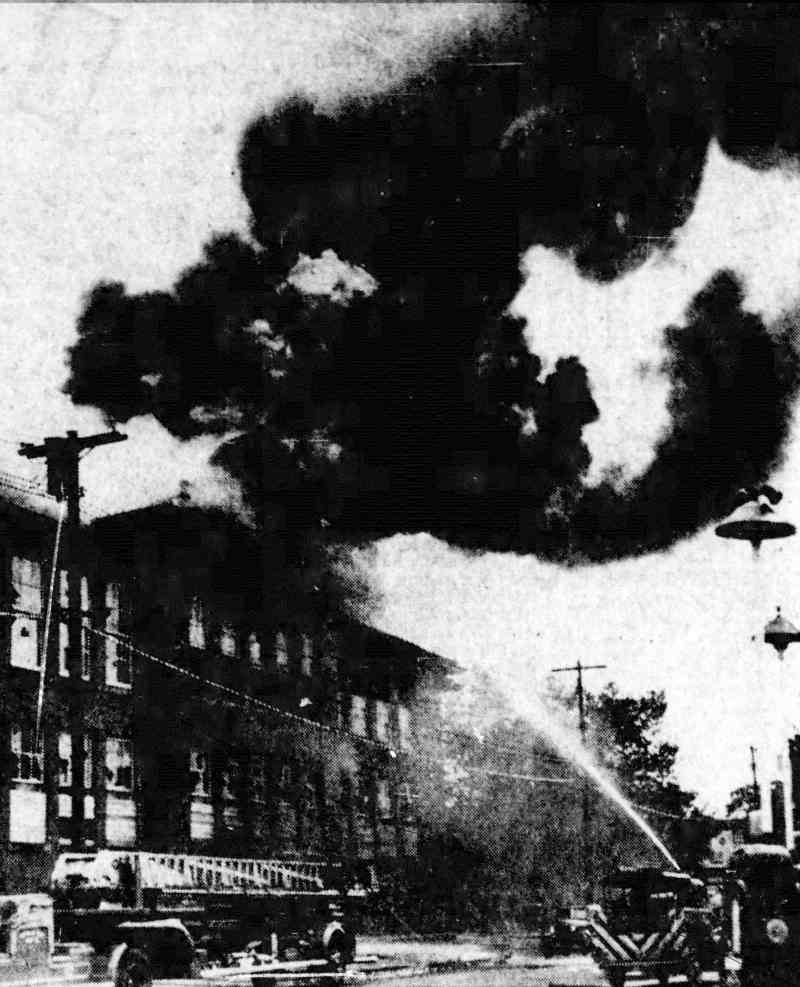
Kaighn School Razed; Blazes Set in Church, Unoccupied House
ABANDONED KAIGHN SCHOOL building was razed Wednesday afternoon in one of three fires within a quarter-mile area. Photo shows flames and smoke pouring through roof of the building at 5th and Chestnut sts. Police were investigating the theory that the three fires within three hours and 46 minutes were the work of an arsonist.
Police today are investigating the possibility that three fires Wednesday within a quarter-mile area inside of three hours and 46 minutes were the work of a firebug.
The blaze which razed the Kaighn School, 5th and Chestnut sts., seriously damaged Our Lady of Mt. Carmel R. C. Church, 4th and Division sts., and consumed a pile of rubbish in the basement of an unoccupied three-story house at 7th and Pine sts., came on the 12th anniversary of the disastrous Hollingshead fire.
That fire, on July 30, 1940, leveled the R. M. Hollingshead plant, then located at 9th and Market sts., took 10 lives and caused an estimated $4 million damage, according to city fire department records. It was Camden’s worst fire.
Police Chief Koerner, commenting on Wednesday’s fires which caused damage estimated at more than $17,000, said: “We are going to make a thorough study of every available clue to see whether the fires could have been started by one person.”
Koerner, Pfefferle Investigate
Fire Chief Pfefferle agreed with Chief Koerner and said that he had already requested the fire marshal’s office to probe into the circumstances of the chain-fires which kept the city’s fire department on the go from 12:46 p. m. until well after 9 p. m.
The most disastrous of the series of fires was that which broke out in the cupola of the Kaighn School at 3 p. m. Damage was estimated at “$15,000 or more,” by Joseph C. Ragone, secretary of the Camden Board of Education.
A dozen row houses on Sycamore st. and six homes on Newton ave. were imperilled and Acting District Fire Chief Henry E. Zook ordered the buildings wetted down.
School Closed for Three Years
The three-story abandoned school was a shambles by 6 p. m. One of the oldest schools in the city, the 15-room structure had been unused for the past three years. The last fire apparatus, Engine 3, left the scene at 9 p. m.
Upon arrival on the scene Zook immediately sent in a second alarm while thousands of onlookers gathered in the area. Police emergency cars, an ambulance, fire apparatus and cars belonging to fire and police officials choked the narrow streets. As the blaze continued an enterprising ice cream vender halted his cart and did a thriving business among spectators.
Three firemen were injured slightly. Walter Dilsworth, of Engine Co. 2, William Warren, of Engine 8, and Eugene Alston, of Engine 1, were treated at Cooper Hospital. In this connection Zook told a Courier-Post reporter: “I’d been expecting this place to go for a long time and I always hoped it would be in the daytime. I don’t hesitate to say that if this fire had broken out at night we might have had a fatality. The roof collapsed within the first 25 minutes.”
’Bottlegangers’ Used School
Still another possibility of tragedy was suggested by Fire Chief Pfefferle. “We found ample evidence that the abandoned school was used as a rendezvous by bottlegangers. Among the debris we saw lots of empty bottles. If any of these bottlegangers had been sleeping off a drunken stupor there is very little chance that he would have been discovered. After all, we do not look for tenants in buildings that are boarded up.”
The chief added that although he would ask Police Chief Koerner to probe into the possibility of an arsonist, he was personally inclined to the belief that children were responsible.
“It looks like kids’ work to me,” Pfefferle declared.
The fire chief declined to estimate the loss in the three fires and said he had no idea as to the cause of the church and school fires. He said the third fire, in the basement of an unoccupied three-story brick apartment at 701 Pine st., was caused by rubbish.
New Truck Used
The chief said the new aerial ladder, used for the first time on a real fire, “worked in first class condition.”
To protect both firemen and spectators Max Dippner, Public Service Gas and Electric Co. employe, disconnected a 2400-volt transformer on a pole near the school and left an area of four city blocks without power or light until 5 p. m., when he restored the service.
Damage at the earlier fire at Our Lady of Mt. Carmel Church, 4th and Division sts., was estimated at “several thousand dollars,” by the Rev. Michael Argullo, the pastor. This alarm was sounded at 12:46 p. m. and Pfefferle said a thorough check would be made of the possibility of deliberate arson.
Church Damaged Earlier
The flames destroyed a confessional, scorched pews and blackened a number of statues, the priest said. The Rev. Richard Gerbino, a curate, removed the Most Blessed Sacrament from its tabernacle, and nuns took a number of vestments into an adjoining building.
While the Kaighn School fire was at its height an alarm was sent in for a blaze at the northeast corner of Newton and Pine sts. Acting Chief Austin Marks of the 2nd District said he believed the fire was set by boys who entered the boarded-up vacant three-story apartment building by climbing up to a second floor porch. Firemen had to batter down at least two doors to get inside the house, Marks said. Engine Cos. 6 and 9 and Truck Co. 3 were at the fire.
State Owns Building
The building is in the right of way of the proposed North-South Freeway and is owned by the state, according to Marks.
Three other alarms rounded out the day for the fire-fighters. At 12:19 p. m. they extinguished a rubbish fire on a lot at Budd and Mulford sts. At 6:07 p. m. they doused a slight blaze in a pile of wooden molds in the rear of the Brown Foundry Corp., Cambridge st. and Wayne ave. Although this blaze was only 100 feet from the Washington School, the building was not endangered at any time, Robert Wonsetler, chief of the 2nd District, said. Engine 11 responded.
Last fire of the day was an automobile on Penn st. between 5th and 6th sts. Firemen were called out for this at 10:43 p. m.
In 1946 the Kaighn School was rated “poor” in nine points of the Camden Educational Council’s physical survey report. Lack of outside fire exits and general rundown conditions were cited in the report.
Frequently the school was the target of vandals. Intruders ransacked eight rooms early in November, 1947, and in October of 1948 seven rooms were ransacked and jets on a gas stove were left turned on. In December, 1948, rooms were again ransacked and late in February of 1949 Red Cross boxes in the school were looted and a radio and record player were stolen.
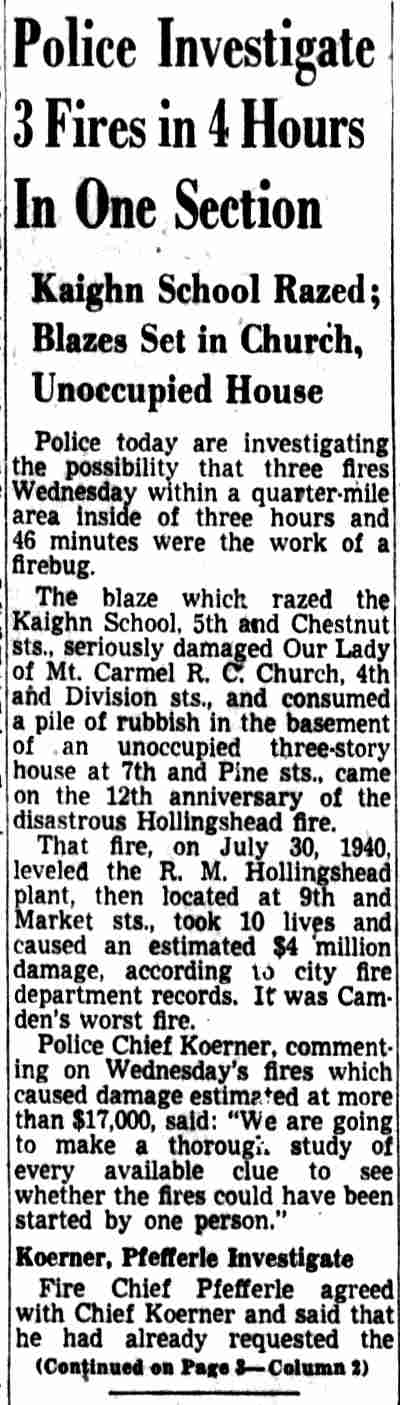
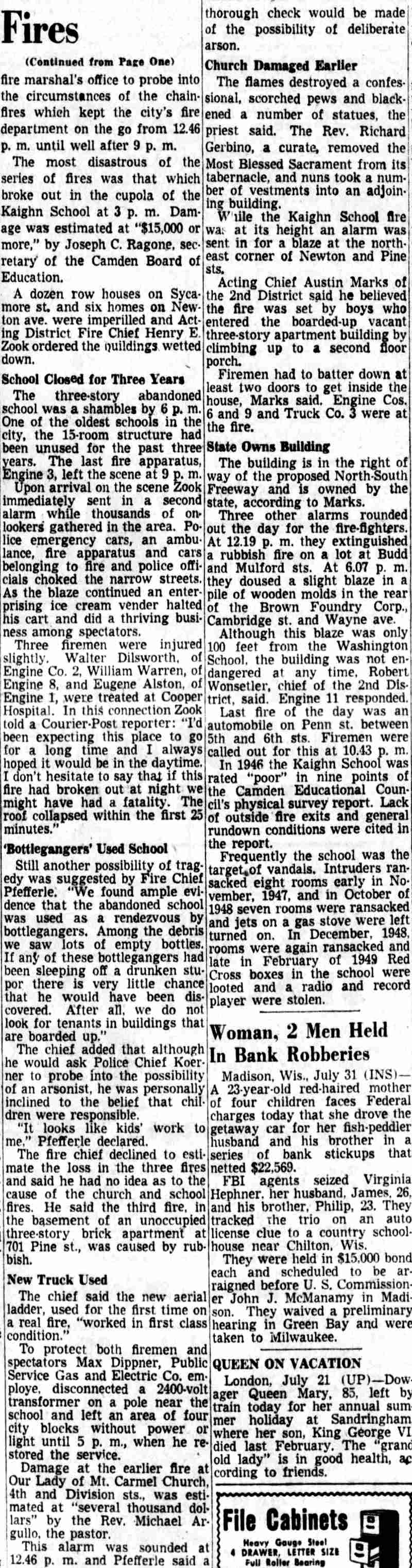
POLICE INVESTIGATE 3 FIRES IN 4 HOURS IN ONE SECTION
Kaighn School Razed; Blazes Set in Church, Unoccupied House
ABANDONED KAIGHN SCHOOL building was razed Wednesday afternoon in one of three fires within a quarter-mile area. Photo shows flames and smoke pouring through roof of the building at 5th and Chestnut sts. Police were investigating the theory that the three fires within three hours and 46 minutes were the work of an arsonist.
Police today are investigating the possibility that three fires Wednesday within a quarter-mile area inside of three hours and 46 minutes were the work of a firebug.
The blaze which razed the Kaighn School, 5th and Chestnut sts., seriously damaged Our Lady of Mt. Carmel R. C. Church, 4th and Division sts., and consumed a pile of rubbish in the basement of an unoccupied three-story house at 7th and Pine sts., came on the 12th anniversary of the disastrous Hollingshead fire.
That fire, on July 30, 1940, leveled the R. M. Hollingshead plant, then located at 9th and Market sts., took 10 lives and caused an estimated $4 million damage, according to city fire department records. It was Camden’s worst fire.
Police Chief Koerner, commenting on Wednesday’s fires which caused damage estimated at more than $17,000, said: “We are going to make a thorough study of every available clue to see whether the fires could have been started by one person.”
Koerner, Pfefferle Investigate
Fire Chief Pfefferle agreed with Chief Koerner and said that he had already requested the fire marshal’s office to probe into the circumstances of the chain-fires which kept the city’s fire department on the go from 12:46 p. m. until well after 9 p. m.
The most disastrous of the series of fires was that which broke out in the cupola of the Kaighn School at 3 p. m. Damage was estimated at “$15,000 or more,” by Joseph C. Ragone, secretary of the Camden Board of Education.
A dozen row houses on Sycamore st. and six homes on Newton ave. were imperilled and Acting District Fire Chief Henry E. Zook ordered the buildings wetted down.
School Closed for Three Years
The three-story abandoned school was a shambles by 6 p. m. One of the oldest schools in the city, the 15-room structure had been unused for the past three years. The last fire apparatus, Engine 3, left the scene at 9 p. m.
Upon arrival on the scene Zook immediately sent in a second alarm while thousands of onlookers gathered in the area. Police emergency cars, an ambulance, fire apparatus and cars belonging to fire and police officials choked the narrow streets. As the blaze continued an enterprising ice cream vender halted his cart and did a thriving business among spectators.
Three firemen were injured slightly. Walter Dilsworth, of Engine Co. 2, William Warren, of Engine 8, and Eugene Alston, of Engine 1, were treated at Cooper Hospital. In this connection Zook told a Courier-Post reporter: “I’d been expecting this place to go for a long time and I always hoped it would be in the daytime. I don’t hesitate to say that if this fire had broken out at night we might have had a fatality. The roof collapsed within the first 25 minutes.”
’Bottlegangers’ Used School
Still another possibility of tragedy was suggested by Fire Chief Pfefferle. “We found ample evidence that the abandoned school was used as a rendezvous by bottlegangers. Among the debris we saw lots of empty bottles. If any of these bottlegangers had been sleeping off a drunken stupor there is very little chance that he would have been discovered. After all, we do not look for tenants in buildings that are boarded up.”
The chief added that although he would ask Police Chief Koerner to probe into the possibility of an arsonist, he was personally inclined to the belief that children were responsible.
“It looks like kids’ work to me,” Pfefferle declared.
The fire chief declined to estimate the loss in the three fires and said he had no idea as to the cause of the church and school fires. He said the third fire, in the basement of an unoccupied three-story brick apartment at 701 Pine st., was caused by rubbish.
New Truck Used
The chief said the new aerial ladder, used for the first time on a real fire, “worked in first class condition.”
To protect both firemen and spectators Max Dippner, Public Service Gas and Electric Co. employe, disconnected a 2400-volt transformer on a pole near the school and left an area of four city blocks without power or light until 5 p. m., when he restored the service.
Damage at the earlier fire at Our Lady of Mt. Carmel Church, 4th and Division sts., was estimated at “several thousand dollars,” by the Rev. Michael Argullo, the pastor. This alarm was sounded at 12:46 p. m. and Pfefferle said a thorough check would be made of the possibility of deliberate arson.
Church Damaged Earlier
The flames destroyed a confessional, scorched pews and blackened a number of statues, the priest said. The Rev. Richard Gerbino, a curate, removed the Most Blessed Sacrament from its tabernacle, and nuns took a number of vestments into an adjoining building.
While the Kaighn School fire was at its height an alarm was sent in for a blaze at the northeast corner of Newton and Pine sts. Acting Chief Austin Marks of the 2nd District said he believed the fire was set by boys who entered the boarded-up vacant three-story apartment building by climbing up to a second floor porch. Firemen had to batter down at least two doors to get inside the house, Marks said. Engine Cos. 6 and 9 and Truck Co. 3 were at the fire.
State Owns Building
The building is in the right of way of the proposed North-South Freeway and is owned by the state, according to Marks.
Three other alarms rounded out the day for the fire-fighters. At 12:19 p. m. they extinguished a rubbish fire on a lot at Budd and Mulford sts. At 6:07 p. m. they doused a slight blaze in a pile of wooden molds in the rear of the Brown Foundry Corp., Cambridge st. and Wayne ave. Although this blaze was only 100 feet from the Washington School, the building was not endangered at any time, Robert Wonsetler, chief of the 2nd District, said. Engine 11 responded.
Last fire of the day was an automobile on Penn st. between 5th and 6th sts. Firemen were called out for this at 10:43 p. m.
In 1946 the Kaighn School was rated “poor” in nine points of the Camden Educational Council’s physical survey report. Lack of outside fire exits and general rundown conditions were cited in the report.
Frequently the school was the target of vandals. Intruders ransacked eight rooms early in November, 1947, and in October of 1948 seven rooms were ransacked and jets on a gas stove were left turned on. In December, 1948, rooms were again ransacked and late in February of 1949 Red Cross boxes in the school were looted and a radio and record player were stolen.
District Firemen Fete 2 Veterans On Retirement
Camden Courier-Post —
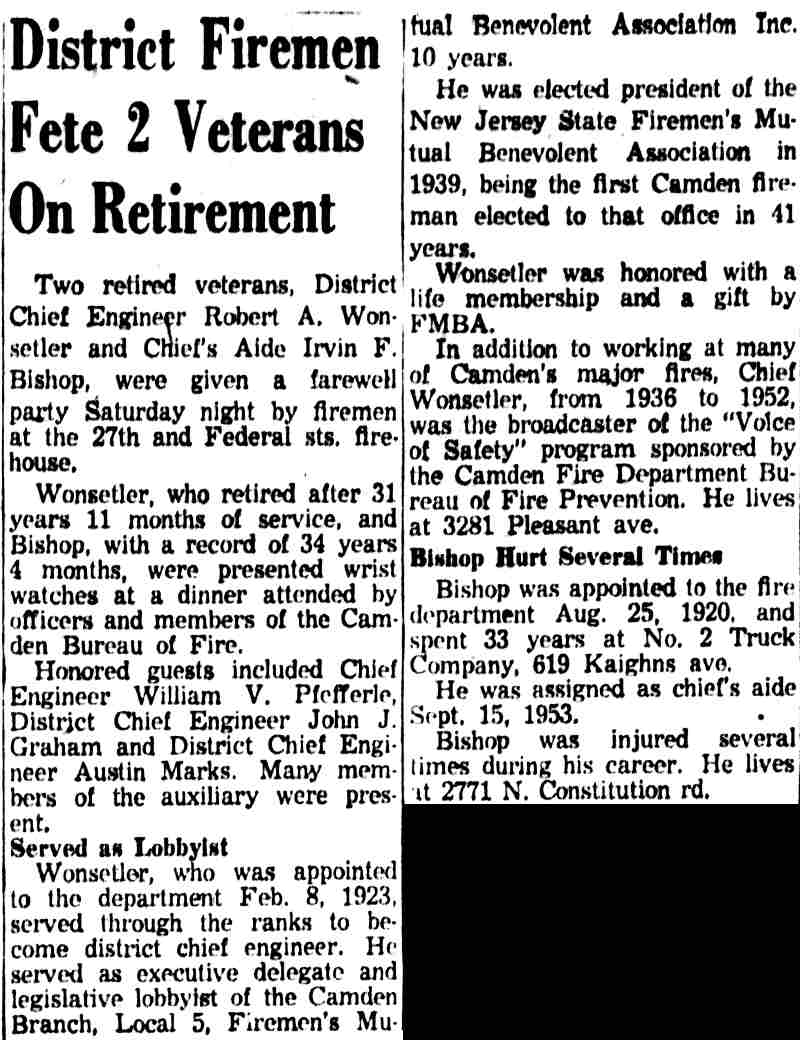
Two retired veterans, District Chief Engineer Robert A. Wonsetler and Chief’s Aide Irvin F. Bishop, were given a farewell party Saturday night by firemen at the 27th and Federal sts. firehouse.
Wonsetler, who retired after 31 years 11 months of service, and Bishop, with a record of 34 years 4 months, were presented wrist watches at a dinner attended by officers and members of the Camden Bureau of Fire.
Honored guests included Chief Engineer William V. Pfefferle, District Chief Engineer John J. Graham and District Chief Engineer Austin Marks. Many members of the auxiliary were present.
Served as Lobbyist
Wonsetler, who was appointed to the department Feb. 8, 1923, served through the ranks to become district chief engineer. He served as executive delegate and legislative lobbyist of the Camden Branch, Local 5, Firemen’s Mutual Benevolent Association Inc. 10 years.
He was elected president of the New Jersey State Firemen’s Mutual Benevolent Association in 1939, being the first Camden fireman elected to that office in 41 years.
Wonsetler was honored with a life membership and a gift by FMBA.
In addition to working at many of Camden’s major fires, Chief Wonsetler, from 1936 to 1952, was the broadcaster of the “Voice of Safety” program sponsored by the Camden Fire Department Bureau of Fire Prevention. He lives at 3281 Pleasant ave.
Bishop Hurt Several Times
Bishop was appointed to the fire department Aug. 25, 1920, and spent 33 years at No. 2 Truck Company, 619 Kaighns ave.
He was assigned as chief’s aide Sept. 15, 1953.
Bishop was injured several times during his career. He lives at 2771 N. Constitution rd.
I had a clear shot at him…
Camden Courier-Post —
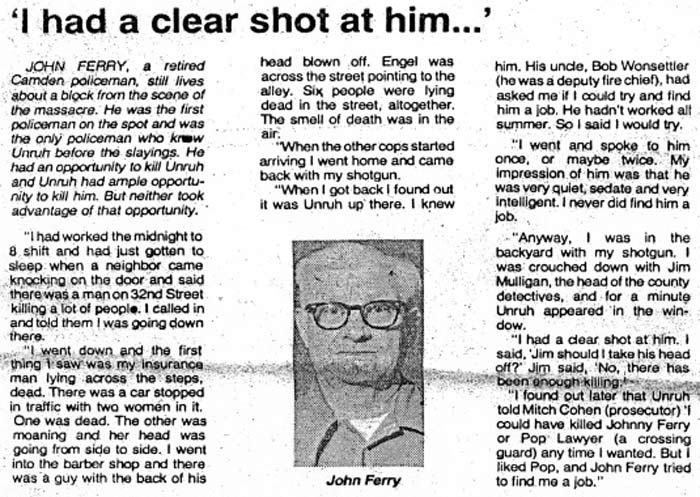
JOHN FERRY, a retired Camden policeman, still lives about a block from the scene of the massacre. He was the first policeman on the spot and was the only policeman who knew Unruh before the slayings. He had an opportunity to kill Unruh and Unruh had ample opportunity to kill him. But neither took advantage of that opportunity.
“I had worked the midnight to 8 shift and had just gotten to sleep when a neighbor came knocking on the door and said there was a man on 32nd Street killing a lot of people. I called in and told them I was going down there.
“I went down and the first thing I saw was my insurance man lying across the steps, dead. There was a car stopped in traffic with two women in it. One was dead. The other was moaning and her head was going from side to side. I went into the barber shop and there was a guy with the back of his head blown off. Engel was across the street pointing to the alley. Six people were lying dead in the street, altogether. The smell of death was in the air.
“When the other cops started arriving I went home and came back with my shotgun.
“When I got back I found out it was Unruh up there. I knew him. His uncle, Bob Wonsettler (he was a deputy fire chief), had asked me if I could try and find him a job. He hadn’t worked all summer. So I said I would try.
“I went and spoke to him once, or maybe twice. My impression of him was that he was very quiet, sedate and very intelligent. I never did find him a job.
“Anyway, I was in the backyard with my shotgun. I was crouched down with Jim Mulligan, the head of the county detectives, and for a minute Unruh appeared in the window.
“I had a clear shot at him. I said, ‘Jim should I take his head off?’ Jim said, ‘No, there has been enough killing.’
“I found out later that Unruh told Mitch Cohen (prosecutor) ‘I could have killed Johnny Ferry or Pop Lawyer (a crossing guard) any time I wanted. But I liked Pop, and John Ferry tried to find me a job.”
John Ferry