Maurice Browning
MAURICE BROWNING was born in 1811, one of 11 children born to Abraham & Buelah Browning. His father owned a large farm on Cooper’s Creek, known today as the Cooper River, and later owned the West Jersey Ferry. Maurice Browning engaged in business after completing his education, and found success in dyed woods. He was a director of the First National Bank of Camden, and at age 75 was elected president of the Board of Managers of the Camden City Dispensary, which was the city’s first hospital, established in 1866 on 3rd Street below Market where the Security Trust Building stands, and later moved to Federal Street east of 7th Street.
Maurice Browning’s daughter Josephine married Isaac Daughten, who served as Deputy Comptroller for the state of New Jersey for many years.
St. Paul’s Episcopal Church Officers Elected
Philadelphia Inquirer —
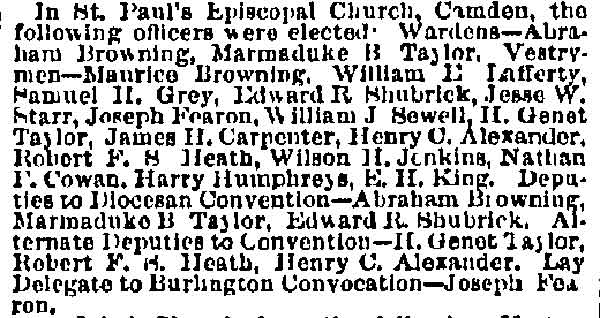
In St. Paul’s Episcopal Church, Camden, the following officers were elected: Wardens—Abraham Browning, Marmaduke B. Taylor. Vestrymen—Maurice Browning, William H. Lafferty, Samuel H. Grey, Edward R. Shubrick, Jesse W. Starr, Joseph Fearon, William J. Sewell, H. Genet Taylor, James H. Carpenter, Henry C. Alexander, Robert F. S. Heath, Wilson H. Jenkins, Nathan F. Cowan, Harry Humphreys, E. H. King. Deputies to Diocesan Convention—Abraham Browning, Marmaduke B. Taylor, Edward R. Shubrick. Alternate Deputies to Convention—H. Genet Taylor, Robert F. S. Heath, Henry C. Alexander. Lay Delegate to Burlington Convocation—Joseph Fearon.
Maurice Browning vs. Hugo Kainer
Philadelphia Inquirer —
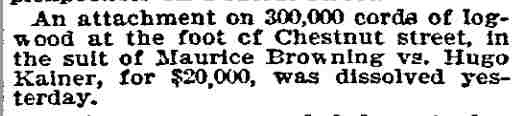
An attachment on 300,000 cords of logwood at the foot of Chestnut street, in the suit of Maurice Browning vs. Hugo Kainer, for $20,000, was dissolved yesterday.
Maurice Browning
Biographical Review — 1897
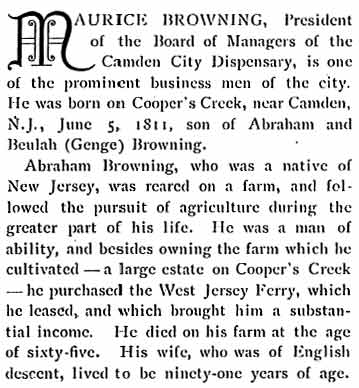
MAURICE BROWNING, President of the Board of Managers of the Camden City Dispensary, is one of the prominent business men of the city. He was born on Cooper’s Creek, near Camden, N.J., June 5, 1811, son of Abraham and Beulah (Genge) Browning.
Abraham Browning, who was a native of New Jersey, was reared on a farm, and followed the pursuit of agriculture during the greater part of his life. He was a man of ability, and besides owning the farm which he cultivated—a large estate on Cooper’s Creek—he purchased the West Jersey Ferry, which he leased, and which brought him a substantial income. He died on his farm at the age of sixty-five. His wife, who was of English descent, lived to be ninety-one years of age. They reared thirteen children, only one of whom, the subject of this sketch, is living to-day.
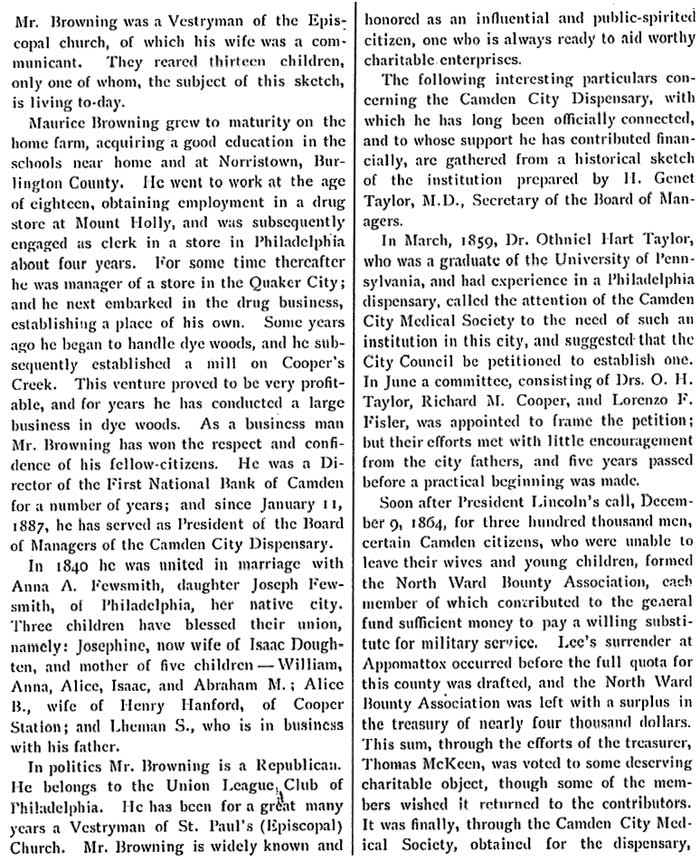
Maurice Browning grew to maturity on the home farm, acquiring a good education in the schools near home and at Norristown, Burlington County. He went to work at the age of eighteen, obtaining employment in a drug store at Mount Holly, and was subsequently engaged as clerk in a store in Philadelphia about four years. For some time thereafter he was manager of a store in the Quaker City; and he next embarked in the drug business, establishing a place of his own. Some years ago he began to handle dye woods, and he subsequently established a mill on Cooper’s Creek. This venture proved to be very profitable, and for years he has conducted a large business in dye woods. As a business man Mr. Browning has won the respect and confidence of his fellow-citizens. He was a Director of the First National Bank of Camden for a number of years; and since January 11, 1887, he has served as President of the Board of Managers of the Camden City Dispensary.
In 1840 he was united in marriage with Anna A. Fewsmith, daughter Joseph Fewsmith, of Philadelphia, her native city. Three children have blessed their union, namely: Josephine, now wife of Isaac Doughten, and mother of five children—William, Anna, Alice, Isaac, and Abraham M.; Alice B., wife of Henry Hanford, of Cooper Station; and Lheman S., who is in business with his father.
In politics Mr. Browning is a Republican. He belongs to the Union League Club of Philadelphia. He has been for a great many years a Vestryman of St. Paul’s (Episcopal) Church. Mr. Browning is widely known and honored as an influential and public-spirited citizen, one who is always ready to aid worthy charitable enterprises.
The following interesting particulars concerning the Camden City Dispensary, with which he has long been officially connected, and to whose support he has contributed financially, are gathered from a historical sketch of the institution prepared by H. Genet Taylor, M.D., Secretary of the Board of Managers.
In March, 1859, Dr. Othniel Hart Taylor, who was a graduate of the University of Pennsylvania, and had experience in a Philadelphia dispensary, called the attention of the Camden City Medical Society to the need of such an institution in this city, and suggested that the City Council be petitioned to establish one. In June a committee, consisting of Drs. O. H. Taylor, Richard M. Cooper, and Lorenzo F. Fisler, was appointed to frame the petition; but their efforts met with little encouragement from the city fathers, and five years passed before a practical beginning was made.
Soon after President Lincoln’s call, December 9, 1864, for three hundred thousand men, certain Camden citizens, who were unable to leave their wives and young children, formed the North Ward Bounty Association, each member of which contributed to the general fund sufficient money to pay a willing substitute for military service. Lee’s surrender at Appomattox occurred before the full quota for this county was drafted, and the North Ward Bounty Association was left with a surplus in the treasury of nearly four thousand dollars. This sum, through the efforts of the treasurer, Thomas McKeen, was voted to some deserving charitable object, though some of the members wished it returned to the contributors. It was finally, through the Camden City Medical Society, obtained for the dispensary, though its disposition was fought in the courts by the members who wished it returned. In the spring of 1866 the Camden City Dispensary was established in the hose house on Third Street, below Market, on the site now occupied by the vaults of the West Jersey Title and Guaranty Company; and for two years or more the generous physicians of the city, men who will long be gratefully remembered for their disinterested philanthropy, gave their services gratuitously.
Private contributions have largely supported the institution from the beginning. In 1868 the City Council voted an annual appropriation of three hundred dollars; and in 1879 it was increased to sixteen hundred dollars, allowing a small salary to the attending physicians. Various changes have been made since then. The new building is on Federal Street, above Seventh, a two-story brick edifice with Indiana limestone trimmings. On the first floor are a reception-room for patients, an office for the Superintendent of the Relief Association, drug-rooms, and surgery, a wide hall with staircase, and at the end of the hall a room which is used for a clinic. On the second floor are a large library, lecture-room, and toilet-rooms, a serving-room, and pantry; and in the rear is a three-story house for the custodian of the building.
Browning Brothers Assigned Estate
Philadelphia Inquirer —
Judge Joline yesterday dismissed the petition of Judge Bergen in the assigned estate of Browning Brothers, in which he asked that the orders in the case be expunged from the records of the New Jersey courts. H. B. Hanford, the assignee, was ordered to hold the $60,000.