John Wesley Beckett
JOHN WESLEY “WES” BECKETT was, in fact, the first Black police officer to serve as a member of the Camden Police Department, having been appointed in September of 1886 and having gone into service almost immediately. William Miles Butts, who over the last hundred-plus years has generally been credited with that distinction, was first appointed to the department in April of 1887 and did not actually begin working as a Camden policeman until mid-July of that year. “Wes” Beckett was also the third Black member of the Camden Fire Department.
“Wes” Beckett was born in Delaware around 1843 to John Beckett and the former Mary Hester “Hettie” Johnson. The family, which included younger brother Charles Beckett, was living in Little Creek Hundred, Kent County, Delaware when the Census was taken in 1850. By 1860 John W. Beckett’s father had passed. The Becketts lived in Newton Township, much of which would become part of Camden several years later. John W. Beckett worked for and lived with Samuel Eastlack, a farmer. His younger brother and mother also lived in Newton, at a separate residence. When the Census was taken in 1870 John W. Beckett was working as a laborer. He lived with his mother, wife Annie L., and daughter Irena Beckett.
“Wes” Beckett, described as tall and slim, apparently liked to fight, and by his own admission had been up on charges twenty times by 1874.
“Wes” Beckett was appointed to the Camden Fire Department as an extra man with Engine Company 2 on November 26, 1877 as a replacement for Pierce Brown. He served until April of 1878, and was not reappointed. Charles Todd replaced him on the Fire Department’s table of organization. Fire Department records do not have an address or occupation for John W. Beckett; however the 1878 Camden City Directory states that he worked as a laborer and was living on South 8th Street below Central Avenue. His widowed mother was also listed at the same location. He also appears to have made an attempt at operating a saloon at 700 Kaighn Avenue at that time. In 1878 he was stabbed at South Fourth Street and Kaighn Avenue.
The 1880 Census shows John W. Beckett, his wife Annie and daughter Irena living in an un-numbered house on Mulford Street. By 1882 he had moved to Baxter Street, at Ann Street. The 1884–1885 City Directory shows him living at 720 Kaighn Avenue, working as a laborer. He opened a cigar store there soon afterwards, which was listed in the 1885 City Directory.
In 1884 John Wesley Beckett witnessed a fight between William Greenan and Charles Henry Jones, and was called on to testify in the matter.
On August 31, 1886 John W. Beckett was appointed to the Camden police department. He is listed in the 1887–1888 and 1888–1889 Directories as a policeman, living at 710 Kaighn Avenue. Directories from 1890–1891 through 1892–1893 show him living at 805 Central Avenue, working as a policeman. The 1893–1894 City Directory shows that he moved to 1807 South 7th Street, and was still a police officer at the time of the directory’s compilation. He worked as a police officer as late as October of 1893. The reason for his departure from the department are not known, but he may well have been let go for political reasons, as the Democrat-controlled Police Commission purged the department of virtually all Republican members in 1893.
John W. Beckett was still residing at 1807 South 7th Street when the 1894–1895 City Directory was compiled, and was working as a laborer. He is listed in the 1895–1896 Directory at that address, but moved to 1820 Kossuth Street prior to the compilation of the 1896 City Directory. He died in 1896.
Besides being the first Black police officer in Camden, John W. Beckett is noteworthy as he was the third Black member of the Camden Fire Department, coming into the department after Pierce Brown and Solomon Clark.
The Courts
Camden Post —

Daniel Perry was convicted October term of riotous assault and battery and cutting Wesley Beckett during riot at Fourth and Kaighn’s Pt. av., but broke jail and was caught but a few days ago. Sentenced to two years in state prison.
A Cross Action
Camden Post — June 12–13, 1884
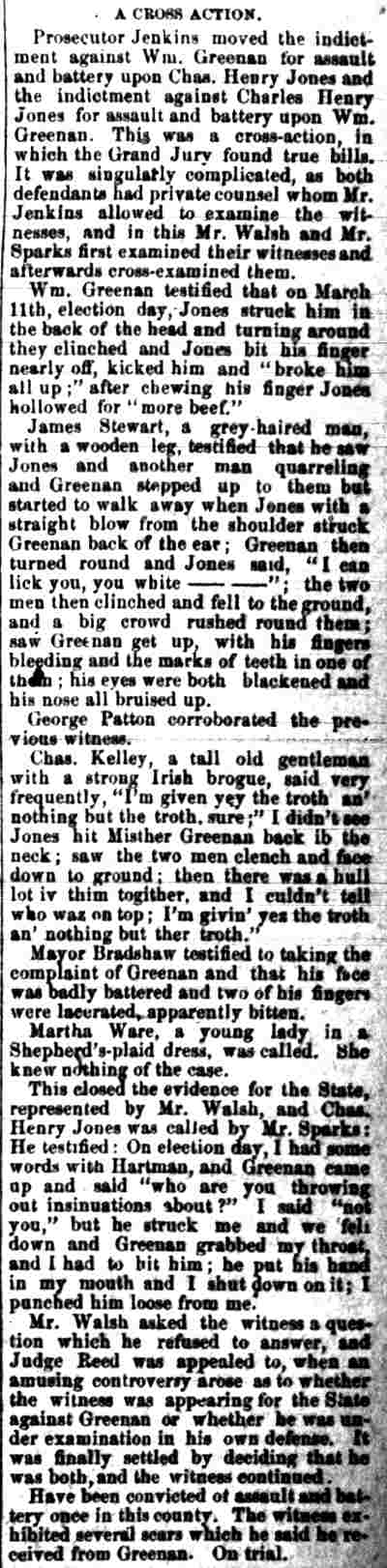
Prosecutor Jenkins moved the indictment against Wm. Greenan for assault and battery upon Chas. Henry Jones and the indictment against Charles Henry Jones for assault and battery upon Wm. Greenan. This was a cross-action, in which the Grand Jury found true bills. It was singularly complicated, as both defendants had private counsel whom Mr. Jenkins allowed to examine the witnesses, and in this Mr. Walsh and Mr. Sparks first examined their witnesses and afterwards cross-examined them.
Wm. Greenan testified that on March 11th, election day, Jones struck him in the back of the head and turning around they clinched and Jones bit his finger nearly off, kicked him and “broke him all up;” after chewing his finger Jones hollowed for “more beef.”
James Stewart, a grey-haired man, with a wooden leg, testified that he saw Jones and another man quarreling and Greenan stepped up to them but started to walk away when Jones with a straight blow from the shoulder struck Greenan back of the ear; Greenan then turned round and Jones said, “I can lick you, you white —— ——”; the two men then clinched and fell to the ground, and a big crowd rushed round them; saw Greenan get up, with his fingers bleeding and the marks of teeth in one of them; his eyes were both blackened and his nose all bruised up.
George Patton corroborated the previous witness.
Chas. Kelley, a tall old gentleman with a strong Irish brogue, said very frequently, “I’m given yey the troth an’ nothing but the troth, sure;” I didn’t see Jones hit Misther Greenan back ib the neck; saw the two men clench and face down to ground; then there was a hull lot iv thim togither, and I culdn’t tell who waz on top; I’m givin’ yes the troth an’ nothing but ther troth.”
Mayor Bradshaw testified to taking the complaint of Greenan and that his face was badly battered and two of his fingers were lacerated, apparently bitten.
Martha Ware, a young lady in a Shepherd’s-plaid dress, was called. She knew nothing of the case.
This closed the evidence for the State, represented by Mr. Walsh, and Chas. Henry Jones was called by Mr. Sparks: He testified: On election day, I had some words with Hartman, and Greenan came up and said “who are you throwing out insinuations about?” I said “not you,” but he struck me and we fell down and Greenan grabbed my throat, and I had to bit him; he put his hand in my mouth and I shut down on it; I punched him loose from me.
Mr. Walsh asked the witness a question which he refused to answer, and Judge Reed was appealed to, when an amusing controversy arose as to whether the witness was appearing for the State against Greenan or whether he was under examination in his own defense. It was finally settled by deciding that he was both, and the witness continued.
Have been convicted of assault and battery once in this county. The witness exhibited several scars which he said he received from Greenan. On trial.
Peter Postles, a big colored man, testified: Saw Jones and Hartman quarreling; saw Hartman leave and a little while afterwards Jones and Greenan go together.
Emory Bowyer, a colored boy, with a short body, long legs and huge pedal extremities, was called, but he saw the fight like a policeman after it was all over.
Wesley Beckett, a tall slim colored man with a brown Jersey, blue overalls and a huge calico standing collar, testified: I knew there was a fight, and knew the two men went together; saw them hang their hats on the fence; they both seemed anxious for the fight; I s’pose Greenan got his hand chewed and got the worst of the fight.
On cross-examination Beckett said he had been before the Court for assault and battery about twenty times, but not in the last ten years.
John Ryon, a little negro with a curly moustache, corroborated Jones’ testimony and said Greenan hung his hat on the fence, and the two men went at it.
Henry Hilmes, a tall yellow man with a long neck and queer look out of his eyes, corroborated the previous testimony.
Constable David O. Hunter testified that Jones and Greenan had some words; the latter put his hat on the fence and Jones followed; the two went together in a pitched battle; was not an officer at that time.
This closed the evidence in the case, and again the complications of the case were made apparent, when the question as to who should open the argument was raised.
Judge Reed said if counsel were unable to pool their issues the Court would have to listen to four arguments.
Mr. Sparks and Mr. Walsh consulted and being unable to decide as to which side they should speak on, the case was given to the jury without argument or charge from the Judge. Jones was found guilty also, with recommendation to the mercy of the Court.
The Changes on the Force
Camden Post —
A Colored Policeman Appointed and Two Resignations Received
The first colored citizen of Camden to put on a suit of blue and wear the brass buttons of a policeman will be Wesley Beckett, of the Eighth ward, who will go on duty today. He was appointed yesterday by Mayor Pratt to fill the vacancy caused by the resignation of Officer Miller, of the ward, another one of the Democrats, who will step out to day. The appointee is well known in the city and is a highly respected representative of his race.
One by one the Democratic force of the past is dropping off, the latest resignations being those of Officers Whalen and Chambers of the Eighth ward, who have sent their resignations to the Mayor, to take effect October the first. This will be the first ward in the city to have a full Republican force.
A Colored Officer
Camden Post —
Wesley Beckett, of the Eighth ward, who was appointed yesterday, on the police force by the Mayor, to do duty in the Eighth ward, is the first appointment ever made of a colored officer in this city, and last night, Officer Beckett donned the suit of blue and patrolled his beat until relieved this morning. He was the admiration of the small colored boys, who all declared that when they became old enough they would vote the Republican ticket and then be appointed on the police force, like Wesley, who took the place of Officer Miller.
Resisting Arrest
Camden Post —
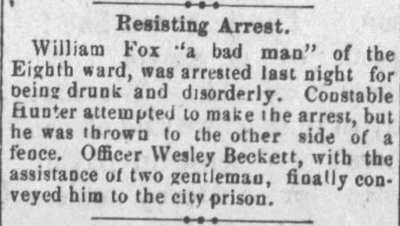
William Fox “a bad man” of the Eighth ward, was arrested last night for being drunk and disorderly. Constable Hunter attempted to make the arrest, but he was thrown to the other side of a fence. Officer Wesley Beckett, with the assistance of two gentleman, finally conveyed him to the city prison.
Over in Camden
Philadelphia Inquirer —
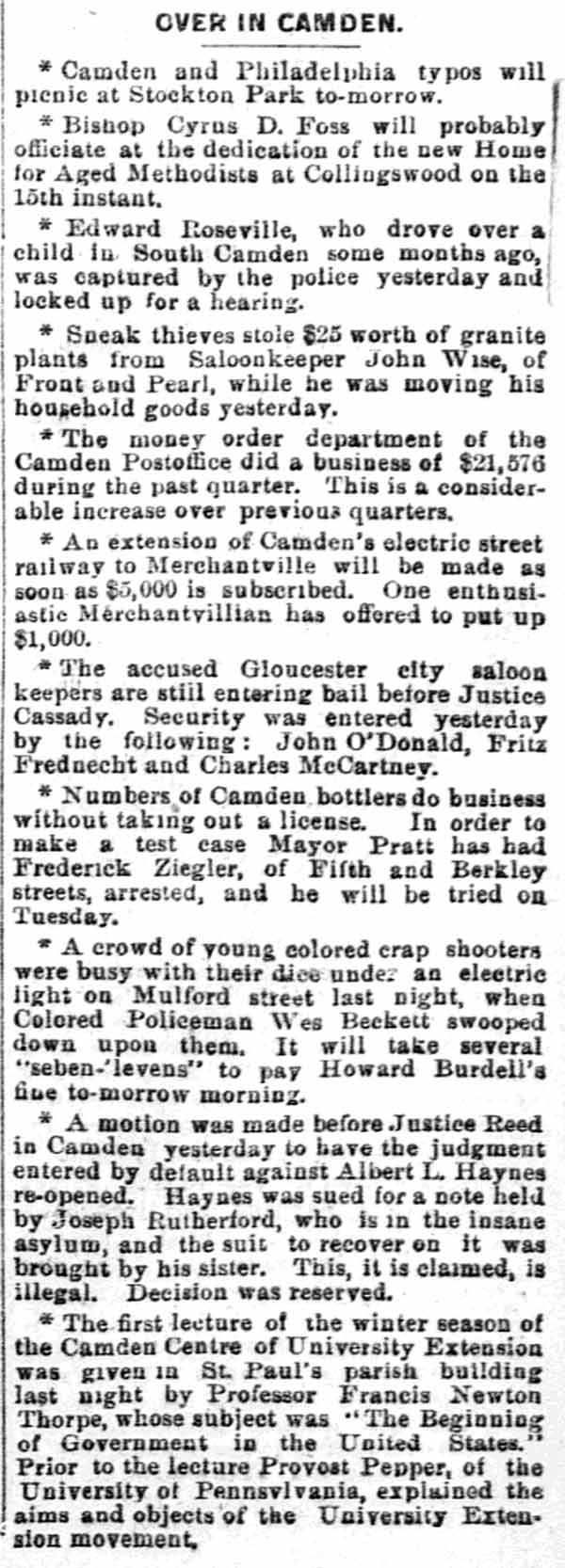
A crowd of young colored crap shooters were busy with their dice under an electric light on Mulford street last night, when Colored Policeman Wes Beckett swooped down upon them. It will take several “seben-’levens” to pay Howard Burdell’s fine to-morrow morning.
A Desperate Prisoner
Philadelphia Inquirer —
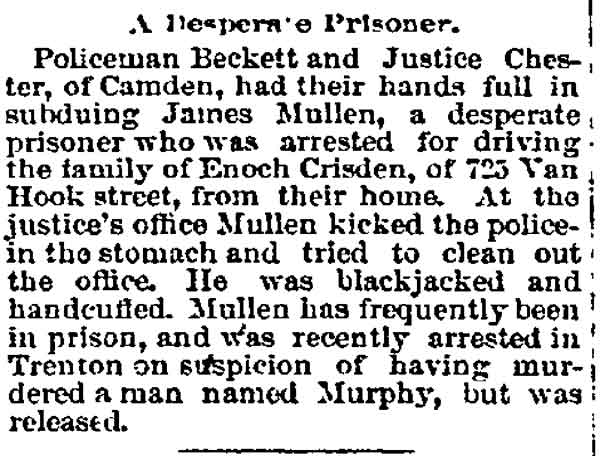
Policeman Beckett and Justice Chester, of Camden, had their hands full in subduing James Mullen, a desperate prisoner who was arrested for driving the family of Enoch Crisden, of 725 Van Hook street, from their home. At the justice’s office Mullen kicked the policeman in the stomach and tried to clean out the office. He was blackjacked and handcuffed. Mullen has frequently been in prison, and was recently arrested in Trenton on suspicion of having murdered a man named Murphy, but was released.
Over in Camden
Philadelphia Inquirer —
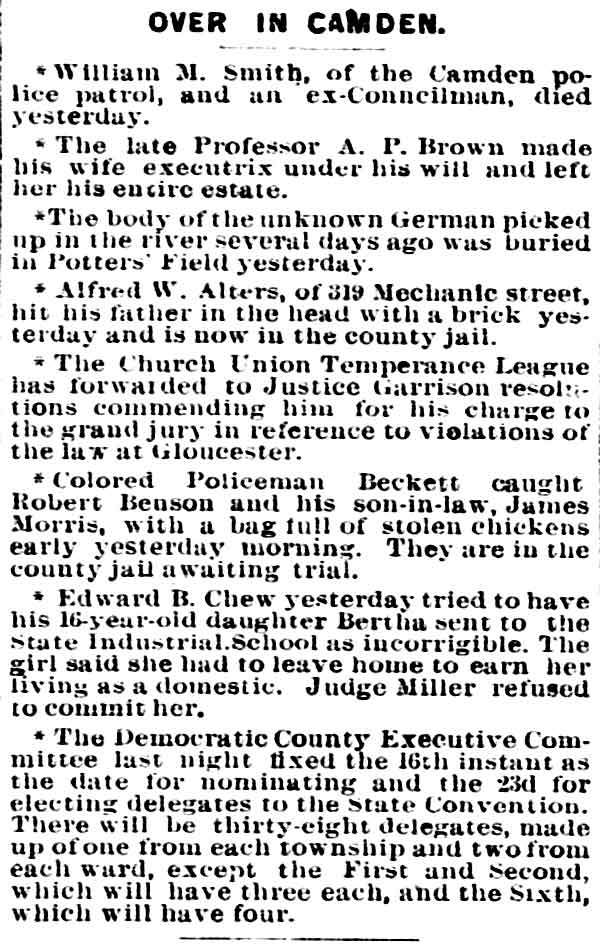
Colored Policeman Beckett caught Robert Benson and his son-in-law, James Morris, with a bag full of stolen chickens early yesterday morning. They are in the county jail awaiting trial.