Introduction
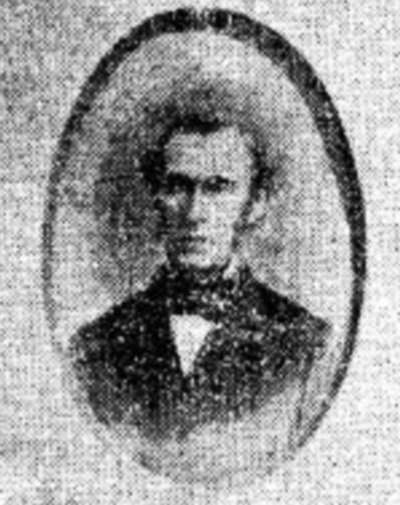
Samuel H. Morton was born May 18, 1810 in Gloucester County, New Jersey, which then included what is now Camden County. Camden County was formed in 1844. He married Lydia Sharp Sweeten on November 15, 1832. The Morton’s soon moved to Camden, and in March of 1834 a daughter, Mary Ann Morton (1834–1915) was born. Four more children followed, Charles Smith Morton (1836–1850), Andrew Sweeten Morton (November 11, 1838–1907), Samuel H. Morton Jr. (1842–1882), and William B. Morton (1845–1898).
Samuel H. Morton was carpenter by trade, and in time he became involved in building and contracting. He also was involved with the Camden Fire Insurance Association for a number of years.
In 1845 Samuel H. Morton was a member of Camden’s Board of Education, which then included Franklin Ferguson, Joseph C. De La Cour, Philander C. Brinck, Jesse Smith, Joseph Taylor, David Brown, Dr. Isaac S. Mulford, and Thomas Chapman.
The 1850s were a difficult time for Samuel H. Morton. Son Charles Smith Morton passed away around 1850, and his wife Lydia Sharp Sweeten died around 1854. On March 19, 1856 he married Mary S. Fields in Camden, sadly, she too passed away not long after the wedding.
On June 17, 1858 in Camden he married Caroline Morris, who was about 20 at the time. They would go onto have four children, Caroline Morris “Carrie” Morton (January 6, 1860), Annie Morton (1862–1927), Horace R Morton (June 1864–1944), Olive B. Morton (November 8, 1870–?).
The Mortons lived in what was then Camden’s Middle Ward, and it is likely that they were living at 328 Bridge Avenue before 1860. Samuel H. Morton served two one year terms (1860 and 1861) as a Camden County freeholder representing the Middle Ward. The 1863 Camden City Directory, which was the first one published shows the Mortons at the 328 Bridge Avenue address.
Records from the Civil War indicate that Samuel H. Morton Jr. enrolled as a Corporal with Company D of the 24th New Jersey Volunteers regiment on September 2, 1862. He mustered in with his regiment at Beverly, New Jersey on September 16, 1862. Corporal Morton saw combat at the Battle of Fredericksburg in December of 1862. He was discharged at Finley U. S. Army General Hospital, Washington, D. on January 7, 1863.
By 1860 Samuel H. Morton was serving on the Board of Directors of the Camden Mutual Insurance Association (later and better known as the Camden Fire Insurance Association). He served as Surveyor for the Association from 1861 through 1870. As a director he served alongside Edward Daugherty, Edmund E. Read, Joab Scull, Henry Fredericks, John Ross, William P. Tatem, Jonathan Burr, Christopher J. Mines Sr., Ralph Lee, John S. Read, Henry B. Wilson Sr., Charles Wilson, Josiah D. Rogers, James H. Stevens, Clayton Truax, Jesse E. Huston and Thomas A. Wilson. He was still a Director as late as 1873.
Samuel H. Morton at a young age became a member of the first Methodist church in Camden, which was simply known as “The Methodist Episcopal Church of Camden,” at Fourth and Federal Streets. In 1834 a new building was erected on South 3rd Street north of Bridge Avenue, and the Mortons were among the original members. This church became known as The Third Street Methodist Episcopal Church, from its location. Samuel H. Morton was quite active in the church. He was a class leader and served as a trustee in 1865. This church built a new building at 301 South 6th Street in the mid-1890s and was renamed First Methodist Episcopal Church.
Samuel H Morton Jr. passed away on August 10, 1882 in Camden. Samuel H. Morton Sr. died on March 13, 1892 in Camden. He was joined by his wife Caroline February 27, 1894.
Not One Is Now Alive
Camden Daily Courier —


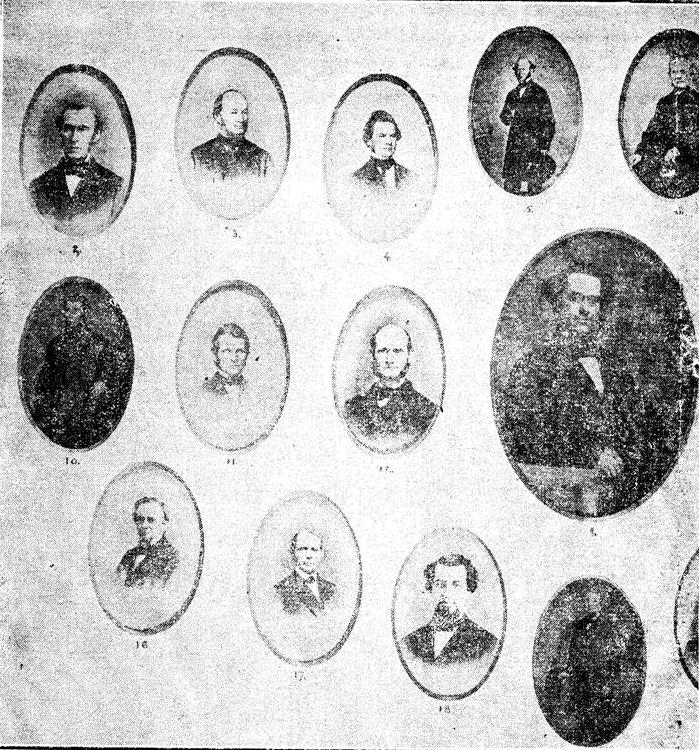
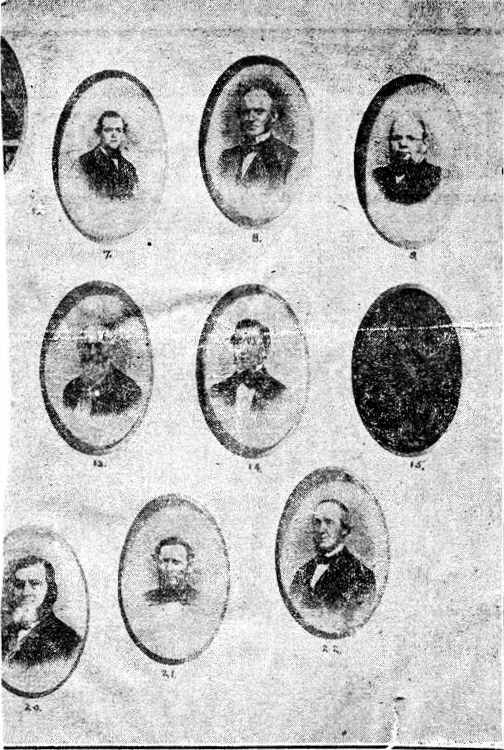
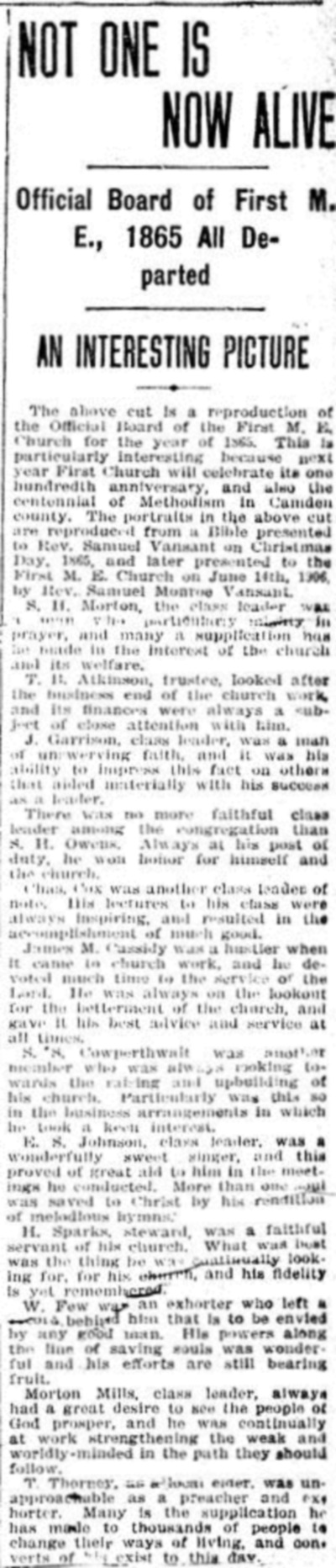
The above cut is a reproduction of the Official Board of the First M. E. Church for the year of 1865. This is particularly interesting because next year First Church will celebrate its one hundredth anniversary, and also the centennial of Methodism in Camden county. The portraits in the above cut are reproduced from a Bible presented to Rev. Samuel Vansant on Christmas Day, 1865, and later presented to the First M. E. Church on June 19th, 1906, by Rev. Samuel Monroe Vansant.
S. H. Morton, the class leader, was a man who particularly mighty in prayer, and many a supplication has he made in the interest of the church and its welfare.
T. B. Atkinson, trustee, looked after the business end of the church work, and its finances were always a subject of close attention with him.
J. Garrison, class leader, was a man of unswerving faith, and it was his ability to impress this fact on others that aided materially with his success as a leader.
There was no more faithful class leader among the congregation than S. H. Owens. Always at his post of duty, he won honor for himself and the church.
Chas. Cox was another class leader of note. His lectures to his class were always inspiring, and resulted in the accomplishment of much good.
James M. Cassidy was a hustler when it came to church work, and he devoted much time to the service of the Lord. He was always on the lookout for the betterment of the church, and gave it his best advice and service at all times.
S. S. Cowperthwait was another member who was always looking towards the raising and upbuilding of his church. Particularly was this so in the business arrangements in which he took a keen interest.
E. S. Johnson, class leader, was a wonderfully sweet singer, and this proved of great aid to him in the meetings he conducted. More than one soul was saved to Christ by his rendition of melodious hymns.
H. Sparks, steward, was a faithful servant of his church. What was best was the thing he was continually looking for, for his church, and his fidelity is yet remembered.
W. Few was an exhorter who left a record behind him that is to be envied by any good man. His powers along the line of saving souls was wonderful and his efforts are still bearing fruit.
Morton Mills, class leader, always had a great desire to see the people of God prosper, and he was continually at work strengthening the weak and worldly-minded in the path they should follow.
T. Thorney, as a class enter, was unapproachable as a preacher and exhorter. Many is the supplication he has made to thousands of people to change their ways of living, and converts of his exist to this day.