Introduction
DANIEL W. CURLIS was Camden’s Chief of Police from 1871 to 1874. He worked at a number of positions at the West Jersey Ferry and West Jersey Railroad after his time as Chief of Police, and also worked as a bank messenger for the Central Trust bank in the years prior to his passing on May 27, 1894.
Daniel Curlis was the son of William Curlis and Mary Stockton Lippincott Curlis. The fifth of nine children, he was born in New Jersey around 1837. His father passed away in 1858. The 1860 Census shows him living in the Chews Landing section of Gloucester Township with an ornamental painter, Justice Hedger and his family. Daniel Curlis was working as a painter, and would follow that line of work into the early 1870s.
On March 21, 1861 Daniel Curlis married Elizabeth Cheeseman at the Presbyterian Church in what was then called Blackwoodtown, New Jersey. A son, William A. Curlis, was born in July of 1862. A daughter, Mary S. Curlis was born on January 15, 1867, but died quite young, as did Gertrude, born in the spring of 1870, and Bertha, who was born around 1877.
The 1869 Camden City Directory shows Daniel Curlis at 511 Royden Street, working as a painter, and his widowed mother at 529 Penn Street. He was still at that address in 1870. That year’s directory shows his mother living at 313 North 4th Street. Daniel Curlis was still living at 511 Royden Street when the 1872 City Directory was compiled. He moved to 512 Berkley Street shortly afterwards.
By 1877 the Curliss family had moved to 414 South 5th Street in South Camden, where they remained through 1898. Daniel Curlis was 57 years of age at the time of his passing. He was buried at Evergreen Cemetery in Camden.
Daniel Curlis’ son, William Curliss, who, like his uncle Samuel Curliss, used the “double-s” spelling of the family surname, worked as a machinist and as a driver in the 1880s. He was appointed to the Camden Fire Department as a driver with the Hook and Ladder Company in 1890 and worked as a fireman throughout the rest of the 1890s. He resigned from the Department in January of 1899.
The New Police Force
Philadelphia Inquirer —
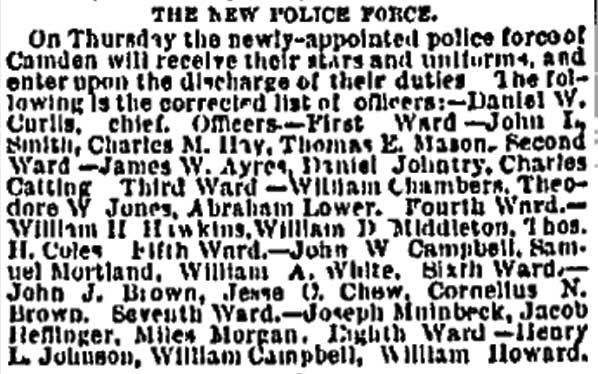
On Thursday the newly-appointed police force of Camden will receive their stars and uniforms, and enter upon the discharge of their duties. The following is the corrected list of officers:—Daniel W. Curlis, chief. Officers—First Ward—John I. Smith, Charles M. Hay, Thomas E. Mason. Second Ward—James W. Ayres, Daniel Johntra, Charles Catting. Third Ward—William Chambers, Theodore W. Jones, Abraham Lower. Fourth Ward—William H. Hawkins, William D. Middleton, Thos. H. Coles. Fifth Ward—John W. Campbell, Samuel Mortland, William A. White. Sixth Ward—John J. Brown, Jesse O. Chew, Cornelius N. Brown. Seventh Ward—Joseph Muinbeck, Jacob Heflinger, Miles Morgan. Eighth Ward—Henry L. Johnson, William Campbell, William Howard.
The Recent Robberies
Philadelphia Inquirer —
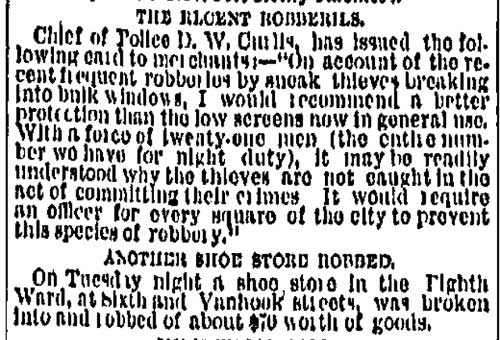
Chief of Police D. W. Curlis, has issued the following card to merchants:—“On account of the recent frequent robberies by sneak thieves breaking into bulk windows, I would recommend a better protection than the low screens now in general use. With a force of twenty-one men (the entire number we have for night duty), it may be readily understood why the thieves are not caught in the act of committing their crimes. It would require an officer for every square of the city to prevent this species of robbery.”
Another Shoe Store Robbed
On Tuesday night a shoe store in the Eighth Ward, at Sixth and Vanhook streets, was broken into and robbed of about $70 worth of goods.