Third Street Methodist Episcopal Church
The members of the First Methodist Episcopal Church put up a new building in 1834 at Third Street and Bridge Avenue. Local builder Thomas Atkinson erected the building. This edifice was destroyed in an 1867 fire. A new church was then built on Third Street between Mickle Street and Bridge Avenue, which was dedicated in 1869 and was known as Third Street Methodist Episcopal Church. This church seated 1,400 people. In June of 1893 the congregation moved to a new building at South 6th and Stevens Street, and returned to the name of First Methodist Episcopal Church.
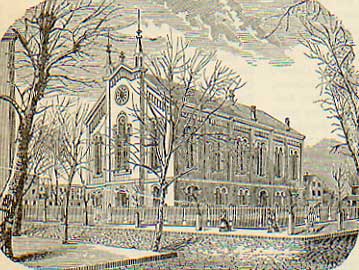
Third Street Methodist Episcopal Church, 1880s
History of Camden County, New Jersey
George Reeser Prowell, 1886
Exactly when Methodist preachers, local or itinerant, commenced preaching at Camden is unknown, but in 1797, Rev. Benjamin Fisler, M.D., of Port Elizabeth, N. J., preached here several times, and we find subsequently that local preachers from St. George's Church, in Philadelphia, made Camden one of their preaching-places. In 1808 the New Jersey District of the Philadelphia Conference was formed, with Joseph Totten presiding elder, and an appointment called “Gloucester Circuit” created, which included what is now Camden. Revs. Richard Sneath and William S. Fisher were appointed as preachers of the new circuit and the following year, 1809, Richard Sneath formed the first regular class in Camden, composed of James and Elizabeth Duer, Henry and Susannah Sawn, William and Martha Price and Phebe Peters, of which James Duer was appointed leader. Services by the circuit preachers were held once every two weeks, on Wednesday evening, in the academy which formerly stood on the corner of Market Street and Sixth. The same year, finding the academy insufficient for their wants, a regular church organization having been formed in the meantime, it was determined to erect a house of worship. A lot on the corner of Fourth Street and Federal was secured and a board of trustees elected, composed of James Duer, Jonathan Petherbridge, Henry Sawn and William Price, and the corporate name of “The Methodist Episcopal Church of Camden” given to the new organization. James Duer and Jonathan Petherbridge were made a building committee. Before the building was completed, Thomas Dunn, one of the preachers on the Gloucester Circuit, preached the first sermon in it from the text, “Who commanded you to build this house and to make up these walls?” The church was dedicated on the 25th of November, 1810, by Presiding Elder Joseph Totten. This was the first house of worship erected in the city of Camden and is still standing near the original site, corner of Fourth and Federal Streets.
In 1834, the congregation having so increased, it was determined to erect a new building more in keeping with the importance of the society and better adapted to its wants. During this time Camden was connected with Gloucester or Burlington Circuits, but it was then thought that it should become a station. Accordingly, a lot on Third Street, between Bridge Avenue and Federal Street, was purchased, and on the Fourth of July, 1834, the cornerstone of a new church was laid with appropriate services. December 14th, following, the church was dedicated by Rev. Charles Pitman, assisted by the pastor, Rev. William Granville. The new building cost about eight thousand dollars. In this new building the society did its work for over thirty years, increasing in numbers rapidly, especially during the great revival in 1837. The church building had been enlarged and improved to meet its increased wants, at considerable expense, and it was a crushing blow to the society when, on the 20th of November, 1867, the building was totally destroyed by fire, with but a slight insurance on it. But though for a moment paralyzed, the congregation soon recovered itself and, with commendable energy, immediately began the erection of a new building, and appointed Rev. Charles H. Whitecar, pastor, S. S. E. Cowperthwait, Thomas B. Atkinson, Morton Mills, E. S. Johnson and James M. Cassady a building committee to superintend the work. The lots on Third and Mickle Streets and Bridge Avenue were purchased, and the work was pushed forward with so much energy that the present beautiful house of worship, with a seating capacity of about fourteen hundred, and costing, with the lot, some sixty thousand dollars, was dedicated on September 1, 1869, in the presence of an immense concourse of people, by Bishop Simpson and the pastor, Rev. C. H. Whitecar.
In all its history this church has been firm in its adherence to the polity of the Methodist Episcopal Church, and in its support to the various religious work of the denomination.
Early in the history of this society, vigorous work in the Sunday school cause was commenced and has been unflagging in it ever since. The present Sunday school numbers over six hundred members, with sixty officers and teachers. Dr. William Shafer is its present superintendent. The church has had the following pastors:
| Year(s) | Pastor(s) |
|---|---|
| 1809 | Thomas Dunn, Charles Read |
| 1810 | Peter Vannest, Joseph Osborn, Thomas Davis |
| 1811 | John Woolston |
| 1812 | Joseph Osborn, John Woolston |
| 1813 | George Wooley, John Price |
| 1814 | George Wooley, Joseph Lybrand |
| 1815 | John Van Schoick, Joseph Rusling |
| 1816 | John Van Schoick, John Fox |
| 1817 | James Moore, Joseph Lybrand |
| 1818 | Solomon Sharp, David Best |
| 1819 | John Walker, James Long |
| 1820 | John Walker, John Potts |
| 1821 | John Potts, Benjamin Collins |
| 1822 | Sylvester G. Hill, Waters Burrows |
| 1823 | Sylvester G. Hill, Joseph Carey |
| 1824 | David Daily, Joseph Osborn |
| 1825 | Jacob Gruber, Wesley Wallace |
| 1826 | George Wooley, Robert Gerry |
| 1827 | George Wooley, Thomas Sovereign |
| 1828 | Henry Boehm, Levin M. Prettyman |
| 1829 | Henry Boehm, W.W. Foulks, Samuel Throckmorton |
| 1830 | William W. Foulks, Joseph Ashbrook |
| 1831 | John Walker, Jefferson Lewis |
| 1832 | John Walker |
| 1833 | Edward Page, David W. Bartine |
| 1834–1835 | William Granville |
| 1836 | Thomas Neal |
| 1837 | James H. Dandy |
| 1838–1839 | Joseph Ashbrook |
| 1840 | John K. Shaw, William A. Brooks |
| 1841 | John K. Shaw |
| 1842 | John L. Lenhart |
| 1843–1844 | Isaac Winner |
| 1845 | Abram K. Street, Elwood H. Stokes |
| 1846 | Abram K. Street |
| 1847 | David W. Bartine, George A. Reybold |
| 1848 | David W. Bartine, Isaac S. Corbit |
| 1849 | Charles H. Whitecar, William H. Jeffreys |
| 1850 | Charles H. Whitecar |
| 1851 | Isaac N. Felch |
| 1852 | Richard W. Petherbridge |
| 1853–1854 | James O. Rogers |
| 1855 | John W. McDougal |
| 1856–1857 | William E. Perry |
| 1858–1859 | Elwood H. Stokes |
| 1860–1861 | Samuel Y. Monroe |
| 1862–1863 | Joseph R. Dobbins |
| 1864–1866 | Samuel Vansant |
| 1867–1869 | Charles H. Whitecar |
| 1870–1871 | John H. Heisler |
| 1872–1874 | Charles E. Hill |
| 1875–1877 | Charles B. Hartranft, Pennel Coombs |
| 1878–1880 | J.B. Graw |
| 1881–1883 | William W. Moffet |
| 1884–1886 | G.B. Wight |
Since its organization, in 1809, Third Street Church has sent out the following church organizations, all of them at present flourishing churches in Camden, which are Union Church, Broadway Church, Tabernacle Church and Centenary Church.
Not One Is Now Alive
Camden Daily Courier —


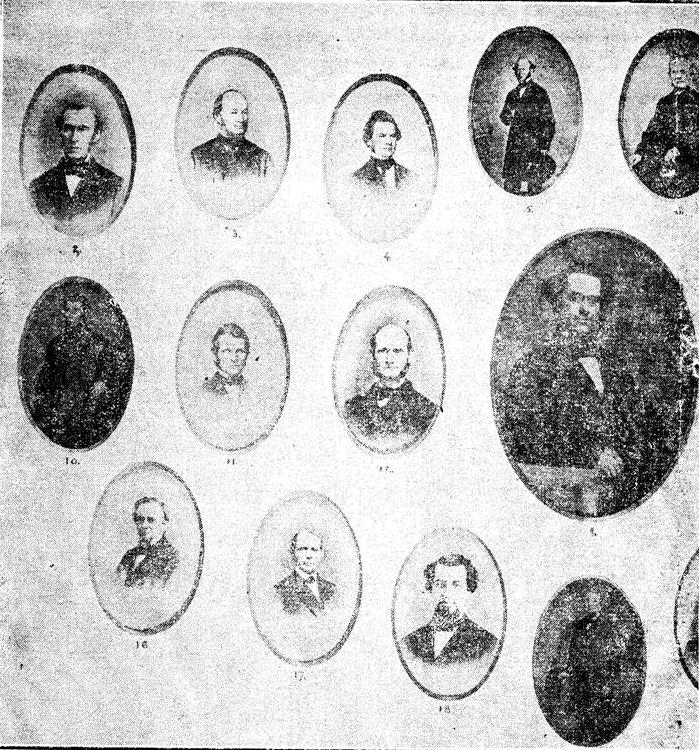
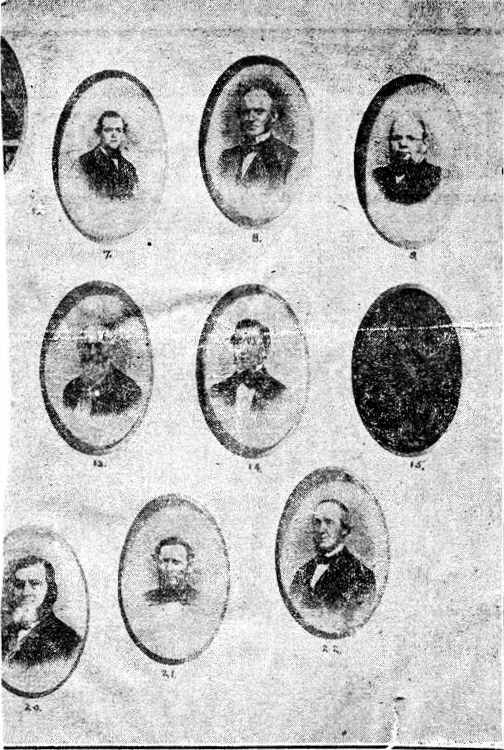
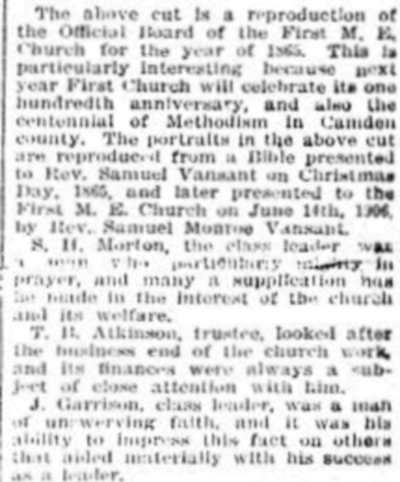
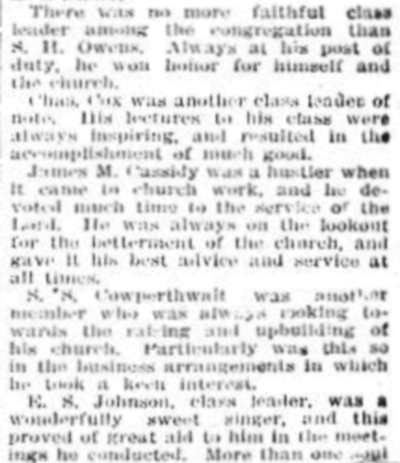
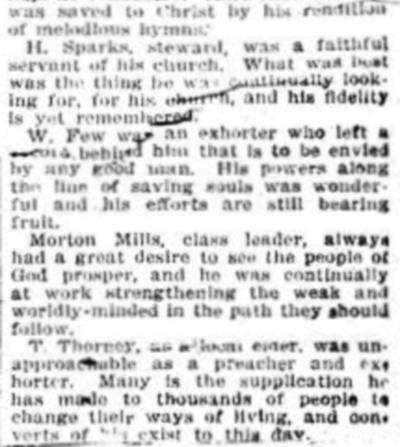
1. Rev. Samuel Van Sant, pastor — 2. Samuel H. Morton, trustee, class leader — 3. Joseph De La Cour, steward — 4. Mr. Hinchman, steward — 5. Thomas B. Atkinson, trustee — 6. J. Garrison, class leader — 7. S.H. Owens, class leader — 8. Charles Cox, class leader — 9. James M. Cassady, steward, trustee — 10. Mr. Williams, Steward — 11. Robert T. Lee, local elder, president, trustee — 12. H. Williams, class leader — 13. William Peacock, Steward, Sunday School Superintendent — 14. Mr. Campbell, trustee, class leader — 15. Mr. Simmons, local elder — 16. Samuel S.E. Cowperthwait, treasurer, trustee — 17. Mr. Sloan, class leader — 18. E.S. Johnson, recording steward, class leader, trustee — 19. H. Sparks, steward — 20. William Few, exhorter, class leader — 21. Morton Mills, steward, class leader — 22. Timothy Thorney, local elder, class leader
NOT ONE IS NOW ALIVE
Official Board of First M. E., 1865 All Departed
AN INTERESTING PICTURE
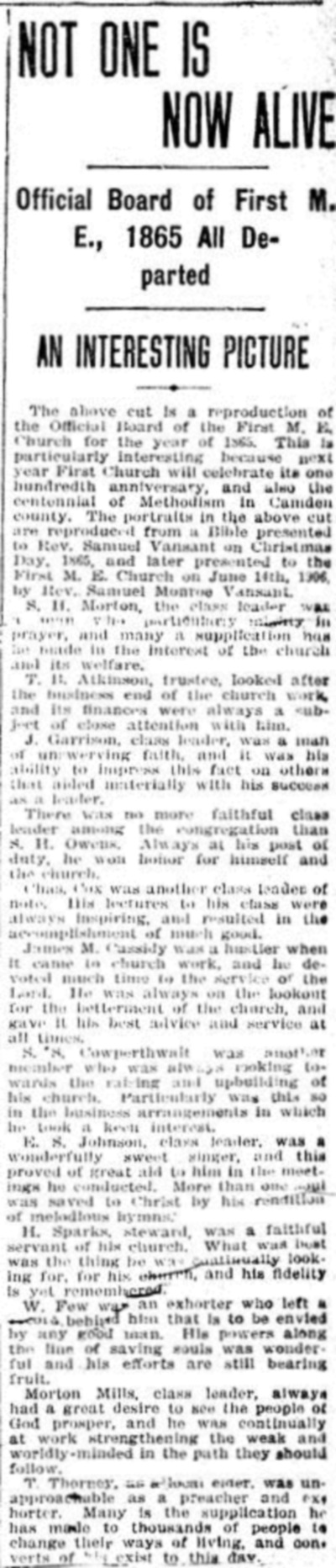
The above cut is a reproduction of the Official Board of the First M. E. Church for the year of 1865. This is particularly interesting because next year First Church will celebrate its one hundredth anniversary, and also the centennial of Methodism in Camden county. The portraits in the above cut are reproduced from a Bible presented to Rev. Samuel Vansant on Christmas Day, 1865, and later presented to the First M. E. Church on June 19th, 1906, by Rev. Samuel Monroe Vansant.
S. H. Morton, the class leader, was a man who particularly mighty in prayer, and many a supplication has he made in the interest of the church and its welfare.
T. B. Atkinson, trustee, looked after the business end of the church work, and its finances were always a subject of close attention with him.
J. Garrison, class leader, was a man of unswerving faith, and it was his ability to impress this fact on others that aided materially with his success as a leader.
There was no more faithful class leader among the congregation than S. H. Owens. Always at his post of duty, he won honor for himself and the church.
Chas. Cox was another class leader of note. His lectures to his class were always inspiring, and resulted in the accomplishment of much good.
James M. Cassidy was a hustler when it came to church work, and he devoted much time to the service of the Lord. He was always on the lookout for the betterment of the church, and gave it his best advice and service at all times.
S. S. Cowperthwait was another member who was always looking towards the raising and upbuilding of his church. Particularly was this so in the business arrangements in which he took a keen interest.
E. S. Johnson, class leader, was a wonderfully sweet singer, and this proved of great aid to him in the meetings he conducted. More than one soul was saved to Christ by his rendition of melodious hymns.
H. Sparks, steward, was a faithful servant of his church. What was best was the thing he was continually looking for, for his church, and his fidelity is yet remembered.
W. Few was an exhorter who left a record behind him that is to be envied by any good man. His powers along the line of saving souls was wonderful and his efforts are still bearing fruit.
Morton Mills, class leader, always had a great desire to see the people of God prosper, and he was continually at work strengthening the weak and worldly-minded in the path they should follow.
T. Thorney, as a class elder, was unapproachable as a preacher and exhorter. Many is the supplication he has made to thousands of people to change their ways of living, and converts of his exist to this day.