Introduction
Thomas J. Francis
THOMAS J. FRANCIS was born in Philadelphia, Pennsylvania on May 6, 1831. He moved to Camden in 1850, and made the city his home for most of the rest of his life. He married his wife Catherine around 1853 and a son, Edward was born soon afterwards. Daughters Frances and Kate followed.
On September 11, 1862 Thomas J. Francis enlisted in the Union Army as a corporal with Company G, Tenth Pennsylvania Militia Regiment. This unit was one of many organized to defend Pennsylvania in case of invasion by General Lee’s Confederate Army. After the Battle of Antietam on September 17 this threat no longer existed, the regiment was disbanded and the men sent home. Corporal Francis was discharged on September 20, 1862.
Thomas Francis worked as an ornamental painter. The 1867 and 1872 Camden City Directories both list Thomas J. Francis at 533 South 5th Street. He moved to Delaware for a short time in the 1870s but returned to Camden shortly before the 1880 Census.
The 1880 Census shows Thomas J. Francis living at 508 Berkley Street in Camden with his wife Catherine and their daughters. Living next door at 510 Berkley was grocer Charles H. Ellis Sr. and family. Charles H. Ellis Jr. went on to serve 17 years as the Mayor of Camden, while sons Walter Ellis and Wilbur Ellis also played significant roles in Camden’s civic affairs during their lifetimes.
In 1866 Thomas J. Francis became a member of the Improved Order of Red Men, a fraternal organization that was very prominent in its time and well into the next century. A member of Camden’s Lenni Lenape Tribe No. 2, Thomas Francis was very active in Red Men affairs, rising to local, state, and national office within the organization. In 1888 he was elected Great Incohonee, the highest office in the Red Men.
The Improved Order of Red Men traces its origin to certain secret patriotic societies founded before the American Revolution. Among the early groups were The Sons of Liberty, the Sons of St. Tammany, and later the Society of Red Men.
On December 16, 1773 a group of men, all members of the Sons of Liberty, met in Boston to protest the tax on tea imposed by England. When their protest went unheeded, they disguised themselves as Mohawk Indians, proceeded to Boston harbor, and dumped overboard 342 chests of English tea.
During the Revolutionary War, members of secret societies took up muskets to join with the Continental Army. Following the American Revolution many of the various secret societies founded before and during the conflict continued in existence as brotherhoods or fraternities.
After the founding of the United States of America, each of the original Sons of Liberty and Sons of St. Tammany groups went their own way, under many different names. In 1813, at historic Fort Mifflin, near Philadelphia, several of these groups came together and formed one organization known as the Society of Red Men. The name was changed to the Improved Order of Red Men in Baltimore in 1834. At Baltimore, Maryland, in 1847, the various local tribes came together and formed a national organization called the Grand Council of the United States.
With the formation of a national organization, the Improved Order of Red Men soon spread, and within 30 years there were State Great Councils in 21 states with a membership of over 150,000. The Order continued to grow and by the mid-1920s there were tribes in 46 states and territories with a membership totaling over one-half million.
The 1900 Census shows Thomas and Catherine Francis still residing at 508 Berkley Street. Daughter Kate lived with them, while Frances Francis resided elsewhere. Son Edward Francis, a butcher, and his wife and daughters lived at 316 Berkley Street, next to Camden police officers Ike Toy at 320 Berkley Street and Albert Keaser at 322 Berkley.
Thomas J. Francis passed away on May 25, 1903 and after services at his home was buried at Evergreen Cemetery.
George Reeser Prowell’s History of Camden County, New Jersey — 1886
In 1886 George Reeser Prowell wrote the following about Lenni Lenape Tribe, No. 2:
LENNI LENAPE TRIBE, No. 2, is the oldest existing tribe of the order in the State, and in numbers and wealth the strongest and richest in the United States. It was instituted May 10, 1850, by Great Incohonee William B. Davis, assisted by Francis Fullerton, of Lenni Lenape Tribe, No. 8, of Pennsylvania, and Great Chief of Records of the United States. These were the charter members: Nathaniel Chew, William F. Colbert, John T. Davis, Timothy C. Moore, Sylvester Rainhard, Joseph Shipley, Daniel S. Garwood, William Beckett, George Wood, E.D. Brister, John Wood, Joseph Myers, Albert Robertson, John W. Hoey, James B. Richardson, Robert Maguire, Joseph B. Hawkins, James O. Stillwell and Anthony Joline. The officers were as follows: P., Timothy C. Moore; S., Nathaniel Chew; S.S., John Wood; J.S., William F. Colbert; C. of R., Joseph Myers; K. of W., Albert Robertson.
Lenni Lenape has had an eventful career, at times flourishing and at other times so short of funds that a few faithful members paid expenses and benefits out of their private purses, but persistence won at last and a flood tide of prosperity set in, which has continued until the Lenni Lenapes number seven hundred and thirty-two and the wampum belt contains $21,370.89.
Among its members are these Past Great Sachems: George W. Watson, John T. Davis, Charles H. Gordon, Thomas J. Francis and Daniel M. Stevens; and of its Past Sachems these are living: Timothy C. Moore, Henry A. Breyer, Lewis Zeigler, Samuel J. Fenner, Edward J. Steer, William F. Farr, Samuel D. Watson, George Horneff, George A. Cairoli (Brother of Mrs. Emma Horneff—PMC), Thomas J. Rowand, Samuel A. Owens, Benjamin M. Braker, Lambert Banes, George Pfeiffer, William Sheridan, Thomas F. Muckelson, Hope Sutton, James P. Moore, D.D. Worts, Leonard L. Roray, Benjamin J. Price, John A. Hall, B.S.M. Branning, Abraham Davis, Harry B. Garrison, Walter E. Garwood, George A. Rogers, William C. Davis, Frank P. Jackson, H. Frank Pettit, John A. Harbeson, John Quick, Angus B. Cameron, Lewis Z. Noble, George Leathwhite, Conrad F. Austermuhl, John K. Seagrove, Charles L. Vansciver, Harry Hoffman, Harry B. Tyler, James H. Reeve and George W. Davis. The officers are: P., G.W. Davis; S., Edward Francis; S.S., Samuel Baker; J.S., Joseph Watson; C. of R., L.Z. Noble; K. of W., C.F. Austermuhl; Trustees, T.J. Francis, T.F. Muckelson, J.K. Reeve, Leonard L. Roray and H.F. Pettit.
Past Great Incohonee Thomas J. Francis
Official History of the Improved Order of Red Men — 1893
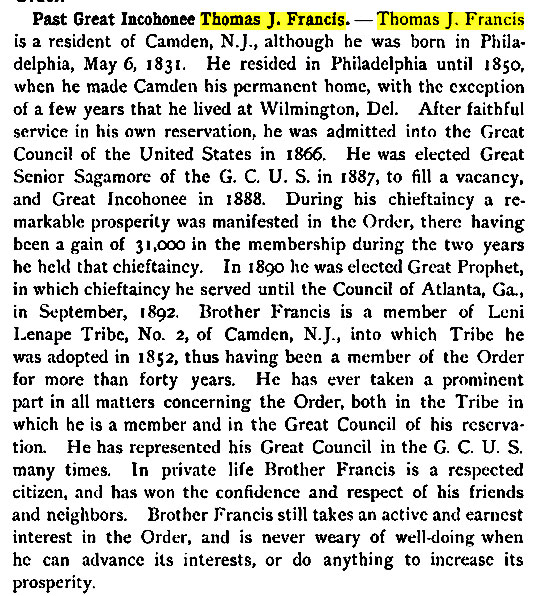
Past Great Incohonee Thomas J. Francis. — Thomas J. Francis is a resident of Camden, N.J., although he was born in Philadelphia, May 6, 1831. He resided in Philadelphia until 1850, when he made Camden his permanent home, with the exception of a few years that he lived at Wilmington, Del. After faithful service in his own reservation, he was admitted into the Great Council of the United States in 1866. He was elected Great Senior Sagamore of the G. C. U. S. in 1887, to fill a vacancy, and Great Incohonee in 1888. During his chieftaincy a remarkable prosperity was manifested in the Order, there having been a gain of 31,000 in the membership during the two years he held that chieftaincy. In 1890 he was elected Great Prophet, in which chieftaincy he served until the Council of Atlanta, Ga., in September, 1892. Brother Francis is a member of Leni Lenape Tribe, No. 2, of Camden, N.J., into which Tribe he was adopted in 1852, thus having been a member of the Order for more than forty years. He has ever taken a prominent part in all matters concerning the Order, both in the Tribe in which he is a member and in the Great Council of his reservation. He has represented his Great Council in the G. C. U. S. many times. In private life Brother Francis is a respected citizen, and has won the confidence and respect of his friends and neighbors. Brother Francis still takes an active and earnest interest in the Order, and is never weary of well-doing when he can advance its interests, or do anything to increase its prosperity.
Thomas Francis Dead
Philadelphia Inquirer —
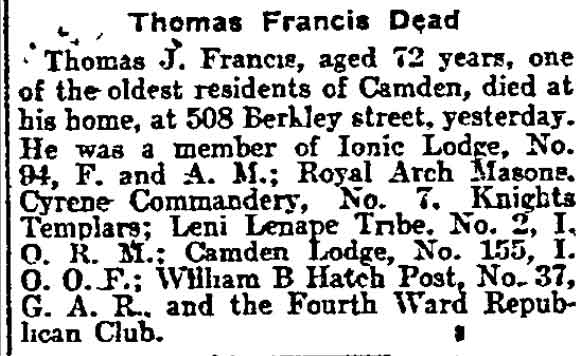
Thomas J. Francis, aged 72 years, one of the oldest residents of Camden, died at his home, at 508 Berkley street, yesterday. He was a member of Ionic Lodge, No. 94, F. and A. M.; Royal Arch Masons, Cyrene Commandery, No. 7, Knights Templars; Leni Lenape Tribe, No. 2, I. O. R. M.; Camden Lodge, No. 155, I. O. O. F.; William B Hatch Post, No. 37, G. A. R., and the Fourth Ward Republican Club.
Many at Bier of Thomas J. Francis
Philadelphia Inquirer —
THE LATE THOMAS J. FRANCIS.
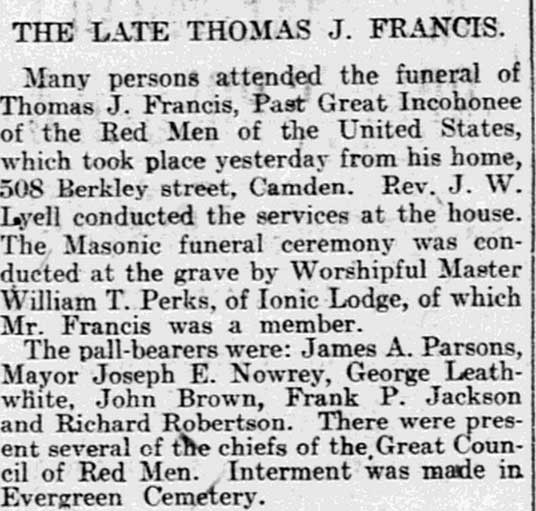
Many persons attended the funeral of Thomas J. Francis, Past Great Incohonee of the Red Men of the United States, which took place yesterday from his home, 508 Berkley street, Camden. Rev. J. W. Lyell conducted the services at the house. The Masonic funeral ceremony was conducted at the grave by Worshipful Master William T. Perks, of Ionic Lodge, of which Mr. Francis was a member.
The pall-bearers were: James A. Parsons, Mayor Joseph E. Nowrey, George Leathwhite, John Brown, Frank P. Jackson and Richard Robertson. There were present several of the chiefs of the Great Council of Red Men. Interment was made in Evergreen Cemetery.