John Morgan
JOHN MORGAN came to Camden from Philadelphia in 1841. A silver plater, he had established an extensive business in that line. In 1858 he purchased the Independent Order of Odd Fellows hall at North 4th and Market Streets and renamed it Morgan's Hall.
John Morgan was appointed Mayor by City Council upon the death of John H. Jones on October 27, 1876. He served until March of the following year, when he was defeated for re-election by James W. Ayers.
After leaving office, John Morgan, a widower, married his housekeeper, Caroline Bittner, a woman some 40 years his junior. When the Census was taken in 1880 John Morgan, wife Carrie, five month old son John Jr., and Carrie's sister were living at 330 Cooper Street.
John Morgan died at his home, 330 Cooper Street on December 5, 1881. Caroline Morgan died in 1885 at the young age of 26. Morgan's Hall remained in use in Camden well into the 1950s.
John Morgan's nephew, George H. Morgan, served as a member of the Camden Fire Department in 1872.
Silver Platers
The History of Camden County New Jersey — George Reeser Prowell, 1886
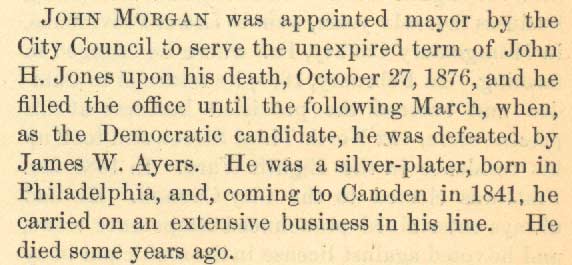
Silver Platers— The carriage factories gave employment to many silver-platers, some working for the manufacturers and others carrying on business for themselves, and giving employment to others. Gordon states that there was a gold and silver-plater here in 1835, but the first establishment of which there is authentic record was that of Gibson & Morgan — Henry Gibson and John Morgan — the latter mayor in 1876–77. Their works, started in 1841, were over the wagon-sheds built by Jacob Ridgway, in 1832, at Second and Arch. Gibson left the firm, and in 1845 Morgan removed the factory to a stable, fitted up for the purpose, on the rear end of a lot on Fourth Street, above Market, afterwards erecting a large brick building on the line of Fourth Street, since converted into dwellings.
Among his workmen were his brother, George Morgan, now in the business at 52 North Second; Edward Fitzer, now in the same trade in Philadelphia; George Welden, Charles Newmayer and others. The work was for volantes, used in Cuba, and the trade was exclusively with that island. As the correspondence was in Spanish, Newmayer, who from journeyman became manager and then partner, learned the language, to avoid the need of an interpreter. The firm employed as many as thirty at one time, and the employees testify that there was never a murmur about wages, even the apprentices receiving full pay for overwork, and the payments were not only prompt, but made in the best currency. The Rebellion (The Civil War) put a stop to the trade, and the firm, dividing a competency, dissolved.
Edward Fitzer and George Morgan joined in business in the “fifties,” with their establishment on Market Street, the site of Heibst's Hotel, but in a few years separated.
Morgan's New Hall
West Jersey Press —

The progress of improvement in Camden has assumed those characteristic features which have caused the citizens to be justly proud of their city. Old styles of architecture are giving way to those more modern and tasteful, and the usual small plainly constructed buildings to those of noble and imposing structures. As an instance of this fact we need only refer to the edifice just erected by John Morgan, Esq., at Fourth and Market Streets. This grand temple of mechanical skill and genius, was formerly known as the “Odd Fellow's Hall,” and was, for years, the only place of any attractive character in Camden, in which lectures, balls, or any public entertainments could be held. But, its capacity and accommodations were inadequate for these, and when the building passed into the possession of Mr. Morgan, that sagacious and enterprising gentleman resolved to make it what the public demanded, a Hall that would be an ornament and convenience to the city, as well as a structure which would reflect credit upon himself and the mechanics who accomplished the work. This he and they have effected, how well, a careful inspection of the edifice, its convenient arrangements, and all the necessary paraphernalia, can best attest. The old hall has been thoroughly overhauled and remodelled, not a vestige of the former interior remaining, and it is now one of the most spacious and amply furnished audience rooms in the State—the largest and best arranged of any in South Jersey. The large ante-room, once occupied by the Franklin Library Association, has been added to this Hall, giving it an amplitude of 120 feet in length by [illegible] feet in width, with a staging of 20 by 34 feet. The splendid room is reached from the new entrance on Market Street, by a spacious stairway and an elegantly designed hall—the old entrance on Fourth Street being used as a private ingress to the building. All the doors leading to and from these rooms open outward, so that in case of accident by fire or otherwise, the audience can find ready egress without the danger of crowding each other against closed doors which make the danger more imminent.
Adjoining the main building, Mr. Morgan has erected an additional structure communicating with it, which is 80 feet long by 30 feet wide, giving the entire edifice the appearance of a Gothic L. In this new apartment are located the ladies' and gentlemen's dressing-rooms, and other necessary and convenient arrangements, such as cloak rooms, offices, and rooms for ice-cream, &c. All of these are arranged with care and for the greatest accommodation, and excite the admiration of all who examine them. On the third story a large and elegant room has been furnished for Societies, such as Odd Fellows, Masons, Sons of Malta, &c., in the rear of which is another designed as a saloon in which exhibitions of a lesser character can find ample accommodations.
The whole structure contains seventeen capacious rooms, with all the necessary closets and other accommodations which modern improvements can suggest, or public wants demand. The citizens of Camden certainly owe Mr. Morgan a debt of gratitude for the liberal spirit of enterprise he has evinced in furnishing the place with such an imposing monument of mechanical skill, and the public with such superior accommodations.
Nor are the workmen any the less entitled to credit and praise. Messrs. Severns and Ward, Builders and Contractors, have done their work well. In fact, no better mechanics can be found, for they are skilled in every department of their profession. The plastering was done by William Allen, the plumbing by William Calhoun, the brickwork by Messrs. Page and Peak, the stone work by John Komar, the painting by Haslett and Berkheiser, and the gas fitting by Thomas Mooney, who used the superior materials which are manufactured by Messrs. Cornelius & Baker. Each of these gentlemen have displayed the greatest proficiency of skill in the work they have accomplished on this immense structure. The building is nearly completed, but now ready and open to those who desire to engage the Hall. It is truly a magnificent affair, and deserving of all praise. We trust that its fine appearance will be the means of stimulating other enterprises which will do credit to the city, and thus give an impetus to improvements calculated to make Camden a city of equal importance with Jersey City, or any of those in the Eastern part of the State.
Obituary — Ex-Mayor John Morgan
Camden Post —

An honored citizen of Camden expired at about 12 o'clock last night in the person of John Morgan, at his residence, southwest corner of Fourth and Cooper streets, in the sixty-seventh year of his age. Mr. Morgan was long identified with the growth and prosperity of Camden, in which he aided by his public spirit and private enterprise. He came here about thirty years ago from Philadelphia, where he carried on the business of silver plating. He transferred his business to this side, building a factory contiguous to his residence, where by his skill, integrity and strict application, he built up an extensive traffic, exporting largely to the West Indies and other countries, besides doing a large home trade, accumulating a fortune. One of his specialties was the manufacture of silver plated mountings for harnesses, which he excelled, and for which he found an extensive demand; in fact his sales were limited only by his ability to produce.
Many years ago he purchased the Odd Fellows' Hall, Fourth and Market streets, and remodeled it, making it not only the largest public hall in the city, save one. It has been known as Morgan's Hall since he purchased it.
In October, 1876, on the death of Mayor Jones, City Council elected Mr. Morgan to fill the position of the balance of the term. He filled the office with credit, and in his administration of duties, while just, was tender-hearted and considerate, tempering justice with mercy. He was the Democratic candidate for Mayor the following election but was defeated by James W. Ayers. This was the only public office he held, for his honest mind never sought to accumulate honors, nor did his desires incline that way. He was given to charity, and was one of the helpers of the Camden City Dispensary, being on its Board of Managers for several years, holding the position as the time of his death.
Mr. Morgan was married, and his son died in infancy, leaving him virtually childless. Several years since he married his housekeeper, but his married life was not a happy one.
His attention to an extensive and successful business kept him from such a participation in public affairs as his qualifications entitled him to. He was too frank and honest in his ways to stoop to the means thought to be essential to success in public life. He was, however, held in the highest esteem, and lived the full measure of life. He was a man of robust health and capable of enjoying the good things that came in his way, until within the past few years when the seeds of an insidious malady, which defied all medical skill, began to manifest themselves, and continued to grow upon him, yielding to no useful treatment. He leaves a widow and one child.
Death of Ex-Mayor John Morgan
Philadelphia Inquirer —
OVER THE RIVER.
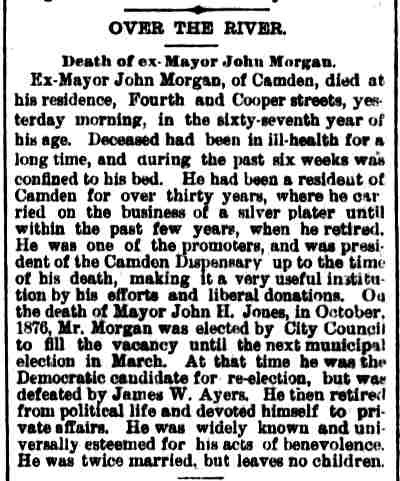
Ex-Mayor John Morgan, of Camden, died at his residence, Fourth and Cooper streets, yesterday morning, in the sixty-seventh year of his age. Deceased had been in ill-health for a long time, and during the past six weeks was confined to his bed. He had been a resident of Camden for over thirty years, where he carried on the business of a silver plater until within the past few years, when he retired. He was one of the promoters, and was president of the Camden Dispensary up to the time of his death, making it a very useful institution by his efforts and liberal donations. On the death of Mayor John H. Jones, in October, 1876, Mr. Morgan was elected by City Council to fill the vacancy until the next municipal election in March. At that time he was the Democratic candidate for re-election, but was defeated by James W. Ayers. He then retired from political life and devoted himself to private affairs. He was widely known and universally esteemed for his acts of benevolence. He was twice married, but leaves no children.
To His Long Home — Ex-Mayor Morgan's Funeral
Camden Post —
Resolutions of the Dispensary and Provisions of the Will.
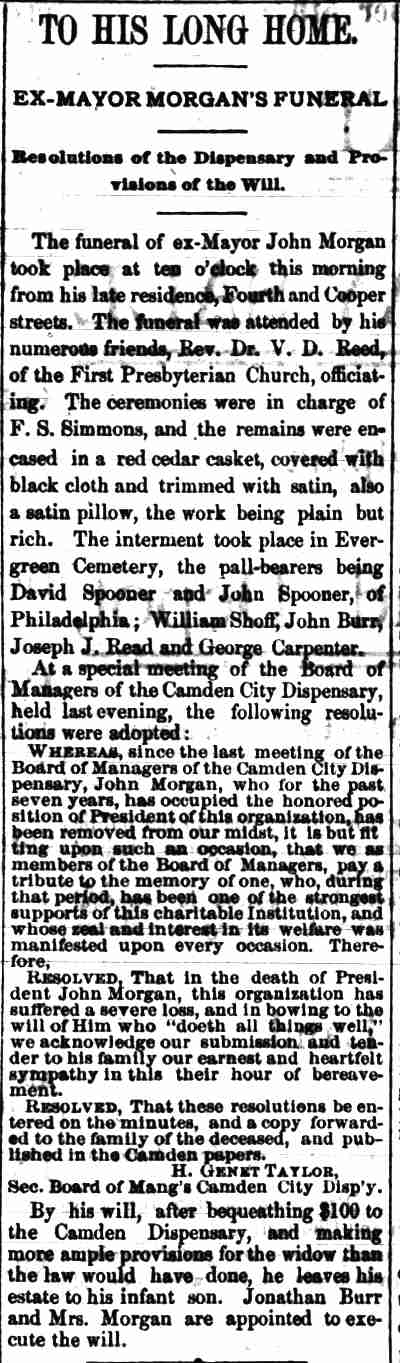
The funeral of ex-Mayor John Morgan took place at ten o'clock this morning from his late residence, Fourth and Cooper streets. The funeral was attended by his numerous friends, Rev. Dr. V. D. Reed, of the First Presbyterian Church, officiating. The ceremonies were in charge of F. S. Simmons, and the remains were encased in a red cedar casket, covered with black cloth and trimmed with satin, also a satin pillow, the work being plain but rich. The interment took place in Evergreen Cemetery, the pall-bearers being David Spooner and John Spooner, of Philadelphia; William Shoff, John Burr, Joseph J. Read and George Carpenter.
At a special meeting of the Board of Managers of the Camden City Dispensary, held last evening, the following resolutions were adopted:
WHEREAS, since the last meeting of the Board of Managers of the Camden City Dispensary, John Morgan, who for the past seven years, has occupied the honored position of President of this organization, has been removed from our midst, it is but fitting upon such an occasion, that we as Members of the Board of Managers, pay a tribute to the memory of one, who, during that period, has been one of the strongest supports of this charitable Institution, and whose zeal and interest in its welfare was manifested upon every occasion. Therefore,
RESOLVED, That in the death of President John Morgan, this organization has suffered a severe loss, and in bowing to the will of Him, who “doeth all things well,” we acknowledge our submission and tender to his family our earnest and heartfelt sympathy in this their hour of bereavement.
RESOLVED, That these resolutions be entered on the minutes, and a copy forwarded to the family of the deceased, and published in the Camden papers.
H. GENET TAYLOR,
Sec. Board of Mang's Camden City Disp'y.
By his will, after bequeathing $100 to the Camden Dispensary, and making more ample provisions for the widow than the law would have done, he leaves his estate to his infant son. Jonathan Burr and Mrs. Morgan are appointed to execute the will.
Irate 'Assemblymen' — Serving Two Masters
Camden Post —

Morgan's Hall a Prey to too Much Janitor.
Morgan's Hall has become the central figure in an interesting contest for mastery, and two if not three janitors contend for the honor of opening and closing its doors, and lighting up, dusting out and arranging its spacious hallways, stairway, stage and auditorium. Two sable Hamites may now be seen moving amidst its lights and shadows, and supplementing the careful supervision of Isaac Shreeve, who for so long a time, and so tenderly, aided the tottering steps of the late owner, who sought by daily walks to relieve the monotony of the sick room, and desisted only when feebleness, even when so faithfully helped, rendered the exercise impossible.
Mr. Shreeve is and is not janitor of the hall. He holds the keys, but others open and close the building with duplicates. They receive pay and so does he. They are not his helpers but suppleanters. This curious state of things has a history, which, if not momentous in the magnitude of the deeds that make it, becomes interesting in the very pettiness of their origin.
John Morgan died leaving by his will his estate to his infant son, his widow, however, to have one-third the income from the hall, as long as she remains a widow. The law, in absence of a will, would give her that much for her life regardless of the duration of her widowhood, and she has six months in which she may, if she chooses, to take her dower under the will or lose it when she marries, or take it under the law and hold it whether she marries or no.
But this has little to do with the triune janitorship of the hall. The will appointed Mrs. Morgan as trustee of the estate, during the minority of the heir. As trustee he has charge of the hall, as well as other property, rents it and selects its care-taker. What good or bad understanding may have existed between the death of trustee Morgan and the fifteenth of February, is not of sufficient import to inquire into, but on that date the deposing of Mr. Shreeve was resolved upon. The history of that event, so far as it relates to the present topic is clearly and freely told by Mr. Shreeve.
Prosecutor of the Pleas Richard S. Jenkins, Peter L. Voorhees and Hamilton Markley were a committee of the Camden Assembly, and before the death of Mr. Morgan, while he was lying sick of the trust, visited upon him and engaged the hall for the 4th of January and 15th of February for the use of the Assembly. The agreement was drawn up and signed, and the price, $60, paid.
Isaac Shreeve is and is not janitor of the hall… [The janitor dispute continued at length before the courts.]
The Circuit Court
Camden Post —
Anthony Banard's Trial Set Down for December 11th.
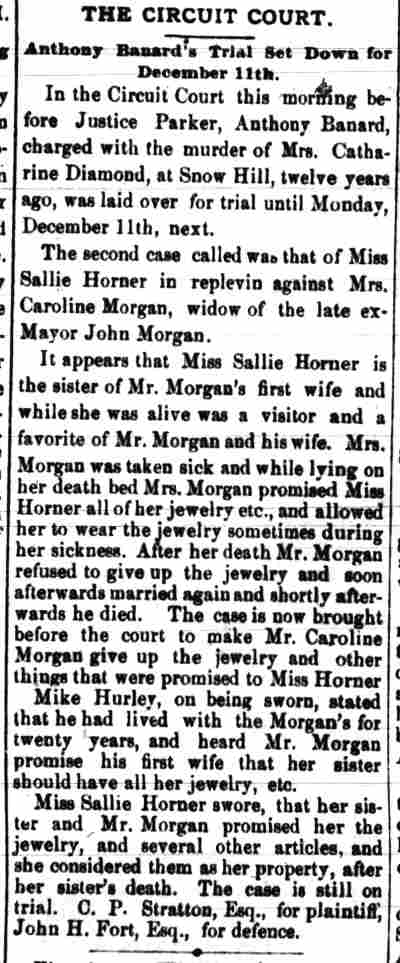
In the Circuit Court this morning before Justice Parker, Anthony Banard, charged with the murder of Mrs. Catharine Diamond, at Snow Hill, twelve years ago, was laid over for trial until Monday, December 11th, next.
The second case called was that of Miss Sallie Horner in replevin against Mrs. Caroline Morgan, widow of the late ex-Mayor John Morgan.
It appears that Miss Sallie Horner is the sister of Mr. Morgan's first wife and while she was alive was a visitor and a favorite of Mr. Morgan and his wife. Mrs. Morgan was taken sick and while lying on her death bed Mrs. Morgan promised Miss Horner all of her jewelry etc., and allowed her to wear the jewelry sometimes during her sickness. After her death Mr. Morgan refused to give up the jewelry and soon afterwards married again and shortly afterwards he died. The case is now brought before the court to make Mrs. Caroline Morgan give up the jewelry and other things that were promised to Miss Horner.
Mike Hurley, on being sworn, stated that he had lived with the Morgan's for twenty years, and heard Mr. Morgan promise his first wife that her sister should have all her jewelry, etc.
Miss Sallie Horner swore, that her sister and Mr. Morgan promised her the jewelry, and several other articles, and she considered them as her property, after her sister's death. The case is still on trial. C. P. Stratton, Esq., for plaintiff, John H. Fort, Esq., for defence.
Camden County Orphan's Court — Order to Show Cause
Camden Post —
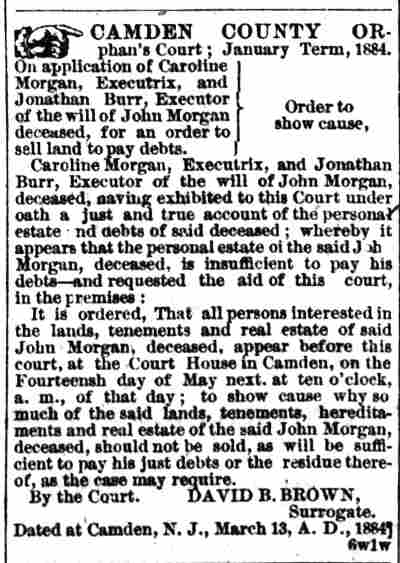
CAMDEN COUNTY ORPHAN'S COURT; January Term, 1884.
On application of Caroline Morgan, Executrix, and Jonathan Burr, Executor of the will of John Morgan deceased, for an order to sell land to pay debts.
Caroline Morgan, Executrix, and Jonathan Burr, Executor of the will of John Morgan, deceased, having exhibited to this Court under oath a just and true account of the personal estate and debts of said deceased; whereby it appears that the personal estate of the said John Morgan, deceased, is insufficient to pay his debts—and requested the aid of this court, in the premises:
It is ordered, That all persons interested in the lands, tenements and real estate of said John Morgan, deceased, appear before this court, at the Court House in Camden, on the Fourteenth day of May next, at ten o'clock, a.m., of that day; to show cause why so much of the said lands, tenements, hereditaments and real estate of the said John Morgan, deceased, should not be sold, as will be sufficient to pay his just debts or the residue thereof, as the case may require.
By the Court. DAVID B. BROWN, Surrogate.
Dated at Camden, N. J., March 13, A. D., 1884.
Death of Mrs. Morgan
Camden Post —
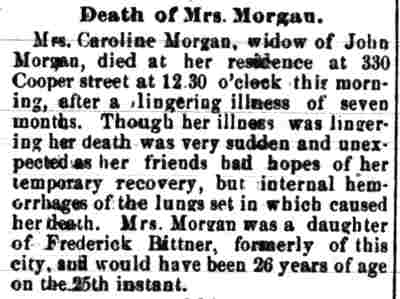
Mrs. Caroline Morgan, widow of John Morgan, died at her residence at 330 Cooper Street at 12.30 o'clock this morning, after a lingering illness of seven months. Though her illness was lingering her death was very sudden and unexpected as her friends had hopes of her temporary recovery, but internal hemorrhages of the lungs set in which caused her death. Mrs. Morgan was a daughter of Frederick Bittner, formerly of this city, and would have been 26 years of age on the 25th instant.
Funeral of Mrs. Morgan
Camden Post —
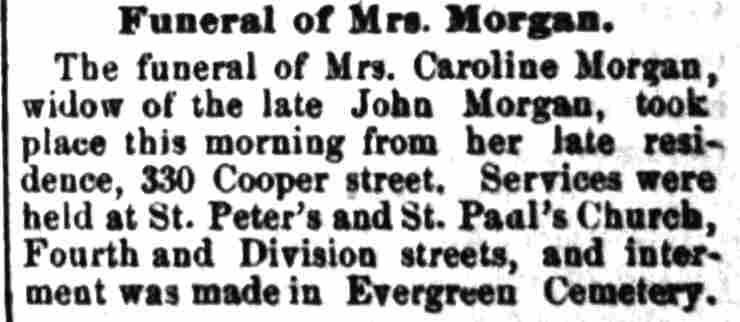
The funeral of Mrs. Caroline Morgan, widow of the late John Morgan, took place this morning from her late residence, 330 Cooper Street. Services were held at St. Peter's and St. Paul's Church, Fourth and Division streets, and interment was made in Evergreen Cemetery.
The Morgan Estate
Camden Post —
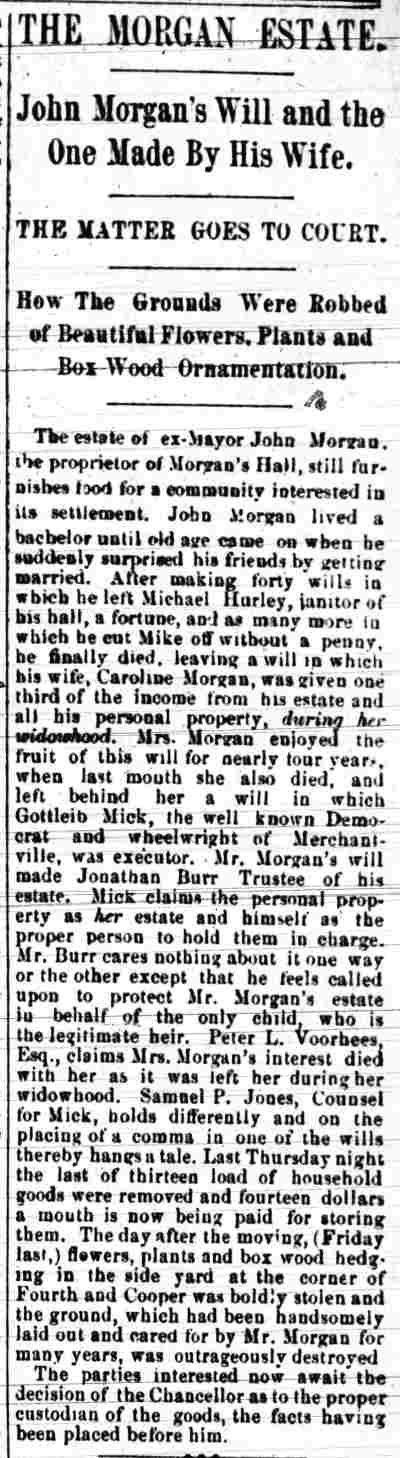
John Morgan's Will and the One Made By His Wife. THE MATTER GOES TO COURT.
How The Grounds Were Robbed of Beautiful Flowers, Plants and Box Wood Ornamentation.
The estate of ex-Mayor John Morgan, the proprietor of Morgan's Hall, still furnishes food for a community interested in its settlement. John Morgan lived a bachelor until old age came on when he suddenly surprised his friends by getting married. After making forty wills in which he left Michael Hurley, janitor of his hall, a fortune, and as many more in which he cut Mike off without a penny, he finally died, leaving a will in which his wife, Caroline Morgan, was given one third of the income from his estate and all his personal property, during her widowhood. Mrs. Morgan enjoyed the fruit of this will for nearly four years, when last month she also died, and behind her a will in which Gottleib Mick, the well known Democratic wheelwright of Merchantville, was executor. Mr. Morgan's will made Jonathan Burr Trustee of his estate. Mick claims the personal property as her estate and himself as the proper person to hold them in charge. Mr. Burr cares nothing about it one way or the other except that he feels called upon to protect Mr. Morgan's estate in behalf of the only child, who is the legitimate heir. Peter L. Voorhees, Esq., claims Mrs. Morgan's interest died with her as she was left her during her widowhood. Samuel P. Jones, Counsel for Mick, holds differently and on the placing of a comma in one of the wills thereby hangs a tale.
Last Thursday night the last of thirteen load of household goods were removed and fourteen dollars a month is now being paid for storing them. The day after the moving, (Friday last,) flowers, plants and box wood hedging in the side yard at the corner of Fourth and Cooper was boldly stolen and the ground, which had been handsomely laid out and cared for by Mr. Morgan for many years, was outrageously destroyed. The parties interested now await the decision of the Chancellor as to the proper custodian of the goods, the facts having been placed before him.