Captain Howard J. Meyer
Heroes of Camden, New Jersey
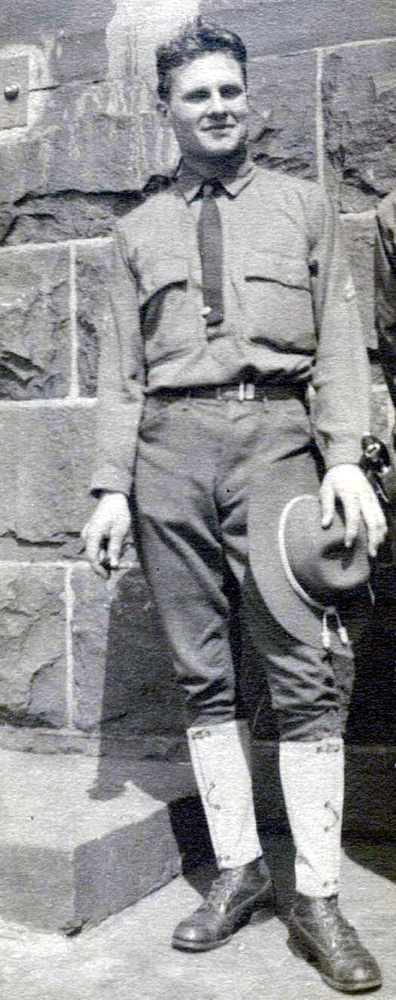
Howard Meyer, 1917.
Captain Howard J. Meyer
Howard Julius Meyer was born June 22, 1896 in Pennsylvania, the oldest of at least five children born to William A. and Mary P. Meyer. After the birth of daughter Marie the Meyers moved to 510 Clinton Street in Camden, New Jersey, which is where they resided in June of 1900. William Meyer worked then as a wheelwright at a carriage works. The family later moved to 576 Auburn Street, where they lived when the 1904 City Directory was published.
When the census was taken in 1910, another daughter, Emeline, and a son, Norman, had been born, both in Camden. By then the family lived at 711 Carman Street. William Meyer was then working as a foreman in an automobile factory.
On October 13, 1915 Howard Meyer had married Helen C. Kellman, whose family lived at 2919 High Street in East Camden.
On March 27, 1916 Howard J. Meyer enlisted as a private in the Pennsylvania National Guard. He was called to active duty almost immediately, and was on active duty June 22, 1916 through October 23, 1916. He was promoted to Corporal while on reserve duty on January 1, 1917. Corporal Meyer was recalled to active duty on March 23, 1917, and served under General Pershing along the Mexican border. His ability was soon recognized, and he was soon promoted to the rank of First Sergeant. During this time America entered World War I, formally declaring war on Germany on April 6, 1917.
First Sergeant Meyer concluded his tour with the Pennsylvania National Guard on the Mexican border on August 4, 1917. He was drafted into Federal Service the following day, and was first sent to a training camp in Oklahoma for aviators, assigned to the Aviation Section of the Signal Officers Reserve Corps. On January 10, 1918 he was commissioned as a Second Lieutenant, and was promoted to First Lieutenant on February 1, 1918. He was called to active duty on March 2, 1918, and was soon in France.
Upon arriving in France, First Lieutenant Howard Meyer was put in charge of equipping planes with radio. Before the war ended, Howard Meyer had been promoted to the rank of Captain, and had served as a member of General Pershing’s staff, flew over the lines as an observer, and commanded an American training camp for pilots in France. He remained on active duty after the Armistice, and was promoted to the rank of Captain in the United States Army’s Air Service on April 7, 1919. Captain Meyer was honorably discharged from active duty on August 6, 1919. He returned to the reserves, and was appointed Captain in the Signal Officers Reserve Corps of the United States Army on December 8, 1919, with the serial number of O-133181. On December 8, 1924 he received an appointment as Captain in the United States Army’s Air Service.
Captain Meyer returned to Camden and his wife Helen after the war. The Meyers settled at 2905 High Street, near her parents. Howard Meyer took a job with the Keystone Construction Company, and in 1923 began working on building what is today called the Ben Franklin Bridge over the Delaware River between Camden and Philadelphia.
On May 22, 1926, while working 30 feet above the ground, Howard Meyer fell after his acetylene torch exploded. Taken to Cooper Hospital with two broken legs and internal injuries, he died shortly after midnight, with his wife by his side.
Howard Meyer was buried with full military honors at Arlington Cemetery in Pennsauken, New Jersey.
Photos

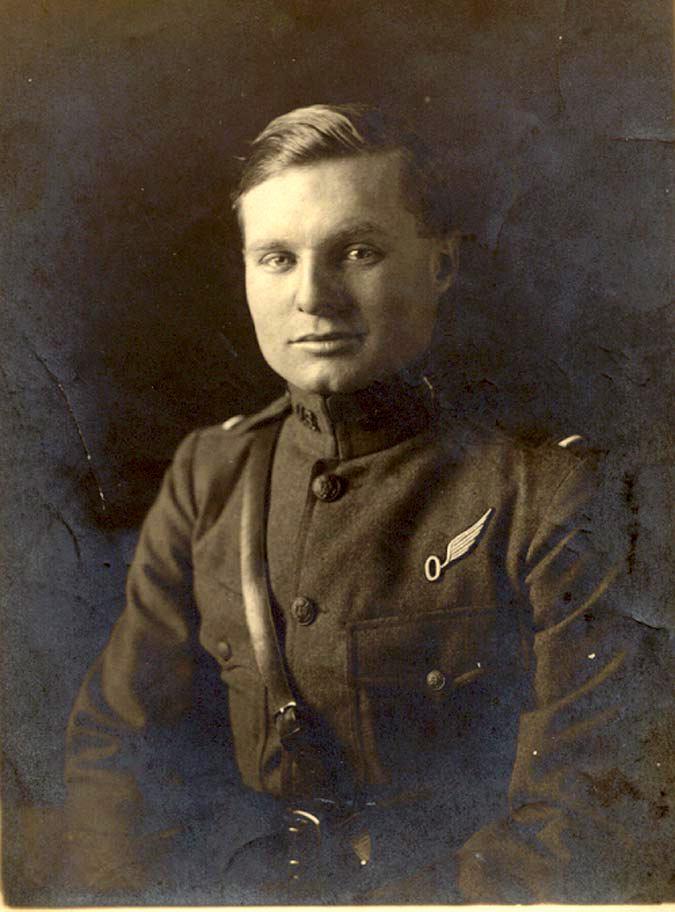

Howard Meyer, 1918 (left); Howard Meyer, 1919 (center); group photograph, 1918 (right).
2905 High Street, Camden
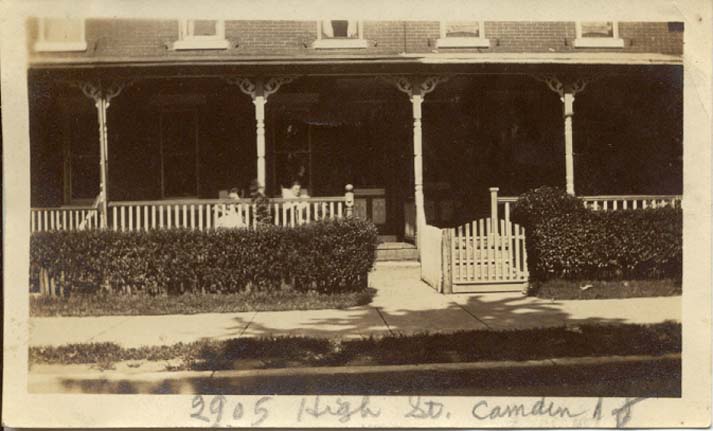
2905 & 2907 High Street, 1920s — home of Howard and Helen Meyer.
Delaware River Bridge Construction — Photos by Howard Meyer


Delaware River Bridge construction photographs taken by Howard Meyer. Meyer worked on the bridge for the Keystone Construction Company from 1923 until his fatal accident in 1926.
Howard Meyer Loses Balance in Torch Blast
Camden Courier-Post —
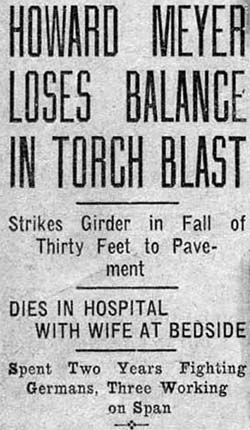


Strikes Girder in Fall of Thirty Feet to Pavement
Dies in Hospital with Wife at Bedside
Spent Two Years Fighting Germans, Three Working on Span
For two years, Captain Howard J. Meyer, American Air Force, piloted his plane over the German lines in the most dangerous job of the greatest of wars. He came out unscathed with a Distinguished Conduct Medal and the Croix de Guerre from two grateful nations.
For three years Howard J. Meyer, of 2905 High street, worked on the Camden Bridge for the Keystone Construction Company. He fell 30 feet yesterday when an acetylene torch exploded. He died this morning in Cooper hospital.
Meyer was working on the bridge at Pearl street between Second and Third streets. When the torch exploded he lost his balance, struck a girder and fell to the street below.
He was unconscious when passersby picked him up. He asked for his wife and she joined him soon afterward at the hospital. Taken there, Meyer was found to be suffering from internal injuries while both legs had been broken.
Mrs. Meyer, formerly Miss Helen C. Kellman, who married the dashing aviator shortly before he went to war, was with him until the end came shortly after midnight. Meyer was 29 years old and the son of Mr. and Mrs. William A. Meyer.
Military honors will be accorded Meyer at funeral services now being arranged for next Tuesday by the South Jersey Aviation Club and the Reserve Officers Corps, both of which he was a member.
A wreath of flowers will be dropped from an airplane on Meyer’s grave.
Fliers to Drop Wreath on Grave of Aviator
Camden Courier-Post —
Services Will Be Conducted Tomorrow For Captain Howard J. Meyer
A wreath will be dropped from an airplane on the grave of Captain Howard J. Meyer tomorrow afternoon as part of funeral services to be conducted from the former aviator’s home, 2905 High Street, by the South Jersey Aviation Club and the Reserve Officers’ Corps.
Meyer was killed last Friday in a fall from the Camden bridge on which he was employed. He served in the Army for 11 years, first as expert machine gunner, rising to the rank of first sergeant while on duty on the Mexican border. In the World War he was sent to a training camp in Oklahoma for aviators and in France was put in charge of equipping planes with radio. He was at one time a member of General Pershing’s staff, flew over the lines as an observer and was in charge of an American aviation training camp overseas.
Airplane Scatters Roses on Grave of War Hero
Camden Courier-Post —
Body of Captain Howard Meyer, Bridge Victim, Laid to Rest by Former Comrades with Solemn Military Ceremonies
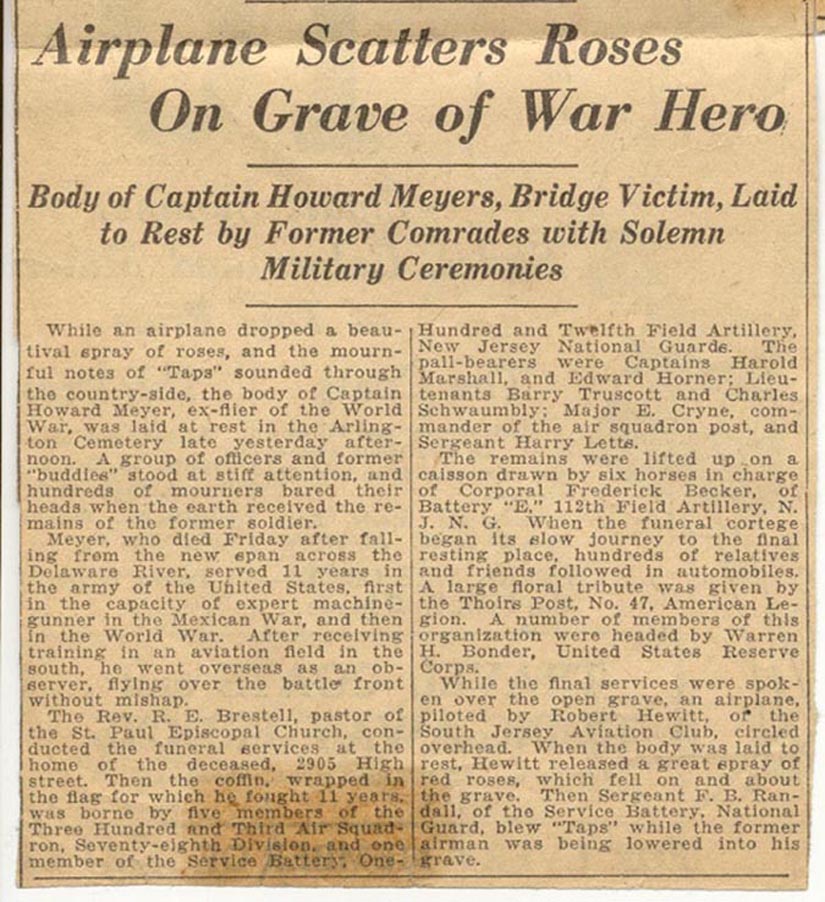
While an airplane dropped a beautiful spray of roses, and the mournful notes of “Taps” sounded through the country-side, the body of Captain Howard Meyer, ex-flier of the World War, was laid at rest in the Arlington Cemetery late yesterday afternoon. A group of officers and former “buddies” stood at stiff attention, and hundreds of mourners bared their heads when the earth received the remains of the former soldier.
Meyer, who died Friday after falling from the new span across the Delaware River, served 11 years in the army of the United States, first in the capacity of expert machinegunner in the Mexican War, and then in the World War. After receiving training in an aviation field in the south, he went overseas as an observer, flying over the battle front without mishap.
The Rev. R. E. Brestell, pastor of the St. Paul Episcopal Church, conducted the funeral services at the home of the deceased, 2905 High street. Then the coffin, wrapped in the flag for which he fought 11 years, was borne by five members of the Three Hundred and Third Air Squadron, Seventy-eighth Division, and one member of the Service Battery, One-Hundred and Twelfth Field Artillery, New Jersey National Guards. The pall-bearers were Captains Harold Marshall, and Edward Horner; Lieutenants Barry Truscott and Charles Schwaumbly; Major E. Cryne, commander of the air squadron post, and Sergeant Harry Letts.
The remains were lifted up on a caisson drawn by six horses in charge of Corporal Frederick Becker, of Battery “E,” 112th Field Artillery, N. J. N. G. When the funeral cortege began its slow journey to the final resting place, hundreds of relatives and friends followed in automobiles. A large floral tribute was given by the Thoirs Post, No. 47, American Legion. A number of members of this organization were headed by Warren H. Bonder, United States Reserve Corps.
While the final services were spoken over the open grave, an airplane, piloted by Robert Hewitt, of the South Jersey Aviation Club, circled overhead. When the body was laid to rest, Hewitt released a great spray of red roses, which fell on and about the grave. Then Sergeant F. B. Randall, of the Service Battery, National Guard, blew “Taps” while the former airman was being lowered into his grave.
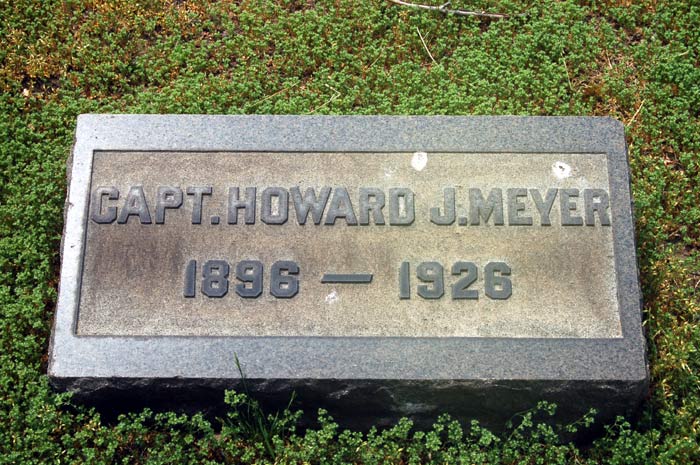
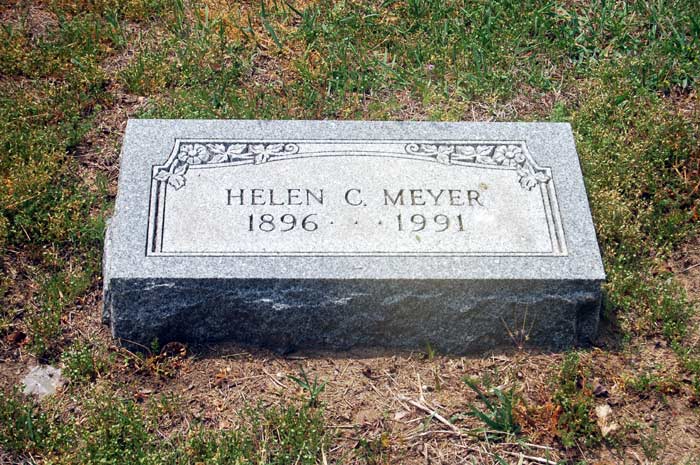
The graves of Howard and Helen Meyer, Arlington Cemetery, Pennsauken, New Jersey.