Roy Steele
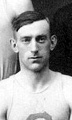
Roy Steele, 1919–1920
H. Roy Steele was a well-known figure in Camden for both his exploits on the basketball court and as a tavern owner. Although he passed away in 1946, bars in both Camden and Somers Point NJ that he owned bore his name into the mid-1960s.
Henry Roy Steele was born in Riddlesburg, Pennsylvania on October 22, 1886 to a butcher, Jacob Steele, and his wife, the former Melissa Fluke. He was the second of four children, coming after brother Homer B. Steele and before younger siblings Mary and Ross E. Steele. The 1900 census shows the family living on Sixth Avenue in Homestead PA.
A fine athlete, Roy Steele played professional basketball for six seasons in the western Pennsylvania-based Central Basketball League, beginning with the 1906–1907 season. Roy Steele had the reputation as a clutch shooter as well as a team player. In 1906 with the Homestead Young Americans he scored 220 points in 29 games, the 7th most points in the CBL. When the league increased its schedule to 70 games the next season, 1907–1908, Roy Steele scored 455 points in 67 games, 8th highest in the Central League. In 1908–1909, Roy Steele helped the Homestead Young Americans win the CBL Championship with a 49-23 record. That season, Roy Steele posted 412 points in 65 games, again 8th best in the Central Basket Ball League. He also played with the Butler and Pittsburgh South Side teams of the Central league.
When the Central league folded in November of 1912, many of the circuit’s best players, including Roy Steele, came over to the Eastern Basketball League, which was centered around Philadelphia. Roy Steele, Jackie Adams, Jimmy Brown, and Eddie Dolin all eventually joined, and starred for the Camden franchise of the Eastern Basketball League, and Camden native Eddie Ferat, nearing the end of his career also returned during the 1912–1913 season. In the better-financed Eastern Basketball League, Roy Steele played with one of the best teams in the East, Camden of New Jersey. The Camden team was known as the Camden Alphas from 1912 to 1917, the Camden Crusaders from 1917 to 1921, and as the Camden Skeeters from 1921 until the league’s collapse in 1923.
Although he did not score as many points per games as before, his defense made him a valuable member of the team. He remained with Camden in the Eastern Basketball League until it folded in 1923. Roy Steele played some games with Gloversville in the New York State league and played one game with Camden during the 1912–1913 season. He split time between Gloversville and Camden the following season as well, and also split time between Camden and the Hazleton PA team of the Pennsylvania State League in 1915–1916. He played two games with the Paterson Crescents of the Interstate Basketball League during the 1916–1917 season.
Professional basketball was for the most part shut down during the 1918–1919 season. Roy Steele played one game for the Nanticoke Nans of the Pennsylvania State league during the 1919–1920 season. The 1919–1920 season for Roy Steele resulted in his only championship, as he played 37 games for the Camden Crusaders and was seventh in the league in scoring. The 1919–1920 Camden Crusaders were champions of the Eastern Basketball League, which was and is acknowledged by many to be the leading professional basketball league of its time. His teammates included star players like Jimmy “Soup” Campbell, Neil Deighan, Eddie Dolin, and Dave Kerr, and young local talents Joe Hyde, Sam Lennox, and Richie Deighan. The team was owned by local businessmen Dr. Charles B. Helm and W. Penn Corson, who had also been Sheriff of Camden County. Roy continued to play basketball in Camden until the Eastern league collapsed on January 18, 1923. Roy Steele appeared in two games for the Paterson Legionnaires in the Metropolitan Basketball league in 1922–1923. He returned to Paterson for the 1923–1924 campaign, when he returned to the Legionnaires for seventeen games. He was 37 years old when his professional basketball career came to an end.
Ed Wachter, a star player for several teams of the era, named Roy Steele as guard on his third team all-time greatest teams of the era, which is notable in that Wachter only played against Steele for two seasons. Ed Ferat was also named on Wachter’s all-star that team.
Roy Steele also played professional baseball on the minor league level. He opened the 1908 season in the Pennsylvania and West Virginia League in 1908 for the Clarksburg team, was released and signed by the Connellsville Cokers of the same circuit where he played first base.
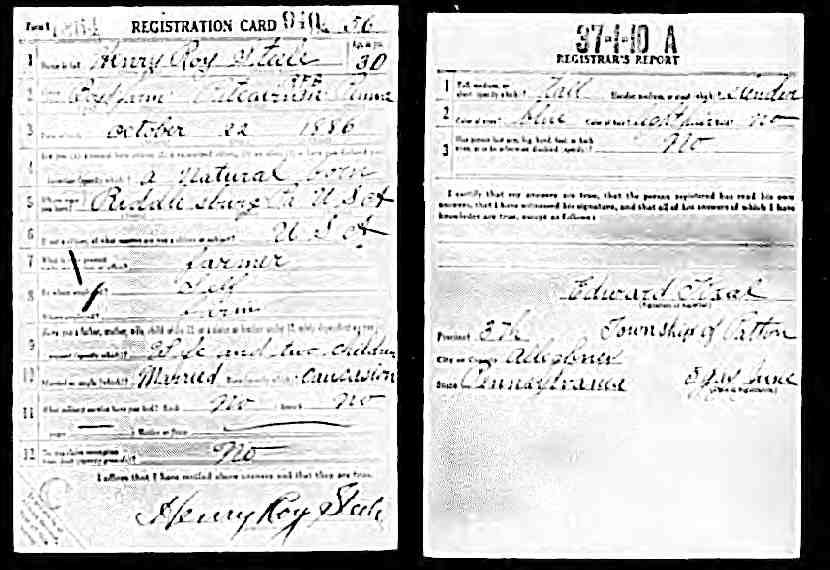
Roy Steele married Georgina “Jean” Orris on November 4, 1909. When he registered for the draft in 1918 he still made his regular home in western Pennsylvania. His draft card shows him living on the Boyd farm at Pitcairn, in Patton Township, Allegheny County PA and working as a farmer. Mr. and Mrs. Steele by that time had two children, with a third on the way, who was born shortly thereafter. His younger brother, Ross Emery Steele also was living and farming there.
The Steele family came to the Camden area the following year. Both the 1920 and 1930 Census shows Roy Steele living in Collingswood NJ with wife Georgina, daughter Edna, and sons Bruce K. and Henry Roy Steele Jr. The 1920 Census shows the Steele family living at 704 Grant Avenue in Collingswood NJ. Roy Steele’s Brother, Ross Steele, who had also played some professional basketball, was living with them, as was teammate Jimmy “Soup” Campbell. Both Steele brothers listed their professions as machinists, while Campbell gave his as a “general mechanic” at a shipyard. In January of 1920, the stars of a champion professional basketball team still worked day jobs to make ends meet! The Steele family was still at the Grant Avenue address in April of 1930. Roy Steele was then selling electrical supplies and not in the bar business. This would indicate that he became involved shortly after that point, as he was operating the bar, apparently under lease, at 28 Haddon Avenue by the time the 1931 Camden City Directory was compiled.
Roy Steele’s Crusader teammate Neil Deighan had gone into the bar business in Camden, Joe Hyde was literally born into the business, as his father owned a bar in the Eight Ward. Before it was all said and done Roy Steele, Jimmy “Soup” Campbell, and Sam Lennox would all be involved in the bar business.
At some point between April of 1930 and the compilation of the 1931 Camden City Directory, H. Roy Steele went into business at 28 Haddon Avenue, which in later years would be known as the Century Bar. In 1933 he bought a barge, built a log cabin on it, and established a floating cafe in the Cooper River near South 18th Street. By 1936 he had acquired a liquor license and opened bar nearby, at 560 Carman Street in the heart of downtown Camden. Prior to its conversion into a bar, 560 Carman Street had been the home of the Barret Tire Company as late as March of 1932. Roy Steele and his family would do business there through at least 1959 under the name Roy Steele’s Tavern. His son Bruce K. Steele joined the family business when he was old enough and managed Roy Steele’s Tavern for many years. Brother Ross Steele also worked there as bartender.
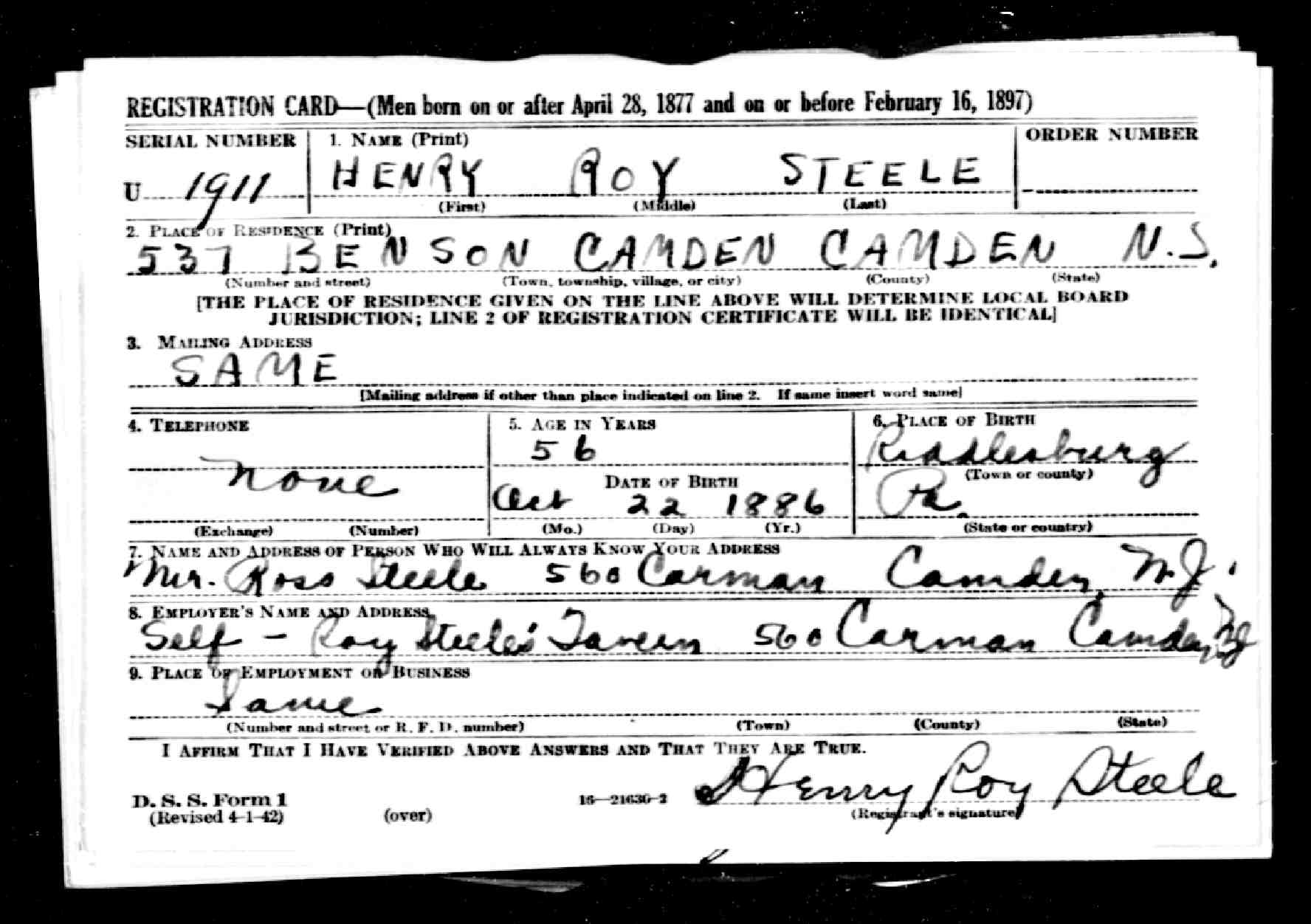
Roy Steele registered for the draft early in 1942. His World War II draft card shows that he lived at 537 Benson Street in Camden. He had by this time however, also acquired a bar at the Jersey shore. The draft card of his brother Ross showed him working as a bartender and also living at the Benson Street address.
In 1939, Roy Steele traveled to Somers Point, New Jersey, looking for a new investment opportunity. At the time Somers Point was a sleepy little town that you passed through to get to Ocean City. Roy found what he was looking for at 943 Bay Avenue, an old tavern named “Stretch Inn.” The tavern had been owned and operated by Thomas Stretch. Since he had passed away his widow, Bertha, had decided to sell the Inn. Steele and Bertha Stretch entered into an agreement to lease the inn for $40.00 a month for three years. The inn was described in the lease as a Tap Room and Cafe, which was a very accurate description. It suited Steele perfectly. Above the bar was an apartment with five bedrooms, one bathroom, dining room, living room and kitchen. The inn had one large room with a huge bar in the shape of a ship. Behind this room was a kitchen and storage area. Steele asked his son-in-law, Elmer Blake, to come to the shore and help him manage the tavern on Bay Avenue now known as Steele’s Inn. So Elmer and his wife Edna and their daughter Jean moved in above the bar with their parents. Not long after this Steele’s younger son and his wife also made the apartment of Steele’s Ship Bar home. All those people and one bathroom, remarkable.
In these early years the Somers Point bar was run like any other local tavern. Draft beer, mixed drinks and a kitchen that served up sandwiches, fries and great cole slaw. Edna Blake helped by serving food to the patrons. She liked to tell the story about two customers who came in and spoke with very heavy German accents and she was convinced they were spies that had been landed by submarine. Who knows—stranger things have happened.
In 1945, Roy Steele became very ill and was hospitalized much of the time. He passed away at Somers Point on June 17, 1946 and left the bar that he had purchased to his wife Georgina. Georgina continued to live with her family above the bar. Mrs. Steele moving to Somers Point, where she resided till her death on November 27, 1955. Elmer and Edna Blake ran Steele’s Inn until the winter of 1965.
After Roy Steele’s death, his family remained in the tavern business in Camden for many years thereafter. Bruce Steele, who managed the Camden bar, Roy Steele’s Tavern, made his home in Collingswood with his wife Lillian. Ross Steele remained as a bartender and lived at 537 Benson Street through at least the fall of 1959. The bar was still open, as stated above, as late as the fall of 1959. Sadly, son Bruce Steele died in Camden on October 13, 1961; his wife Lillian remained a Collingswood resident until her passing in 1997. Ross Steele passed away in September of 1965. Roy Steele’s Tavern had closed by 1970. When Carman Street was “erased” to make way for “urban renewal” Roy Steele’s Tavern went with it. The Walter Rand Transportation Center sits on the land where Roy Steele’s Tavern once lay.
Roy Steele’s Professional Basketball Career
| Season | Team | G | FG | FT | TP | PPG | Rank |
|---|---|---|---|---|---|---|---|
| Central Basketball League | |||||||
| 1906–1907 Regular Season | Homestead Young Americans | 29 | 109 | 2 | 220 | 8th | |
| 1906–1907 Post Season | Butler | 19 | 62 | 7 | 131 | 6.9 | 10th |
| 1907–1908 | Homestead Young Americans | 67 | 226 | 3 | 455 | 6.8 | 8th |
| 1908–1909 | Homestead Young Americans | 65 | 205 | 2 | 412 | 6.3 | 8th |
| 1909–1910 | Homestead Young Americans | 67 | 196 | 0 | 392 | 5.9 | |
| 1910–1911 | Homestead Young Americans | 49 | 147 | 0 | 294 | 6.0 | |
| 1912–1913 | Pittsburgh South Side | 46 | 160 | 6 | 326 | 7.1 | 10th |
| CBL Career Totals | 342 | 1105 | 20 | 2230 | |||
| New York State League | |||||||
| 1912–1913 | Gloversville | 15 | 35 | 10 | 80 | 8.3 | |
| 1913–1914 | Gloversville | 38 | 94 | 27 | 215 | 5.7 | |
| NYS Career Totals | 53 | 129 | 37 | 295 | |||
| Eastern Basketball League | |||||||
| 1912–1913 | Camden Alphas | 1 | 3 | 0 | 6 | 6.0 | |
| 1913–1914 | Camden Alphas | 11 | 18 | 0 | 36 | 3.3 | |
| 1914–1915 | Camden Alphas | 40 | 114 | 0 | 228 | 5.7 | 9th |
| 1915–1916 | Camden Alphas | 40 | 72 | 0 | 144 | 3.6 | |
| 1916–1917 | Camden Alphas | 36 | 76 | 0 | 152 | 4.2 | |
| 1917–1918 | Camden Crusaders | 6 | 15 | 9 | 39 | 6.5 | |
| 1918–1919 | NO EBL DUE TO WAR | ||||||
| 1919–1920 | Camden Crusaders | 37 | 79 | 52 | 210 | 5.7 | 7th |
| 1920–1921 | Camden Crusaders | 39 | 77 | 71 | 225 | 5.8 | 4th |
| 1921–1922 | Camden Skeeters | 46 | 89 | 56 | 234 | 5.1 | 10th |
| 1922–1923 | Camden Skeeters | 22 | 57 | 31 | 145 | 6.6 | 5th |
| The league disbanded on January 19, 1923 | |||||||
| EBL Career Totals | 278 | 600 | 219 | 1419 | 5.1 | ||
| Pennsylvania State League | |||||||
| 1915–1916 | Hazleton Mountaineers | 14 | 4 | 0 | 8 | 0.6 | |
| 1919–1920 | Nanticoke Nans | 1 | 2 | 2 | 6 | 6.0 | |
| PSL Career Totals | 15 | 6 | 2 | 14 | |||
| Interstate Basket Ball League | |||||||
| 1916–1917 | Paterson Crescents | 2 | 4 | 4 | 12 | 6.0 | |
| Metropolitan Basketball League | |||||||
| 1922–1923 | Paterson Legionnaires | 2 | 6 | 1 | 13 | 6.5 | |
| 1923–1924 | Paterson Legionnaires | 17 | 30 | 23 | 83 | 4.9 | |
| MBL Career Totals | 19 | 36 | 24 | 96 | 5.0 | ||
Camden in Eastern League
Camden Courier —
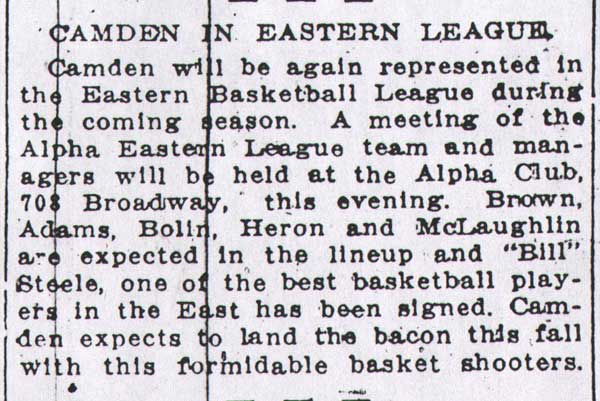
Camden will be again represented in the Eastern Basketball League during the coming season. A meeting of the Alpha Eastern League team and managers will be held at the Alpha Club, 708 Broadway, this evening. Brown, Adams, Bolin, Heron and McLaughlin are expected in the lineup and “Bill” Steele, one of the best basketball players in the East has been signed. Camden expects to land the bacon this fall with this formidable basket shooters.
Deneri’s Winning Streak Halted by Greystock; Jimmy Campbell Is Sensation Against Beckman
Philadelphia Evening Public Ledger —


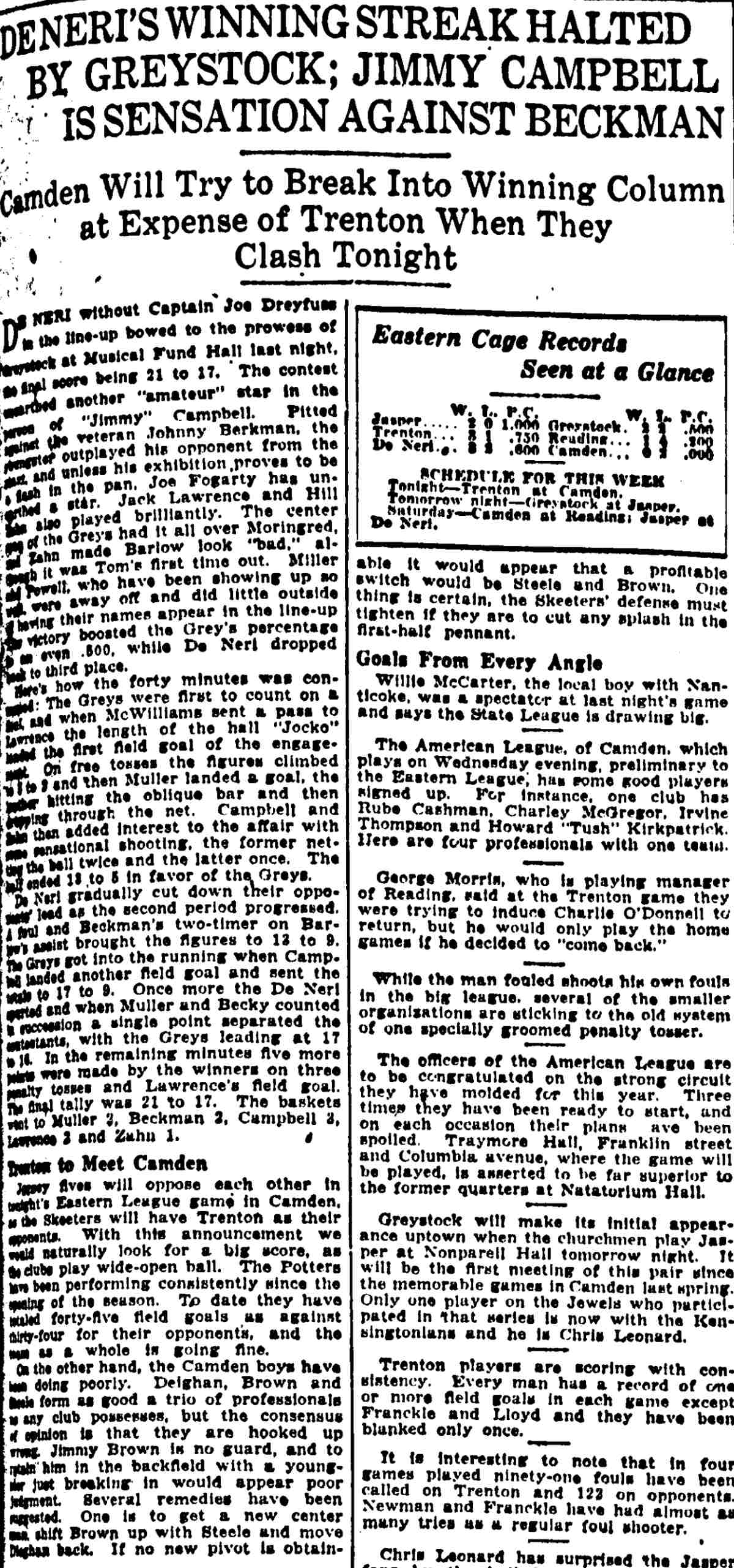
Camden Will Try to Break Into Winning Column at Expense of Trenton When They Clash Tonight
Eastern League Goes Into Discard
Philadelphia Inquirer —

Eastern League Goes Into Discard
EASTERN LEAGUE GOES INTO DISCARD
Attempt to Reorganize Basketball Organization With Four Club Circuit a Failure
Squabble Over Players and Latters' Fickleness Caused Blowup; Trenton and Camden to Play Series
The attempt to reorganize the Eastern Basketball League has resulted in a dismal failure. In an effort to get the public interested enough to support professional basketball, Philadelphia, Camden, Trenton and Reading met last night in this city and when Reading failed to send a representative to the conference the other three clubs present decided to throw up the sponge for the season and officially disband.
The members felt that this was the best course to pursue in the face of the existing conditions. The attendance at the games had been far below normal and the inability of some of the four teams to agree on the allotment of players to certain teams had made matters continually troublesome. J. C. Kiver, of Trenton, and William J. Scheffer, of Camden, are of the opinion that there was no hope of presenting next fall if the conditions improve. The other two clubs were both discouraged and were ready to post their increased wages and Scheffer says the Camden club failed to have a representative at the meeting last night because he had decided there was enough trouble in trying to keep the thing going. In light of the circumstances he had decided not to try again.
Thrown on the market by the retirement of Jasper and Greystock, were McWilliams, Stutz, Moorhead and White. Most of these men looked toward Camden but only three were in demand, McWilliams, Sugarman and Lawrence. Those and other players, however, who became available had led Club Managers of Camden and Reading in letting Brown and Steele go. Camden and Reading had signed. Camden with Steele, Deighan and Kelth as the nucleus agreed to use men from Philadelphia and Camden.
They, however, had failed to take into consideration the fickleness of some of their players. Williams had signed with the New York State League and would not play another game. Sugarman declined to play because he found it would interfere with his polo playing in the New York State League, and Lawrence only wanted to play on Saturdays when most games were played midweek. Camden could not get McWilliams and Sugarman, and Reading learned this on top of the stand taken by Philadelphia and there was a storm of disapproval from the owners.
This brought the scene up between Philadelphia and Camden. The latter expressed a decisive desire to recruit another first-class player. Philadelphia expressed a decisive desire to recruit a few new men for the reserve list of the Philadelphia team. The two clubs could not agree and apparently the clubs were ready for the deal.
Jimmy “Soup” Campbell - Roy Steele - Neil Deighan - Dr. Charles B. Helm - Jack Kelly - Chol Engle - Pete Kilpatrick - Willie Miller
Camden Crusaders — 1919–1920 Eastern Basketball League Champions
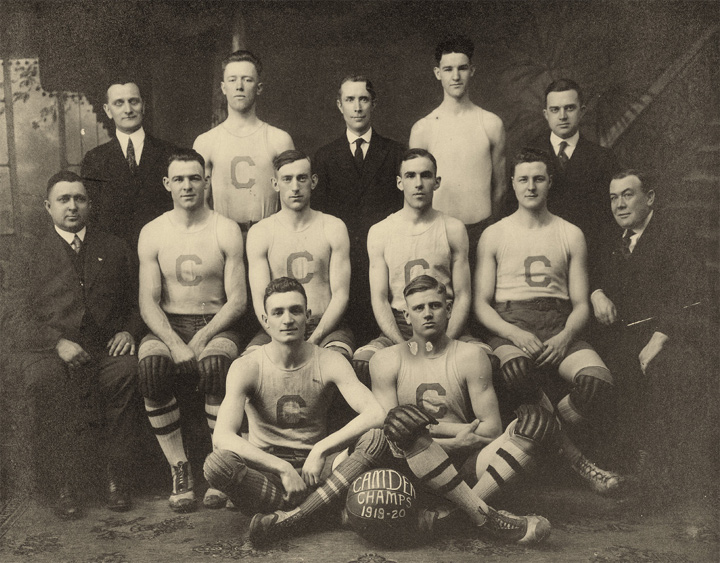
Front row, left to right: Jimmy “Soup” Campbell and Joe Hyde.
Second row: Dr. Charles B. Helm, Neil Deighan, Roy Steele, Eddie Dolin, Dave Kerr and Sheriff W. Penn Corson.
Back row: Bill Mitchell, trainer; Sam Lennox, Manager Bill Kennedy, Richie Deighan and Timekeeper Jim Kane.
560 Carman Street — Barrett Tire Company
Camden Courier-Post —
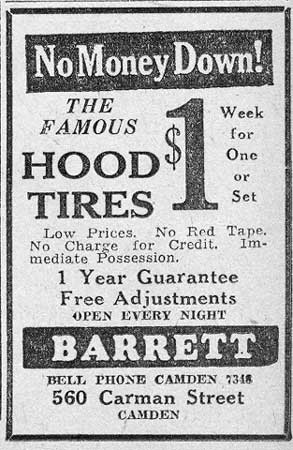
Barrett Tire advertisement — 560 Carman Street
No Money Down!
THE FAMOUS HOOD TIRES $1 Week for One or Set
Low Prices. No Red Tape. No Charge for Credit. Immediate Possession. 1 Year Guarantee / Free Adjustments / OPEN EVERY NIGHT
BARRETT BELL PHONE CAMDEN 7318 560 Carman Street CAMDEN
Roy Steele, Basketball Hero, Starts New Career in Cabin
Camden Courier-Post —
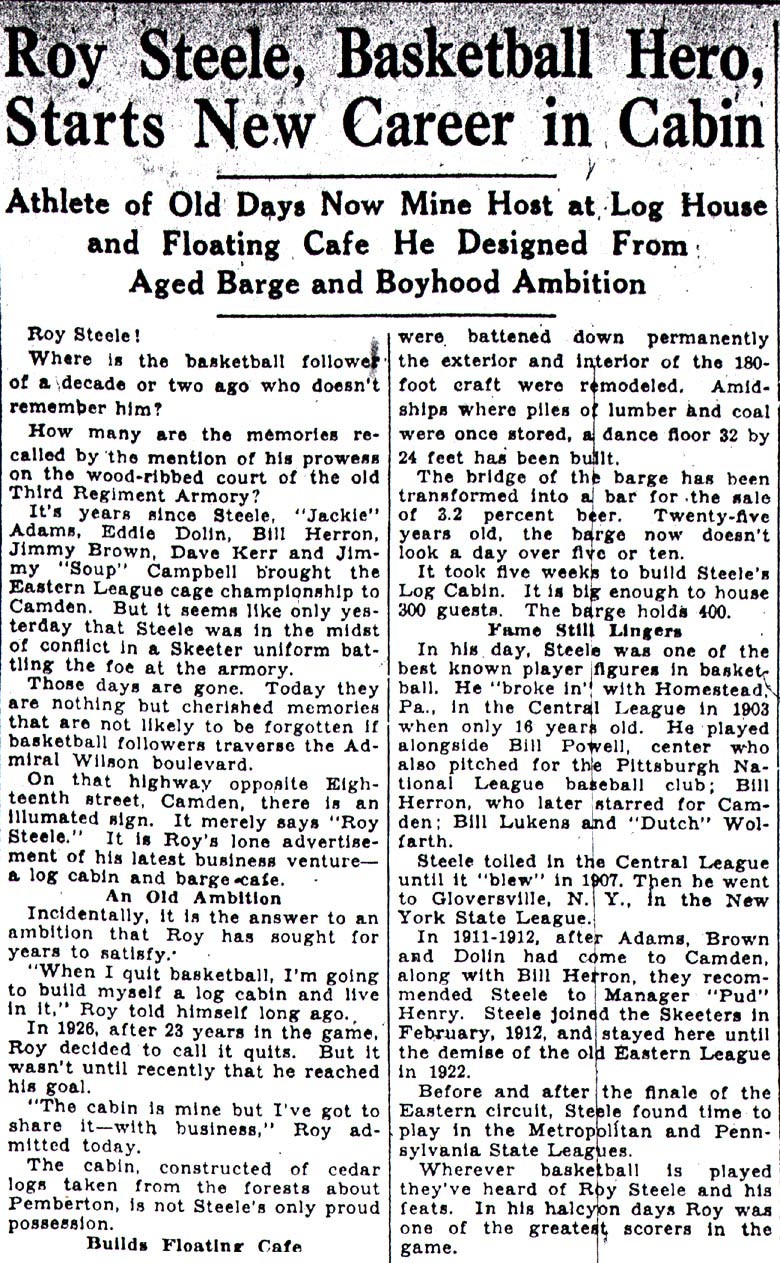

ROY STEELE, BASKETBALL HERO, STARTS NEW CAREER IN CABIN
Athlete of Old Days Now Mine Host at Log House and Floating Cafe He Designed From Aged Barge and Boyhood Ambition
Roy Steele!
Where is the basketball follower of a decade or two ago who doesn’t remember him?
How many are the memories recalled by the mention of his prowess on the wood-hardened court of the old Third Regiment Armory.
It’s years since Steele, “Jackie” Adams, Eddie Dolin, Bill Herron, Jimmy Brown, Bill Herron and Jimmy “Soup” Campbell brought the Eastern League cage championship to Camden. But it seems like only yesterday that Steele was in the midst of conflict in a Skeeter uniform battling the foe in the armory.
Those days are gone. Today they are nothing but cherished memories and not entirely forgotten if basketball followers traverse the Admiral Wilson boulevard.
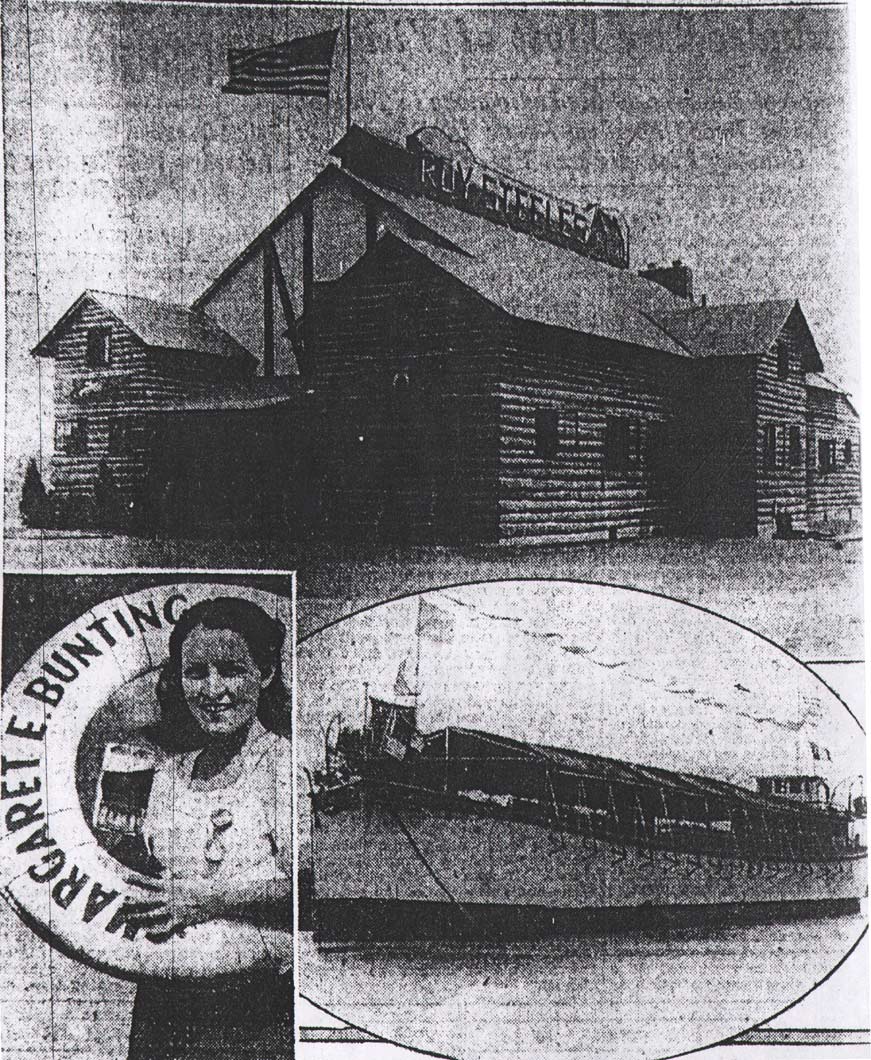
On an illuminated sign opposite Eighteenth street, Camden, there is an illuminated sign. It merely says “Roy Steele” — the lone advertisement of his latest business venture — a log cabin and barge-cafe.
An Old Ambition
Incidentally, it is the answer to an ambition that Roy has sought for years to satisfy.
“When I quit basketball, I’m going to build myself a log cabin and live in it,” Roy told himself long ago.
In 1926, after 23 years in the game, Roy decided to call it quits. But it wasn’t until recently that he reached his goal.
“The cabin is mine but I’ve got to share it—with business,” Roy admitted today.
The cabin, constructed of cedar logs taken from the forests about Pemberton, is not Steele’s only proud possession.
Builds Floating Cafe
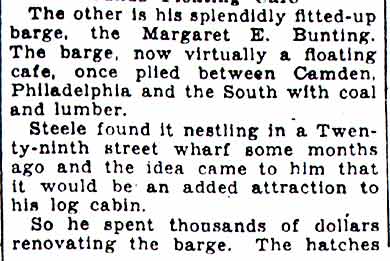
The other is his splendidly fitted-up barge, the Margaret E. Bunting. The barge, now virtually a floating cafe, once plied between Camden, Philadelphia and the South with coal and lumber.
Steele found it nestling in a Twenty-ninth street wharf some months ago and the idea came to him that it would be an added attraction to his log cabin.
So he spent thousands of dollars renovating the barge. The hatches were battened down permanently, the exterior and interior of the 180-foot craft were remodeled. Amidships where piles of lumber and coal were once stored, a dance floor 32 by 24 feet has been built.
The bridge of the barge has been transformed into a bar for the sale of 3.2 percent beer. Twenty-five years old, the barge now doesn’t look like its former self.
It took five weeks to build Steele’s Log Cabin. It is big enough to house 300 guests, the barge holding 400.
Fame Still Lingers
In his day, Steele was one of the best players in the Eastern basketball. He “broke in” with Homestead, Pa., in the Central League in 1903 and served for 10 years. He starred alongside Bill Powell, center who also pitched for the Pittsburgh National League baseball team; Bill Herron, who later starred for Camden; Bill Lukens and “Dutch” Wolfarth.
Steele toiled in the Central League until it “blew” in 1907. Then he went to Gloversville, N.Y., in the New York State League.
In 1911-1912, after Adams, Brown and Dolin had come to Camden, Steele came too because Adams recommended Steele to Manager “Pud” Henry. Steele joined the Skeeters in February, 1912, and stayed here until the demise of the old Eastern League in 1922.
Before and after the finale of the Eastern circuit, Steele found time to play in the Metropolitan and Pennsylvania State Leagues.
Wherever the game is played they’ve heard of Roy Steele and his feats. In his halcyon days Roy was one of the greatest scorers in the game.
Years ago when Roy Steele scintillated across the basketball courts for Camden he had two ideas in mind. One was to own a log cabin. The other was to start a business career when he finished playing the game. Today he has accomplished both. Out at Admiral Wilson Boulevard and the Cooper River the name of Steele — once emblazoned forth in newspaper sport page headlines — now sparkles from a log cabin. Roy is the possessor also of a floating cafe on a barge anchored in Cooper River beside the cabin. Opposite the barge (above), decorating the life-preserver, is pretty Miss Ann Pizagno, of 809 Moore street, Philadelphia.
N.J. Beverage Association Opposes State Stores
Camden Courier-Post —
More Power Urged for Burnett Office on Fair Trade Pact
Curb on Price Cutting Sought in Resolution of State-wide Organization
Heavy Penalties Asked
The New Jersey Licensed Beverage Association, in a one-day special convention, passed resolutions flatly opposing inauguration of state-operated liquor stores in New Jersey and asking the Legislature to grant State A. B. C. Commissioner D. Frederick Burnett wider powers to enforce the Fair Trade Act it was announced last night by Neil F. Deighan, president of the association.
Deighan reported the Camden and Jersey City delegations offered the only open opposition to the resolution against the state stores. They argued, Deighan said, that the association may be forced later to advocate state stores to break up price cutting by package stores.
The additional powers asked for Burnett are designed to break up price cutting, Deighan pointed out. He said the resolution asks setting of mandatory penalties, to be enforced by Burnett, of 30 days suspension for the first offense and license revocation for the second offense against the fair trade act.
Deighan said he supported the anti-state stores resolution, both personally and as president.
The association, which met Monday in Trenton, also passed a resolution urging that breweries be placed under the same Federal permit system as that which now prohibits ownership of liquor selling establishments by distillers.
Another resolution continued a committee, authorized to select private brands of whisky to bear the association’s emblem and to be sold only by association members.
The association also passed a resolution disavowing criticism of Burnett as expressed in quotations from Roy Dunn, counsel for the Original Tavern Owners’ Association of Newark, in the Newark News of January 28, went on record as being “not in agreement” with the criticism, and commended Burnett’s administration. Deighan said the resolution pointed out also that “the association represented by Mr. Dunn is not affiliated with the New Jersey Licensed Beverage Association.”
A resolution urging the display of “Buy American Whisky” signs in taverns was passed also.
Deighan was given a vote of confidence by the delegates when questions involving administration policies was brought up, John Pennington, head of the Camden Unit, reported.
Camden delegates to the convention were Pennington, Roy Steele, Alfred Munyon, Bruno Bronislaus, Celia Ellis and Tony Paretto.
Roy Steele’s Tavern — 1939 Banquet Program Advertisement
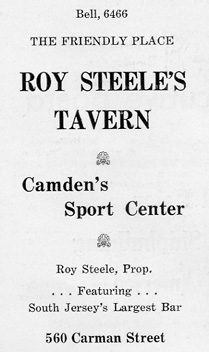
Bell, 6466
THE FRIENDLY PLACE
ROY STEELE’S TAVERN
Camden’s Sport Center
Roy Steele, Prop. … Featuring … South Jersey’s Largest Bar
560 Carman Street
Steele Dies At 59
Trenton Evening Times —
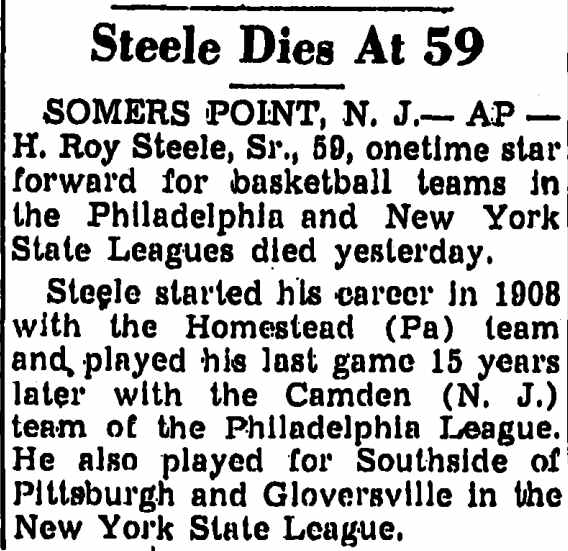
SOMERS POINT, N. J.— AP — H. Roy Steele, Sr., 59, onetime star forward for basketball teams in the Philadelphia and New York State Leagues died yesterday.
Steele started his career in 1908 with the Homestead (Pa) team and played his last game 15 years later with the Camden (N. J.) team of the Philadelphia League. He also played for Southside of Pittsburgh and Gloversville in the New York State League.
In the ’30s, they danced on a Cooper River barge
Camden Courier-Post —
Over the years, Admiral Wilson Boulevard has been home to many attractions — some good and some not so good.
Among the good ones were the first drive-in theater, which was in Pennsauken; the famous Whoopie Coaster, a wooden thrill ride that automobiles could drive onto for 25 cents; and Roy Steele’s log cabin and dance barge.
The log cabin and dance barge were the brainchild of Steele, a former Camden basketball great. He was a member of the Camden Skeeters basketball club of the Eastern League and helped bring the league’s championship game to Camden. He started playing in 1903 and retired in 1922, after the league’s demise.
When he died in 1946, at age 59, a Courier-Post editorial said, “Roy Steele was the toast of the town back in the years from 1912 to 1922.”
After his basketball career ended, Steele wanted to realize his longtime dream of owning and living in a log cabin. The one he built was made of cedar logs from the woods of Pemberton Township. It was constructed on Admiral Wilson Boulevard at 18th Street during the early 1930s.
An illuminated sign that carried his name was the only advertisement of his business venture — a barge cafe in the Cooper River.
According to Courier-Post stories, the barge was called the Margaret E. Bunting, and it had been used to transport coal to the South from Camden and Philadelphia. Steele found it in the Delaware River, at the foot of 29th Street in Camden.
After having it moved to the Cooper River, Steele spent thousands to renovate it. The 180-foot barge had a dance floor that was 32 feet by 24 feet. Its bridge served as a bar that, according to research, sold 3.2 percent beer.
The barge could hold approximately 400 patrons, and it was linked by walkway to Steele’s log cabin, which also had a bar.
Frank Brown, 91, said he played drums in an eight-piece band on the dance barge when he was 15. He says the open-air barge had a canvas cover, held up by pipes with dropcloths draped over the sides, that kept patrons dry during inclement weather. Brown, a Collingswood High School graduate, remembers a time when a storm came up with winds so strong that it bent the pipes and created a sail effect. “It (the storm) shorted out all of the lights, and things were hectic for a minute,” Brown said.
Florence Jaggard of Haddon Township, Steele’s step-granddaughter, told us via e-mail that she does not remember seeing the “ship,” as she called it. “But I heard many stories about it. This man was far ahead of his time!! It was a great idea.”
Grandson Bruce R. Steele of Marco Island, Fla., said: “My grandfather was, of course, a tremendous basketball player back in the ‘20s, and there was a picture in the Basketball Hall of Fame, in Springfield, Mass., of his team. My father, Bruce K. Steele, was an all-state football and baseball player at Collingswood High School and later was a championship golfer at Riverton Country Club.”
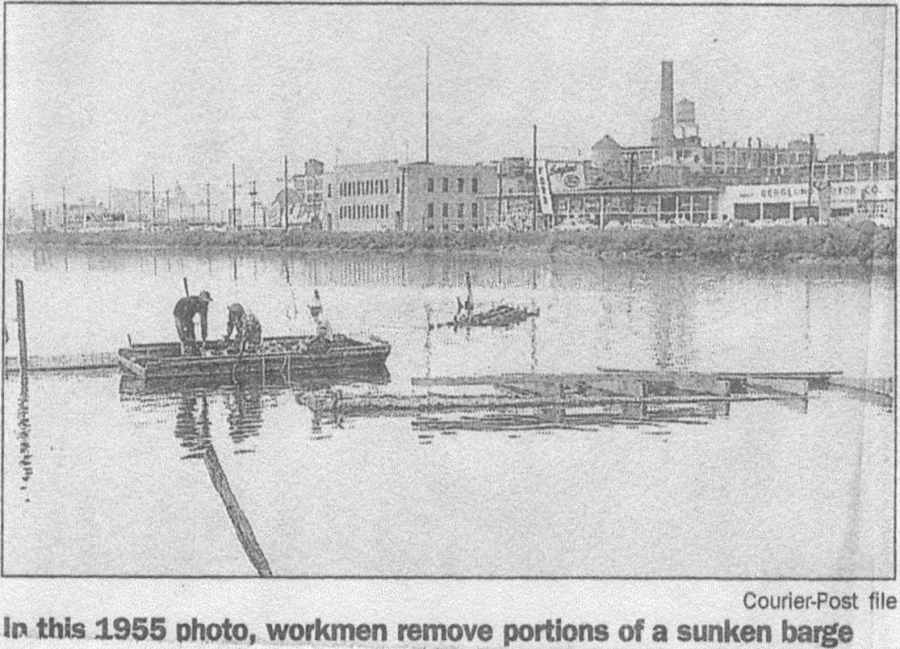
Shirley Grinnan of Mount Laurel and Walter Moore of Haddon Township both called to say they recalled the barge but were too young to go dancing on it. Moore, 79, said he remembered it always being lit up with all kinds of string lights. “I believe it burnt down,” he said. Reports say the barge eventually sank, and others recall it catching fire, but its remains were visible for years along the boulevard.
Bruce Steele says his father owned Steele’s, a bar on Carmen Street in Camden for many years, which his father had inherited from Roy Steele. The former basketball star owned two bars in Somers Point — Steele’s Ship Bar and the Bala Inn. He was living in Somers Point at the time of his death.
“Roy Steele not only brought fame to himself but to Camden, the town that adopted him 34 years ago,” the Courier-Post concluded in its 1946 editorial.
Downtown Camden — 1957
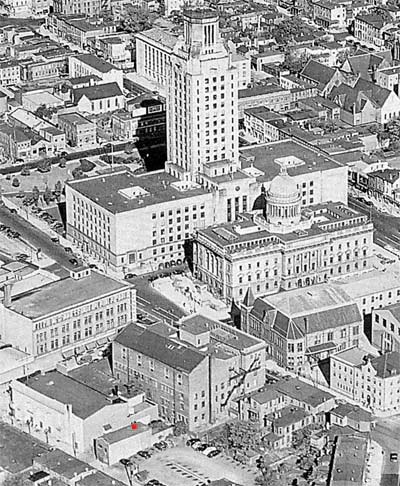
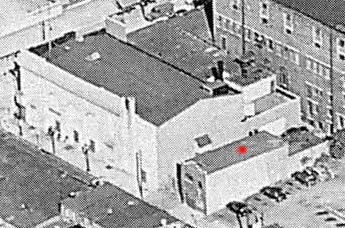
Downtown Camden — 1957. Indicated by the red dot, 565 Carman Street lay just east of Broadway, behind the Broadway (later known as the Midway) Theater. Roy Steele’s Tavern was directly across the street. To the left you can see where the tavern and Carman Street lay in relationship to City Hall, the old Camden County courthouse, and Camden Catholic High School. All but City Hall were gone by the end of 1961. The Parkade Building had not yet been built.
More About Steele’s Ship Bar in Somers Point, New Jersey
Much has been written of the Point in the 1960’s. The rock and roll bars, the great music and the endless summer party. Steele’s shared some of that, but it’s real era was the decade before—the fifties. The post-war fifties was a gracious time when people wanted to forget the horror of World War II and the Great Depression. It was like the whole country could breathe a sigh of relief. The economy was booming and so were families. It was a time that was right for music, dancing and partying till dawn.
The Ship Bar was quite plain on the outside. The only unique characteristics were the front door that was wooden with a porthole window and the other windows which were all port holes. Inside there was the main ship bar complete with bandstand in the center. Surrounding the main bar were four smaller bars. These were in the shape of docks which completed the nautical theme. The walls behind these bars were painted to resemble harbor scenes. They had all been created by Elmer’s friend Charlie Shane. In the later years, the front door was replaced with a double glass front door. A side addition to the original structure added three more side bars, bringing the total number of bars to seven.
Over the years many bands played in the bar. The first memorable one was Dave Apple and the Applejacks. Bill Haley and his Comets were there. A group called Dicky Doo and the Don’ts, Pete Carrol and the Carrol Brothers and in the later years Mike Pedicin became the regular attraction. These bands never took their audiences for granted. They knew there was too much competition next door and across the street. Customers could be lost very easily if the band wasn’t catering to what they wanted to hear.
The band members constantly came up with new ideas and gimmicks to keep the entertainment new. Mike Pedicin’s band had an excellent drummer. He would do a drum solo with his hands in white gloves and blue lights shining on him. The house lights were turned down and the only thing you could see were the hands flying. The only sound was a magnificent drum solo. New acts and performers were always joining the regulars on stage. The bands, however, were not the only attractions at Steele’s. There were the regular bartenders that people came to count on for entertainment as well. Mac MacNamara was there season after season. It was said that Mac once played with the Boston Pops and wrote MacNamara’s Band. Somehow he got sand in his shoes and made his home at the Jersey shore. He would share his gift on the violin with the whatever band happened to be appearing. Patrons who were not regulars were always surprised when their bartender suddenly joined the band and played his wonderful songs. There was also the group known as the Cherry Sisters. This group would consist of a group of younger bartenders dressed as women in feed sacks, straw hats and scarves. They would also become part of the floor show. Jim Ross was usually the lead singer of the Cherry Sisters. In addition to the regular bartenders, each year a group of college kids would earn next year’s tuition tending bar for the summer at Steele’s. This was the group that usually attracted the younger female college students each summer.
Although the Ship Bar was named a bar, it was really a night club. It usually opened around noon. By day, fisherman would come in for a couple of drafts. If it was a rainy day, you might get some of the beach refugees. During the dinner hour the bar was very quiet. The music would start at nine and Elmer would be there, in his white dinner jacket, to great his guest. Those were the days when people still dressed to go out for an evening. Ladies dressed to the nines, men in their summer suits. There were three distinct groups of customers. The first were natives of the area who would cap off a day of fishing or golfing with an evening at Steele’s. The second were the Ocean City summer visitors that had finally worn the children out on beach and boardwalk and now where looking for some great entertainment. The last group were the college students out on the town looking for summer romance. They would all come to Steele’s. Elmer used to joke that it was only a good house if those that fainted had to remain standing up because there was no room to fall.
Elmer was also part of the fun at Steele’s. He always had a gimmick. He would dress up as a trapeze artist in long johns and boxer shorts and do a skit with the band. He’d walk into the bar on a busy evening with a ladder, paint cans, overalls and at least one tooth blacked out and just start painting. Everyone including the band would wonder where this strange man had come from and what he was doing painting the wall in the middle of a busy evening until they realized it was just another of Elmer’s gags. He advertised a special appearance of Liberace and had a look-alike show up. He’d get on stage with the band and lip-sync with the lead singer. Most of all he would entertain people with great stories. He was a great joke and story teller that genuinely enjoyed people.
In the early days, one band playing was usually sufficient to keep the crowd for the evening. As time wore on and Tony Mart’s and Bay Shores began to compete for the same customers, the music would have to be constant or you could loose your entire crowd during a break. So when one band would go on break another would pick up the music and no one would notice the difference. The job of the entertainers didn’t stop at break time. Most of their breaks were spent chatting with the various groups of regular customers. Everyone wanted to be friends with the band and owner and be able to say they knew so and so personally.
What did Bay Avenue look like back then? It was very different from today. If you were coming around the circle the first street that took you down to the bay was Goll Avenue. At the corner of Goll and Shore Road there was a billboard for Steele’s. When it was put up, Mike Pedicin was playing at Steele’s. His lead guitarist was Sammy. Sammy not only played guitar, he also charmed the audience with “riqué ditties” and so earned the name of “Sexy Sam.” The billboard originally advertised Mike Pedicin featuring “Sexy Sam.” Since this was the fifties, the sexy had to go. So for billboard purposes “Sexy Sam” became “Suburban Sam.” As you turned onto Goll Ave, you would pass the old brick trolley station on your left and at the bottom on the hill on your right was the Gateway. For a few glorious summers it was the Gateway Theater. A summer stock theater that had marvelous shows. When it was open they would use search lights to attract people. If you followed along the Bay front the next structure was a little pier and in the summer it magically became “Ray White’s Ski School” complete with ski jump for the braver set. Bay Shores occupied the lot next to the Ski School. Next to Bay Shores was a beautiful old seashore home that was called the “Customs House.
In summer The Customs House had the only front lawn on the corner. Unfortunately, this home was subsequently torn down and replaced by a miniature golf course and penny arcade. Completing the corner was “Dick’s Dock” featuring smelly bait and leaky boats. Tony Mart’s and Steele’s Ship Bar were located across the street from Bay Shore’s, The Custom House and Dick’s Dock. This was the corner. In one day you could fish, crab, water ski, see a Broadway show and dance, drink and hear great entertainment till the wee small hours. (2:00 am for music, 3:00 am for drinks.)
Tony Mart’s was right next door to Steele’s with only a narrow alley in between. The alley was large enough for a dolly with a keg on it and that’s about it. The owner was Anthony Marotta. Although Marotta and Blake were direct competitors they also had a great deal of respect for each other. In the early days Tony Mart’s employed a band called Len Carey and the Kracker Jacks. They were quite an act. The lead played saxophone and was also a contortionists of sorts. He would play that horn from almost any position; it was amazing. As part of the advertising for this band, Tony Mart’s would give away boxes of Cracker Jacks. Weekends in the summer on Bay Ave. were the best.
Each of the bars had what they referred to as a jam session or matinee. From 3:00 to 6:00 the bands would play and people would come in casual clothes to party. Rain drums were beaten on weekend afternoons to get the Shoobies off the beach. The clubs would shake with the sounds of “Someone’s in the Kitchen with DinaHHHHHHHHH” “Alabama Jubilee” and endless cheers as a new keg was tapped. After the matinees, customers would go back to their rental houses, clean up, have a little dinner at Mac’s, Daniels, or the Bala Inn and be back in time for the bands to start again at nine.
The Summer season usually started on Easter Weekend. Many visitors and locals would join the Easter Parade in either Ocean City or Atlantic City and then spend their afternoon on Bay Ave. It was always fun to see the ladies in their new Easter suits, bonnets and corsages. Usually by the end of the day the suits were wrinkled, the flowers wilted and the hats slightly askew but a good time was had by all. Most of the places including Steele’s were open on weekends from Easter to Memorial Day. Memorial Day weekend became the official start of summer and seven nights a week of rock and roll. Labor Day meant the end of summer. The corner would go from noisy, crowded, brightly lit to a ghost town the next day. The bands would play their last song and say good-bye for the winter. The cars would leave the parking lot for the last time and finally the band members would have all their equipment packed up in their cars and leave. Summer was over and the party at the corner ended for another season.
— Elizabeth Blake Houck