Dr. Charles B. Helm
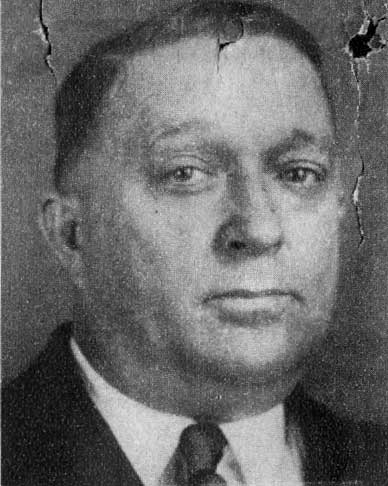
Dr. Charles B. Helm
Dr. Charles Blaine Helm was born in Camden in 1884. He was a graduate of the University of Pennsylvania School of Veterinary Medicine in 1906.
After establishing a veterinary practice in Camden at 900 South 5th Street where he also lived for many years, Dr. Helm involved himself in a variety of pursuits. Active politically as a Republican from the Sixth Ward, Dr. Helm served as city veterinarian in the days prior to the acquisition of police cars. Considered for a spot on the Republican slate in the commissioners race of 1927, he was not on the ticket, but was named as the city purchasing agent for Camden, and served as such through the administrations of Mayor Winfield S. Price and Mayor Roy R. Stewart. William M. Dilmore served under him as Assistant Purchasing Agent. Dr. Helm then took a position with the federal government as a poultry inspector, and worked at the Campbell’s Soup Plant from 1934 through 1949, when he was transferred to Salisbury MD.
Dr. Helm was most famous in the city of Camden for his involvement in professional basketball. He was manager and co-owner, with one-time Camden County Sheriff W. Penn Corson of the Camden franchise of the Eastern Basket Ball League from 1913 through 1925. The team, coached by William “Billy” Morgenweck was known as the Camden Alphas prior to World War I. The Alphas were the league champions in 1914–1915.
1917 was a year of turmoil in the world as the United States entered World War I. The New York State League and the Interstate Basket Ball League both suspended operations but the Eastern League began play in mid-November. On December 3 the league disbanded abruptly as two teams withdrew from the league without warning. An unsuccessful attempt was made to reorganize with a four team league and the league remained inactive until the 1919-20 season.
One of Camden’s players during this abridged season was future Olympic rowing star, Jack Kelly. He later would become the father of Grace Kelly, movie star and Princess of Monaco.
After the abrupt season ending, Trenton and Camden agreed to play a best of seven series for the “Championship of New Jersey” with EBL President William J. Scheffer as referee. The first game was won by Camden 28-27 at Trenton on December 19, 1917. Two days later a second game was played at Camden and Trenton was the victor 47-19 but attendance was very poor. On December 14, 1917 the Dr. Helm called off the series due to the lack of fan interest.
Dr. Helm renamed the team Camden Crusaders after World War I. The Camden five were champions again in 1919–1920, winning both halves of the split-season with a combined 30 and 9 record. The team was renamed once again as the Camden Skeeters for the 1921–1922 season. They were one of the league’s better teams, until it disbanded in 1923. Dr. Helm fielded a team in the a new Eastern Basketball League in 1925 (note the new spelling of “Basketball”), but the team did not do well, and that marked the end of his involvement the professional game in Camden.
The Camden team was generally a winner in the league. Besides bringing players to Camden from out of town, Helm’s team employed and/or developed many fine players from Camden, including Eddie Ferat, Sam Lennox, Roy Steele, Joe Hyde, Neil Deighan, and his brother Rich Deighan.
Dr. Helm died in Salisbury MD on December 5, 1951 of a heart condition. He was survived by his wife Mabel, two brothers, and a sister. His nephew, Dr. David Helm Jr. was Camden’s health inspector at the time of Dr. Helm’s passing.
Camden Basketball Company.
Philadelphia Inquirer —
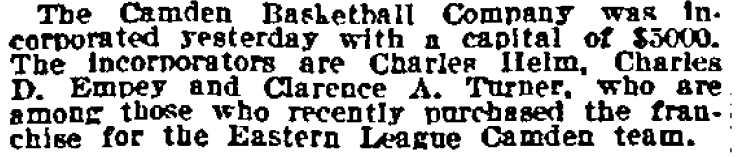
The Camden Basketball Company was incorporated yesterday with a capital of $5000. The incorporators are Charles Helm, Charles D. Empey and Clarence A. Turner, who are among those who recently purchased the franchise for the Eastern League Camden team.
Names Cattle Inspector.
Philadelphia Inquirer —
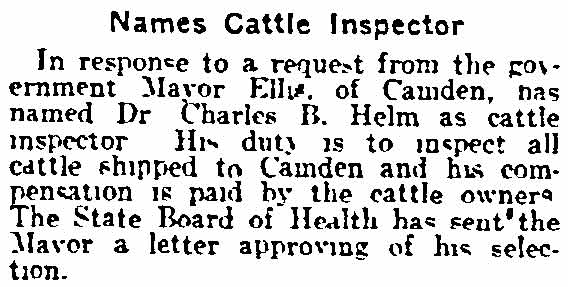
In response to a request from the government Mayor Ellis, of Camden, has named Dr. Charles B. Helm as cattle inspector. His duty is to inspect all cattle shipped to Camden and his compensation is paid by the cattle owners. The State Board of Health has sent the Mayor a letter approving of his selection.
Eastern League Goes Into Discard.
Philadelphia Inquirer —

Eastern League Goes Into Discard
Attempt to Reorganize Basketball Organization With Four Club Circuit a Failure
Squabble Over Players and Latters’ Fickleness Caused Blowup; Trenton and Camden to Play Series
The attempt to reorganize the Eastern Basketball League has resulted in a dismal failure. In an effort to get the purposed four-club circuit composing Philadelphia, Camden, Trenton and Reading, going [sic] the league held another special meeting last night in this city and when Reading failed to send a representative to the conference the other three clubs present decided to throw up the sponge for the season and officially disband.
The magnates decided that this was the best course to pursue in the face of the existing conditions. The exhorbitant salaries demanded by the players and the inability of some of the four clubs to reach a mutual agreement over the allotment of players to certain teams left such a chaotic condition remaining that those present decided it was futile to attempt to make a re-start for the rest of this season. Those who were present, Dr. Charles B. Helm, of Camden; B. C. Kuser, of Trenton, and William Meyers, of this city, went on record that they were in favor of reorganizing next fall if the conditions improve
There is little doubt, however, but that the league would have tried it again this season had Reading put in an appearance last night. The other three clubs expressed a willingness to continue and were ready to post their increased guarantee of $200. When the Reading club failed to have a representative at the pow-wow the magnates decided they had wasted enough time in trying to make the re-start and that it was time to call a halt for the rest of the season.
When the league disbanded last Monday night when Jasper and Greystock quit the other four clubs attempted a comeback the next night with a four-club circuit. With the Jasper and Greystock teams out of business several valuable players were thrown on the market and the reorganization scheme was to have the best of these men distributed between three of the four clubs, Trenton being satisfied with its present team. This scheme was feasible enough and promised to give four equally matched clubs, but, unfortunately, there arose a violent dispute between the teams over these players, and it was this which ultimately resulted in the grand blow off last night.
Thrown on the market by the retirement of Jasper and Greystock were McWilliams, Lawrence, Fogarty, Campbell, Zahn, Leonard, Dark, Norman, White, Moorehead and White. Most of these men are good players, yet of this group only three were in demand, McWilliams, Lawrence and Dark. There were two other players, however, who became involved in this grab list by the action of Camden and Reading in letting Brown and Sugarman go. This left a good field to pick from and during the first meeting of the attempted re-organization it was decided to let Reading have Brown, Dark and Lawrence, which was satisfactory to the Bears, who intended to round out the team with Morris and O’Donnell.
This brought the issue up between Philadelphia and Camden. The latter club wanted McWilliams and Sugarman and Philadelphia expressed a decisive desire also for McWilliams. Over these men the two clubs bickered for nearly two hours on Wednesday night and then did not reach any conclusion. The next day Philadelphia waived the point and let Camden have free rein to go after Sugarman and McWilliams, which meant a mighty nifty lineup for the Skeeters, for with Steele, Deighan and Kelly as a nucleus the team would have been of championship calibre. Philadelphia was to stand pat on Beckman, Muller, Dreyfuss, Dengath and Powell, with the possibility of securing another first-class man. Tom Barlow, a Trenton boy, on the reserve list of the Philadelphia team, had been turned over to Trenton and apparently the clubs were ready for the re-start.
They, however, had failed to take into consideration the fickleness of some of the players. McWilliams jolted the Camden club by announcing that he had quit basketball and would not play another game, Dark refused to go to Reading because he found it would interfere with his police duties in town, but expressed a desire to play with either Camden or Philadelphia; Sugarman announced that he was going to continue playing with Carbondale in the Pennsylvania State League, and Lawrence only wanted the modest sum of $25 per game to play in Reading. Finding that they could not get McWilliams and Sugarman, Camden wanted Brown back and when Reading learned this on top of the stand taken by Dark and Lawrence it brought a storm of disapproval from the owners.
This brought about a condition bordering on panic among the other magnates, and after a hurried meeting on Friday night, which was adjourned until last night, the owners decided they had enough of the uncertainty pertaining to this season, and that it would be good business to disband.
This probably could have been avoided had some of the clubs been willing to take Leonard; Norman, Campbell, Moorehead, White, Fogarty and Zahn, but these men were not satisfactory to the warring clubs, who only wanted the five men mentioned.
After the meeting B. C. Kuser, of Trenton, and Dr. Charles B. Helm, of Camden, said they would like to give their patrons a few more games and agreed to play a series of seven games for the championship of New Jersey. It is a real championship series, for each team posted a $200 forfeit with President Scheffer. The winner of the series takes the forfeit. The receipts of the games will be kept by each home team, and if a seventh game is needed the receipts will be divided equally. William Kelley was selected to referee the games. The line-up of the teams will be the same as used in the regular league games, as follows: Trenton, Franckle, Tome, Newman, Hargreaves, Lloyd, Ballard and Watt; Camden, Steele, Deighan, Engle, Kelly, Kilpatrick, Muller, and one other professional and one other minor leaguer to be named. The first game will be played in Trenton tomorrow night, and the second in Camden on Wednesday of this week. The games will then continue on those two nights until one team wins four games. If a seventh game is needed, it will be played in Camden or Trenton, as a toss of a coin will decide. Jimmy Kane, of Camden, and Charles Barlow, of Trenton, will be the official timekeepers.
World War I Draft Registration Cards
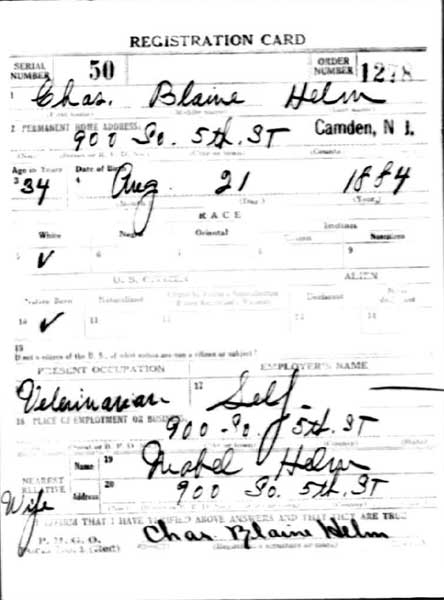
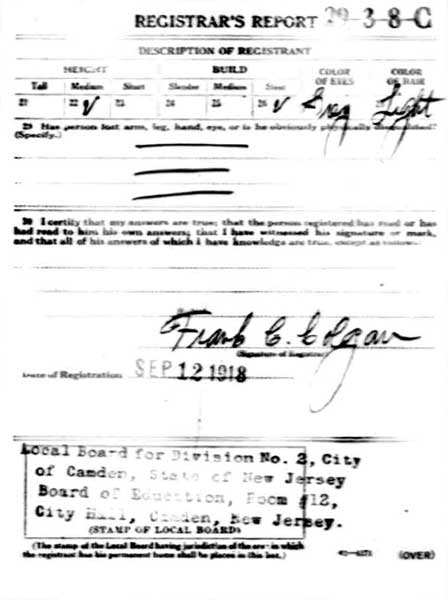
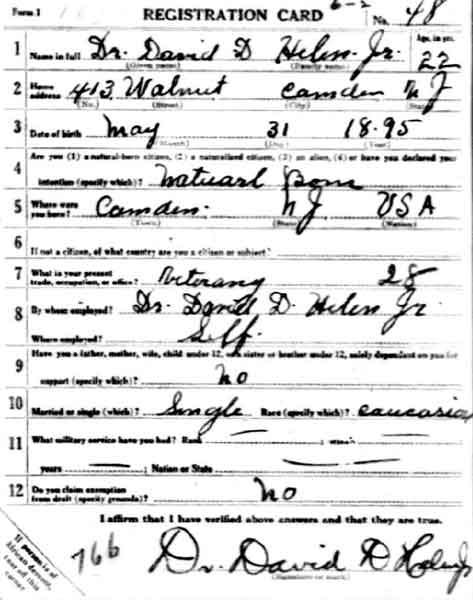
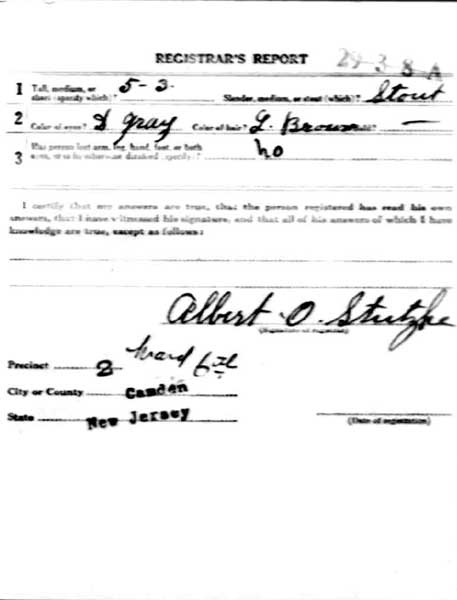
World War I Draft Registration Cards for Charles & David Helm
Camden Crusaders
1919–1920 Eastern Basketball League Champions
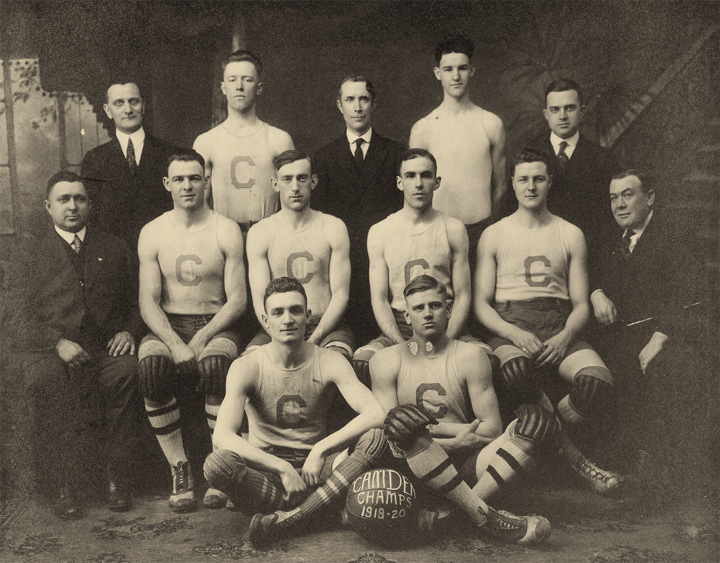
Front row, left to right: Jimmy “Soup” Campbell and Joe Hyde. Second row, left to right: Dr. Charles B. Helm, Neil Deighan, Roy Steele, Eddie Dolin, Dave Kerr and Sheriff W. Penn Corson. Back row, left to right: Bill Mitchell, trainer; Sam Lennox, Manager Bill Kennedy, Richie Deighan and Timekeeper Jim Kane.
War Vet Withdraws for Purchasing Job.
Camden Courier-Post —
Leaves Way Clear for Dr. Helm to Take City Position
Permanent appointment of Dr. Charles B. Helm as city purchasing agent was made possible today with the formal withdrawal of John R. Michaelson, a war veteran, as one of the Civil Service eligibles for the post.
Michaelson said today that he had notified the Civil Service Commission of his withdrawal, explaining that he prefers not to be considered for the position “at this time.” The veteran’s formal notice followed a conference with Mayor Price in City Hall.
Michaelson is adjutant of the 112th Field Artillery, New Jersey National Guard, with headquarters at Ninth street and Wright avenue. Mayor Price is a brigadier general in the National Guard. The two men are close friends.
“It’s for Mayor Price’s sake that I have withdrawn,” Michaelson explained today. “I consider him a high-minded man and I admire him as a gentleman. Mayor Price did not ask me to withdraw. As a matter of fact, no one approached me. It was my own idea.”
Michaelson’s announcement removes the last barrier in the way of Dr. Helm’s appointment, as Jack Weinberg, city assessor and another eligible war veteran, had announced his withdrawal after the eligible list was released by the state board several weeks ago. This leaves the way open for Dr. Helm, who passed the Civil Service tests.
Michaelson said today that he explained in his letter to the state board that while he has withdrawn his name “for consideration at this time,” he desires to remain on the eligibility list, a privilege to which he is entitled under civil service regulations. Officials of the state board said the veteran’s name will be continued on the eligible list in accordance with his request.
Dr. Helm, who was third in the list of three eligibles, already has been appointed permanently as city purchasing agent, it was announced at City Hall today. The appointment has been made by Commissioner T. Yorke Smith, director of revenue and finance, and is expected to be confirmed by the city commission Thursday.
Michaelson in the civil service tests attained an average of 80 and a fraction. Weinberg was second with 72 and a fraction, while Helm’s mark was 71 and a fraction. The post of city purchasing agent pays $4,000 a year.
Bids Opened for Base of City Tennis Courts
Camden Courier-Post —
Frank B. Sweeten, with a bid of $1,258, was the lowest of three Camden contractors to submit estimates for the laying of a concrete foundation for a tennis court fence at Victor King Park. The bids were received by Dr. Charles B. Helm, city purchasing agent, at City Hall this morning.
The other bids were George Bradbury, $1,682, and J. J. Breslin, $1,790. The contract for the work is expected to be awarded at the city commission meeting Thursday. It specifies that the foundation be eighteen inches above ground.
Only one bid was submitted for a tractor-type chassis for the municipal motors towing machine. It was offered by the White Company, at $2,000. This contract also is expected to be awarded Thursday.
‘Black Bill’ Is Hurt When Car Hits Wagon
Camden Courier-Post —
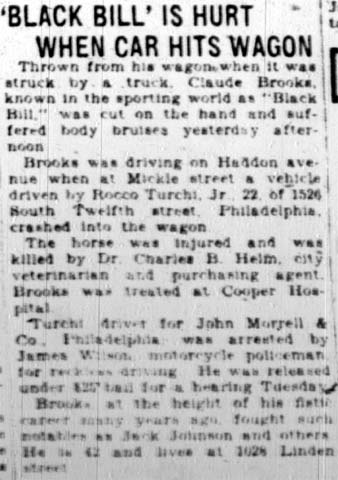
Thrown from his wagon when it was struck by a truck, Claude Brooks, known in the sporting world as “Black Bill,” was cut on the hand and suffered body bruises yesterday afternoon.
Brooks was driving on Haddon avenue when at Mickle street a vehicle driven by Rocco Turchi, Jr., 22, of 1526 South Twelfth street, Philadelphia, crashed into the wagon.
The horse was injured and was killed by Dr. Charles B. Helm, city veterinarian and purchasing agent. Brooks was treated at Cooper Hospital.
Turchi, driver for John Morrell & Co., Philadelphia, was arrested by James Wilson, motorcycle policeman, for reckless driving. He was released under $22[?] bail for a hearing Tuesday. Brooks, at the height of his fistic career many years ago, fought such notables as Jack Johnson and others. He is 42 and lives at 1028 Linden street.
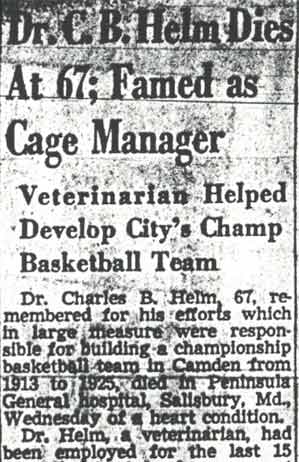
Dr. C. B. Helm Dies at 67; Famed as Cage Manager.
Camden Courier-Post —
Veterinarian Helped Develop City’s Champ Basketball Team
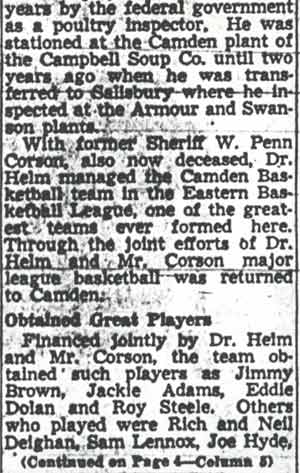
Dr. Charles B. Helm, 67, remembered for his efforts which in large measure were responsible for building a championship basketball team in Camden from 1913 to 1925, died in Peninsula General Hospital, Salisbury, Md., Wednesday of a heart condition. Dr. Helm, a veterinarian, had been employed for the last 15 years by the federal government as a poultry inspector. He was stationed at the Camden plant of the Campbell Soup Co. until two years ago when he was transferred to Salisbury where he inspected at the Armour and Swanson plants.
With former Sheriff W. Penn Corson, also now deceased, Dr. Helm managed the Camden Basketball team in the Eastern Basketball League, one of the greatest teams ever formed here. Through the joint efforts of Dr. Helm and Mr. Corson major league basketball was returned to Camden.
Obtained Great Players
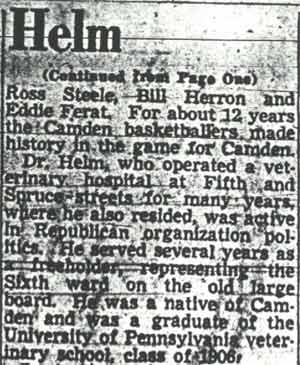
Financed jointly by Dr. Helm and Mr. Corson, the team obtained such players as Jimmy Brown, Jackie Adams, Eddie Dolan and Roy Steele. Others who played were Rich and Neil Deighan, Sam Lennox, Joe Hyde, Ross Steele, Bill Herron and Eddie Ferat. For about 12 years the Camden basketballers made history in the game for Camden.
Dr. Helm, who operated a veterinary hospital at Fifth and Spruce streets for many years, where he also resided, was active in Republican organization politics. He served several years as a freeholder representing the Sixth ward on the old large board. He was a native of Camden and was a graduate of the University of Pennsylvania veterinary school, class of 1906.
In the days when the city and police departments used horses, Dr. Helm was city veterinarian. A power in Republican politics in the Sixth ward, Dr. Helm was prominently mentioned as a candidate for the city commission in the second election of that form of government in the city in 1927.
Became Purchasing Chief
When the organization ticket was announced, his name was not listed as a candidate. Friends at once interceded for him and as a result it was decided that Dr. Helm would be given the post of city purchasing agent. The organization ticket won, and Dr. Helm succeeded Harry P. Pelouze, of Haddon Heights, in the city purchasing post. He held the post through two administrations. He was a member of the Sixth Ward Republican club.
Dr. Helm was the uncle of Dr. David B. Helm Jr., present director of the city health department.
Also surviving are his widow, Mabel; two brothers, David D. Helm Sr., of Oaklyn, father of the city health director, and Walter G. Helm, of Berlin, formerly in the feed business in South Camden and now in the produce business, and a sister, Mrs. Arthur Harmon, of Oaklyn.
Funeral arrangements have not been completed.
Dr. Helm Service Set Saturday.
Camden Courier-Post —
Services for Dr. Charles B. Helm, 67, will be held Saturday at 2 p. m. in a funeral home at 1820 Chestnut street, Philadelphia, where friends may call tonight from 7 to 9 o’clock. Burial will be in Fernwood cemetery, Philadelphia.
Dr. Helm, a native of Camden, and widely known for his efforts which in a great degree were responsible for building a championship basketball team in Camden, died Wednesday in the Peninsula General hospital, Salisbury, Md.
He was a veterinarian and for the last 15 years had been employed by the federal government as a poultry inspector. Two years ago, he was transferred from the Camden plant of Campbell Soup Co. to Salisbury to inspect at the Armour and Swanson plants.
Active in Republican organization politics in the Sixth ward of Camden, he was a former member of the large board of freeholders and had been city purchasing agent.
Skeeters Brought Camden Only E.L. Court Crown
Camden Courier-Post —
Dolin, N. Deighan, Campbell, Kerr, Steele 1919-20 Pro Champions
By JACK CARTY
There was an era when Camden was known for more than its production of ships, soups, radios and sundry other commercial items. That was when the Camden Skeeters were the scourge of the Eastern Professional Basketball League.
It was over 35 years ago when a banner line screamed across four columns of an old Daily Courier sports page proclaiming that “All Hail the Champions!”
The date was March 11, 1920. It was the day after the Camden team won its first and only championship of the old Eastern League.
Kennedy Was Manager
After 10 years of striving to bring home the coveted flag, Manager “Whispering Will” Kennedy’s Skeeters sewed up the title by defeating the Bridgeport, Conn., quintet, 45-34 at the Third Regiment Armory, now known as the Camden Armory at Haddon avenue and Mickle st.
The date is a memorable one for many, especially those who were around in the days when professional basketball was “the thing” in Camden. Days when such outstanding stars as Neil Deighan, Jimmy “Soup” Campbell, Rich Deighan, Dave Kerr, Roy Steele, Eddie Dolin and others were the masters of the cage game. They mastered it to the delight of two and three thousand fans every time they stepped on the floor at the Armory.
That season and that 1919-20 basketball team provide one of the proudest sports memories in the history of Camden. Although its short-lived glory lasted for less than two years, the mark the Skeeters left is indelible.
Corson, Helm Owners
The Skeeters, owned and financed by former Sheriff W. Penn Corson and Dr. Charles B. Helm, a veterinarian, had many near misses in the search for the pennant. But they never made the direct hit until Kennedy stepped into the picture.
It was the first season the Eastern League had resumed operation following World War I that the ex-Jasper coach took over the club.
He molded a winner with three veterans of former years—Steele, the captain, Dolin and Neil Deighan—with a couple of comparative unknowns, Kerr, and a youngster named Campbell.
With this aggregation as his nucleus, Kennedy won the pennant for Camden and it seemed that only he could have done it.
Frank H. Ryan, late editor of The Courier-Post, who then was sports editor of The Daily Courier, wrote of Kennedy following the team’s successful first half finish:
Describes Kennedy
“He has been connected with the cage game for a score of years, never bullyrags his men and can get results where others fail. Working hand and glove with Steele, who is captain and the king pin of the men on the floor, Kennedy has succeeded in giving Camden what others have failed to do, namely, the much coveted pennant. If the Skeeters can crown their achievement with the second half crown the natives from the city of ships, phonographs, soaps, furniture and fair zone activities can well afford to look our way and give us a silent sneer.”
And they did.
The Skeeters went right on to win 16 more games and the second half, which also included the “much coveted pennant.” They tied a league record of the Reading Bears with 30 wins per season, even though they had one more loss—10.
‘Reading Bear Pit’
Ryan had said of the Skeeters: “The desire to do the right thing at the right moment, a willingness for team play and a general pull together spirit made a combination which the other five teams found too formidable to surmount.” That was one description of the champions.
One of the biggest moments of that glorious season was marked when, for the first time in more than five seasons, Camden was able to beat Reading on the latter’s own court. The Skeeters prevailed 31-24 in the “Reading Bear Pit.”
Campbell, the import from Homestead, Pa., playing his first year in the “fast” ranks of professional basketball, fired the victory with an 11-point effort. That was Jan. 31, 1920—one of the opening games of the second half.
Wallop DeNeri
Prior to that, Campbell, Dolin and Neil Deighan were consistent leaders in point-making to spark the team to the first half championship.
During the season, Germantown, second place finisher in both halves, Trenton, Reading, DeNeri (Philadelphia) Bridgeport and North Philadelphia competed. Bridgeport took over the North Philadelphia franchise in the second half, after the North Phillies dropped out of the league.
In one game against DeNeri, Camden broke all existing records when it beat the Philadelphians, 53-28. Twenty-three field goals were registered by the “coming champs” that December night in 1919.
Campbell set the pace with seven double deckers, tieing the individual high score record for the season.
Only Two Regulars
DeNeri took the floor at the Armory with but two regulars in the lineup. That was blamed for the rout. The other regulars were playing with teams in other leagues—a situation which was to cost the Skeeters the pennant the following season.
The opening account of that particular Camden-DeNeri game read: “That the Eastern League is due to regret the rule which allows its men to play in other leagues was demonstrated by the misfit combination that Manager Myers, of De Neri, brought to this city last night to oppose the local league leaders at the Third Regiment Armory.”
The rule later was amended by league president William J. Scheffer. The amendment cost Adamless Express one of its brightest young stars and took away its championship in 1920-21 when the owners suspended Campbell.
‘Adamless Express’
The 1919-20 Skeeters often were called the “Adamless Express.” When Jackie tucked away his uniform after the league took time out for the first World War, Camden assumed the “Adamless Express” tag.
Brown was one of the mainstays of the North Philadelphia team during Camden’s Championship year, but missed much of the opening half campaign after he suffered a knee injury.
Meanwhile, the Adamless Express got up its head of steam and sailed merrily along its way.
A capacity crowd of nearly 3000 fans turned out at the Armory when the Skeeters opened the 1919-20 season by defeating De Neri, 26-18, on Nov. 5, 1919.
Trenton Causes Trouble
It was Steele, Campbell, Dolin, Neil Deighan and Kerr who played the entire game and Ryan’s account of the victory was very enthusiastic about their showing.
“It surely did seem strange to see the locals enter the cage minus the familiar and popular faces of Jackie Adams and Jimmy Brown as it was the advent of those two stars along with Eddie Dolin that took Camden out of the ‘also ran’ class in the Eastern and gave this city a permanent pennant contender. It can truthfully be said that more than one fan was indeed sorry to note the wrecking of the famous Adams Express, but at the same time no fault can be found with the aggregation Manager Bill Kennedy substituted in its place last night, as the new combination gave a dandy exhibition and looks strong enough to give any club in the circuit a battle for the pennant,” Ryan reported.
There were some squeakers in that first half. Four of them were with Trenton, a team which always had been a formidable foe of the Skeeters.
In the second game of the season Camden stacked up against the Royal Bengals and edged them, 20-18, in Trenton. Camden later won verdicts of 15-14, 24-23 and 20-18, the latter in overtime.
N. Deighan KO’s Schmeelk
However, in a game against Germantown, Kennedy’s cohorts dropped their second verdict of the race—their first at home that season—when the “Germs” prevailed, 21-18. Camden lost its next game and Germantown made it three straight reverses for the Adamless Express when it won, 35-27, Dec. 23, 1919.
The locals league lead was cut to a single game in the rip-snortin’ contest which featured the first fight of the season and banishment of two players. Kerr and Germantown’s Gary Schmeelk had come to blows, but it was Neil Deigham [sic], who entered the melee and “dropped Schmeelk to the floor.”
Referee Bill Kelley banished both men—Schmeelk and Deighan—from the game and both were fined $10.
However, two nights later on Christmas, Camden regained its winning ways by clobbering Reading, 36-15, when Deighan got back into action to score 11 points.
The overtime battle with Trenton clinched the first half diadem—before 2500 fans at the Armory.
Rich Deighan Plays
Camden breezed through the second half without too much trouble and wound up that part of the race with a 16-5 record, clinching the title with the win over Bridgeport and closing the season with Campbell’s 15 points sparking a 35-26 decision over Trenton on March 17, 1920.
Richie Deighan made his first appearance in the Camden lineup early in February that same year when he played the last 10 minutes against Bridgeport. The Skeeters romped home 42-15 winners, with Rich getting three points.
“The last six minutes of action saw the cloak-room boys, Sam Lennox and Joe Hyde in action for Camden and six points of Bridgeport’s total were amassed in this period,” clippings stated.
Rich Deighan, following the championship season, shifted his alliances to Coatesville.
Entered League in 1910
The championship was the end of a long and detoured road for the Skeeters. Early experiences by Camden teams were not quite as pleasant even though it had the pennant in its grasp twice. Once it was awarded to the Skeeters on forfeit, but even then they found a way to get rid of it.
Camden first entered the Eastern League in 1910 when it took over the franchise forfeited by Princeton. The Skeeters just about “tottered along for three years.”
However, they wound up in a three-way tie for first place in 1913-14 season but lost out in the playoffs, finishing second to Jasper. Trenton was third.
Reading Didn’t Show Up
The next season, the Skeeters were part of the league’s worst “fiasco.” Camden and Reading carried the fight from start to finish and ended in a stalemate (identical 25-15 records). Camden, then under Sam Herrmann, won the first game of the playoff at the Armory, but was clobbered in Reading.
The third game was to be played at the Musical Fund Hall at Eighth and Locust sts., Philadelphia. After the hall was packed and hundreds of fans turned away, Reading refused to play the game. In fact, the Bears never showed up.
The Reading team claimed Camden misrepresented the ticket situation. The first decision by the league, which had not handled the playoffs originally—leaving it up to the two teams—was to award the championship to Camden via the forfeit route. But the club owners thought different and agreed to close the season with no championship awarded.
It was one of the worst black eyes the Eastern League ever got.
Third in 1916
The Skeeters fell heir to third place in the spring of 1916 and fourth the following year. The first World War closed the Eastern for the next two seasons and the first year back in the harness Camden started its successful bid for its first championship.
The Champions couldn’t quit [sic] find themselves in the 1920-21 race. Although they were continually in contention for the flag, they never did make it two in a row.
The Skeeters finished third behind Reading and Trenton and ahead of Philadelphia, Germantown and Coatesville in the first half.
Owners Scold Players
They were going great guns in the second half as Campbell, Kerr and Steele began stepping up the attack. The Adamless Express once again was back in first place—all alone. Then one February 4, the disintegration began.
Headlines blurted: “Camden Owners Scold Players. Threaten to Suspend Team Members Playing in Other Leagues. Campbell, Kerr and Deighan Offenders.”
Kerr and Neil Deighan had been playing for a club in the Penn State League. Campbell was active in that and another circuit. Dr. Helm was quoted as saying: “It has come to a showdown. These players will either stick to the Camden team or play with others. A Camden player who violates the rule will be definitely suspended. We want to give the people of Camden a square deal. The players owe it to the fans. No man can serve two or three masters.”
Campbell Suspended
Two days prior to Helm’s attack, Reading had downed Camden, 25-32 and handed Germantown a tie for the lead. Camden won its next game, but still shared the lead with Germantown. Then came the big blow.
Campbell was suspended for not complying with the management. He did not play for the Skeeters again until the next season. There went their chances for the pennant.
Louis Sugarman took over the Homestead star’s position and made a creditable showing, but it just was not up to the standard of Campbell.
‘Say It With Flowers’
Camden retook the lead with its eighth victory by defeating Philadelphia, 32-15, Feb. 9. But a loss to Germantown the following week dropped them into second place and they never were to regain outright possession of first place again.
The Skeeters tied for the lead twice in the late stages of the second half race in March and had a chance of forcing the race [text missing between the crops] week but finished out of the money.
The first half saw the Skeeters in a tight race with Trenton. That half merited Camden second place with over 20 victories. In the final half race Kennedy’s courtmen again became the bridesmaid, despite a 15-5 record.
Campbell was back in the harness again and with Kerr, Dolin, Steele and Neil Deighan they had a pretty powerful club.
Eight teams, including the New York Celtics, battled in the first half, while the roster dwindled to six quintets in the final race.
But the league registered eight teams when it opened its 1922-23 season. It was believed by many to be the best setup for the Eastern League in its history. The other major circuits in the area had folded and the Eastern was supposed to be set solidly.
League Folds
It started an early season (October) and that was the beginning of the end. Football was in full swing. Baseball had just ended. Fans like their sports in season.
The league began to crumble when Scranton and then Wilkes-Barre dropped out. Atlantic City and Reading were next to toss in the towel. A meeting at Musical Fund Hall saved the league for a short time when Trenton, Camden, Coatesville and Philadelphia vowed to make a go of it.
However, in mid-January of 1923 the Eastern League succumbed as the four remaining teams went broke. The main reason for the crackup was put to the “inflated salaries” of the players. But the Skeeters’ backers decried that explanation when they said “every Camden player was worth every cent.” They had kept Camden in first place until the league folded.
Fans Were Confused
Following one of the last games played in the league in Camden, Ryan wrote, “Wednesday night’s crowd would have been a disgrace to the East Side Church League.” That about summed it up.
Constant rearrangement of the league had jumbled the schedule. Fans never knew when or where their teams were playing. The gates were pitiful and the teams couldn’t operate without the money.
That was the end of the championship era of players like Steele, the Deighans, Campbell, Kerr, Dolin and the others. Some of them competed in the Philadelphia League the following season, but Camden dropped out of that league in 1924-25.
Old-timers who can recall the days of the championship Skeeters claim it was the “greatest basketball” team the East ever had.
Players Still Around
And some of the boys who played on that club are still around to verify that. Neil Deighan runs a restaurant in Gloucester and brother Rich manages the Sports Center here in Camden.
Eddie Dolin is a familiar figure as the bridge operator at 12th and Federal sts. Sam Lennox tends bar on Hudson st. and Davey Kerr deals in sporting goods in Ohio.
The rest — Steele, Campbell, Hyde, timekeeper Jim Kane, Helm, Corson and Kennedy—have passed away. But the memories of their court capabilities are very much alive.
Eastern Basketball League Standings
Eastern Basketball League Standings
Camden Alphas and Camden Crusaders seasons in the Eastern Basketball League
1913–1914
| Team ↕ | W ↕ | L ↕ | Pct ↕ | Gb ↕ |
|---|---|---|---|---|
| Jasper Jewels | 23 | 17 | .575 | – |
| Camden Alphas | 23 | 17 | .575 | – |
| Trenton Potters | 23 | 17 | .575 | – |
| Reading Bears | 22 | 18 | .550 | 1 |
| DeNeri | 20 | 20 | .500 | 3 |
| Greystock Greys | 9 | 31 | .225 | 14 |
1914–1915
| Team ↕ | W ↕ | L ↕ | Pct ↕ | Gb ↕ |
|---|---|---|---|---|
| Camden Alphas | 25 | 15 | .625 | – |
| Reading Bears | 25 | 15 | .625 | – |
| Trenton Potters | 20 | 20 | .500 | –5 |
| Greystock Greys | 18 | 22 | .450 | 7 |
| DeNeri | 17 | 23 | .435 | 8 |
| Jasper Jewels | 15 | 25 | .375 | 10 |
1919–1920 First Half
| Team ↕ | W ↕ | L ↕ | Pct ↕ | Gb ↕ |
|---|---|---|---|---|
| Camden Crusaders | 15 | 5 | .750 | – |
| Germantown G's | 11 | 9 | .550 | 4 |
| DeNeri | 10 | 10 | .500 | 5 |
| Trenton Potters | 9 | 10 | .474 | 6 |
| Reading Bears | 8 | 12 | .400 | 7 |
| North Philadelphia Phillies | 6 | 13 | .316 | 9 |
1919–1920 Second Half
| Team ↕ | W ↕ | L ↕ | Pct ↕ | Gb ↕ |
|---|---|---|---|---|
| Camden Crusaders | 15 | 4 | .789 | – |
| Reading Bears | 10 | 8 | .556 | 5 |
| Trenton Potters | 11 | 9 | .550 | 4 |
| Germantown G's | 10 | 10 | .500 | 5 |
| DeNeri | 7 | 11 | .389 | 8 |
| Bridgeport Blue Ribbons | 4 | 15 | .211 | 11 |
1914 Playoff Results — EBL Finals
Jasper won round robin:
23 Mar 14 at Trenton 30, Camden 24
25 Mar 14 at Camden 34, Trenton 22
26 Mar 14 at Jasper 42, Camden 18
27 Mar 14 at Trenton — Jasper 24, Trenton 20
28 Mar 14 at Camden 33, Jasper 24
30 Mar 14 at Jasper 29, Trenton 20
1915 Playoff Results — EBL Finals
Reading 1, Camden 1:
23 Mar 15 at Camden 45, Reading 35
24 Mar 15 at Reading 52, Camden 29
Third game not played as teams couldn’t agree on site
1920 Playoff Results — No Playoffs as Camden won both halves