Joe Hyde
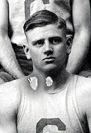
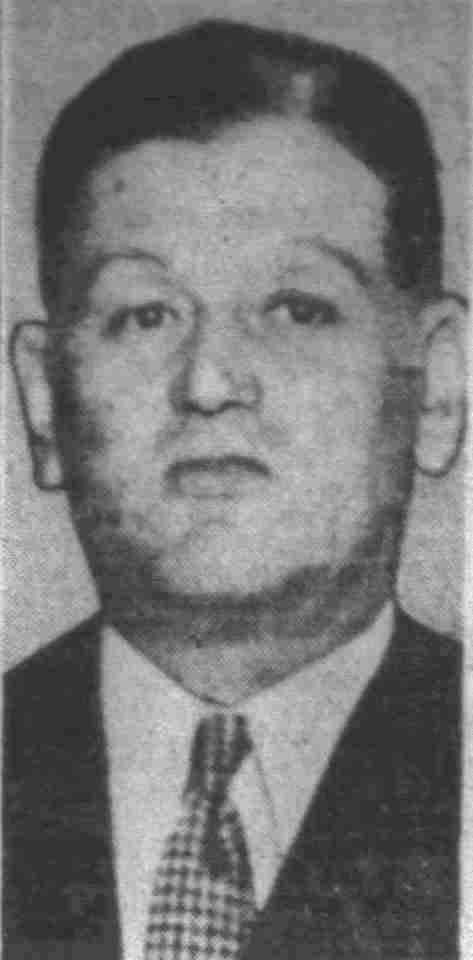
Joe Hyde
JOSEPH J. “JOE” HYDE was an all around athlete, was well known in Camden as a professional basketball player and also played minor league ball. In his later years he operated a bar at 203 Market Street. He is not to be confused with Joseph F. Hyde or Joseph F. Hyde Jr., who owned Hyde’s Cafe (aka Hyde’s Saloon) at 1600 South 6th Street from the 1900s into the 1950s, which was open for business as early as 1906, and was still trading under that name as late as 1947.
Joseph J. “Joe” Hyde was born in 1897. He was the youngest of four children born to Richard Hyde Jr. and his wife, the former Eva Smith, coming after Elizabeth, George and Richard. His father worked as representative of a Philadelphia brewery. Richard Hyde had also worked as Camden policeman for a year in the 1890s. Joe Hyde’s grandfather, Richard Hyde Sr., had been a constable and a Camden County freeholder from the Seventh Ward in the 1880s. His uncle, Joseph F. Hyde Sr., owned a bar at 1600 South 6th Street, Hyde’s Cafe. Sadly, Richard Hyde died at the age of 50 in January of 1913.
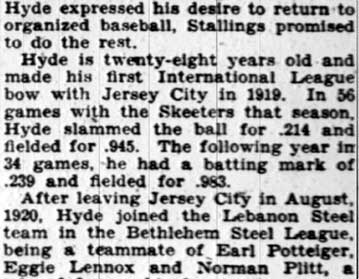
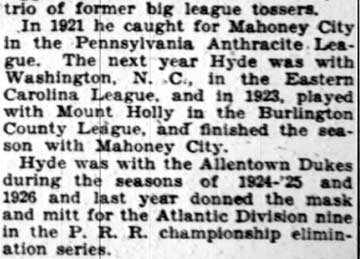
Joe Hyde played professional and semi-pro baseball in the 1910s and throughout the 1920s. After starring locally with semi-pro teams, Joe Hyde broke into organized baseball as a catcher with the Jersey City Skeeters of the International League in 1919. He returned to Jersey City in 1920, but left the team after getting into a dispute with manager “Wild Bill” Donovan. Suspended from organized baseball, Joe Hyde played with the Lebanon Steel team of the Bethlehem Steel League, where he was the teammate of former major leaguers Eggie Lennox, Norman Plitt, and Earl Potteiger, who would go on to coach the New York Giants of the National Football League in the 1920s.
Joe Hyde played for a series of semi-pro teams until 1928, when he was reinstated into the pro game at the behest of George Stallings, who also had managed at the major league level, taking the 1914 Boston Braves to the World Series, and sweeping Connie Mack’s Philadelphia Athletics in four games. Joe Hyde caught at least one game for Montreal of the International League that summer. He played for Allentown of the Eastern League in 1929.
Joe Hyde made his professional basketball debut during the 1919–1920 season, with the Camden Crusaders of the Eastern Basketball League. The Crusaders were owned by Camden veterinarian Dr. Charles B. Helm and former Camden County Sheriff W. Penn Corson. Other team members included Neil Deighan, Eddie Ferat, Sam Lennox, Jimmy “Soup” Campbell, Roy Steele, and another rookie, Rich Deighan. The Crusaders were the 1919–1920 Eastern Basketball League champions. He stayed in the game, although not at that level, then the pinnacle of pro hoops.
Joe Hyde returned to the pro ranks with the Camden franchise of the 1928–29 Eastern Basketball League. The EBL was then a shadow of its former self, and must be considered a semi-pro league at best. The Camden roster as known included Joe Hyde, Rich Deighan, Sam Lennox, and two other players named Leach and Mulligan. The team lost all ten of the games it played before folding.
The 1930 Census shows Joe Hyde, his mother, brothers Richard and George and their wives, living at 1403 Kaighn Avenue. When the census was taken in 1940, Joe Hyde was living with his brother George in Collingswood and was working as a bartender. The Census also indicates that he had been living with his brother in Collingswood as early as 1935. His widowed mother also lived there. Joe Hyde married Mary Lind not long after the Census was taken. The couple made their home at 2713 Hayes Avenue in Cramer Hill.
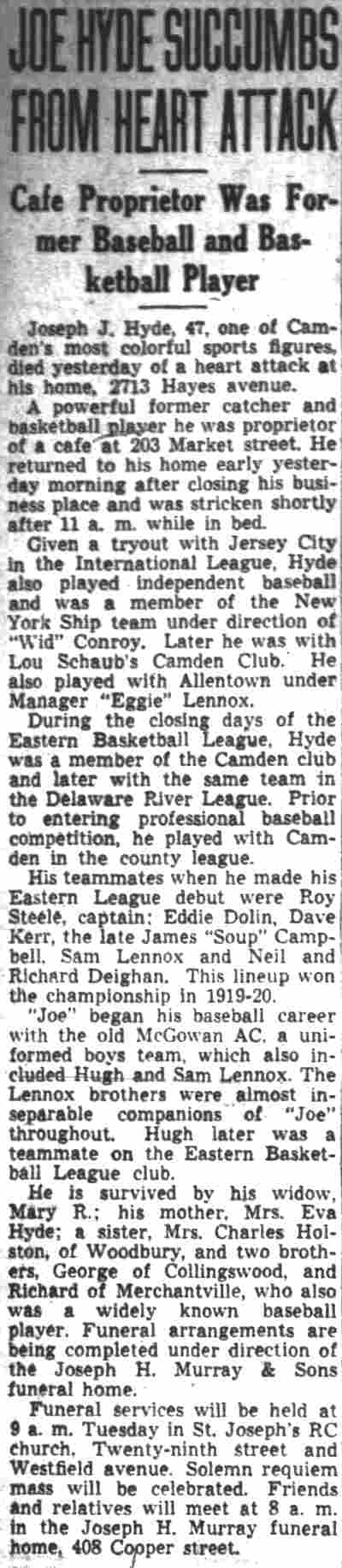
Joe Hyde was working as a bartender at Homo’s at 227–229 Market Street as early as 1941. In the summer of 1943 Joe Hyde acquired the bar at 203 Market Street, which had been operating as the Delight Grille for the previous few years. Sadly, Joe Hyde died of a heart attack at his home at 2713 Hayes Avenue on December 31, 1943. His wife sold the bar after a fire in March of 1944. Last a resident of Maple Shade, Mary Lind Hyde died in January of 1986.
Joe Hyde’s Eastern Basketball League Career Record
| Season | G | FG | FT | TP | PPG |
|---|---|---|---|---|---|
| 1919–1920 Camden Crusaders | 11 | 3 | 6 | 12 | 1.1 |
| 1928–1929 Camden | ??? | ??? | ??? | ??? | ??? |
| Eastern League Career Record | 11 | 3 | 6 | 12 | 1.1 |
Camden Courier-Post — July 15, 1915
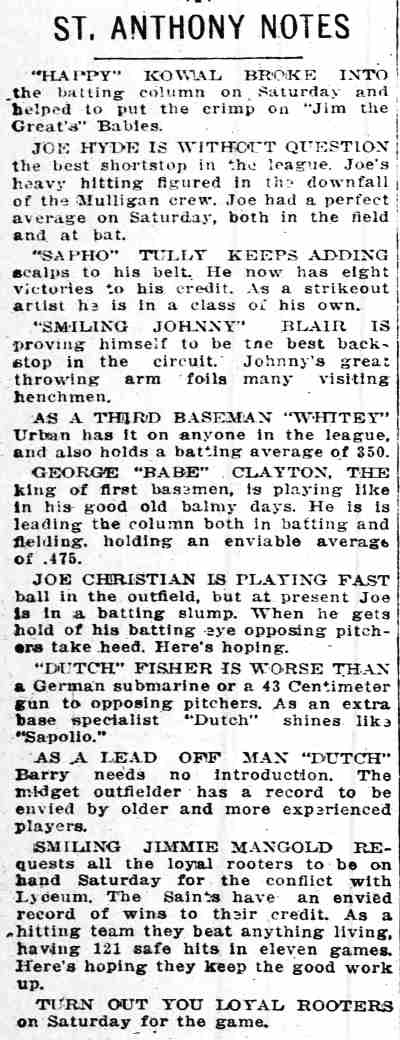
“Happy” Kowal broke into the batting column on Saturday and helped to put the crimp on “Jim the Great’s” Babies.
Joe Hyde is without question the best shortstop in the league. Joe’s heavy hitting figured in the downfall of the Mulligan crew. Joe had a perfect average on Saturday, both in the field and at bat.
“Sapho” Tully keeps adding scalps to his belt. He now has eight victories to his credit. As a strikeout artist he is in a class of his own.
“Smiling Johnny” Blair is proving himself to be the best backstop in the circuit. Johnny’s great throwing arm foils many visiting henchmen.
As a third baseman “Whitey” Urban has it on anyone in the league, and also holds a batting average of 350.
George “Babe” Clayton, the king of first basemen, is playing like in his good old balmy days. He is leading the column both in batting and fielding, holding an enviable average of .475.
Joe Christian is playing fast ball in the outfield, but at present Joe is in a batting slump. When he gets hold of his batting eye opposing pitchers take heed. Here’s hoping.
“Dutch” Fisher is worse than a German submarine or a 43 Centimeter gun to opposing pitchers. As an extra base specialist “Dutch” shines like “Sapolio.”
As a lead off man “Dutch” Barry needs no introduction. The midget outfielder has a record to be envied by older and more experienced players.
Smiling Jimmie Mangold requests all the loyal rooters to be on hand Saturday for the conflict with Lyceum. The Saints have an envied record of wins to their credit. As a hitting team they beat anything living, having 121 safe hits in eleven games. Here’s hoping they keep the good work up.
Turn out you loyal rooters on Saturday for the game.
Camden Crusaders — 1919–1920 Eastern Basketball League Champions
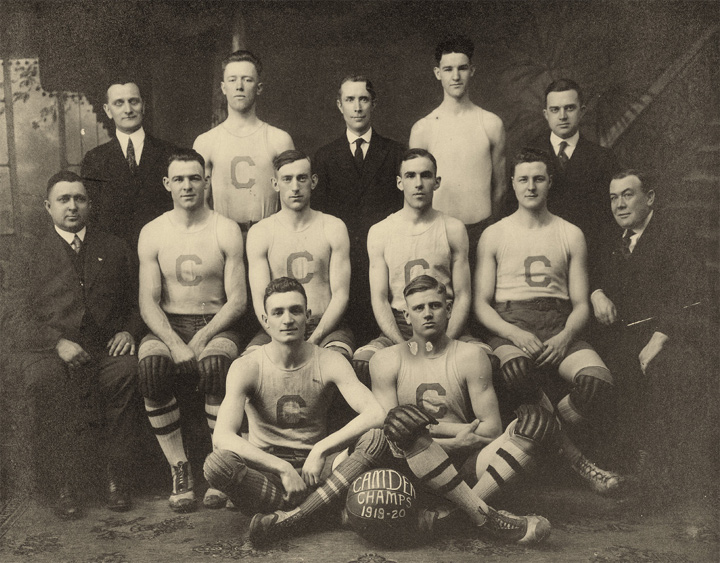
Camden Crusaders, 1919–1920 Eastern Basketball League champions — Front row, left to right: Jimmy “Soup” Campbell and Joe Hyde. Second row, left to right: Dr. Charles B. Helm, Neil Deighan, Roy Steele, Eddie Dolin, Dave Kerr and Sheriff W. Penn Corson. Back row, left to right: Bill Mitchell, trainer; Sam Lennox, Manager Bill Kennedy, Richie Deighan and Timekeeper Jim Kane.
Camden Courier-Post — January 26, 1928
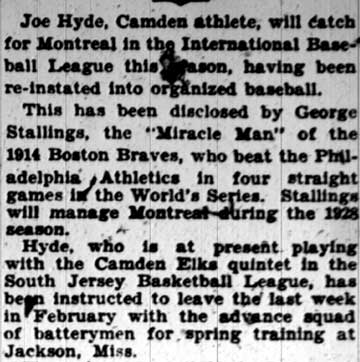
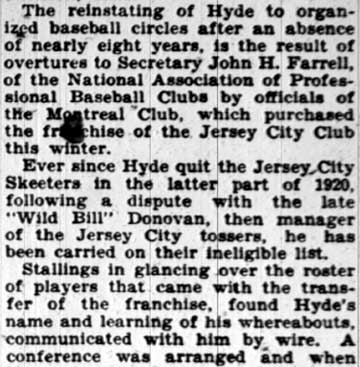
Camden Courier-Post, January 26, 1928 — Joe Hyde
Black Yanks Here in Double-Header
Camden Courier-Post —
Camden Club to Entertain Colorful Stars at Fairview Ball Park
Probably the greatest collection of colored talent in the country will perform before local fans tomorrow afternoon at the Fairview Athletic Field when the New York Black Yankees and Lou Schaub’s Camden Club engage in a double-header. The opening game is slated to start promptly at 2 o’clock.
This will be the first appearance of the New Yorkers here this season.
Schaub had originally scheduled them for the opening game of the season, but rain forced the cancellation of the game.
Due to the fact that the Yankees happened to have an open date for this Sunday, Schaub immediately grabbed the chance of bringing this fast-moving outfit here. The players comprising the New York ensemble are of the best in the country and is the finest collection of stars gathered in one team.
They have a pitching staff that ranks with the best, namely, “Reds” Ryan, Phil Rolland, Luther Farrell and Gandy. A number of other out-standing players who will be in the lineup are Yancey, Riggins, Smith, Rector, “Fat” Jenkins and George Scales, who also manages the club.
The Yanks have taken on all kinds of opposition since the season started and have made the best bite the dirt. The most recent visit of the New Yorkers in the section was last Tuesday when they defeated the Mayfair Club of Philadelphia, a team which also bowed to the Schaubmen.
Schaub announced that the pitching assignments will be turned over to the veteran Johnny “Rube” Chambers and Jack Kimble, Wildwood High athletic director, who has been twirling splendid ball for Camden this season.
Tommy Naughton and Joe Hyde will take care of the receiving, with the former probably donning the mask and windpad in the opener.
The local infield will be taken care of by Bill O’Donnell on first with Bill “Jigger” Black at second, and Joe Snyder at shortstop, while either Ernie Padgett or Fritz Schadel will hold down third base. In the outfield will be Dick Spalding, George Gilham and Bill Graupner, the latter having recently graduated from the University of Pennsylvania, where he captained the nine.
Camden Courier-Post — June 18, 1932
Klein and Hurst Among Regulars to Face Schaubmen Here Tomorrow
CHAMBERS VS. ELLIOTT
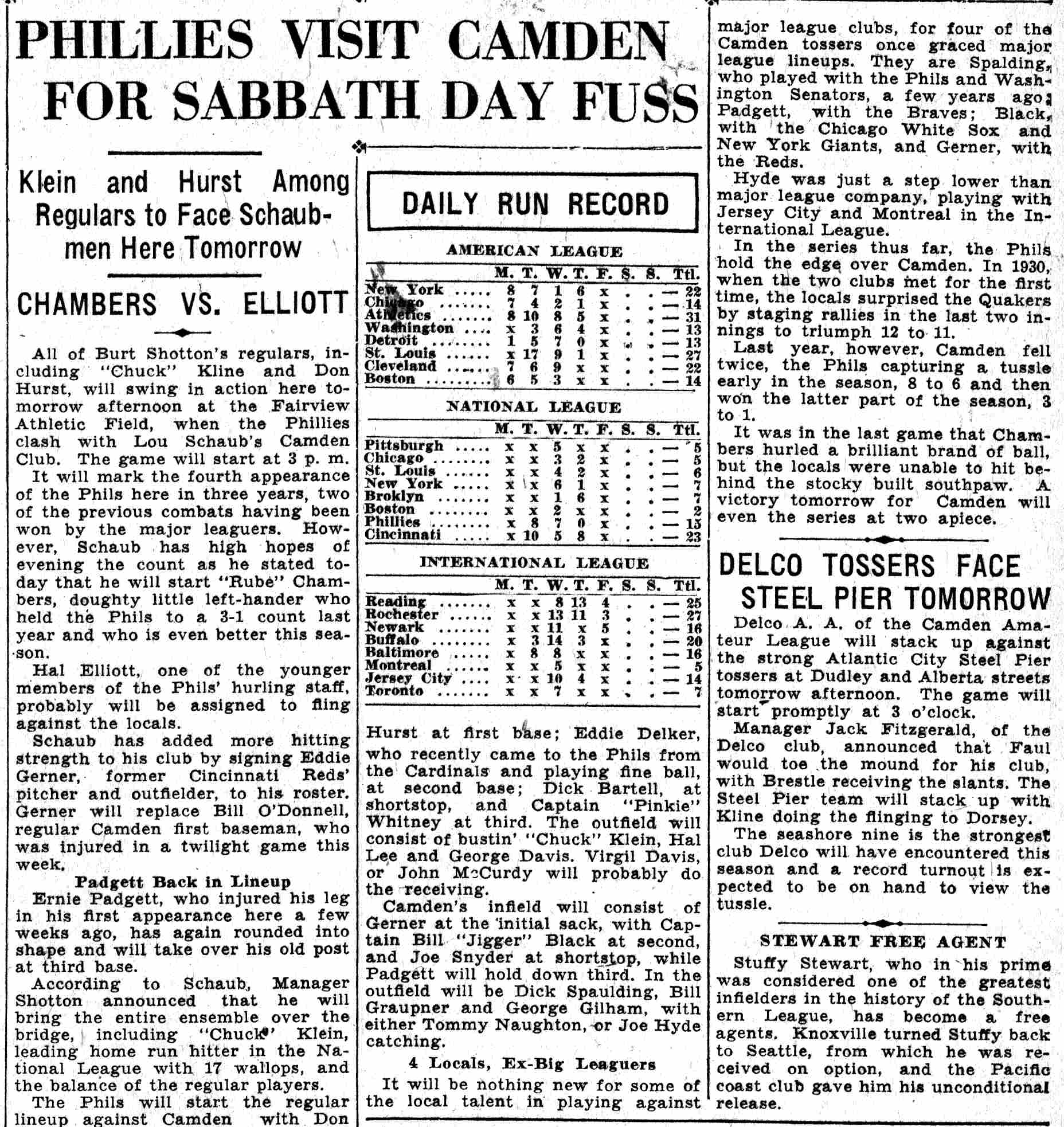
All of Burt Shotton’s regulars, including “Chuck” Kline and Don Hurst, will swing in action here tomorrow afternoon at the Fairview Athletic Field, when the Phillies clash with Lou Schaub’s Camden Club. The game will start at 3 p. m.
It will mark the fourth appearance of the Phils here in three years, two of the previous combats having been won by the major leaguers. However, Schaub has high hopes of evening the count as he stated today that he will start “Rube” Chambers, doughty little left-hander who held the Phils to a 3-1 count last year and who is even better this season.
Hal Elliott, one of the younger members of the Phils’ hurling staff, probably will be assigned to fling against the locals.
Schaub has added more hitting strength to his club by signing Eddie Gerner, former Cincinnati Reds’ pitcher and outfielder, to his roster. Gerner will replace Bill O’Donnell, regular Camden first baseman, who was injured in a twilight game this week.
Padgett Back in Lineup
Ernie Padgett, who injured his leg in his first appearance here a few weeks ago, has again rounded into shape and will take over his old post at third base.
According to Schaub, Manager Shotton announced that he will bring the entire ensemble over the bridge, including “Chuck” Klein, leading home run hitter in the National League with 17 wallops, and the balance of the regular players.
The Phils will start the regular lineup against Camden with Don Hurst at first base; Eddie Delker, who recently came to the Phils from the Cardinals and playing fine ball, at second base; Dick Bartell, at shortstop, and Captain “Pinkie” Whitney at third. The outfield will consist of bustin’ “Chuck” Klein, Hal Lee and George Davis. Virgil Davis, or John McCurdy will probably do the receiving.
Camden’s infield will consist of Gerner at the initial sack, with Captain Bill “Jigger” Black at second, and Joe Snyder at shortstop, while Padgett will hold down third. In the outfield will be Dick Spaulding, Bill Graupner and George Gilham, with either Tommy Naughton or Joe Hyde catching.
4 Locals, Ex-Big Leaguers
It will be nothing new for some of the local talent in playing against major league clubs, for four of the Camden tossers once graced major league lineups. They are Spalding, who played with the Phils and Washington Senators, a few years ago; Padgett, with the Braves; Black, with the Chicago White Sox and New York Giants, and Gerner, with the Reds.
Hyde was just a step lower than major league company, playing with Jersey City and Montreal in the International League.
In the series thus far, the Phils hold the edge over Camden. In 1930, when the two clubs met for the first time, the locals surprised the Quakers by staging rallies in the last two innings to triumph 12 to 11.
Last year, however, Camden fell twice, the Phils capturing a tussle early in the season, 8 to 6 and then won the latter part of the season, 3 to 1.
It was in the last game that Chambers hurled a brilliant brand of ball, but the locals were unable to hit behind the stocky built southpaw. A victory tomorrow for Camden will even the series at two apiece.
Camden Courier-Post — January 1, 1944
Named: Camden Courier-Post, Morning Post, January 1, 1944, and Joe Hyde obituary; also mentioning Wid Conroy, Lou Schaub, Eggie Lennox, Roy Steele, Eddie Dolin, Dave Kerr, James “Soup” Campbell, Sam Lennox, Neil Deighan, and Rich Deighan.
Camden Evening Courier — January 1, 1944
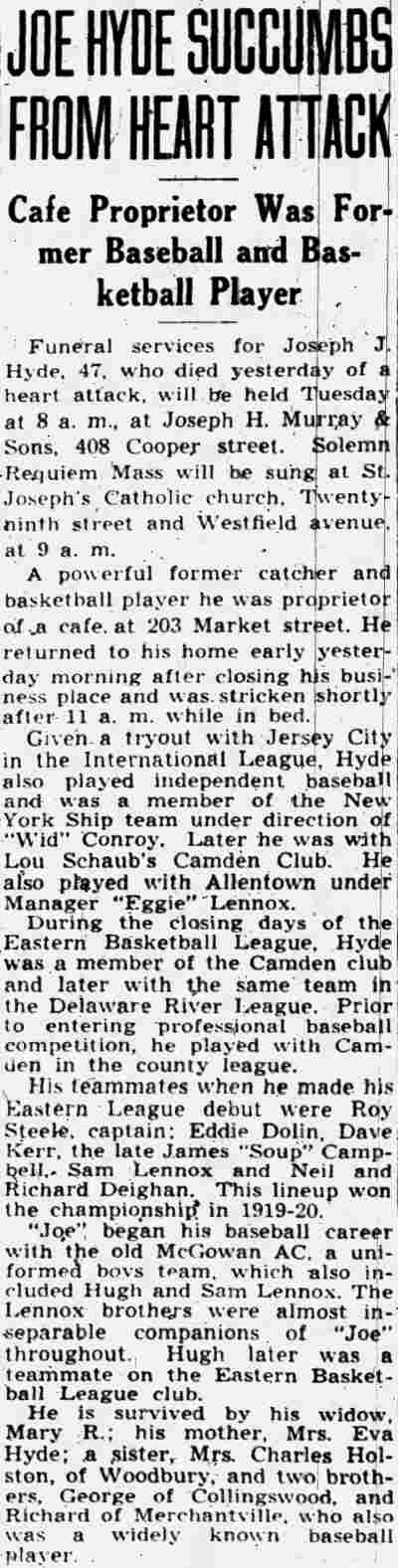
Camden Evening Courier, January 1, 1944 — Joe Hyde obituary
Skeeters Brought Camden Only E.L. Court Crown
Camden Courier-Post —
Dolin, N. Deighan, Campbell, Kerr, Steele 1919-20 Pro Champions
By Jack Carty
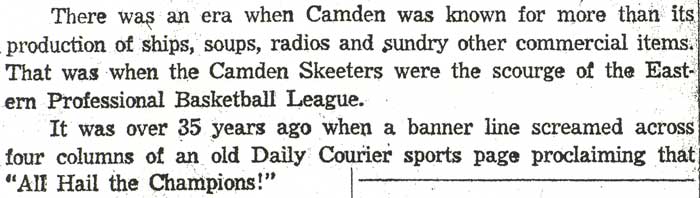
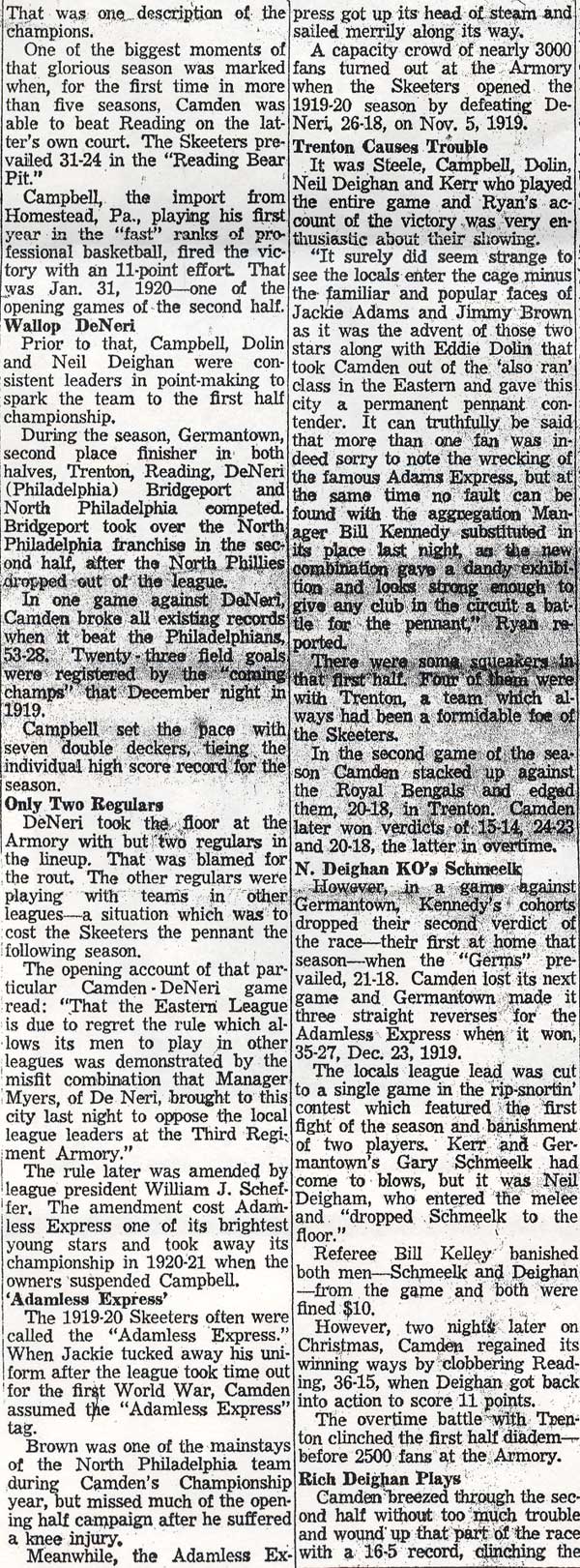
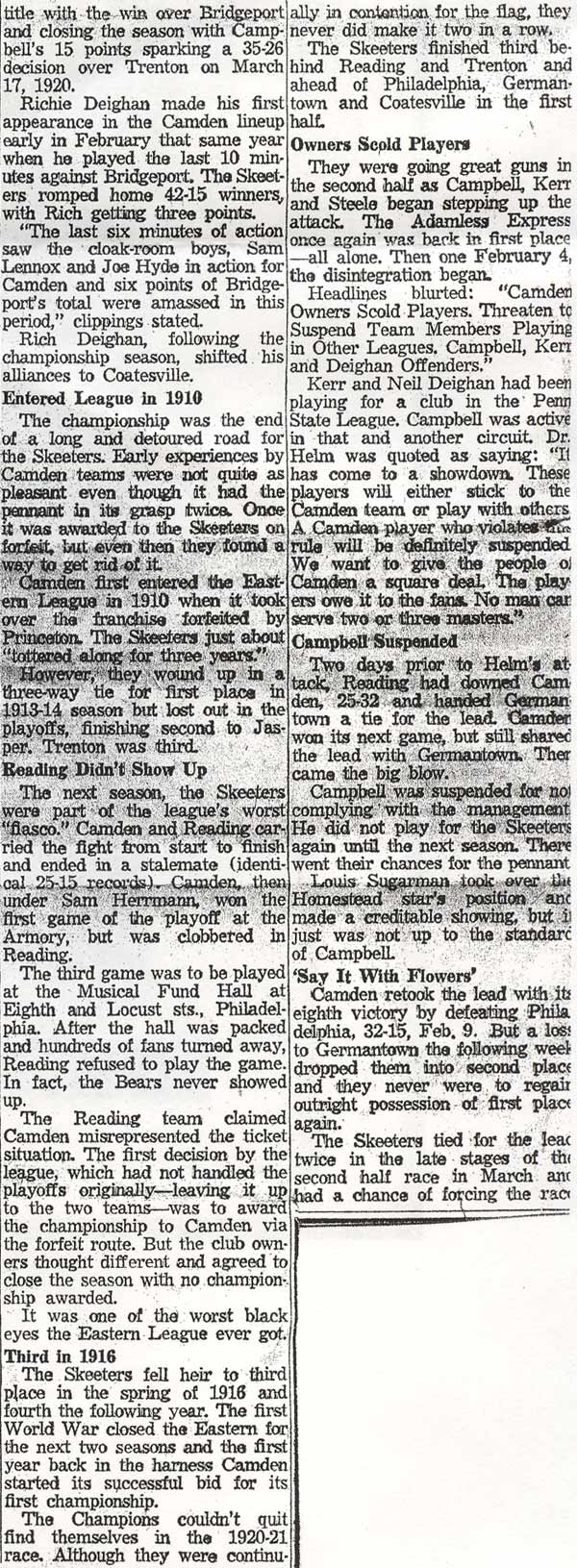
There was an era when Camden was known for more than its production of ships, soups, radios and sundry other commercial items. That was when the Camden Skeeters were the scourge of the Eastern Professional Basketball League.
It was over 35 years ago when a banner line screamed across four columns of an old Daily Courier sports page proclaiming that “All Hail the Champions!”
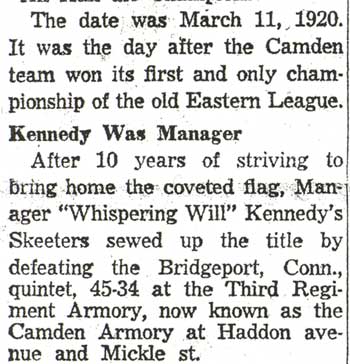
The date was March 11, 1920. It was the day after the Camden team won its first and only championship of the old Eastern League.
Kennedy Was Manager
After 10 years of striving to bring home the coveted flag, Manager “Whispering Will” Kennedy’s Skeeters sewed up the title by defeating the Bridgeport, Conn., quintet, 45–34 at the Third Regiment Armory, now known as the Camden Armory at Haddon avenue and Mickle st.
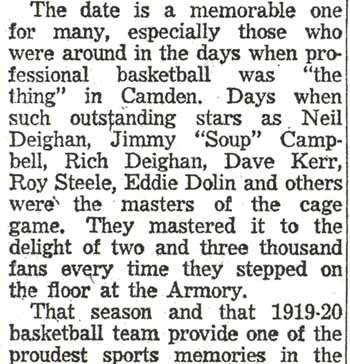
The date is a memorable one for many, especially those who were around in the days when professional basketball was “the thing” in Camden. Days when such outstanding stars as Neil Deighan, Jimmy “Soup” Campbell, Rich Deighan, Dave Kerr, Roy Steele, Eddie Dolin and others were the masters of the cage game. They mastered it to the delight of two and three thousand fans every time they stepped on the floor at the Armory.
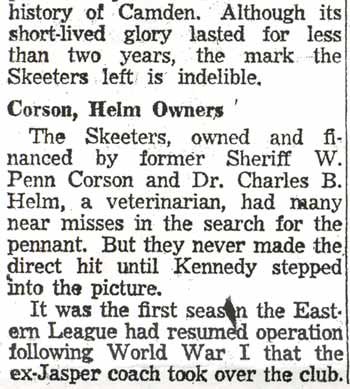
That season and that 1919–20 basketball team provide one of the proudest sports memories in the history of Camden. Although its short-lived glory lasted for less than two years, the mark the Skeeters left is indelible.
Corson, Helm Owners
The Skeeters, owned and financed by former Sheriff W. Penn Corson and Dr. Charles B. Helm, a veterinarian, had many near misses in the search for the pennant. But they never made the direct hit until Kennedy stepped into the picture.
It was the first season the Eastern League had resumed operation following World War I that the ex-Jasper coach took over the club.
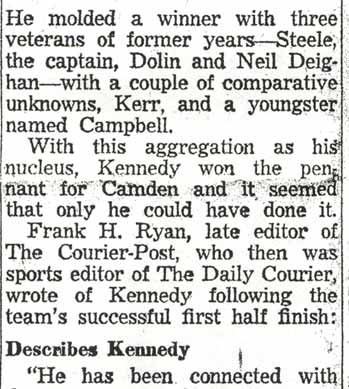
He molded a winner with three veterans of former years—Steele, the captain, Dolin and Neil Deighan—with a couple of comparative unknowns, Kerr, and a youngster named Campbell.
With this aggregation as his nucleus, Kennedy won the pennant for Camden and it seemed that only he could have done it.
Frank H. Ryan, late editor of The Courier-Post, who then was sports editor of The Daily Courier, wrote of Kennedy following the team’s successful first half finish:
Describes Kennedy
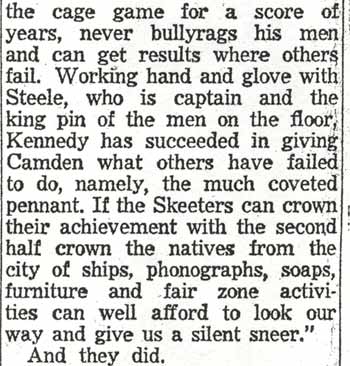
“He has been connected with the cage game for a score of years, never bullyrags his men and can get results where others fail. Working hand and glove with Steele, who is captain and the king pin of the men on the floor, Kennedy has succeeded in giving Camden what others have failed to do, namely, the much coveted pennant. If the Skeeters can crown their achievement with the second half crown the natives from the city of ships, phonographs, soaps, furniture and fair zone activities can well afford to look our way and give us a silent sneer.”
And they did.
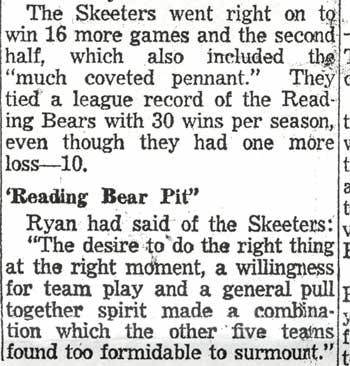
The Skeeters went right on to win 16 more games and the second half, which also included the “much coveted pennant.” They tied a league record of the Reading Bears with 30 wins per season, even though they had one more loss—10.
‘Reading Bear Pit’
Ryan had said of the Skeeters: “The desire to do the right thing at the right moment, a willingness for team play and a general pull together spirit made a combination which the other five teams found too formidable to surmount.”
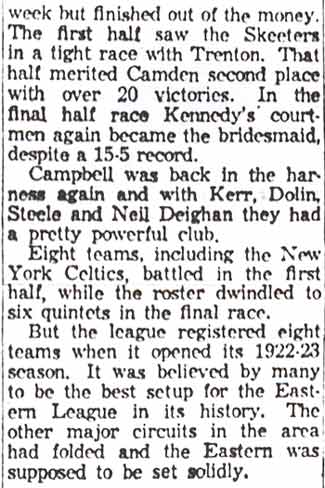
The first half saw the Skeeters in a tight race with Trenton. That half merited Camden second place with over 20 victories. In the final half race Kennedy’s courtmen again became the bridesmaid, despite a 15–5 record.
Campbell was back in the harness again and with Kerr, Dolin, Steele and Neil Deighan they had a pretty powerful club.
Eight teams, including the New York Celtics, battled in the first half, while the roster dwindled to six quintets in the final race.
But the league registered eight teams when it opened its 1922–23 season. It was believed by many to be the best setup for the Eastern League in its history. The other major circuits in the area had folded and the Eastern was supposed to be set solidly.
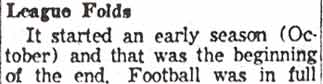
League Folds
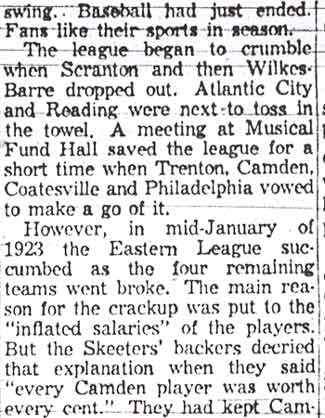
It started an early season (October) and that was the beginning of the end. Football was in full swing. Baseball had just ended. Fans like their sports in season.
The league began to crumble when Scranton and then Wilkes-Barre dropped out. Atlantic City and Reading were next to toss in the towel. A meeting at Musical Fund Hall saved the league for a short time when Trenton, Camden, Coatesville and Philadelphia vowed to make a go of it.
However, in mid-January of 1923 the Eastern League succumbed as the four remaining teams went broke. The main reason for the crackup was put to the “inflated salaries” of the players. But the Skeeters’ backers decried that explanation when they said “every Camden player was worth every cent.” They had kept Camden in first place until the league folded.
Fans Were Confused
Following one of the last games played in the league in Camden, Ryan wrote, “Wednesday night’s crowd would have been a disgrace to the East Side Church League.” That about summed it up.
Constant rearrangement of the league had jumbled the schedule. Fans never knew when or where their teams were playing. The gates were pitiful and the teams couldn’t operate without the money.
That was the end of the championship era of players like Steele, the Deighans, Campbell, Kerr, Dolin and the others. Some of them competed in the Philadelphia League the following season, but Camden dropped out of that league in 1924–25.
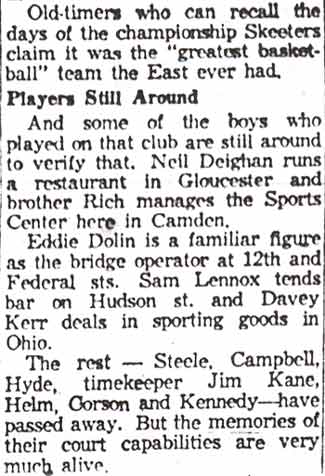
Players Still Around
Old-timers who can recall the days of the championship Skeeters claim it was the “greatest basketball” team the East ever had.
And some of the boys who played on that club are still around to verify that. Neil Deighan runs a restaurant in Gloucester and brother Rich manages the Sports Center here in Camden.
Eddie Dolin is a familiar figure as the bridge operator at 12th and Federal sts. Sam Lennox tends bar on Hudson st. and Davey Kerr deals in sporting goods in Ohio.
The rest — Steele, Campbell, Hyde, timekeeper Jim Kane, Helm, Corson and Kennedy — have passed away. But the memories of their court capabilities are very much alive.