James “Soup” Campbell
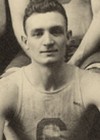
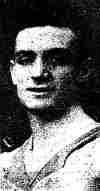
James Francis “Soup” Campbell (1897–1942)
James Francis “Soup” Campbell was born on December 24, 1897 in Homestead, Pennsylvania. He appears to have learned to play basketball, as fellow Homestead natives Jackie Adams and Roy Steele, under the tutelage of famed 23rd Street Wanders’ star Sandy Shields at the Homestead YMCA. Steele and Adams were teammates for nine pro seasons, the last five of which were in Camden, New Jersey. Familiarity allowed Adams and Steele to develop the most sophisticated offense in the early years of professional basketball. Season after season, Steele and Adams refined their offensive system which was based on rapid ball movement and an intricate short passing game. When Adams retired in 1918, Steele assumed Adams’ role as team leader of Camden’s powerful offense. Steele formed a new partnership with Soup Campbell, a young player from Homestead, which created the most formidable scoring duo in the league. The team enjoyed tremendous post-war success winning the 1919–20 EBL championship and compiled a 112–37 record in three and a half seasons before the demise of the league in January of 1923.
Soup Campbell joined the Camden club, which alternately was known as the Alphas, Skeeters, and Camden Crusaders of the Eastern Basket Ball League in time for the 1919–1920 season. The team was owned by Camden veterinarian Dr. Charles B. Helm and former Camden County Sheriff W. Penn Corson. Other team members included Neil Deighan and his brother Rich Deighan, Eddie Ferat, Sam Lennox, Roy Steele, Dave Kerr, and Joe Hyde.
Soup Campbell was one of pro basketball’s top offensive stars in the early 1920s. Campbell was a fine set shooter, but speed and agility were the keys to his game. He was considered one of the best of the “two-handed dribblers” of the era. Campbell’s greatest success came early in his pro basketball career. In his first full pro season, he led Camden to the Eastern League championship and was the league’s leading scorer. He won two more EBL scoring titles in 1922 and 1923. He starred in the Metropolitan League for three seasons before he joined the American Basketball League in 1925. Campbell played for five ABL teams during the next four seasons. During the later years of his career, Campbell was no longer among the top echelon of scorers, but remained valuable as a floor leader and strategist.
James Campbell married Gladys Frick in 1924. A son, James F. Campbell Jr., was born in Camden on February 25, 1925. Two more children followed by 1930, William A. Campbell and Shirley E. Campbell. The April 1930 Census shows the family living at 111 Terrace Avenue in East Camden. The 1928 and 1929 City Directory shows him involved with a bar at 28 Haddon Avenue, with Neil Deighan. By 1931 James Campbell was the proprietor of a restaurant, the Marmon Cafe, at 821 Market Street.
On July 25, 1930 James Campbell’s basketball career came to an abrupt end when he was involved in an automobile accident on the Admiral Wilson Boulevard in Pennsauken, New Jersey, just outside of Camden’s city limits. Both of his sons were also injured in the crash. James Campbell was awarded $15,000 damages, which were reduced to $12,000 in June of 1932. He appeared in three games in the 1932–1933 season, but time and injury had taken their toll and that was the end of his basketball career.
Sadly, James and Gladys Campbell divorced during the 1930s, and apparently his business ventures outside of sports did not do well either. The 1940 Census shows Mrs. Campbell living with her children and mother at 229 Ivins Avenue in Delaware Township (present-day Cherry Hill), New Jersey. James Campbell appears to have been living in Camden, renting a room at the home of Charles J. and Lydia Davidson of 319 North 2nd Street. The Census states that James Campbell, oddly enough, was working in the cannery at Campbell Soup.
James “Soup” Campbell died on March 5, 1942 in Camden, New Jersey.
Career Statistics
James 'Soup' Campbell Basketball Statistics
Career statistics. Height: 5'9' · Weight: 160 · College: None · Hometown: Homestead, Pa.
Regular Season
| Year ↕ | Team ↕ | League ↕ | Ga ↕ | Fgm ↕ | Ftm ↕ | Fta ↕ | Pct ↕ | Ast ↕ | Pts ↕ | Avg ↕ |
|---|---|---|---|---|---|---|---|---|---|---|
| 1914–15 | Homestead Shippers | Indep | ||||||||
| 1915–16 | Tower City (Pa) | Indep | 26 | 86 | 0 | 172 | 6.6 | |||
| 1916–17 | Pitcairn | IBLWP | 17 | 76 | 9 | 161 | 9.5 | |||
| 1917–18 | Pitcairn | IBLWP | 7 | 24 | 16 | 33 | .485 | 64 | 9.1 | |
| 1917–18 | Greystock | EBL | ||||||||
| 1918–19 | Wilmerding Airbrakes | ICL | ||||||||
| 1919–20 | Camden | EBL | 37 | 91 | 93 | 146 | .637 | 38 | 275 | 7.4 |
| 1919–20 | Nanticoke | PSL | 3 | 6 | 7 | 12 | .583 | 0 | 19 | 6.3 |
| 1920–21 | Camden | EBL | 26 | 57 | 63 | 108 | .583 | 30 | 177 | 6.8 |
| 1920–21 | Nanticoke | PSL | 21 | 37 | 35 | 18 | 109 | 5.2 | ||
| 1920–21 | Easthampton | IL | 3 | 8 | 6 | 22 | 7.3 | |||
| 1921–22 | Camden | EBL | 44 | 137 | 140 | 414 | 9.4 | |||
| 1922–23 | Camden | EBL | 23 | 59 | 79 | 139 | .568 | 47 | 197 | 8.6 |
| 1922–23 | Brooklyn Pros–Yonkers | MBL | 31 | 77 | 72 | 226 | 7.3 | |||
| 1922–23 | Cohoes | NYSL | 5 | 9 | 15 | 33 | 6.6 | |||
| 1922–23 | Tri-Council | PBL | 18 | 37 | 90 | 164 | 9.1 | |||
| 1923–24 | Trenton–Kingston | MBL | 18 | 48 | 42 | 138 | 7.7 | |||
| 1923–24 | Tri-Council | PBL | 40 | 71 | 144 | 286 | 7.2 | |||
| 1923–24 | Pottsville Big-5 | Indep | ||||||||
| 1924–25 | Passiac/Kingston–Trenton | MBL | 31 | 60 | 48 | 168 | 5.4 | |||
| 1924–25 | Tri-Council | PBL | 32 | 60 | 93 | 213 | 6.7 | |||
| 1924–25 | Hazleton Professionals | AnBL | 7 | 9 | 7 | 25 | 3.6 | |||
| 1925–26 | Camden–Pottsville | EBL | 7 | 14 | 39 | 67 | 9.6 | |||
| 1925–26 | Perth Amboy | MBL | 10 | 12 | 14 | 38 | 3.8 | |||
| 1925–26 | Chicago | ABL | 21 | 27 | 39 | 93 | 4.4 | |||
| 1926–27 | Philadelphia | ABL | 39 | 66 | 50 | 182 | 4.7 | |||
| 1927–28 | Philadelphia–Detroit–Cleveland | ABL | 29 | 41 | 31 | 113 | 3.9 | |||
| 1927–28 | Salem | SJL | 7 | 13 | 19 | 45 | 6.4 | |||
| 1928–29 | Trenton | ABL | 22 | 33 | 12 | 78 | 3.5 | |||
| 1928–29 | Salem-Millville | SJL | 20 | 43 | 37 | 123 | 6.2 | |||
| 1929–30 | Camden | EBL | 16 | 35 | 27 | 97 | 6.1 | |||
| 1932–33 | Philadelphia WPEN | EBL | 4 | 3 | 3 | 9 | 2.3 | |||
| Totals | Major League | 464 | 953 | 1115 | 3021 | 6.5 |
Playoffs
| Year ↕ | Team ↕ | League ↕ | Ga ↕ | Fgm ↕ | Ftm ↕ | Fta ↕ | Pct ↕ | Ast ↕ | Pts ↕ | Avg ↕ |
|---|---|---|---|---|---|---|---|---|---|---|
| 1923–24 | Tri-Council | PBL | 2 | 4 | 5 | 13 | 6.5 | |||
| 1927–28 | Salem | SJL | 3 | 7 | 13 | 27 | 9.0 | |||
| 1928–29 | Millville | SJL | 3 | 8 | 8 | 24 | 8.0 | |||
| Totals | Major League | 2 | 4 | 5 | 13 | 6.5 |
Camden Crusaders 1919–1920
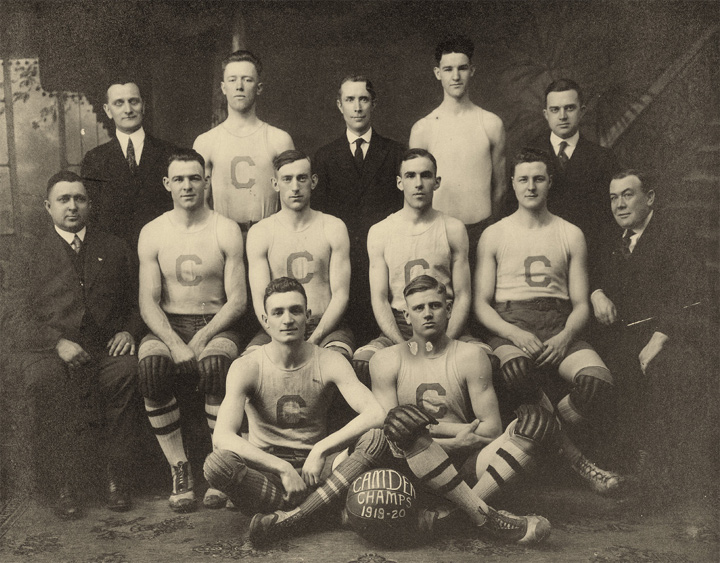
Camden Crusaders 1919–1920 Eastern Basketball League Champions.
Front row, left to right: Jimmy “Soup” Campbell and Joe Hyde. Second row, left to right: Dr. Charles B. Helm, Neil Deighan, Roy Steele, Eddie Dolin, Dave Kerr and Sheriff W. Penn Corson. Back row, left to right: Bill Mitchell, trainer; Sam Lennox, Manager Bill Kennedy, Richie Deighan and Timekeeper Jim Kane.
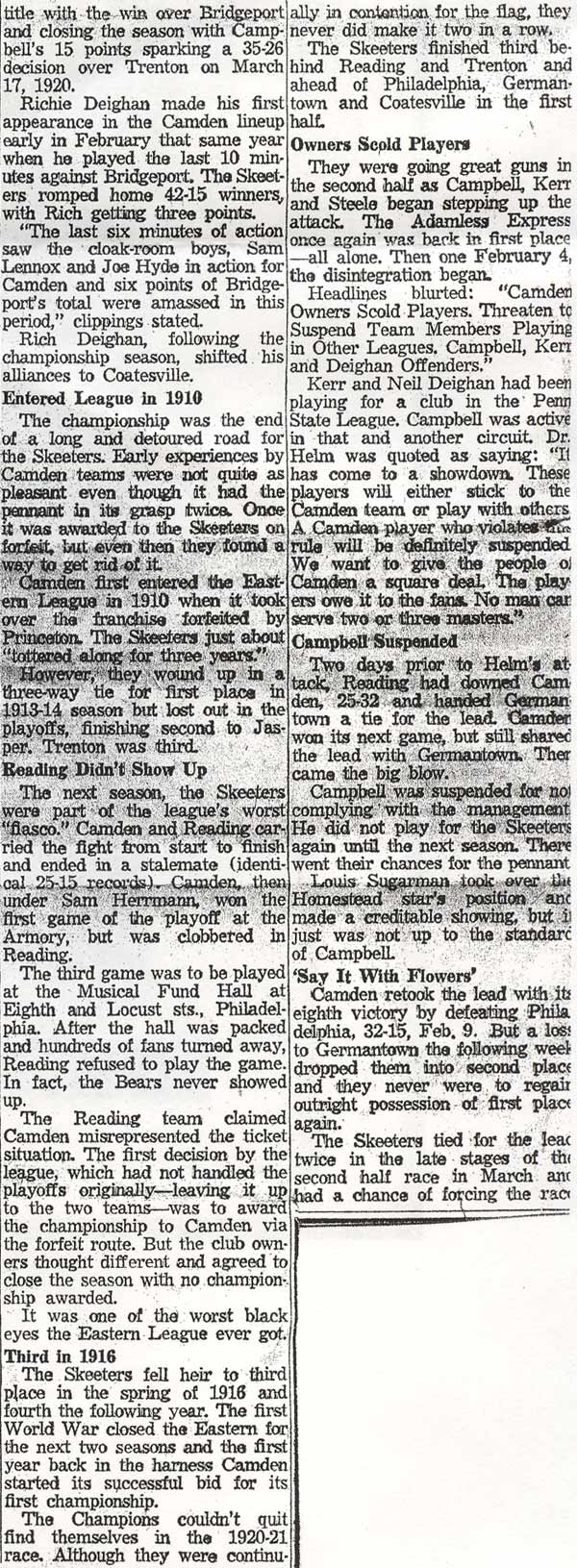
Skeeters Brought Camden Only E.L. Court Crown
Camden Courier-Post –
Dolin, N. Deighan, Campbell, Kerr, Steele 1919–20 Pro Champions
By Jack Carty
There was an era when Camden was known for more than its production of ships, soups, radios and sundry other commercial items. That was when the Camden Skeeters were the scourge of the Eastern Professional Basketball League.
It was over 35 years ago when a banner line screamed across four columns of an old Daily Courier sports page proclaiming that “All Hail the Champions!”
The date was March 11, 1920. It was the day after the Camden team won its first and only championship of the old Eastern League.
Kennedy Was Manager
After 10 years of striving to bring home the coveted flag, Manager “Whispering Will” Kennedy’s Skeeters sewed up the title by defeating the Bridgeport, Conn., quintet, 45–34 at the Third Regiment Armory, now known as the Camden Armory at Haddon avenue and Mickle st.
The date is a memorable one for many, especially those who were around in the days when professional basketball was “the thing” in Camden. Days when such outstanding stars as Neil Deighan, Jimmy “Soup” Campbell, Rich Deighan, Dave Kerr, Roy Steele, Eddie Dolin and others were the masters of the cage game. They mastered it to the delight of two and three thousand fans every time they stepped on the floor at the Armory.
That season and that 1919–20 basketball team provide one of the proudest sports memories in the history of Camden. Although its short-lived glory lasted for less than two years, the mark the Skeeters left is indelible.
Corson, Helm Owners
The Skeeters, owned and financed by former Sheriff W. Penn Corson and Dr. Charles B. Helm, a veterinarian, had many near misses in the search for the pennant. But they never made the direct hit until Kennedy stepped into the picture.
It was the first season the Eastern League had resumed operation following World War I that the ex-Jasper coach took over the club.
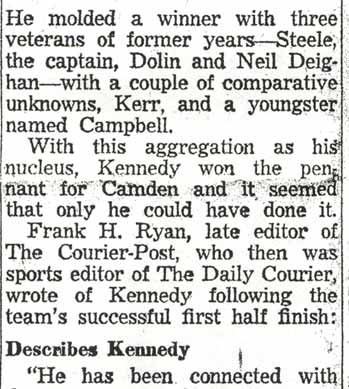
He molded a winner with three veterans of former years—Steele, the captain, Dolin and Neil Deighan—with a couple of comparative unknowns, Kerr, and a youngster named Campbell.
With this aggregation as his nucleus, Kennedy won the pennant for Camden and it seemed that only he could have done it.
Frank H. Ryan, late editor of The Courier-Post, who then was sports editor of The Daily Courier, wrote of Kennedy following the team’s successful first half finish:
Describes Kennedy
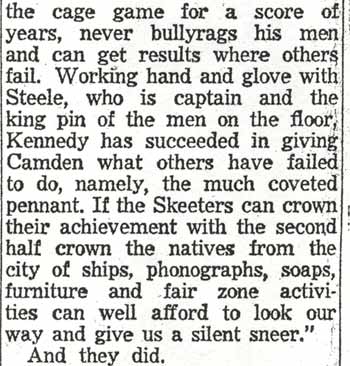
“He has been connected with the cage game for a score of years, never bullyrags his men and can get results where others fail. Working hand and glove with Steele, who is captain and the king pin of the men on the floor, Kennedy has succeeded in giving Camden what others have failed to do, namely, the much coveted pennant. If the Skeeters can crown their achievement with the second half crown the natives from the city of ships, phonographs, soaps, furniture and fair zone activities can well afford to look our way and give us a silent sneer.”
And they did.
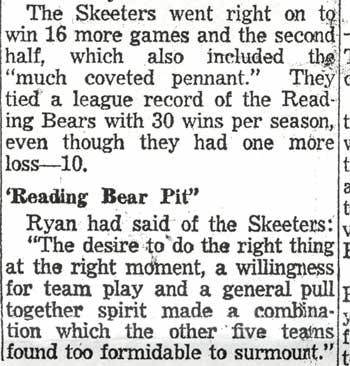
The Skeeters went right on to win 16 more games and the second half, which also included the “much coveted pennant.” They tied a league record of the Reading Bears with 30 wins per season, even though they had one more loss—10.
‘Reading Bear Pit’
Ryan had said of the Skeeters: “The desire to do the right thing at the right moment, a willingness for team play and a general pull together spirit made a combination which the other five teams found too formidable to surmount.”
The first half saw the Skeeters in a tight race with Trenton. That half merited Camden second place with over 20 victories. In the final half race Kennedy’s courtmen again became the bridesmaid, despite a 15–5 record.
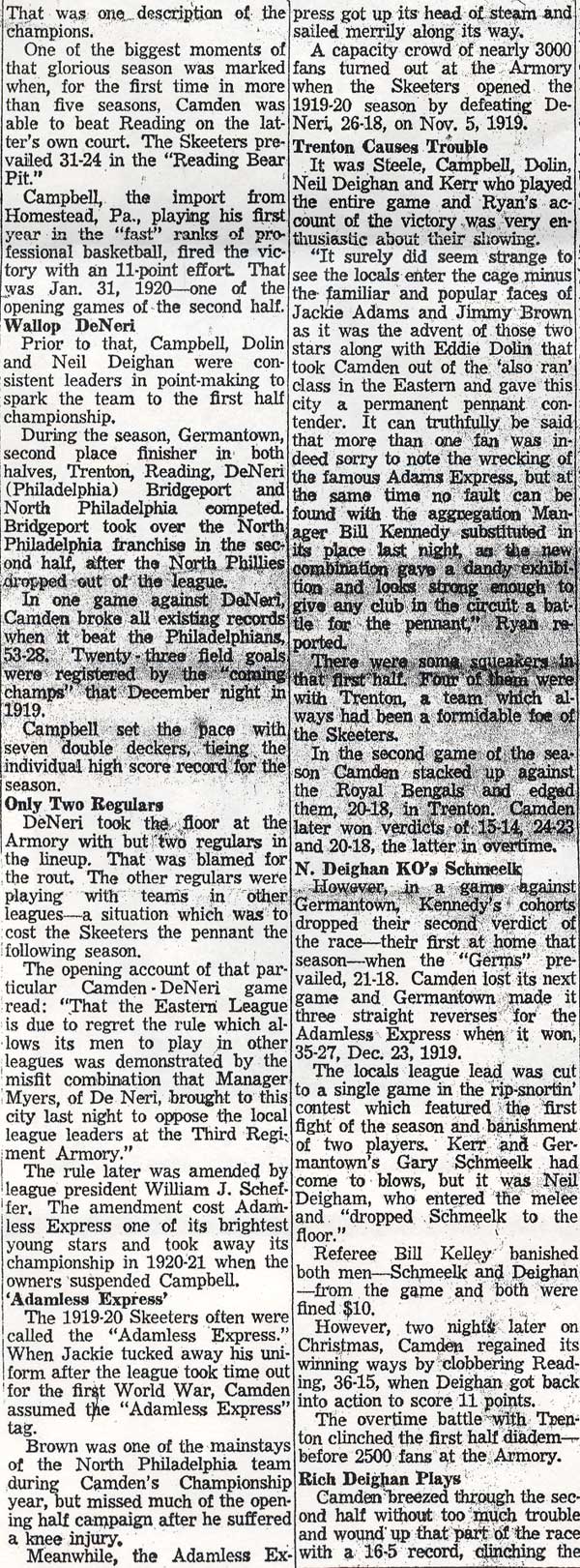
Campbell was back in the harness again and with Kerr, Dolin, Steele and Neil Deighan they had a pretty powerful club.
Eight teams, including the New York Celtics, battled in the first half, while the roster dwindled to six quintets in the final race.
But the league registered eight teams when it opened its 1922–23 season. It was believed by many to be the best setup for the Eastern League in its history. The other major circuits in the area had folded and the Eastern was supposed to be set solidly.
League Folds
It started an early season (October) and that was the beginning of the end. Football was in full swing. Baseball had just ended. Fans like their sports in season.
The league began to crumble when Scranton and then Wilkes-Barre dropped out. Atlantic City and Reading were next to toss in the towel. A meeting at Musical Fund Hall saved the league for a short time when Trenton, Camden, Coatesville and Philadelphia vowed to make a go of it.
However, in mid-January of 1923 the Eastern League succumbed as the four remaining teams went broke. The main reason for the crackup was put to the “inflated salaries” of the players. But the Skeeters’ backers decried that explanation when they said “every Camden player was worth every cent.” They had kept Camden in first place until the league folded.
Fans Were Confused
Following one of the last games played in the league in Camden, Ryan wrote, “Wednesday night’s crowd would have been a disgrace to the East Side Church League.” That about summed it up.
Constant rearrangement of the league had jumbled the schedule. Fans never knew when or where their teams were playing. The gates were pitiful and the teams couldn’t operate without the money.
That was the end of the championship era of players like Steele, the Deighans, Campbell, Kerr, Dolin and the others. Some of them competed in the Philadelphia League the following season, but Camden dropped out of that league in 1924–25.
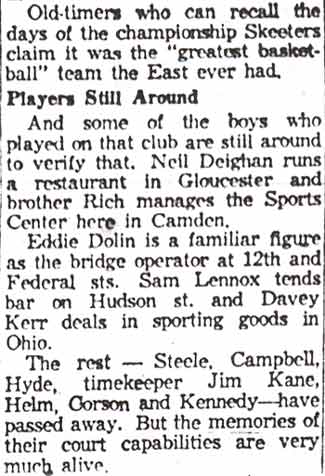
Old-timers who can recall the days of the championship Skeeters claim it was the “greatest basketball” team the East ever had.
Players Still Around
Neil Deighan runs a restaurant in Gloucester and brother Rich manages the Sports Center here in Camden.
Eddie Dolin is a familiar figure as the bridge operator at 12th and Federal sts. Sam Lennox tends bar on Hudson st. and Davey Kerr deals in sporting goods in Ohio.
The rest — Steele, Campbell, Hyde, timekeeper Jim Kane, Helm, Corson and Kennedy—have passed away. But the memories of their court capabilities are very much alive.
Denéri’s Winning Streak Halted by Greystock; Jimmy Campbell Is Sensation Against Beckman
Philadelphia Evening Public Ledger –


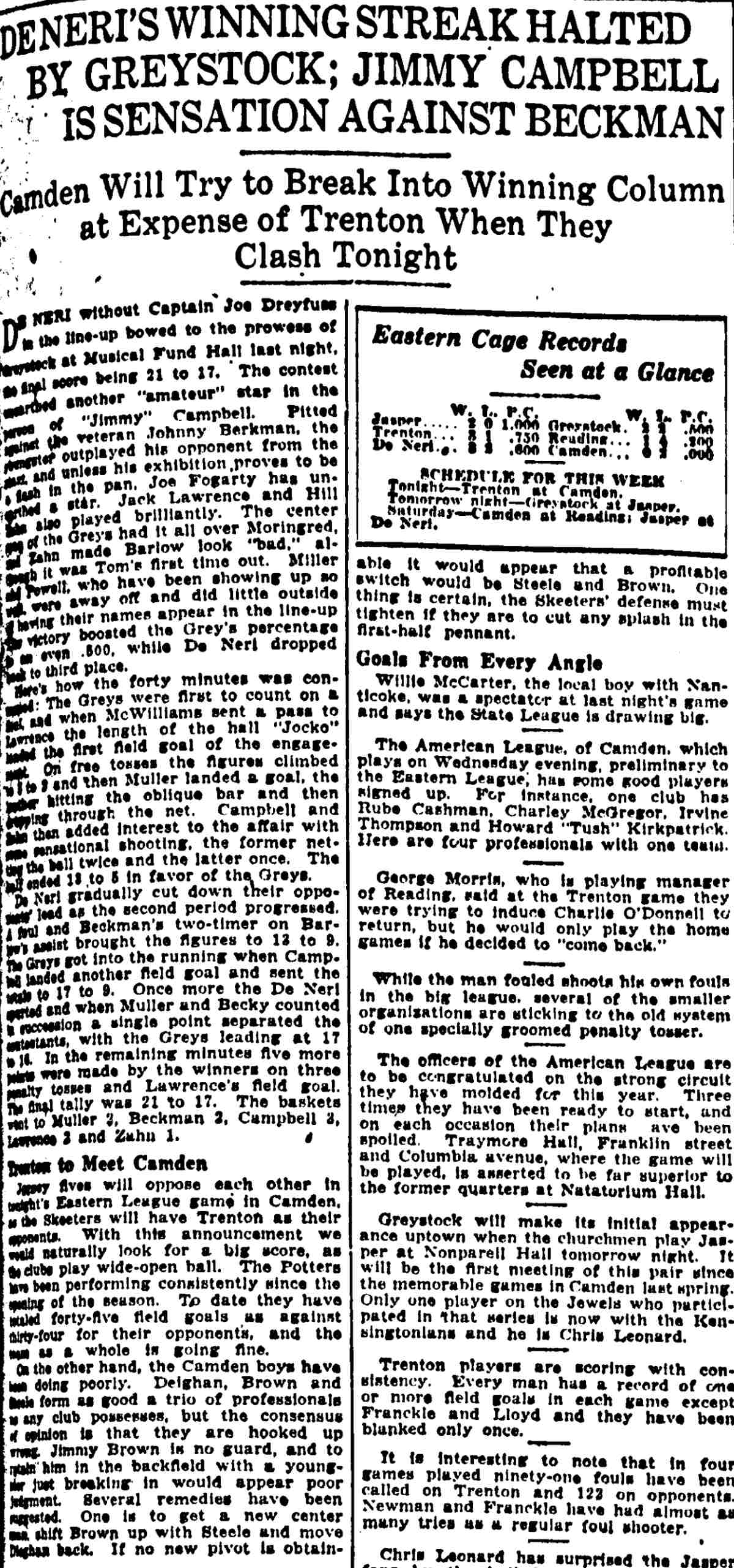
Greystock Proves Best “Home” Team
In Clash at Musical Fund Hall
Greystock’s five, without their captain, Joe Dreyfuss, in the line-up, bowed to the prowess of their opponents at the Musical Fund Hall last night, winning 31 to 17. The contest brought to the fore another “amateur” star in the person of “Jimmy” Campbell. Pitted against the veteran Johnny Beckman, Campbell played his opponent from the start and, unless his exhibition proves to be a flash in the pan, Joe Fogarty has uncovered a real find in this ambitious youngster.
Lawry and Lawrence and Hill played brilliantly. The center played a great game, and Biller, another youngster, who has been showing up so well, was a way off and did little outside of score.
When the other fellow’s names appear in the line-up at 6, Lorie boosted the Grey’s percentage to .600, while De Neri dropped back.
The match lasted forty minutes was contested. The Greys were first to count on a goal when McWilliams sent a pass down the length of the hall. “Jocko” landed a goal and at the intermission of free tosses the figures climbed to 7. After Muller landed a goal, the score went to 8 to 1 when Beckman hit the oblique bar and then went through the net. Campbell and Fogarty infused interest to the affair with sensational shooting, the former netting the bell twice and the latter once. The score went to 13 to 6 in favor of the Greys.
De Neri gradually cut down their opponent’s lead as the second period progressed. Fogarty and Beckman’s two-timer on Barlow’s assist brought the figures to 13 to 9. The Greys got into the running when Campbell landed another field goal and sent the scoring to 17 to 9. Once more the De Neri team got one when Muller and Becky counted and the score was on a single point separated the combatants, with the Greys leading at 17 to 16. In the remaining minutes five more goals were made by the winners on three foul tosses and Lawrence’s field goal. The final tally was 31 to 17. The baskets were made by De Neri at 10, Muller 3, Beckman 2, Campbell 3.
Camden Will Try to Break Into Winning Column at Expense of Trenton When They Clash Tonight
Trenton and Camden fives will oppose each other in tonight’s Eastern League game in Camden, when the Skeeters will have Trenton as their opponents. With this announcement we would naturally look for a big score, as both clubs play wide-open ball. The Potters have been performing consistently since the opening of the season. To date they have rolled forty-five field goals as against thirty-four for their opponents, and the machine as a whole is going fine.
On the other hand, the Camden boys have not been doing poorly. Deighan, Brown and Steele form as good a trio of professionals as any club possesses, but the consensus of opinion is that they are hooked up wrong. Jimmy Brown is no guard, and to place him in the backfield with a youngster just breaking in would appear poor judgment. Several remedies have been suggested. One is to get a new center man and shift Brown up with Steele and move Deighan back. If no new pivot is obtainable, it would appear that a profitable switch would be Steele and Brown. One thing is certain, the Skeeters’ defense must tighten if they are to cut any splash in the first-half pennant.
Eastern League Goes Into Discard
Philadelphia Inquirer –

Attempt to Reorganize Basketball Organization With Four Club Circuit a Failure
Squabble Over Players and Latters’ Fickleness Caused Blowup; Trenton and Camden to Play Series
The attempt to reorganize the Eastern Basketball League has resulted in a dismal failure. In an effort to get the proposed four-club circuit composing Philadelphia, Camden, Trenton and Reading, the league held another special meeting last night in this city and when Reading failed to send a representative to the conference the other three clubs present decided to throw up the sponge for the season and officially disband.
The magnates decided that this was the best course to pursue in the face of the existing conditions. The exorbitant salaries demanded by the players and the inability of some of the four clubs to reach a mutual agreement over the allotment of players to certain teams left such a chaotic condition remaining that those present decided it was futile to attempt to make a re-start for the rest of this season. Those who were present, Dr. Charles B. Helm, of Camden; R. C. Kuser, of Trenton, and William Meyers, of this city, went on record that they were in favor of reorganizing next fall if the conditions improve.
When the league disbanded last Monday night when Jasper and Greystock quit, the other four clubs attempted a comeback the next night with a four-club circuit. With the Jasper and Greystock teams out of business, several valuable players were thrown on the market and the reorganization scheme was to have the best of these men distributed between three of the four clubs, Trenton being satisfied with its present team. This scheme was feasible enough and promised to give four equally matched clubs, but, unfortunately, there arose a violent dispute between the teams of these players, and it was this which ultimately resulted in the grand blow off last night.
Thrown on the market by the retirement of Jasper and Greystock were McWilliams, Lawrence, Fogarty, Campbell, Zahn, Leonard, Dark, Norman, White, Moorehead and White. Most of these men are good players, yet of this group only three were in demand, McWilliams, Lawrence and Dark. There were two other players, however, who became involved in this grab list by the action of Camden and Reading in letting Brown and Sugarman go. This left a good field to pick from and during the first meeting of the attempted re-organization it was decided to let Reading have Brown, Dark and Lawrence, which was satisfactory to the Bears, who intended to round out the team with Morris and O’Donnell.
This brought up the issue between Philadelphia and Camden. The latter club wanted McWilliams and Sugarman and Philadelphia expressed a decisive desire also for McWilliams. Over two hours on Wednesday night the two clubs bickered and then did not reach any conclusion. The next day Philadelphia waived the point and let Camden have free rein to go after Sugarman and McWilliams, which meant a mighty fine combination for the Skeeters, for with Steele, Deighan and Kelly as a nucleus the team would have been of championship calibre. Philadelphia was to stand pat on Beckman, Muller, Dreyfuss, Dengath and Powell, with the possibility of securing another first-class man. Tom Barlow, a Trenton boy, on the reserve list of the Philadelphia team, had been turned over to Trenton and apparently the clubs were ready for the re-start.
They, however, had failed to take into consideration the fickleness of some of the players. McWilliams jolted the Camden club by announcing that he had quit basketball and would not play another game. Dark refused to go to Reading because he found it would interfere with his police duties in town, but expressed a desire to play with either Camden or Philadelphia; Sugarman announced that he was going to continue playing with Carbondale in the Pennsylvania State League, and Lawrence only wanted the modest sum of $25 per game to play in Reading. Finding that they could not get McWilliams and Sugarman, Camden wanted Brown back and when Reading learned this it brought a storm of disapproval from the owners.
This brought about a condition bordering on panic among the other magnates, and after a hurried meeting on Friday night, which was adjourned until last night, the owners decided they had enough of the uncertainty pertaining to this season, and that it would be good business to disband.
After the meeting B. C. Kuser, of Trenton, and Dr. Charles B. Helm, of Camden, said they would like to give their patrons a few more games and agreed to play a series of seven games for the championship of New Jersey. It is a real championship series, for each team posted a $200 forfeit with President Scheffler. The winner of the series takes the forfeit. The receipts of the games will be kept by each home team, and if a seventh game is needed the receipts will be divided equally. William Kelley was selected to referee the games. The line-up of the teams will be the same as used in the regular league games, as follows: Trenton, Francke, Tome, Newman, Hargreaves, Lloyd, Ballard and Watt; Camden, Steele, Deighan, Engle, Kelly, Kilpatrick, Miller, and one other professional and one other minor leaguer to be named. The first game will be played in Trenton tomorrow night, and the second in Camden on Wednesday of this week. The games will then continue on those two nights until one team wins four games. If a seventh game is needed, it will be played in Camden or Trenton, as a toss of a coin will decide. Jimmy Kane, of Camden, and Charles Barlow, of Trenton, will be the official timekeepers.
World War I Draft Card
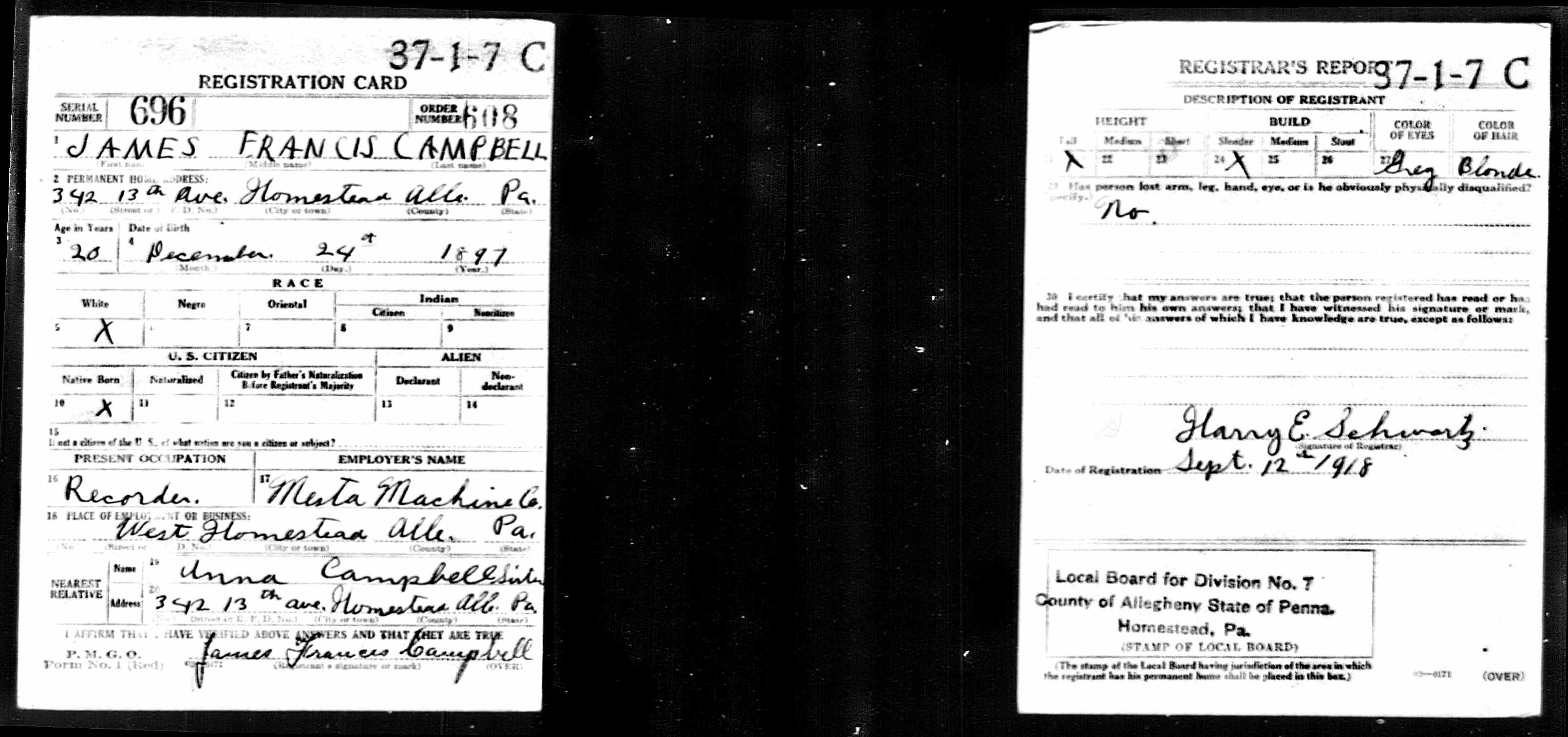
World War I Draft Registration Card for James Francis Campbell. Serial No. 696, Order No. 608. Born December 24, 1897. Address: 342 13th Ave., Homestead, Allegheny, Pa. Present occupation: Recorder, Meta Machine Co., West Homestead, Allegheny, Pa. Nearest relative: Anna Campbell. Date of Registration: September 12, 1918.
Campbell Leading Eastern Scores
Trenton Evening Times –

Camden Forward Gathers 112 Points in 18 Games Far-low High
“Soup” Campbell, of the Camden “Skeeters,” continues to hold the lead in the Eastern League basketball race for individual point honors.
In 18 games Campbell, the Camden forward, has netted the ball 31 times from the fifteen-foot mark, for a total of 112 points, putting him 20 points ahead of his nearest opponent. Eddie Dolin, centre of the “Skeeters,” is holding down third place. Campbell and Dolin are the only two players of the 52 in the league who have passed the century mark.
Campbell Carried Off Scoring Honors
Philadelphia Inquirer –
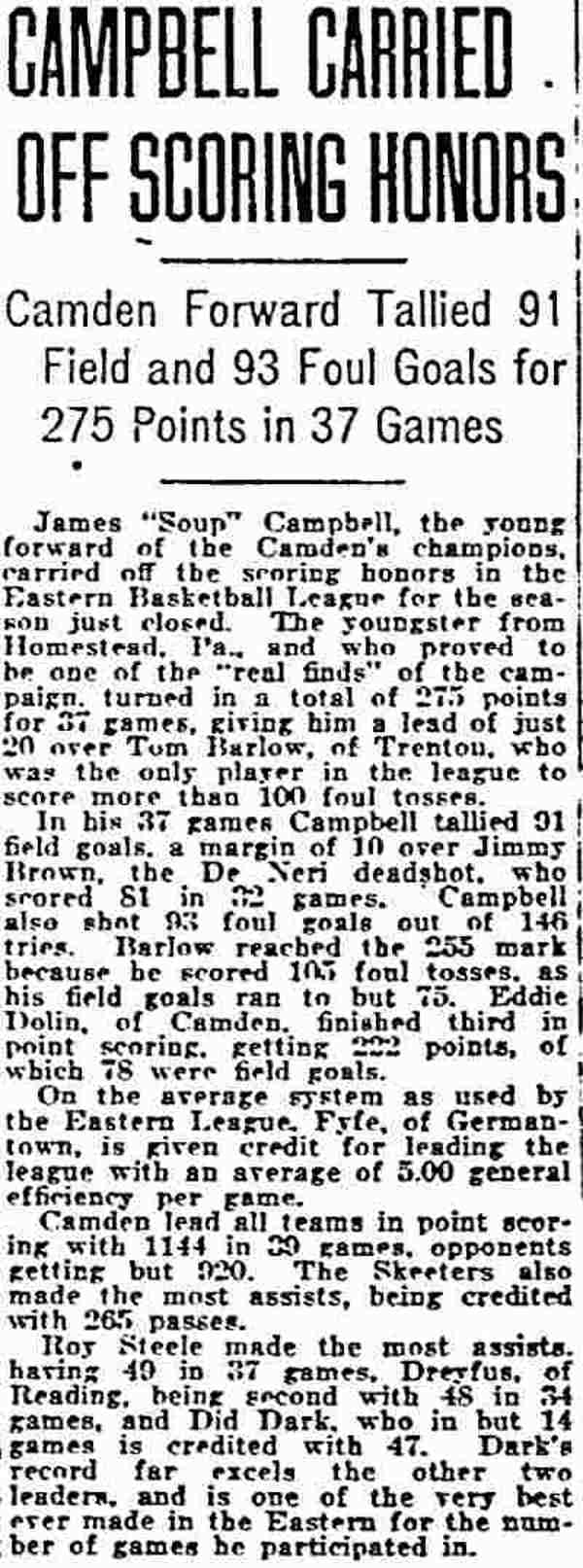
Camden Forward Tallied 91 Field and 93 Foul Goals for 275 Points in 37 Games
James “Soup” Campbell, the young forward of the Camden champions, carried off the scoring honors in the Eastern Basketball League for the season just closed. The youngster from Homestead, Pa., who proved to be one of the “real finds” of the campaign, turned in a total of 275 points for 37 games, giving him a lead of just 20 over Tom Barlow, of Trenton, who was the only player in the league to score more than 100 foul tosses.
In his 37 games Campbell tallied 91 field goals, a margin of 10 over Jimmy Brown, the De Neri deadshot, who scored 81 in 32 games. Campbell also shot 93 foul goals out of 146 tries. Barlow reached the 255 mark because he scored 105 foul tosses, as his field goals ran to but 75. Eddie Dolin, of Camden, finished third in point scoring, getting 222 points, of which 78 were field goals.
On the average system as used by the Eastern League, Fyfe, of Germantown, is given credit for leading the league with an average of 5.00 general efficiency per game.
Camden lead all teams in point scoring with 1144 in 39 games, opponents getting but 920. The Skeeters also made the most assists, being credited with 265 passes.
Roy Steele made the most assists, having 49 in 37 games. Dreyfus, of Reading, being second with 48 in 34 games, and Did Dark, who in but 14 games is credited with 47. Dark’s record far excels the other two leaders, and is one of the very best ever made in the Eastern for the number of games he participated in.
Campbell Best Scorer
Philadelphia Evening Public Ledger –
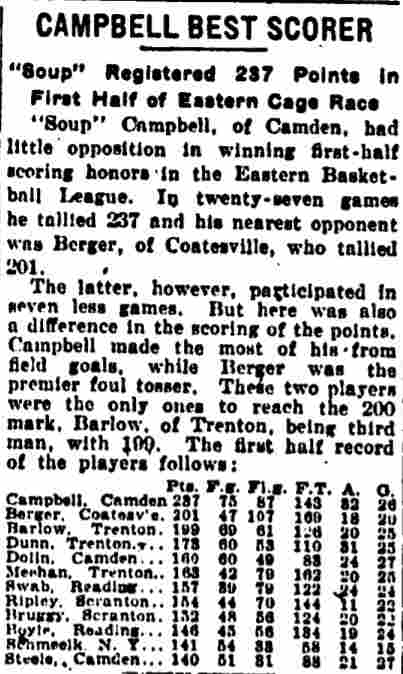
“Soup” Registered 237 Points in First Half of Eastern Cage Race
“Soup” Campbell, of Camden, had little opposition in winning first-half scoring honors in the Eastern Basketball League. In twenty-seven games he tallied 237 and his nearest opponent was Berger, of Coatesville, who tallied 201.
The latter, however, participated in seven less games. But here was also a difference in the scoring of the points. Campbell made the most of his from field goals, while Berger was the premier foul tosser. These two players were the only ones to reach the 200 mark, Barlow, of Trenton, being third man, with 199.
Campbell Best Scorer
Philadelphia Evening Public Ledger –
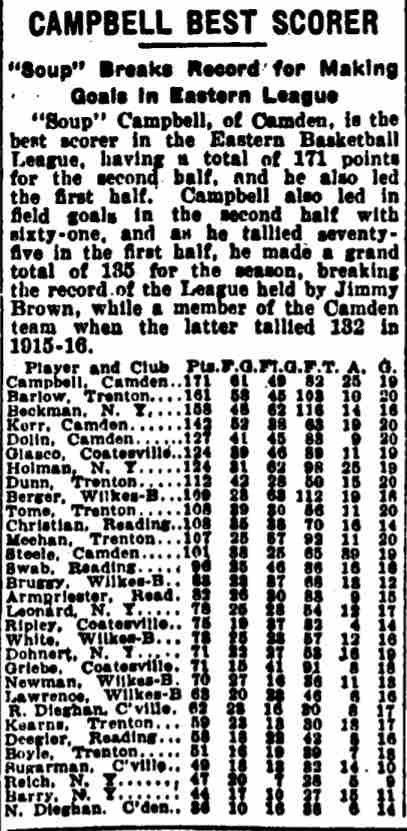
“Soup” Breaks Record for Making Goals in Eastern League
“Soup” Campbell, of Camden, is the best scorer in the Eastern Basketball League, having a total of 171 points for the second half, and he also led the first half. Campbell also led in field goals in the second half with sixty-one, and as he tallied seventy-five in the first half, he made a grand total of 135 for the season, breaking the record of the League held by Jimmy Brown, while a member of the Camden team when the latter tallied 132 in 1915–16.
Jimmie Campbell, Leading Goal Scorer
Trenton Evening Times –
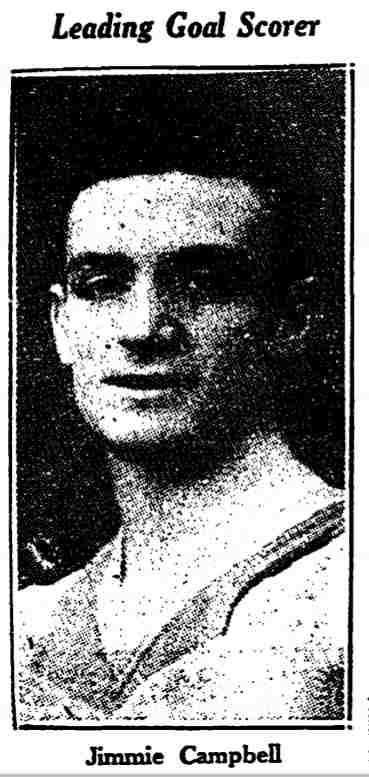
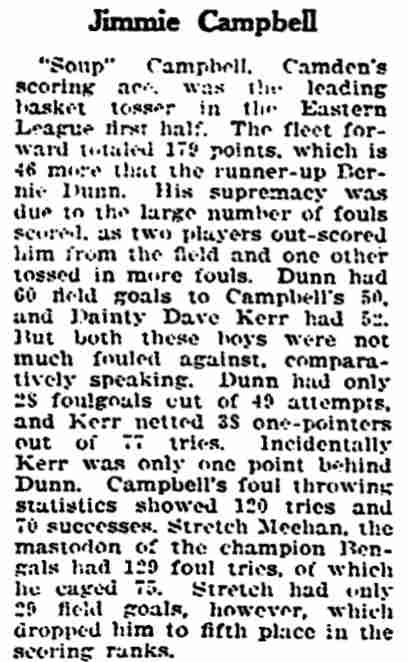
“Soup” Campbell, Camden’s scoring ace, was the leading basket tosser in the Eastern League first half. The fleet forward totaled 179 points, which is 46 more than the runner-up Bernie Dunn. His supremacy was due to the large number of fouls scored, as two players out-scored him from the field and one other tossed in more fouls. Dunn had 60 field goals to Campbell’s 59, and Dainty Dave Kerr had 52. But both these boys were not much fouled against, comparatively speaking. Dunn had only 28 foul goals out of 49 attempts, and Kerr netted 38 one-pointers out of 77 tries. Incidentally Kerr was only one point behind Dunn.
Campbell’s foul throwing statistics showed 120 tries and 70 successes. Stretch Meehan, the mastodon of the champion Bengals had 129 foul tries, of which he caged 75. Stretch had only 29 field goals, however, which dropped him to fifth place in the scoring ranks.
Trenton Downs Paterson With Campbell Playing Star Role
Trenton Times –
By William J. Waldron
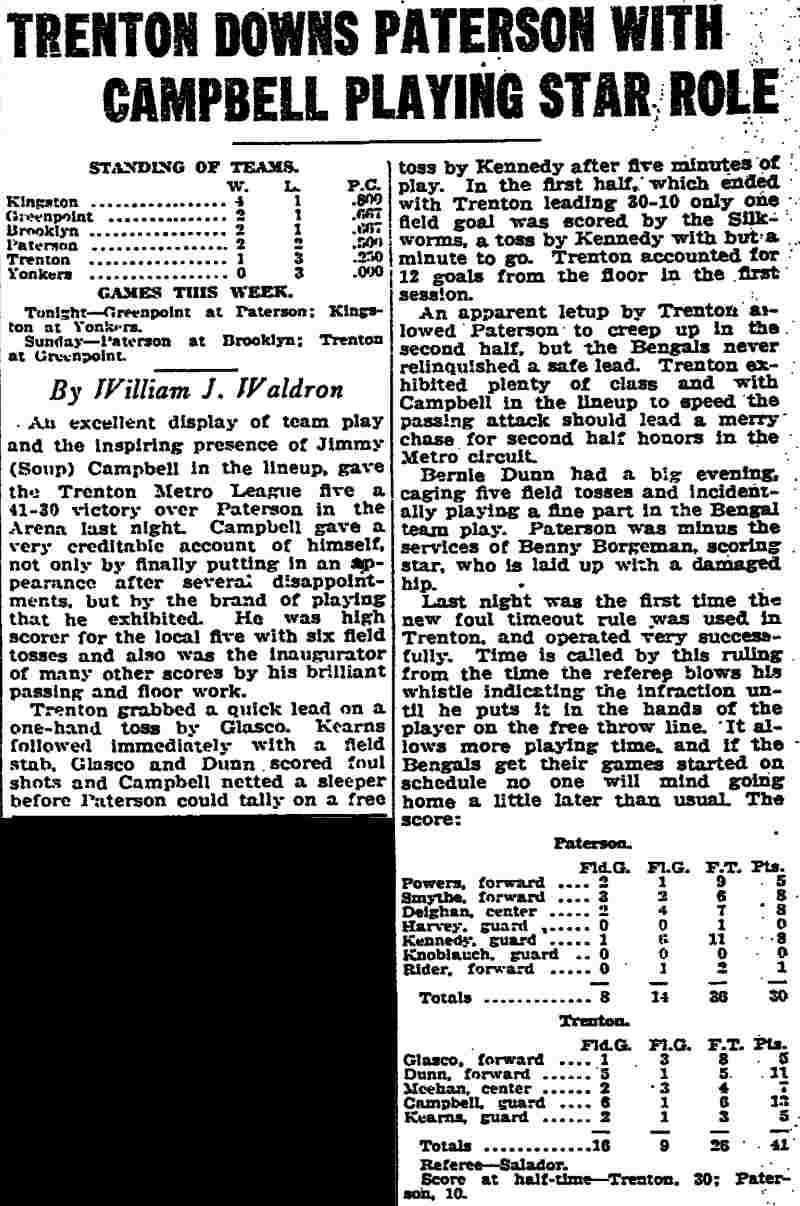
An excellent display of team play and the inspiring presence of Jimmy (Soup) Campbell in the lineup, gave the Trenton Metro League five a 41–30 victory over Paterson in the Arena last night. Campbell gave a very creditable account of himself, not only by finally putting in an appearance after several disappointments, but by the brand of playing that he exhibited. He was high scorer for the local five with six field tosses and also was the inaugurator of many other scores by his brilliant passing and floor work.
Trenton grabbed a quick lead on a one-hand toss by Glasco. Kearns followed immediately with a field stab, Glasco and Dunn scored foul shots and Campbell netted a sleeper before Paterson could tally on a free toss by Kennedy after five minutes of play. In the first half, which ended with Trenton leading 30–10 only one field goal was scored by the Silkworms, a toss by Kennedy with but a minute to go. Trenton accounted for 12 goals from the floor in the first session.
An apparent letup by Trenton allowed Paterson to creep up in the second half, but the Bengals never relinquished a safe lead. Trenton exhibited plenty of class and with Campbell in the lineup to speed the passing attack should lead a merry chase for second half honors in the Metro circuit.
Bernie Dunn had a big evening, caging five field tosses and incidentally playing a fine part in the Bengal team play. Paterson was minus the services of Benny Borgeman, scoring star, who is laid up with a damaged hip.
Eastern League Opens Monday With Trenton Playing Camden
Trenton Times –
Reading Takes on Philadelphia
By Edward F. Connelly
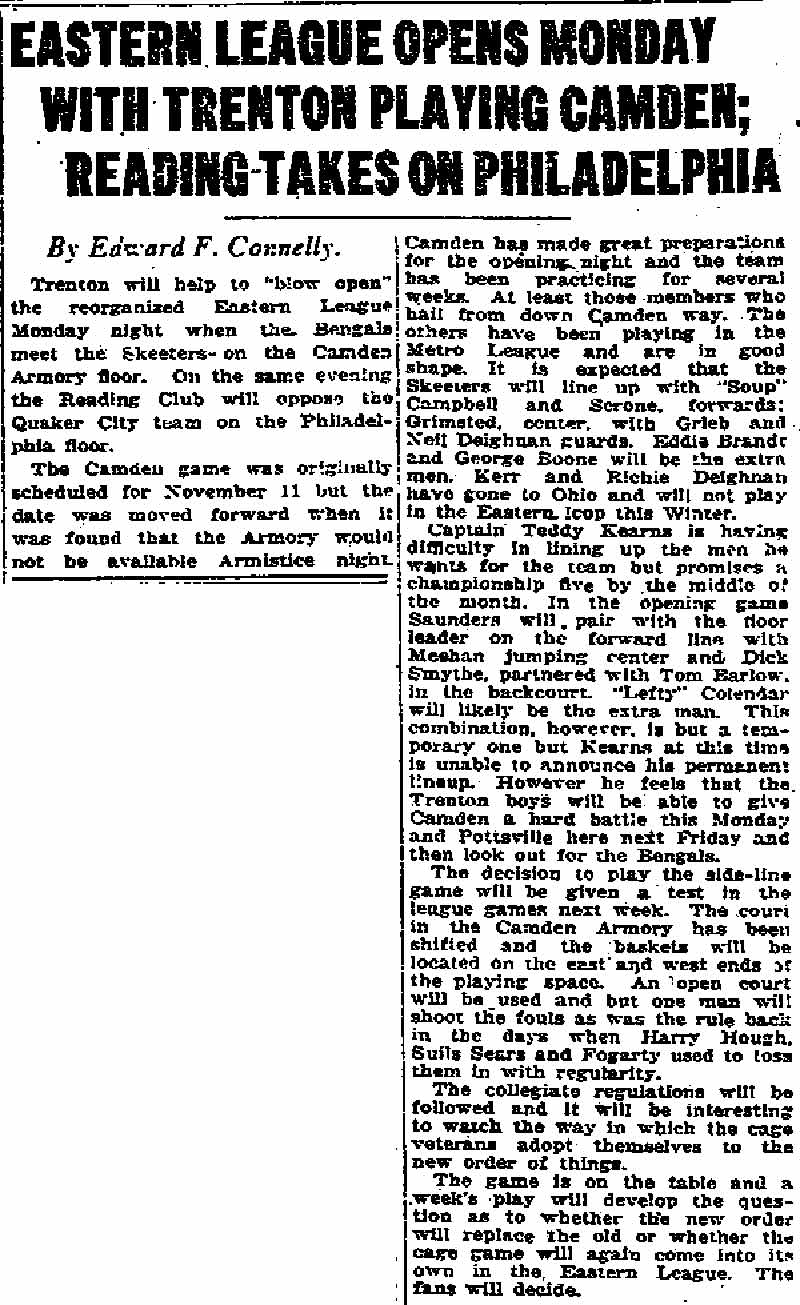
Trenton will help to “blow open” the recognized Eastern League Monday night when the Bengals meet the Skeeters on the Camden Armory floor. On the same evening the Reading Club will oppose the Quaker City team on the Philadelphia floor.
The Camden game was originally scheduled for November 11 but the date was moved forward when it was found that the Armory would not be available Armistice night.
Camden has made great preparations for the opening night and the team has been strengthened considerably in the past few weeks. At least those members who hail from down Camden way. The Skeeters have been playing in the Metro League and are in good shape. It is expected that the Skeeters will line up with “Soup” Campbell and Scrone, forwards; Grimstead, center, with Grieb and Neil Deighan as extra men. George Boone will be the extra men. Kerr and “Richie” Deighan have gone to Ohio and will not play in the Eastern loop this Winter.
Coach Roy Steele is having difficulty in lining up the men he wants for the team but promises a championship drive by the middle of the month. In the opening games Saunders will pair with the floor leader on the forward line with Meahan jumping center and Dick Smythe, partnered with Tom Barlow, in the backcourt. “Abe” Cotenlan will likely be the extra man. This combination, however, is but a temporary one but Kear says that he is unable to announce his permanent lineup. However he feels that the Trenton boys will be able to give Camden a hard battle this Monday and Pottsville here Friday and then look out for the Bengals.
The rules amendment by the league to play the side-line game will be given a tryout in the league games next week. The court in the Camden Armory has been shifted and the baskets will be located on the east and west ends of the playing space. An “open court” will be used and bets men will shoot the fouls as was the rule back in the days when Harry Hough, Sulis Sears and Fogarty used to toss them in with regularity.
The college rules regulations will be followed and it will be interesting to watch the way in which the cage veterans adopt themselves to the new order of things.
The game is on the table and a “week’s delay” centers the question as to whether the new order will replace the old or whether the old Eastern League will come into its own in the Eastern League. The fans will decide.
Barlow, Glasco and Kearns Feature as Philadelphia Warriors Win Game From Cleveland
Trenton Times –
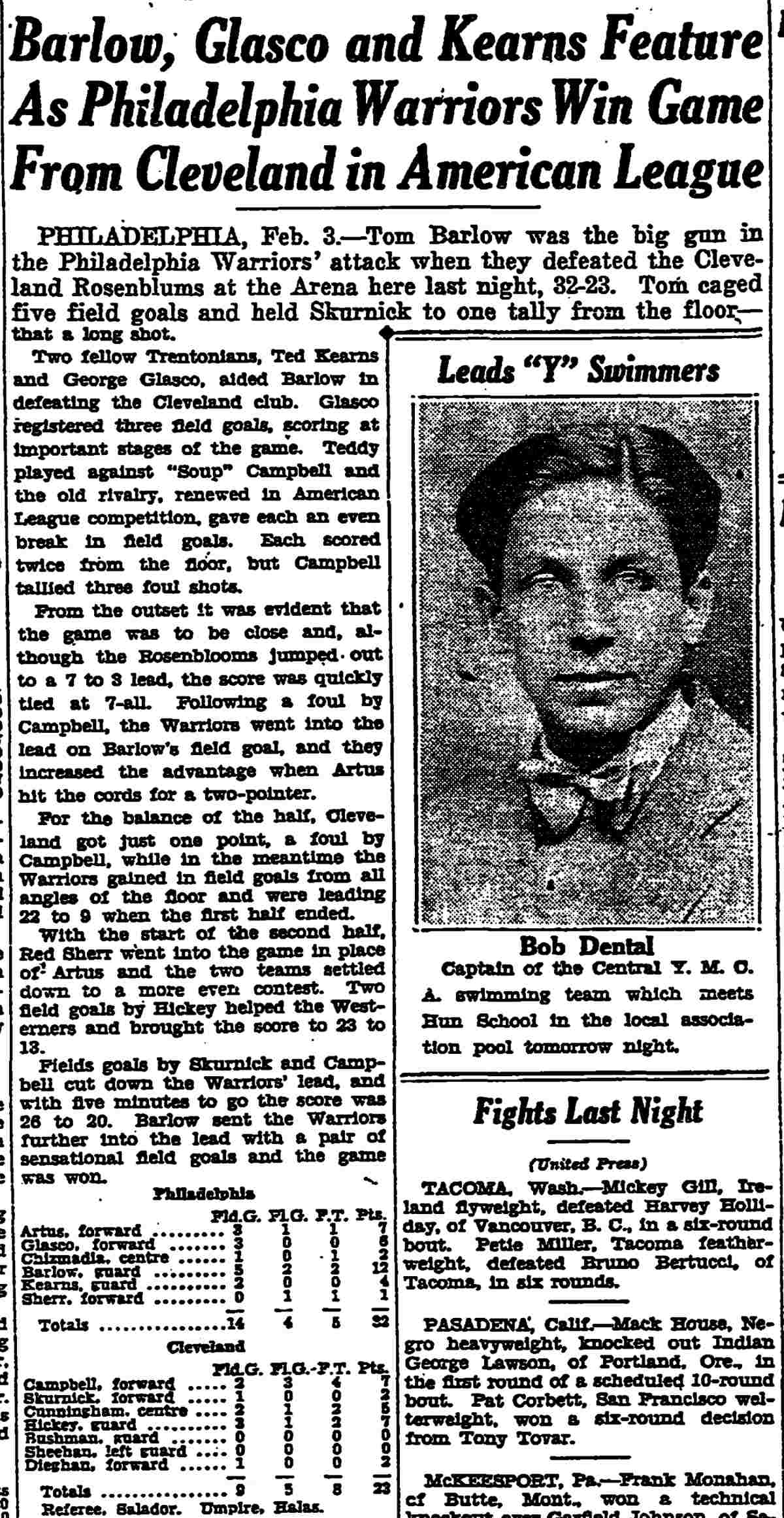
PHILADELPHIA, Feb. 3.—Tom Barlow was the big gun in Philadelphia’s attack when they defeated the Cleveland Rosenblums at the Arena here last night, 32–23. Tom caged eight field goals and held Artus to a standstill while Campbell registered three field goals. Both scored an even break in foul goals.
After the score appeared to be close and the game was going to be done and, after a 7 to 1 lead, the score was quickly closed. Following Artus, Campbell, with the Warriors, went into the offensive and the Warriors jumped up the advantage when Artus opened the corridor a two point lead.
‘Soup’ Campbell Injured in Auto
Trenton Evening Times –
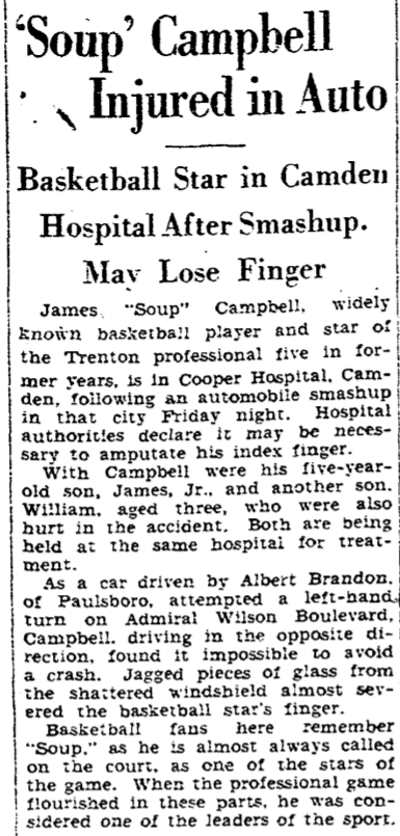
Basketball Star in Camden Hospital After Smashup. May Lose Finger
James “Soup” Campbell, widely known basketball player and star of the Trenton professional five in former years, is in Cooper Hospital, Camden, following an automobile smashup in that city Friday night. Hospital authorities declare it may be necessary to amputate his index finger.
With Campbell were his five-year-old son, James, Jr., and another son, William, aged three, who were also hurt in the accident. Both are being held at the same hospital for treatment.
As a car driven by Albert Brandon, of Paulsboro, attempted a left-hand turn on Admiral Wilson Boulevard, Campbell, driving in the opposite direction, found it impossible to avoid a crash. Jagged pieces of glass from the shattered windshield almost severed the basketball star’s finger.
Basketball fans here remember “Soup,” as he is almost always called on the court, as one of the stars of the game. When the professional game flourished in these parts, he was considered one of the leaders of the sport.
$15,000 Crash Award for ‘Soup’ Campbell
Trenton Evening Times –
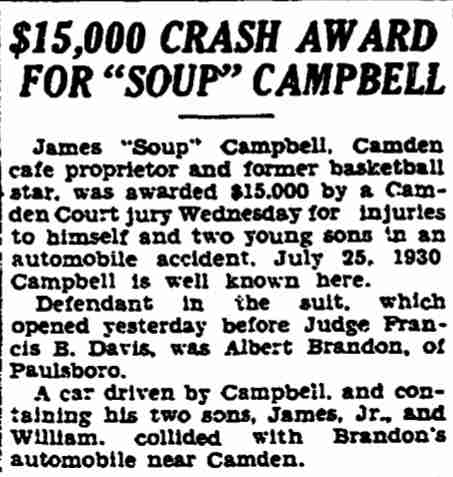
James “Soup” Campbell, Camden cafe proprietor and former basketball star, was awarded $15,000 by a Camden Court jury Wednesday for injuries to himself and two young sons in an automobile accident, July 25, 1930. Campbell is well known here.
Defendant in the suit, which opened yesterday before Judge Francis B. Davis, was Albert Brandon, of Paulsboro.
A car driven by Campbell, and containing his two sons, James, Jr., and William, collided with Brandon’s automobile near Camden.
$3,000 Cut Off Decree for ‘Soup’ Campbell
Camden Courier-Post –
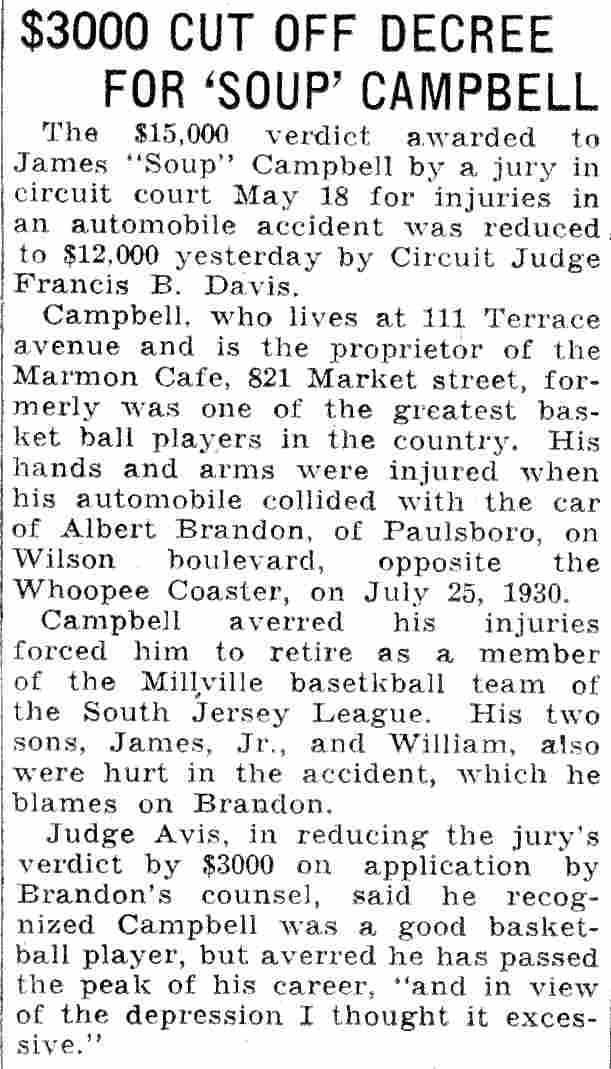
The $15,000 verdict awarded to James “Soup” Campbell by a jury in circuit court May 18 for injuries in an automobile accident was reduced to $12,000 yesterday by Circuit Judge Francis B. Davis.
Campbell, who lives at 111 Terrace avenue and is the proprietor of the Marmon Cafe, 821 Market street, formerly was one of the greatest basket ball players in the country. His hands and arms were injured when his automobile collided with the car of Albert Brandon, of Paulsboro, on Wilson boulevard, opposite the Whoopee Coaster, on July 25, 1930.
Campbell averred his injuries forced him to retire as a member of the Millville basketball team of the South Jersey League. His two sons, James, Jr., and William, also were hurt in the accident, which he blames on Brandon.
Judge Avis, in reducing the jury’s verdict by $3,000 on application by Brandon’s counsel, said he recognized Campbell was a good basketball player, but averred he has passed the peak of his career, “and in view of the depression I thought it excessive.”
Cager Dies at Camden
The Evening News, Harrisburg, Pa. –
CAMDEN, N.J., March 5.—James (Soup) Campbell, known in pro basketball in Pennsylvania and New Jersey for more than ten years, died in a hospital here yesterday. Campbell, 44, and a native of Homestead, Pa., was a star in the old Eastern Professional League.