Introduction
CHARLES GALL was born in Philadelphia, Pennsylvania on June 24, 1888 to Gustav and Minna Gall. The family came to New Jersey around 1895. The 1897 and 1898 City Directories shows Gustav Gall, pretzel baker, at 268 Spruce Street. The 1899 City Directory shows the family at 1318 South 4th Street. The 1900 Census shows them living at 123 Mechanic Street. Gustav Gall was then working as a baker. The family had moved to 711 Fairview Street in Camden by 1906.
When the Census was taken in 1910, Gustav and Minna Gall, and seven of their eight living children were living at 711 Fairview Street. Two other children had passed away. Gustav Gall was in business as a cattle and horse dealer. Charles Gall was the oldest child still at home. He was then working as a riveter, most likely at the New York Shipbuilding Corporation shipyard. Younger siblings Bertha and Gustav were working at a woolen mill, most likely the nearby Howland Croft mill. The other children at home were Adolf, Henry, Mathilda, and Elizabeth.
Charles Gall was working as a pipefitter and living at 711 Fairview Street when the 1914 City Directory was compiled. He was appointed to the Camden Fire Department not long afterwards. When he registered for the draft of June 5, 1917 he was living at 710 Fairview Street with his brother Adolf. Charles Gall served as a member of the Camden Fire Department into the 1930s. He had left the department by 1940, but re-trained in the spring of 1941 to serve as an auxiliary fire fighter. Charles Gall was still living at 710 Fairview Street with his brother Adolph in the spring of 1942. He was not working at the time when he registered for the draft. By 1947 he had passed away. His brother was still living at 710 Fairview Street.
World War I Draft Card
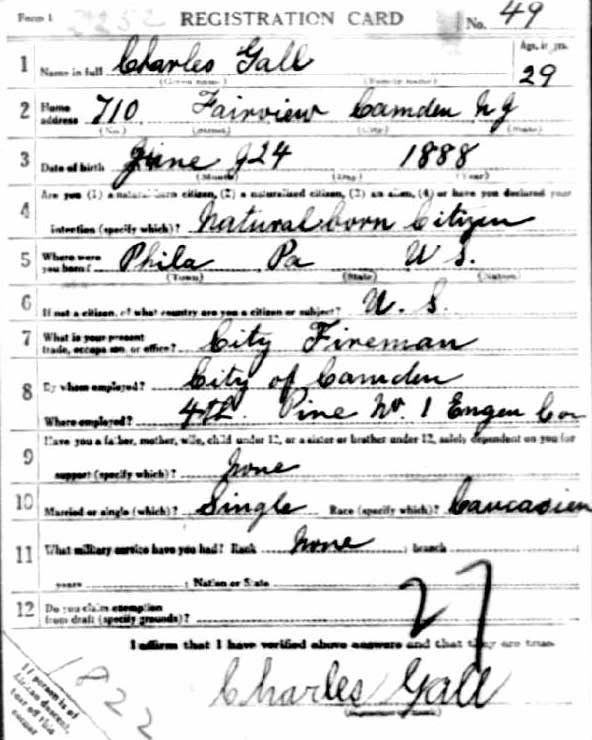
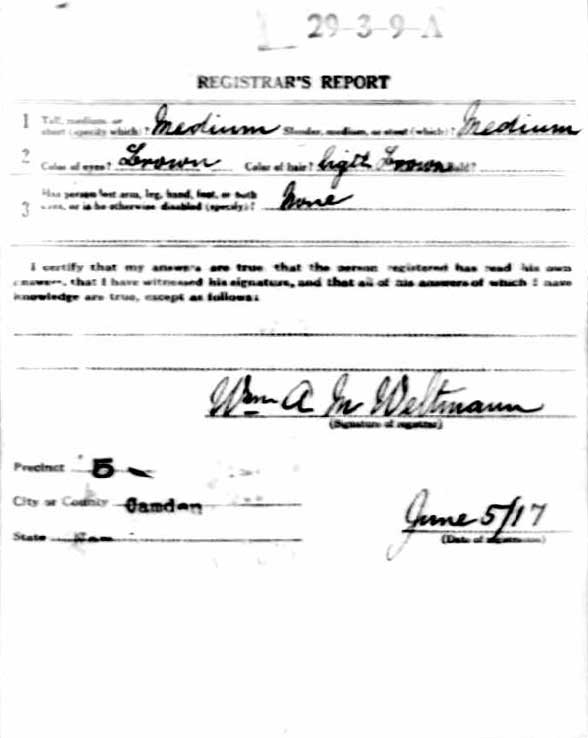
World War I Draft Card — Charles Gall
Many Transfers of City Firemen
Camden Daily Courier —
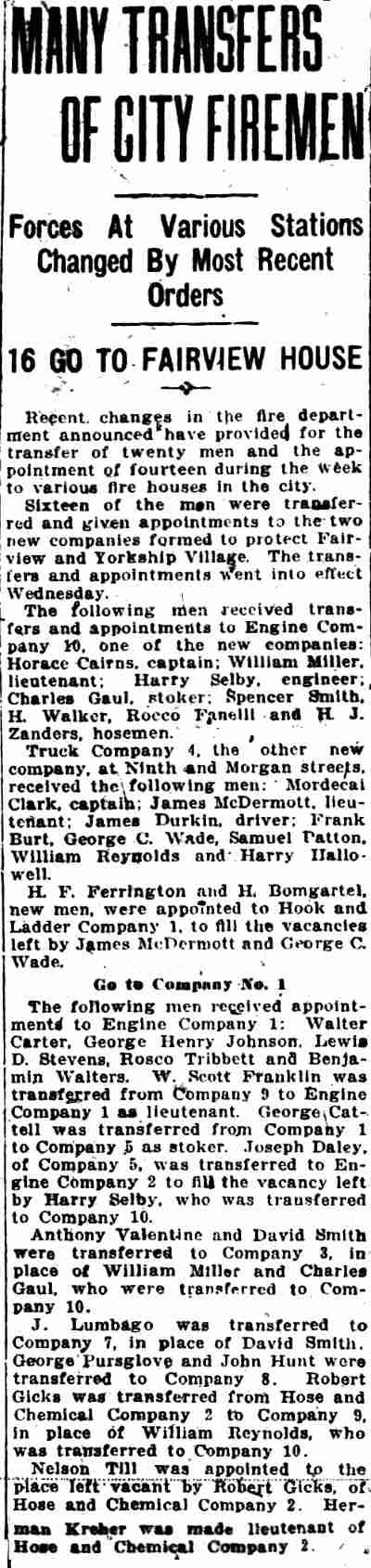
MANY TRANSFERS OF CITY FIREMEN
Forces At Various Stations Changed By Most Recent Orders
16 GO TO FAIRVIEW HOUSE
Recent changes in the fire department announced have provided for the transfer of twenty men and the appointment of fourteen during the week to various fire houses in the city.
Sixteen of the men were transferred and given appointments to the two new companies formed to protect Fairview and Yorkship Village. The transfers and appointments went into effect Wednesday.
The following men received transfers and appointments to Engine Company 10, one of the new companies: Horace Cairns, captain; William Miller, lieutenant; Harry Selby, engineer; Charles Gaul, stoker; Spencer Smith, H. Walker, Rocco Fanelli and H. J. Zanders, hosemen.
Truck Company 4, the other new company, at Ninth and Morgan streets, received the following men: Mordecai Clark, captain; James McDermott, lieutenant; James Durkin, driver; Frank Burt, George C. Wade, Samuel Patton, William Reynolds and Harry Hallowell.
H. F. Ferrington and H. Bomgartel, new men, were appointed to Hook and Ladder Company 1, to fill the vacancies left by James McDermott and George C. Wade.
Go to Company No. 1
The following men received appointments to Engine Company 1: Walter Carter, George Henry Johnson, Lewis D. Stevens, Rocco Tribbett and Benjamin Walters. W. Scott Franklin was transferred from Company 9 to Engine Company 1 as lieutenant. George Cattell was transferred from Company 1 to Company 5 as stoker. Joseph Daley, of Company 5, was transferred to Engine Company 2 to fill the vacancy left by Harry Selby, who was transferred to Company 10.
Anthony Valentine and David Smith were transferred to Company 3, in place of William Miller and Charles Gaul, who were transferred to Company 10.
J. Lumbago was transferred to Company 7, in place of David Smith. George Pursglove and John Hunt were transferred to Company 8. Robert Gicks was transferred from Hose and Chemical Company 2 to Company 9, in place of William Reynolds, who was transferred to Company 10.
Nelson Till was appointed to the place left vacant by Robert Gicks, of Hose and Chemical Company 2. Herman Kreher was made lieutenant of Hose and Chemical Company 2.
No. 10 Engine Company Stag Party
Camden Post-Telegram —
Captain Clark, Lieutenant Miller, Chas. Gaul, Howard Walker, Harry Hallowell, Hugh Rementa, Thomas Clark, James Derken, Al Haley, Adolph Gaul and George Wade, all of No. 10 Engine Company, were among those present at a stag party held last night on the farm of Norris Black at Harrisonville. A chicken dinner and a watermelon party were the features. An orchestra furnished music.
50 Volunteer Firemen Complete Training for Emergency Duties
Camden Courier-Post —
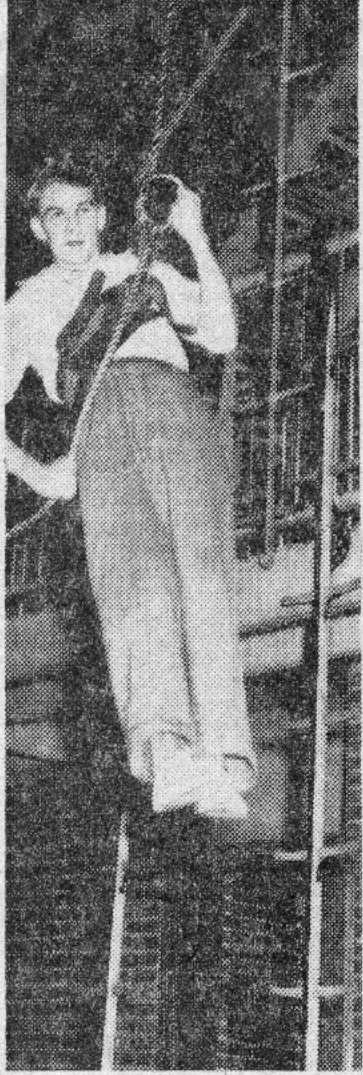
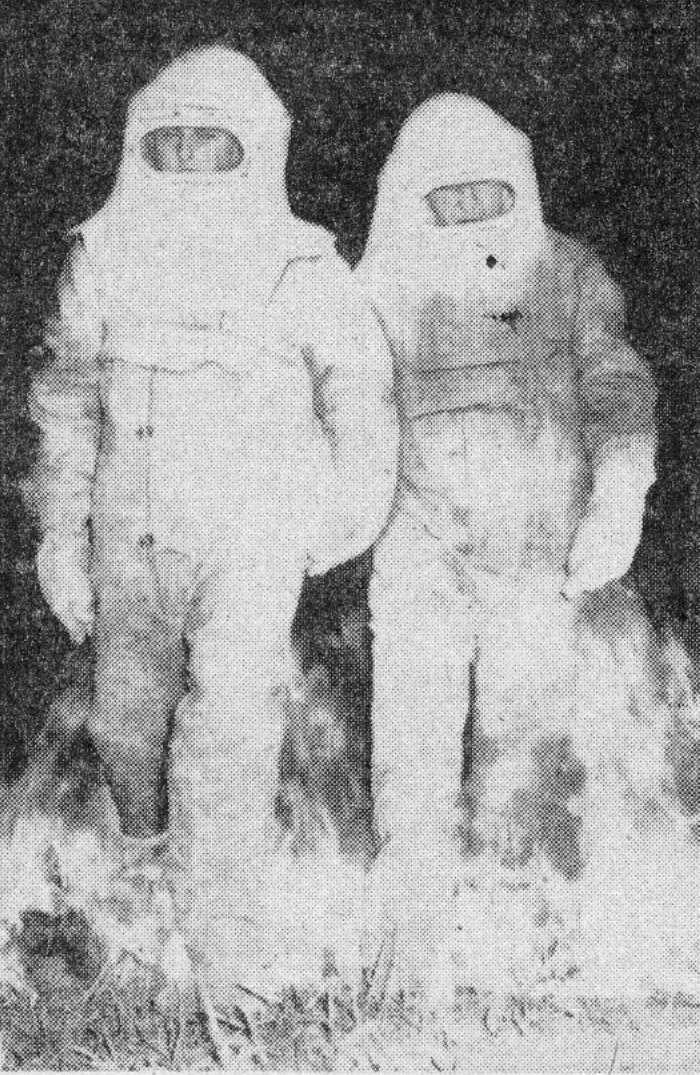
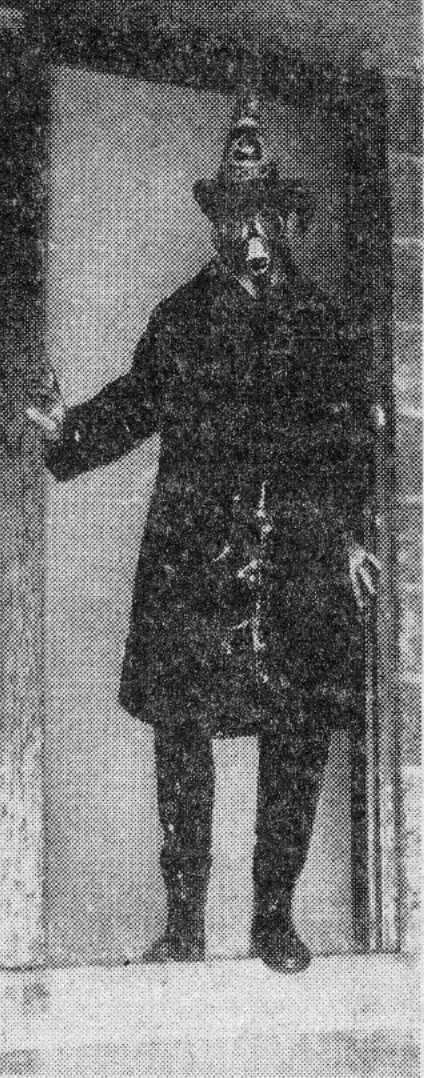
Graduates First of 500 to Be Trained by City for Huge Reserve. Similar to that in London; Defense Officials Praise Work
Camden’s first group of war and emergency volunteer firemen received their “diplomas” last night on completion of their training at the fire school in no. 10 firehouse, Ninth street and Morgan boulevard.
They are the initial volunteers to be trained as a reserve for the city fire department in an emergency. The volunteers, 50 of them, will be on 24-hour call. Eventually more than 500 men are expected to receive the training course for a huge reserve similar to the corps of firemen now being used in London.
The men range in ages from 11 to 59 years with Charles Smith, son of Sgt. Ray Smith, being the youngest, and Harry L. Freidel, the oldest.
The training course started May 12 and the trainees have attended three sessions a week, Monday, Wednesday and Friday nights, for seven weeks under the direction of Fire Captain Raymond Smith, no relation to the sergeant, who is director of the training school. Smith is a graduate of Class 56, of the Philadelphia Fire Training School.
Each volunteer fireman will be issued an identification card which will hold his fingerprints.
Class Praised
Among those congratulating the graduates were Herbert E. Harper, chairman of the Camden Defense Council; William C. Schriver, council member; Fire Chief John Lennox and Captain Smith. Howard Odrain, deputy chief of the Philadelphia Fire Department with 31 years of experience in fighting fires, attended as an observer.
“In behalf of the Camden City Defense Council, I want to thank you men for the hours and days you have put into taking this course,” Harper told the graduates.
“You have been prompt in attendance and have been attentive. We don’t anticipate any air raids or any acts of war-invasion, but we have an important problem in enabling national defense Industries in Camden city to make load in their Jobs.
“The sabotage committee of the defense council has been visiting the local Industries encouraging the plants to set up their own fire fighting squads and many are doing so. You men will be needed in times of an emergency to aid these forces and to assist at industries where there is no fire fighting squads.”
Chief Lennox termed the volunteers “our second line of defense” and thanked them for their cooperation.
Training Complete
The course included training in all phases of fire-fighting from operating pumpers to climbing ladders and combating incendiaries. Rescue work also was included. The use of gas masks and asbestos suits in chemical fires, how to approach delayed bombs with snubbers and the proper methods of using extinguishers were taught. A demonstration was held outside the firehouse by the volunteers. Their activities included scaling ladders, using gas masks to enter a smoke house, climbing and working on the top of the fire tower, using an aerial truck, tying tools for the lifting to tools, working on the end of water lines, working on pumpers, hooking up to stand pipes, jumping into life nets, tying life ropes and using asbestos suits through flaming gasoline and oil.
The Class
The graduates included: George D. Wilkinson, fire marshal of the RCA Manufacturing Company, and his two sons, Ernest and George; Garfield Watson, sergeant of police at New York Shipbuilding Corporation; Lieut. George Hamilton, Jr., of the 157th Field Artillery; Captain William Hare, of the Kaighn Avenue-South Street Ferry.
Harry B. Thompson, Earl Denby, Lester W. Giberson, Norman P. Maull, Joseph Leone, Samuel Schuele, George P. Smith, Joseph Marchese, Nicholas A. Messaro, Willam S. Martz, William E. Doan, Elwood P. Martz, Jr., Clyde Getzinger, George W. Grove, Stephen Kirby, James W. McCracken, William Watkin, Manuel Weiss, Riccardo DiGiacomo, Louis Cimini, William P. Walter, Sigmund Yakaski, Nicholas Iacovelli, Robert Holmes, Walter D. Lohrman.
Myer J. Mutter, Charles Geitz, Charles A. B. Smith, Howard Doerschner, Harry L. Freidel, Franklin L. Wright, Paul W. Kessler, Warren I. Carter, Creston Polland, Edward E. Friant, Frank F. Shropshire, Charles Gall, Albert E. Pine, Nicholas Cerasoli, George W. Williams, Joseph G. Foster, Joseph Elliott, George Hance and Irving L. Stiefel.
World War II Draft Card
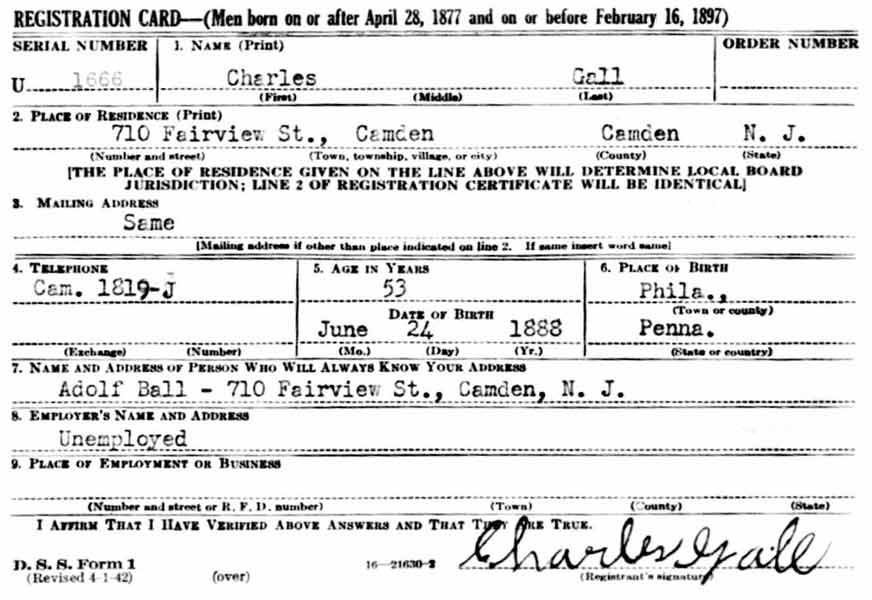
World War II Draft Card — Charles Gall