William P. Reynolds
WILLIAM REYNOLDS was born in Camden, New Jersey on August 31, 1883 to Charles G. and his wife, the former Anna M. Thomas. He was one of nine children, seven of whom were living when the census was taken in 1900 and in 1910. The family was living at the time of both census at 324 Washington Street in South Camden. William P. Reynolds was then working as a clerk at a wholesale grocery.
By the time the 1914 Camden City Directory was compiled, Charles G. Reynolds had passed away. Anna Reynolds and her sons had moved to 907 Penn Street in North Camden. She remarried shortly afterwards.
William P. Reynolds was living with his mother and her second husband, George Wilcox, at 327 Lansdowne Avenue in South Camden and working as a teamster at the New York Shipbuilding Corporation shipyard when he registered for the draft on September 12, 1918.
William Reynolds was appointed to the Camden Fire Department on October 1, 1919. By 1922 he had been assigned to Ladder Company 2, quartered at 619 Kaighn Avenue in South Camden, where he served for the balance of his career with the Department.
William Reynolds lived with his mother and stepfather into the late 1920s. The 1924 Directory shows them at 327 Lansdowne Avenue. The 1927 and 1929 Camden City Directories both show that he lived at 1157 North 36th Street in Cramer Hill. By April of 1930 William Reynolds had married, and he was not living with mother and stepfather when the census was taken in April of 1930.
Fire Department records from 1931 show William Reynolds living at 2901 Pleasant Street in East Camden. By the end of 1939 he and wife Adele had moved to 1155 Lois Avenue in Cramer Hill.
William Reynolds was admitted to West Jersey Hospital on January 4, 1941 for a stomach disorder. William Reynolds passed away on March 23, 1941 and was buried at Arlington Cemetery in Pennsauken, New Jersey. He was survived by his mother, a sister, and his wife. There were no children.
World War I Draft Card
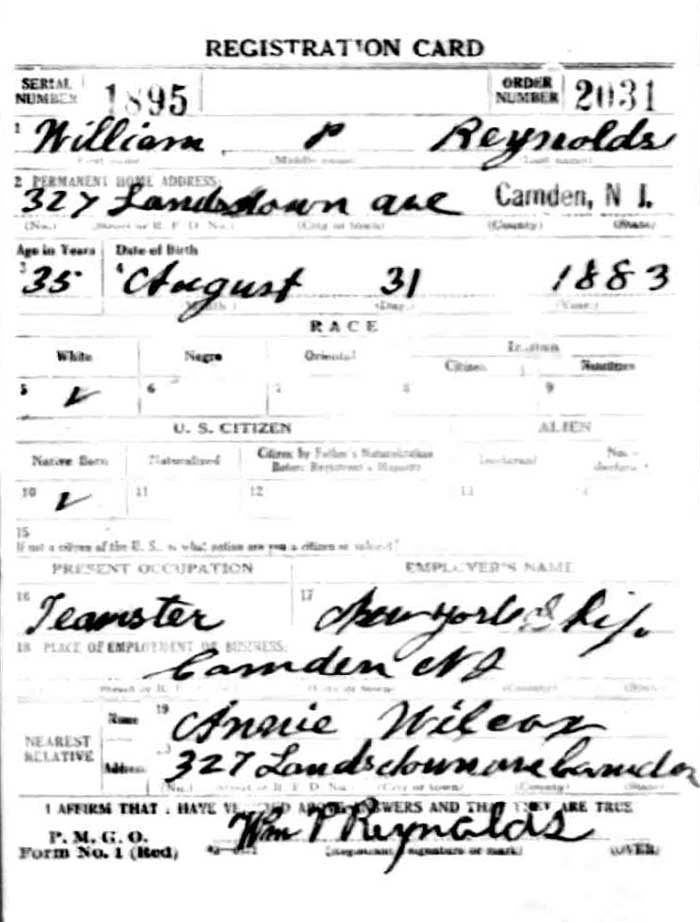
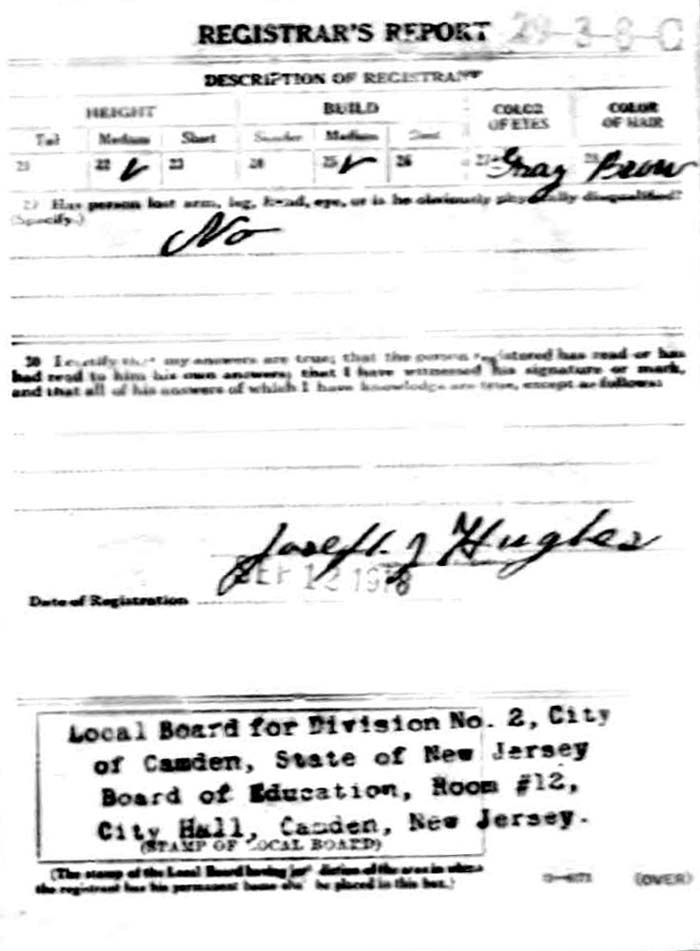
World War I Draft Registration Card — William P. Reynolds, registered September 12, 1918
Many Transfers of City Firemen
Camden Daily Courier —
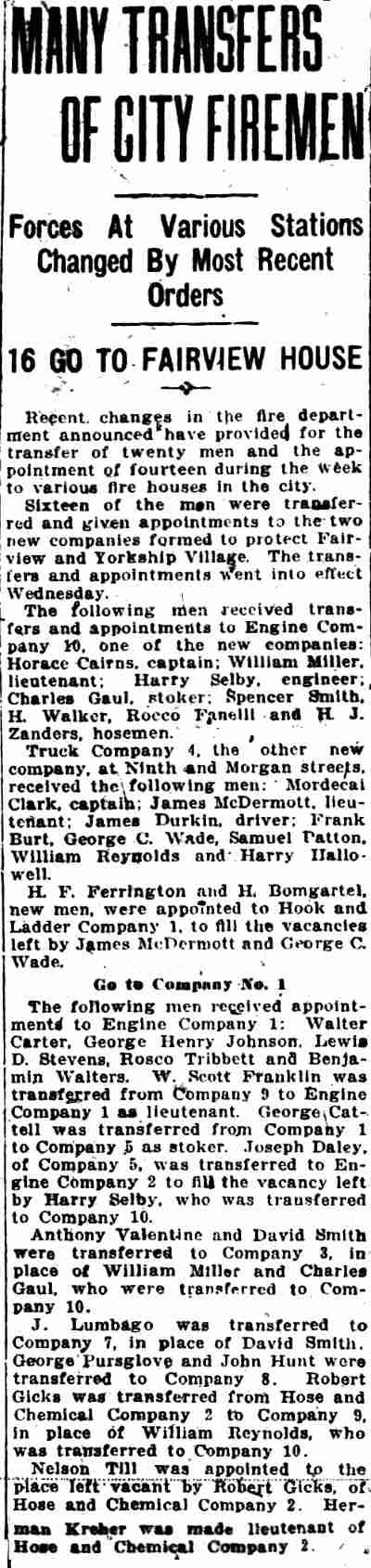
Forces At Various Stations Changed By Most Recent Orders
16 GO TO FAIRVIEW HOUSE
Recent changes in the fire department announced have provided for the transfer of twenty men and the appointment of fourteen during the week to various fire houses in the city.
Sixteen of the men were transferred and given appointments to the two new companies formed to protect Fairview and Yorkship Village. The transfers and appointments went into effect Wednesday.
The following men received transfers and appointments to Engine Company 10, one of the new companies: Horace Cairns, captain; William Miller, lieutenant; Harry Selby, engineer; Charles Gaul, stoker; Spencer Smith, H. Walker, Rocco Fanelli and H. J. Zanders, hosemen.
Truck Company 4, the other new company, at Ninth and Morgan streets, received the following men: Mordecai Clark, captain; James McDermott, lieutenant; James Durkin, driver; Frank Burt, George C. Wade, Samuel Patton, William Reynolds and Harry Hallowell.
H. F. Ferrington and H. Bomgartel, new men, were appointed to Hook and Ladder Company 1, to fill the vacancies left by James McDermott and George C. Wade.
Go to Company No. 1
The following men received appointments to Engine Company 1: Walter Carter, George Henry Johnson, Lewis D. Stevens, Rocco Tribbett and Benjamin Walters. W. Scott Franklin was transferred from Company 9 to Engine Company 1 as lieutenant. George Cattell was transferred from Company 1 to Company 5 as stoker. Joseph Daley, of Company 5, was transferred to Engine Company 2 to fill the vacancy left by Harry Selby, who was transferred to Company 10.
Anthony Valentine and David Smith were transferred to Company 3, in place of William Miller and Charles Gaul, who were transferred to Company 10.
J. Lumbago was transferred to Company 7, in place of David Smith. George Pursglove and John Hunt were transferred to Company 8. Robert Gicks was transferred from Hose and Chemical Company 2 to Company 9, in place of William Reynolds, who was transferred to Company 10.
Nelson Till was appointed to the place left vacant by Robert Gicks, of Hose and Chemical Company 2. Herman Kreher was made lieutenant of Hose and Chemical Company 2.
Firemen on Vacation
Camden Post-Telegram —

Thomas Clark, Bill Reynolds and Fireman Zanders, all of No. 10 Engine Company, are on a two-weeks’ vacation.
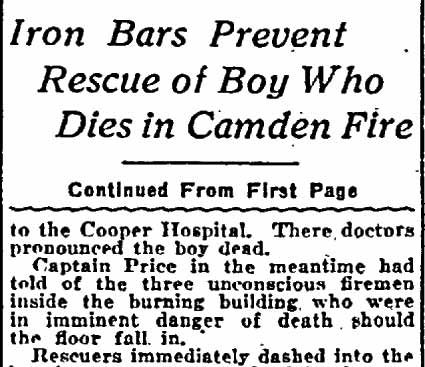
Iron Bars Prevent Rescue of Boy Who Dies in Camden Fire
Philadelphia Inquirer —
Six Firemen Injured in Heroic Attempts to Save Little Victim
Doomed Lad Stares Piteously Out Windows as House Is Blazing Furnace
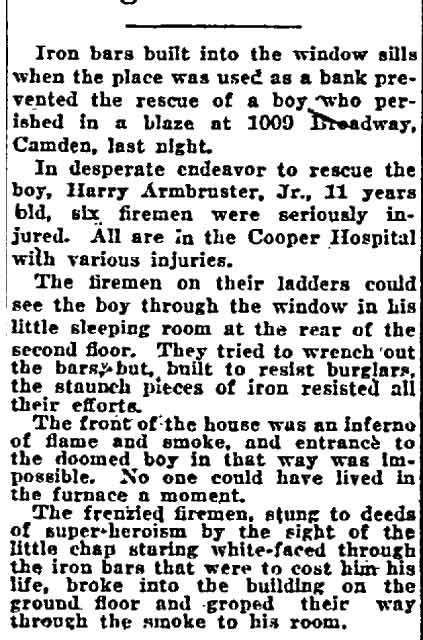
Iron bars built into the window sills when the place was used as a bank prevented the rescue of a boy who perished in a blaze at 1009 Broadway, Camden, last night.
In desperate endeavor to rescue the boy, Harry Armbruster, Jr., 11 years old, six firemen were seriously injured. All are in the Cooper Hospital with various injuries.
The firemen on their ladders could see the boy through the window in his little sleeping room at the rear of the second floor. They tried to wrench out the bars, but, built to resist burglars, the staunch pieces of iron resisted all their efforts.
The front of the house was an inferno of flame and smoke, and entrance to the doomed boy in that way was impossible. No one could have lived in the furnace a moment.
The frenzied firemen, stung to deeds of super-heroism by the sight of the little chap staring white-faced through the iron bars that were to cost him his life, broke into the building on the ground floor and groped their way through the smoke to his room.
Help Comes Too Late
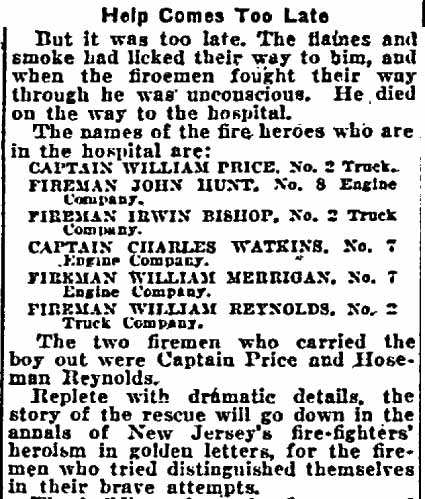
But it was too late. The flames and smoke had licked their way to him, and when the firemen fought their way through he was unconscious. He died on the way to the hospital.
The names of the fire heroes who are in the hospital are:
CAPTAIN WILLIAM PRICE, No. 2 Truck.
FIREMAN JOHN HUNT, No. 8 Engine Company.
FIREMAN IRWIN BISHOP, No. 2 Truck Company.
CAPTAIN CHARLES WATKINS, No. 7 Engine Company.
FIREMAN WILLIAM MERRIGAN, No. 7 Engine Company.
FIREMAN WILLIAM REYNOLDS, No. 2 Truck Company.
The two firemen who carried the boy out were Captain Price and Hoseman Reynolds.
Replete with dramatic details, the story of the rescue will go down in the annals of New Jersey’s fire-fighters’ heroism in golden letters, for the firemen who tried distinguished themselves in their brave attempts.
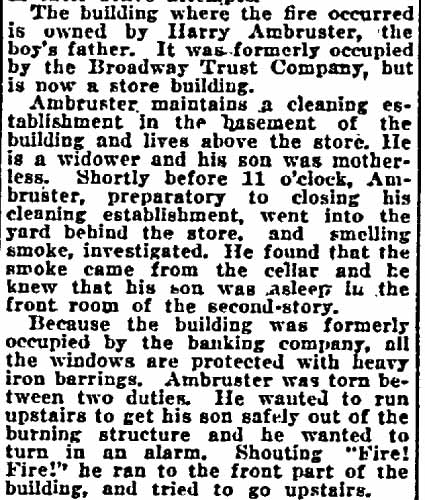
The building where the fire occurred is owned by Harry Ambruster, the boy’s father. It was formerly occupied by the Broadway Trust Company, but is now a store building.
Ambruster maintains a cleaning establishment in the basement of the building and lives above the store. He is a widower and his son was motherless. Shortly before 11 o’clock, Ambruster, preparatory to closing his cleaning establishment, went into the yard behind the store, and smelling smoke, investigated. He found that the smoke came from the cellar and he knew that his son was asleep in the front room of the second-story.
Because the building was formerly occupied by the banking company, all the windows are protected with heavy iron barrings. Ambruster was torn between two duties. He wanted to run upstairs to get his son safely out of the burning structure and he wanted to turn in an alarm. Shouting “Fire! Fire!” he ran to the front part of the building, and tried to go upstairs.
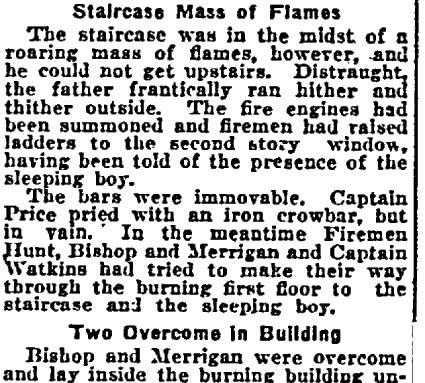
Staircase Mass of Flames
The staircase was in the midst of a roaring mass of flames, however, and he could not get upstairs. Distraught, the father frantically ran hither and thither outside. The fire engines had been summoned and firemen had raised ladders to the second story window, having been told of the presence of the sleeping boy.
The bars were immovable. Captain Price pried with an iron crowbar, but in vain. In the meantime Firemen Hunt, Bishop and Merrigan and Captain Watkins had tried to make their way through the burning first floor to the staircase and the sleeping boy.
Two Overcome in Building
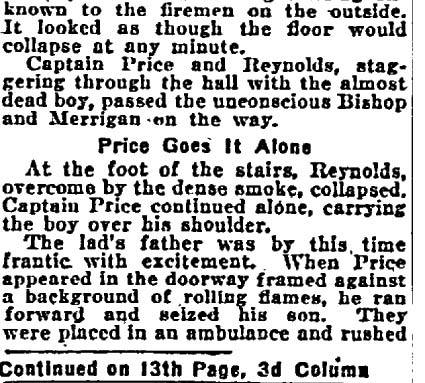
Bishop and Merrigan were overcome and lay inside the burning building unknown to the firemen on the outside. It looked as though the floor would collapse at any minute.
Captain Price and Reynolds, staggering through the hall with the almost dead boy, passed the unconscious Bishop and Merrigan on the way.
Price Goes It Alone
At the foot of the stairs, Reynolds, overcome by the dense smoke, collapsed. Captain Price continued alone, carrying the boy over his shoulder.
The lad’s father was by this time frantic with excitement. When Price appeared in the doorway framed against a background of rolling flames, he ran forward and seized his son. They were placed in an ambulance and rushed to the Cooper Hospital. There doctors pronounced the boy dead.
Captain Price in the meantime had told of the three unconscious firemen inside the burning building who were in imminent danger of death should the floor fall in.
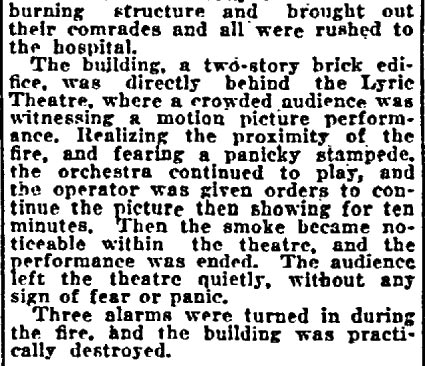
Rescuers immediately dashed into the burning structure and brought out their comrades and all were rushed to the hospital.
The building, a two-story brick edifice, was directly behind the Lyric Theatre, where a crowded audience was witnessing a motion picture performance. Realizing the proximity of the fire, and fearing a panicky stampede, the orchestra continued to play, and the operator was given orders to continue the picture then showing for ten minutes. Then the smoke became noticeable within the theatre, and the performance was ended. The audience left the theatre quietly, without any sign of fear or panic.
Three alarms were turned in during the fire, and the building was practically destroyed.
W.P. Reynolds Dies, Camden Fireman
Camden Courier-Post —
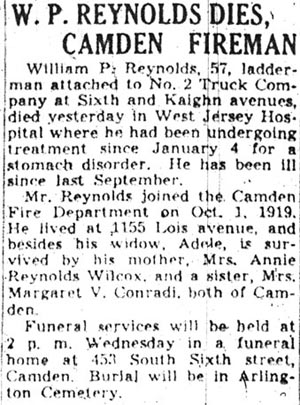
William P. Reynolds, 57, ladderman attached to No. 2 Truck Company at Sixth and Kaighn avenues, died yesterday in West Jersey Hospital where he had been undergoing treatment since January 4 for a stomach disorder. He has been ill since last September.
Mr. Reynolds joined the Camden Fire Department on Oct. 1, 1919. He lived at 1155 Lois avenue, and besides his widow, Adele, is survived by his mother, Mrs. Annie Reynolds Wilcox, and a sister, Mrs. Margaret V. Conradi, both of Camden.
Funeral services will be held at 2 p. m. Wednesday in a funeral home at 453 South Sixth street, Camden. Burial will be in Arlington Cemetery.