Introduction
Adam Kolb Sr. was born in Berlin, Germany in 1812. By the mid 1840s he had wed, his wife Mary Magdalena being 16 years his junior. They were living in Pennsylvania when son Adam Jr. was born in 1846. The 1860 Census shows the Kolb family living near Chews Landing in what was then Waterford Township, New Jersey. The census states that Adam Sr. was working as a tailor.
Both Adam Sr. and his son Adam Jr. enlisted during the Civil War on the same day, October 14, 1862, and served together in the same unit, Battery M, 3rd Pennsylvania Artillery. They both mustered out on October 14, 1865.
After the war Adam Kolb Sr. and Adam Kolb Jr. returned to New Jersey, reuniting with their wife and mother. The family came to Camden, and by 1870 Adam Sr. was the proprietor of a bar at 302 Spruce Street. Adam Jr. lived at home, working as a laborer. Sadly, Adam Kolb Jr. passed away in 1872.
Adam Kolb Sr. died between April 5, 1877, when his will was dated, and April 23, 1877, when a document states that his wife “Mary Magdalena Kolb” is now executor of the deceased Adam Kolb’s estate. He was buried with his son in lot #466 of Old Camden Cemetery. Adam’s April 5th will left his money and “real estate” to his wife Mary Magdalena Kolb for the remainder of her natural life. Upon her death, half was to go to the Trinity German Lutheran Church in Camden and half to the Children’s Home in Germantown. Mary Magdalena could not write and signed with her mark.
By 1880 the bar at 302 Spruce Street was no longer being run by the Kolb family, although Mary Magdalena may still have held title to the property.
Mary Magdalena Kolb remarried on August 29, 1878. Her second husband, John Daniel Hahn, is listed in Chew’s 1878–1879 Camden City Directory as a hostler, residing at 21 North 4th Street. The 1878–1879 Directory shows John Hahn at 1159 Sycamore Street. The 1881–1882 Directory shows John Hahn as a saloonkeeper at 120 Market Street, a bar which had been run by a Lewis Linkenhiel when the 1880 Census was enumerated.
Subsequent entries in the City Directories are quite interesting, and point to a conclusion that Mary Magdalena Kolb and her second husband may have parted ways. The Howe’s Camden Directory of 1885–1888 lists “Kolb, Mary, widow of Adam, home 1159 Sycamore.” Howe’s Camden Directory of 1884–85 has a listing for “Hahn, Daniel, home 618 N. Front.” This indicated that John Daniel Hahn is living with his married daughter Christina Dellmuth, whose husband, Henry Dellmuth, owned a bakery.
John Daniel Hahn died on February 11, 1886 in Philadelphia at the house of another daughter. According to the Camden Lutheran Church record, he left his widow, Mary Hahn, exactly $1 in his will. He was buried at Old Camden Cemetery.
Mary Magdalena Kolb Hahn died in June of 1889 and was buried at Old Camden Cemetery on June 27, 1889. Howe’s Camden Directory for 1889, in its commercial listings for Meat Markets, reads “Kolb, Mary, 133 Kaighn Avenue.”
Regimental History
The Union Army, vol. 1
Pennsylvania One Hundred and Fifty-Second Infantry (Third Heavy Artillery)
Third Artillery.—Col., Joseph Roberts; Lieut.-Col., R. V. W. Howard; Majs., John A. Darling, J. S. Stevenson, F. Von Schilling, John A. Blake.
This regiment, the 152nd of the line, was recruited from the state at large, rendezvoused at Philadelphia, and was mustered into the U.S. service at various periods during the latter part of the year 1862 and the early part of 1863. Cos. A and B had been organized as a battalion of marine artillery in 1861 by Hermann Segebarth, and garrisoned Fort Delaware. Late in the summer of 1862, authority was given Col. Segebarth to increase this battalion to a full regiment of heavy artillery and batteries D, F, G and H were recruited during the fall and winter and mustered in for three years. In Sept., 1862, Maj. Roberts, of the 4th regular artillery, was authorized by the war department to raise a picked battalion of artillery for service at Fortress Monroe and as fast as the companies were organized and mustered in they were sent to that point, where they were drilled in infantry, light and heavy artillery tactics.
In the spring of 1863, by order of the war department, the commands of Segebarth and Roberts were consolidated to form the 3rd Pa. heavy artillery. Co. H, Capt. William D. Rank, was detached for garrison duty in the defenses of Baltimore, where it remained throughout its term of service with a single exception, when a section was ordered to the front during the battle of Gettysburg and served as light artillery in McIntosh’s brigade, 2nd cavalry division, losing 2 killed, 10 wounded and 1 missing. The headquarters of the regiment were at Fortress Monroe and from this point detachments were sent out, both by land and sea, to serve in any arm of the service and wherever troops were needed. During the invasion of Eastern Virginia by Longstreet’s corps, in the spring of 1863, Cos. A, B, F and G served in the defenses of Suffolk throughout the siege. Every company except H furnished detachments for service at the front in the campaigns of 1864–65, and they were engaged on the James, Chickahominy and Nansemond rivers in numerous battles, as well as in the capture of Fort Fisher.
In the engagement at Smithfield, Va., in Feb., 1864, detachments from Cos. A and B, serving on the army gunboats, suffered a loss of 38 captured, many of whom afterwards died at Andersonville. A detachment of Co. A, serving on the gunboat Bombshell, at Plymouth, N.C., in April, 1864, lost 27 captured when the boat was sunk. During most of its term of service Co. I performed guard duty at the headquarters of the Army of the James and was present at the surrender of Lee. As its numbers exceeded the requirements of the army regulations, many of the original members volunteered to form the 188th Pennsylvania Infantry in connection with a number of unassigned recruits, though new recruits were added to the 152nd and its ranks were still more than full. Cos. D, E, G and M served with the Army of the James before Petersburg, being stationed at Bermuda Hundred; Co. E, with others, under command of Capt. Hazard, was posted at Fort Converse, covering the pontoon bridge across the Appomattox. Many details were furnished for work on the fortifications and for duty in the various arms of the service.
After the close of hostilities, detachments of the 152nd served as guard for Jefferson Davis during his confinement in Fortress Monroe. Sixteen men of Co. F were lost on March 31, 1865, while returning to Fortress Monroe from Wilmington, N.C., on account of the destruction by fire of the transport General Lyon. From the foregoing sketch it will be noted that, though this command was originally organized for special duty at Fortress Monroe, it performed a large amount of duty at the front, both by land and sea. By reason of its excellent training in every branch of the service, it was enabled to furnish details when called upon for every branch of the artillery service, as well as in the infantry and naval arms. The regiment was mustered out as follows: Cos. A and B, at Fortress Monroe, Va., July 11, 1865; Co. H, at Baltimore, Md., July 25, 1865; the remaining companies, at Fortress Monroe, Va., Nov. 9, 1865.
Battles Fought
- 16 Oct 1863
- 1 Feb 1864 at Smithfield, VA
- 16 Feb 1864 at Smithfield, VA
- 15 Apr 1864 at Norfolk, VA
- 17 Apr 1864 at Plymouth, NC
- 20 Apr 1864
- 9 May 1864 on Gunboat “Brewster”
- 14 May 1864
- 18 May 1864
- 5 Jun 1864 at Gaines Farm, VA
- 22 Jul 1864 at James River, VA
- 29 Jul 1864 at Petersburg, VA
- 8 Nov 1864 at Petersburg, VA
- 13 Dec 1864
- 17 Dec 1864
- 23 May 1865
Photos
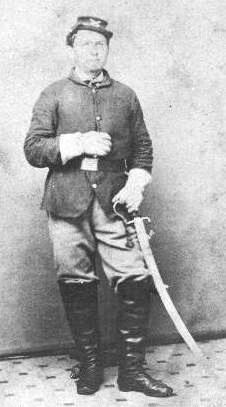
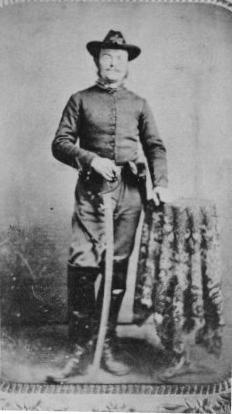
The younger man with the round face and the artillery cap “could be” Adam Kolb Jr. The second photo could be Adam Sr. “I got these photos in 2001. He does look like he could be 44.” —Susan Biedron, May 2008