John H. Andrus
JOHN HEWITT ANDRUS was born in Pennsylvania on October 7, 1869 to Seth and Emeline Andrus. The family moved to New York State in the 1890s. During the Spanish-American War John H. Andrus served with the Third New York Volunteer Infantry. After mustering out he reenlisted in the regular Army in May of 1899 and in time was posted to Havana, Cuba. While in Cuba John H. Andrus assisted Dr. Walter Reed in discovering the cause of yellow fever by voluntarily allowing himself to be infected with the disease in 1901. He undertook a long convalescence, and was discharged from the Army in 1902.
John Andrus’ parents and siblings were living in Southport, New York when the Census was taken in 1900. After leaving the Army in 1902, John H. Andrus came to Camden, New Jersey. His parents brought the rest of the family to Camden by 1906. The City Directory for that year shows them at 337 Warren Avenue. The 1910 Census shows Seth Andrus had passed away. His widowed mother, sons Chester, Tracy and Vernon, and sisters Ethel and Mary, were then living at 812 Birch Street.
John H. Andrus married Anna Logue around 1905. Her father, David Logue, was a turnkey at the Camden County jail, and was promoted to warden the following year. The 1906 City Directory shows John H. Andrus living at 722 Grant Street. A son, David L. Andrus, was born in Camden, New Jersey in 1906. The 1910 Census and the 1914 Directory has the John H. Andrus family living with David Logue and family at 825 Penn Street. By the summer of 1918 they had moved to the next block, taking up residence at 925 Penn Street, which remained the family home into the 1930s.
John Andrus was involved in a number of patriotic organizations. In 1917, with America involved in World War I, John Andrus returned to service as an officer of the Camden Battalion of the Home Guard.
After America entered the war and the Eddystone plant was evidently destroyed by incendiaries with such terrible loss of life, the Government deemed it necessary that each community provide its own protection, so Home Guards were organized subject to the call of the mayor of the community in which these units were formed. When the organization call came hundreds of men volunteered, many of them as old as sixty-five years.
Camden set apart April 17, 1917, as registration day. Sheriff Joshua C. Haines was chairman of the Home Guards Committee of the Public Safety Committee and perfected an organization for the registration. In Camden 2,040 men enrolled in the thirteen wards and several companies were organized. Gloucester City, Haddon Heights, Westmont and Haddonfield formed companies while Merchantville formed a battalion.
The companies drilled with broom sticks at first. Then riot clubs were secured. Merchantville and Haddon Heights furnished arms for their companies by popular subscription. The guards sought recognition from the State and permission to drill in armories, which was granted about six months later. In the fall of 1917 the guards became known as the State Militia Reserve. They were not liable to duty outside of the community in which they were organized but could volunteer their services to the State in case of necessity.
In Camden, companies were organized in every ward in the city. In fact there were two companies in some wards, but the slowness of the State department in equipping the men caused them to lose heart after they drilled on the hot streets with broom sticks during the summer of 1917, and the companies gradually dwindled away until there were but enough men to make up four full companies throughout the city.
When the State finally recognized the Home Guard units Camden organized a battalion. The Camden Battalion was formally recognized and accepted by the State on November 17, 1917. The battalion was uniformed and equipped by the City of Camden. The first to command this body was Major Edward C. Austermuhl, who later resigned to enter the service of the Government. The board of officers then elected, and the Governor commissioned Captain John H. Andrus as major of the Camden Battalion.
Two hundred and seventy-seven officers and men comprised the command of Major Andrus with headquarters in the Third Regiment Armory. The battalion took part in each of the Liberty Loan campaigns and in the drives conducted by the Red Cross, Knights of Columbus, Young Men’s Christian Association, et al. During the influenza epidemic an Emergency Hospital was established at the Armory of Battery “B,” in charge of a committee from City Council. Unable to employ sufficient help, Mayor Ellis called on the State Militia Reserve. While the hospital was in service one hundred and ten men of the Battalion were on duty twelve hours each and performed every task assigned them most willingly. Aside from their hospital duties, men of the Battalion were at various times assigned to go to private homes to assist the nurses in restraining delirious patients.
On May 1, 1919, when anarchist and Bolshevist sympathizers had prepared a May Day celebration against organized government, Mayor Charles Ellis called two companies of the Battalion to Third Regiment Armory where they were held in reserve to aid the Police Department should the situation become alarming. Their services were not needed, however, during the day.
On September 17, 1919 Mayor Ellis called upon Major Andrus and the Home Guard to provide security for the street car conductors and motormen after a highly unpopular zone fare system was introduced.
John H. Andrus worked for many years for the R.M. Hollingshed Corporation in Camden as a purchasing agent. This firm, which manufactured the Whiz line of automotive chemicals, may be best remembered for the disastrous fire that destroyed its factory at North 9th Street and Market Street in 1940.
In February of 1929 by an Act of Congress John H. Andrus was awarded the Walter Reed Medal for his work in fighting yellow fever.
Son David L. Andrus graduated from Camden High School in 1925 and went on to become a doctor, practicing in Camden for many years. In the 1930s Dr. Andrus set up residence and practice at 805 Cooper Street. John Hewitt Andrus moved from Penn Street to 805 Cooper Street during the 1930s. He died of heart disease in Philadelphia on May 1, 1942.
John H. Andrus’ younger brother, Chester J. Andrus, served for many years with the Camden Fire Department.
Photos
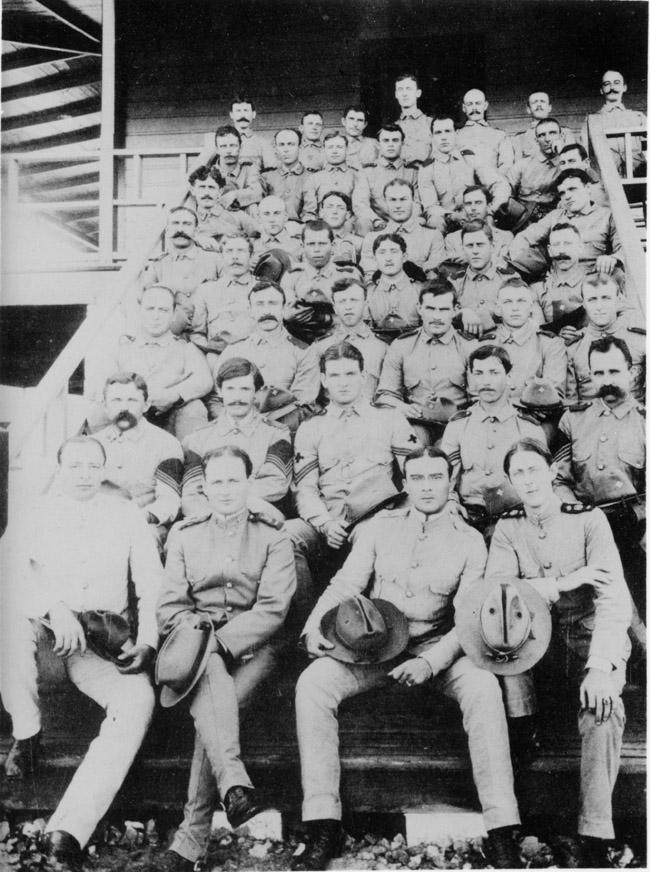
Yellow Fever Commission — The Detachment Hospital Corps, Columbia Barracks, Cuba. September 1900. Identified (L to R): Front row — Alvah S. Pinto, Lt. A.E. Truby (Commander of Detachment), Raoul Amador, Robert P. Cooke. Second row — Acting Hospital Steward (A.H.S.) Campbell, A.H.S. Pahnke, A.H.S. George Burton, A.H.S. Claude Cooke, A.H.S. Arnold. Third row — Pvt. John Morris, Pvt. Kneisley, Pvt. De Lamar, Pvt. Thomas Kane, Pvt. Braemer, Pvt. John Kissinger. Fourth row — Pvt. Lawrence, Pvt. William Olsen, Pvt. Samillion, Pvt. Carr, Pvt. Martin, Pvt. William McHardy. Fifth row — Pvt. Clyde L. West, Pvt. Harroldsen, Pvt. John Andrus, Pvt. Thomas England, Pvt. Tate, Pvt. Gustave Lambert. Sixth row — Pvt. Brent La Mar, Pvt. James Toler, Pvt. Thomas Brault, Pvt. Frank Buholtz, Pvt. James Byington, Pvt. William Williamson, Pvt. Young. Seventh row (top row) — Pvt. Charles Sontag, Pvt. John Colby, Pvt. Frank Dawley, Pvt. Courtney, Pvt. William Roberton, Pvt. Rutledge, Pvt. Springer. This detachment furnished most of the volunteers for the yellow fever experiment at Camp Lazear.
The Walter Reed Medal
The Walter Reed Medal is a military decoration of the United States Army which was created by an act of the United States Congress on February 28, 1929. The medal recognizes the accomplishments of both United States civilian and Army doctors who investigated the cause and treatment of yellow fever between 1901 and 1902.
The Walter Reed Medal, named for Major Walter Reed (1851 to 1902) was a one time only decoration which was retroactive by design. The award was intended to denote the accomplishments of a group of American medical personnel who had discovered that the cause of yellow fever was that of infection caused by the mosquito. As part of the so named “Yellow Fever Investigation,” twenty four Americans had exposed themselves to yellow fever in certain areas of Cuba between 1900 and 1901. The Walter Reed Medal recognized the bravery of both living in a disease infested area for the cause of science, and also the enormous significance of discovering the cause of yellow fever.
The original Walter Reed Medal was first bestowed upon the following Americans:
Aristides Agramonte • John H. Andrus • John R. Bullard • James Carroll • Robert P. Cooke • Albert W. Covington • William H. Dean • Thomas M. England • Levi E. Folk • Wallace W. Forbes • Paul Hamann • James L. Hanberry • James Hildebrand • Warren G. Jernegan • John R. Kissinger • Jesse William Lazear • John J. Moran • William Olsen • Walter Reed • Charles Sonntag • Edward Weaterwalks • Clyde L. West
Around the time 1957, the Medal had also been awarded to Gustaf E. Lambert and Roger Post Ames.
Surviving Walter Reed Medals appear as bronze medallions, upon which is the image of Walter Reed. Earlier versions of the medal depicted the figures of a man and a woman, with the woman holding a caduceus and the medal bearing the words “Conquest of Yellow Fever.” There are no known original Walter Reed Medals in existence with the later version being the only surviving examples.
While the Walter Reed Medal was an official United States Army award, the medal was never designed to be worn on a military uniform and did not appear on any military precedence charts nor are there any photographs of the medal being displayed on an active military uniform. A red ribbon for the medal did exist and was authorized for wear on civilian attire.
Letter from John H. Andrus to John J. Moran, January 14, 1937
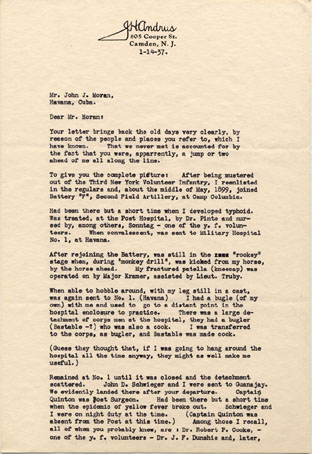
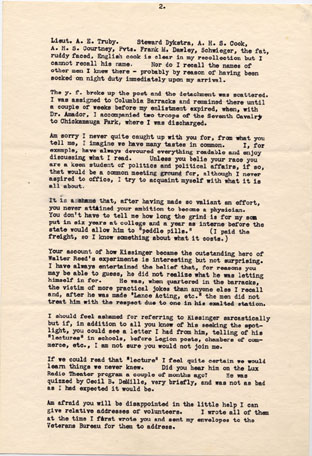
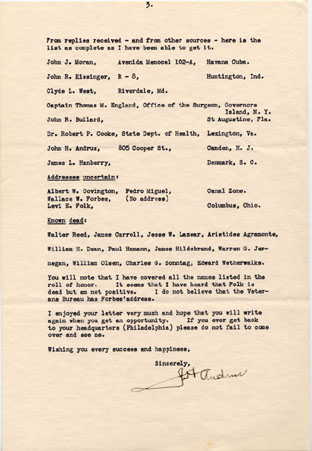
Letter from J. H. Andrus, 805 Cooper St., Camden, N.J. to Mr. John J. Moran, Havana, Cuba. January 14, 1937.
J. H. Andrus
805 Cooper St.
Camden, N. J.
1-14-37Mr. John J. Moran,
Havana, Cuba.Dear Mr. Moran:
Your letter brings back the old days very clearly, by reason of the people and places you refer to, which I have known. That we never met is accounted for by the fact that you were, apparently, a jump or two ahead of me all along the line.
To give you the complete picture: After being mustered out of the Third New York Volunteer Infantry, I reenlisted in the regulars and, about the middle of May, 1899, joined Battery “F,” Second Field Artillery, at Camp Columbia.
Had been there but a short time when I developed typhoid. Was treated, at the Post Hospital, by Dr. Pinto and nursed by, among others, Sonntag—one of the y. f. volunteers. When convalescent, was sent to Military Hospital No. 1, at Havana.
After rejoining the Battery, was still in the “rookey” stage when, during “monkey drill,” was kicked from my horse, by the horse ahead. My fractured patella (kneecap) was operated on by Major Kramer, assisted by Lieut. Truby.
When able to hobble around, with my leg still in a cast, was again sent to No. 1. (Havana.) I had a bugle (of my own) with me and used to go to a distant point in the hospital enclosure to practice. There was a large detachment of corps men at the hospital, they had a bugler (Bastable—?) who was also a cook. I was transferred to the corps, as bugler, and Bastable was made cook.
(Guess they thought that, if I was going to hang around the hospital all the time anyway, they might as well make me useful.)
Remained with the corps until discharged in August, 1902.
Am sure I was in Cuba longer than most. Started making inquiries regarding the yellow fever experiment about December, 1900. There was a member of the corps at the hospital, Harroldson (see photo), who had been a volunteer but was then hospitalized. He advised me to write to Dr. Pinto, which I did. Pinto referred the matter to Dr. Lazear, (who had already been a victim of his own experiment) and word came back that I was acceptable.
It may interest you to know that my yellow fever experiment was witnessed by a photographer, whose name I do not recall. I have been trying to locate such a photo for years but, so far, without success. The photographer was there, supposedly, to take pictures of “Camp Lazear” generally, and I happened to be “it” that day. A Dr. Amador—son, I believe, of General Amador—was the doctor in charge of me at the time.
I should feel ashamed for referring to Kissinger sarcastically but if, in addition to all you know of his seeking the spotlight, you could see a letter I had from him, telling of his “lectures” in schools, before Legion posts, chambers of commerce, etc., I am not sure you would not join me.
If we could read that “lecture” I feel quite certain we would learn things we never knew. Did you hear him on the Lux Radio Theater program a couple of months ago? He was quizzed by Cecil B. DeMille, very briefly, and was not as bad as I had expected it would be.
Am afraid you will be disappointed in the little help I can give relative addresses of volunteers. I wrote all of them at the time I first wrote you and sent my envelopes to the Veterans Bureau for them to address.
From replies received—and from other sources—here is the list as complete as I have been able to get it:
John J. Moran, Avenida Menocal 102-A, Havana Cuba.
John R. Kissinger, R–8, Huntington, Ind.
Clyde L. West, Riverdale, Md.
Captain Thomas M. England, Office of the Surgeon, Governors Island, N. Y.
John R. Bullard, St. Augustine, Fla.
Dr. Robert P. Cooke, State Dept. of Health, Lexington, Va.
John H. Andrus, 805 Cooper St., Camden, N. J.
James L. Hanberry, Denmark, S. C.Addresses uncertain:
Albert W. Covington, Pedro Miguel, Canal Zone.
Wallace W. Forbes, (No address).
Levi E. Folk, Columbus, Ohio.Known dead: Walter Reed, James Carroll, Jesse W. Lazear, Aristides Agramonte, William H. Dean, Paul Hamann, James Hildebrand, Warren G. Jernegan, William Olsen, Charles G. Sonntag, Edward Wetherwalks.
You will note that I have covered all the names listed in the roll of honor. It seems that I have heard that Folk is dead but am not positive. I do not believe that the Veterans Bureau has Forbes’ address.
I enjoyed your letter very much and hope that you will write again when you get an opportunity. If you ever get back to your headquarters (Philadelphia) please do not fail to come over and see me.
Wishing you every success and happiness,
Sincerely,
J H Andrus
Service Records
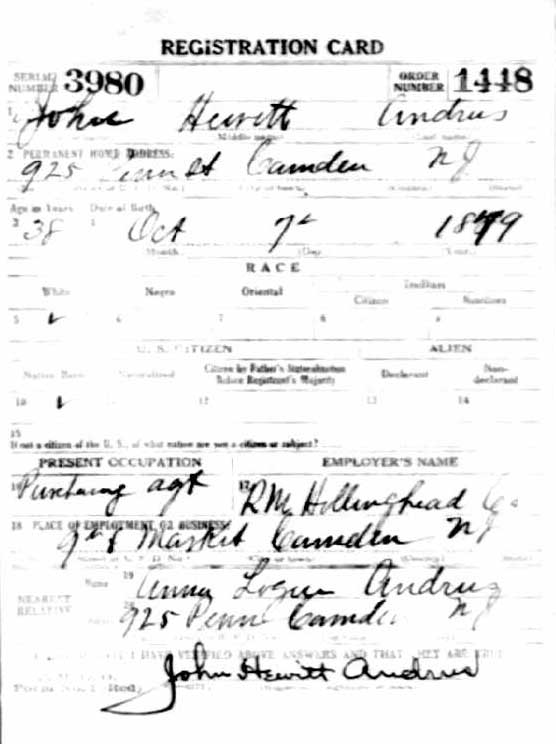
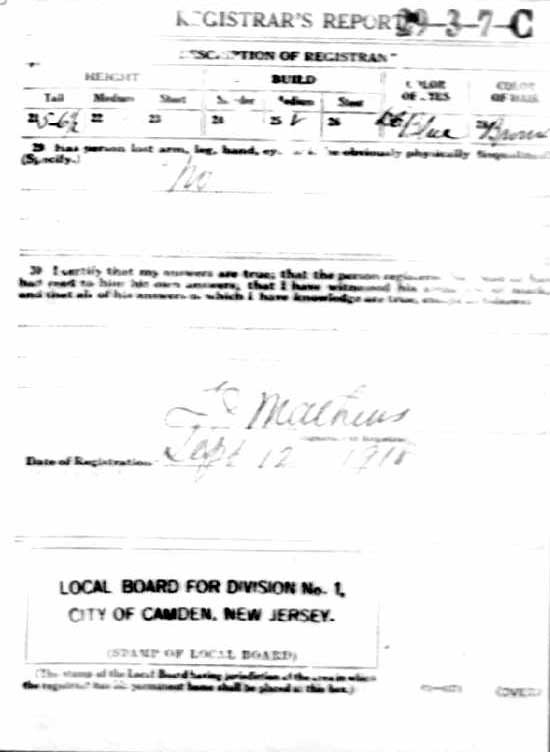
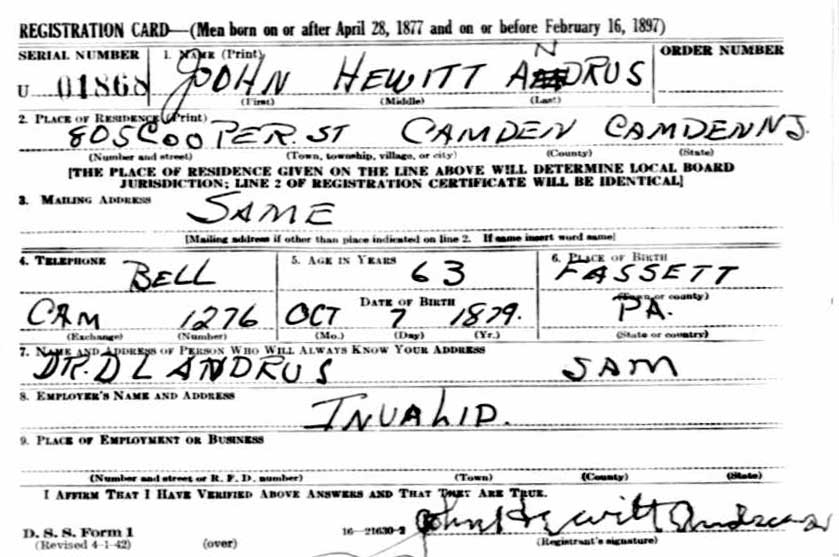
John H. Andrus draft registration records.