Trinity Methodist Episcopal Church
From George Reeser Prowell’s History of Camden County, New Jersey — 1886
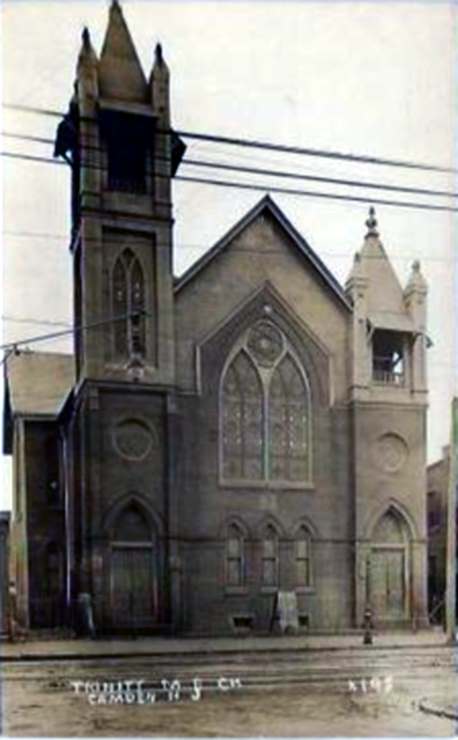
Named: Trinity Methodist Episcopal Church, Broadway, and Camden, New Jersey..
In 1856 a mission school, under the auspices of the Methodist Episcopal Church, was organized in the house of Jesse Perkins, No. 1722 Broadway, and was superintended by John Dobbins and Mrs. Shuttleworth. Soon after its organization it was removed to the house of William Hammond, on Fillmore Street, opposite to the site of the present church, and Samuel Duval became superintendent. The school was a success, the number of scholars increased, and in 1868 the Fifth Street Methodist Episcopal Church adopted measures to procure land and build a church in that locality.
A one-story frame building, with a small chapel to the rear, was built by Clayton Peacock in 1859, and dedicated by Rev. William Brown. The building committee were William Boom, William Hammond, John Dobbins, Thomas B. Jones, John S. Bundick, Josiah Matlack and William Brown, the pastor. A large number of members joined the church at this time and the Sunday school had eight teachers and sixty pupils. The pastors who have been assigned to this charge, from the time of the organization to the present time, have been George W. Smith, J. T. Price, Joseph Hopkins, G.H. Tullis, Lewis Atkinson, John Y. Dobbins, David Stewart, Edward Messier, William Mitchell, George Musseroll, D.W.C. McIntire and James E. Diverty, the present pastor. The congregation in the year 1886 built a new church, fifty-two by eighty-two feet in size, of stone, with modern improvements and neatness of architectural design, at a cost of fifteen thousand dollars. Two large lots were donated by Mrs. John Dobbins for the site of the new church and a parsonage. These lots are on Broadway, corner of Van Hook Street. The building committee, to draft the plans and superintend the building of the new church, is composed of John Dobbins, chairman; Herman Helmbold, treasurer; Benjamin E. Mellor, secretary; and Geo. W. Burroughs, George W. Lacomey, James O. Smith, Joseph Cline, Thomas Harman, G. W. Laird, Robert H. Comey, Frederick Kifferly and Henry Davis.
The church at present (1886) has a membership of one hundred and seventy-two communicants, and in the Sunday school there are two hundred and eighty-nine pupils and teachers, with George W. Burroughs as superintendent.
Additional Notes by Phillip Cohen — November, 2011: The church soon moved from the donated lots at Broadway and Van Hook Street, however. Five lots were acquired on Broadway (1818 to 1826) and in 1889 a new church was erected, and, having left Fillmore Street, the name Trinity Methodist Episcopal Church was adopted.
History of Trinity Methodist Episcopal Church
From The Centennial History of Camden Methodism — 1909
In the year 1855 Mr. William Hammond, a member of the Mariner’s Bethel, Philadelphia, moved to Stockton, now South Camden. In the following year he began holding a Sunday school in his home receiving help from some of his neighbors. A deep interest was aroused and it was not long before a flourishing school was firmly established.
The list of officers and teachers and scholars in the school is still extant. The superintendent was Samuel Duval and the following band of teachers most ably supported him; Bible class, William Duval; Testament class, John Dobbins, the father of the Rev. John Y. Dobbins, now a member of the New Jersey Conference, who himself was a scholar in his father’s class; Spelling and Reading class, Henry Cattell; Nathan Hammond, Nancy Powell, Emma Moore, A. Church and Elizabeth Dobbins were also teachers.
It was not long before the necessity was felt for the further development of the work, and preaching services were begun in the various homes under the leadership of the Rev. Samuel Dixon, a local preacher of the Fifth Street M. E. Church (now Union) assisted by William Hurst a member of the same church.
In favorable weather meetings were held in Captain John Mickle’s woods. Later on the use of the public school building was secured in which to hold the services, it was not long before a class of twenty-four members was formed, and the prospects for a successful work seemed extremely hopeful.
This devoted little band longed for a church home and after careful consideration they thought they saw their way clear to build.
Fearing lest they might be unable to carry the project through successfully, they made application to Fifth Street Church to be attached to them as a Mission and their request was granted.
The Rev. John Hickman was at that time pastor of Union Church and almost immediately a building committee of seven members was appointed, their names were as follows: W. Rooms, William Hammond, John Dobbins, Thomas Jones, J. S. Bundick, J. Matlock, and the Rev. H.M. Brown, this committee was appointed in 1859 and shortly afterwards, largely through the instrumentality of William Hammond aided by his brother-in-law W. B. Rooms, a church edifice was erected on Fillmore Street one block west of Broadway, known as Fillmore Street M. E. Church. The contract for the building was given to Clayton Peacock, and the building was dedicated in 1860.
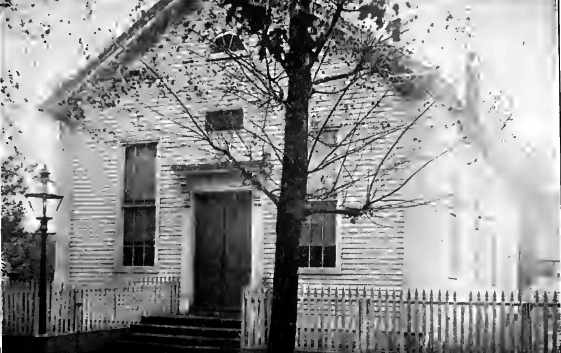
Fillmore Street M. E. Church — 1860.
An old record shows that the foundation stone was laid by the Rev. H. M. Brown, at that time pastor of Union Church, assisted by the Rev. Samuel W. Thomas of the Philadelphia Conference, the Presiding Elder of the district, the Rev. George F. Brown, being present at the services.
Union Church not being willing to assume the debt of the new and struggling society, it is extremely doubtful if the church organization could have been continued had it not been for the unsparing liberality of William Hammond, who also assisted greatly in the furnishing of the church, as well as bearing a large share of the current expenses.
The leading members of the church at this time were, William Hammond, John Dobbins, Captain Jones, Jesse Perkins, Brother Dusen, Samuel Duval, Robert Shuttleworth, Nancy Powell, Samuel Lehman, Jonas Mellor and John J. Smith.
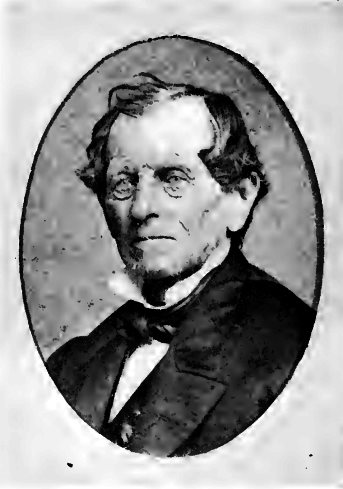
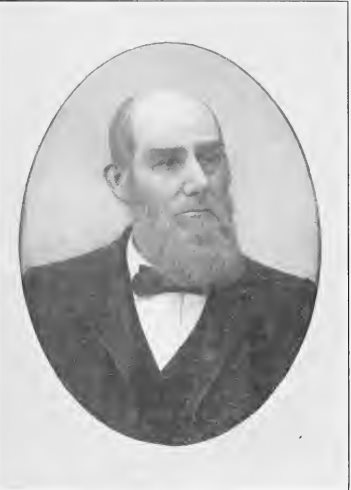
Rev. William Hammond — Samuel S. Lehman.
Trinity, though small in many respects, has never been lacking in blessed seasons of spiritual power and many are the souls that have been born for God within its walls, and have gone out to bless the world in other localities beyond South Camden.
It was on this sacred ground that the Rev. John Y. Dobbins began his Christian life and his work for God; and after his graduation from college he became pastor of the church.
During his pastorate he desired to have an organ placed in the church, and it is scarcely possible at this day of elaborate musical services to conceive the opposition and amazement with which this proposition was received by some of the official members of the young organization, they thought that an organ was quite a fit furnishing for a hall or a saloon, but not for a church.
However after much opposition and the exercise of great tact and judgment, an organ was secured and placed in the church.
It was during the administration of the Rev. George S. Meseroll that the mortgage on the Fillmore street property was cleared off and burnt amid great rejoicings.
But the years were rolling on, and the young society had been gaining new blood and much strength and courage; for nearly thirty years they had been carrying on their work, and the feeling arose that they ought to have a new church edifice, more modern and commodious.
During the administration of the Rev. James E. Diverty, now of the Philadelphia Conference, the question of a new church edifice came prominently to the fore, was earnestly discussed and some funds raised towards carrying out the project, a site was procured and plans actually prepared for a new building which was to be erected at the N.W. corner of Broadway and Van Hook street. This project however through unforeseen difficulties had to be abandoned.
In 1889 the Rev. W. S. Ludlow was sent to the charge and again the advisability of building a new church was discussed, and this time with better success.
During the ministry of the Rev. John L. Souder, who came between the Rev. J. E. Diverty and the Rev. W. S. Ludlow, the site now occupied by the present church had been secured.
At the first quarterly conference after the arrival of Bro. Ludlow a committee on plans was appointed, and later on the same men were appointed a building committee, their names were as follows: John Dobbins, James O. Smith, J. Kennedy, George W. Leckney, W. S. Ludlow, R. H. Comey, B. E. Meillor and J. Applegate.
Thus the old Fillmore street church was sold and in 1889 the present commodious edifice, known as Trinity M.E. Church was erected on Broadway and dedicated by Bishop Foss to the worship of Almighty God.
During the last twenty years the work has progressed with varying success. Great hopes were entertained at the opening of the New York Ship Building Yard, that this neighborhood would speedily develop.
While these hopes have not been altogether realized, great good has been accomplished and many souls have been led out of darkness into light.
Trinity Church still stands with open doors, and with many godly souls ready and willing to lift up the fallen and guide the erring.
For fifty years these people have stood at the South end of Camden holding up the standard of Jesus Christ, this year they celebrate their Jubilee and start on the work of a new half century with hearts full of hope.
Trinity Methodist Church Official Board — 1909
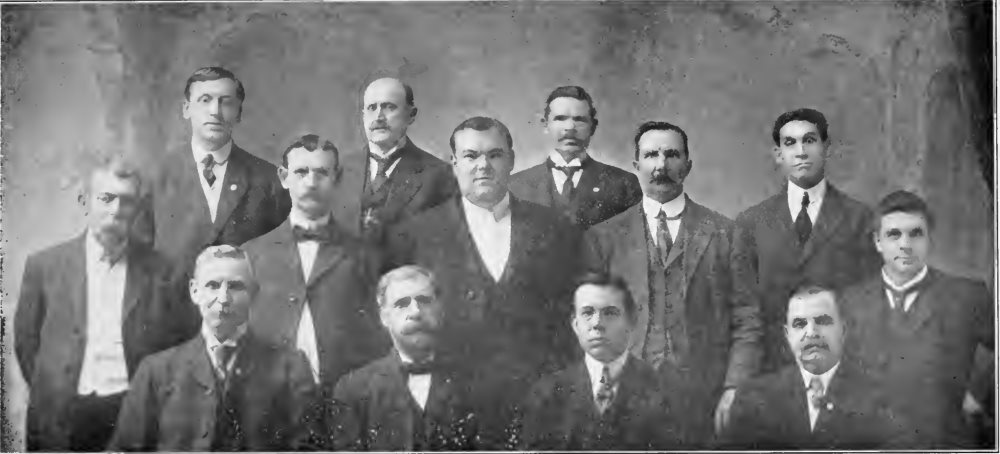
Named: Thomas Davis, J.F. Roork, George Derham, Dr. R.F. Smith, John Gray, Walter Walker, C.E. Weeks, Julian Anderson, Rev. Charles Morse, Rev. Charles Bingley, Rev. George E. Archer, Joseph Hopkins, and Joseph Cline..
Rev. George E. Archer
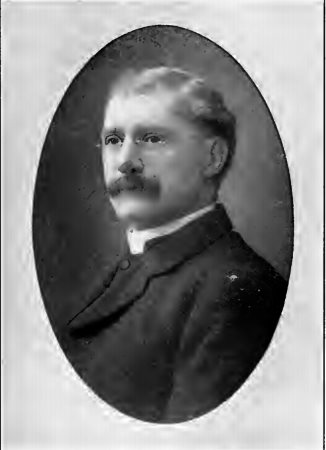
Rev. George E. Archer.
Photos
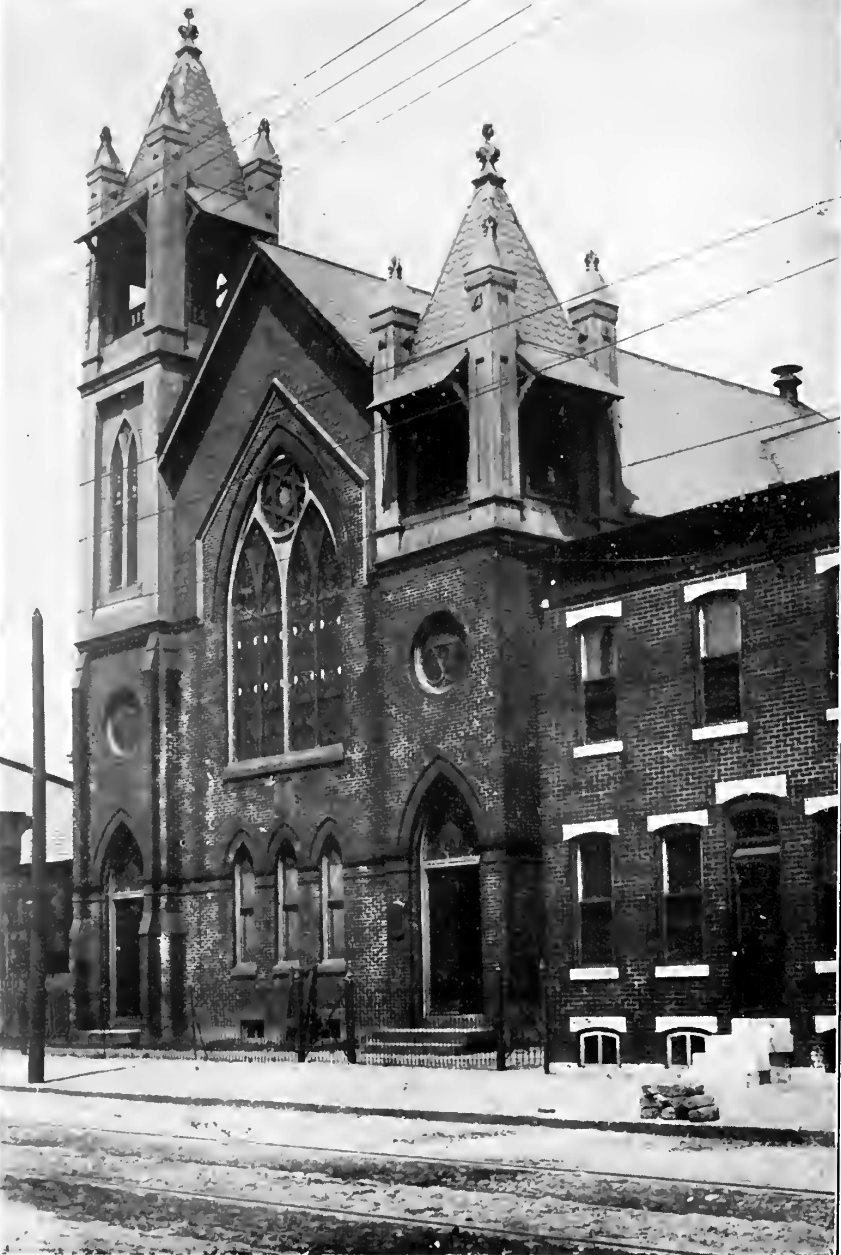
Trinity Methodist Church — 1909.
Police in a Church
Philadelphia Inquirer —
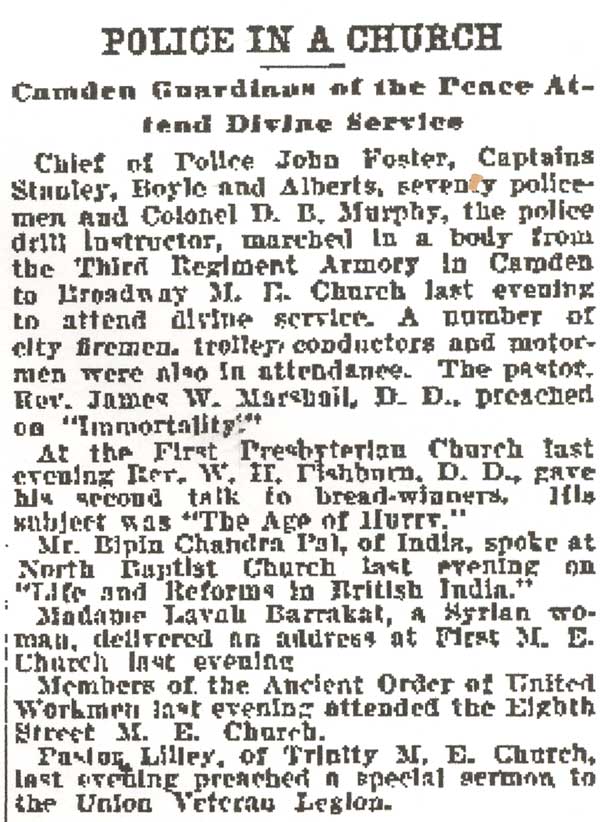
POLICE IN A CHURCH
Camden Guardians of the Peace Attend Divine Service
Chief of Police John Foster, Captains Stanley, Boyle and Alberts, seventy policemen and Colonel D. B. Murphy, the police drill instructor, marched in a body from the Third Regiment Armory in Camden to Broadway M. E. Church last evening to attend divine service. A number of city firemen, trolley conductors and motormen were also in attendance. The pastor, Rev. James W. Marshall, D. D., preached on “Immortality.”
At the First Presbyterian Church last evening Rev. W. H. Fishburn, D. D., gave his second talk to bread-winners. His subject was “The Age of Hurry.”
Mr. Bipin Chandra Pal, of India, spoke at North Baptist Church last evening on “Life and Reforms in British India.”
Madame Lavah Barrakat, a Syrian woman, delivered an address at First M. E. Church last evening.
Members of the Ancient Order of United Workmen last evening attended the Eighth Street M. E. Church.
Pastor Lilley, of Trinity M. E. Church, last evening preached a special sermon to the Union Veteran Legion.
Ergood Wedding
Philadelphia Inquirer —
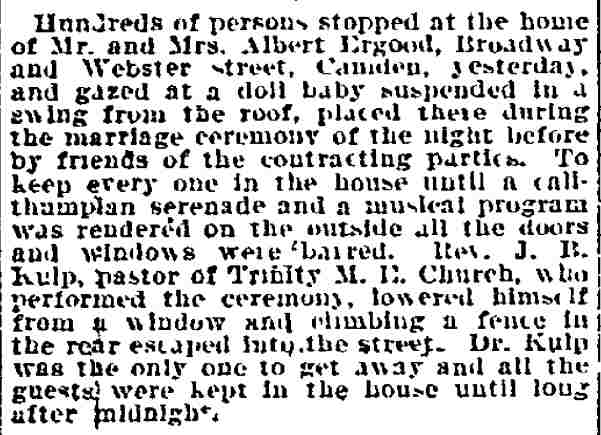
Hundreds of persons stopped at the home of Mr. and Mrs. Albert Ergood, Broadway and Webster street, Camden, yesterday, and gazed at a doll baby suspended in a swing from the roof, placed there during the marriage ceremony of the night before by friends of the contracting parties. To keep every one in the house until a calithumpian serenade and a musical program was rendered on the outside all the doors and windows were barred. Rev. J. B. Kulp, pastor of Trinity M. E. Church, who performed the ceremony, lowered himself from a window and climbing a fence in the rear escaped into the street. Dr. Kulp was the only one to get away and all the guests were kept in the house until long after midnight.
Methodists Begin Golden Jubilee
Philadelphia Inquirer —
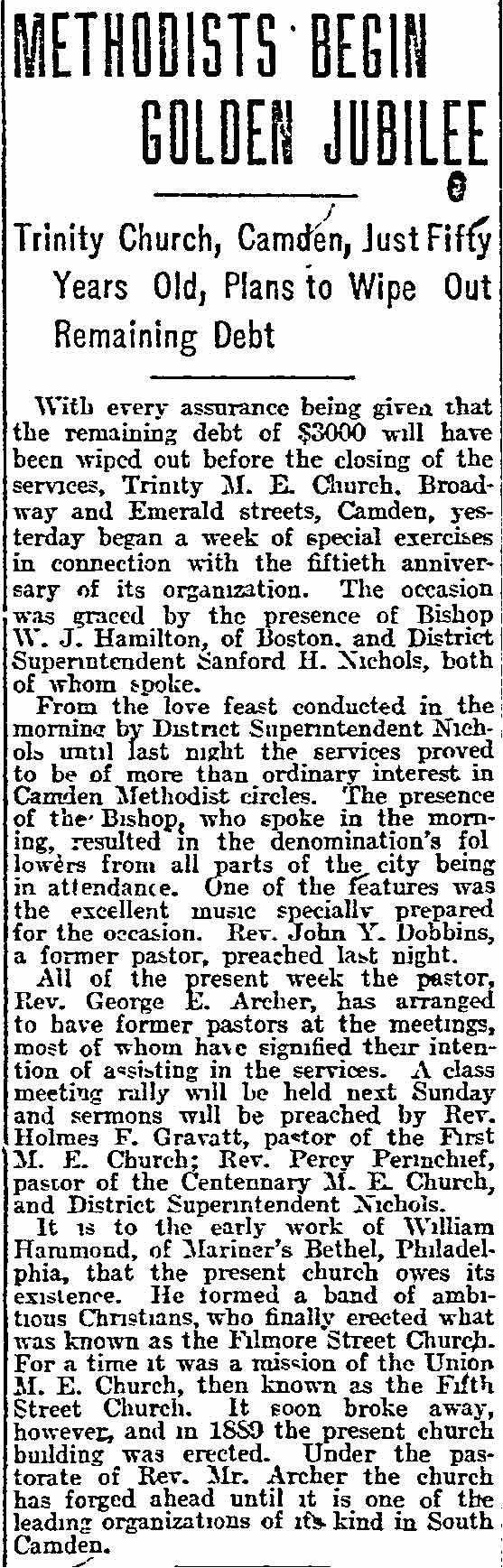
METHODISTS BEGIN GOLDEN JUBILEE
Trinity Church, Camden, Just Fifty Years Old, Plans to Wipe Out Remaining Debt
With every assurance being given that the remaining debt of $500 will have been wiped out before the closing of the services, Trinity M. E. Church, Broadway and Emerald streets, Camden, yesterday began a Golden Jubilee to be held in connection with the fiftieth anniversary of the organization. The occasion was graced by the presence of Bishop William Burt, D.D., District Superintendent Sanford H. Nichols, both of Philadelphia. See PDF for full article.
Another Fire on Hump
Philadelphia Inquirer —
ANOTHER FIRE ON HUMP.
Another fire broke on the “Hump” this morning when sparks from the stack of an Atlantic City Railroad tarin [sic] set the Bulson street bridge on fire. Engine Company No. 8 was sent to the scene. This wood structure gets on fire almost daily and residents of the vicinity are urging that a steel structure be built in its stead.
Trinity M. E. Orchestra
Philadelphia Inquirer —
The Trinity M. E. Orchestra furnished the music at the anniversary exercises of Trinity Lodge, I. O. M., which were held in the parish building of the Church of Our Saviour, Broadway and Viola street.
The Trinity M. E. Orchestra is rehearsing a Christmas story in song entitled “In Quest of the King.”
Becker–Durham Wedding
Philadelphia Inquirer —

Miss Lucy Becker, of 1160 Jackson street, and William Durham, a real estate operator of 1533 Broadway, were married yesterday by Rev. William Grum, of the Trinity M. E. Church.
Daughters of Pocahontas
Philadelphia Inquirer —

Members of Running Deer Council, No. 52, Daughters of Pocahontas of Gloucester City, were addressed by Rev. William Grum at the Trinity M. E. Church last night. See PDF for full article.
New Camden Pastor Is Given Reception
Camden Courier-Post —
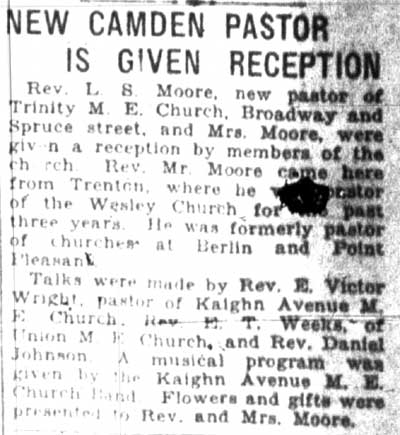
NEW CAMDEN PASTOR IS GIVEN RECEPTION
Rev. L. S. Moore, new pastor of Trinity M. E. Church, Broadway and Spruce street, and Mrs. Moore, were given a reception by members of the church. Rev. Mr. Moore came here from Trenton, where he was pastor of the Wesley Church for the past three years. He was formerly pastor of churches at Berlin and Point Pleasant.
Talks were made by Rev. E. Victor Wright, pastor of Kaighn Avenue M. E. Church, Rev. H. T. Weeks, of Union M. E. Church, and Rev. Daniel Johnson. A musical program was given by the Kaighn Avenue M. E. Church Band. Flowers and gifts were presented to Rev. and Mrs. Moore.