The Hollingshead Fire — July 30, 1940
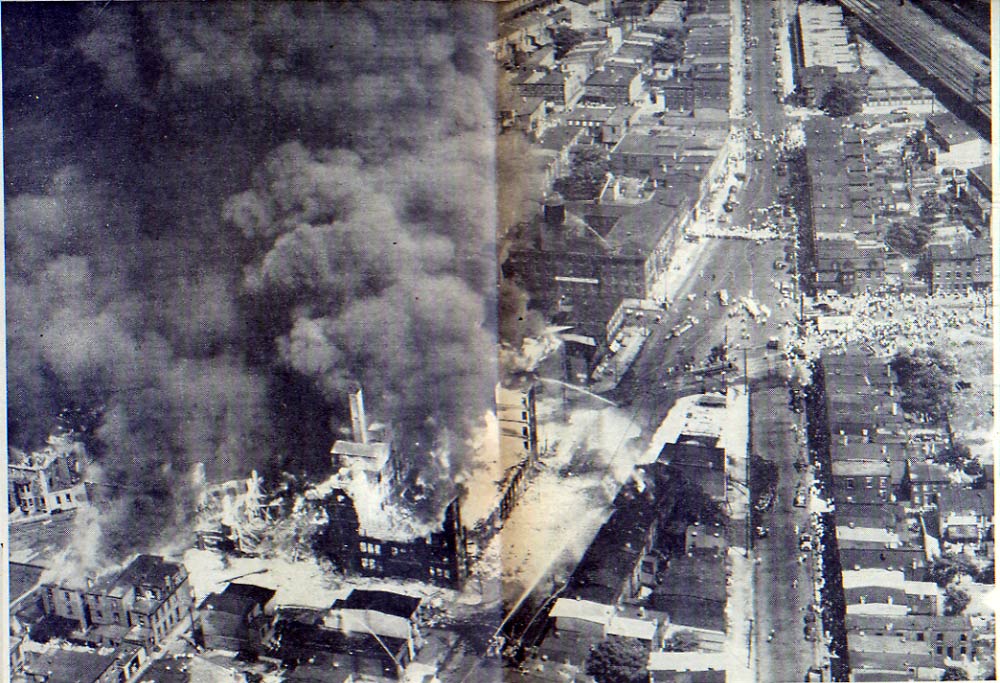
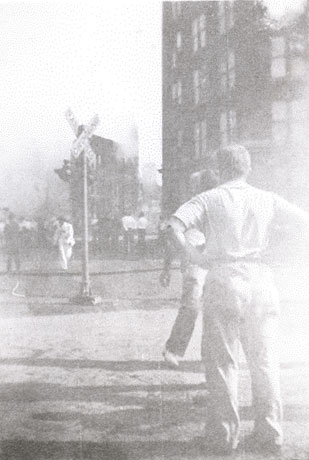
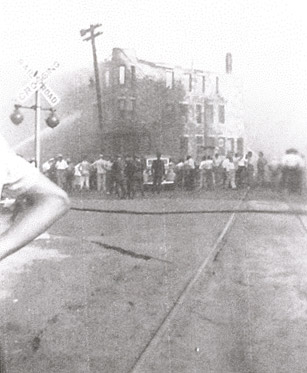
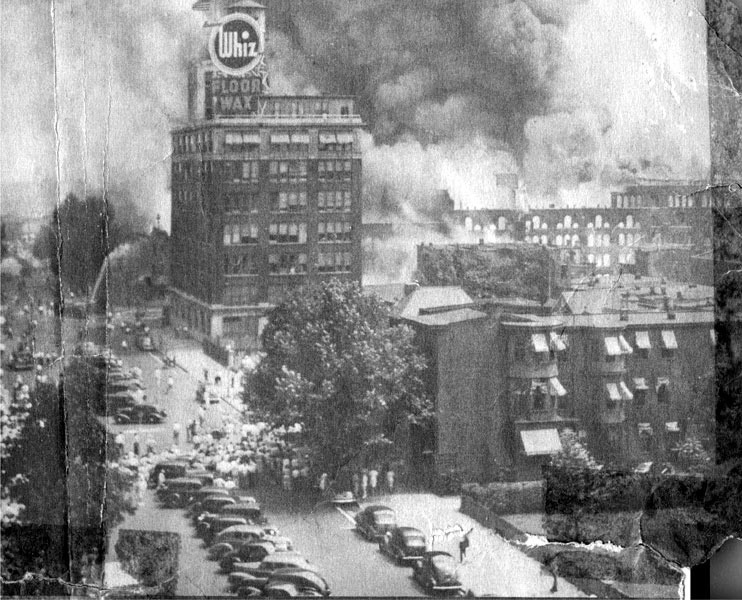
On Tuesday, July 30, 1940, a fire broke out at the R.M. Hollingshead plant, an industrial complex of large factory buildings between 9th and 10th Streets on the north side of Market Street in center city. The plant manufactured a variety of highly inflammable products including floor wax, furniture polish, and cigarette lighter fluid. The City had been suffering through a two-week heat wave, with temperatures soaring over the 100 degree mark. Box 61 at 9th and Penn Streets was transmitted at 1:15 P.M. following an explosion in the northeast corner of a five story factory building. Just two minutes later, Box 184 at 11th and Cooper Streets was also pulled for the same incident. A raging fire ensued and the fourth alarm was received at 1:39 P.M. Camden Mayor George Brunner made an urgent call to Philadelphia Mayor Lamberton asking for help. Mayor Lamberton at once called his Public Safety Commissioner, James H. Malone, ordering Philadelphia to “Give Camden all the help she needs — now!” Malone relayed the order to Deputy Chief Engineer William Simmer and within two minutes, Philadelphia Fire Companies were rolling over the bridge. Thirteen minutes later they were pumping water on the fire. At that time, Philadelphia was using two-piece engine companies with hose wagons and pumpers. Units of the Philadelphia Fire Department that initially responded were Engine Companies 8, 17, 21, 27 and 33, with Trucks 9 and 23.
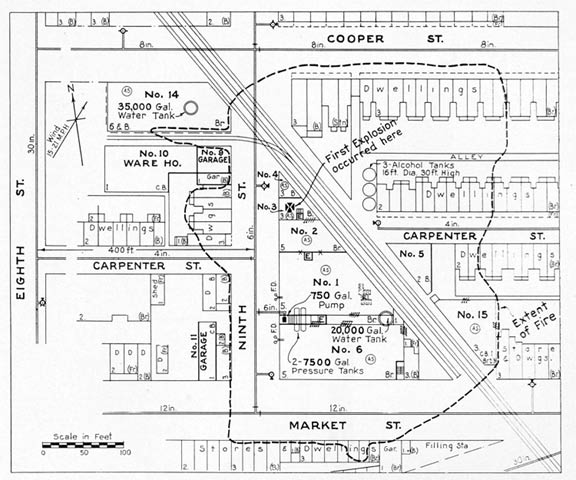
Tremendous radiant heat generated by the blaze, coupled with a water shortage caused by heavy demand during the heat wave, made effective firefighting especially difficult. Engine companies were forced to draft water from the Cooper River, one-half mile away from the fire. Worse, some 28 explosions rocked the plant as stores of gasoline, naptha, paint and grease were ignited. The fire spread to involve other factory buildings in the Hollingshead complex, and also extended to scores of surrounding dwellings and businesses.
The fire burned throughout the night and into the following day. The next morning explosive experts had to be called in to dynamite the ruins allowing firemen to get at the remaining fire and finally bring the inferno under control. The fire again flared on Thursday and it was not until Sunday, five days after the initial blast, that the blaze was finally extinguished. Ten employees of the plant were killed in this fire as well as Fireman William Merrigan of Engine Company 3 who died of a heart attack induced by heat exhaustion. Over 400 persons were left homeless and damage exceeded $1 million dollars.
An interesting postscript to this fire was told in a story by the late Battalion Chief John Letts, who at the time of the fire was not yet a member of the Department. The late Chief, a former employee of RCA, was on his lunch hour walking with a co-worker near 9th and Market Streets when the blast occurred. The force of the blast sent the man out the window and backward across the street where he sailed through the plate glass window of a first floor barber shop, opposite the factory. The late Chief ran the distance to the shop and found the victim laying on the floor bleeding heavily. The story goes that in the process of flying backward through the window, the razor sharp glass acted as a guillotine and amputated both of the man’s ears. The startled barber had the presence of mind to grab a pair of dusty, fur lined earmuffs that had been hanging on a wall hook in the shop over several previous winters. With the help of a customer, the barber placed the muffs over the victim’s bloody head where his ears had been, and secured it tightly with a roll of masking tape. This action by the quick thinking barber effectively stemmed the flow of blood as the poor man was rushed to the hospital.
Further devastation had been avoided when some unidentified youths climbed aboard a train of steaming tank cars parked on a rail siding adjacent to the complex, and opened the hatches relieving pressure upon thousands of gallons of heated naptha. Grateful neighbors reported the heroic action of the teens to a nearby Policeman. When the officer called to the youths, they quickly fled the scene. Because the Policeman was unable to get their names the boys could not be recognized for their brave deed.
More than 50 years following this incident and while conducting research, Department Historian Mr. Lee T. Ryan discovered the information and realized that one of the boys in question was his own father. Indeed many years before, the historian had overheard his father reminiscing with Lee E. Ryan, described that same incident in which he had participated. He said that he and his friends had heard onlookers expressing fears of further explosions which prompted him and his companions to react by opening the hatch covers. When called by the Policeman, they had run away fearing they were in trouble. Fire Fighter James Ryan of Engine Company 6 is the grandson of Mr. Lee E. Ryan, that brave youth from so long ago.
From Fire Department Camden New Jersey 125th Anniversary 1869–1994. Thanks to Lee Ryan for making this book available.
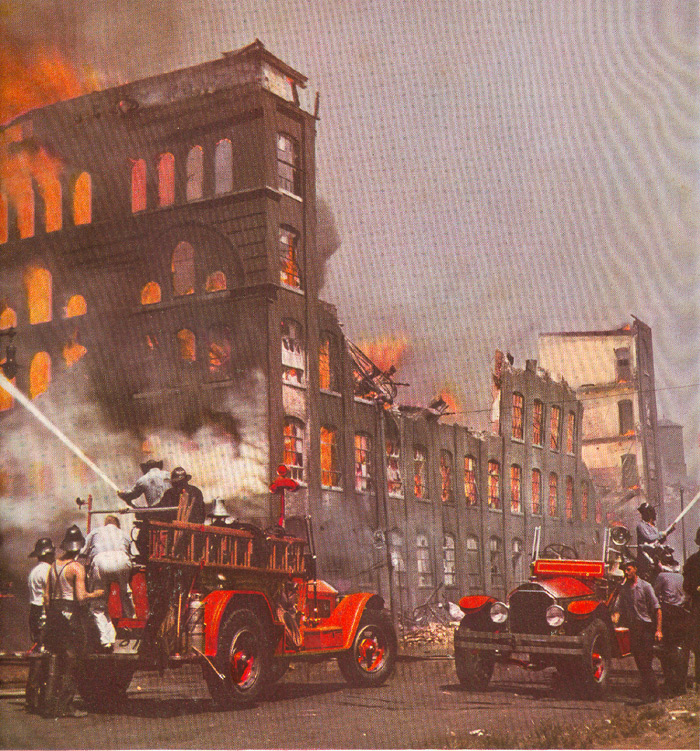
The Hollingshead Plant
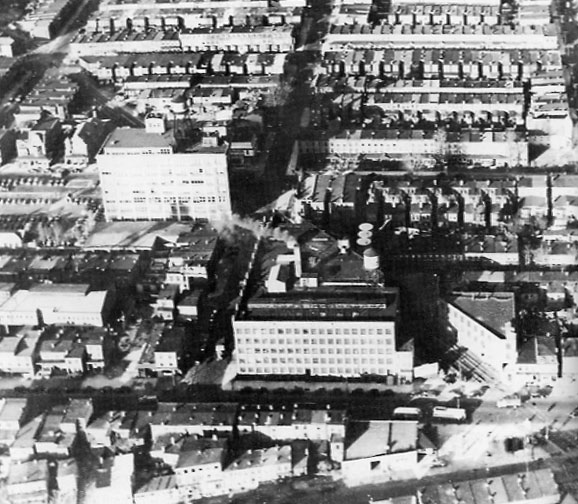
The Fire Begins
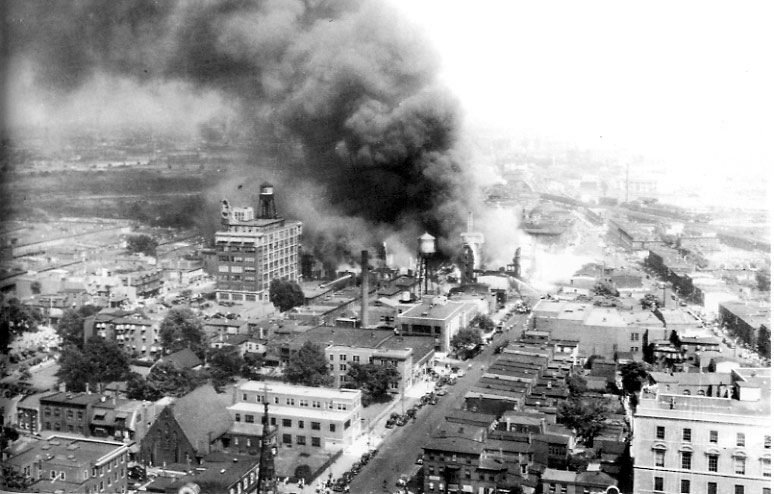
Northeast Corner, 9th and Market Street
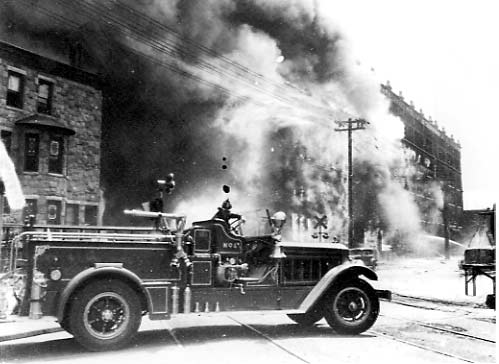
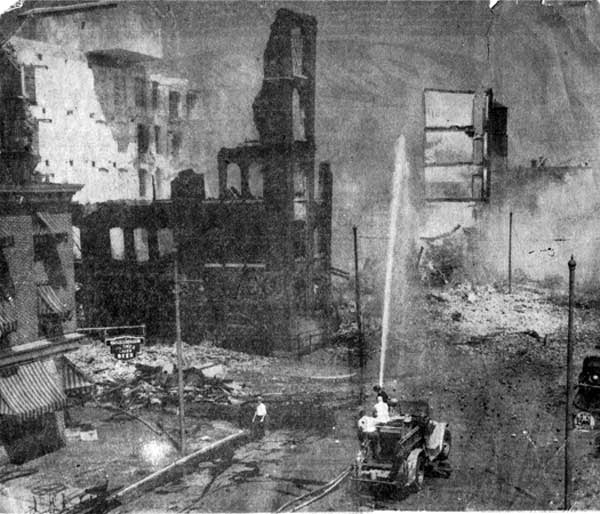
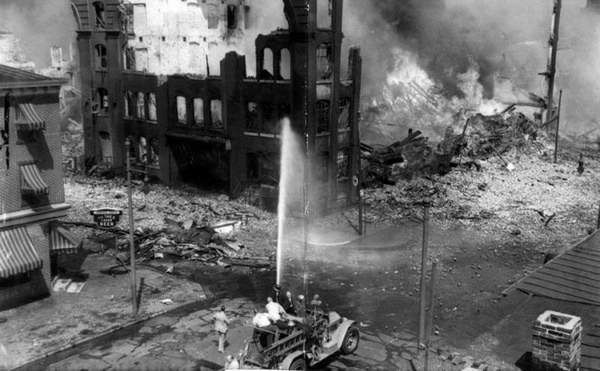
Engine Company 6 Repositions at 9th and Cooper Street
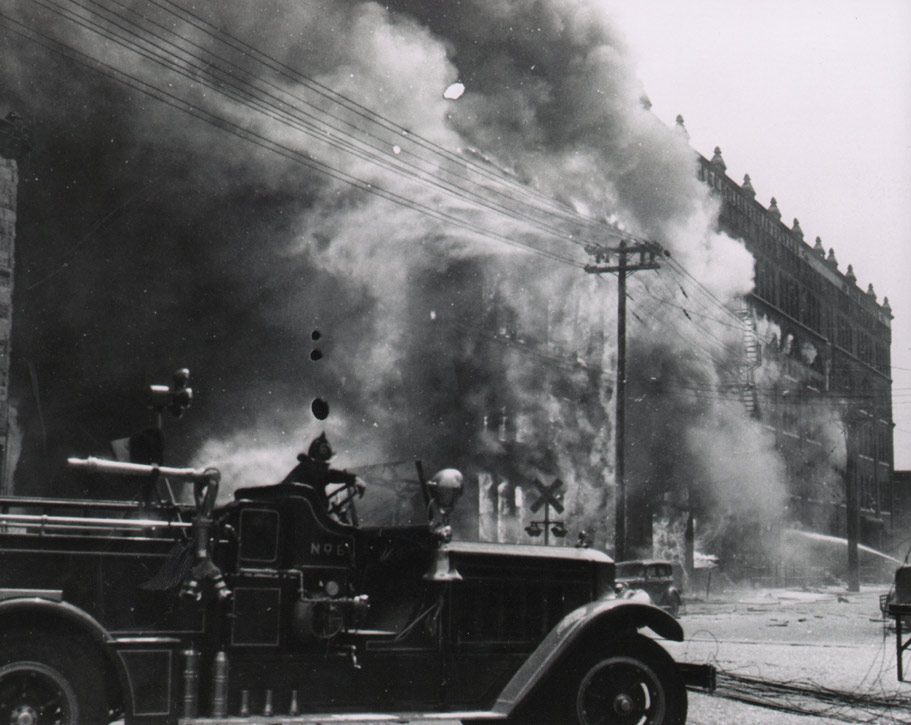
Carpenter Street
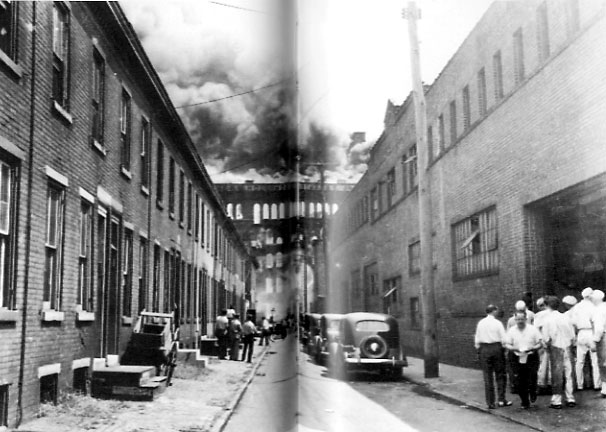
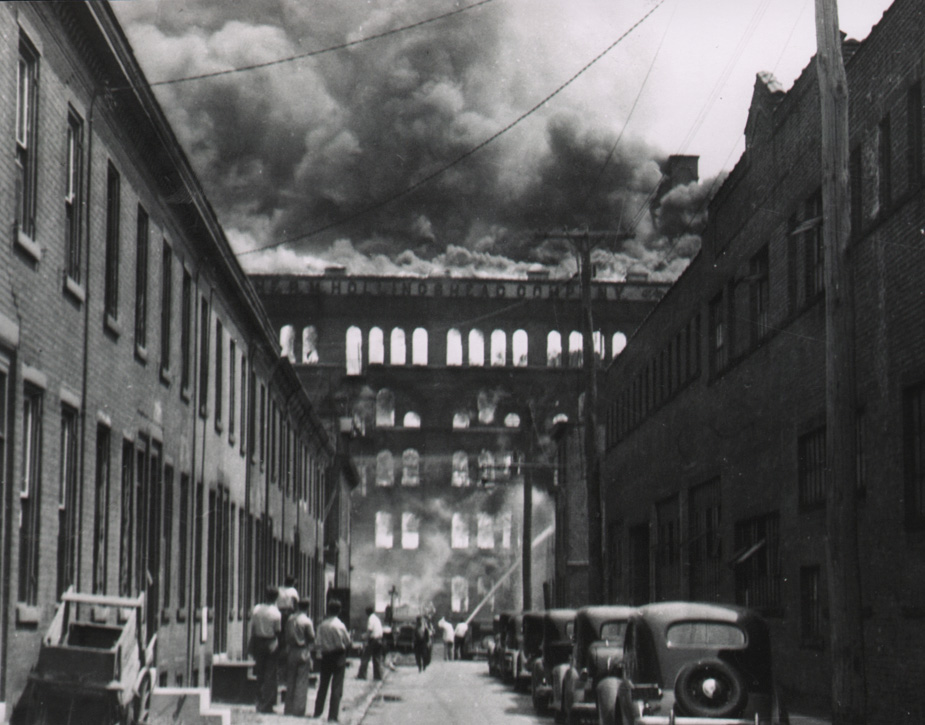
Looking east on Carpenter Street — a scene repeated many times throughout the neighborhoods surrounding the fire. Dwellings were dwarfed by the immense size of the burning factory complex. Hot and windy weather, low water pressure, flying embers, and severe radiant heat conditions joined forces to spread the fire in all directions among several city blocks. The Colucci print was made from a negative furnished in 2012 by Bill Colucci.
900 Block, Cooper Street
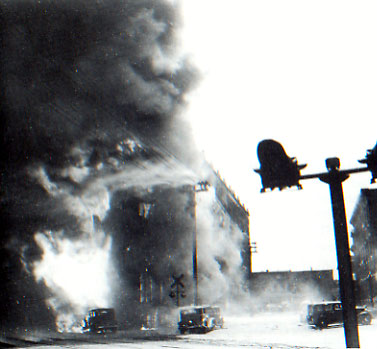
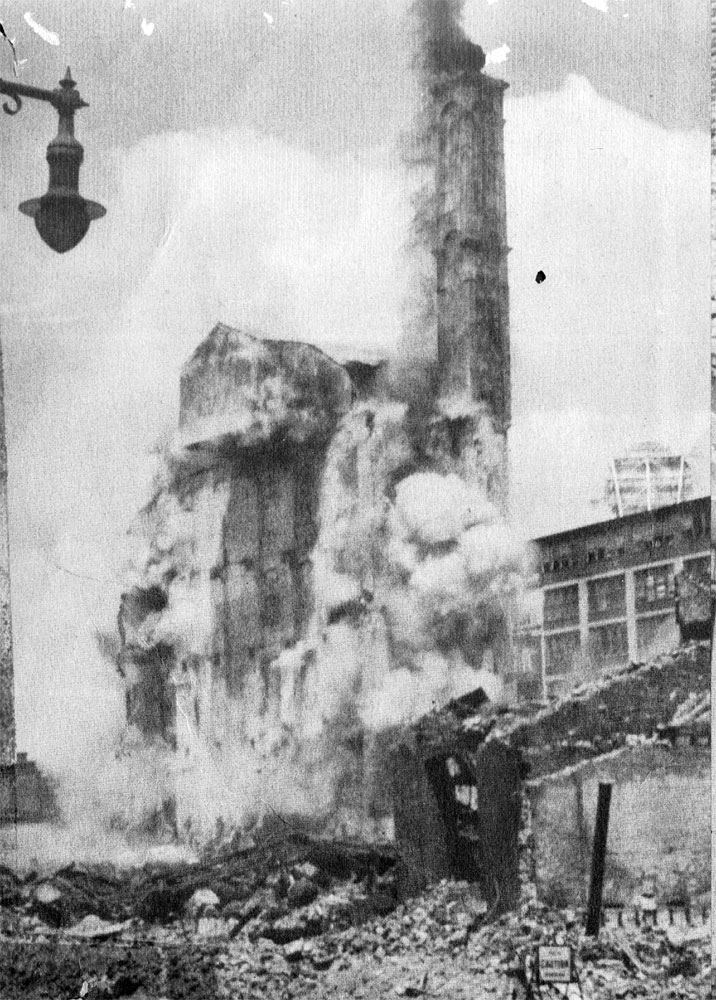
Wall Collapses
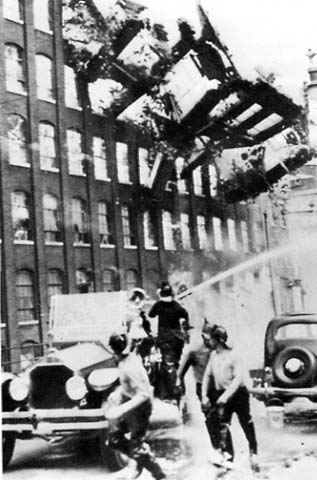
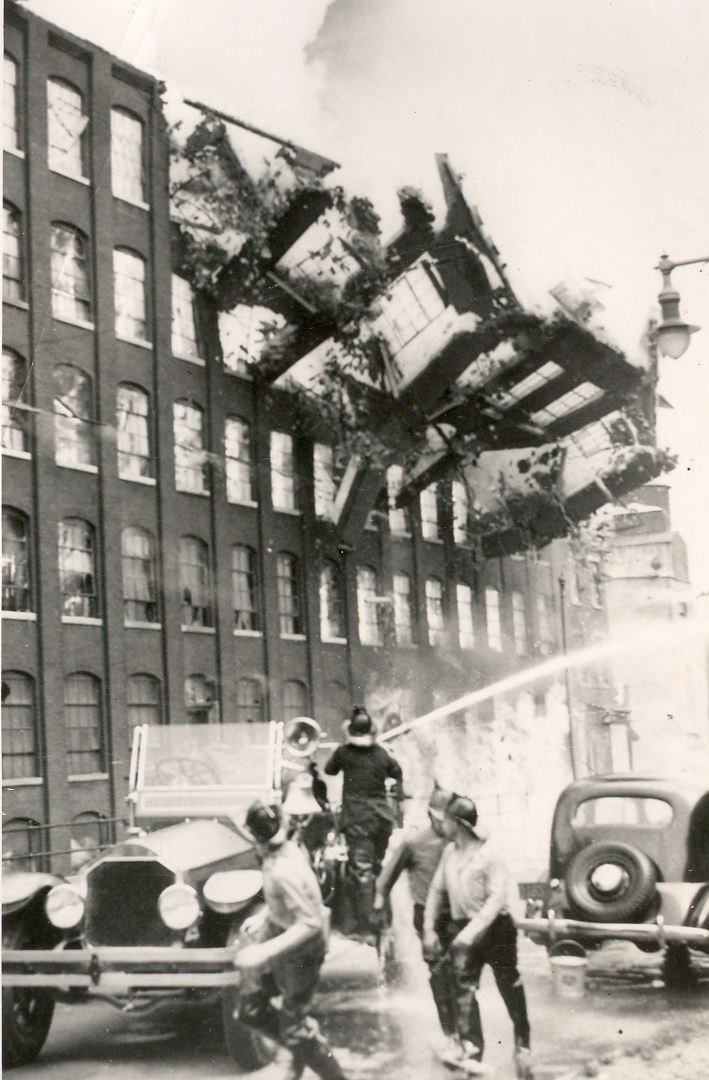
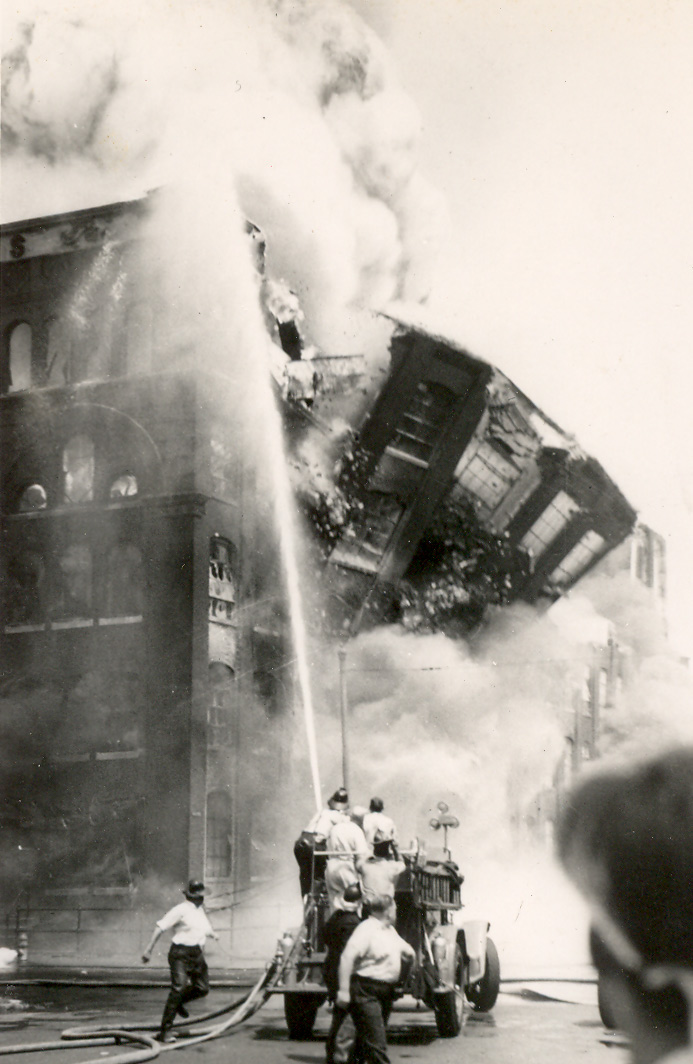
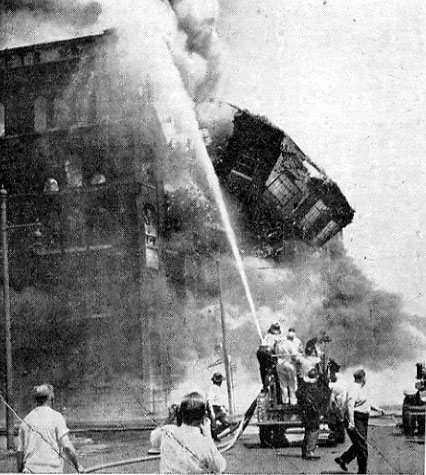
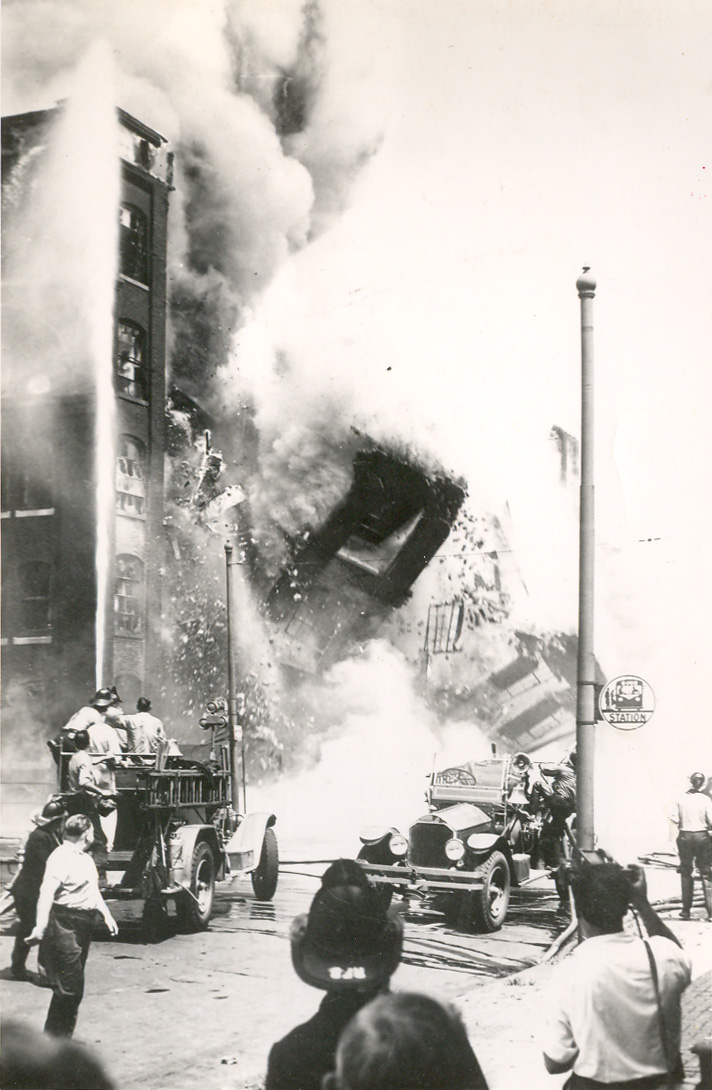
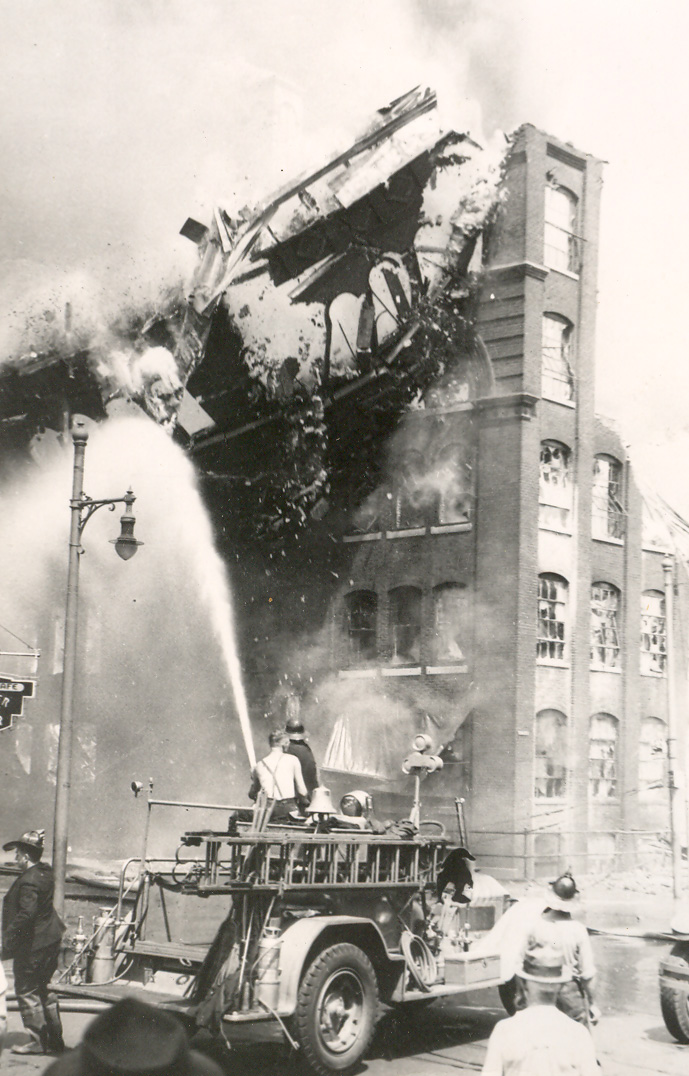
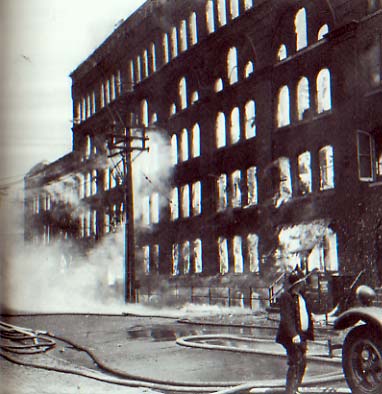
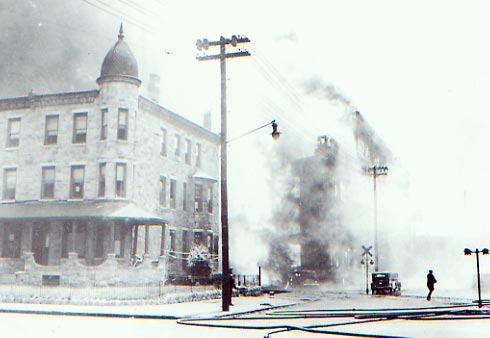
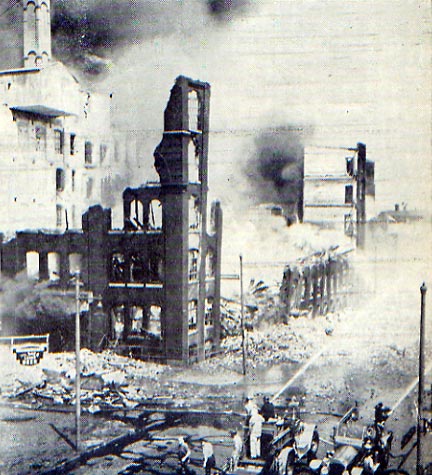
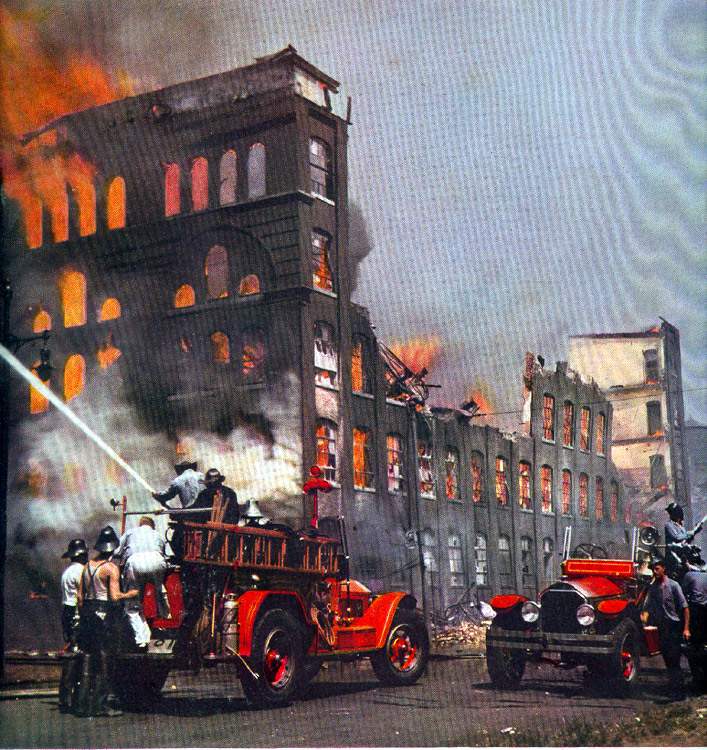
The wall on 9th Street collapses, as seen from the corner of 9th & Cooper Street. Left: another view of the 9th Street wall. Right: the heat soon crumbled the side wall on Market Street. As the walls progressively collapsed and spewed masonry into the streets, firemen had to abandon their posts and race for safety. The “lights” are on in every window from basement to roof as the fire consumes the factory — note the almost total absence of smoke as the fire fully reaches the free burning phase.
MacDougall’s Tavern
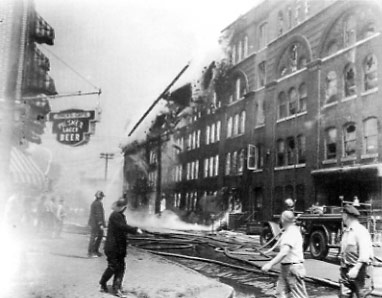
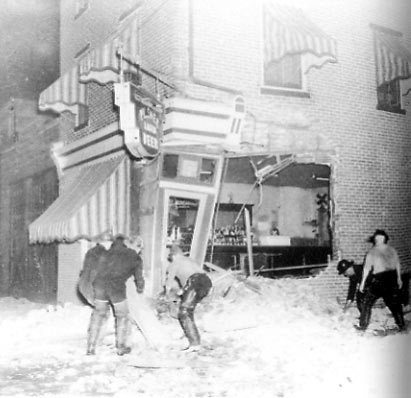
After the Walls Fell
1000 and 1002 Cooper Street
Photos courtesy of Warren Fairess, from the collection of his mother, Marie Fisbeck Fairess.
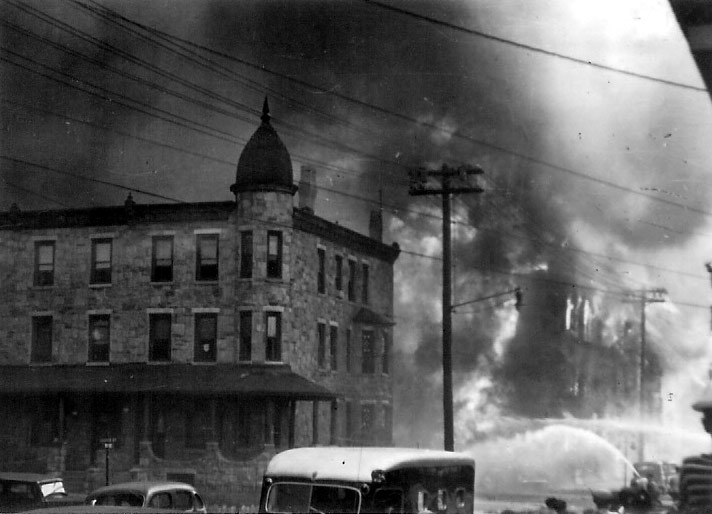
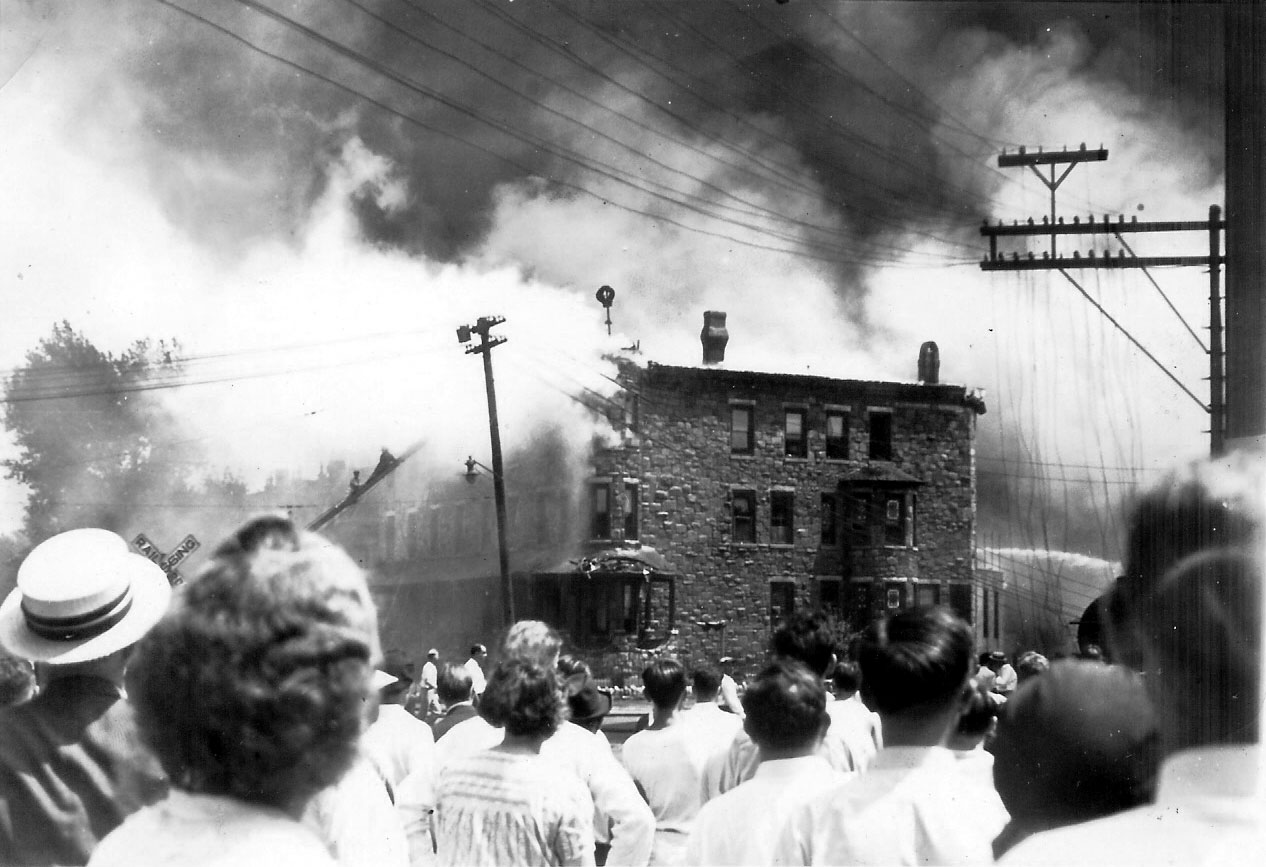
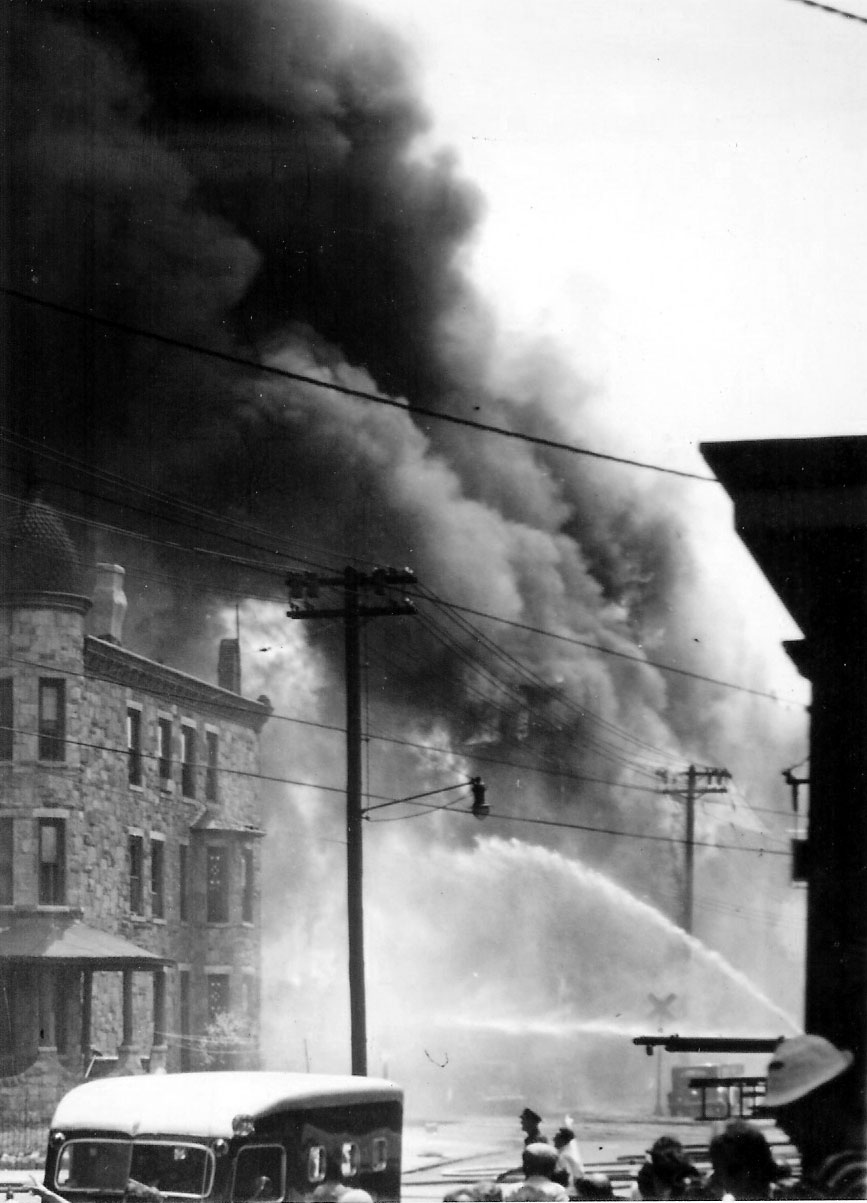
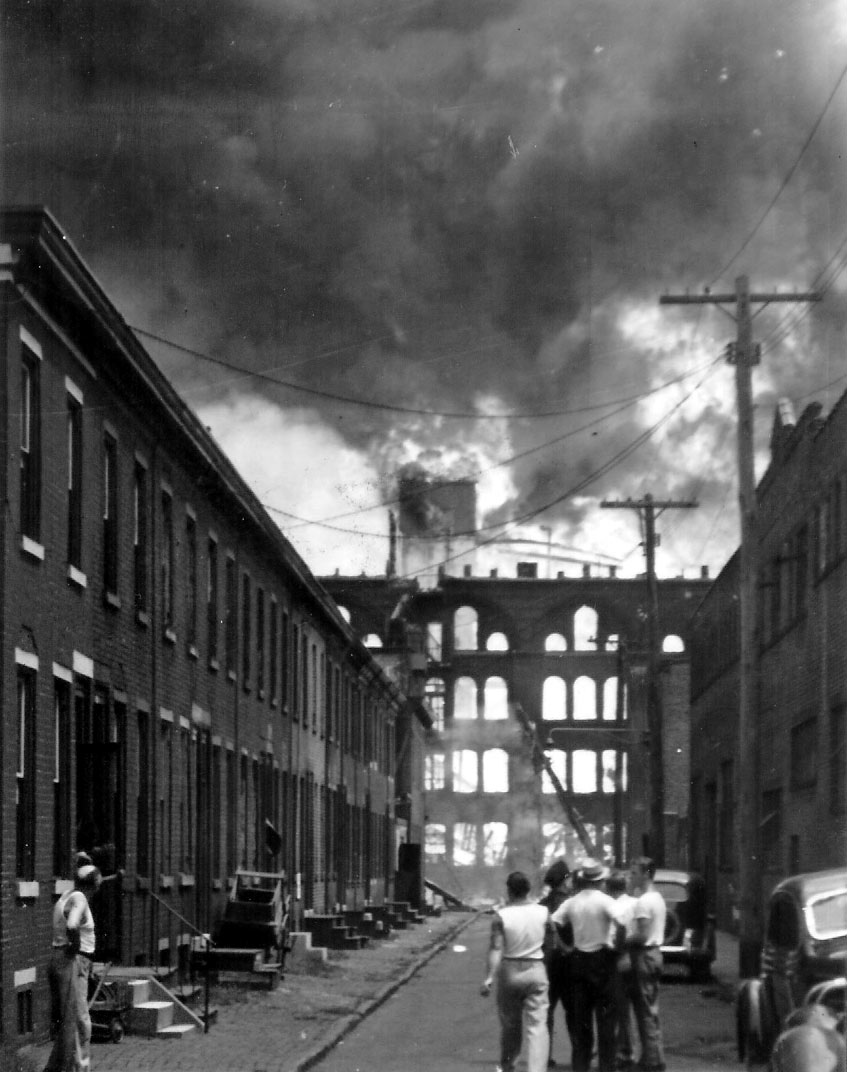
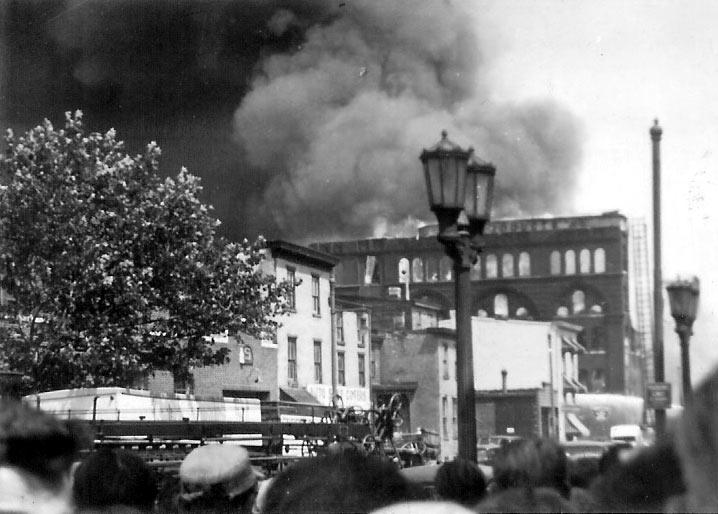
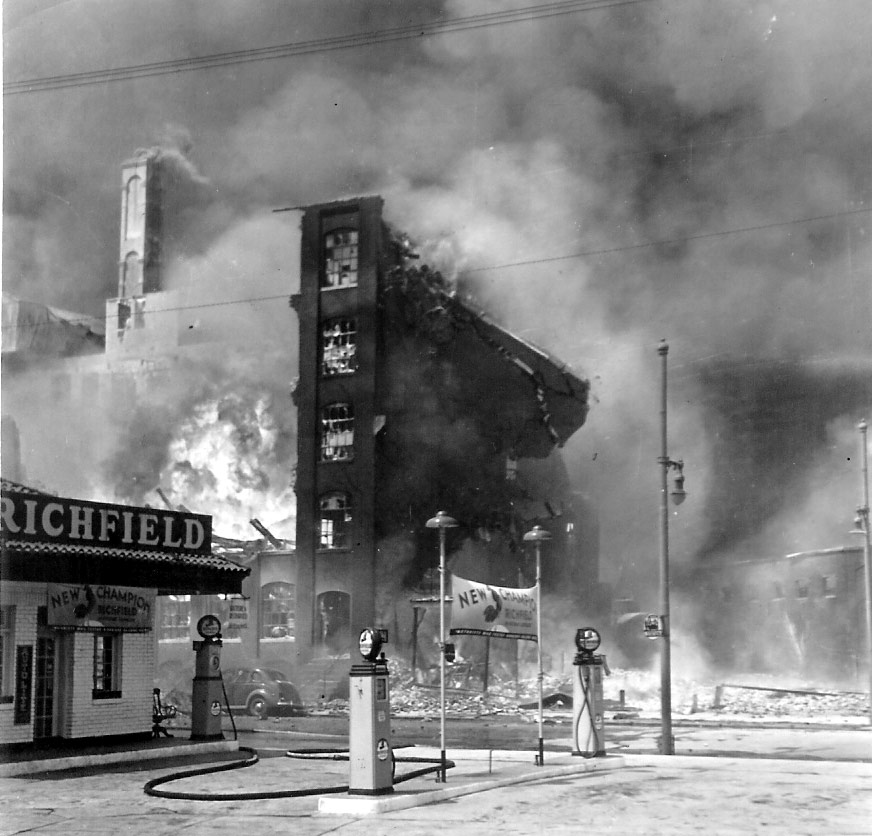
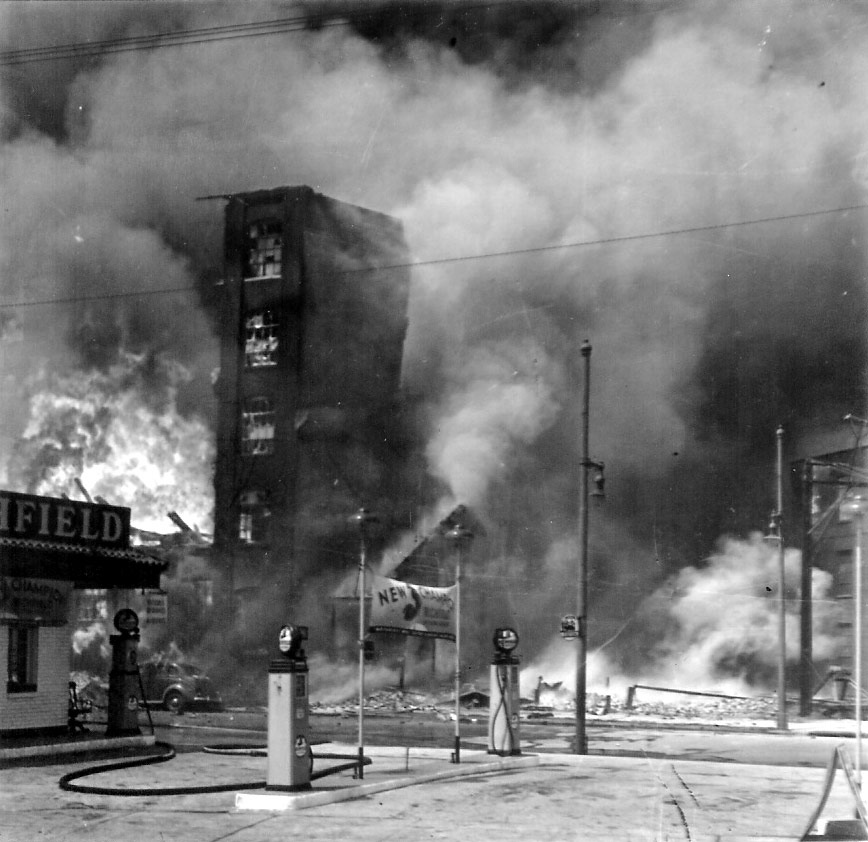
1000 and 1002 Cooper Street — these and other homes were destroyed by fire. Crowds gather on Cooper Street at 10th to watch the fire. The fire department could not save this home; the entire south side of the block was destroyed. View from 9th and Carpenter Street. View from the southwest corner, 9th and Market Streets. Looking northwest from William Dickinson’s garage at 1027–1029 Market Street. Photos courtesy of Warren Fairess, from the collection of his mother, Marie Fisbeck Fairess.
Market Street
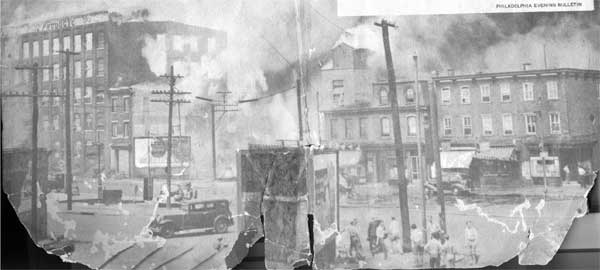
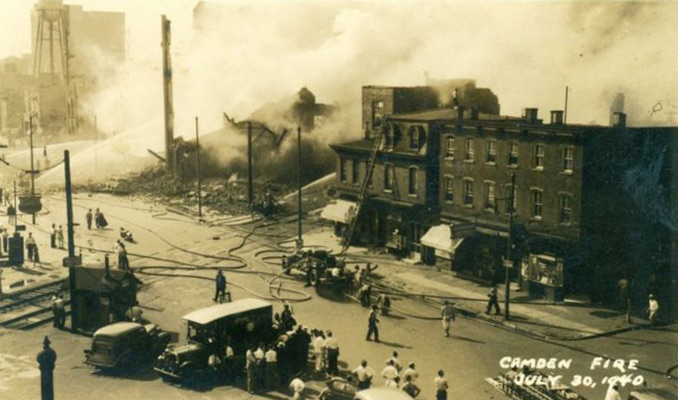
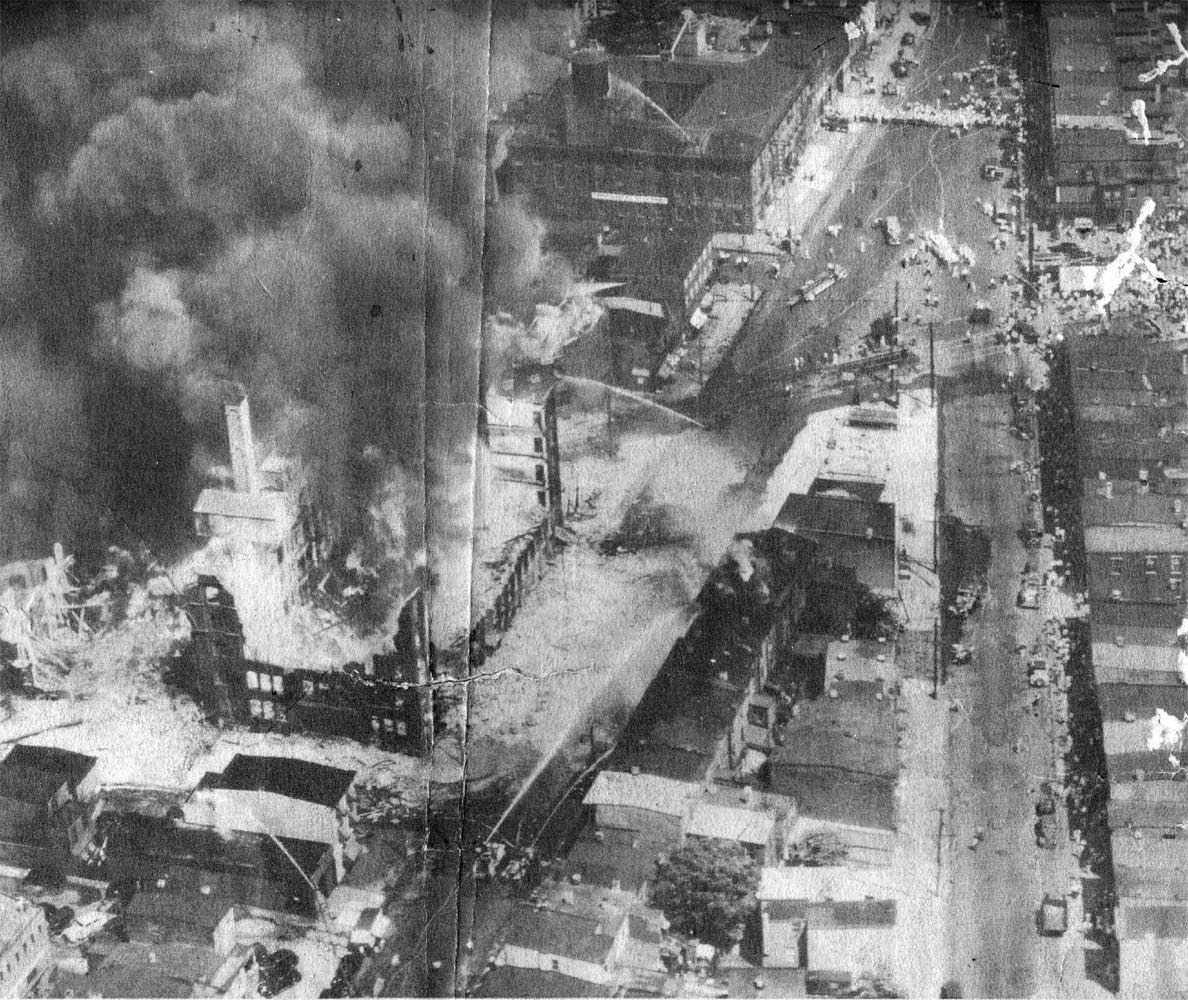
9th and Cooper Street
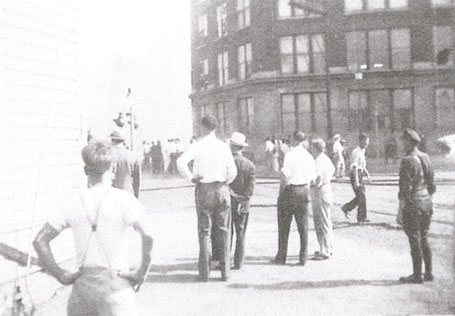
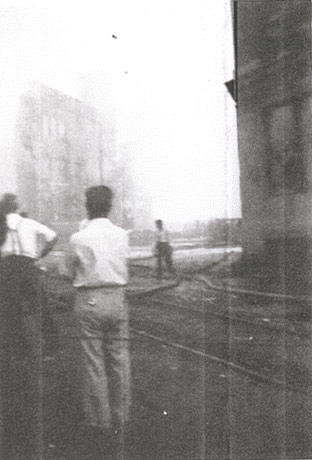
The Morning After
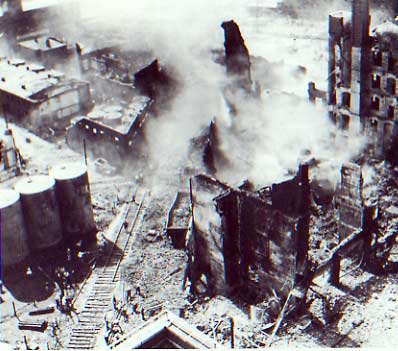
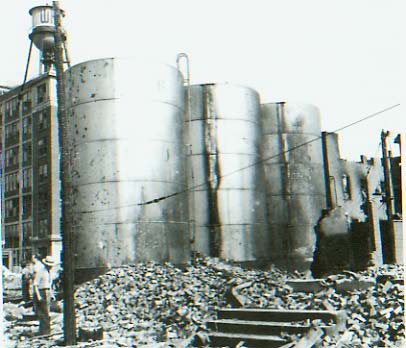
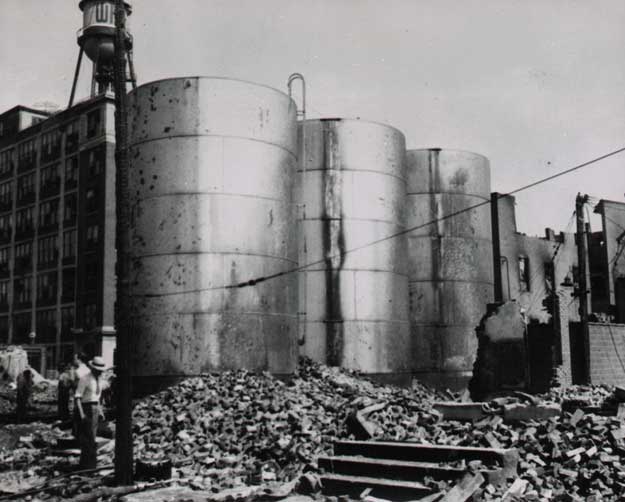
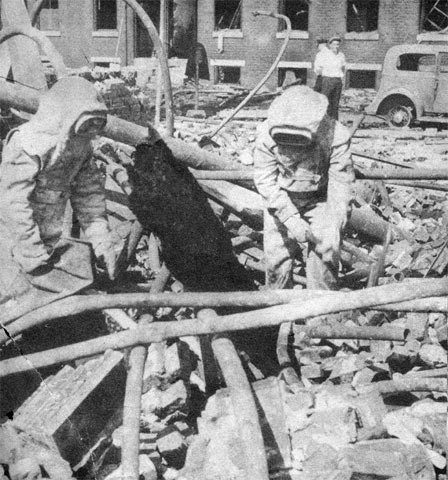
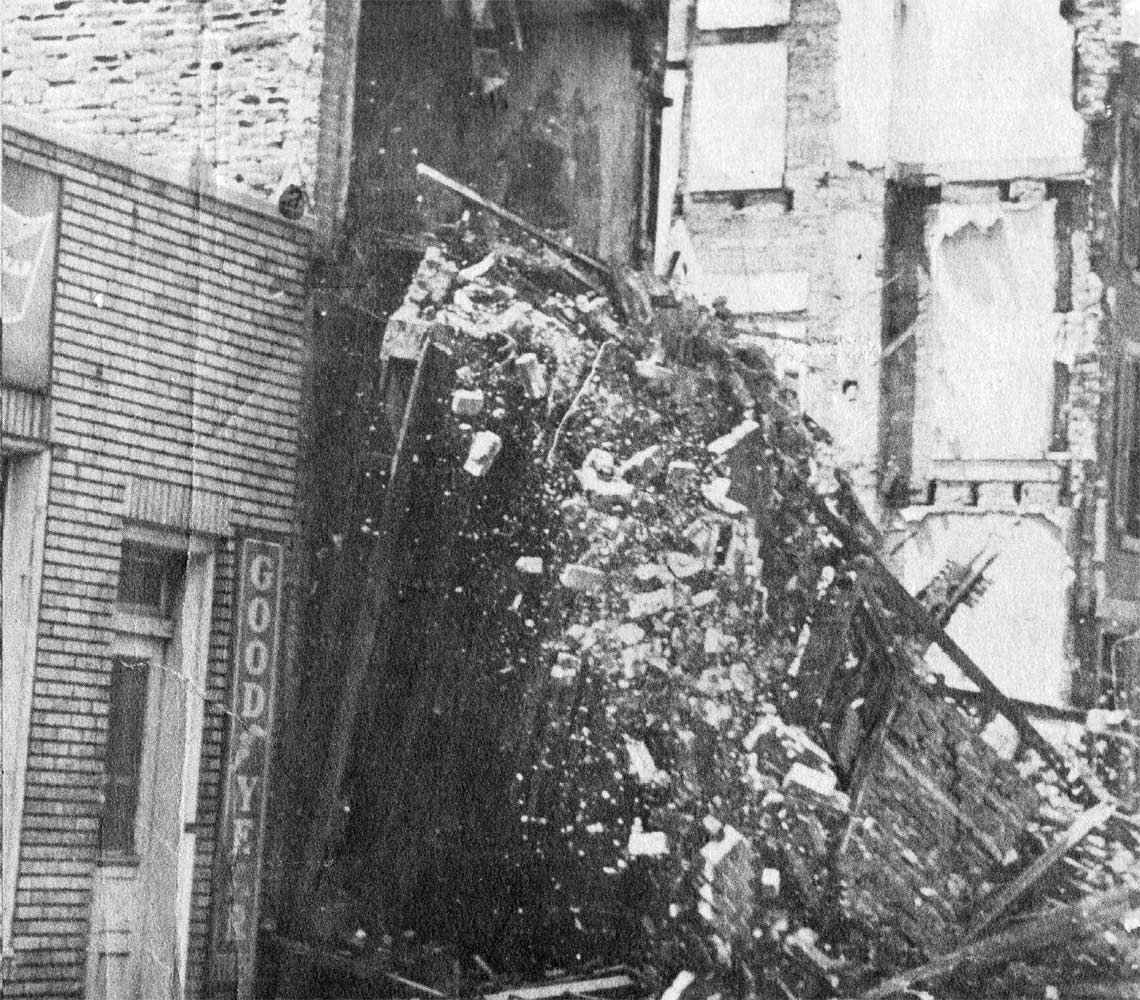
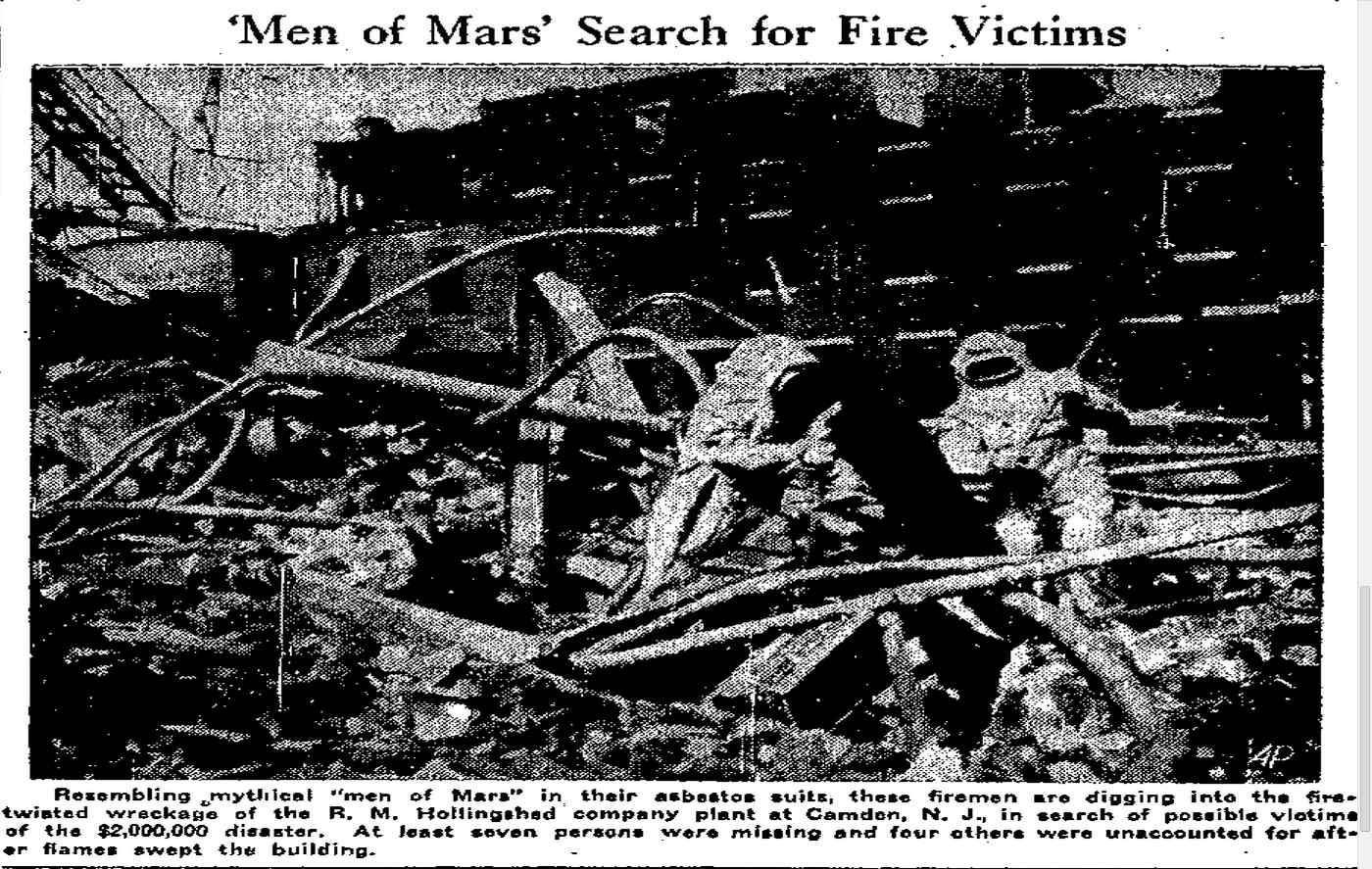
The morning after shows the extent of devastation near the point of origin. The total number of units operating at this incident including Camden County as well as the City of Philadelphia approached the equivalent of twenty alarms. Many of the ruins were so unstable that dynamite was used to raze the damaged properties. Outside storage tanks containing flammable product at the perimeter of the fire were saved through concerted efforts of firefighters with master streams. The building at the far left was the Hollingshead administrative office, and the only structure in the complex to survive the fire — it still stands today and is known as 800 Hudson Square. Rescue workers in asbestos suits search for the missing while demolition of what was left of the factory still standing takes place. Photo of the rear of 837 & 839 Market Street shows extensive damage to 839.
2 Dead, 10 Missing, 200 in Hospital, 50 Buildings Flat, After Camden Fire
New York PM —
By William Toumey
Two men are dead, 10 factory workers, including four girls, are missing and more than 200 persons are in hospitals this morning as the result of the fire at Camden, N.J. Heat melted the rubber boots of firemen and prevented them from searching for more victims in the smoldering ruins of the R.M. Hollingshead Co. paint factory.
One of the dead was Raymond Harter, 38, Collingswood, an employee of the company. The other was William Merrigan, 49, a Camden fireman who collapsed from the heat, died of heart disease.
The $2,000,000 fire and explosion destroyed the five-story factory and showered burning oil on nearby buildings. Fifty structures were destroyed.
The Red Cross is seeking shelter for the 1000 forced to quit their homes as the flames spread over a five-block area.
As additional New Jersey National Guardsmen were called to Camden during the night to aid in the search and prevent looting, police said it was impossible to believe that the 10 known missing survived. They were trapped in the factory as the explosion roared.
Even more victims may be found when the ruins cool enough to permit a search. All night and this morning, police and company officials were telephoning the homes of the factory employees to check on those who fled safely after the first explosion at 1 p.m.
At least 150 employees were working in the factory. Others may have returned from their lunch hour without knowledge of the foremen.
Police believe the first explosion may have been caused by heat exploding a can of naphtha. The Hollingshead Co. recently received a large order from the War Department, but work on it had not been started and the possibility of sabotage was ridiculed.
The state of emergency decreed in the fire area yesterday by Mayor George E. Brunner continued this morning. Police and Guardsmen patrolled the streets.
Late last night police had to rescue a volunteer fireman from an incensed crowd. They had seen him emerge from a ruined dwelling with his arms full of jewelry and clothing.
Recollections: Tom Agin
I remember the day fairly well. I was sitting at our dining room table doing a jigsaw puzzle when I heard the first explosion. It wasn’t until much later that I got to the fire scene and even now remember the heat and the total chaos. All quite frightening to a 13 year old.
But to the point. You mention three lads who were instrumental in preventing further explosions by opening up the hatches on a naptha tanker parked alongside the building. Here is what I learned, possibly that night or the following day, as to the identity of the three guys.
They were Lee E. Ryan, his brother Robert R. Ryan and Frank Kennedy, all of East State Street. They were all young. Lee could not have been more than fifteen and Robert and Frank a few years older at the time.
Lee E. Ryan and I grew up best friends from the mid 1930’s until his passing not too long ago. Knowing Lee I was not in the least surprised by his actions in this event.
Lee Thomas Ryan, from whom you got this story, is my God-son and my son is Thomas Lee Agin — that’s how close we were.
In 1949 I ended up working at the R.M. Hollingshead Corp plant at 16th and the Boulevard, the old Keystone Leather Works. I was there until 1959. While there I heard many stories from the old timers about how the wooden floors at the old plant were saturated with oils and waxes and went up like torches. Even at this location we had thousands of gallons of flammable solvents outside but very close to the building. Not only naptha, but petroleum, ether, acetone, and others even worse.
The Hollingshead Corp is now gone and most of the people once employed there.
Tom Agin
August 8, 2004
Recollections: Catherine Casselman Grenhart
Another memory… not a pleasant one, is of the strike at RCA. Men in their undershirts came up North 2nd St. from as far north as York Street, brandishing all sorts of “weapons”… sticks, baseball bats, etcetera… marching by our house on their way to RCA which was one block from our house. We were at Penn and RCA started at 2nd and Cooper in those days. The library in Johnson Park (in between our house and RCA) was just full of them. I only remember the first wave. I suppose my Dad loaded us into the car and drove us out to our place in the country… as he did when Hollingshead blew up.
I was in the dentist’s office on Cooper Street (Dr. John S. Owens, 407 Cooper Street — PMC) when we heard the first boom. Dr. Owens said “There goes another explosion at Dupont’s”… Yes, in those days we could hear explosions all the way up from Delaware… can you believe that?
I left the office to see the smoke billowing up at 10th and Cooper to see that oil(?) drums were shooting up into the air from the yard outside the building. It got so hot (we did not have air-conditioning) that we, again, were loaded into the car and driven out to the farm.
Catherine Casselman Grenhart
Camden High School Class of 1942
July, 2009
A Different View of the Color Photo
William Scholl — Camden Courier-Post, July 30, 1940
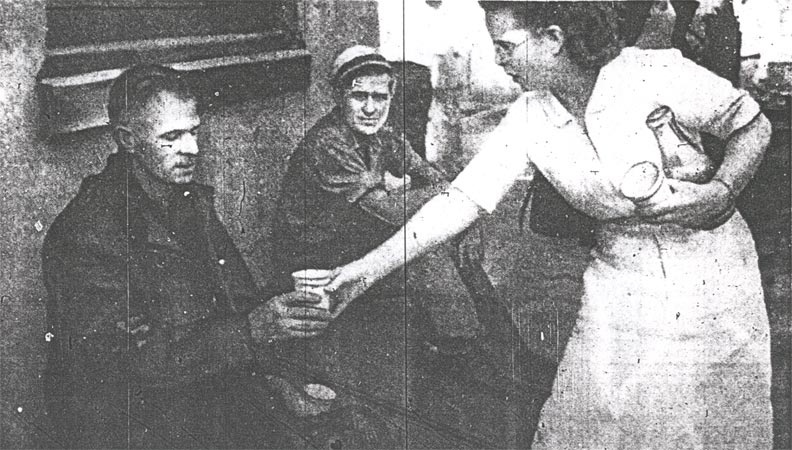

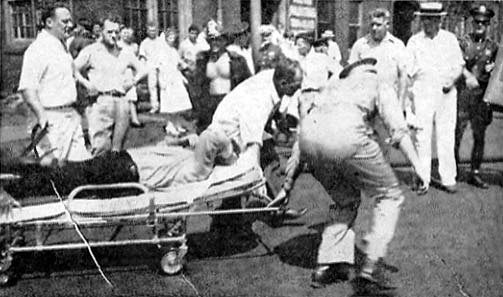
Hoseman William Scholl, of Engine Company 3, collapsed from the searing heat and was given ice water by Ruth Hamilton, white-clad Cooper Hospital nurse. Heavy rubber coats didn’t make the firemen’s jobs easier.
Augustus F. ‘Dewey’ Parker — Camden Courier-Post, July 31, 1940
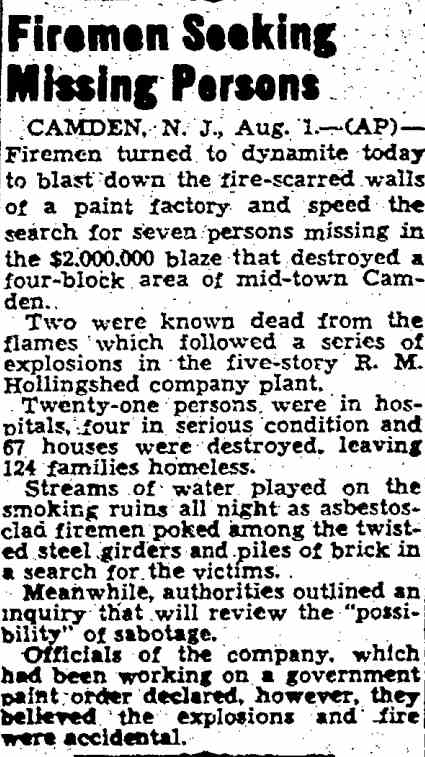
Greensboro Record — August 1, 1940
Trenton Times — August 2, 1940
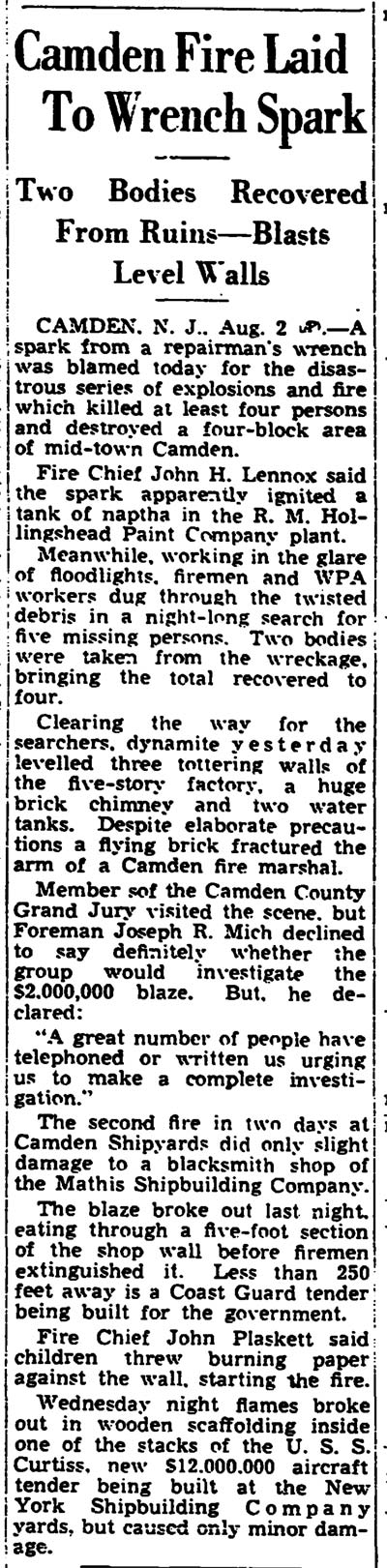
Camden Fire Laid To Wrench Spark
Two Bodies Recovered From Ruins—Blasts Level Walls
CAMDEN, N.J., Aug. 2 — A spark from a repairman’s wrench was blamed today for the disastrous series of explosions and fire which killed at least four persons and destroyed a four-block area of mid-town Camden.
Fire Chief John H. Lennox said the spark apparently ignited a tank of naptha in the R. M. Hollingshead Paint Company plant.
Meanwhile, working in the glare of floodlights, firemen and WPA workers dug through the twisted debris in a night-long search for five missing persons. Two bodies were taken from the wreckage, bringing the total recovered to four.
Clearing the way for the searchers, dynamite yesterday levelled three tottering walls of the five-story factory, a huge brick chimney and two water tanks. Despite elaborate precautions a flying brick fractured the arm of a Camden fire marshal.
Member of the Camden County Grand Jury visited the scene, but Foreman Joseph R. Mich declined to say definitely whether the group would investigate the $2,000,000 blaze. But he declared: “A great number of people have telephoned or written us urging us to make a complete investigation.”
The second fire in two days at Camden Shipyards did only slight damage to a blacksmith shop of the Mathis Shipbuilding Company. The blaze broke out last night, eating through a five-foot section of the shop wall before firemen extinguished it. Less than 250 feet away is a Coast Guard tender being built for the government.
Fire Chief John Plaskett said children threw burning paper against the wall, starting the fire.
Wednesday night flames broke out in wooden scaffolding inside one of the stacks of the U.S.S. Curtiss, new $12,000,000 aircraft tender being built at the New York Shipbuilding Company yards, but caused only minor damage.
Baton Rouge Advocate — August 2, 1940
Jewels and $341 Hard Cash Escape Fire
Camden Courier-Post —
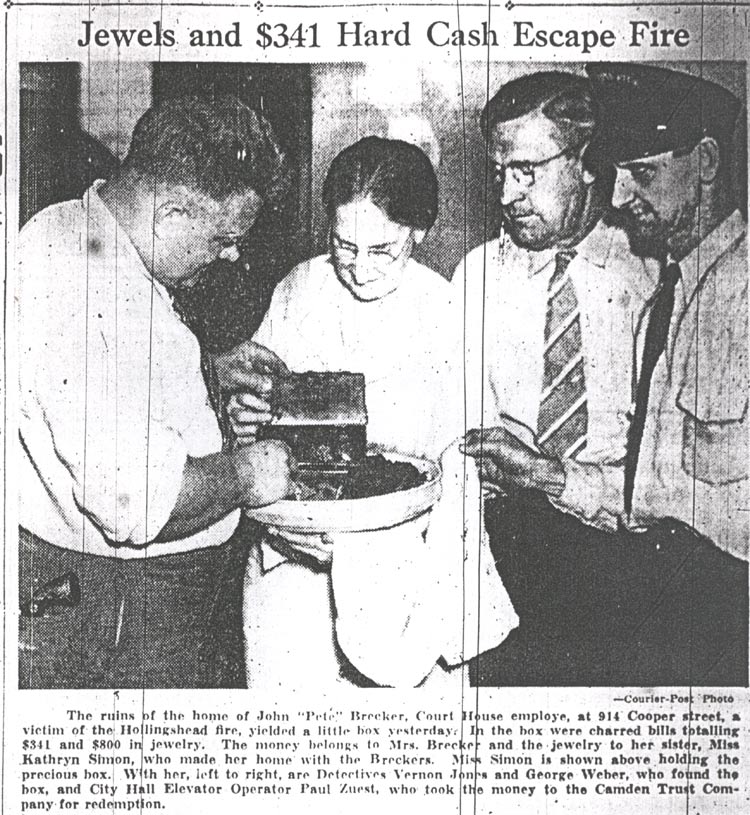

Jewels and $341 Hard Cash Escape Fire
Jewels and $341 Hard Cash Escape Fire
The ruins of the home of John "Pete" Brecker, Court House employe, at 914 Cooper street, a victim of the Hollingshead fire, yielded a little box yesterday. In the box were charred bills totaling $341 and $800 in jewelry. The money belongs to Mrs. Brecker and the jewelry to her sister, Miss Kathryn Simon, who made her home with the Breckers. Miss Simon is shown above holding the precious box. With her, left to right, are Detectives Vernon Jones and George Weber, who found the box, and City Hall Elevator Operator Paul Zuest, who took the money to the Camden Trust Company for redemption.
Camden Courier-Post — July 24, 1941
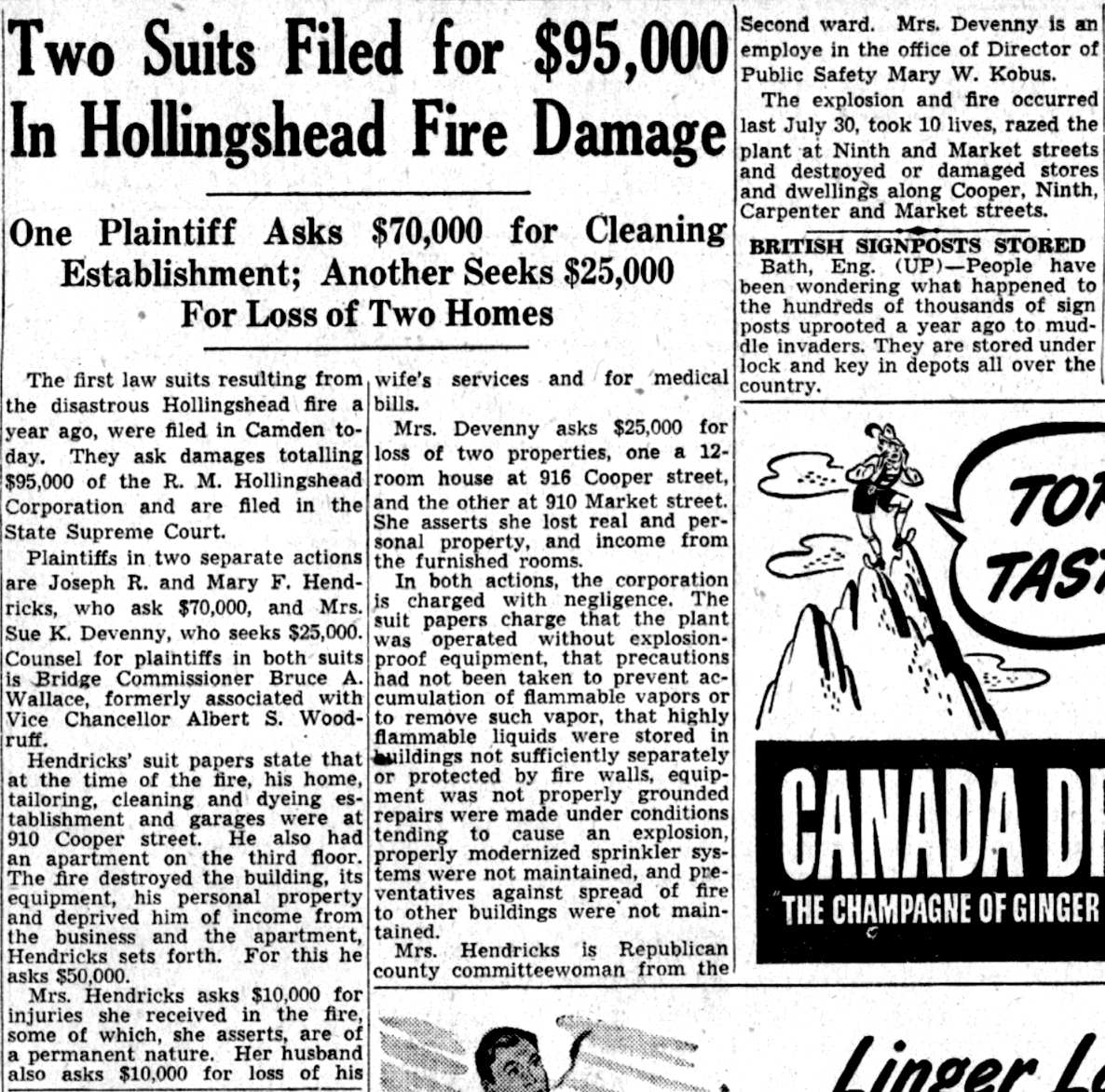
Two Suits Filed for $95,000 In Hollingshead Fire Damage
TWO SUITS FILED FOR $95,000 IN HOLLINGSHEAD FIRE DAMAGE
One Plaintiff Asks $70,000 for Cleaning Establishment; Another Seeks $25,000 For Loss of Two Homes
The first law suits resulting from the disastrous Hollingshead fire a year ago today were filed in Camden in the State Supreme Court. They ask damages totalling $95,000 of the R. M. Hollingshead Corporation and are filed in the State Supreme Court.
Plaintiffs in two separate actions are Joseph R. and Mary F. Hendricks, who ask $70,000, and Mrs. Sue K. Devenny, who seeks $25,000. Counsel for plaintiffs in both suits is Bridge Commissioner Bruce A. Wallace, formerly associated with Vice Chancellor Albert S. Woodruff.
Hendricks' suit papers state that at the time of the fire his home, tailoring, cleaning and dyeing establishment and garages were at 910 Cooper street. He also had an apartment on third floor. The fire destroyed the building, its equipment, his personal property and deprived him of income from the business and the apartment, Hendricks sets forth. For this he asks $50,000.
Mrs. Hendricks asks $10,000 for injuries she received in the fire, some of which, she asserts, are of a permanent nature. Her husband also asks $10,000 for loss of his wife's services and for medical bills.
Mrs. Devenny asks $25,000 for loss of two properties, one a 12-room house at 916 Cooper street, and the other at 901 Market street. She asserts she lost rent and personal property, and income from the furnished rooms.
In both actions, the corporation is charged with negligence. The suit papers charge that the plant was operated without explosion-proof equipment, that precautions had not been taken to prevent the accumulation of flammable vapors or to remove such vapor, that highly flammable liquids were stored in buildings not sufficiently separately protected by fire walls, equipment was not properly grounded repairs were made under conditions tending to cause an explosion, properly modernized sprinkler systems were not maintained, and preventatives against spread of fire to other buildings were not maintained.
Mrs. Hendricks is Republican county committeewoman from the Second ward. Mrs. Devenny is an employe in the office of Director of Public Safety Mary W. Kobus.
The explosion and fire occurred last July 30, took 10 lives, razed the plant at Ninth and Market streets and destroyed or damaged stores and dwellings along Cooper, Ninth, Carpenter and Market streets.
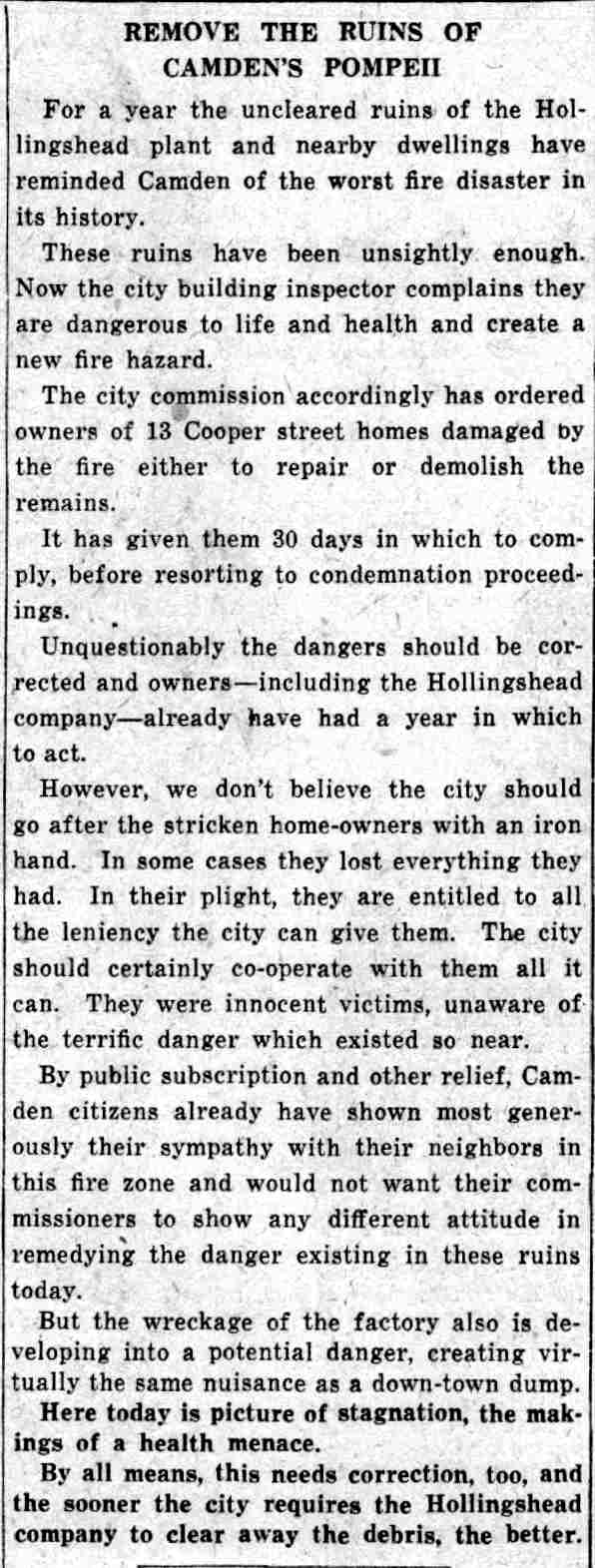
Camden Courier-Post — July 26, 1941
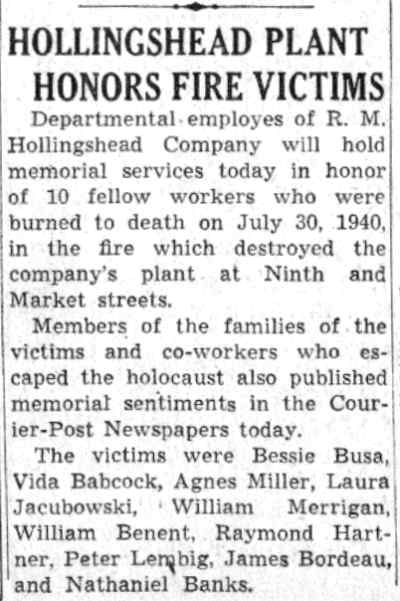
Camden Courier-Post — July 30, 1941
Camden Courier-Post — July 31, 1941
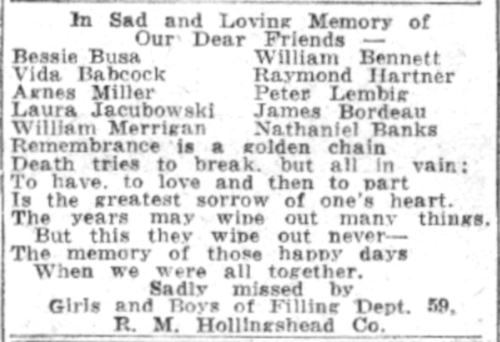
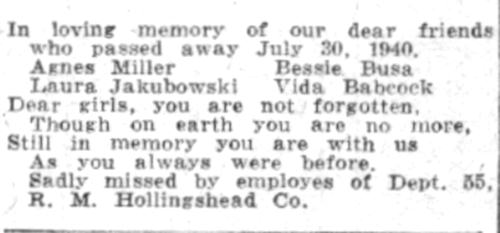
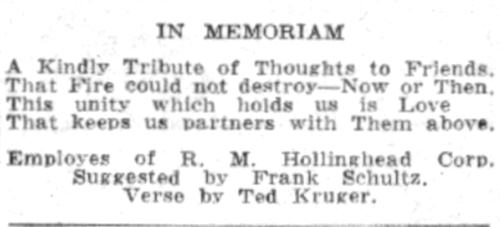
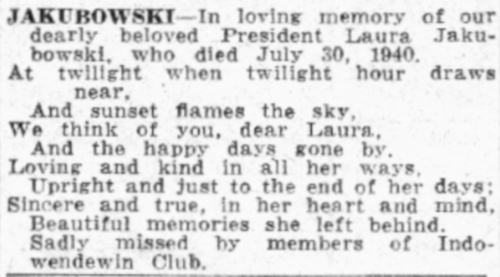
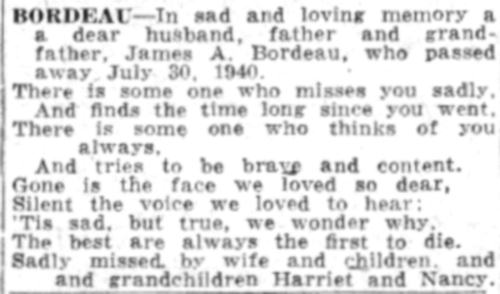
IN LOVING MEMORY
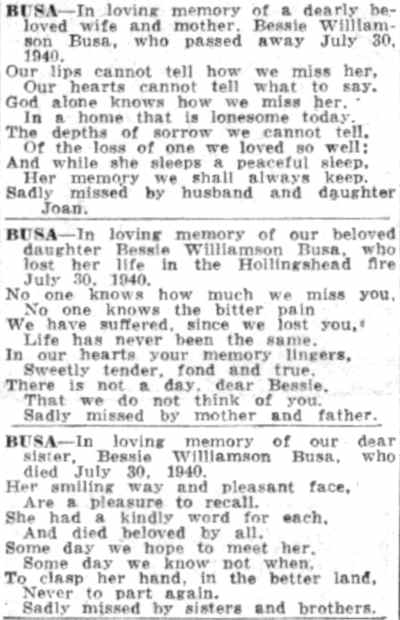
BUSA — In loving memory of a dearly beloved wife and mother, Bessie Williamson Busa, who passed away July 30, 1940.
Our lips cannot tell how we miss her,
Our hearts cannot tell what to say.
God alone knows how we miss her,
In a home that is lonesome today.
The depths of sorrow we cannot tell,
Of the loss of one we loved so well;
And while she sleeps a peaceful sleep,
Her memory we shall always keep.
Sadly missed by husband and daughter Joan.
—
BUSA — In loving memory of our beloved daughter Bessie Williamson Busa, who lost her life in the Hollingshead fire July 30, 1940.
No one knows how much we miss you,
No one knows the bitter pain
We have suffered, since we lost you,
Life has never been the same.
In our hearts your memory lingers,
Sweetly tender, fond and true,
There is not a day, dear Bessie,
That we do not think of you.
Sadly missed by mother and father.
—
BUSA — In loving memory of our dear sister, Bessie Williamson Busa, who died July 30, 1940.
Her smiling way and pleasant face,
Are a pleasure to recall.
She had a kindly word for each,
And died beloved by all.
Some day we hope to meet her.
Some day we know not when,
To clasp her hand, in the better land,
Never to part again.
Sadly missed by sisters and brothers.