Kaighn Public School
The Kaighn School was one of the first schools built in Camden by its Board of Education. Camden Board of Education used some of its funding to construct schools to accommodate the hundreds of scholars on the school system’s waiting list. New Jersey had no compulsory education law at this time, so the district allowed only as many scholars to enroll as there were seats in the classrooms. The Kaighn Family donated land on Newton Avenue, below Chestnut Street, to the board, and they hired Mr. James W. Shroff, a prominent contractor (and Mayor of Camden in 1856 and 1857), to erect a school with the money borrowed from the Legislature under the supervision of architect Lewis E. Joy. The school, named the Kaighn School after the benefactors, on motion of Isaac W. Mickle, was 45 feet wide by 75 feet deep, stood two-stories high, and had large and airy rooms. The school had a capacity of more than 570 students, and an average class size of 64 scholars. The school was ready for occupancy on January 1, 1855, at a cost of $13,000.
The Kaighns were a prominent Camden family. Joseph Kaighn, a grandson to John Kaighn, the first to settle at Kaighn’s Point, constructed a house that formerly stood on the southeast corner of Front Street and Kaighn Avenue, known as the South Ferry Hotel, and occupied by him until he died in 1797. His son, also Joseph Kaighn, was one of Camden’s leading citizens, a state legislator and a senator, and began the first ferryboat crossing from Kaighn’s Point to Philadelphia in 1809. He greatly aided his sister Sarah in her business, and she, in turn gave him a valuable piece of property. He proposed, instead, to have her convey the lot to the Camden Board of Education for school purposes. It was on this lot that the board erected the Kaighn School.
Over the summer of 1890, the board voted to have a new school built on the property contiguous with the Kaighn School, on Chestnut Street and Newton Avenue, opposite the termination of Fifth Street. They hired Moses, King, & Co. as architects for the project, but a problem developed over land ownership. Camden City Council insisted that the land did not belong to the Camden Board of Education, so the board created a committee of three to examine the title of the land, but they could not find a paper title. The solicitor assured them that, through “adverse possession, or twenty years of peaceful possession of the property,” the land belonged to the Camden Board of Education.
The following month the committee reported that everything was fine with the title, and the school board authorized John Corbett to build the school on Chestnut Street, and for building an extension to the Mount Vernon School. The Mount Vernon School closed in September 1890, and remained closed until he completed the work on December 12. Work began on a new school, next to the Kaighn School site, in August. However, City Council was not convinced that the property belonged to the board, instead of the city. In addition, construction of the school occurred in such a way that if sometime in the future City Council wanted to extend Fifth Street southward; council had to lengthen the street right through the school. The board opted to erect the school there because board members felt (and as more than a century showed, felt correctly) that City Council would never go through the expense of extending Fifth Street southward at that point.
City Councilman Lord threatened to obtain an injunction to stop the construction. The board was chagrined because the recent school census count indicated that there were nearly a thousand children in the area, and there were not enough schools in the neighborhood. In late August, Councilman Lord introduced legislation to open “5th Street, south from Chestnut to Kaighn Avenue.” Lord demanded immediate passage, but the addition of an amendment preventing the board of education from erecting a new school on Chestnut Street, and closing a nearby 20-foot alley to the public, forced the resolution to the Council’s Streets Committee.
Although City Council took no action, the board notified its builder, in September, to stop erecting the school, and two months later, Corbett, realizing that he would not be constructing the Fifth and Chestnut Streets’ school, settled with the board. The board did not want a fight with city government, so they dropped pursuit of the title, and purchased seven lots on Mount Vernon Street, west of Fifth Street, for the sum of $7,500. The architect altered the plans to fit the new location, and in June 1890, the board awarded John Corbett the construction contract. In 1904, after 50 years of use, the Kaighn School finally was rebuilt on the same location.
In mid-February 1929, Superintendent of Schools Dr. James Bryan learned of the sale of tickets of chance in the school system. Mr. Charles F. Otto, Principal of Kaighn School reported the incident in response to published accounts in the papers of the selling of chances at his school. The board questioned the principal and two students, Nicholas Perino and Charles Menequale. Otto recounted that on the playground, a pupil, Leon Gendler, complained to him that Charles Menequale threatened him with harm, if he [Leon] did not give him money. For this attempted extortion of money, Mr. Otto reprimanded Charles. Disregarding the warning, however, Charles continued his threats for money, and Leon again complained to the principal. Consequently, Otto summoned both boys to the office, and learned that Charles was coercing Leon to extort money from others in order to play a form of lottery. Otto decided it was advisable to inform the police, and let them make a full investigation. The board appointed a committee of three to work with the police, and to investigate further the sale of lottery tickets in the schools. The committee exonerated Mr. Otto from all blame in reference to the published accounts in the papers, and the board complimented him for his promptness in reporting the incident. The board directed the superintendent to instruct principals to cooperate “in stamping out the evil of school children selling or buying lottery chances.”
The Kaighn School was still in use as late as 1947, with Camden High School graduate Rosalia Cioffi as principal.
In the fall of 1948, declining enrollment forced the closing of the Kaighn School’s “sister school,” the C.A. Bergen School, which stood at 419 Mount Vernon Street. Camden’s schools were integrated that year as well. Mendel Tubis took over as principal of the Kaighn School in 1948. Although the building was relatively new compared to others in the city, it was determined during the 1948–1949 school year that the heating system needed to be completely replaced. With that in mind, on May 31, 1949 the school board voted to close the Kaighn School and reopen the C.A. Bergen School, which had been shut down the year before. A similar move was also made involving closing the Jesse W. Starr School and moving the students to the Mt. Vernon School.
The Kaighn School’s yard was almost immediately put in use as a parking lot. On July 30, 1952 the school and two other buildings in the neighborhood were set ablaze. The abandoned school was utterly destroyed, and the lot was soon cleared and paved to provide additional parking.
The lot where for almost a century the Kaighn School’s students once learned and played has stood empty for many, many years.
Photos
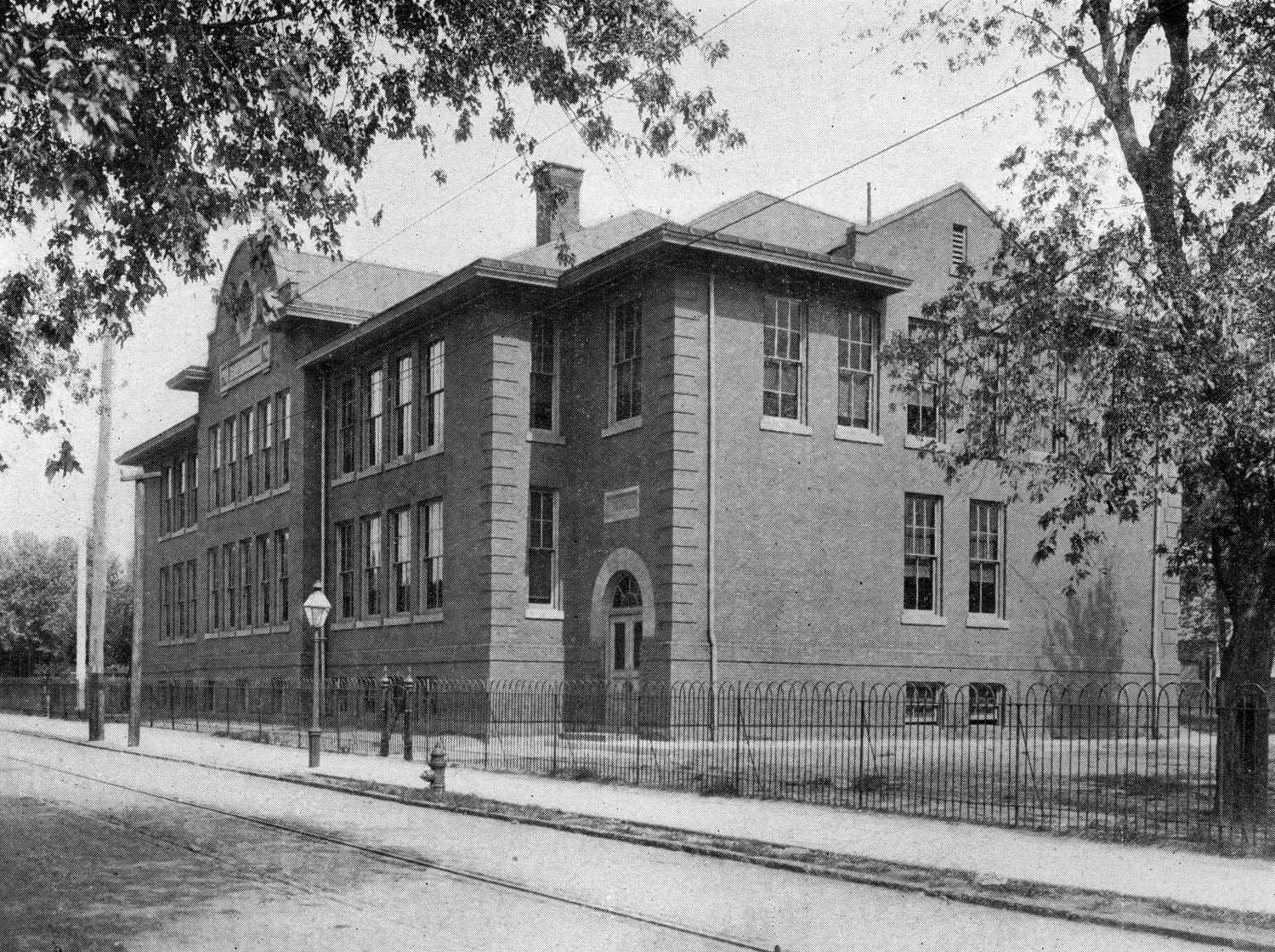
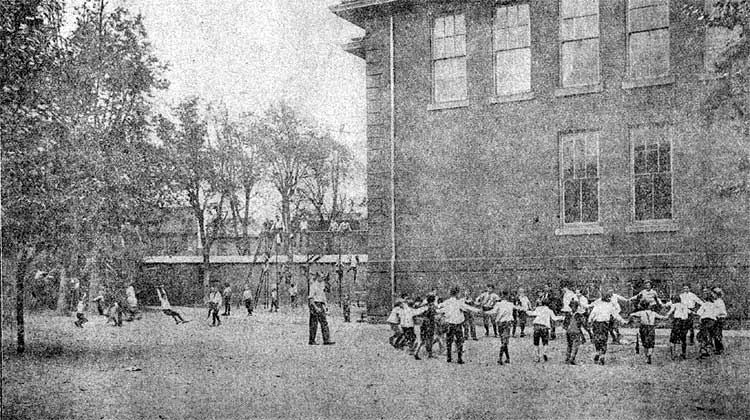
Janitor Election Controversy
Philadelphia Inquirer —
At a meeting of the Camden Board of Education last night, Frank H. Green, at present a policeman in the Fifth ward, was elected janitor of the Kaighn school by a vote of 10 to 4 cast for Howard Sharp. No sooner had President Carson announced the vote, and declared Green elected, than Martin, a Republican from the Seventh ward, and a supporter of Sharp, jumped to his feet and charged two of the members of the board with not being entitled to their seats, but refused to give any names. The board then adjourned amidst much confusion.
Howard Sharp — Frank H. Green — James R. Carson — Edward A. Martin
First Free School Opened to Public
Camden Post-Telegram —
FIRST FREE SCHOOL OPENED TO PUBLIC
Contents of Corner Stone Settles Question of Date Building Was Erected.
SOME OF THE PAPERS DESTROYED
By the finding of the corner stone in the foundation of the Kaighn school, at the intersection of Sycamore street, Fourth street and Newton avenue, Saturday, all doubts were dispelled as to when the building was erected.
Owing to the fact that all of the records appertaining to the school have either been lost or destroyed considerable discussion has been had throughout the city as to the date and the contractors were given especial instructions to be careful in locating the stone and to see that its contents were preserved as far as possible.
The workmen had about given up hope of discovering the stone when about 11 o’clock one of them, in digging out the lower course of stone of the foundation walls, came across an odd shaped block. He struck it with a pick and the top came off disclosing two glass jars within.
The corner stone was taken to the workshop of the contractors and examined. It was found to be of white marble 16 inches long, 9 inches wide, 3 inches deep. The jars were in a niche 10 inches long, 6 inches wide and 5 inches deep.
The first jar opened contained a number of coins bearing the date 1853 and a quantity of paper reduced to pulp by the action of the elements. When this mass was taken out and dried it resembled powder.
The other jar contained a copy of the city charter; a copy of the ordinances of City Council, while R. W. Howell was the presiding officer; the specifications of the building, of which Lewis E. Foy was the architect. These were all water soaked.
In a good state of preservation after being dried were found two copies of the The Reformer and New Jersey Temperance Advocate, respectively, dated December 14 and 21, 1853; The Camden Democrat, December 24, 1853, Isaac Mickle, editor; The West Jerseyman, December 14 and 21, 1853, Philip J. Gray, editor; The American Banner, December 17 and 24, 1853, John H. Jones, editor; address of the Native American National Convention to the citizens of the United States with a copy of the resolutions adopted July 5 and 7, 1845.
The documents will be turned over to J. W. F. Bleakly, secretary of the Board of Education and it is more than likely that some of them will be placed in the corner stone of the new building, to be erected on the site of Camden’s first public school.
Parent-Teacher Association News
Camden Courier-Post —
Kaighn— Founders Day will be observed at the meeting February 15. Music will be furnished by the WPA orchestra. There will be a white elephant party after the meeting.
Joseph Balzano, 11, Selected As City's No. 1 Young Citizen
Camden Courier-Post —
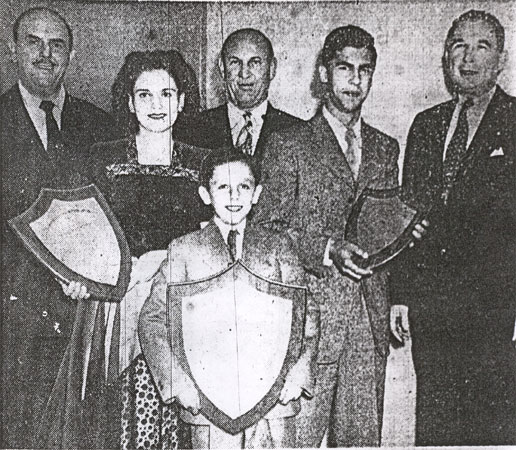

Camden’s outstanding young citizen for 1945, Joseph Balzano, Jr., a sixth grade pupil at Kaighn School, wants to be a “bone doctor” so that he can help other children get well again.
Last night before an audience of more than 500 adults and pupils this courageous youngster, the son of a longshoreman, accepted with calm dignity and a radiant smile the tumultuous applause that greeted the announcement he had been picked for this high honor in the annual contest sponsored by the Camden Lodge of Moose.
Known only to a few of the audience that taxed the capacity of the city hall commission chamber was the father of the “champ,” Joseph Balzano Sr., who after quitting work in Philadelphia rushed to Camden in time to hear his son called to the platform to receive a certificate naming him the outstanding citizen of his own school.
The audience virtually shrieked its approval of young Joe’s selection. His surprised and excited father naturally jumped up and down for joy as the lad, attired in a gray suit with long trousers walked to the platform where he was received by Stan Lee Broza, director of the radio “Children’s Hour” program; Dr. Ethan A. Lang, governor of the local lodge of Moose; Mayor Brunner and Supreme Court Justice Donges, Past Supreme Governor of the Loyal Order of Moose.
Broza presented the outstanding youth plaque to the winner. Justice Donges gave a plaque to Miss Emilia Corda, 16, of 1104 South Fourth Street, Camden High School junior, winner of the second award. Dr. Lang also gave a plaque to James Zitz, 16, of 702 Florence Street, Camden Catholic High School junior, who won the third award.
Suffered Blood Poisoning
Young Joe Balzano never dreamed as he lay on his pain-wracked cot in Hahnemann Hospital in January and February last year that this great honor would come to him. Joe had blood poisoning in his left leg. He suffered excruciating pain.
When the doctors stuck needles in his leg every two hours, day after day, he never cried. He only wanted to do one thing — go back to school.
When he was brought home he was told he could not go to school. Members of the Camden Board of Education, of which Dr. Lang is president, assigned Miss Clara Mantini to give him home instructions. That was almost like going to school. Joe went back to school and ended the term in the upper quarter of his class, Miss Mantini said.
After he was whisked into a side room to escape well-wishers, fellow pupils and others who wanted to shake his hand, this typical American lad, taking it all in stride sat down to be interviewed.
Tells of Ambition
“My ambition in life is to be a bone doctor,” he said. “While I was in the hospital I watched the doctors and nurses who treated me so fine. They told me I would walk again, and I did. I want to be that kind of doctor so I can help other boys and girls who were stricken as I was. I want to do something when I become a man to show my gratitude for what was done for me by the doctors in the Hahnemann hospital.”
Obtaining a perfect score of 80 points in the contest, young Balzano was rated for courtesy, kindness, trustworthiness, sportsmanship, cleanliness, obedience, thrift, loyalty, reverence, leadership, cooperation, punctuality, initiative, leisure time activities, school activities — extra curricula and social attitude.
His regular teacher, Miss Rosolia Cioffi, gave him a testimonial to the judges. She lauded his courageous spirit, among other attributes.
Rev. Michael Argullo, acting pastor of Our Lady of Mt. Carmel Church, had this to say about Joe. “He is an outstanding boy endowed with many fine qualities. He is a boy of fine character, manly, a good sport, faithful to his religious duties and has the necessary qualifications for the honor of the outstanding young citizen.”
Miss Mantini, who taught him at home, added this: “He is pleasant, good natured and above all, a courageous boy. I have never known him to complain. There are many words I could use to describe Joe, but I prefer you see and speak to him personally.”
Mrs. John Beskett, director of recreation, Deaconess Home and Community center, also praised the citizen award winner. As a member of the center’s boys club, she said, he accepts responsibility, is honest, trustworthy, ambitious and is willing at all times to help others.
The winner and the two runners up will receive two additional awards. Sunday all will appear on the “Children’s Hour” broadcast over WCAU at 11:30 AM.
Going to Washington
In addition, they will be taken on a two-day trip to Washington. The escorts will be Justice and Mrs. Donges.
Mayor Brunner said the three winners and each of those picked as outstanding citizen of the other public and parochial schools are the future citizens of the community, state and nation. The mayor congratulated all the outstanding young citizens and praised the local lodge of Moose for conducting its second annual award program.
Offering his congratulations, Justice Donges warned against optimism over the early end of the war with Japan. Sacrifices on the home front, he added, must be endured until the victory is won.
Dr. Lang presided at the exercises. Rev. William L. McKeever, assistant rector of the Cathedral of the Immaculate Conception, gave the invocation. Vocal selections were given by the Cooper School choir under the direction of Mrs. Anna Malloy. Rev. Everett W. Palmer, pastor of Centenary-tabernacle Methodist Church, offered benediction.
Among those attending were Leon N. Neulen, superintendent of public schools; Daniel R. Weigle, executive vice-president, county Chamber of Commerce; David Balsam, director of youth activities, Federation of Jewish Charities, and Mrs. Alice K. Predmore, member of the Camden Board of Education.
Close 2 Buildings
Camden Courier-Post —
To avoid installation of new heating system in the Kaighn school, and complete renovation and extensive repairs to Starr school, the board voted to close both buildings, with pupils of the former school to be sent to Bergen school, and those from Starr school to be sent to the Mt. Vernon school. Bergen and Mt. Vernon school buildings will be reopened in September. They were closed last June because of the board’s integration program.
C.A. Bergen School — Jesse W. Starr School — Mt. Vernon School
Police Investigate 3 Fires in 4 Hours In One Section
Camden Courier-Post —
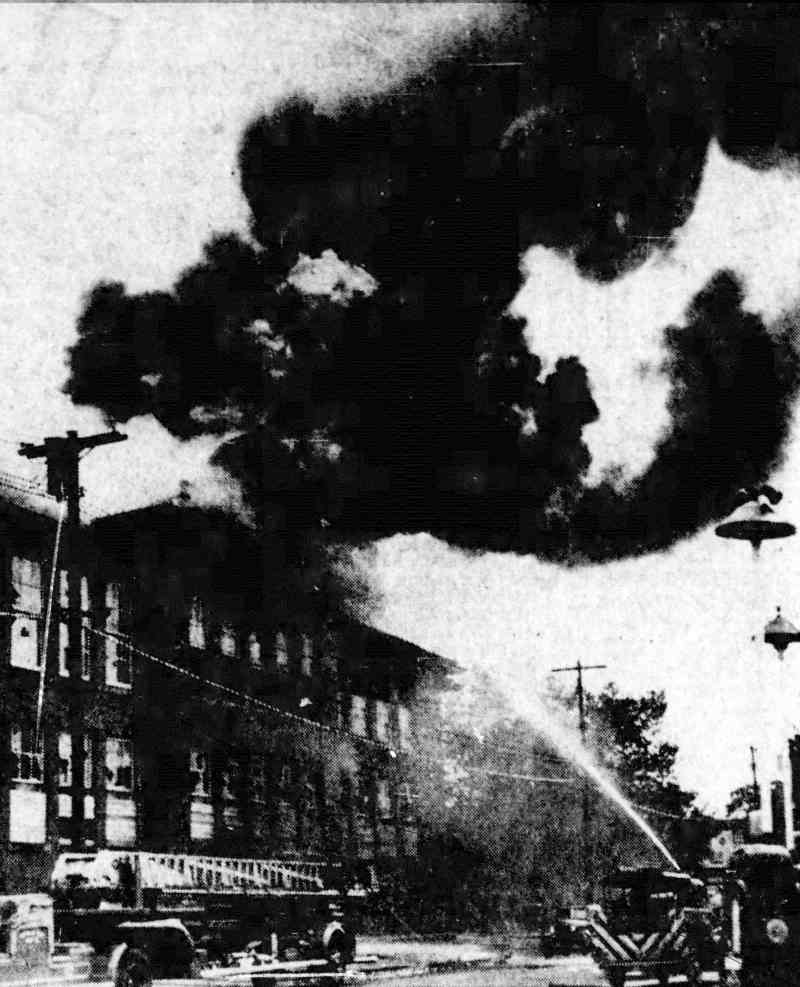
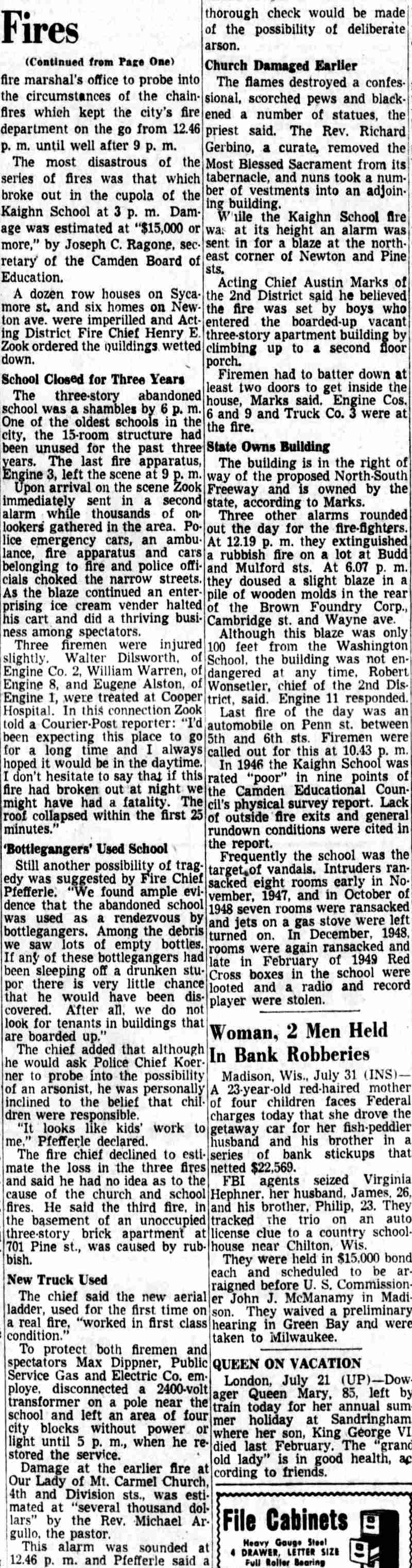
Kaighn School Razed; Blazes Set in Church, Unoccupied House
Police today are investigating the possibility that three fires Wednesday within a quarter-mile area inside of three hours and 46 minutes were the work of a firebug.
The blaze which razed the Kaighn School, 5th and Chestnut sts., seriously damaged Our Lady of Mt. Carmel R. C. Church, 4th and Division sts., and consumed a pile of rubbish in the basement of an unoccupied three-story house at 7th and Pine sts., came on the 12th anniversary of the disastrous Hollingshead fire.
That fire, on July 30, 1940, leveled the R. M. Hollingshead plant, then located at 9th and Market sts., took 10 lives and caused an estimated $4 million damage, according to city fire department records. It was Camden’s worst fire.
Police Chief Koerner, commenting on Wednesday’s fires which caused damage estimated at more than $17,000, said: “We are going to make a thorough study of every available clue to see whether the fires could have been started by one person.”
Koerner, Pfefferle Investigate
Fire Chief Pfefferle agreed with Chief Koerner and said that he had already requested the fire marshal’s office to probe into the circumstances of the chain of fires. He kept the city’s fire department on the go from 12:46 p.m. until well after 9 p.m.
The most disastrous of the series of fires was that which broke out in the cupola of the Kaighn School at 3 p.m. Damage was estimated at “$15,000 or more,” by Joseph C. Ragone, secretary of the Camden Board of Education.
A dozen row houses on Sycamore st. and six homes on Newton ave. were imperilled and Acting District Fire Chief Henry E. Zook ordered the buildings wetted down.
School Closed for Three Years
The three-story abandoned school was a shambles by 6 p.m. One of the oldest schools in the city, the 15-room structure had been unused for the past three years. The last fire apparatus, Engine 3, left the scene at 9 p.m.
Upon arrival on the scene Zook immediately sent in a second alarm while thousands of onlookers gathered in the area. Police emergency cars, an ambulance, fire apparatus and cars belonging to fire and police officials choked the narrow streets. As the blaze continued an enterprising ice cream vender halted his cart and did a thriving business among spectators.
Three firemen were injured slightly. Walter Dilsworth, of Engine Co. 2, William Warren, of Engine 8, and Eugene Alston, of Engine 1, were treated at Cooper Hospital. In this connection Zook told a Courier-Post reporter: “I’d been expecting this place to go for a long time and I always hoped it would be in the daytime. I don’t hesitate to say that if this fire had broken out at night we might have had a fatality. The roof collapsed within the first 25 minutes.”
‘Bottlegangers’ Used School
Still another possibility of tragedy was suggested by Fire Chief Pfefferle. “We found ample evidence that the abandoned school was used as a rendezvous by bottlegangers. Among the debris we saw lots of empty bottles. If any of these bottlegangers had been sleeping off a drunken stupor there is very little chance that he would have been discovered. After all, we do not look for tenants in buildings that are boarded up.”
The chief added that although he would ask Police Chief Koerner to probe into the possibility of an arsonist, he was personally inclined to the belief that children were responsible.
“It looks like kids’ work to me,” Pfefferle declared.
The fire chief declined to estimate the loss in the three fires and said he had no idea as to the cause of the church and school fires. He said the third fire, in the basement of an unoccupied three-story brick apartment at 701 Pine st., was caused by rubbish.
New Truck Used
The chief said the new aerial ladder, used for the first time on a real fire, “worked in first class condition.”
To protect both firemen and civilians Max Dippner, Public Service Gas and Electric Co. employe, disconnected a 2400-volt transformer on a pole near the school and left an area of four city blocks without power or light until 5 p.m., when he restored the service.
Damage at the earlier fire at Our Lady of Mt. Carmel Church, 4th and Division sts., was estimated at “several thousand dollars,” by Rev. Michael Argullo, the pastor.
Kaighn School Site Rented as Parking Lot
Camden Courier-Post —
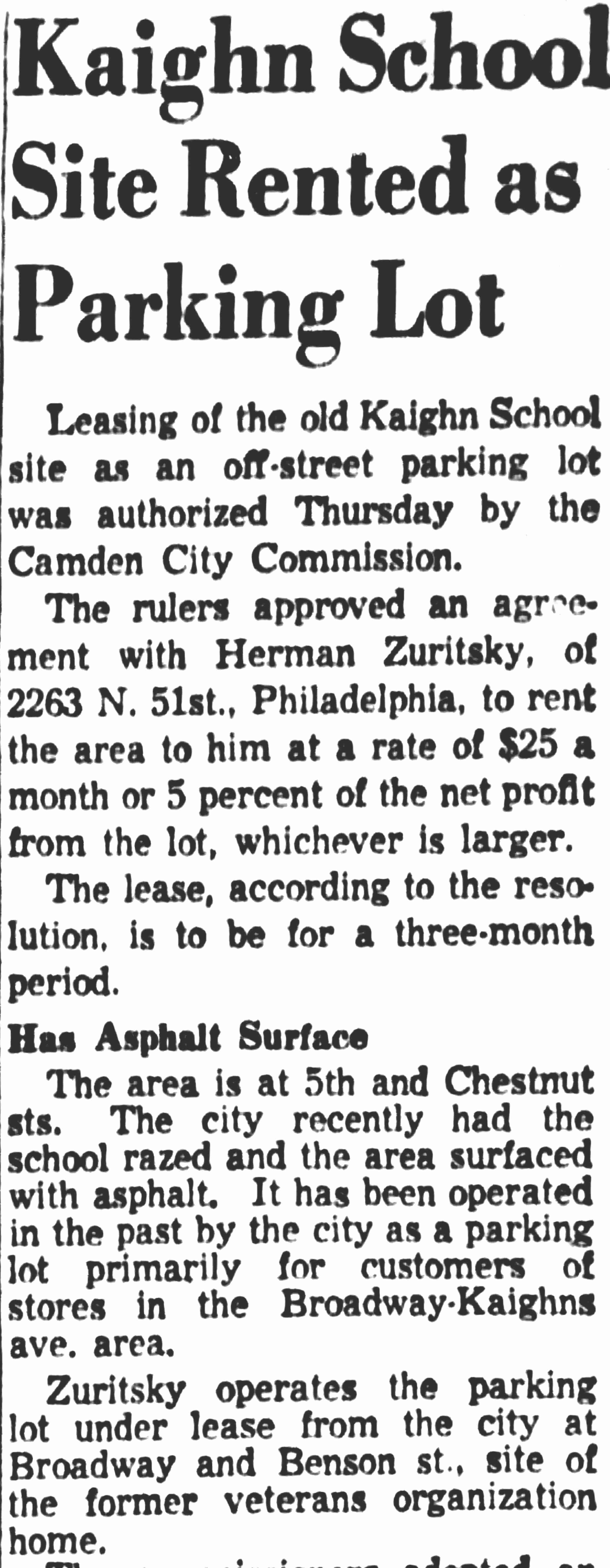
Leasing of the old Kaighn School site as an off-street parking lot was authorized Thursday by the Camden City Commission.
The rulers approved an agreement with Herman Zuritsky, of 2263 N. 51st., Philadelphia, to rent the area to him at a rate of $25 a month or 5 percent of the net profit from the lot, whichever is larger.
The lease, according to the resolution, is to be for a three-month period.
Has Asphalt Surface
The area is at 5th and Chestnut sts. The city recently had the school razed and the area surfaced with asphalt. It has been operated in the past by the city as a parking lot primarily for customers of stores in the Broadway–Kaighns ave. area.
Zuritsky operates the parking lot under lease from the city at Broadway and Benson st., site of the former veterans organization home.
Sources
Thanks to Fred Reiss, Ed.D., for writing the defining book on public education in Camden prior to 1948, PUBLIC EDUCATION IN CAMDEN, N.J. — From Inception to Integration, from which much of the above history of the Kaighn School is derived.