John J. Mogck Jr.
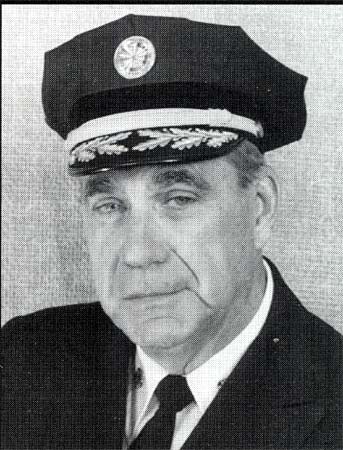
Chief John J. Mogck Jr.
JOHN J. MOGCK JR. was born November 21, 1921 to John and Mary Mogck. The family resided at 40 Wood Street in North Camden. The elder Mogck worked as a bus driver.
John Mogck's widowed grandmother, Maggie Mogck had come from Philadelphia to Camden sometime after 1906 with her sons John, William, Edward, Henry, and a son from a previous marriage, James Walker. The 1910 Census shows the family at 227 Burns Street, in the Poets Row section of North Camden. By 1914, Maggie Mogck and sons were living at 55 North Street. When, in June of 1917 the time came for America's young men to register for the draft, John Mogck Sr. had married. The young couple lived at 31 Wood Street. They soon would move to 40 Wood Street, where they raised their children. The first was a daughter, Eleanor, then John Mogck Jr., and by 1930 there were three more children, Thomas Edward, and Marie. At least one more child, Betty, was born during the 1930s.
John Mogck Jr. attended school at the Holy Name Roman Catholic Church school and graduated from Camden Catholic High School. He had attended St. Francis College in Loretto, Pennsylvania when called to arms after the Japanese attack on Pearl Harbor.
On April 3rd, 1942 units of the Camden Fire Department's First Battalion were responding to an alarm at Point and Erie Streets, North Camden. A group of children were on their way to a birthday party for nine-year-old, Betty Mogck. The group of excited birthday celebrants, hearing the fire engines coming, ran into the street to see where they were going. As Engine Company 2 was making the turn at Erie Street, the Chauffeur, Fireman Harry Kleinfelder pulled hard on the wheel to avoid running over the children but not before striking little Betty Mogck. The apparatus swerved to the side of the street, sheared off a utility pole and came to rest on the pavement. Two members were hurled to the ground, slightly injured. Betty's older brother, John, was down the block talking with friends and came running up the street. Betty Mogck was rushed to Cooper Hospital suffering from a broken leg. Firemen William Hopkins and Harry Haines were treated for bruises and released. Years later, Betty's brother, John J. Mogck, Jr. would himself enter the Department and rise from the ranks of Probationary Fireman to retire as Chief of Department.
John J. Mogck Jr. was assigned to the 115th AAA Gun Battalion (mobile). This unit organized at Camp Davis, North Carolina in March of 1943, and left for England via New York in December of that year. The 115th participated in the Battle of Britain (anti-aircraft defense of London), the landings at Normandy at Omaha Beach in June 1944 and fought its way across France and into Germany with Patton's Third Army. The battalion was present at the Third Army's crossing of the Rhine in 1945, and finished the war at Abensberg, Germany. John Mogck Jr. had been promoted to Technical Sergeant and had been awarded the Bronze Star by the time he was discharged from the Army.
After the war John J. Mogck Jr. returned to Camden and the family home at 40 Wood Street. The 1947 City Directory lists his occupation as student, indicating that he had returned to college. At 50 Wood Street, a neighbor, Ervin Brennan, had joined the Camden Fire Department. Interestingly enough, of the 20 houses standing on Wood Street in 1947, at least four had family members or relatives who either had been, were in, or would be members of the Camden Fire Department, the other two men being Philip Bocelli and Joseph J. Randik Jr.
John J. Mogck Jr. joined the Camden Fire department on January 13, 1951. Early in his career he was assigned to Ladder Company 1, based at Fire Headquarters at North 5th Street and Arch Street. He also was detailed for service in other capacities.
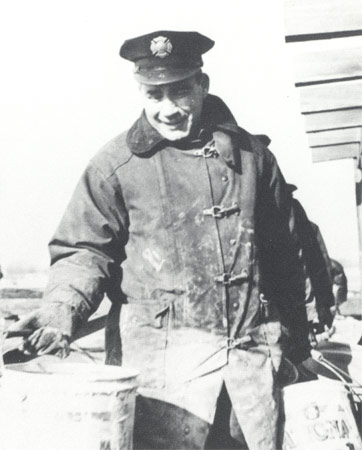
Named: Firefighter John J. Mogck Jr., Ladder Company No. 1, and Circa 1954.
Between 1950 and 1959 the Fire Department replaced its entire fleet of hose wagons. The Fire Department's vehicle maintenance was done at Camden's municipal garage under the direction of superintendent Al Healy, Assistant Joe Snyder and Fire Mechanics Earl VanSandt and Ed Campbell would design and manufacture most of these apparatus in-house. Fireman John J. Mogck Jr., who was by the time he joined the Fire Department well trained in the use of welding and cutting, would be detailed to the shop as needed. The Department would acquire commercial truck chassis upon which the hose wagon bodies would be fabricated. The first of these units was a 1951 GMC 2-1/2 ton cab and chassis. The hose wagon body was equipped with a 250 gallon per minute hale pump, a 1000 gallon per minute deckpipe, a 150 gallon booster tank, and a cartridge canister containing “Wet Water”— an additive agent designed to allow water to penetrate and soak through deep seated fire in baled rags, paper, and similar materials. Engine Company 8 and Engine Company 2 were the first to receive the new hose wagons. In later years Dodge cab and chassis trucks were utilized.
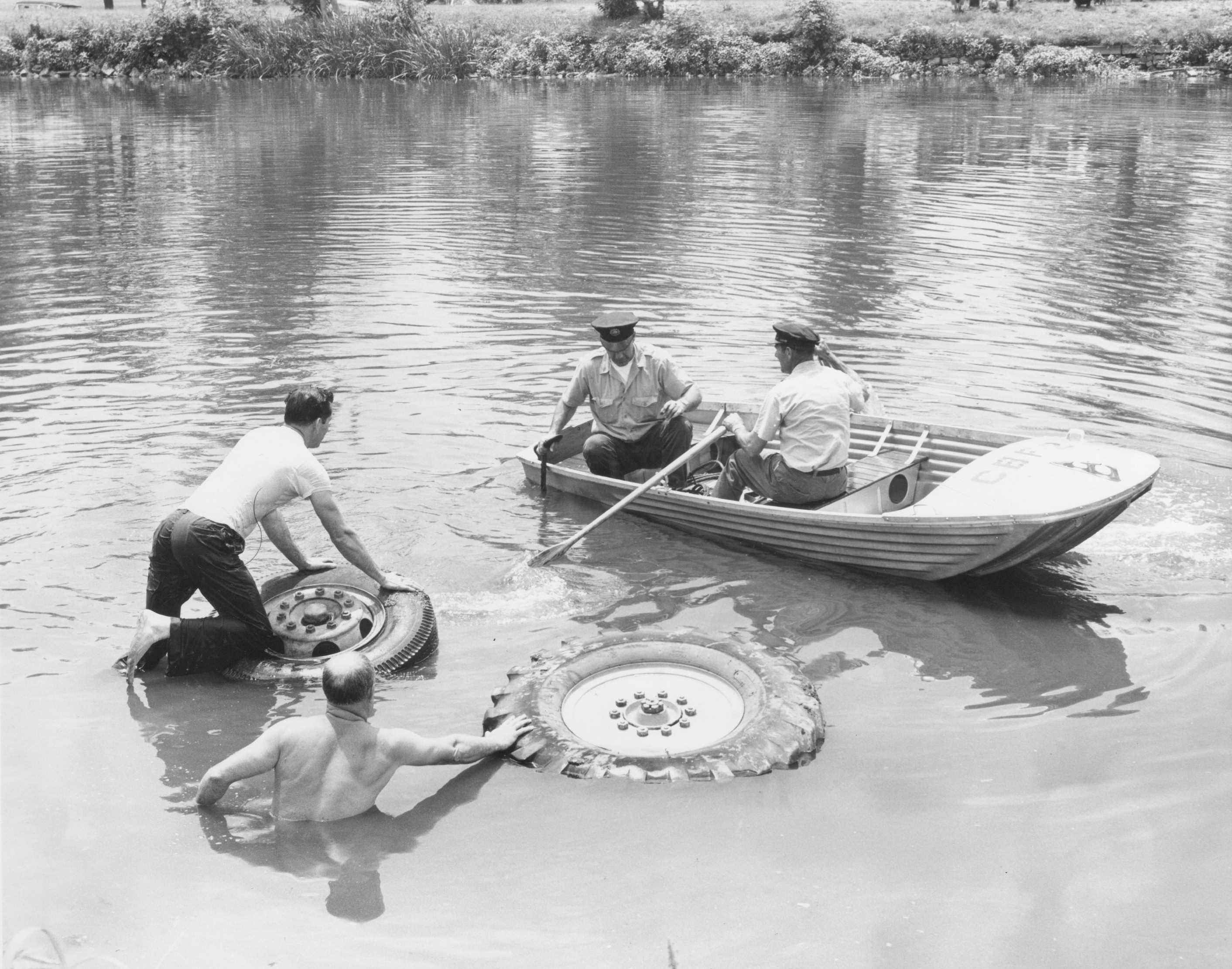
July 18, 1960 — An industrial accident with a fatality, at the Cooper River at Baird Avenue. A front end loader flipped off embankment pinning the operator underwater. In the foreground without shirt: Battalion Chief William Deitz, 2nd Battalion, who first arrived at scene and attempted rescue of operator. Members of Rescue Company 1 are Fireman Edward Brendlinger (kneeling on the machine's wheel) and Firemen John Mogck Jr. and James McGrory in the boat. Battalion Chief Deitz would later be killed in the line of duty and Fireman John Mogck would become Chief of Department.
Fireman Mogck's abilities outside the maintenance shop were recognized, and on January 1, 1963 he was promoted to Captain. On May 1, 1969 he was appointed Battalion Chief.
In the spring of 1981, following three year tenure as Chief of Department, Theodore L. Primas retired after nearly thirty-five years of service in the Uniformed Force. Chief John J. Mogck Jr. was appointed as his successor. Like his predecessor, Theodore Primas, the Fire Administration that Chief Mogck would inherit was fraught with fiscal constraint while the demand for fire services continued to reach all time highs. Chief Mogck was sworn in on July 8, 1982. On that same day at 1800 hours Engine Company 3 left its building at 1815 Broadway, which had become unsafe, and moved in with Engine Company 10 on Morgan Boulevard.
As Chief John J. Mogck Jr. assumed the helm of the Department, the City faced yet another fiscal crisis amid looming budget deficits. An ever decreasing tax base coupled with recurring shortfalls in revenue, created the worst possible conditions. The City's ability to increase revenues was thwarted by an ever shrinking source of ratables. While thousands of vacant buildings bled city coffers of critically needed revenue, infusions of State and Federal aid already in place could not close the budget gap. As municipal services were curtailed throughout every city agency, the Fire Department became no exception. On April 13th just two weeks after his appointment Chief Mogck was compelled to order the disbanding of Engine Company 2. Following 112 years of service to center city, Engine Company 2 passed into history.
For 1981 the Department sustained a record high of 38 Greater Alarms for the year. The loss of Engine Company 2 only exacerbated an already overburdened Fire Control Force. With its retrenchment to just eight engine companies, the Department's dependency upon mutual aid services continued to expand dramatically. While other urban fire departments in the State of New Jersey of comparable size to Camden, incurred only a few incidents of mutual aid in the course of a year, it was not uncommon for Camden to summon mutual aid services on as many as fifty and sixty occasions within any twelve month period.
Under the auspice of a regional Fire Communications Center, mutual aid services throughout Camden County had been greatly improved, both in terms of coverage and unit deployment. For over a hundred years, the mutual aid policy in the City of Camden involved a cumbersome and inefficient method, whereby mutual aid services could only be summoned upon the expressed order of the Chief of Department. The Department's resource base allocated to a fourth alarm level under the classification of General Alarm would only summon scheduled mutual aid when that incident level was reached.
This policy remained seriously flawed and created interim gaps in the continuity of fire protection. In the event of simultaneous incidents, where many resources were committed in a short period of time leaving large sections of the City devoid of available fire companies, the dispatcher was first required to contact the Chief of Department or his designee, to authorize mutual aid response. While this process of contact and solicited authorization could take more than just a few moments, the assignment and response of mutual aid units were often delayed. The Department would alleviate this long standing deficiency by implementing a policy of automatic mutual aid in conjunction with other refinements.
The Supervising Fire Dispatcher was charged with the responsibility for ensuring that the City never fell below a specified level of available resources. Partial mutual aid coverage would be automatically summoned to maintain this minimum balance at all times. Upon reaching a fourth alarm level or the equivalent thereof, full mutual aid services would be automatically enacted. Also the long standing classification of General Alarm was discarded, as response policies were expanded to a ninth alarm level to include the automatic deployment of mutual aid units. These refinements substantially enhanced the quality of fire services throughout the City of Camden.
Among nearly eleven thousand alarms during 1982, the Department also sustained a record high of more than 6,000 malicious false alarms for a single year. In some regions of the City, it was not uncommon for an engine company to answer as many as ten and twelve false alarms at the same pulled box in a single day. An epidemic of malicious false alarms from street boxes were stripping many areas of the City of essential fire protection as companies responded from one false alarm to the next. This burden, coupled with an increasing number of working fires posed serious risk to fire fighters and public alike. The Fire Administration was compelled to re-evaluate its mission and develop effective solutions to combat this ever growing problem.
Initial considerations focused upon the total elimination of the municipal fire alarm system. This solution would transfer all public reporting of fire incidents to the domestic telephone system. Among a number of cited concerns, the availability of telephone service — both public and residential throughout many areas of the City remained highly problematic. Public telephones frequently disabled by vandals who burglarize coin receptacles, left many neighborhoods without public communications. Likewise, an increasing number of city residents living at or below poverty level while faced with the choice of buying food or paying the telephone bill, occupied homes without residential phone service. The matter of reliability in the telephone system was another concern. A widespread telephone outage would pose serious ramifications if the public couldn't get a dial tone. Fire services would virtually cease to exist without an effective means to report fires.
One viable but costly alternative concerned the replacement of the mechanical pull box system with electronic voice reporting. Fire alarm boxes on the street would be hard wired for voice communications between the public and the Fire Dispatcher. A number of cities had reduced false alarms by an overwhelming number as a result of adopting such voice technology. The premise behind this successful design concerned a person's unwillingness to activate an ERS Box and then stand on a street corner in plain view, while engaging the dispatcher in a verbal dialogue for the purpose of reporting a malicious alarm. The result of a feasibility study to determine project cost for converting the current mechanical system proved cost prohibitive in terms of limited capital funding relative to other municipal priorities.
As the City was politically unprepared to abandon the municipal fire alarm system in its entirety during 1982, the Fire Administration decided upon a policy of selective retrenchment for removing problem boxes from the field. With the ensuing removal of dozens, then scores, and eventually hundreds of boxes throughout the City during the subsequent decade, the rate of malicious false alarms continued to fall each and every year from 1983 until 1992 when the few remaining boxes were finally removed, dismantling the entire system. The application of risk management in balancing the proprieties of public fire protection against the demands of fire service operations was the determining factor in the eventual elimination of the system. As well, many other major cities across the United States would also dismantle their long established systems in the interests of operations.
Another matter involving the judicious application of risk management concerned a long-standing problem with the municipal fire hydrant system. During the hot summer months, the illegal opening of hundreds of fire hydrants created formidable problems for the Fire Control Force. Millions of gallons of potable water were bled from the system while reducing operating pressures to dangerously low levels. Normal operating pressures of 50 to 70 PSI, were frequently reduced to as little as ten or fifteen pounds residual. Far below the minimum level necessary to provide an adequate rate of flow for fire control.
The Fire Department in conjunction with the Water Department attempted to educate the public in the hazards associated with illegally opened hydrants. Public education campaigns both in the schools and the adult community, endeavored to solicit understanding and cooperation. The slogan “Save Water — Save Lives” appearing on bumper stickers and fire prevention literature, sought to focus upon the community's vested interest. Indeed many residents of the City experienced first hand, the problems affecting domestic water supplies as hundreds of neighborhoods complained about having no water above the first floor of buildings, and in not being able to flush toilets or bathe. Still, the problem continued to grow worse with each passing summer.
Sprinkler caps for fire hydrants designed to consume a fraction of the water, were distributed by various city agencies but did little to stem the epidemic of wide open hydrants. Water Department personnel, Police, and local fire companies armed with wrenches, visited hundreds of locations, turning off hydrants only to have them repeatedly opened, often as soon as the fire company left the scene. Even worse, fire fighters, water department employees and even Police were harassed, threatened and barraged by rocks and bottles while attempting to shut down hydrants.
The occurrence of serious fires during the hot summer months created extraordinary problems for responding fire fighters. A one or two room blaze in a building that should have been handled readily by just two hoselines spread to involve multiple rooms or more than one floor under conditions of low water pressure. In an effort to obtain the necessary volume, fire companies were frequently compelled to connect apparatus to more than one hydrant. This approach precipitated a demand for additional manpower and the need to transmit Greater Alarms for incidents that should have been controlled early on, by a first alarm assignment. At one particular incident there were so many hydrants open in the area surrounding a serious blaze, that the Battalion Chief transmitted both a second and third alarm. Second alarm companies were ordered to respond directly into the fire, while third alarm companies were directed to enter surrounding neighborhoods and shut down hydrants in an effort to increase water supplies.
In a proactive approach, the City began to explore solutions through technology, designed to enhance hydrant security and prevent unauthorized operation. Special types of wrenches, fittings, outlet caps and stem configurations were adopted in a never-ending search to find a better mousetrap. Over many years, thousands of dollars were expended by the City on a wide variety of hydrant security systems, each producing limited or less than positive results. In more than just a few instances where adopted technology discouraged the opening of hydrants by unlawful persons, a twenty pound sledge hammer was brought to bear by frustrated individuals, shattering the hydrant ball and rendering the appliance wholly inoperable.
During the nineteen eighties, the Fire Administration recognized that a radical solution was necessary in order to avert a disaster in fire service operations. Indeed, in recent years and particularly during periods of extremely hot weather, the problem in water supplies alarmingly became one of volume rather than pressure. The demand for domestic water coupled with the opening of fire hydrants began to exhaust municipal reservoirs. On several occasions, mutual aid water tankers from rural fire companies were summoned to the City as a measure of last resort. If the reservoirs ran dry, there would be no water in the system and effective fire services would cease to exist. The Fire Administration's solution was the shutting off of hydrants at the street valve. Each appliance that was turned off at the water main was effectively rendered inoperable without the use of a street valve key.
This extraordinary measure was not without its disadvantages. While every fire company was equipped with a five foot long “T” shaped wrench, having to locate the valve box in the street and then activate the hydrant while the fire was blazing, routinely caused some delays in obtaining water. At the scene of serious fires, it was not uncommon to look down a street for several blocks and see teams of fire fighters standing over valve box receptacles at different locations, resembling water witches with “T” shaped divining rods in their hands, looking for water under the ground. Undoubtedly, such delays resulted in additional fire spread and some otherwise preventable fire loss. But the Department viewed the matter in the appropriate perspective that delayed water was far better than no water at all. Certainly an essential measure of effective risk management.
During 1983, the Department took delivery of a new Mack Tower Ladder. This seventy-five foot rig was assigned to Ladder Company 3 and was particularly well suited for operating at the large two and one-half story frame dwellings so peculiar to the East Camden and Cramer Hill sections. A reduction in the number of Greater Alarms for 1983 would incur a total of 28 incidents or nine less than the previous year. Total activity for 1983 remained well over ten thousand alarms. Principal Greater Alarms for the year included:
The night of May 6th near 11:30 P.M., Engine Company 7 turned out for a verbal alarm from quarters, reporting smoke from the rear of a commercial building on Kaighns Avenue opposite the firehouse. As the housewatchman opened the station's overhead door, the strong odor of rich, acrid smoke was already evident. The Company Officer ordered a line stretched and the pumper connected to a hydrant at the front of quarters. In moments, heavy smoke was pushing from the front of a one-story, commercial type garage building that measured 50 x 100. As Ladder Company 2 began forcing a garage door to gain access for the engine, the interior of the building lit up in roaring fire. Rows of occupied dwellings on either side of the blazing building were saved as four alarms were transmitted for this Box.
At 7 A.M. on June 26, 1983, a third alarm destroyed a vacant building at Broadway and Everett Streets, South Camden. On September 19th, another third alarm roared through a vacant factory at Fifth and Byron Streets, North Camden.
The last major incident of the year occurred on Christmas morning, December 25th. Christmas 1983 dawned on a clear, sunny day with frigid temperatures near the five degree mark. As families everywhere prepared to celebrate the solemn holiday, the men in the firehouses around the City had settled into what everyone expected to be an uneventful tour of duty. Holiday routine as it is traditionally known in the Camden Fire Department, are quiet times in the firehouse. Particularly on special days like Christmas when the environment of the fire station with its concrete floors and the ever present smell of diesel fuel, seem to assume a peaceful, even homey atmosphere. The fire fighters are often engaged in personal activities — some quietly reading or watching a holiday program on television, while still others are busy preparing the noon meal for their brothers.
A few minutes after 10 A.M., the quiet tranquility of the firehouse was shattered by the shrill sound of the alarm tones over the department radio, followed by the blaring voice of the fire dispatcher announcing a structural fire at Fourth Street and Lansdowne Avenue, South Camden. Engine Company 8 and Ladder Company 2 assigned first due, left the warm confines of their ancient firehouse and entered the biting cold of Kaighns Avenue heading west toward Broadway. From several blocks away, they could see the gray and yellow streams of smoke blowing over the rooftops. As Engine Company 8 entered the block, heavy menacing smoke billowed from the second floor of a two-story dwelling attached in the middle of a row of eight buildings. In the bone chilling cold of the street whipped by ferocious winds, stood a family of occupants huddled together, some wrapped in blankets, as they watched their Christmas turned into ashes.
The absence of integral party walls allowed the fire to rapidly extend to adjoining buildings. Battalion Chief Ronald Guernon pulled a second alarm on arrival as hose lines were aggressively advanced to the second floors of three buildings. Ladder companies armed with roof saws performed rapid ventilation to stem the spread of fire. As heavy fire conditions took possession of the top floors and cockloft of at least three buildings, third and fourth alarms were transmitted. Fire fighters were punished by the extreme cold and constant battering of gale force winds as heavy icing made footing treacherous. Following a two hour battle, the flames were finally subdued but not before at least four families were made homeless.
Shivering on the sidewalk, the occupants stared in disbelief at the ruins of all their worldly possessions and of what their holiday might have been. Near the front windows of one building a Christmas tree could be seen, still standing in the corner of a room adorned by once colorful decorations, now tarnished an ugly brown and coated in real icicles where tinsel had hung. Ashes and debris now lay where gift wrapped presents had been. As the homeless children wept openly in the street, fire fighters went silently about their work knowing that the real gift that Christmas, had been no loss of life or injuries to the occupants. That the families would live on to enjoy other Christmas Days together.
During 1984, there would be ten civilian fire deaths, seventy-seven line of duty injuries, and twenty-two Greater Alarms.
The principal incident of the year involved a fourth alarm at a block long vacant factory near Delaware Avenue and Elm Street, North Camden, on May 26th. The Box was transmitted shortly after 7 P.M. and first alarm units found heavy fire roaring through the roof. At the height of the fire, the nearby span of the Benjamin Franklin Bridge became a primary exposure and traffic between New Jersey and Pennsylvania was halted for over an hour. Units remained at the scene throughout the night following a five hour battle to control this stubborn blaze.
Like a majority of other cities, for many years the Department utilized station wagons and sedans for Chief Officers and staff personnel. During the nineteen eighties, a radical departure from the use of the automobile emerged in the fire service as an increasing number of fire departments began to adopt light duty trucks as personnel carriers. The vehicles were far more durable than the auto and particularly well suited for heavy use in alarm responses and traversing off road surfaces. In the Camden Fire Department, the vehicle of choice became the Ford Bronco. Its full seating capacity for five persons also made it ideal for transporting groups of fire fighters when making relief between the station and the fireground. During 1985, the Department took delivery of a fleet of eight Ford Bronco trucks.
The first major incident for 1985 occurred at 6:30 A.M. on the cold morning of January 14th, at Ninth and Grant Streets, North Camden. A third alarm destroyed several occupied dwellings in a block long row of attached buildings. On February 12th, a stubborn third alarm damaged an occupied commercial building on Broadway near Chestnut Street, South Camden. In March, another third alarm ripped through a row of eight attached dwellings at Second and Vine Streets, North Camden. In April, yet another third alarm heavily damaged a church on Benson Street off Broadway.
On July 9, 1985, shortly before 4 A.M., units arrived at the New Jersey Transit bus barns at Tenth Street and Newton Avenue. The block long one-story building held over one-hundred buses parked bumper to bumper, side by side. Less than four feet separated each column of parked coaches. Upon arrival, one bus located several rows back from the entrance was heavily involved, threatening to ignite adjacent coaches inside the building. Heavy smoke filled the storage bays of the terminal and billowed outward from the large door openings at both ends of the structure. A second alarm was transmitted as members hustled to stretch lines and reach the blazing coach. Ever resourceful, fire fighters began to enter the parked buses and drive them out of the terminal on to Newton Avenue. By the time the first due engine had water on the fire, a dozen coaches had been removed from the building and lay randomly parked on surrounding streets. The blaze was under control within a half hour and the Transit Authority credited fire fighters with preventing certain damage to many buses that were removed from harms way.
During 1986, the Department would incur eighty-four line of duty injuries, fifteen civilian fire deaths and thirty Greater Alarms. A fleet of six new Hahn pumpers and a 100’ tractor and tiller aerial ladder were delivered to the Department. Engine Companies 1, 3, 7, 9, 10, 11 and Ladder Company 2 received new apparatus. During a five month period, more than fifteen thousand free smoke detectors were installed by local fire companies at one and two family residential dwellings throughout the City. These detectors were made possible by a funding grant from the William Penn Foundation and distribution through the American Red Cross.
Of thirty Greater Alarms for 1986, twenty-nine were second alarm incidents. A spectacular fifth alarm occurred on August 7th, at 12th and Fairview Streets, South Camden. Engine Company 10 just three blocks away, arrived to find a two-story trucking warehouse measuring 200 x 500, heavily involved. Pumper relays over distances of one-half mile were used to supplement water supplies for numerous master streams. During the last month of the year, two church fires would be held to second alarms by the aggressive effort of fire fighters. On Christmas Day at Broadway and Viola Streets, rapid line placement and coordinated ventilation saved a large stone church. On New Years Eve near Broadway and Spruce Streets, an equally aggressive attack by units in the basement of another church also saved this edifice from certain destruction.
As another active year in the city, 1987 would incur eighteen civilian fire deaths and eighty-three line of duty injuries. Of thirty-three Greater Alarms for the year, the most serious occurred shortly after 1 A.M. on March 27th at Baird and Admiral Wilson Boulevards, East Camden. Companies arrived to find a five story motel pushing heavy smoke with reports of numerous occupants trapped above the fire. Second and third alarms were transmitted on arrival with a special call for three additional ladder companies above the third alarm. Numerous rescues were made over ladders as the fire spread through void spaces from the first to fifth floors. Only one fatality resulted from this near catastrophe. Many awards and citations were received as a result of this incident, including Unit Citations to two mutual aid companies from Pennsauken and Collingswood for their effective work.
On March 4, 1987 at Second Street and Atlantic Avenue, a large vacant three-story factory went for three alarms and resulted in several injuries. Windows above the first floor were sealed with masonry block and created serious ventilation problems throughout the operation. Heavy smoke conditions blinded fire fighters as they endeavored to advance interior lines to reach large quantities of burning rubbish. Scores of air cylinders were expended at this incident. On March 23rd, yet another church was saved from destruction at a smoky second alarm on Yorkship Road near Morgan Boulevard, Fairview. Once again, rapid deployment of attack lines coordinated with judicious ventilation, cutoff a rapidly spreading fire.
On April 9, 1987, a third alarm for a row of vacant dwellings kept units busy for several hours at 34th Street and Rosedale Avenue, East Camden. On June 3rd, another third alarm in the same block destroyed some large vacant frames. Again on June 20th, a second alarm occurred in a vacant three-story apartment building on 34th Street near Merriel Avenue. Within a two month period, an entire city block of buildings would be destroyed in several Greater Alarms and numerous working fires along North 34th Street. Shortly after A.M. on October 23rd, a smoky second alarm damaged several classroom facilities at Camden High School, Park Boulevard and Baird Avenue, Parkside. This would be the third Greater Alarm to occur at a city school for the year.
Principal Greater Alarms for 1988 occurred during the month of October. At 2 P.M. on October 26th, a spectacular sixth alarm destroyed a vacant warehouse at 17th Street and River Avenue, Cramer Hill. The property, a one-story building was one city block wide and two blocks long, encompassing several acres of land. The warehouse was heavily fortified with chained metal doors and window openings sealed with masonry block. Upon arrival, Engine Company 11 found extremely heavy fire conditions racing through the building on the River Avenue side. Such access barriers created serious forcible entry problems and delayed units in getting water on the fire. At the height of the blaze, a huge column of smoke rising hundreds of feet could be seen as far as 20 miles away. After many hours and numerous master streams, the fire was confined to the original building. An adjoining vacant warehouse of similar size was saved.
Just five days later on October 31, 1988 at 2:30 A.M., the Box at East State Street and River Avenue was transmitted for a reported factory. Engine Company 11 arriving first-due found the adjoining warehouse that had been saved during the previous sixth alarm, now heavily involved with fire extending throughout the block long building. This second incident went for a fifth alarm and leveled the remaining complex. During January 1988, two church fires within one block of each other near Broadway and Spruce Streets, South Camden, would be termed arson. The first fire occurred on January 6th at 5 A.M. and went for three alarms. The second incident on the evening of January 28th was a smoky second alarm resulting in several injuries to members.
During 1989, the department attended thirty-seven Greater Alarms. The most notable incident occurred at the end of the year on the evening of December 17th during one of the coldest nights in recent memory. Engine 9, Ladder 3 and Battalion 2 responded to a verbal alarm for 26th Street and Westfield Avenue, just one block from the firehouse. A passing civilian reported fire in a drug store. Units arrived within moments to find several stores pushing heavy smoke. A second alarm was transmitted as lines were quickly stretched. Metal security gates and frozen hydrants caused delays in getting water on the fire. As units forced entry to rolling security doors, a sea of flame illuminated the ceiling area of the store.
The fire rapidly spread left and right to involve adjoining properties. The drug store, interconnected among several other buildings, posed serious exposure problems. At the height of the blaze, smoke conditions were so severe that the Incident Commander did not know how many properties were involved in fire. The Field Communications Unit coming in on the second alarm, had difficulty negotiating nearby streets as fire dispatchers cautiously made their way through a veil of dense smoke permeating the entire area. Fire fighters forced entry to building after building, attempting to locate fire extension. An adjoining furniture warehouse became the focus of concern as a seventh alarm assignment was transmitted. Mutual aid units relocating into the quarters of Engine 9 reported hot embers dropping on the apron of the firehouse a block away. The fire burned throughout the evening, totally destroying the drug emporium and heavily damaging two adjoining buildings. Tenacious efforts by fire fighters prevented the blaze from extending to the furniture store. At daybreak, the fire scene resembled a winter carnival. Buildings, apparatus, trees and overhead wiring were frozen solid as the landscape appeared as virtual ice palaces.
Just two nights before the East Camden blaze on December 16, 1989, two third alarms occurred only blocks from each other. The first at 4:30 A.M. leveled a row of vacant dwellings near Second and Chestnut Streets, South Camden. Later that evening, another third alarm damaged a church near Sixth and Walnut Streets. On June 23rd at 8 P.M., a stubborn fourth alarm on lower Broadway near Morgan Street destroyed a vacant commercial building. At 6 A.M. on August 11th, another fourth alarm occurred at an occupied warehouse near Eighth Street and Fairmount Avenue, South Camden. This fire extended to involve an adjoining row of occupied dwellings in a public housing project.
Among thirty-one second alarms for the year, one particular incident destroyed the Cramer Hill Boys Club — a City landmark at 29th Street and Tyler Avenue, Cramer Hill. The clubhouse was formed in 1954 to discourage juvenile delinquency. Its sad demise in recent years culminated in this blaze that spelled a death knell for the once proud organization. Numerous Camden Fire Fighters actively supported this institution for many years. Indeed, more than just a few members of the Department grew up in the East Camden and Cramer Hill sections as participating youth. As Engine Company 11 left the scene of the blaze, all that remained were gutted ruins among a host of fond, personal memories.
The last decade of the century would begin for Camden Fire Fighters like so many other active years, fraught with heavy fire duty, debilitating injury and heroic action. As truly soldiers in a war that never ends, the early nineties would recapture a period reminiscent of the raging seventies as an increasing number of serious fires honed the occupational skill of newer members.
During 1990 and following nearly forty years of service, Chief of Department John J. Mogck Jr. retired upon reaching the maximum age of service, stepping down on March 1, 1990. Chief Kenneth L. Penn was appointed as his successor to constitute the twenty-third Fire Administration in the City of Camden since the inception of the paid department.
Chief Mogck was last a resident of Haddonfield NJ. He passed away on May 30, 2008, and was buried at the Brigadier William C. Doyle Veterans Memorial Cemetery in Wrightstown NJ.
Woman Gas Victim Saved by Camden Rescue Squad
Camden Courier-Post —
The hour-long effort of a fire department rescue squad Friday night saved a woman who tried to kill herself by gas.
Police said Mrs. Florence Marshall, 46, of 330 North Tenth Street, locked herself in the bathroom and turned on a gas jet. They added she was despondent because her daughter, Eva, 22, was planning to marry and leave home.
A son, William, 19, broke down the bathroom door and dragged the mother from the room. Patrolmen John Voll and Harrison Wilkinson were called and summoned the rescue squad headed by Captains Godfrey Patterson and George Boone.
It took the squad an hour to revive Mrs. Marshall by artificial respiration. She was taken to Cooper hospital and later to police headquarters, where she was released for a hearing Monday on a charge of attempted suicide.
Other members of Rescue Squad 1 are George Baxter, William Watkin, John Mogck, Edward Brendlinger, Arthur Ballinghoff, Christopher Moll, Edwin Decker, Carl Wirtz, Robert Olesiewicz, John Kolessar and Raymond Banford.
Firemen Here Get Advanced First Aid Course
Camden Courier-Post —
More than 40 members of the Camden Fire Department have completed the Red Cross course in advanced first aid according to announcement today by Howard F. Keller, Collingswood, chairman of the Camden County Chapter's first aid committee.
Instruction sessions were under the direction of Fire Chief William V. Pfefferle, Drillmaster Anthony Dzinski, a member of the local chapter first aid group, assisted by Nicholas E. George, were instructors. Dzinski is a member of the Red Cross faculty at the National Aquatic School held in this area each year for instruction in advance safety techniques. Dick Harris, director of Red Cross safety services, supervised.
All members of the graduating class are personnel of several units housed at fire department headquarters here. These include the Headquarters Company, Engine Company 2, Rescue Squad 1 and Truck Company 1. These groups include:
Rescue Squad: Captains Arthur Batten, Philip A. Stinger and Albert Weller; Edward Brendlinger, Harrison MacNeir, Robert Olesiewicz and James W. Smith.
Headquarters Company: Raymond Banford, John K. Voll and John W. Yates.
Truck Company 1: Captains Daniel Jiannetto, Robert E. Dukes and Otto V. Kaiser; William Watkin, Chester Gedrich, George Baxter, John Mogck, George C. Hennessy, Charles Devlin, Ambrose W. Faust, Joseph McTaggart, Howard R. Taggart, William G. Winstanley and Elmer Johnson Jr.
Engine Company 2: Captains James R. Asher, Thomas Winstanley; Carl Wirtz, James McGrory, Edwin V. Decker, James Stewart, Francis X. McTaggart, Anthony T. Orme, Mario D. Fattore, James O. Jones, Francis P. Stibi, William Hopkins, Robert E. Briggs, John Giuliano, Casper Martelli, Harold H. Pike, John J. Vane, William Stibi, John DiMaggio and Harry Kleinfelder.
Captain John J. Mogck & Fireman Earl Robinson at the Cherry Hill Mall — 1966
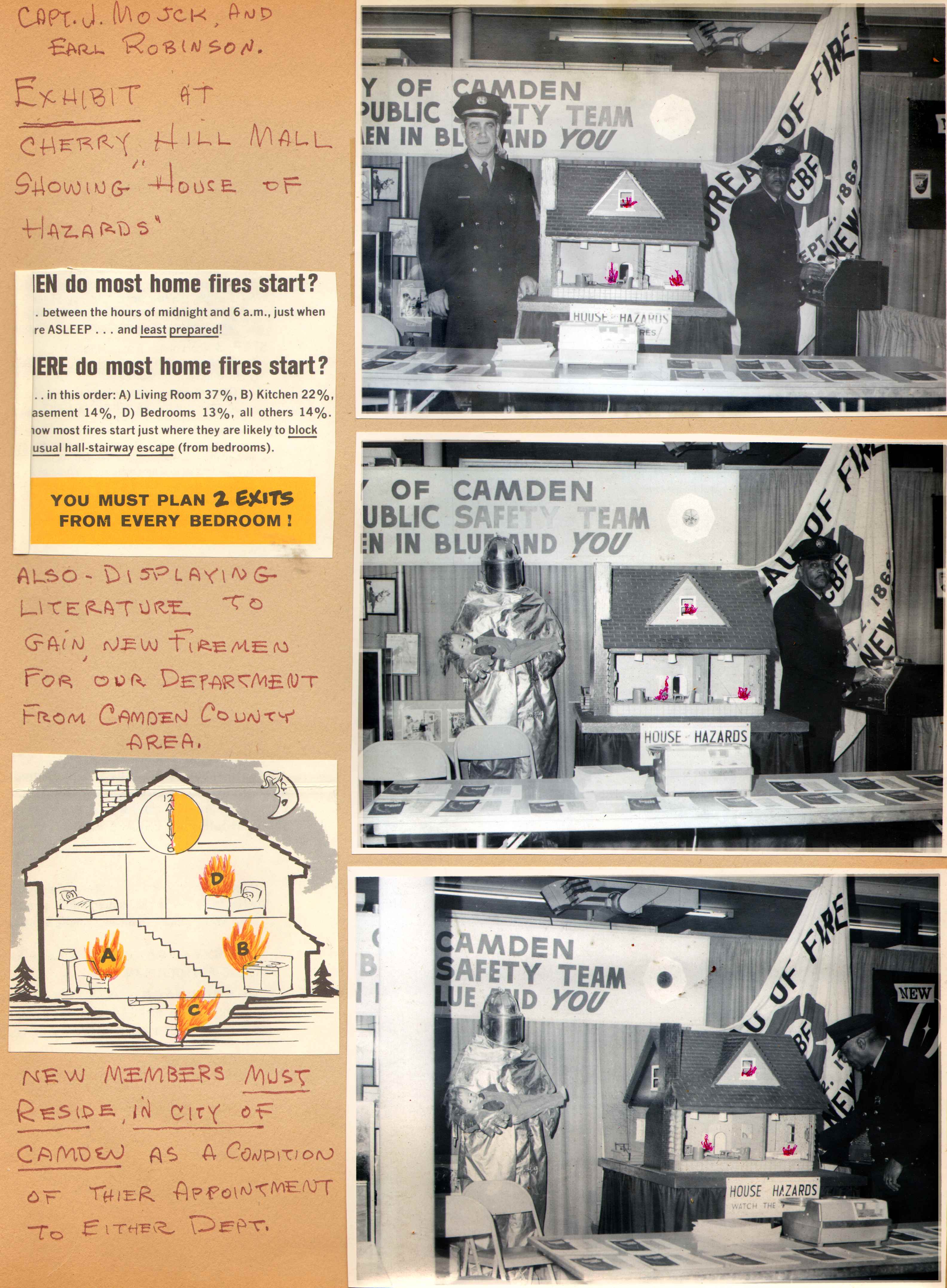
Captain John J. Mogck and Fireman Earl Robinson at the Cherry Hill Mall — 1966
Equipment Check
Camden Courier-Post —
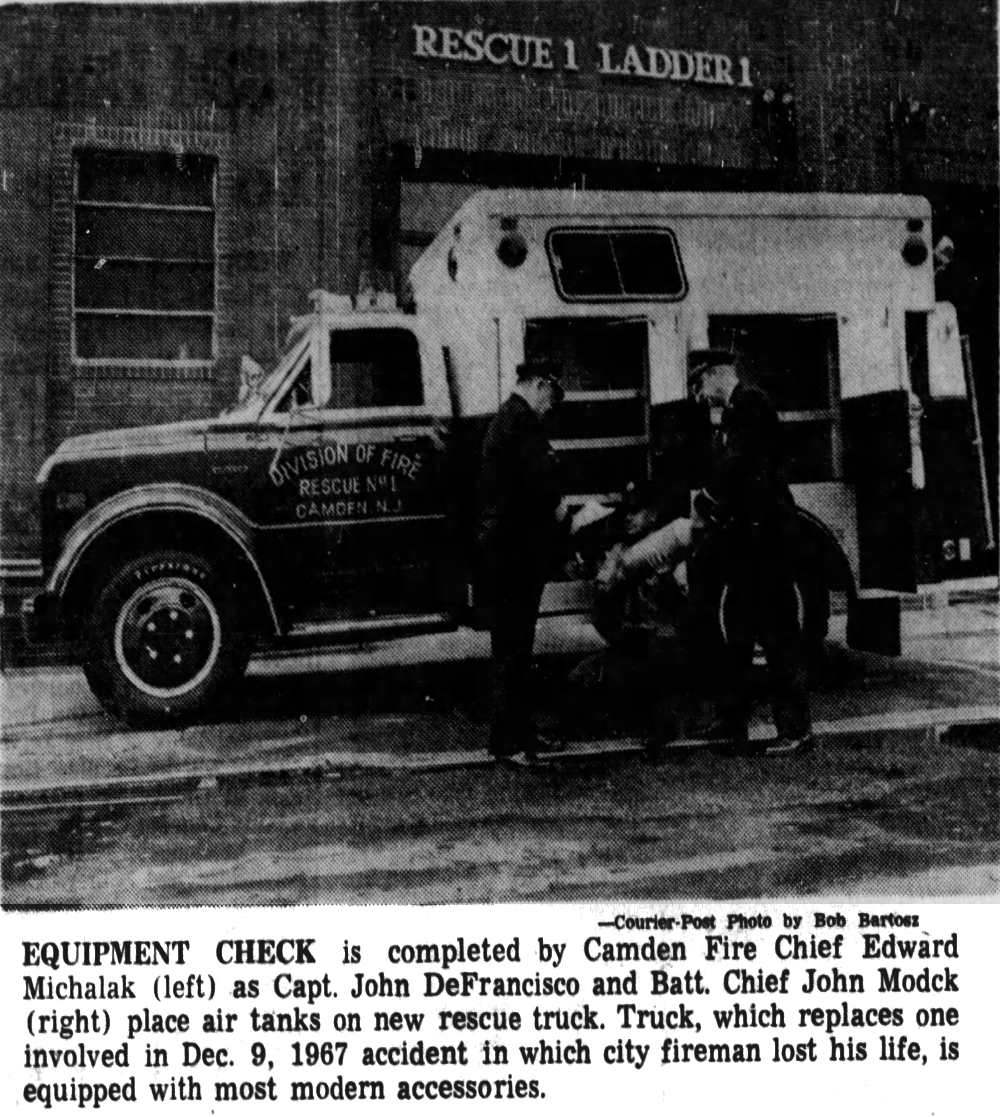
EQUIPMENT CHECK is completed by Camden Fire Chief Edward V. Michalak (left) as Capt. John DeFrancisco and Batt. Chief John Mogck (right) place air tanks on new rescue truck. Also pictured: Ernest A. Tartaglia. (Rescue Company 1)
Fire Watch Magazine — Spring 1977
In Recognition… Anniversary Dates and Congratulations
| Name | Years |
|---|---|
| Fr. Howard G. Brickner #5 | 26 Years |
| Fr. Harvey J. Fisher #186 | 26 Years |
| Capt. James W. Smith | 26 Years |
| Dep. Chf. Anthony C. Saponare | 35 Years |
| Fr. Andrew H. Foreman #183 | 26 Years |
| Fr. William J. Stibi #120 | 26 Years |
| Batt. Chf. Robert E. Dukes | 30 Years |
| Fr. Henry S. Keubler #34 | 26 Years |
| Fr. William M. Stone #29 | 26 Years |
| Insp. Fr. George C. Hennessy #21 | 30 Years |
| Fr. Joseph J. Lesniewski #50 | 26 Years |
| Capt. William G. Winstanley | 26 Years |
| Dep. Chf. Daniel F. Jiannetto | 30 Years |
| Fr. Phillip MacDonald #71 | 26 Years |
| Fr. Adolph S. Zubrzycki #62 | 26 Years |
| Dep. Chf. Theodore L. Primas | 30 Years |
| Fr. Joseph J. McTaggart #26 | 26 Years |
| Batt. Chf. John J. Giuliano | 21 Years |
| Fr. Eugene F. Alston #7 | 29 Years |
| Batt. Chf. John J. Mogck | 26 Years |
| Insp. Fr. Alfred D. Nigro #76 | 21 Years |
| Batt. Chf. Biaggio P. Ardire | 29 Years |
| Capt. John E. Moore | 26 Years |
| Fr. Leon Puszczykowski #100 | 21 Years |
| Fr. William R. Harring #69 | 29 Years |
| Capt. Robert P. Olesiewicz | 26 Years |
| Fr. John L. Sterner #73 | 21 Years |
| Fr. William E. Hinch #151 | 29 Years |
| Capt. Anthony T. Orme | 26 Years |
| Fr. Francis P. Stibi #143 | 21 Years |
| Capt. Herbert J. Schott | 28 Years |
| Fr. Ralph H. Palmer #46 | 26 Years |
| Fr. Carl R. Szalkowski #95 | 21 Years |
| Batt. Chf. Charles A. Bates | 26 Years |
Members as listed above have anniversary dates which fall during the first quarter.
Merit Awards
Camden Courier-Post —
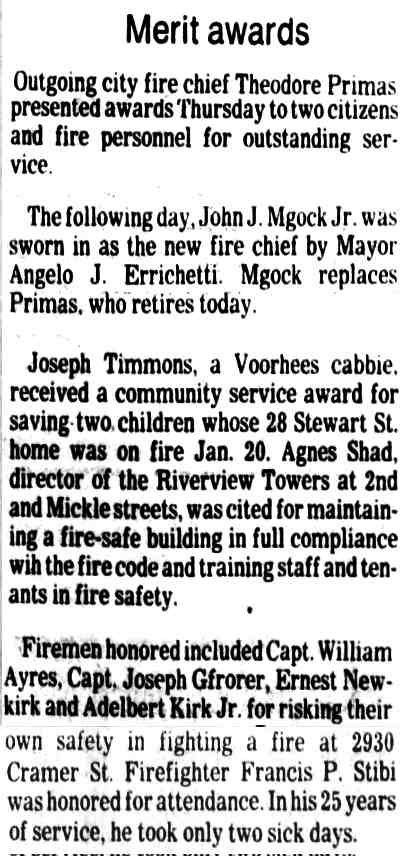
Outgoing city fire chief Theodore Primas presented awards Thursday to two citizens and fire personnel for outstanding service.
The following day, John J. Mogck Jr. was sworn in as the new fire chief by Mayor Angelo J. Errichetti. Mogck replaces Primas, who retires today.
Joseph Timmons, a Voorhees cabbie, received a community service award for saving two children whose 28 Stewart St. home was on fire Jan. 20. Agnes Shad, director of the Riverview Towers at 2nd and Mickle streets, was cited for maintaining a fire-safe building in full compliance with the fire code and training staff and tenants in fire safety.
Firemen honored included Capt. William Ayres, Capt. Joseph Gfrorer, Ernest Newkirk and Adelbert Kirk Jr. for risking their own safety in fighting a fire at 2930 Cramer St. Firefighter Francis P. Stibi was honored for attendance. In his 25 years of service, he took only two sick days.
Gallagher's Warehouse Fire
Camden Courier-Post —
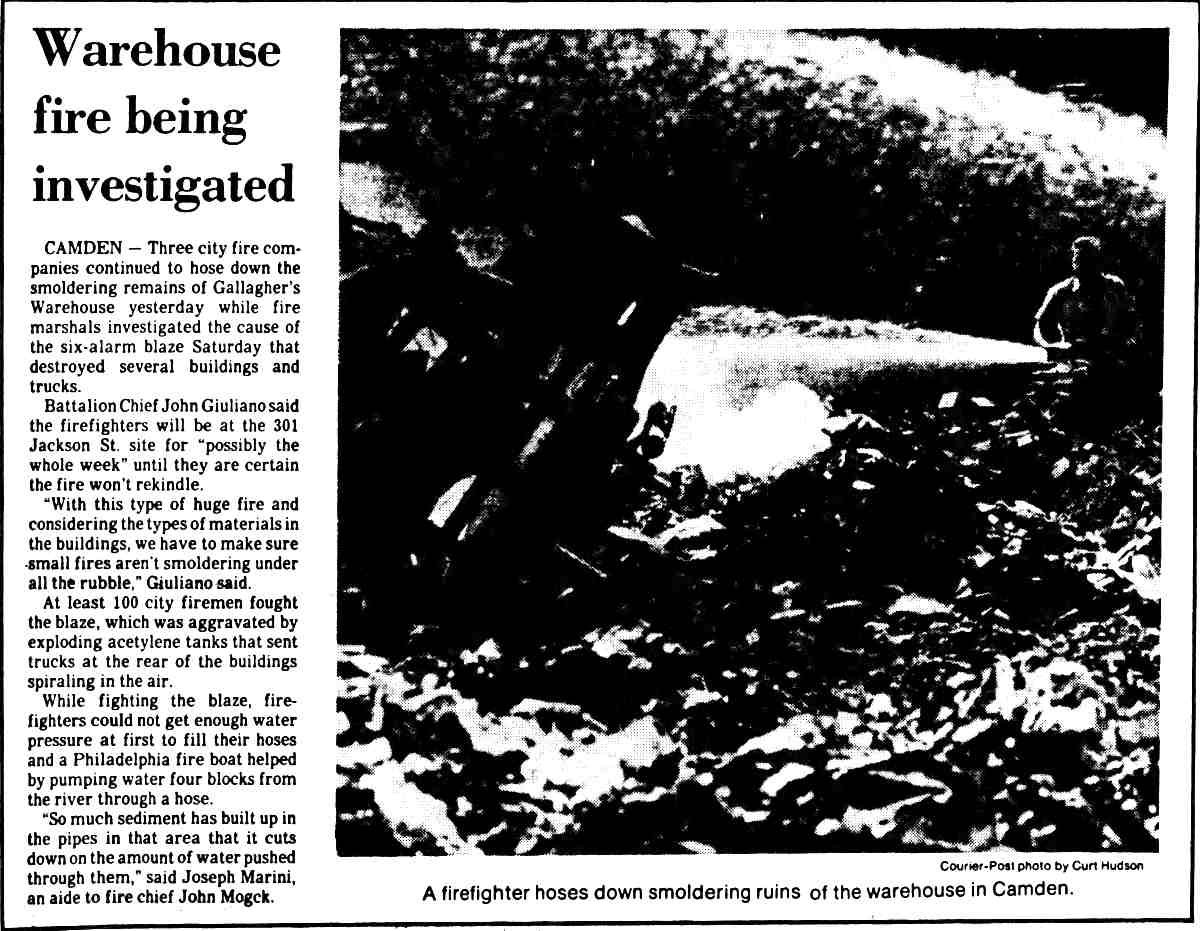
Jackson Street — Gallagher's Warehouse — Eavenson & Levering — Joseph Marini — Peter Del Grande — John J. Giuliano — John Mogck. Left: A firefighter hoses down smoldering ruins of the warehouse in Camden.
City Honors Firefighters Retiring After 38 Years
Camden Courier-Post —
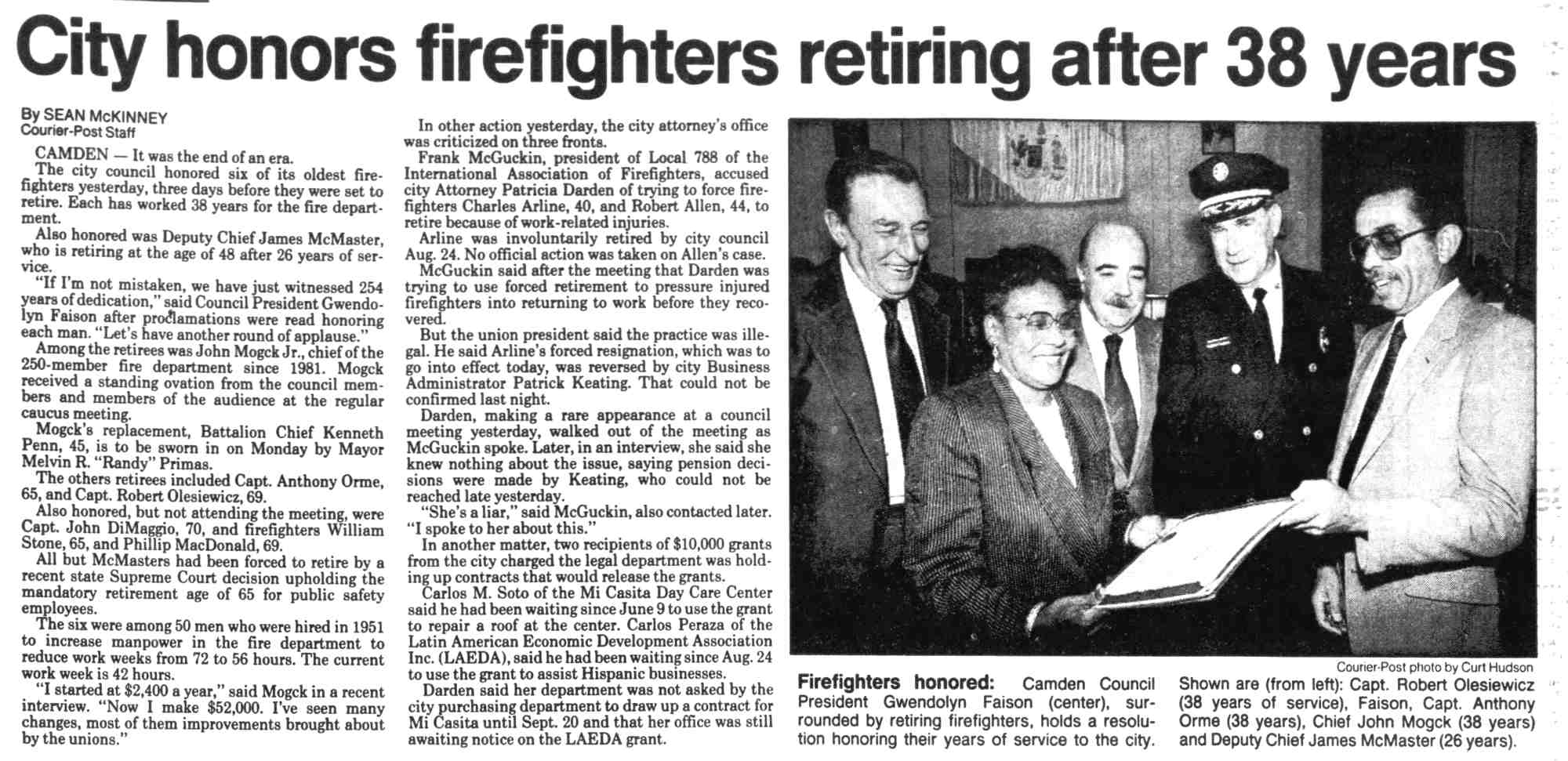
By SEAN McKINNEY
CAMDEN — It was the end of an era.
The city council said farewell to six of its oldest firefighters yesterday, three days before they were set to retire. Each has worked for the city fire department for 38 years.
Also honored was Deputy Chief James McMaster, who is retiring after 36 years of service.
“If I’m not mistaken, we have just witnessed 254 years of combined service,” said Council President Gwendolyn Faison after proclamations were read honoring the men who have dedicated over three decades to the city. Deputy Fire Chief John Mogck, who is leaving as chief, started a standing ovation from the audience at the regular council session.
Kenneth Penn, 44, is to be sworn in on Monday by Mayor Randy Primas as the new fire chief.
Frank McGuckin, president of Local 788 of the International Association of Firefighters, criticized City Attorney Patricia Darden of trying to force firefighters Charles Arline, 44, and John DiMaggio, 44, to work a week of 41 hours.
McGuckin said after the meeting that Darden was trying to use an old provision to increase working hours, and that the department constitution would have to be changed. But the union president said the practice was illegal. A new contract proposal that would require all to go into effect today was voted by Business Administrator Patricia Lacy.
Mogck's successor, Chief Kenneth Penn, 44, is to be sworn in on Monday. Mogck, in an interview, said he couldn’t be more proud of the city department. Penn will take over as chief effective Oct. 1.
“He’s a top man,” said McGuckin, who also contacted Penn being named chief.
Photos
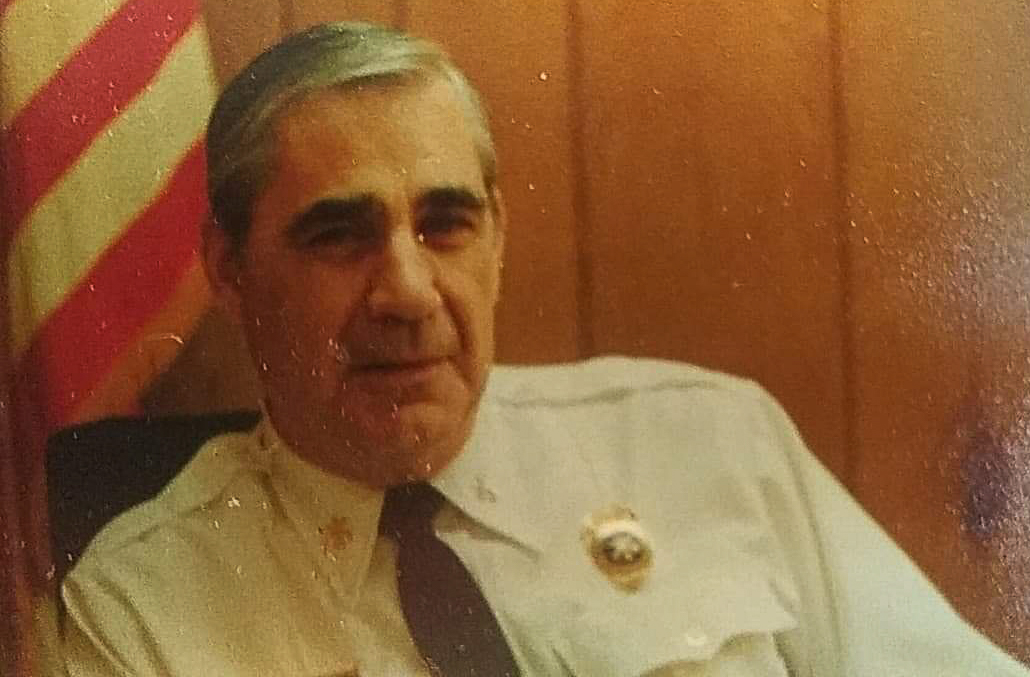
John DeFrancisco and colleagues, Camden Fire Department
Retirement Letter
City of Camden Fire Department —
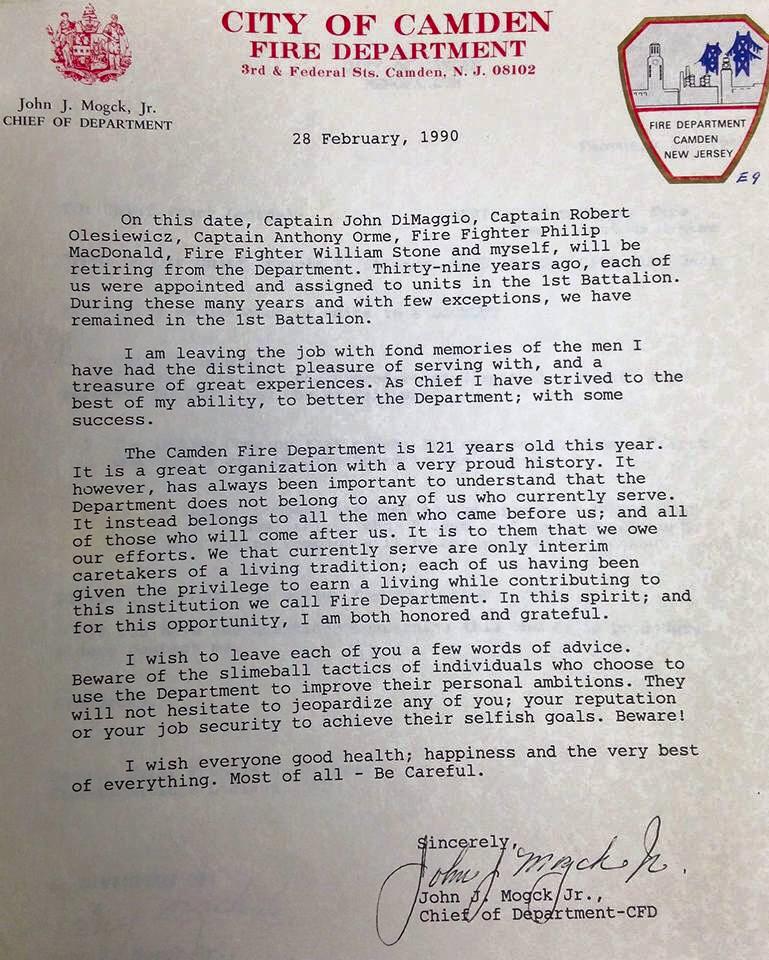
CITY OF CAMDEN FIRE DEPARTMENT
3rd & Federal Sts. Camden, N. J. 08102
28 February, 1990
On this date, Captain John DiMaggio, Captain Robert Olesiewicz, Captain Anthony Orme, Fire Fighter Philip MacDonald, Fire Fighter William Stone and myself, will be retiring from the Department. Thirty-nine years ago, each of us were appointed and assigned to units in the 1st Battalion. During these many years and with few exceptions, we have remained in the 1st Battalion.
I am leaving the job with fond memories of the men I have had the distinct pleasure of serving with, and a treasure of great experiences. As Chief I have strived to the best of my ability, to better the Department; with some success.
The Camden Fire Department is 121 years old this year. It is a great organization with a very proud history. It however, has always been important to understand that the Department does not belong to any of us who currently serve. It instead belongs to all the men who came before us; and all of those who will come after us. It is to them that we owe our efforts. We that currently serve are only interim caretakers of a living tradition; each of us having been given the privilege to earn a living while contributing to this institution we call Fire Department. In this spirit; and for this opportunity, I am both honored and grateful.
I wish to leave each of you a few words of advice. Beware of the slimeball tactics of individuals who choose to use the Department to improve their personal ambitions. They will not hesitate to jeopardize any of you; your reputation or your job security to achieve their selfish goals. Beware!
I wish everyone good health; happiness and the very best of everything. Most of all — Be Careful.
Sincerely,
John J. Mogck Jr.
Chief of Department – CFD
Fire Card
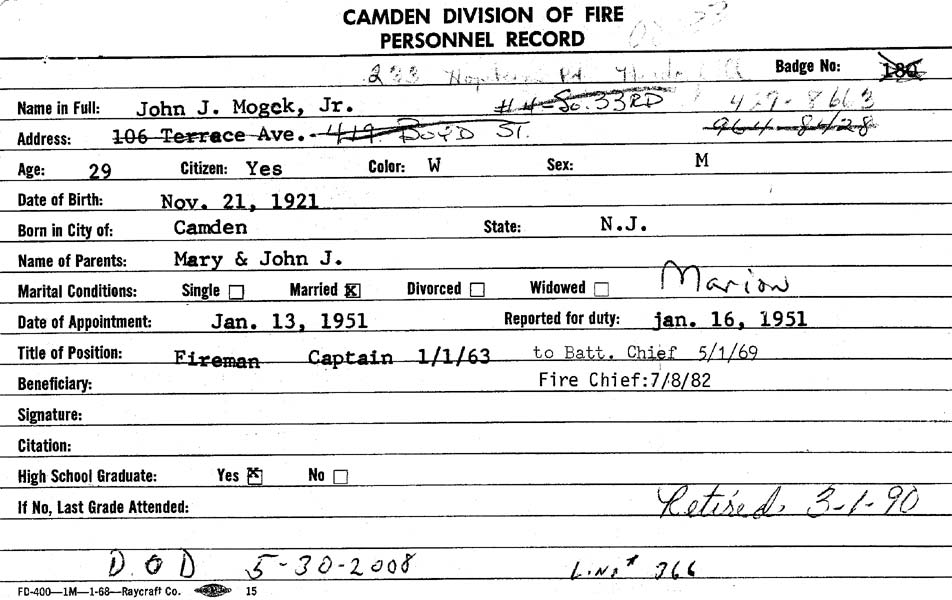
Fire card — Chief John J. Mogck Jr.
Obituary
Camden Courier-Post —
MOGCK, JOHN J., JR.
On May 30, 2008, former Camden City Fire Chief, age 86, of Haddonfield, beloved husband of Marion Connie (nee Carroll) and father of John J., III (Jingyan) of Voorhees. Also survived by one brother, Thomas (Eleanor) of Haddonfield, two sisters, Marie Diefendorf of Audubon and Betty Spinosi (Eli) of Malaga, one step-grand-daughter, Iris Tian and numerous nieces and nephews.
Chief Mogck first attended Holy Name Elementary School and then Camden Catholic HS. His studies at St. Francis College in Loretto, PA were interrupted by his entrance into the European Theatre of WWII. For 3 long years, he saw action as a member of the U.S. Third Army's 115th AAA Gun Battalion operating in France, Belgium, Germany & Luxembourg. Noted campaigns from the beaches of Normandy to the ‘Battle of the Bulge’ cited him for gallantry. He was awarded 6 Battle Stars and the Bronze Star. In 1945 Chief Mogck returned to Camden and joined the Fire Department. He moved up through the ranks and in 1982 became the 17th Chief of the Fire Department.
Chief Mogck's family and friends are invited to his Funeral Mass, Wednesday, June 4th, 9:30 AM, at St. Vincent Pallotti R.C. Church, 901 Hopkins Rd., Haddon Twp., NJ. Interment, Brig Gen. Wm. C. Doyle Veterans Memorial Cemetery, Wrightstown, NJ. In lieu of flowers the family requests, memorial donations may be made in Chief Mogck's name to Holy Name Catholic Church, 522 State St., Camden, NJ 08102. Arrangements by KAIN-MURPHY FUNERAL SERVICES OF HADDONFIELD, NJ.